Contenidos
Levitating — Dua Lipa (2020)
Three chords on a loop from start to finish, and one part that never repeats the same way twice: the bass. This is the song where the bass player finds out their part is a melody.
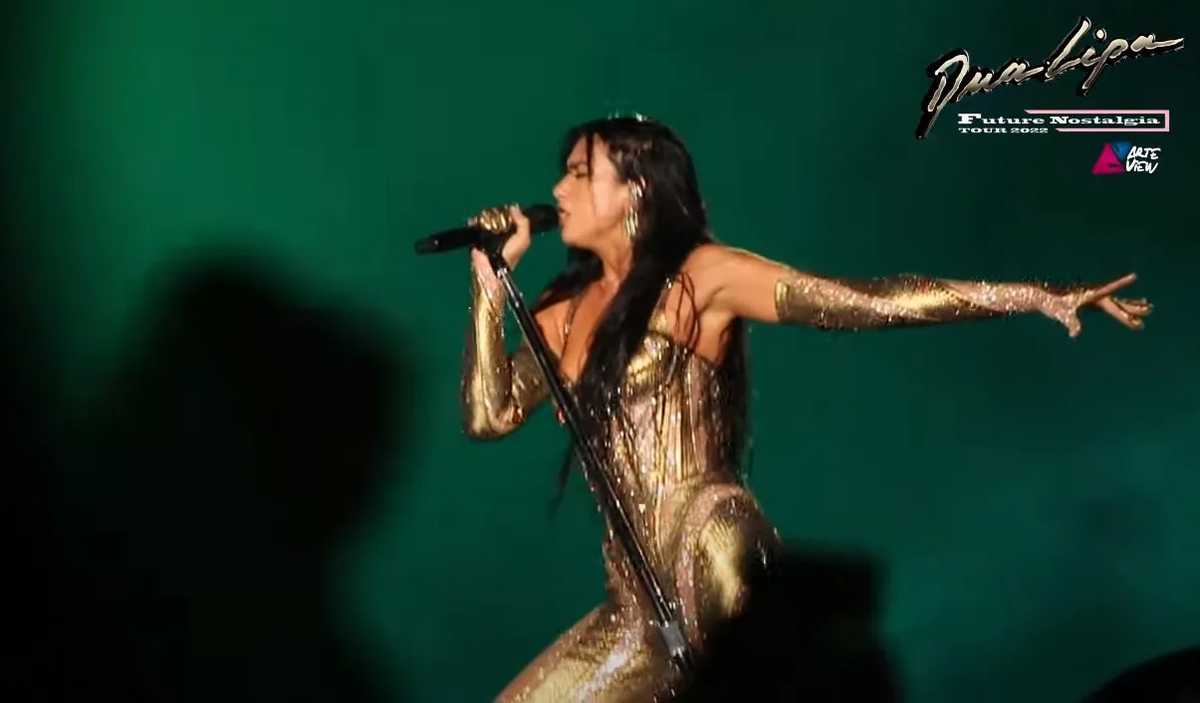
🏷️ Ficha musical
Why this song
Levitating came out in the last week of March 2020, days into lockdown. A dance record released at the exact moment nobody could go dancing. Billboard went on to name it the number one song of 2021.
So here is the question worth asking: how does a song with three chords and no harmonic surprises hold your attention for three and a half minutes? The answer is not in the chords. It is underneath them.
Historical context
Levitating was written and recorded in a single day, on 28 August 2018, in a London studio. It was the first finished track of Future Nostalgia, and it settled how the rest of the album would sound.
The starting point was not a tune. It was a machine. Producer Stephen Kozmeniuk had spent seven or eight years hunting for a Roland VP-330, a synthesiser from the late 1970s. He had it shipped from Tokyo to Toronto, plugged it in, and the first thing he played — a synthetic choir sound — is the line that opens the song.
The album title states the plan: Future Nostalgia. Disco sounds from the seventies, built with today's production. The idea was not new. Daft Punk had run the same operation in 2013 on Random Access Memories, bringing in musicians from that era — Nile Rodgers, the guitarist of Chic, among them — to play on the record. Critics compared Levitating to exactly those two: Chic and Daft Punk.
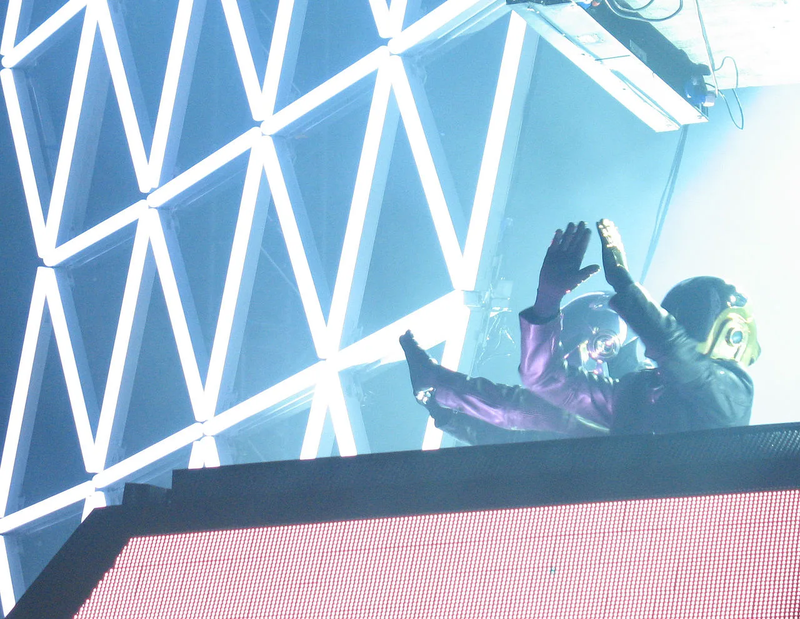
Daft Punk en Berkeley (California), 2007. Foto: Minyoung Choi, CC BY-SA 2.0, vía Wikimedia Commons
The album was due on 3 April 2020 and was moved a week forward, to 27 March, because the whole thing had leaked. Lipa said at the time that she was worried about releasing a dance album in that particular week.
Musical characteristics
The first thing you hear is that VP-330 choir: voices that are not voices, held with nobody breathing. It puts the song in a decade before the beat even starts.
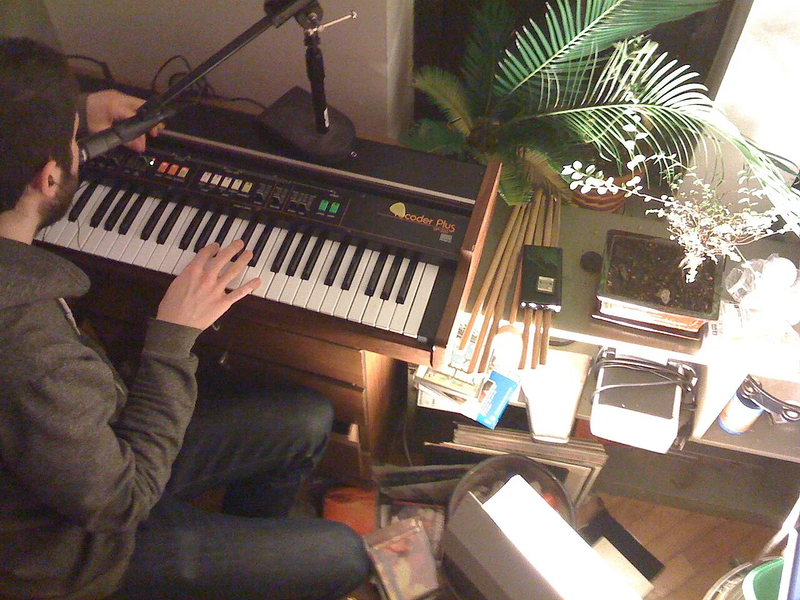
Un Roland VP-330 Vocoder Plus, el sintetizador de finales de los setenta que abre la canción. Foto: ghostdad, CC BY-SA 2.0, vía Wikimedia Commons
Underneath, the drums do the simplest thing available: a kick on every one of the four beats, never missing one. It is the floor of almost all club music, and it has a name — four on the floor. It lets you dance without counting.
The harmony is just as plain. Three minor chords in the same order every time, and the same loop in the verse and in the chorus. No detour, no new section.
That is where the division of labour in this song shows up. If the harmony does not move and the drums do not move, somebody has to.
Instead of sitting on the root of each chord, the bass jumps to that same note an octave above and back. It puts many of those jumps between the beats rather than on them: that is syncopation, and it is where the bounce comes from.
Between notes it adds muted strokes with no pitch at all. Those are ghost notes: no melody, only rhythm.
Then, on the hook, when the "I'm levitating" line arrives, the bass stops accompanying. It runs a quick figure that is precisely the melody the voice is singing. For those bars there are two identical melodies, one on top and one underneath.
Here is the twist: nobody played that bass line. Producer Stuart Price programmed it, imitating what a person holding a bass would do. The octaves, the ghost notes and the odd slapped note are written in on purpose so that it sounds human.
One more strange sound: a voice that behaves like a keyboard. It is a talk box — a tube that carries an instrument's sound up to the player's mouth, where lips and tongue shape it without singing. Bosko Kante plays it here. It is a 1970s funk trick, and it is the source of the robot edge.
Hard facts: B minor, 4/4, 103 BPM, 3:23. Form: intro, verse, chorus, verse, chorus, bridge, chorus. Lipa's vocal moves between F#3 and B4.
In class you will play it in A minor: Am, Em and Dm, the same three functions one tone lower. With a capo at the 2nd fret those three shapes sound in the album's original key. The JamZone chart runs at 110 BPM, slightly faster than the record.
Trivia and curiosities
- The middle eight is a rap, and Lipa leans into her British accent for it. She has said she added it to get her British side across, because people keep guessing wrong about where she is from. Critics have described the rap as Blondie-influenced.
- The bass line is programmed, not performed. What makes it sound like a person is a set of imperfections somebody wrote in one by one. "Sounds human" and "played by a human" are not the same claim.
- The song was sued twice for plagiarism and neither suit stuck. Reggae band Artikal Sound System filed in March 2022 over their 2017 track Live Your Life, then dropped it in June 2023 after a judge found no evidence Lipa's team had ever heard it.
- The second suit came from the writers of the 1979 disco track Wiggle and Giggle All Night, and was dismissed in March 2025. The judge held that the only resemblance lay in a descending scale, and a scale belongs to nobody. It marks the border neatly: shared raw material cannot be owned.
- On Songsterr the song has exactly two transcribed tracks: bass and drums. Nobody bothers transcribing three minor chords. What people want is the part underneath.
Classroom activities
- Play (everyone): the Am – Em – Dm loop, without stopping. Guitars and keyboards will have it in two minutes; with a capo at the 2nd fret it sounds in the album key. The Andy Guitar tutorial below uses those exact shapes.
- Play (bass), in three stages: start with the root of each chord, one per bar. Then root and octave, alternating. Finally, push those jumps half a beat early so they land between pulses. Same line three times, each one closer to the record.
- Analyse: a closed question. Listen to the chorus and name the exact word where the bass stops accompanying and starts playing the vocal melody. Check your answer against the bass transcription linked below.
- Create: take any three chords and write two different bass lines over the same loop. One that only hits the root on beat one; another with octaves and notes placed between the beats. Record both over the same backing and compare. The harmony does not change. Everything else does.
Key vocabulary
- Four on the floor — bombo en los cuatro tiempos
- Octave — octava: la misma nota, más aguda o más grave
- Syncopation — síncopa: el acento entre los tiempos, no encima
- Ghost note — nota fantasma: un golpe apagado, ritmo sin altura
- Talk box — talk box: el tubo que lleva el sonido a la boca del músico
Resources
In Year 3 — this song is also used in the unit ¿Quién pagaba por oír una historia cantada?, from the theory and history book.
Where it is explained — this song is studied in ¿Por qué no te aburre una canción de un solo acorde?, from the modern music history book.
Official music video (album version, animated)
Guitar tutorial — Andy Guitar. Three minor chords with a capo at the 2nd fret, which is exactly the classroom version.
Piano tutorial — PHianonize. Easy version, no talking, keyboard on screen.
Bass tutorial — channel 참치크래커 베이스. No talking: it builds the line in seven stages, from the bare root to slap, with the tab on screen. This is the one the exercise above follows.
Drum tutorial — Joe The Drummer. He assembles the groove ingredient by ingredient, starting with four on the floor, and gives away the sheet as a PDF.
Analysis: did Dua Lipa actually plagiarise this? — Adam Neely. Goes through the lawsuits and the earlier songs it resembles.
- JamZone chart (Music Will) — https://jamzone.musicwill.org/songs/levitating
- Harmonic analysis — https://www.hooktheory.com/theorytab/view/dua-lipa/levitating
- Bass transcription PDF — https://freebasstranscriptions.com/transcriptions/dua-lipa-levitating/
- Tab — Songsterr, bass and drum tracks: https://www.songsterr.com/a/wsa/dua-lipa-levitating-tab-s476682
Por dónde entrar
Esta canción la puede tocar una clase entera el primer día. Son tres acordes, siempre en el mismo orden, en la estrofa y en el estribillo.
Todos menos uno. El bajo no se limita a pisar la nota del acorde: salta, se adelanta al tiempo y, en el momento del gancho, se pone a tocar la misma melodía que canta Dua Lipa. Si tocas el bajo, esta es tu canción, y no es la fácil.
Contexto histórico
Levitating se escribió y se grabó en un solo día, el 28 de agosto de 2018, en unos estudios de Londres. Fue la primera canción terminada de Future Nostalgia, y la que decidió cómo iba a sonar el resto del disco.
El punto de partida no fue una melodía: fue un aparato. El productor Stephen Kozmeniuk llevaba entre siete y ocho años buscando un Roland VP-330, un sintetizador de finales de los setenta. Lo hizo traer de Tokio a Toronto, lo enchufó, y lo primero que tocó —un sonido de coro sintético— es la línea que abre la canción.
El título del disco explica el plan: Future Nostalgia, nostalgia del futuro. Sonidos de la época del disco de los setenta, producidos con la tecnología de hoy.
No era una idea nueva. Daft Punk había hecho la misma operación en 2013 con Random Access Memories: llamar a músicos de aquella época —entre ellos Nile Rodgers, el guitarrista de Chic— y grabar con ellos. La crítica comparó Levitating precisamente con esos dos, Chic y Daft Punk.
Daft Punk en Berkeley (California), 2007. Foto: Minyoung Choi, CC BY-SA 2.0, vía Wikimedia Commons
El disco iba a salir el 3 de abril de 2020 y se adelantó una semana, al 27 de marzo, porque se había filtrado entero. Salió, entonces, en los primeros días del confinamiento. Dua Lipa dijo en su momento que le preocupaba publicar un disco de baile justo en ese momento.
Cómo suena
Lo primero que entra es ese coro sintético del VP-330: voces que no son voces, sostenidas, sin que nadie respire. Coloca la canción en una época antes de que empiece el ritmo.
Un Roland VP-330 Vocoder Plus, el sintetizador de finales de los setenta que abre la canción. Foto: ghostdad, CC BY-SA 2.0, vía Wikimedia Commons
Debajo, la batería hace lo más sencillo que puede hacer: un golpe de bombo en cada uno de los cuatro tiempos, sin fallar uno. Es la base de casi toda la música de discoteca, y tiene nombre propio: four on the floor. Sirve para que se pueda bailar sin contar.
Con la armonía pasa lo mismo de sencillo. Tres acordes menores, siempre en el mismo orden, y el mismo bucle en la estrofa y en el estribillo. Ni un cambio, ni un puente armónico distinto.
Aquí está el reparto de trabajo que hace esta canción. Si la armonía no se mueve y la batería tampoco, alguien tiene que moverse: el bajo.
En vez de quedarse en la nota fundamental del acorde, salta a esa misma nota una octava más arriba y vuelve. Y coloca muchos de esos saltos entre los tiempos en lugar de encima: eso es la síncopa, y es de donde sale la sensación de rebote.
Entre nota y nota mete golpes apagados que no llegan a sonar como notas. Son notas fantasma: no aportan altura, aportan ritmo.
Y en el gancho, cuando entra el «I'm levitating», el bajo deja de acompañar: hace una carrerilla que es exactamente la melodía que está cantando la voz. Durante esos compases hay dos melodías iguales, una arriba y otra abajo.
El detalle que descoloca: esa línea de bajo no la tocó nadie. La programó el productor Stuart Price, imitando lo que haría una persona con un bajo en las manos. Las octavas, las notas fantasma y algún pellizco seco de los que se usan en el slap están puestos a propósito para que suene humana.
Queda un sonido raro más: una voz que parece un teclado. Se consigue con un talk box, un tubo que lleva el sonido de un instrumento hasta la boca del músico, que lo moldea con los labios y la lengua sin cantar. En esta canción lo toca Bosko Kante. Es un truco de la música funk de los setenta, y es el que da el toque de robot.
Datos duros: Si menor, 4/4, 103 BPM, 3:23. Forma: intro, estrofa, estribillo, estrofa, estribillo, puente, estribillo. La voz de Dua Lipa se mueve entre Fa#3 y Si4.
En clase la vais a tocar en La menor: Lam, Mim y Rem, las mismas tres funciones un tono por debajo. Con la cejilla en el traste 2 esas tres posiciones suenan en la tonalidad original del disco. El chart de JamZone va a 110 BPM, un poco más rápido que la grabación.
Curiosidades
- El sintetizador llegó antes que la canción. Kozmeniuk pasó años buscando el VP-330, y lo primero que tocó nada más enchufarlo se quedó tal cual en la grabación. A veces la idea no precede al sonido: la provoca.
- La línea de bajo está programada, no tocada. Lo que la hace sonar a persona son las imperfecciones que alguien decidió escribir una por una. Es un buen recordatorio de que «suena humano» y «lo tocó un humano» no son lo mismo.
- La canción recibió dos demandas por plagio y no prosperó ninguna. La primera la puso el grupo de reggae Artikal Sound System en marzo de 2022, por su tema Live Your Life (2017). La retiraron ellos mismos en junio de 2023, cuando un juez no encontró indicios de que el equipo de Dua Lipa hubiera oído esa canción.
- La segunda la pusieron los autores del tema disco Wiggle and Giggle All Night (1979), y se desestimó en marzo de 2025. El juez dictaminó que lo único parecido era una escala descendente, y una escala no es propiedad de nadie. Sirve para fijar dónde está la frontera: el material común no se puede registrar.
- En Songsterr, la canción solo tiene dos pistas transcritas: bajo y batería. Nadie se molesta en transcribir tres acordes menores; lo que la gente quiere sacar es la línea de abajo.
- El vídeo más visto de Levitating no es el de la canción del disco, sino el de una versión con un rapero invitado, DaBaby. La que se toca en clase es la original, la de Dua Lipa sola.
Para hacer en clase
- Tocar (todos): el bucle Lam – Mim – Rem, sin parar. Guitarras y teclados lo tienen en dos minutos; con cejilla en el traste 2 suena en la tonalidad del disco. El tutorial de Andy Guitar enlazado abajo usa exactamente esas posiciones.
- Tocar (bajo), en tres niveles: primero solo la fundamental de cada acorde, una por compás. Después la fundamental y su octava, alternando. Por último, adelantando esos saltos medio tiempo para que caigan entre pulsos. Es la misma línea tres veces, cada vez más cerca del disco.
- Analizar: pregunta cerrada. Escucha el estribillo y di en qué palabra exacta el bajo deja de acompañar y se pone a tocar la melodía de la voz. Comprueba tu respuesta con la transcripción de bajo enlazada abajo.
- Crear: coge tres acordes cualesquiera y escribe dos líneas de bajo distintas para el mismo bucle. Una que solo pise la fundamental en el primer tiempo; otra con octavas y con las notas colocadas entre los tiempos. Grabad las dos sobre la misma base y comparad qué cambia. No cambia la armonía: cambia todo lo demás.
Vocabulario fundamental
- Four on the floor — El bombo golpeando en los cuatro tiempos del compás, sin excepción. Es lo que permite bailar sin tener que contar.
- Octava — La misma nota, más aguda o más grave. Saltar a la octava es moverse sin cambiar de nota.
- Síncopa — Colocar el acento entre los tiempos en vez de encima. Es lo que hace que una línea rebote en lugar de marchar.
- Nota fantasma — Un golpe apagado en la cuerda: se oye el ritmo, no la altura. Rellena los huecos sin añadir notas.
- Talk box — Un tubo que lleva el sonido de un instrumento a la boca del músico, que lo moldea con los labios. Un teclado que parece hablar.
Recursos
En 3º de ESO — también se usa en la unidad ¿Quién pagaba por oír una historia cantada?, del libro de teoría e historia.
Dónde se explica — esta canción se estudia en ¿Por qué no te aburre una canción de un solo acorde?, del libro de historia de la música moderna.
Videoclip oficial (versión del disco, animado)
Tutorial de guitarra — Andy Guitar. Tres acordes menores con cejilla en el traste 2, que es justo la versión de clase.
Tutorial de piano — PHianonize. Versión fácil, sin locución, con el teclado en pantalla.
Tutorial de bajo — canal 참치크래커 베이스. Sin locución: construye la línea en siete niveles, de la fundamental sola hasta el slap, con la tablatura en pantalla. Es el que sigue el ejercicio de arriba.
Tutorial de batería — Joe The Drummer. Monta el groove por ingredientes, empezando por el four on the floor, y regala la partitura en PDF.
Análisis: ¿plagió Dua Lipa esta canción? — Adam Neely, en inglés. Revisa las demandas y las canciones anteriores que se le parecen.
- Ficha de JamZone (Music Will) — https://jamzone.musicwill.org/songs/levitating
- Análisis armónico — https://www.hooktheory.com/theorytab/view/dua-lipa/levitating
- Transcripción de bajo en PDF — https://freebasstranscriptions.com/transcriptions/dua-lipa-levitating/
- Tablatura — Songsterr, pistas de bajo y batería: https://www.songsterr.com/a/wsa/dua-lipa-levitating-tab-s476682
Why this song
Levitating came out in the last week of March 2020, days into lockdown. A dance record released at the exact moment nobody could go dancing. Billboard went on to name it the number one song of 2021.
So here is the question worth asking: how does a song with three chords and no harmonic surprises hold your attention for three and a half minutes? The answer is not in the chords. It is underneath them.
Historical context
Levitating was written and recorded in a single day, on 28 August 2018, in a London studio. It was the first finished track of Future Nostalgia, and it settled how the rest of the album would sound.
The starting point was not a tune. It was a machine. Producer Stephen Kozmeniuk had spent seven or eight years hunting for a Roland VP-330, a synthesiser from the late 1970s. He had it shipped from Tokyo to Toronto, plugged it in, and the first thing he played — a synthetic choir sound — is the line that opens the song.
The album title states the plan: Future Nostalgia. Disco sounds from the seventies, built with today's production. The idea was not new. Daft Punk had run the same operation in 2013 on Random Access Memories, bringing in musicians from that era — Nile Rodgers, the guitarist of Chic, among them — to play on the record. Critics compared Levitating to exactly those two: Chic and Daft Punk.
Daft Punk en Berkeley (California), 2007. Foto: Minyoung Choi, CC BY-SA 2.0, vía Wikimedia Commons
The album was due on 3 April 2020 and was moved a week forward, to 27 March, because the whole thing had leaked. Lipa said at the time that she was worried about releasing a dance album in that particular week.
Musical characteristics
The first thing you hear is that VP-330 choir: voices that are not voices, held with nobody breathing. It puts the song in a decade before the beat even starts.
Un Roland VP-330 Vocoder Plus, el sintetizador de finales de los setenta que abre la canción. Foto: ghostdad, CC BY-SA 2.0, vía Wikimedia Commons
Underneath, the drums do the simplest thing available: a kick on every one of the four beats, never missing one. It is the floor of almost all club music, and it has a name — four on the floor. It lets you dance without counting.
The harmony is just as plain. Three minor chords in the same order every time, and the same loop in the verse and in the chorus. No detour, no new section.
That is where the division of labour in this song shows up. If the harmony does not move and the drums do not move, somebody has to.
Instead of sitting on the root of each chord, the bass jumps to that same note an octave above and back. It puts many of those jumps between the beats rather than on them: that is syncopation, and it is where the bounce comes from.
Between notes it adds muted strokes with no pitch at all. Those are ghost notes: no melody, only rhythm.
Then, on the hook, when the "I'm levitating" line arrives, the bass stops accompanying. It runs a quick figure that is precisely the melody the voice is singing. For those bars there are two identical melodies, one on top and one underneath.
Here is the twist: nobody played that bass line. Producer Stuart Price programmed it, imitating what a person holding a bass would do. The octaves, the ghost notes and the odd slapped note are written in on purpose so that it sounds human.
One more strange sound: a voice that behaves like a keyboard. It is a talk box — a tube that carries an instrument's sound up to the player's mouth, where lips and tongue shape it without singing. Bosko Kante plays it here. It is a 1970s funk trick, and it is the source of the robot edge.
Hard facts: B minor, 4/4, 103 BPM, 3:23. Form: intro, verse, chorus, verse, chorus, bridge, chorus. Lipa's vocal moves between F#3 and B4.
In class you will play it in A minor: Am, Em and Dm, the same three functions one tone lower. With a capo at the 2nd fret those three shapes sound in the album's original key. The JamZone chart runs at 110 BPM, slightly faster than the record.
Trivia and curiosities
- The middle eight is a rap, and Lipa leans into her British accent for it. She has said she added it to get her British side across, because people keep guessing wrong about where she is from. Critics have described the rap as Blondie-influenced.
- The bass line is programmed, not performed. What makes it sound like a person is a set of imperfections somebody wrote in one by one. "Sounds human" and "played by a human" are not the same claim.
- The song was sued twice for plagiarism and neither suit stuck. Reggae band Artikal Sound System filed in March 2022 over their 2017 track Live Your Life, then dropped it in June 2023 after a judge found no evidence Lipa's team had ever heard it.
- The second suit came from the writers of the 1979 disco track Wiggle and Giggle All Night, and was dismissed in March 2025. The judge held that the only resemblance lay in a descending scale, and a scale belongs to nobody. It marks the border neatly: shared raw material cannot be owned.
- On Songsterr the song has exactly two transcribed tracks: bass and drums. Nobody bothers transcribing three minor chords. What people want is the part underneath.
Classroom activities
- Play (everyone): the Am – Em – Dm loop, without stopping. Guitars and keyboards will have it in two minutes; with a capo at the 2nd fret it sounds in the album key. The Andy Guitar tutorial below uses those exact shapes.
- Play (bass), in three stages: start with the root of each chord, one per bar. Then root and octave, alternating. Finally, push those jumps half a beat early so they land between pulses. Same line three times, each one closer to the record.
- Analyse: a closed question. Listen to the chorus and name the exact word where the bass stops accompanying and starts playing the vocal melody. Check your answer against the bass transcription linked below.
- Create: take any three chords and write two different bass lines over the same loop. One that only hits the root on beat one; another with octaves and notes placed between the beats. Record both over the same backing and compare. The harmony does not change. Everything else does.
Key vocabulary
- Four on the floor — bombo en los cuatro tiempos
- Octave — octava: la misma nota, más aguda o más grave
- Syncopation — síncopa: el acento entre los tiempos, no encima
- Ghost note — nota fantasma: un golpe apagado, ritmo sin altura
- Talk box — talk box: el tubo que lleva el sonido a la boca del músico
Resources
In Year 3 — this song is also used in the unit ¿Quién pagaba por oír una historia cantada?, from the theory and history book.
Where it is explained — this song is studied in ¿Por qué no te aburre una canción de un solo acorde?, from the modern music history book.
Official music video (album version, animated)
Guitar tutorial — Andy Guitar. Three minor chords with a capo at the 2nd fret, which is exactly the classroom version.
Piano tutorial — PHianonize. Easy version, no talking, keyboard on screen.
Bass tutorial — channel 참치크래커 베이스. No talking: it builds the line in seven stages, from the bare root to slap, with the tab on screen. This is the one the exercise above follows.
Drum tutorial — Joe The Drummer. He assembles the groove ingredient by ingredient, starting with four on the floor, and gives away the sheet as a PDF.
Analysis: did Dua Lipa actually plagiarise this? — Adam Neely. Goes through the lawsuits and the earlier songs it resembles.
- JamZone chart (Music Will) — https://jamzone.musicwill.org/songs/levitating
- Harmonic analysis — https://www.hooktheory.com/theorytab/view/dua-lipa/levitating
- Bass transcription PDF — https://freebasstranscriptions.com/transcriptions/dua-lipa-levitating/
- Tab — Songsterr, bass and drum tracks: https://www.songsterr.com/a/wsa/dua-lipa-levitating-tab-s476682