Contenidos
¿Cómo sabes por dónde vas en una música que oyes por primera vez?
You put on a piece you have never heard, and within seconds you know that what just played will come back. This unit is about how that is done, and about why somebody had to invent it once audiences started paying at the door.
We ask ourselves
- How do you know the chorus is coming back before it comes back?
- If you hear a piece once in your life, what do you need in order not to get lost?
- Why does almost everything you listen to repeat something?
- Who paid for music before tickets existed?
- How many people were actually listening in an eighteenth-century room?
- If the harpsichord already worked, why did the piano eat it?
Don't answer yet. We come back to these at the end.
The fragment
Before any piece is played, the class learns eight bars. They come from the second movement of Haydn's Symphony No. 94, they run two notes to the bar, and they use nothing but notes of the chord.
- The first half goes up: do, do, mi, mi, sol, sol, mi.
- The second half comes down and closes: fa, fa, re, re, si, si, sol.
Sing the whole thing twice through. Notice what the first half does: it leaves you hanging. The second half answers and shuts the door. It is a question and its answer, which is why it stands up with no accompaniment at all.
Now listen to the movement. The same eight bars come round again, quieter, and at the end of that repeat the whole orchestra lands on one chord at full power. After that the theme returns several times, changed. Spotting the return is the entire job of this unit.
What changed
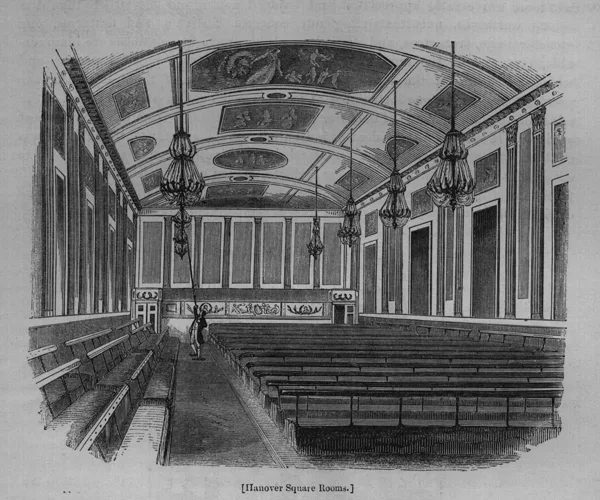
For centuries music happened in places where the listener already knew what was coming: church, palace, ballroom. In 1725 Paris gets the Concert Spirituel, putting on concerts on the days the theatres were shut, attended by comfortable middle classes, minor nobility and travellers. In 1774 the Hanover Square Rooms open in London. Nobody is obliged to attend. There is a ticket.
That creates a very concrete new problem. The room is full of strangers who paid, who will hear this piece exactly once, and to whom nobody is going to explain anything. The piece has to explain itself. The answer was not to make it simpler. It was to give it a shape you can hear.
Shape is built from three gestures. Repeat, so you recognise. Contrast, so you notice you have moved. Return, so you know it is closing. Combine them and you get three floors of the same building:
- Binary form — A A B B. Two parts, each repeated. It is the shape of dances, and it is exactly what you just sang: Haydn's eight bars are two halves, and each half plays twice.
- Ternary form — A B A. You leave and you come back. A symphony minuet is in 3/4 and has a middle section that used to be scored for a trio of instruments, which is why it is still called the trio when three people are nowhere in sight. Then the whole minuet plays again. It is the standard third movement of a classical symphony.
- Rondo — A B A C A. A main theme alternating with contrasting ones, always coming back. It was the fashionable form of the late eighteenth century and the typical finale of a concerto or a quartet.
Above all three sits the idea holding them up: the theme that returns. It can return unchanged, and then it tells you where you are. It can return changed — ornamented, on another instrument, louder — and then it still tells you where you are, and on top of that it shows you how far something can be stretched while staying itself.
And the payer changes. Haydn was an employee: until 1779 everything he wrote belonged to the Esterházy family, and that year his contract was renegotiated and he could sell his music to publishers. Writing for a lord and writing for a market are not the same job. The lord receives; the market has to like it first time. Haydn wrote at least 106 symphonies in 36 years and 68 quartets; Mozart at least 47 symphonies in 24 years.
The string quartet runs the other way, which is why it is worth hearing. Two violins, a viola and a cello, four more-or-less equal partners, no conductor and no box office. You do not play that in a hall. You play it in a room, for the people inside it. The forms are the same; the audience fits on a sofa.
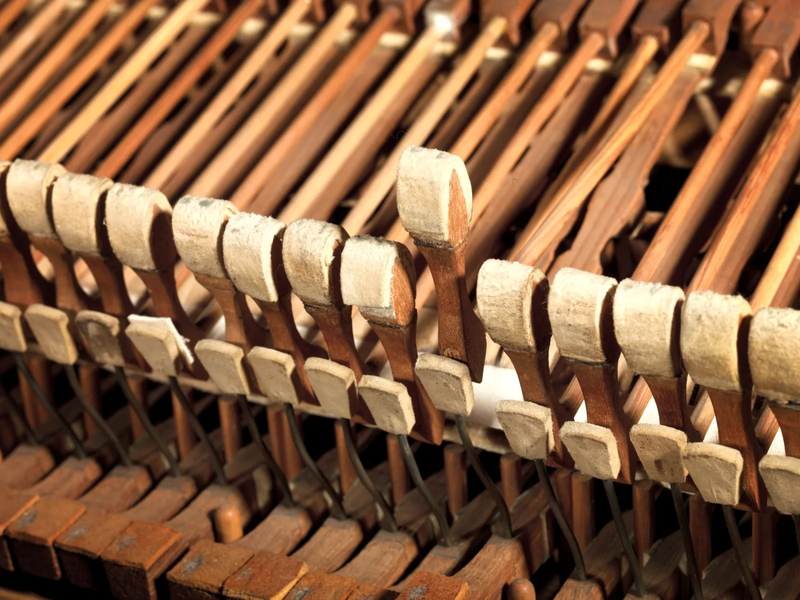
Foto: Metropolitan Museum of Art, CC0, vía Wikimedia Commons
The instrument changes too, for the same reason. The 1700 Medici inventory lists an "arpicembalo… che fa' il piano, e il forte": a harpsichord that does soft and loud. Bartolomeo Cristofori had built it; by 1711 he had made three, and three survive today, from 1720, 1722 and 1726.
The difference is mechanical. A harpsichord plucks the string with a quill and always sounds the same. A piano strikes it with a hammer, so your finger is audible.
That is why the piano wins. If you can play the return of a theme softer than its first appearance, you have marked the form without saying a word. A harpsichord cannot do that with the fingers. Harpsichord continuo drops out of the orchestra between 1750 and 1775, and by the early 1800s it is gone.
Hard facts: Concert Spirituel, Paris, 1725-1790. Hanover Square Rooms, London, 1774, main room 24.1 by 9.8 metres — measure your classroom and compare. Symphony No. 94 premiered 23 March 1792 in that room. Cristofori's piano, around 1700, three instruments surviving.
The same device elsewhere
The theme that returns is not an eighteenth-century idea and not a European one. These three do it two hundred years and ten thousand kilometres apart:
- La Gozadera, Gente de Zona — the verses keep swapping the list of countries and the chorus comes back identical every time. Verse and chorus are A and B: a rondo under another name.
- Handel's Lascia ch'io pianga — a da capo aria from the early eighteenth century. A plays, a contrasting B plays, then A comes back from the top with the singer decorating it. Pure ternary.
- The saz semai, from Ottoman classical music — four sections called hane, each followed by the same refrain, the teslim. The first three hane and the teslim are in 10/8; the fourth changes metre. It is A-refrain, B-refrain, C-refrain, D-refrain.
None of them copies the others. All three solve the same problem: somebody has to know where they are without being told.
And here at home?
In Spain the answer is not in the concert hall, it is in the theatre. The tonadilla escénica starts in 1757 with Luis Misón's Una mesonera y un arriero, runs about twenty minutes and is wedged between the acts of a play.
It was sung to a standing, noisy audience walking in and out, which is why it repeats so much. Around two thousand have been catalogued, largely thanks to the musicologist José Subirá, and by about 1820 no authors were left alive to write them.
Madrid also gets an Italian who stays. Luigi Boccherini travels to Spain in the spring of 1768 and by 1770 is cellist and composer to the chapel of the Infante Luis Antonio de Borbón; from 1786 he serves the Duchess of Osuna, and he dies in Madrid on 28 May 1805. He wrote 124 string quintets with two cellos: room music, patron music, not box-office music.
One of them, La musica notturna delle strade di Madrid, does something you understand with no training at all. It copies what you could hear at night in the street and names each chunk after it, like the pasacalle or the soldiers' retreat, which arrives from far off, passes, and goes. The form is literally a thing approaching and receding.
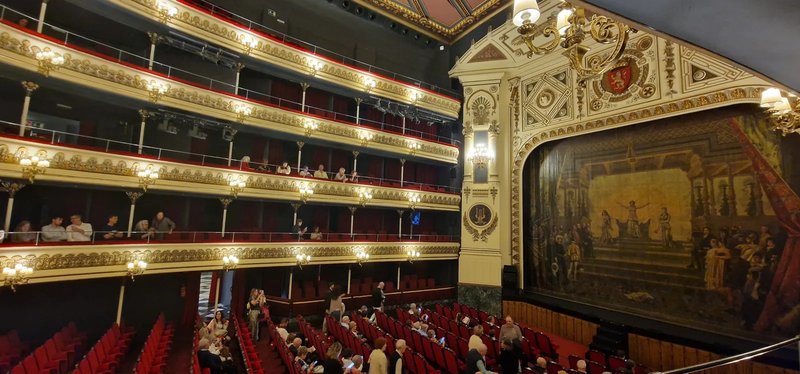
Foto: Ecelan, CC BY-SA 4.0, vía Wikimedia Commons
Aragón supplies two facts and both are dated. First: Francisco Javier García Fajer, nicknamed el Españoleto, born in Nalda on 2 December 1730, was maestro de capilla of La Seo in Zaragoza from 1756 until his death on 9 April 1809. Fifty-three years in the same post, pushing Italian style into cathedral music. He was not Aragonese by birth; he was Aragonese by trade, which in that century is what counted.
Second: the Teatro Principal in Zaragoza opened on 25 August 1799, designed by the Zaragozan architect Agustín Sanz. It seats 834 today. While Haydn was playing to paying strangers in London, Zaragoza was building its own paying room. For once, we were not late.
Classroom activities
- While the second movement of Symphony No. 94 plays: we sing the eight bars once, then go quiet. Everyone raises a hand at the moment the theme returns. Afterwards we count the hands and check whether we agreed.
- While the minuet of Mozart's Symphony No. 40 plays: half the class stands during the minuet and sits when the trio enters; the other half does the opposite. When the minuet returns, A-B-A is standing up in the room.
- While the finale of Haydn's "Joke" quartet plays: we raise a hand every time the main theme comes back. At the end it comes back one time more than you expect, with silences in between. Most of the class will clap too early. That is the joke, and it only lands if you heard the form.
- Play: we build the eight bars on whatever instruments are in the room and perform them as a rondo. Group A plays the theme, group B improvises four bars, A returns, group C does something else, A returns. Then we map the form of We Will Rock You, which has its article, chart and tab in the library.
- Create: in pairs, write a five-section rondo on paper using letters, and decide what changes on each return of A. You do not need to write notes. You need to decide.
Key vocabulary
- Form — forma: el plan de una pieza, qué partes tiene y en qué orden
- Theme — tema: la melodía de referencia; cuando vuelve cambiada es una variación
- Binary form — forma binaria: A A B B, dos partes con repetición
- Ternary form — forma ternaria: A B A, se va y se vuelve
- Rondo — rondó: A B A C A, un tema que vuelve entre secciones distintas
Resources
The songs in this unit are in the library, each with its own article, full-band chart and tab: We Will Rock You, Uptown Funk, La Gozadera.
Songs in the library with the form in plain sight, each with its article, chart and tab: La Gozadera, We Will Rock You, Uptown Funk.
The work of the unit — Haydn's Symphony No. 94, premiered at the Hanover Square Rooms on 23 March 1792. The second movement holds the theme; the third is the minuet with its trio.
The minuet and its trio, A-B-A in the open — third movement of Mozart's Symphony No. 40, by the Norwegian Chamber Orchestra. This is the listening for the second activity.
The rondo, and a room instead of a hall — Haydn's Quartet Op. 33 No. 2, "The Joke", by the Chamber Music Society of Lincoln Center. Four people, no conductor.
Why the piano wins — the difference between harpsichord and piano, explained and played by the Philharmonia Baroque Orchestra.
Ternary form before the Classical period — Handel's Lascia ch'io pianga, by Voices of Music. Listen to how the voice decorates A on its return.
The same device in another tradition — an Ottoman Pençgâh Saz Semâî, by Kudsi Erguner and the Bîrûn Ensemble at the Fondazione Giorgio Cini. Listen for the refrain closing each section.
The first tonadilla escénica — a seguidilla from Luis Misón's Una mesonera y un arriero, around 1757.
Three tonadillas in a row — Blas de Laserna, at the Fundación Juan March.
Madrid at night, in a quintet — Boccherini's La musica notturna delle strade di Madrid, by the Bremer Barockorchester.
El Españoleto — music by Francisco Javier García Fajer, maestro de capilla at La Seo in Zaragoza from 1756 to 1809, by the Burgos Baroque Ensemble.
- The opposite case, in the Year 10 book — "Why don't songs make you wait any more?", on what happens when form is compressed until no waiting is left: in the library.
Nos preguntamos
- ¿Cómo sabes que el estribillo va a volver antes de que vuelva?
- Si oyes una pieza una sola vez en tu vida, ¿qué necesitas para no perderte?
- ¿Por qué casi todo lo que escuchas repite algo?
- ¿Quién pagaba la música antes de que existieran las entradas?
- ¿Cuánta gente escuchaba de verdad en una sala del siglo XVIII?
- Si el clave ya funcionaba, ¿por qué se lo comió el piano?
No las respondas todavía. Al final de la unidad volvemos a ellas.
El fragmento
Antes de poner ninguna obra, la clase se aprende ocho compases. Son del segundo movimiento de la Sinfonía nº 94 de Haydn, van a dos notas por compás y solo usan notas del acorde.
- La primera mitad sube: do, do, mi, mi, sol, sol, mi.
- La segunda mitad baja y cierra: fa, fa, re, re, si, si, sol.
Cántalo entero dos veces seguidas. Fíjate en lo que hace la primera mitad: te deja en el aire. La segunda contesta y cierra. Es una pregunta y su respuesta, y por eso se sostiene sin acompañamiento.
Ahora escucha el movimiento. Los mismos ocho compases suenan otra vez, más flojo, y al terminar esa repetición llega un acorde de toda la orquesta a plena potencia. Después el tema vuelve varias veces, cambiado. Reconocer cuándo vuelve es todo el trabajo de esta unidad.
Qué cambió
Durante siglos, la música sonaba en sitios donde el que escuchaba ya sabía lo que venía: la iglesia, el palacio, el baile. En 1725 aparece en París el Concert Spirituel, que da conciertos los días en que los teatros cerraban, y al que iba burguesía acomodada, baja nobleza y gente de paso. En 1774 se abre en Londres la sala de Hanover Square. Ahí no hay obligación de ir: hay entrada.
Eso crea un problema nuevo y muy concreto. En la sala hay gente que no te conoce, que ha pagado, que va a oír esa pieza una sola vez y a la que nadie va a explicarle nada. La obra tiene que explicarse sola. La solución no fue hacerla más fácil: fue darle una forma que se oiga.
La forma se construye con tres gestos. Repetir, para que reconozcas. Contrastar, para que notes que has cambiado de sitio. Volver, para que sepas que aquello se cierra. Combinándolos salen las tres plantas del edificio:
- Forma binaria — A A B B. Dos partes, cada una repetida. Es la forma de las danzas, y es exactamente lo que acabas de cantar: los ocho compases de Haydn son dos mitades, y cada una suena dos veces.
- Forma ternaria — A B A. Se va y se vuelve. El minueto de una sinfonía va en 3/4, tiene una sección central que se orquestaba para un trío de instrumentos, y por eso se llama trío aunque ya no lo toquen tres. Después se repite el minueto entero. Es el tercer movimiento habitual de la sinfonía clásica.
- Rondó — A B A C A. Un tema principal que alterna con otros que contrastan, y que vuelve siempre. Fue la forma de moda a finales del siglo XVIII y es el final típico de un concierto o de un cuarteto.
Por encima de las tres está la idea que las sostiene: el tema que vuelve. Puede volver igual, y entonces te orienta. Puede volver cambiado —más adornado, en otro instrumento, más fuerte— y entonces te orienta igual, pero además te enseña cuánto se puede estirar algo sin que deje de ser lo mismo.
Y cambia quién paga. Haydn era un empleado: hasta 1779 todo lo que escribía era propiedad de la familia Esterházy. Ese año se renegoció su contrato y pudo vender su música a editores.
Trabajar para un señor y trabajar para un mercado no es el mismo oficio. Al señor se le entrega; al mercado hay que gustarle a la primera. Haydn escribió al menos 106 sinfonías en 36 años y 68 cuartetos; Mozart, al menos 47 sinfonías en 24 años.
Con el cuarteto de cuerda pasa lo contrario, y por eso conviene oírlo. Dos violines, una viola y un violonchelo, cuatro socios más o menos iguales, sin director y sin taquilla. Eso no se toca en una sala: se toca en una habitación, para los que están dentro. La forma sigue siendo la misma, pero el público cabe en un sofá.
Foto: Metropolitan Museum of Art, CC0, vía Wikimedia Commons
El instrumento también cambia, y por el mismo motivo. En el inventario de los Medici de 1700 aparece un «arpicembalo… che fa' il piano, e il forte»: un clave que hace el flojo y el fuerte. Lo había construido Bartolomeo Cristofori; en 1711 llevaba tres hechos y hoy se conservan tres, de 1720, 1722 y 1726.
La diferencia es mecánica. El clave pellizca la cuerda con una púa y suena siempre igual; el piano la golpea con un macillo, y la fuerza del dedo se oye.
Por eso gana el piano. Si puedes tocar la vuelta del tema más floja que la primera vez, has marcado la forma sin decir una palabra. El clave no puede hacer eso con los dedos. El continuo de clave en la orquesta cae en desuso entre 1750 y 1775, y a principios del siglo XIX ya no se usa.
Datos duros: Concert Spirituel, París, 1725-1790. Sala de Hanover Square, Londres, 1774, sala principal de 24,1 por 9,8 metros —mide tu aula y compara—. Estreno de la Sinfonía nº 94: 23 de marzo de 1792, en esa sala. Piano de Cristofori: hacia 1700, tres ejemplares conservados.
El mismo recurso en otros sitios
El tema que vuelve no es del siglo XVIII ni de Europa. Estos tres lo hacen con doscientos años y diez mil kilómetros de diferencia:
- La Gozadera, de Gente de Zona — las estrofas van cambiando la lista de países, y el coro vuelve idéntico cada vez. Estrofa y estribillo son A y B: es un rondó con otro nombre.
- Lascia ch'io pianga, de Händel — un aria da capo de principios del siglo XVIII. Suena A, suena una parte B que contrasta, y luego se vuelve a A desde el principio; la voz la adorna al volver. Ternaria pura.
- El saz semai, de la música clásica otomana — cuatro secciones llamadas hane, y detrás de cada una el mismo estribillo, el teslim. Las tres primeras hane y el teslim van en 10/8; la cuarta cambia de compás. Es A-estribillo, B-estribillo, C-estribillo, D-estribillo.
Ninguno copia a los otros. Los tres resuelven el mismo problema: alguien tiene que saber dónde está sin que nadie se lo diga.
Y aquí, ¿qué?
En España la respuesta no está en la sala de conciertos, está en el teatro. La tonadilla escénica nace en 1757 con Una mesonera y un arriero, de Luis Misón, dura unos veinte minutos y se mete entre los actos de la comedia.
Se cantaba delante de un público de pie, con ruido, que entraba y salía: por eso repite tanto. Se han catalogado unas dos mil, gracias sobre todo al musicólogo José Subirá, y hacia 1820 ya no quedaban autores vivos que las escribieran.
En Madrid hay además un italiano que se queda. Luigi Boccherini viaja a España en la primavera de 1768 y en 1770 es violonchelista y compositor de la capilla del infante Luis Antonio de Borbón; desde 1786 sirve a la duquesa de Osuna, y muere en Madrid el 28 de mayo de 1805. Escribió 124 quintetos de cuerda con dos violonchelos, música de habitación y de mecenas, no de taquilla.
Uno de esos quintetos, La musica notturna delle strade di Madrid, hace algo que se entiende sin saber nada: copia lo que se oía de noche en la calle y le pone nombre a cada trozo, como el pasacalle o la retirada de los soldados, que llega de lejos, pasa y se va. La forma es literalmente una cosa que se acerca y se aleja.
Foto: Ecelan, CC BY-SA 4.0, vía Wikimedia Commons
En Aragón hay dos datos y los dos son de fecha. El primero: Francisco Javier García Fajer, el Españoleto, nacido en Nalda el 2 de diciembre de 1730, fue maestro de capilla de La Seo de Zaragoza desde 1756 hasta su muerte, el 9 de abril de 1809. Cincuenta y tres años en el mismo puesto, metiendo estilo italiano en la música de la catedral. No era aragonés de nacimiento; lo fue de oficio, que en esa época es lo que contaba.
El segundo: el Teatro Principal de Zaragoza se inaugura el 25 de agosto de 1799, con proyecto del arquitecto zaragozano Agustín Sanz. Hoy tiene 834 localidades. Mientras Haydn tocaba para desconocidos que pagaban en Londres, Zaragoza se estaba construyendo su propia sala de pago. Aquí, para variar, no llegamos tarde.
Para hacer en clase
- Mientras suena el segundo movimiento de la Sinfonía nº 94: cantamos los ocho compases una vez y después nos callamos. Cada uno levanta la mano en el momento en que el tema vuelve. Al final contamos cuántas manos se levantaron y si coincidimos.
- Mientras suena el minueto de la Sinfonía nº 40 de Mozart: media clase se pone de pie durante el minueto y se sienta cuando entra el trío; la otra media hace lo contrario. Cuando vuelve el minueto, la forma A-B-A está de pie en el aula.
- Mientras suena el final del cuarteto «La broma» de Haydn: levantamos la mano cada vez que vuelve el tema principal. Al final vuelve una vez más de lo que esperas, con silencios en medio. Casi toda la clase aplaudirá antes de tiempo. Esa es la broma, y solo funciona si has oído la forma.
- Tocar: montamos los ocho compases con los instrumentos que haya en el aula y los tocamos en rondó. Grupo A toca el tema, grupo B improvisa cuatro compases, vuelve A, grupo C hace otra cosa, vuelve A. Después marcamos la forma de We Will Rock You, que tiene su artículo, su chart y su tablatura en la biblioteca.
- Crear: en parejas, escribid un rondó de cinco secciones en un papel, con letras, y decidid qué cambia en cada vuelta de A. No hace falta escribir notas: hace falta decidir.
Vocabulario fundamental
- Forma — El plan de una pieza: qué partes tiene, en qué orden y cuáles se repiten.
- Tema — La melodía que la pieza toma como referencia. Cuando vuelve cambiada —adornada, en otro instrumento, con otra fuerza— se llama variación.
- Forma binaria — Dos partes, A y B, normalmente repetida cada una: A A B B. Es la forma de las danzas.
- Forma ternaria — Tres partes que son dos: A B A. Se va y se vuelve al punto de partida. El minueto con su trío es el ejemplo estándar.
- Rondó — Un tema que vuelve una y otra vez alternando con secciones distintas: A B A C A. Fue el final típico de conciertos y cuartetos a finales del siglo XVIII.
Recursos
Las canciones de esta unidad están en la biblioteca, cada una con su artículo, su chart de banda y su tablatura: We Will Rock You, Uptown Funk, La Gozadera.
Canciones de la biblioteca con la forma a la vista, cada una con su artículo, su chart y su tablatura: La Gozadera, We Will Rock You, Uptown Funk.
La obra de la unidad — Sinfonía nº 94 de Haydn, estrenada en Hanover Square el 23 de marzo de 1792. El segundo movimiento es el del tema; el tercero es el minueto con su trío.
El minueto y su trío, la forma A-B-A — tercer movimiento de la Sinfonía nº 40 de Mozart, por la Norwegian Chamber Orchestra. Es la audición de la segunda actividad.
El rondó, y una habitación en vez de una sala — Cuarteto op. 33 nº 2 de Haydn, «La broma», por la Chamber Music Society of Lincoln Center. Cuatro personas, sin director.
Por qué gana el piano — la diferencia entre clave y piano, explicada y tocada por la Philharmonia Baroque Orchestra.
La forma ternaria antes del clasicismo — Lascia ch'io pianga, de Händel, por Voices of Music. Escucha cómo adorna la voz cuando vuelve A.
El mismo recurso en otra tradición — un Pençgâh Saz Semâî otomano, por Kudsi Erguner y el Bîrûn Ensemble en la Fondazione Giorgio Cini. Busca el estribillo que cierra cada sección.
La primera tonadilla escénica — una seguidilla de Una mesonera y un arriero, de Luis Misón, hacia 1757.
Tres tonadillas seguidas — Blas de Laserna, en la Fundación Juan March.
Madrid de noche, en un quinteto — La musica notturna delle strade di Madrid de Boccherini, por la Bremer Barockorchester.
El Españoleto — música de Francisco Javier García Fajer, maestro de capilla de La Seo de Zaragoza entre 1756 y 1809, por el Burgos Baroque Ensemble.
- Lo contrario, en el libro de 4º — «¿Por qué las canciones ya no te hacen esperar?», sobre lo que pasa cuando la forma se comprime hasta que no queda espera: en la biblioteca.
We ask ourselves
- How do you know the chorus is coming back before it comes back?
- If you hear a piece once in your life, what do you need in order not to get lost?
- Why does almost everything you listen to repeat something?
- Who paid for music before tickets existed?
- How many people were actually listening in an eighteenth-century room?
- If the harpsichord already worked, why did the piano eat it?
Don't answer yet. We come back to these at the end.
The fragment
Before any piece is played, the class learns eight bars. They come from the second movement of Haydn's Symphony No. 94, they run two notes to the bar, and they use nothing but notes of the chord.
- The first half goes up: do, do, mi, mi, sol, sol, mi.
- The second half comes down and closes: fa, fa, re, re, si, si, sol.
Sing the whole thing twice through. Notice what the first half does: it leaves you hanging. The second half answers and shuts the door. It is a question and its answer, which is why it stands up with no accompaniment at all.
Now listen to the movement. The same eight bars come round again, quieter, and at the end of that repeat the whole orchestra lands on one chord at full power. After that the theme returns several times, changed. Spotting the return is the entire job of this unit.
What changed
For centuries music happened in places where the listener already knew what was coming: church, palace, ballroom. In 1725 Paris gets the Concert Spirituel, putting on concerts on the days the theatres were shut, attended by comfortable middle classes, minor nobility and travellers. In 1774 the Hanover Square Rooms open in London. Nobody is obliged to attend. There is a ticket.
That creates a very concrete new problem. The room is full of strangers who paid, who will hear this piece exactly once, and to whom nobody is going to explain anything. The piece has to explain itself. The answer was not to make it simpler. It was to give it a shape you can hear.
Shape is built from three gestures. Repeat, so you recognise. Contrast, so you notice you have moved. Return, so you know it is closing. Combine them and you get three floors of the same building:
- Binary form — A A B B. Two parts, each repeated. It is the shape of dances, and it is exactly what you just sang: Haydn's eight bars are two halves, and each half plays twice.
- Ternary form — A B A. You leave and you come back. A symphony minuet is in 3/4 and has a middle section that used to be scored for a trio of instruments, which is why it is still called the trio when three people are nowhere in sight. Then the whole minuet plays again. It is the standard third movement of a classical symphony.
- Rondo — A B A C A. A main theme alternating with contrasting ones, always coming back. It was the fashionable form of the late eighteenth century and the typical finale of a concerto or a quartet.
Above all three sits the idea holding them up: the theme that returns. It can return unchanged, and then it tells you where you are. It can return changed — ornamented, on another instrument, louder — and then it still tells you where you are, and on top of that it shows you how far something can be stretched while staying itself.
And the payer changes. Haydn was an employee: until 1779 everything he wrote belonged to the Esterházy family, and that year his contract was renegotiated and he could sell his music to publishers. Writing for a lord and writing for a market are not the same job. The lord receives; the market has to like it first time. Haydn wrote at least 106 symphonies in 36 years and 68 quartets; Mozart at least 47 symphonies in 24 years.
The string quartet runs the other way, which is why it is worth hearing. Two violins, a viola and a cello, four more-or-less equal partners, no conductor and no box office. You do not play that in a hall. You play it in a room, for the people inside it. The forms are the same; the audience fits on a sofa.
Foto: Metropolitan Museum of Art, CC0, vía Wikimedia Commons
The instrument changes too, for the same reason. The 1700 Medici inventory lists an "arpicembalo… che fa' il piano, e il forte": a harpsichord that does soft and loud. Bartolomeo Cristofori had built it; by 1711 he had made three, and three survive today, from 1720, 1722 and 1726.
The difference is mechanical. A harpsichord plucks the string with a quill and always sounds the same. A piano strikes it with a hammer, so your finger is audible.
That is why the piano wins. If you can play the return of a theme softer than its first appearance, you have marked the form without saying a word. A harpsichord cannot do that with the fingers. Harpsichord continuo drops out of the orchestra between 1750 and 1775, and by the early 1800s it is gone.
Hard facts: Concert Spirituel, Paris, 1725-1790. Hanover Square Rooms, London, 1774, main room 24.1 by 9.8 metres — measure your classroom and compare. Symphony No. 94 premiered 23 March 1792 in that room. Cristofori's piano, around 1700, three instruments surviving.
The same device elsewhere
The theme that returns is not an eighteenth-century idea and not a European one. These three do it two hundred years and ten thousand kilometres apart:
- La Gozadera, Gente de Zona — the verses keep swapping the list of countries and the chorus comes back identical every time. Verse and chorus are A and B: a rondo under another name.
- Handel's Lascia ch'io pianga — a da capo aria from the early eighteenth century. A plays, a contrasting B plays, then A comes back from the top with the singer decorating it. Pure ternary.
- The saz semai, from Ottoman classical music — four sections called hane, each followed by the same refrain, the teslim. The first three hane and the teslim are in 10/8; the fourth changes metre. It is A-refrain, B-refrain, C-refrain, D-refrain.
None of them copies the others. All three solve the same problem: somebody has to know where they are without being told.
And here at home?
In Spain the answer is not in the concert hall, it is in the theatre. The tonadilla escénica starts in 1757 with Luis Misón's Una mesonera y un arriero, runs about twenty minutes and is wedged between the acts of a play.
It was sung to a standing, noisy audience walking in and out, which is why it repeats so much. Around two thousand have been catalogued, largely thanks to the musicologist José Subirá, and by about 1820 no authors were left alive to write them.
Madrid also gets an Italian who stays. Luigi Boccherini travels to Spain in the spring of 1768 and by 1770 is cellist and composer to the chapel of the Infante Luis Antonio de Borbón; from 1786 he serves the Duchess of Osuna, and he dies in Madrid on 28 May 1805. He wrote 124 string quintets with two cellos: room music, patron music, not box-office music.
One of them, La musica notturna delle strade di Madrid, does something you understand with no training at all. It copies what you could hear at night in the street and names each chunk after it, like the pasacalle or the soldiers' retreat, which arrives from far off, passes, and goes. The form is literally a thing approaching and receding.
Foto: Ecelan, CC BY-SA 4.0, vía Wikimedia Commons
Aragón supplies two facts and both are dated. First: Francisco Javier García Fajer, nicknamed el Españoleto, born in Nalda on 2 December 1730, was maestro de capilla of La Seo in Zaragoza from 1756 until his death on 9 April 1809. Fifty-three years in the same post, pushing Italian style into cathedral music. He was not Aragonese by birth; he was Aragonese by trade, which in that century is what counted.
Second: the Teatro Principal in Zaragoza opened on 25 August 1799, designed by the Zaragozan architect Agustín Sanz. It seats 834 today. While Haydn was playing to paying strangers in London, Zaragoza was building its own paying room. For once, we were not late.
Classroom activities
- While the second movement of Symphony No. 94 plays: we sing the eight bars once, then go quiet. Everyone raises a hand at the moment the theme returns. Afterwards we count the hands and check whether we agreed.
- While the minuet of Mozart's Symphony No. 40 plays: half the class stands during the minuet and sits when the trio enters; the other half does the opposite. When the minuet returns, A-B-A is standing up in the room.
- While the finale of Haydn's "Joke" quartet plays: we raise a hand every time the main theme comes back. At the end it comes back one time more than you expect, with silences in between. Most of the class will clap too early. That is the joke, and it only lands if you heard the form.
- Play: we build the eight bars on whatever instruments are in the room and perform them as a rondo. Group A plays the theme, group B improvises four bars, A returns, group C does something else, A returns. Then we map the form of We Will Rock You, which has its article, chart and tab in the library.
- Create: in pairs, write a five-section rondo on paper using letters, and decide what changes on each return of A. You do not need to write notes. You need to decide.
Key vocabulary
- Form — forma: el plan de una pieza, qué partes tiene y en qué orden
- Theme — tema: la melodía de referencia; cuando vuelve cambiada es una variación
- Binary form — forma binaria: A A B B, dos partes con repetición
- Ternary form — forma ternaria: A B A, se va y se vuelve
- Rondo — rondó: A B A C A, un tema que vuelve entre secciones distintas
Resources
The songs in this unit are in the library, each with its own article, full-band chart and tab: We Will Rock You, Uptown Funk, La Gozadera.
Songs in the library with the form in plain sight, each with its article, chart and tab: La Gozadera, We Will Rock You, Uptown Funk.
The work of the unit — Haydn's Symphony No. 94, premiered at the Hanover Square Rooms on 23 March 1792. The second movement holds the theme; the third is the minuet with its trio.
The minuet and its trio, A-B-A in the open — third movement of Mozart's Symphony No. 40, by the Norwegian Chamber Orchestra. This is the listening for the second activity.
The rondo, and a room instead of a hall — Haydn's Quartet Op. 33 No. 2, "The Joke", by the Chamber Music Society of Lincoln Center. Four people, no conductor.
Why the piano wins — the difference between harpsichord and piano, explained and played by the Philharmonia Baroque Orchestra.
Ternary form before the Classical period — Handel's Lascia ch'io pianga, by Voices of Music. Listen to how the voice decorates A on its return.
The same device in another tradition — an Ottoman Pençgâh Saz Semâî, by Kudsi Erguner and the Bîrûn Ensemble at the Fondazione Giorgio Cini. Listen for the refrain closing each section.
The first tonadilla escénica — a seguidilla from Luis Misón's Una mesonera y un arriero, around 1757.
Three tonadillas in a row — Blas de Laserna, at the Fundación Juan March.
Madrid at night, in a quintet — Boccherini's La musica notturna delle strade di Madrid, by the Bremer Barockorchester.
El Españoleto — music by Francisco Javier García Fajer, maestro de capilla at La Seo in Zaragoza from 1756 to 1809, by the Burgos Baroque Ensemble.
- The opposite case, in the Year 10 book — "Why don't songs make you wait any more?", on what happens when form is compressed until no waiting is left: in the library.