Contenidos
I Got You (I Feel Good) — James Brown (1965)
Three chords, twelve bars and a scream. What makes this funk is not the notes that sound, but the gaps between them.
🏷️ Ficha musical
Why this song
In Leipzig, every time the home team score a goal, the stadium plays this song. It gets used that way constantly — adverts, films, sports grounds — and almost always it is the opening that gets used: the scream, and the horns crashing in behind it.
So that is how most people know it, and they rarely hear what comes next. Underneath the scream sits a twelve-bar blues, the same frame rock and roll had been using since the fifties.
Same frame, different planet. This is where funk starts to take shape.
Historical context
By 1965 James Brown had spent ten years making soul hits. His previous single, "Papa's Got a Brand New Bag" (July 1965), was the first step away from that. This one, three months later, was the second.
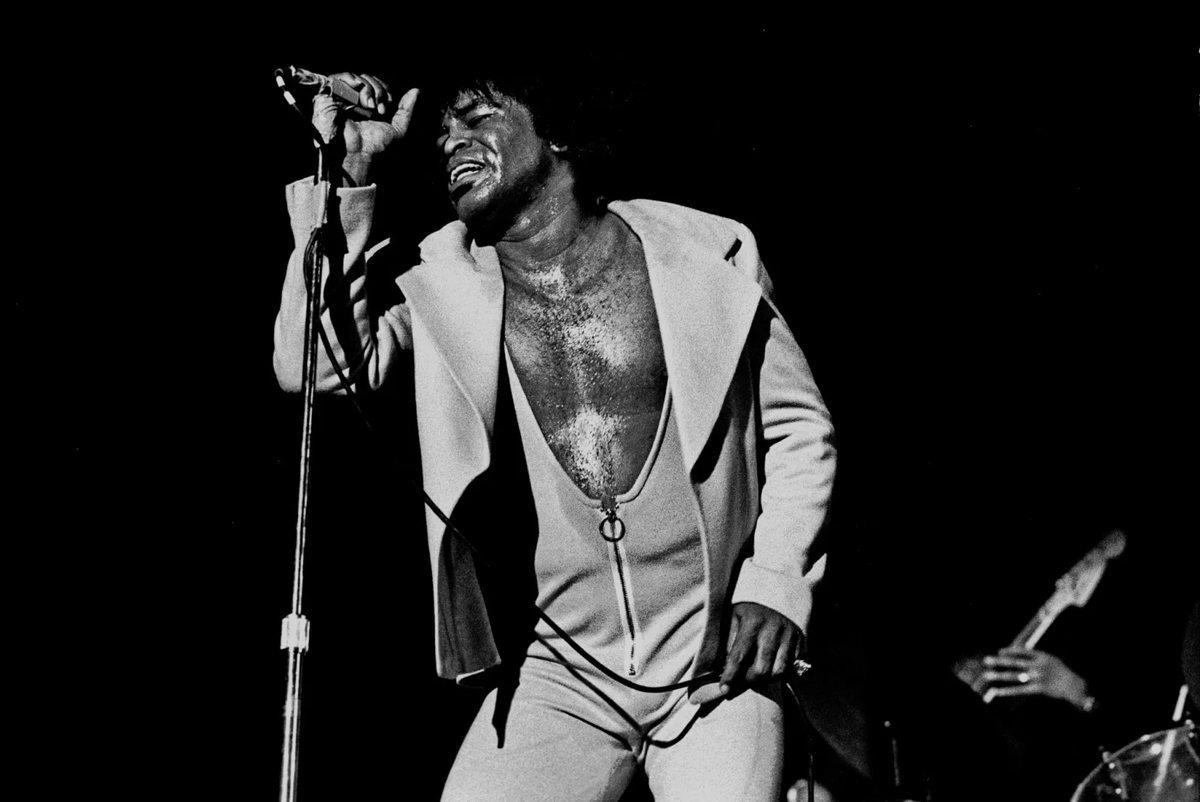
He recorded it on 6 May 1965 at Criteria Studios in Miami. Syd Nathan, who owned his record label, had visited the studio, liked the sound of the mixing desk there and booked the session.

Foto: Ebyabe, CC BY-SA 3.0, vía Wikimedia Commons
It was not the first time he had recorded it. In September 1964 he had cut a different version, with a different arrangement, for a different label. A judge stopped its release: King Records had him under contract and went to court.
That 1964 take ended up inside a beach film, Ski Party, where Brown and the Famous Flames mime it. The version you know is the second one. It came out in October 1965 and reached number three in the United States — Brown's highest position ever, out of 91 songs he put on that chart.
Musical characteristics
Put the song on and count 1-2-3-4 out loud over it. Something will feel off.
In the rock and roll of the time the strong hit lands on 2 and 4. That is the backbeat, and it is what makes your head move side to side. Here that hit is not in charge. The one is: the first beat of each bar, where the whole band lands together before scattering again.
Moving the accent looks like a small change and it changes everything. The song stops sounding like something travelling forward and starts sounding like a machine turning.
The harmony, meanwhile, does not move. Three chords spread over twelve bars, and those twelve bars go round until the end. In an ordinary song the tension comes from chord changes. Here there is nowhere to go, so the interest moves somewhere else.
It moves to how the hits are shared out. Listen to Jimmy Nolen's guitar on its own: no long chords, just short dry strums, then silence. The bass does the same. What you hear as "the rhythm" is four instruments that almost never play at the same moment.
That is the point to take away: in funk it matters less which note you play than when you stop playing it. Silence does half the work, the way white paper does half the work in a drawing.
Around the middle an alto sax solo comes in, usually credited to Maceo Parker. It is the only moment when one instrument steps out of the grid and sings above everyone.
Hard facts: twelve-bar blues in D (D7, G7, A7), 4/4, 142 BPM, 2:44. The form is verse, verse, interlude, bridge, verse, interlude, bridge, verse, verse.
Two clarifications. First: this is not quite funk yet. Finished funk arrives two years later with "Cold Sweat" (1967), where the harmony shrinks to a single chord and the blues disappears. This song is the halfway step.
Second: the chart used in class is in A (A, D, E), not D. Same song, moved down so the three chords fall in open position on ukulele and guitar. To play along with the record, put a capo on the 5th fret and use the A shapes: that gives you D.
Trivia and curiosities
- This song exists twice because a judge decided so. Brown recorded it in 1964 for one label and King Records took him to court over his contract. He had to walk back into a studio and do it again. What we call "the song" is the result of a lawsuit, not of an artistic choice.
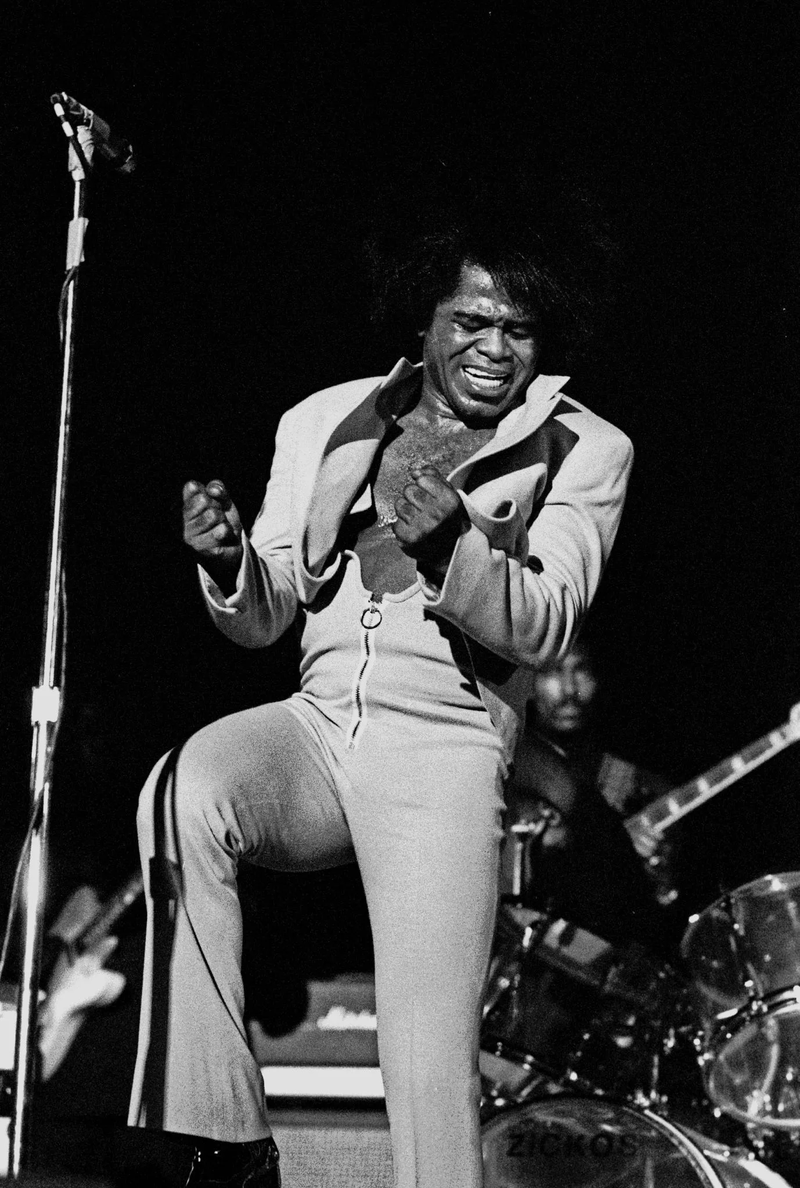
Foto: Heinrich Klaffs, CC BY-SA 2.0, vía Wikimedia Commons
- Brown fined his musicians. For turning up late, for missing the bow tie, for unshined shoes, for playing a wrong note. And he collected on stage: he would dance with his back to the audience, splaying his fingers at whoever had slipped, while the crowd took it for choreography. This is documented, not legend — his saxophonist Maceo Parker described the discipline in an NPR radio interview, and a 2000 Dance Magazine article describes the hand signals. The precision you hear did not happen by itself.
- The melody had already failed once. In 1962 Brown wrote "I Found You" for his backing singer Yvonne Fair, with almost the same tune and almost the same words. Nobody bought it. Three years later, with a different arrangement and a different voice, the same melody reached number three. A song is not only its notes.
- Sixty years on, the part still being reused is not the melody: it is the scream. It has been sampled dozens of times, most recently in "Supa Good!!!" by the rapper Yung Gravy, for the film Dog Man. Out of two and a half minutes of music, what survives as reusable material is half a second of noise.
Classroom activities
- Play: the twelve-bar blues in A (A, D, E) from the chart. On ukulele and guitar all three chords are open shapes. Add bass and drums underneath and you have the whole song in three chords.
- The silence experiment: play the twelve bars twice. First with continuous strumming, never stopping. Then playing one short hit on beat 1 of each bar and nothing else. Compare them. One of the two sounds like funk and the other does not, and the difference is not in the notes.
- Analyse: a closed question. Listen to the whole song with the chart in front of you and count how many different chords sound from start to finish. Then find the exact moment when one instrument leaves the grid and plays alone.
- Create: take those same three chords and share the hits between the four instruments with one rule — nobody plays at the same time as anyone else, except on the first beat of the bar. Steal the procedure, not the song.
Key vocabulary
- Twelve-bar blues — blues de doce compases: un esquema de doce compases con tres acordes que se repite entero
- Backbeat — el golpe fuerte en los tiempos 2 y 4
- On the one — el acento en el uno: el peso en el primer tiempo del compás
- Silence / rest — el silencio: el hueco en el que un instrumento deja de tocar, que en el funk es parte del diseño
- Horn section — la sección de vientos: trompetas y saxos tocando en bloque
Resources
In Year 3 — this song also serves the units ¿Cómo sabes por dónde vas en una música que oyes por primera vez? and ¿Cómo se guarda algo que solo existe mientras suena?, from the theory and history book.
Official video — visualiser from James Brown's official channel.
Ukulele tutorial — TenThumbs Productions, with tab on screen. He teaches it as what it is, a twelve-bar blues in D, so it explains the structure as well as the chords.
Electric guitar tutorial — JustinGuitar. Free lesson, with the short strums broken down step by step.
Bass tutorial — Stuart Clayton. Full song, bar by bar, with a free downloadable transcription.
Drum tutorial — Joe The Drummer. Five minutes, separating the verse groove, the bridge groove and the fills.
- Tab — the button opens it in Songsterr.
Por dónde entrar
Los dos primeros segundos los reconoces seguro: un grito, y detrás los vientos entrando de golpe. Esa parte suena en anuncios, en estadios y en películas, casi siempre sin el resto de la canción detrás.
Lo interesante empieza justo después. Debajo del grito hay un blues de doce compases, el mismo armazón que llevaba desde los años cincuenta sonando en el rock and roll. Si has trabajado Hound Dog, es exactamente la misma estructura.
Y aun así suena a otro planeta. Aquí es donde empieza a nacer el funk.
Contexto histórico
James Brown llevaba diez años encadenando éxitos de soul cuando decidió cambiar las reglas. Su single anterior, «Papa's Got a Brand New Bag» (julio de 1965), fue el primer paso. Este fue el segundo, tres meses después.
La grabó el 6 de mayo de 1965 en los Criteria Studios de Miami. El dueño de su discográfica, Syd Nathan, había visitado el estudio, le gustó cómo sonaba la mesa de mezclas que tenían allí y reservó la sesión.
Foto: Ebyabe, CC BY-SA 3.0, vía Wikimedia Commons
No era la primera vez que la grababa. En septiembre de 1964 había registrado otra versión, con un arreglo distinto, para otro sello. Un juez paró su publicación porque King Records tenía contrato con él y reclamó.
Aquella toma de 1964 se quedó dentro de una película de playa, Ski Party, donde Brown y los Famous Flames la hacen en playback. La versión que conoces es la segunda, la de 1965. Salió en octubre y llegó al número tres en Estados Unidos: el puesto más alto que alcanzó Brown en esa lista, de 91 canciones que metió en ella.
Cómo suena
Pon la canción y cuenta 1-2-3-4 en voz alta encima. Vas a notar que algo no encaja con lo que esperas.
En el rock and roll de entonces el golpe fuerte cae en el 2 y en el 4. Eso es el backbeat, y es lo que hace que muevas la cabeza a un lado y a otro. Aquí no manda ese golpe. Lo que manda es el 1: el primer tiempo de cada compás, donde toda la banda se junta antes de volver a repartirse.
Cambiar el acento de sitio parece poca cosa y lo cambia todo. Deja de sonar a canción que avanza y empieza a sonar a máquina que gira.
La armonía, mientras tanto, no se mueve. Son tres acordes repartidos en doce compases, y esos doce compases dan vueltas hasta el final. En una canción normal la tensión la produce el cambio de acordes; aquí no hay adónde ir, así que todo el interés se traslada a otro sitio.
Ese otro sitio es el reparto de los golpes. Escucha solo la guitarra de Jimmy Nolen: no sostiene acordes largos, da rasgueos cortos y secos y se calla enseguida. El bajo hace lo mismo. Lo que tú oyes como «el ritmo» son cuatro instrumentos que casi nunca tocan a la vez.
De ahí sale la idea que hay que llevarse de esta canción: en el funk no importa tanto qué nota tocas como cuándo la dejas de tocar. El silencio ocupa la mitad del trabajo, igual que en un dibujo importa el papel en blanco.
Hacia la mitad entra un solo de saxo alto, que suele atribuirse a Maceo Parker. Es el único momento en que un instrumento se sale del reparto y canta por encima de todos.
Datos duros: blues de doce compases en Re (Re7, Sol7, La7), 4/4, 142 BPM, 2:44. La forma es estrofa, estrofa, interludio, puente, estrofa, interludio, puente, estrofa y estrofa.
Dos precisiones. La primera: esto todavía no es funk del todo. El funk terminado llega dos años después con «Cold Sweat» (1967), donde la armonía se reduce a un solo acorde y ya no queda ni el blues. Esta canción es el paso intermedio.
La segunda: el chart que se reparte en clase está en La (La, Re, Mi), no en Re. Es la misma canción bajada para que los tres acordes queden en posición abierta en ukelele y en guitarra. Si quieres tocar sobre el disco, pon cejilla en el traste 5 y usa las posiciones de La: sale Re.
Curiosidades
- Esta canción existe dos veces porque un juez lo decidió. Brown la grabó en 1964 para un sello y King Records lo llevó a los tribunales alegando contrato. Tuvo que volver a entrar en un estudio y hacerla otra vez. Lo que sabemos como «la canción» es el resultado de un pleito, no de una decisión artística.
Foto: Heinrich Klaffs, CC BY-SA 2.0, vía Wikimedia Commons
- Brown multaba a sus músicos. Por llegar tarde, por no llevar la pajarita, por los zapatos sin lustrar, por tocar una nota equivocada. Y cobraba las multas en pleno concierto: bailaba de espaldas al público abriendo los dedos de la mano hacia el que había fallado, y la gente creía que formaba parte de la coreografía. Está documentado, no es leyenda: lo contó su saxofonista Maceo Parker en una entrevista de radio en la NPR, y lo recoge un artículo de Dance Magazine de 2000. Esa precisión que oyes no salió sola.
- La melodía ya había fracasado antes. En 1962 Brown escribió «I Found You» para su corista Yvonne Fair, con casi la misma melodía y casi la misma letra. No la compró nadie. Tres años después, con otro arreglo y otra voz, la misma melodía llegó al número tres. La canción no está solo en las notas.
- Sesenta años después, lo que se sigue reutilizando no es la melodía: es el grito. Se ha sampleado decenas de veces, la última en «Supa Good!!!» del rapero Yung Gravy, para la película Dog Man. De los dos minutos y tres cuartos de música, lo que ha sobrevivido como material reutilizable es medio segundo de ruido.
Para hacer en clase
- Tocar: el blues de doce compases en La (La, Re, Mi) con el chart. En ukelele y en guitarra los tres acordes salen en posición abierta. Con el bajo y la batería debajo, ya tenéis la canción entera en tres acordes.
- El experimento del silencio: tocad los doce compases dos veces. La primera, con rasgueo continuo, sin parar. La segunda, tocando solo un golpe seco en el 1 de cada compás y callando el resto. Comparad las dos. Una de las dos suena a funk y la otra no, y la diferencia no está en las notas.
- Analizar: pregunta cerrada. Escuchad la canción entera con el chart delante y contad cuántos acordes distintos suenan de principio a fin. Después, buscad el momento exacto en que un instrumento se sale del reparto y toca solo.
- Crear: coged esos mismos tres acordes y repartid los golpes entre los cuatro instrumentos con una regla: nadie toca a la vez que otro, salvo en el primer tiempo del compás. Se trata de robar el procedimiento, no la canción.
Vocabulario fundamental
- Blues de doce compases — Un esquema de doce compases con tres acordes que se repite entero, una y otra vez, durante toda la canción.
- Backbeat — El golpe fuerte en los tiempos 2 y 4. Es el que hace mover la cabeza en el rock and roll, y aquí deja de mandar.
- Acento en el uno — Poner el peso en el primer tiempo del compás. Es lo que convierte una canción que avanza en una máquina que gira.
- Silencio — El hueco en el que un instrumento deja de tocar. En el funk no es un descanso: es parte del diseño.
- Sección de vientos — El grupo de trompetas y saxos que toca a la vez, en bloque, como si fueran un solo instrumento de golpes.
Recursos
En 3º de ESO — esta canción sirve también para las unidades ¿Cómo sabes por dónde vas en una música que oyes por primera vez? y ¿Cómo se guarda algo que solo existe mientras suena?, del libro de teoría e historia.
Videoclip oficial — visualizador del canal oficial de James Brown.
Tutorial de ukelele — TenThumbs Productions, con tablatura en pantalla. Explica la canción como lo que es, un blues de doce compases en Re, y por eso sirve para entender la estructura además de para tocarla.
Tutorial de guitarra eléctrica — JustinGuitar. Lección gratuita, con los rasgueos cortos desglosados paso a paso.
Tutorial de bajo — Stuart Clayton. Canción completa, compás a compás, con transcripción descargable gratis.
Tutorial de batería — Joe The Drummer. Cinco minutos, separando el groove de la estrofa, el del puente y los rellenos.
- Tablatura — el botón la abre en Songsterr.
Why this song
In Leipzig, every time the home team score a goal, the stadium plays this song. It gets used that way constantly — adverts, films, sports grounds — and almost always it is the opening that gets used: the scream, and the horns crashing in behind it.
So that is how most people know it, and they rarely hear what comes next. Underneath the scream sits a twelve-bar blues, the same frame rock and roll had been using since the fifties.
Same frame, different planet. This is where funk starts to take shape.
Historical context
By 1965 James Brown had spent ten years making soul hits. His previous single, "Papa's Got a Brand New Bag" (July 1965), was the first step away from that. This one, three months later, was the second.
He recorded it on 6 May 1965 at Criteria Studios in Miami. Syd Nathan, who owned his record label, had visited the studio, liked the sound of the mixing desk there and booked the session.
Foto: Ebyabe, CC BY-SA 3.0, vía Wikimedia Commons
It was not the first time he had recorded it. In September 1964 he had cut a different version, with a different arrangement, for a different label. A judge stopped its release: King Records had him under contract and went to court.
That 1964 take ended up inside a beach film, Ski Party, where Brown and the Famous Flames mime it. The version you know is the second one. It came out in October 1965 and reached number three in the United States — Brown's highest position ever, out of 91 songs he put on that chart.
Musical characteristics
Put the song on and count 1-2-3-4 out loud over it. Something will feel off.
In the rock and roll of the time the strong hit lands on 2 and 4. That is the backbeat, and it is what makes your head move side to side. Here that hit is not in charge. The one is: the first beat of each bar, where the whole band lands together before scattering again.
Moving the accent looks like a small change and it changes everything. The song stops sounding like something travelling forward and starts sounding like a machine turning.
The harmony, meanwhile, does not move. Three chords spread over twelve bars, and those twelve bars go round until the end. In an ordinary song the tension comes from chord changes. Here there is nowhere to go, so the interest moves somewhere else.
It moves to how the hits are shared out. Listen to Jimmy Nolen's guitar on its own: no long chords, just short dry strums, then silence. The bass does the same. What you hear as "the rhythm" is four instruments that almost never play at the same moment.
That is the point to take away: in funk it matters less which note you play than when you stop playing it. Silence does half the work, the way white paper does half the work in a drawing.
Around the middle an alto sax solo comes in, usually credited to Maceo Parker. It is the only moment when one instrument steps out of the grid and sings above everyone.
Hard facts: twelve-bar blues in D (D7, G7, A7), 4/4, 142 BPM, 2:44. The form is verse, verse, interlude, bridge, verse, interlude, bridge, verse, verse.
Two clarifications. First: this is not quite funk yet. Finished funk arrives two years later with "Cold Sweat" (1967), where the harmony shrinks to a single chord and the blues disappears. This song is the halfway step.
Second: the chart used in class is in A (A, D, E), not D. Same song, moved down so the three chords fall in open position on ukulele and guitar. To play along with the record, put a capo on the 5th fret and use the A shapes: that gives you D.
Trivia and curiosities
- This song exists twice because a judge decided so. Brown recorded it in 1964 for one label and King Records took him to court over his contract. He had to walk back into a studio and do it again. What we call "the song" is the result of a lawsuit, not of an artistic choice.
Foto: Heinrich Klaffs, CC BY-SA 2.0, vía Wikimedia Commons
- Brown fined his musicians. For turning up late, for missing the bow tie, for unshined shoes, for playing a wrong note. And he collected on stage: he would dance with his back to the audience, splaying his fingers at whoever had slipped, while the crowd took it for choreography. This is documented, not legend — his saxophonist Maceo Parker described the discipline in an NPR radio interview, and a 2000 Dance Magazine article describes the hand signals. The precision you hear did not happen by itself.
- The melody had already failed once. In 1962 Brown wrote "I Found You" for his backing singer Yvonne Fair, with almost the same tune and almost the same words. Nobody bought it. Three years later, with a different arrangement and a different voice, the same melody reached number three. A song is not only its notes.
- Sixty years on, the part still being reused is not the melody: it is the scream. It has been sampled dozens of times, most recently in "Supa Good!!!" by the rapper Yung Gravy, for the film Dog Man. Out of two and a half minutes of music, what survives as reusable material is half a second of noise.
Classroom activities
- Play: the twelve-bar blues in A (A, D, E) from the chart. On ukulele and guitar all three chords are open shapes. Add bass and drums underneath and you have the whole song in three chords.
- The silence experiment: play the twelve bars twice. First with continuous strumming, never stopping. Then playing one short hit on beat 1 of each bar and nothing else. Compare them. One of the two sounds like funk and the other does not, and the difference is not in the notes.
- Analyse: a closed question. Listen to the whole song with the chart in front of you and count how many different chords sound from start to finish. Then find the exact moment when one instrument leaves the grid and plays alone.
- Create: take those same three chords and share the hits between the four instruments with one rule — nobody plays at the same time as anyone else, except on the first beat of the bar. Steal the procedure, not the song.
Key vocabulary
- Twelve-bar blues — blues de doce compases: un esquema de doce compases con tres acordes que se repite entero
- Backbeat — el golpe fuerte en los tiempos 2 y 4
- On the one — el acento en el uno: el peso en el primer tiempo del compás
- Silence / rest — el silencio: el hueco en el que un instrumento deja de tocar, que en el funk es parte del diseño
- Horn section — la sección de vientos: trompetas y saxos tocando en bloque
Resources
In Year 3 — this song also serves the units ¿Cómo sabes por dónde vas en una música que oyes por primera vez? and ¿Cómo se guarda algo que solo existe mientras suena?, from the theory and history book.
Official video — visualiser from James Brown's official channel.
Ukulele tutorial — TenThumbs Productions, with tab on screen. He teaches it as what it is, a twelve-bar blues in D, so it explains the structure as well as the chords.
Electric guitar tutorial — JustinGuitar. Free lesson, with the short strums broken down step by step.
Bass tutorial — Stuart Clayton. Full song, bar by bar, with a free downloadable transcription.
Drum tutorial — Joe The Drummer. Five minutes, separating the verse groove, the bridge groove and the fills.
- Tab — the button opens it in Songsterr.