Contenidos
La sala donde suena esta canción no existe
Almost no song you listen to has ever been played all the way through in a single room. This unit is about how you build a room that does not exist, and about the moment recording stopped being a record of what happened and became the place where mus
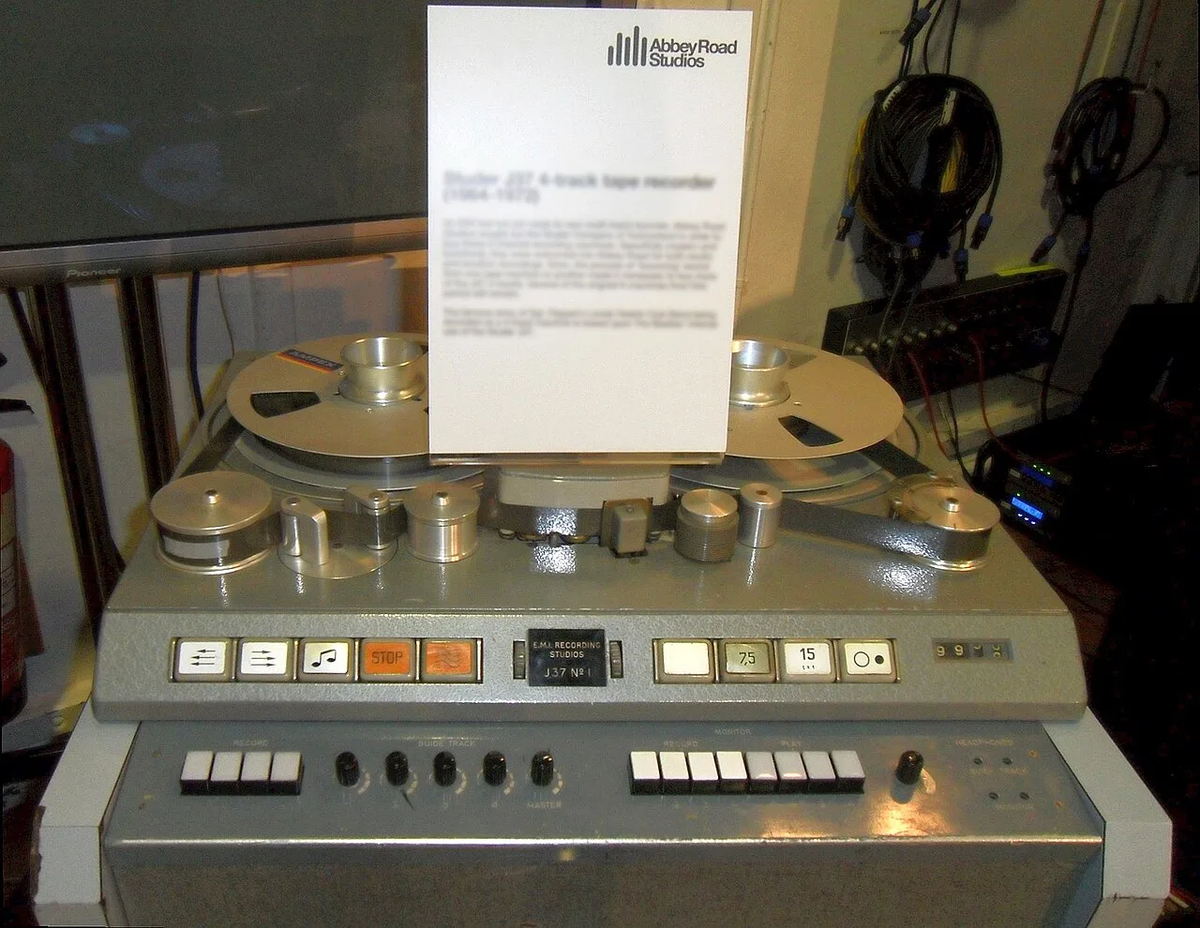
We ask ourselves
- What room is this song playing in?
- If only one person is singing, why can you sometimes hear three, and all three are her?
- Why can a guitar come out of your left ear only?
- Did they all play together, or did each of them record alone on a different day?
- How much of what you hear was decided while playing, and how much afterwards?
- Can a band play on stage exactly what is on the record?
Don't answer yet. We come back to these at the end.
The fragment
You need headphones, not a speaker. A speaker blends the two channels before they reach you and ruins the experiment.
Start With or Without You and take out your right earbud. What is left is a sustained guitar, dry and close, as if somebody were playing it next to you.
Now the other way round: take out the left one. Same guitar, but now it sounds far away, with a tail, as if it were inside a church.
There is one guitar. The church is invented, and it is only on one side.
Now do it with your bodies, no equipment. Half the class says one short word and cuts it dead. The other half repeats it straight after, quieter, then again quieter still, until it fades. That is a hand-made reverberation: sound still sounding after whoever made it has stopped.
Now play With or Without You, all of it, with nobody talking over it.
What changed
Until the mid-fifties, recording meant taking minutes of a meeting. Musicians stood in a room, played from beginning to end, and the microphone acted as a witness. If somebody fluffed the last bar, you did the whole thing again. The record was proof that it had happened.
In 1955 Ross Snyder designed the first Sel-Sync machine at Ampex: eight separate tracks on one inch of tape. It was sold to Les Paul for ten thousand dollars and he called it "the Octopus". You could record onto one track while listening to the other seven. In other words: you could answer yourself.
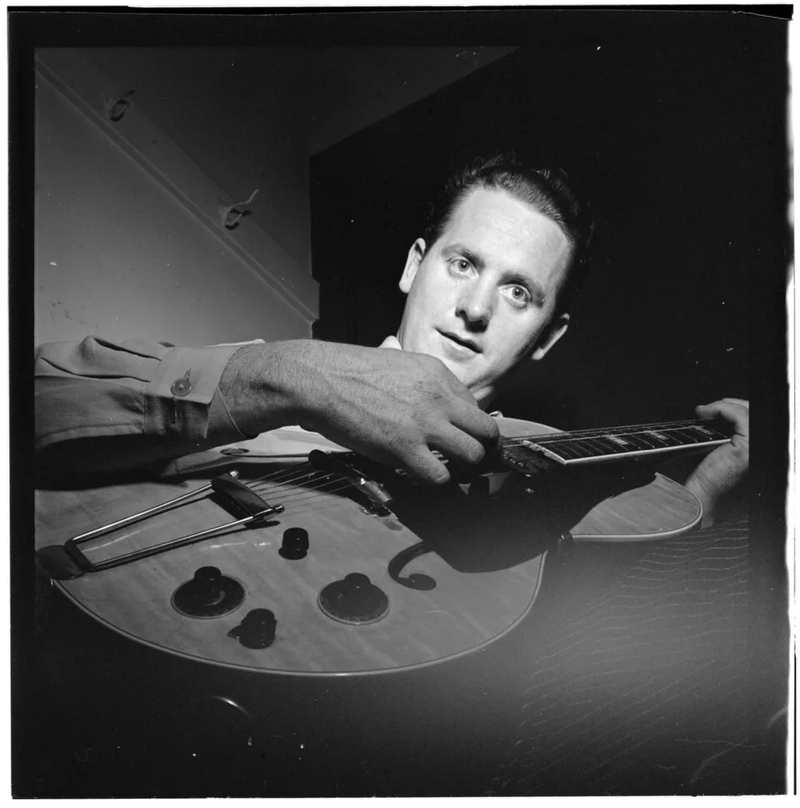
Foto: William P. Gottlieb, Library of Congress. Dominio público, vía Wikimedia Commons
In the ear that changes three things, and those are the three you will recognise from today on.
The first is overdubbing: the same person recorded more than once, sounding alongside herself. Ken Townsend automated it at Abbey Road in the spring of 1966, because Lennon was sick of singing every song twice.
The second is artificial reverberation: you choose the room after you play. Bill Putnam was already doing it in 1947, putting a speaker and a microphone in the studio bathroom. Ten years later the EMT 140 turned it into a machine: a steel plate one metre by two, with a decay you could set between one and five seconds. Abbey Road ended up with four of them.
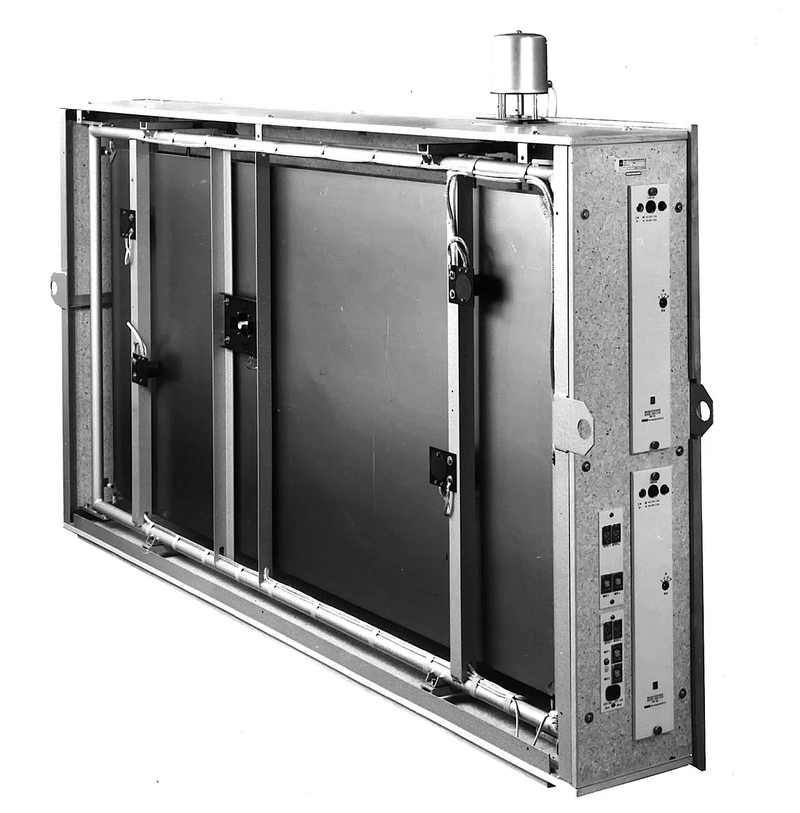
Foto: EMT-Archiv-Lahr, CC BY-SA 4.0, vía Wikimedia Commons
The third is stereo: two channels instead of one, and therefore a decision nobody had to make before. What is playing is no longer enough; somebody has to decide where each thing sits between your two ears.
Put the three together and recording stops documenting and starts building. The place where the musical decision gets made moves: out of the room and onto the mixing desk. That is why we say the studio becomes an instrument.
The proof is in what it cost. The Beatles recorded Sgt. Pepper between 24 November 1966 and 21 April 1967: around seven hundred studio hours, according to their engineer Geoff Emerick, and around twenty-five thousand pounds.
And they did it on four-track machines, not eight. Eight-track machines were not working in London commercial studios until late 1967. When they ran out of room, they mixed several tracks down into one and carried on recording on top.
"Chain of Fools" gives you the same thing in miniature, in 1967. The take they recorded runs four minutes and three seconds; the record that went on sale runs two minutes and forty-seven. Somebody cut a minute and a quarter at a desk. What you buy is not what they played.
Hard facts: Ampex Sel-Sync, 1955, eight tracks, ten thousand dollars. EMT 140, 1957, steel plate 1 × 2 m, one to five seconds of decay, twenty-five years in production. Automatic double tracking, Abbey Road, 1966. The whole toolkit was ready before 1960.
The same device elsewhere
The studio as an instrument is not a pop thing and not a sixties thing. Listen to these three back to back:
- Birds of a Feather, Billie Eilish (2024) — recorded by her brother Finneas in his home studio in Los Angeles. One microphone, one keyboard, one computer. The voice sounds so close you can hear her breathe, and that closeness is a recording decision, not a singing one.
- Stockhausen's Gesang der Jünglinge (Cologne, 1955-56) — thirteen minutes and fourteen seconds of a twelve-year-old boy's voice cut up and fused with electronic sound. There is no score anyone can play: the piece is the tape. Lose the tape and nothing is left.
- Jamaican dub — in Kingston, from the late sixties, King Tubby mixed live, moving the faders while the tape rolled, dropping instruments out and bringing them back. The desk is played. The modern idea of the remix comes from there.
None is better than the others. All three start from the same premise: a recording is not the end of the work, it is raw material.
And here at home?
Madrid did have a studio that could keep up, and it was on calle Torrelaguna. It belonged to Hispavox. Rafael Trabucchelli arrived as artistic director in 1965 and built a team around the arranger Waldo de los Ríos and the sound engineer Mike Llewellyn-Jones, who was Chilean-born. People called the result "el sonido Torrelaguna". That the engineer had to be brought in from abroad tells you something.
Outside that, the honest answer is that you had to get on a plane. Los Bravos recorded "Black Is Black" in London in 1966, for Decca, produced by Ivor Raymonde.
And in the United Kingdom, by union agreement, only local musicians could record. The whole band travelled, but the tape has nothing on it but Mike Kennedy's voice: British session players do the rest. The first international hit in Spanish pop is not played by the Spaniards.
In Aragón the journey was shorter, but just as compulsory. Look at three Aragonese records in a row and look at where they were made.
Labordeta's Tiempo de espera was recorded in March 1975 at Estudios Kirios, in Madrid. La Bullonera 2 was recorded in August 1977 at Estudios Sonoland, also in Madrid. And the first Chicotén album, built entirely from the folk songbooks of Teruel, Zaragoza and the Alto Aragón, was recorded in February 1978 at Estudios Gema 1 in Barcelona, with sleeve notes signed by Labordeta.
Three Aragonese records, three studios, none of them in Aragón. You could write here, rehearse here and sing here. To fix it on tape you had to leave.
Classroom activities
- While With or Without You plays: half the class listens with the left earbud only and half with the right only, in silence. Afterwards each half describes what it heard and you compare. Two different songs should come out.
- While Chain of Fools plays: raise a hand every time an answering voice comes in. At the end, count how many different voices you heard and decide which of them are the same person.
- While Uptown Funk plays: write down each instrument in order of entry. Then I tell you that song was made in six studios in six cities over seven months, and you look at your list again.
- Play: we build Chain of Fools with the band. It is one single chord, so the whole class is in from day one. The full-band chart and the tab are attached to its own article.
- Create: use a phone to record one person singing the same line three times, and stack the three tracks. Then record the same line sung by three people at once. They do not sound the same, and the difference has a name.
One opinion of mine, so you can argue with it: of the three songs, the one that interests me most is Uptown Funk, and it is also the most dishonest. Seven months of work and more than a hundred takes so that it sounds like it fell out in an afternoon. That ease is the most expensive thing on the record.
Key vocabulary
- Multitrack — multipista: grabar cada cosa en su propia pista de la misma cinta
- Overdubbing — doblaje: grabar encima de lo ya grabado
- Artificial reverberation — reverberación artificial (la cola de una sala, fabricada con un aparato)
- Stereo — estéreo: dos canales, y por tanto una decisión sobre dónde suena cada cosa
- Mix — mezcla: cuánto suena cada pista, con qué efecto y en qué lado
Resources
The songs in this unit are in the library, each with its own article, full-band chart and tab: Chain of Fools, With or Without You, Uptown Funk.
The song the unit opens with — With or Without You, U2 (1987). Its article, with the chart and the tab, is in the library.
The song we play — Chain of Fools, Aretha Franklin (1967). Also in the library.
Inside the desk — George Martin, sitting at the tape machine, takes "A Day in the Life" apart track by track. You hear what is underneath.
A work that exists only as tape — Gesang der Jünglinge, Karlheinz Stockhausen (1955-56).
The desk as an instrument — how Jamaican dub turned mixing into composition.
The band that had to go to London — Black Is Black, Los Bravos (1966).
The band that had to go to Barcelona — "Jota del Chicotén", from the album Chicotén recorded in February 1978.
- Third song of the unit — "Uptown Funk", Mark Ronson and Bruno Mars (2015), in the library.
- The other face of the home studio — "Birds of a Feather", Billie Eilish (2024), in the library.
- More from this era — "1960s – British Invasion and Psychedelia", in the library.
Nos preguntamos
- ¿En qué sala suena esta canción?
- Si la persona que canta es una sola, ¿por qué a veces se oyen tres y las tres son ella?
- ¿Por qué una guitarra puede sonar solo en tu oreja izquierda?
- ¿Tocaron todos a la vez, o cada uno grabó por su lado y otro día?
- ¿Cuánto de lo que oyes se decidió tocando, y cuánto se decidió después?
- ¿Se puede tocar en un escenario exactamente lo que hay en el disco?
No las respondas todavía. Al final de la unidad volvemos a ellas.
El fragmento
Necesitas unos auriculares, no un altavoz. Un altavoz mezcla los dos canales antes de llegarte al oído y destroza el experimento.
Pon el principio de With or Without You y quítate el auricular derecho. Lo que queda es una guitarra sostenida, seca, cercana, como si te la tocaran al lado.
Ahora al revés: quítate el izquierdo. Es la misma guitarra, pero ahora suena lejos, con cola, como si estuviera dentro de una iglesia.
Hay una sola guitarra. La iglesia está inventada, y solo está en un lado.
Ahora hazlo con el cuerpo, sin aparatos. Media clase dice una palabra corta y la corta en seco. La otra media la repite justo después, más floja, y otra vez todavía más floja, hasta apagarse. Eso es una reverberación hecha a mano: el sonido sigue sonando cuando quien lo produjo ya ha callado.
Y ahora sí, With or Without You entera y sin comentarios por encima.
Qué cambió
Hasta mediados de los cincuenta, grabar era levantar acta. Los músicos se colocaban en una sala, tocaban de principio a fin, y el micrófono hacía de testigo. Si alguien fallaba en el último compás, se repetía todo. El disco era la prueba de que aquello había pasado.
En 1955 Ross Snyder diseñó en Ampex la primera máquina Sel-Sync: ocho pistas separadas sobre una misma cinta de una pulgada. Se la vendieron a Les Paul por diez mil dólares y él la llamaba «el pulpo». Podías grabar en una pista mientras escuchabas las otras siete. Es decir: podías contestarte a ti mismo.
Foto: William P. Gottlieb, Library of Congress. Dominio público, vía Wikimedia Commons
En el oído eso cambia tres cosas, y son las tres que vas a reconocer a partir de hoy.
La primera es el doblaje: la misma persona grabada más de una vez, sonando a la vez consigo misma. Ken Townsend lo automatizó en Abbey Road en la primavera de 1966 porque Lennon estaba harto de cantar dos veces cada canción.
La segunda es la reverberación artificial: la sala se elige después de tocar. Bill Putnam ya lo hizo en 1947 metiendo un altavoz y un micro en el cuarto de baño del estudio. Diez años más tarde la EMT 140 lo convirtió en un aparato: una plancha de acero de un metro por dos, con una caída regulable entre uno y cinco segundos. En Abbey Road llegaron a tener cuatro.
Foto: EMT-Archiv-Lahr, CC BY-SA 4.0, vía Wikimedia Commons
La tercera es el estéreo: dos canales en vez de uno, y por tanto una decisión nueva que antes no existía. Ya no basta con qué suena; hay que decidir dónde suena cada cosa entre tus dos orejas.
Juntas las tres, la grabación deja de documentar y empieza a construir. El sitio donde se toma la decisión musical se desplaza: de la sala a la mesa de mezclas. Por eso decimos que el estudio pasa a ser un instrumento.
La prueba está en lo que costó. Los Beatles grabaron Sgt. Pepper entre el 24 de noviembre de 1966 y el 21 de abril de 1967: unas setecientas horas de estudio, según su ingeniero Geoff Emerick, y unas veinticinco mil libras.
Y lo hicieron sobre magnetófonos de cuatro pistas, no de ocho. En Londres los de ocho no funcionaron en estudios comerciales hasta finales de 1967. Cuando se quedaban sin sitio, mezclaban varias pistas en una sola y seguían grabando encima.
En «Chain of Fools» lo tienes en pequeño y en 1967. La toma que se grabó dura cuatro minutos y tres segundos; el disco que salió a la venta dura dos minutos y cuarenta y siete. Alguien cortó minuto y cuarto en una mesa. Lo que compras no es lo que tocaron.
Datos duros: Ampex Sel-Sync, 1955, ocho pistas, diez mil dólares. EMT 140, 1957, plancha de acero de 1 × 2 m, de uno a cinco segundos de caída, veinticinco años fabricándose. Doblaje automático, Abbey Road, 1966. La caja de herramientas entera estaba lista antes de 1960.
El mismo recurso en otros sitios
El estudio como instrumento no es cosa del pop ni de los sesenta. Escucha estos tres seguidos:
- Birds of a Feather, Billie Eilish (2024) — grabada por su hermano Finneas en el estudio de su casa en Los Ángeles. Un micro, un teclado y un ordenador. La voz suena tan cerca que se le oye respirar, y esa cercanía es una decisión de grabación, no de canto.
- Gesang der Jünglinge, de Stockhausen (Colonia, 1955-56) — trece minutos y catorce segundos de la voz de un niño de doce años troceada y mezclada con sonido electrónico. No hay partitura que se pueda tocar: la obra es la cinta. Si se pierde la cinta, no queda nada.
- El dub jamaicano — en Kingston, desde finales de los sesenta, King Tubby hacía las mezclas en directo, moviendo los faders mientras corría la cinta y quitando y devolviendo instrumentos sobre la marcha. La mesa se toca. De ahí sale la idea moderna de remezcla.
Ninguno es mejor que otro. Los tres parten de lo mismo: la grabación no es el final del trabajo, es material.
Y aquí, ¿qué?
En Madrid hubo un estudio a la altura, y estaba en la calle Torrelaguna. Era el de Hispavox. Rafael Trabucchelli llegó como director artístico en 1965 y montó un equipo con el arreglista Waldo de los Ríos y el ingeniero de sonido Mike Llewellyn-Jones, de origen chileno. Al sonido de aquellos discos se le llamó «sonido Torrelaguna». Que al ingeniero hubiera que traerlo de fuera dice bastante.
Fuera de ahí, la respuesta honesta es que había que coger un avión. Los Bravos grabaron «Black Is Black» en Londres en 1966, para Decca y con Ivor Raymonde de productor.
Y en el Reino Unido, por convenio, solo podían grabar músicos locales. El grupo viajó entero, pero en la cinta solo está la voz de Mike Kennedy: lo demás lo tocan músicos de estudio británicos. El primer éxito internacional de la música española no lo tocan los españoles.
En Aragón el viaje era más corto, pero igual de obligatorio. Mira tres discos aragoneses seguidos y mira dónde se hicieron.
Tiempo de espera, de Labordeta, se grabó en marzo de 1975 en los Estudios Kirios, en Madrid. La Bullonera 2 se grabó en agosto de 1977 en los Estudios Sonoland, también en Madrid. Y el primer disco de Chicotén, hecho entero con música de los cancioneros de Teruel, Zaragoza y el Alto Aragón, se grabó en febrero de 1978 en los Estudios Gema 1 de Barcelona, con las notas de la funda firmadas por Labordeta.
Tres discos aragoneses, tres estudios, ninguno en Aragón. Se podía componer aquí, ensayar aquí y cantar aquí. Para fijarlo había que irse.
Para hacer en clase
- Durante la escucha de With or Without You: media clase escucha solo con el auricular izquierdo y la otra media solo con el derecho, sin hablar. Al acabar, cada mitad describe lo que ha oído y comparáis. Deberían salir dos canciones distintas.
- Durante la escucha de Chain of Fools: levantad la mano cada vez que entre una voz que contesta. Al final, contad cuántas voces distintas habéis oído y decidid cuáles son la misma persona.
- Durante la escucha de Uptown Funk: id apuntando cada instrumento por orden de entrada. Luego os cuento que esa canción se hizo en seis estudios de seis ciudades a lo largo de siete meses, y volvéis a mirar la lista.
- Tocar: montamos Chain of Fools con la banda. Es un solo acorde, así que entra la clase entera desde el primer día. El chart de banda y la tablatura están en su artículo.
- Crear: grabad con el móvil a una sola persona cantando la misma frase tres veces y superponed las tres pistas. Después, la misma frase cantada por tres personas a la vez. No suena igual, y la diferencia tiene nombre.
Un juicio mío, para que discutáis: de las tres canciones, la que más me interesa es Uptown Funk, y es también la más tramposa. Siete meses de trabajo y más de cien tomas para que parezca que salió sola una tarde. Esa facilidad es el producto más caro del disco.
Vocabulario fundamental
- Multipista — Grabar cada cosa en su propia pista de la misma cinta, para poder cambiarlas por separado después.
- Doblaje — Grabar encima de lo ya grabado. Permite que la misma persona suene dos o tres veces a la vez.
- Reverberación artificial — La cola que deja un sonido en una sala, fabricada con un aparato. La sala se elige después de tocar.
- Estéreo — Dos canales en lugar de uno. Obliga a decidir dónde se coloca cada instrumento entre tus dos orejas.
- Mezcla — Decidir cuánto suena cada pista, con qué efecto y en qué lado. Es la parte de la música que no se toca.
Recursos
Las canciones de esta unidad están en la biblioteca, cada una con su artículo, su chart de banda y su tablatura: Chain of Fools, With or Without You, Uptown Funk.
La canción con la que se abre la unidad — With or Without You, U2 (1987). El artículo, con su chart y su tablatura, está en la biblioteca.
La canción que se toca — Chain of Fools, Aretha Franklin (1967). También en la biblioteca.
La mesa por dentro — George Martin, delante del magnetófono, desmonta «A Day in the Life» pista a pista. Se oye lo que hay debajo.
Una obra que solo existe como cinta — Gesang der Jünglinge, de Karlheinz Stockhausen (1955-56).
La mesa como instrumento — cómo el dub jamaicano convirtió la mezcla en composición.
El que tuvo que irse a Londres — Black Is Black, Los Bravos (1966).
El que tuvo que irse a Barcelona — «Jota del Chicotén», del disco que Chicotén grabó en febrero de 1978.
- Tercera canción de la unidad — «Uptown Funk», Mark Ronson y Bruno Mars (2015), en la biblioteca.
- La otra cara del estudio de casa — «Birds of a Feather», Billie Eilish (2024), en la biblioteca.
- De esta misma época — «1960s – British Invasion and Psychedelia», en la biblioteca.
We ask ourselves
- What room is this song playing in?
- If only one person is singing, why can you sometimes hear three, and all three are her?
- Why can a guitar come out of your left ear only?
- Did they all play together, or did each of them record alone on a different day?
- How much of what you hear was decided while playing, and how much afterwards?
- Can a band play on stage exactly what is on the record?
Don't answer yet. We come back to these at the end.
The fragment
You need headphones, not a speaker. A speaker blends the two channels before they reach you and ruins the experiment.
Start With or Without You and take out your right earbud. What is left is a sustained guitar, dry and close, as if somebody were playing it next to you.
Now the other way round: take out the left one. Same guitar, but now it sounds far away, with a tail, as if it were inside a church.
There is one guitar. The church is invented, and it is only on one side.
Now do it with your bodies, no equipment. Half the class says one short word and cuts it dead. The other half repeats it straight after, quieter, then again quieter still, until it fades. That is a hand-made reverberation: sound still sounding after whoever made it has stopped.
Now play With or Without You, all of it, with nobody talking over it.
What changed
Until the mid-fifties, recording meant taking minutes of a meeting. Musicians stood in a room, played from beginning to end, and the microphone acted as a witness. If somebody fluffed the last bar, you did the whole thing again. The record was proof that it had happened.
In 1955 Ross Snyder designed the first Sel-Sync machine at Ampex: eight separate tracks on one inch of tape. It was sold to Les Paul for ten thousand dollars and he called it "the Octopus". You could record onto one track while listening to the other seven. In other words: you could answer yourself.
Foto: William P. Gottlieb, Library of Congress. Dominio público, vía Wikimedia Commons
In the ear that changes three things, and those are the three you will recognise from today on.
The first is overdubbing: the same person recorded more than once, sounding alongside herself. Ken Townsend automated it at Abbey Road in the spring of 1966, because Lennon was sick of singing every song twice.
The second is artificial reverberation: you choose the room after you play. Bill Putnam was already doing it in 1947, putting a speaker and a microphone in the studio bathroom. Ten years later the EMT 140 turned it into a machine: a steel plate one metre by two, with a decay you could set between one and five seconds. Abbey Road ended up with four of them.
Foto: EMT-Archiv-Lahr, CC BY-SA 4.0, vía Wikimedia Commons
The third is stereo: two channels instead of one, and therefore a decision nobody had to make before. What is playing is no longer enough; somebody has to decide where each thing sits between your two ears.
Put the three together and recording stops documenting and starts building. The place where the musical decision gets made moves: out of the room and onto the mixing desk. That is why we say the studio becomes an instrument.
The proof is in what it cost. The Beatles recorded Sgt. Pepper between 24 November 1966 and 21 April 1967: around seven hundred studio hours, according to their engineer Geoff Emerick, and around twenty-five thousand pounds.
And they did it on four-track machines, not eight. Eight-track machines were not working in London commercial studios until late 1967. When they ran out of room, they mixed several tracks down into one and carried on recording on top.
"Chain of Fools" gives you the same thing in miniature, in 1967. The take they recorded runs four minutes and three seconds; the record that went on sale runs two minutes and forty-seven. Somebody cut a minute and a quarter at a desk. What you buy is not what they played.
Hard facts: Ampex Sel-Sync, 1955, eight tracks, ten thousand dollars. EMT 140, 1957, steel plate 1 × 2 m, one to five seconds of decay, twenty-five years in production. Automatic double tracking, Abbey Road, 1966. The whole toolkit was ready before 1960.
The same device elsewhere
The studio as an instrument is not a pop thing and not a sixties thing. Listen to these three back to back:
- Birds of a Feather, Billie Eilish (2024) — recorded by her brother Finneas in his home studio in Los Angeles. One microphone, one keyboard, one computer. The voice sounds so close you can hear her breathe, and that closeness is a recording decision, not a singing one.
- Stockhausen's Gesang der Jünglinge (Cologne, 1955-56) — thirteen minutes and fourteen seconds of a twelve-year-old boy's voice cut up and fused with electronic sound. There is no score anyone can play: the piece is the tape. Lose the tape and nothing is left.
- Jamaican dub — in Kingston, from the late sixties, King Tubby mixed live, moving the faders while the tape rolled, dropping instruments out and bringing them back. The desk is played. The modern idea of the remix comes from there.
None is better than the others. All three start from the same premise: a recording is not the end of the work, it is raw material.
And here at home?
Madrid did have a studio that could keep up, and it was on calle Torrelaguna. It belonged to Hispavox. Rafael Trabucchelli arrived as artistic director in 1965 and built a team around the arranger Waldo de los Ríos and the sound engineer Mike Llewellyn-Jones, who was Chilean-born. People called the result "el sonido Torrelaguna". That the engineer had to be brought in from abroad tells you something.
Outside that, the honest answer is that you had to get on a plane. Los Bravos recorded "Black Is Black" in London in 1966, for Decca, produced by Ivor Raymonde.
And in the United Kingdom, by union agreement, only local musicians could record. The whole band travelled, but the tape has nothing on it but Mike Kennedy's voice: British session players do the rest. The first international hit in Spanish pop is not played by the Spaniards.
In Aragón the journey was shorter, but just as compulsory. Look at three Aragonese records in a row and look at where they were made.
Labordeta's Tiempo de espera was recorded in March 1975 at Estudios Kirios, in Madrid. La Bullonera 2 was recorded in August 1977 at Estudios Sonoland, also in Madrid. And the first Chicotén album, built entirely from the folk songbooks of Teruel, Zaragoza and the Alto Aragón, was recorded in February 1978 at Estudios Gema 1 in Barcelona, with sleeve notes signed by Labordeta.
Three Aragonese records, three studios, none of them in Aragón. You could write here, rehearse here and sing here. To fix it on tape you had to leave.
Classroom activities
- While With or Without You plays: half the class listens with the left earbud only and half with the right only, in silence. Afterwards each half describes what it heard and you compare. Two different songs should come out.
- While Chain of Fools plays: raise a hand every time an answering voice comes in. At the end, count how many different voices you heard and decide which of them are the same person.
- While Uptown Funk plays: write down each instrument in order of entry. Then I tell you that song was made in six studios in six cities over seven months, and you look at your list again.
- Play: we build Chain of Fools with the band. It is one single chord, so the whole class is in from day one. The full-band chart and the tab are attached to its own article.
- Create: use a phone to record one person singing the same line three times, and stack the three tracks. Then record the same line sung by three people at once. They do not sound the same, and the difference has a name.
One opinion of mine, so you can argue with it: of the three songs, the one that interests me most is Uptown Funk, and it is also the most dishonest. Seven months of work and more than a hundred takes so that it sounds like it fell out in an afternoon. That ease is the most expensive thing on the record.
Key vocabulary
- Multitrack — multipista: grabar cada cosa en su propia pista de la misma cinta
- Overdubbing — doblaje: grabar encima de lo ya grabado
- Artificial reverberation — reverberación artificial (la cola de una sala, fabricada con un aparato)
- Stereo — estéreo: dos canales, y por tanto una decisión sobre dónde suena cada cosa
- Mix — mezcla: cuánto suena cada pista, con qué efecto y en qué lado
Resources
The songs in this unit are in the library, each with its own article, full-band chart and tab: Chain of Fools, With or Without You, Uptown Funk.
The song the unit opens with — With or Without You, U2 (1987). Its article, with the chart and the tab, is in the library.
The song we play — Chain of Fools, Aretha Franklin (1967). Also in the library.
Inside the desk — George Martin, sitting at the tape machine, takes "A Day in the Life" apart track by track. You hear what is underneath.
A work that exists only as tape — Gesang der Jünglinge, Karlheinz Stockhausen (1955-56).
The desk as an instrument — how Jamaican dub turned mixing into composition.
The band that had to go to London — Black Is Black, Los Bravos (1966).
The band that had to go to Barcelona — "Jota del Chicotén", from the album Chicotén recorded in February 1978.
- Third song of the unit — "Uptown Funk", Mark Ronson and Bruno Mars (2015), in the library.
- The other face of the home studio — "Birds of a Feather", Billie Eilish (2024), in the library.
- More from this era — "1960s – British Invasion and Psychedelia", in the library.