Contenidos
Chan Chan — Compay Segundo (1997)
Four chords that go round the same way and never change once in four minutes. What organises the time is not the harmony: it is two sticks of wood.
🏷️ Ficha musical
Why this song
Listen to the first twenty seconds and you already know what comes next. Four chords, one bar each, then back to the start. They do not change once in the whole song.
That makes it one of the easiest songs in the world to join in with, and one of the hardest to play well. Anyone can hold the chords. Getting the rhythm right is a different job.
So if the harmony never moves, what makes the song go forward? That is the question this page answers.
Historical context
Compay Segundo's real name was Máximo Francisco Repilado Muñoz, born in Cuba in 1907. He wrote Chan Chan in 1984, aged 76. He said he did not compose it: he dreamt it. He woke up with four notes in his head and gave them words taken from a story he was told as a child.
The song existed for twelve years before it became famous. He first recorded it in 1985. In 1989 he recorded it again in Santiago de Cuba with Eliades Ochoa and the Cuarteto Patria, and they played it at the Casa de la Trova there. People liked it. It did not leave Cuba.
What got it out was a paperwork failure. In March 1996, the British producer Nick Gold and the American guitarist Ry Cooder had arranged for two musicians from Mali to record in Havana with Cuban players. The visas for the Malians never arrived. With the studio booked and the days paid for, they changed the plan: a son record with whoever was already there.
They went looking for older musicians who had not recorded in years. Compay Segundo was 88. The pianist Rubén González, 76, had retired after 1987. The singer Ibrahim Ferrer had retired in 1991.
They recorded fourteen songs in six days, on the 1950s equipment still standing in the EGREM studios. The record came out in 1997, was called Buena Vista Social Club, and has sold over eight million copies.
Musical characteristics
Start with your hands, not with the words.
Count to eight, slowly and always at the same speed. Five strokes fit inside those eight beats: three in the first four, two in the last four. And the first three are not evenly spaced — the middle one arrives late, between two and three. Clap it until it comes out on its own.
What you have just played is the clave. It is the pattern that organises time in almost all Cuban music. Everything else — bass, tres, voice — is placed in relation to it. The two wooden sticks that play it are also called claves: one rests in a cupped hand, the other strikes.
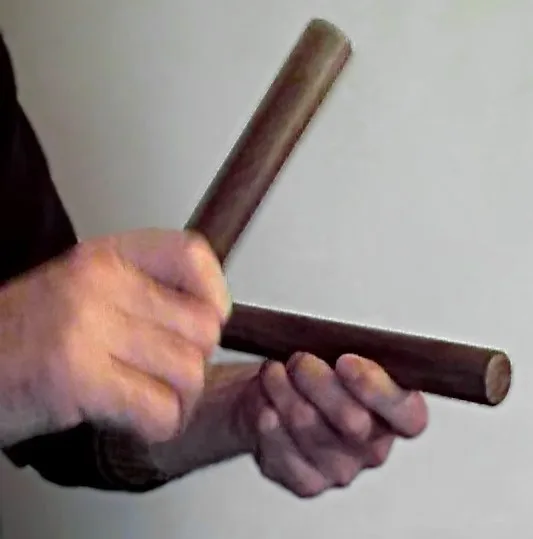
Foto: Freddythehat, dominio público, vía Wikimedia Commons
Now the bass, which is where the surprise is. In almost all the music you listen to, the bass lands on beat one: the chord changes and it is there, marking it. Not in son. The bass skips beat one. It comes in just after beat two, and again on beat four.
A note that lands where you do not expect it, off the strong beat, is a syncopation. The son bass line is made almost entirely of syncopations, and it has its own name: tumbao. That is why the song pulls forward without speeding up.
The class chart has four chords: Em – G – Am – B7, one bar each. The verse and the chorus use exactly the same loop. The only thing that changes between them is who is singing: one person, or everybody.
The bright metallic sound running over the top is not a guitar. It is a Cuban tres. It is smaller than a guitar and has six strings, but grouped in twos: three pairs. Both strings of a pair are plucked together, and in two of the three pairs one is high and one is low. That is why every note comes out double, with a brightness no ordinary guitar has.
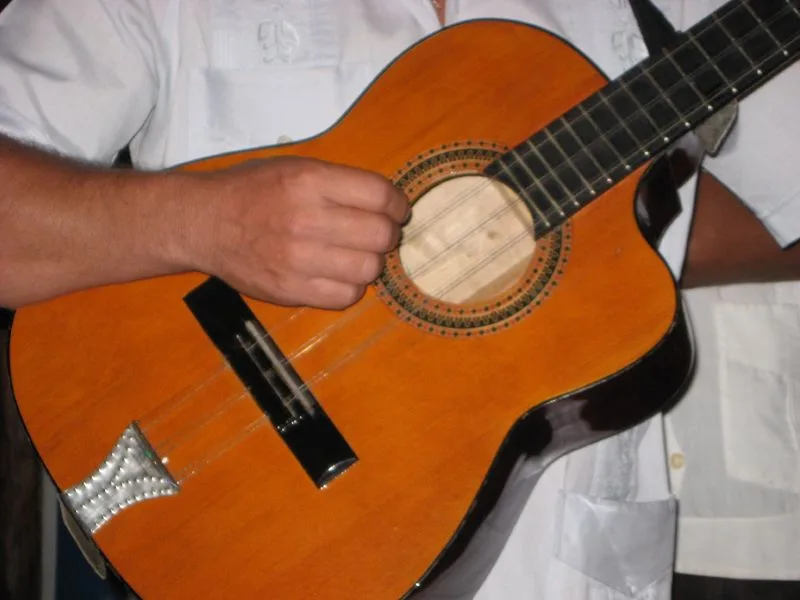
Foto: dblackadder, CC BY-SA 2.0, vía Wikimedia Commons
The form is easy to follow: intro, two verses, chorus, another verse, a solo, chorus, a bridge, verse and chorus. The chorus names four real towns, all of them in Holguín province in eastern Cuba: Alto Cedro, Marcané, Cueto and Mayarí. You can trace the journey on a map.
Hard facts: E minor, 4/4, 4:16. The class chart says 174 BPM, but that number counts the subdivision; the pulse you tap with your foot is half of it, around 87.
One warning about the key: the chart is in E minor so it can be played with what we have, but the 1997 recording sounds a tone lower, in D minor (Dm – F – Gm – A7). Play along with the video and it will not fit.
Trivia and curiosities
- The best-selling world music album in history exists because two Malian musicians did not get their visas in time. What was planned was never recorded at all.
- "Compay Segundo" is not a name, it is a job. Compay means mate or godfather, and segundo means second voice — the one that harmonises underneath the tune. On this recording the man who wrote the song does not sing the melody. He sings below it. Eliades Ochoa takes the lead.
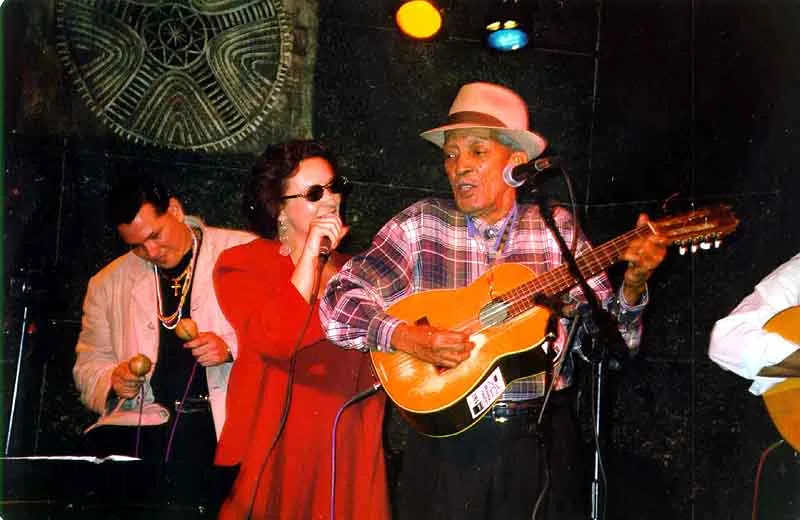
- Compay Segundo built himself an instrument, a cross between a Spanish guitar and a Cuban tres, and called it the armónico. It is what he is holding in the photo at the top of this page.
- He recorded this at 88 and spent the last years of his life touring half the world. He died in 2003, aged 95. The international career started at 89.
- Ry Cooder called Chan Chan the Buena Vista's calling card. It is the first track on the record, and it is the one that sold it.
Classroom activities
- Play: the loop Em – G – Am – B7, one bar per chord. Ukuleles and electric guitar hold the chords. The bass tries the tumbao: nothing on beat one, one note just after beat two, another on beat four. The drums keep the pulse, no fills. It will feel wrong at first, and that is exactly the point.
- Clave by hand: half the class plays, the other half claps the five strokes. Swap after two minutes. You know it is working when nobody needs to look at the person next to them.
- Analyse: a closed question. Verse and chorus use the same four chords in the same order. So how do you know the section has changed? Write it in one sentence, about what you hear, not about what this page says.
- Create: the chorus lists four towns in a row, a real journey. Make your own with four places from around here, over the same four-chord loop. This connects with ¿Cuándo empieza una melodía a decir de dónde eres?.
Key vocabulary
- Son — son cubano: el género cubano de cuerdas y percusión del que sale esta canción
- Clave — la clave: los cinco golpes en ocho tiempos que organizan el tiempo
- Syncopation — síncopa
- Tumbao — tumbao: la línea de bajo del son, que se salta el primer tiempo
- Tres — el tres cubano, la guitarra de tres pares de cuerdas
Resources
In Year 3 — this song is used in ¿Cómo se guarda algo que solo existe mientras suena? and ¿Cuándo empieza una melodía a decir de dónde eres?, from the theory and history book.
Official video — from the World Circuit label channel.
Live at Carnegie Hall, New York, 1998 — the same musicians, one year after the record.
Ukulele tutorial — Karma Guitar. Chords and the son strumming pattern, which is the hard part.
Guitar tutorial — El Salón de Guitarra, ten minutes, taken slowly.
Bass tutorial — Yousician, tab on screen and the line cut back to the basics.
Drums — Daniel Ponce. Not a tutorial for this song: it is how the son rhythm moves onto a drum kit, which is what you need here.
What a Cuban tres is — Michael McClintock plays this same song on a tres, with a close view of the instrument.
The clave, explained — Yilian, with her hands and counting out loud.
- Tab — on Songsterr, with electric bass, electric guitar, congas and maracas tracks: https://www.songsterr.com/a/wsa/buena-vista-social-club-chan-chan-tab-s446852
- Cover image — Compay Segundo con su armónico, en la sala Suristán de Madrid (1999). Foto: Sceptikón, CC BY-SA 4.0, vía Wikimedia Commons
Por dónde entrar
Si alguien dice «pon música cubana», hay muchas papeletas de que suene esta canción. Está en anuncios de viajes, en documentales y en casi todos los restaurantes que quieren sonar a La Habana.
Y son cuatro acordes. Cuatro compases, uno por acorde, y vuelta a empezar. No cambian ni una sola vez en toda la canción.
Entonces, si la armonía no se mueve, ¿qué hace que la canción avance? Esa es la pregunta que se responde aquí.
Contexto histórico
Compay Segundo se llamaba Máximo Francisco Repilado Muñoz y nació en Cuba en 1907. Escribió Chan Chan en 1984, con 76 años. Contó que no la compuso: la soñó. Se despertó con cuatro notas en la cabeza y les puso una letra sacada de un cuento que le contaban de pequeño.
La canción existió doce años antes de hacerse famosa. La grabó por primera vez en 1985. En 1989 volvió a grabarla en Santiago de Cuba con Eliades Ochoa y el Cuarteto Patria, y la tocaban en la Casa de la Trova de allí. Gustaba, pero no salía de Cuba.
Lo que la sacó fue un fallo de papeleo. En marzo de 1996, el productor británico Nick Gold y el guitarrista estadounidense Ry Cooder habían citado en La Habana a dos músicos de Malí para grabar con cubanos. A los de Malí no les llegaron los visados. Con el estudio reservado y los días pagados, cambiaron de plan: un disco de son con la gente que ya estaba allí.
Fueron a buscar a músicos mayores que llevaban años sin grabar. Compay Segundo tenía 88 años. El pianista Rubén González, 76, se había retirado después de 1987. El cantante Ibrahim Ferrer se había jubilado en 1991.
Grabaron catorce canciones en seis días, con los aparatos de los años cincuenta que seguían en los estudios EGREM. El disco salió en 1997, se llamó Buena Vista Social Club y ha vendido más de ocho millones de copias.
Cómo suena
Empieza por las manos, antes que por los nombres.
Cuenta hasta ocho, despacio y siempre al mismo paso. En esos ocho tiempos caben cinco golpes: tres en los cuatro primeros y dos en los cuatro últimos. Y los tres primeros no están repartidos a partes iguales; el de en medio llega tarde, entre el dos y el tres. Dalos con las manos hasta que salgan solos.
Eso que acabas de tocar es la clave. Es el patrón que organiza el tiempo en casi toda la música cubana. Todo lo demás —el bajo, el tres, la voz— se coloca con respecto a ella. También se llaman claves los dos palos de madera que la tocan: uno se apoya en la mano hueca y el otro golpea.
Foto: Freddythehat, dominio público, vía Wikimedia Commons
Ahora el bajo, que es donde está la sorpresa. En casi toda la música que escuchas, el bajo pisa el primer tiempo: el acorde cambia y él está ahí, marcándolo. En el son, no. El bajo se salta el uno. Entra justo después del segundo tiempo y vuelve a entrar en el cuarto.
Una nota que cae donde no la esperas, fuera del golpe fuerte, es una síncopa. La línea de bajo del son está hecha casi entera de síncopas, y tiene nombre propio: tumbao. Por eso la canción tira hacia delante sin acelerar.
Los acordes del chart de clase son cuatro: Mim – Sol – Lam – Si7, un compás cada uno. La estrofa y el estribillo llevan exactamente la misma vuelta. Lo único que cambia entre uno y otro es quién canta: uno solo, o todos.
El sonido metálico y brillante que suena por encima todo el rato no es una guitarra. Es un tres cubano. Es más pequeño que una guitarra y tiene seis cuerdas, pero agrupadas de dos en dos: tres pares. Los dos hilos de cada par se pulsan a la vez, y en dos de los tres pares uno va agudo y el otro grave. Por eso cada nota sale doble, con ese brillo que no tiene una guitarra normal.
Foto: dblackadder, CC BY-SA 2.0, vía Wikimedia Commons
La forma es fácil de seguir: introducción, dos estrofas, estribillo, otra estrofa, un solo, estribillo, un puente, estrofa y estribillo. El estribillo nombra cuatro pueblos que existen de verdad, los cuatro en la provincia de Holguín, al este de Cuba: Alto Cedro, Marcané, Cueto y Mayarí. Es un viaje que se puede seguir en un mapa.
Datos duros: Mi menor, 4/4, 4:16. El chart de clase marca 174 BPM, pero ese número cuenta la subdivisión; el pulso que das con el pie va a la mitad, sobre 87.
Una advertencia sobre la tonalidad: el chart está en Mi menor para que se pueda tocar con lo que tenemos, pero la grabación de 1997 suena un tono más abajo, en Re menor (Rem – Fa – Solm – La7). Si tocas con el vídeo delante, no va a cuadrar.
Curiosidades
- La canción es doce años más vieja que el disco que la hizo famosa: 1984 contra 1997. Estar terminada y ser conocida no son la misma fecha, y a veces se llevan una década.
- El disco de músicas del mundo más vendido de la historia existe porque dos músicos de Malí no consiguieron el visado a tiempo. Lo que estaba planeado no llegó a grabarse nunca.
- «Compay Segundo» no es un nombre: es un puesto de trabajo. Compay es compadre, y segundo es la segunda voz, la que hace la armonía por debajo de la melodía. En esta grabación, el hombre que compuso la canción no canta la melodía: canta debajo. La lleva Eliades Ochoa.
- Compay Segundo se fabricó un instrumento propio, cruce de guitarra española y tres cubano, y lo llamó armónico. Es lo que lleva en la foto de arriba. Cuando un instrumento no te da lo que quieres, cabe la opción de construir otro.
- Grabó esto con 88 años y se pasó los últimos años de su vida de gira por medio mundo. Murió en 2003, con 95.
Para hacer en clase
- Tocar: el ciclo Mim – Sol – Lam – Si7, un compás por acorde, en bucle. Los ukeleles y la guitarra eléctrica sostienen los acordes. El bajo prueba el tumbao: nada en el uno, un golpe justo después del dos y otro en el cuatro. La batería marca el pulso, sin adornos. Al principio va a sonar descolocado, y es exactamente lo que tiene que pasar.
- La clave con las manos: media clase toca y la otra media da los cinco golpes. A los dos minutos se cambia. La señal de que va bien es que ya nadie necesita mirar al de al lado.
- Analizar: pregunta cerrada. La estrofa y el estribillo llevan los mismos cuatro acordes en el mismo orden. Entonces, ¿en qué notas que ha cambiado de sección? Escríbelo en una frase, y que la frase hable de lo que oyes, no de lo que pone aquí.
- Crear: el estribillo nombra cuatro pueblos seguidos, que son un viaje real. Haz el tuyo con cuatro sitios de aquí, encima del mismo ciclo de cuatro acordes. Esto conecta con ¿Cuándo empieza una melodía a decir de dónde eres?.
Vocabulario fundamental
- Son — El género cubano del que sale esta canción: cuerdas y percusión, y un ciclo corto de acordes que da vueltas.
- Clave — Los cinco golpes repartidos en ocho tiempos que organizan el tiempo. Todo lo demás se coloca con respecto a ella. También es el nombre de los dos palos que la tocan.
- Síncopa — Una nota que cae donde no la esperas, fuera del golpe fuerte.
- Tumbao — La línea de bajo del son. Se salta el primer tiempo y entra a destiempo.
- Tres — La guitarra cubana de tres pares de cuerdas. Es ese sonido metálico y doble que se reconoce enseguida.
Recursos
En 3º de ESO — esta canción sirve para ¿Cómo se guarda algo que solo existe mientras suena? y para ¿Cuándo empieza una melodía a decir de dónde eres?, del libro de teoría e historia.
Videoclip oficial — canal del sello World Circuit.
En directo en el Carnegie Hall de Nueva York, 1998 — los mismos músicos, un año después del disco.
Tutorial de ukelele — Karma Guitar. Va a los acordes y al rasgueo de son, que es lo que cuesta.
Tutorial de guitarra — El Salón de Guitarra, diez minutos, despacio.
Tutorial de bajo — Yousician, con la tablatura en pantalla y la línea reducida a lo básico.
Batería — Daniel Ponce. No es un tutorial de esta canción: es cómo se pasa el ritmo de son a una batería, que es lo que necesitas aquí.
Qué es el tres cubano — Michael McClintock toca esta misma canción en un tres y se ve el instrumento de cerca.
La clave, explicada — Yilian, con las manos y contando en voz alta.
- Tablatura — en Songsterr, con pistas de bajo eléctrico, guitarra eléctrica, congas y maracas: https://www.songsterr.com/a/wsa/buena-vista-social-club-chan-chan-tab-s446852
- Imagen de portada — Compay Segundo con su armónico, en la sala Suristán de Madrid (1999). Foto: Sceptikón, CC BY-SA 4.0, vía Wikimedia Commons
Why this song
Listen to the first twenty seconds and you already know what comes next. Four chords, one bar each, then back to the start. They do not change once in the whole song.
That makes it one of the easiest songs in the world to join in with, and one of the hardest to play well. Anyone can hold the chords. Getting the rhythm right is a different job.
So if the harmony never moves, what makes the song go forward? That is the question this page answers.
Historical context
Compay Segundo's real name was Máximo Francisco Repilado Muñoz, born in Cuba in 1907. He wrote Chan Chan in 1984, aged 76. He said he did not compose it: he dreamt it. He woke up with four notes in his head and gave them words taken from a story he was told as a child.
The song existed for twelve years before it became famous. He first recorded it in 1985. In 1989 he recorded it again in Santiago de Cuba with Eliades Ochoa and the Cuarteto Patria, and they played it at the Casa de la Trova there. People liked it. It did not leave Cuba.
What got it out was a paperwork failure. In March 1996, the British producer Nick Gold and the American guitarist Ry Cooder had arranged for two musicians from Mali to record in Havana with Cuban players. The visas for the Malians never arrived. With the studio booked and the days paid for, they changed the plan: a son record with whoever was already there.
They went looking for older musicians who had not recorded in years. Compay Segundo was 88. The pianist Rubén González, 76, had retired after 1987. The singer Ibrahim Ferrer had retired in 1991.
They recorded fourteen songs in six days, on the 1950s equipment still standing in the EGREM studios. The record came out in 1997, was called Buena Vista Social Club, and has sold over eight million copies.
Musical characteristics
Start with your hands, not with the words.
Count to eight, slowly and always at the same speed. Five strokes fit inside those eight beats: three in the first four, two in the last four. And the first three are not evenly spaced — the middle one arrives late, between two and three. Clap it until it comes out on its own.
What you have just played is the clave. It is the pattern that organises time in almost all Cuban music. Everything else — bass, tres, voice — is placed in relation to it. The two wooden sticks that play it are also called claves: one rests in a cupped hand, the other strikes.
Foto: Freddythehat, dominio público, vía Wikimedia Commons
Now the bass, which is where the surprise is. In almost all the music you listen to, the bass lands on beat one: the chord changes and it is there, marking it. Not in son. The bass skips beat one. It comes in just after beat two, and again on beat four.
A note that lands where you do not expect it, off the strong beat, is a syncopation. The son bass line is made almost entirely of syncopations, and it has its own name: tumbao. That is why the song pulls forward without speeding up.
The class chart has four chords: Em – G – Am – B7, one bar each. The verse and the chorus use exactly the same loop. The only thing that changes between them is who is singing: one person, or everybody.
The bright metallic sound running over the top is not a guitar. It is a Cuban tres. It is smaller than a guitar and has six strings, but grouped in twos: three pairs. Both strings of a pair are plucked together, and in two of the three pairs one is high and one is low. That is why every note comes out double, with a brightness no ordinary guitar has.
Foto: dblackadder, CC BY-SA 2.0, vía Wikimedia Commons
The form is easy to follow: intro, two verses, chorus, another verse, a solo, chorus, a bridge, verse and chorus. The chorus names four real towns, all of them in Holguín province in eastern Cuba: Alto Cedro, Marcané, Cueto and Mayarí. You can trace the journey on a map.
Hard facts: E minor, 4/4, 4:16. The class chart says 174 BPM, but that number counts the subdivision; the pulse you tap with your foot is half of it, around 87.
One warning about the key: the chart is in E minor so it can be played with what we have, but the 1997 recording sounds a tone lower, in D minor (Dm – F – Gm – A7). Play along with the video and it will not fit.
Trivia and curiosities
- The best-selling world music album in history exists because two Malian musicians did not get their visas in time. What was planned was never recorded at all.
- "Compay Segundo" is not a name, it is a job. Compay means mate or godfather, and segundo means second voice — the one that harmonises underneath the tune. On this recording the man who wrote the song does not sing the melody. He sings below it. Eliades Ochoa takes the lead.
- Compay Segundo built himself an instrument, a cross between a Spanish guitar and a Cuban tres, and called it the armónico. It is what he is holding in the photo at the top of this page.
- He recorded this at 88 and spent the last years of his life touring half the world. He died in 2003, aged 95. The international career started at 89.
- Ry Cooder called Chan Chan the Buena Vista's calling card. It is the first track on the record, and it is the one that sold it.
Classroom activities
- Play: the loop Em – G – Am – B7, one bar per chord. Ukuleles and electric guitar hold the chords. The bass tries the tumbao: nothing on beat one, one note just after beat two, another on beat four. The drums keep the pulse, no fills. It will feel wrong at first, and that is exactly the point.
- Clave by hand: half the class plays, the other half claps the five strokes. Swap after two minutes. You know it is working when nobody needs to look at the person next to them.
- Analyse: a closed question. Verse and chorus use the same four chords in the same order. So how do you know the section has changed? Write it in one sentence, about what you hear, not about what this page says.
- Create: the chorus lists four towns in a row, a real journey. Make your own with four places from around here, over the same four-chord loop. This connects with ¿Cuándo empieza una melodía a decir de dónde eres?.
Key vocabulary
- Son — son cubano: el género cubano de cuerdas y percusión del que sale esta canción
- Clave — la clave: los cinco golpes en ocho tiempos que organizan el tiempo
- Syncopation — síncopa
- Tumbao — tumbao: la línea de bajo del son, que se salta el primer tiempo
- Tres — el tres cubano, la guitarra de tres pares de cuerdas
Resources
In Year 3 — this song is used in ¿Cómo se guarda algo que solo existe mientras suena? and ¿Cuándo empieza una melodía a decir de dónde eres?, from the theory and history book.
Official video — from the World Circuit label channel.
Live at Carnegie Hall, New York, 1998 — the same musicians, one year after the record.
Ukulele tutorial — Karma Guitar. Chords and the son strumming pattern, which is the hard part.
Guitar tutorial — El Salón de Guitarra, ten minutes, taken slowly.
Bass tutorial — Yousician, tab on screen and the line cut back to the basics.
Drums — Daniel Ponce. Not a tutorial for this song: it is how the son rhythm moves onto a drum kit, which is what you need here.
What a Cuban tres is — Michael McClintock plays this same song on a tres, with a close view of the instrument.
The clave, explained — Yilian, with her hands and counting out loud.
- Tab — on Songsterr, with electric bass, electric guitar, congas and maracas tracks: https://www.songsterr.com/a/wsa/buena-vista-social-club-chan-chan-tab-s446852
- Cover image — Compay Segundo con su armónico, en la sala Suristán de Madrid (1999). Foto: Sceptikón, CC BY-SA 4.0, vía Wikimedia Commons