Contenidos
¿Quién pagaba por oír una historia cantada?
Around 1600 somebody decided that a whole story could be sung from beginning to end. This unit is about what had to be invented to make that intelligible, and about who paid for it.
We ask ourselves
- If a story is sung all the way through, how do you know who is speaking?
- What exactly does the person who "accompanies" play?
- Why do some pages of old music have numbers written under the notes?
- Who paid forty musicians for a single evening?
- Can you play something well when nobody has written down what you should play?
- If two people read the same page and it comes out different, is one of them wrong?
Don't answer yet. We come back to these at the end.
The fragment
Before any recording, the class builds the accompaniment. Four low notes and nothing else: A, G, F, E. One note every four beats, very slowly, round and round.
First everyone plays it in unison, two full turns. Bass only. It sounds empty, and it is supposed to sound empty.
Then three or four people on guitar or keyboard put chords on top: A minor, G, F, E. The bass has not moved a single note, and already it sounds like a song.
Now the trick. Write a 6 under the F. That six means: over this note, play a D minor chord with the F at the bottom. Write another 6 under the G, and there you play E minor with the G at the bottom.
Same four low notes. Two new digits. A different accompaniment. And nobody wrote the right hand: whoever is playing decides that.
Claudio Monteverdi, dominio público, vía Wikimedia Commons
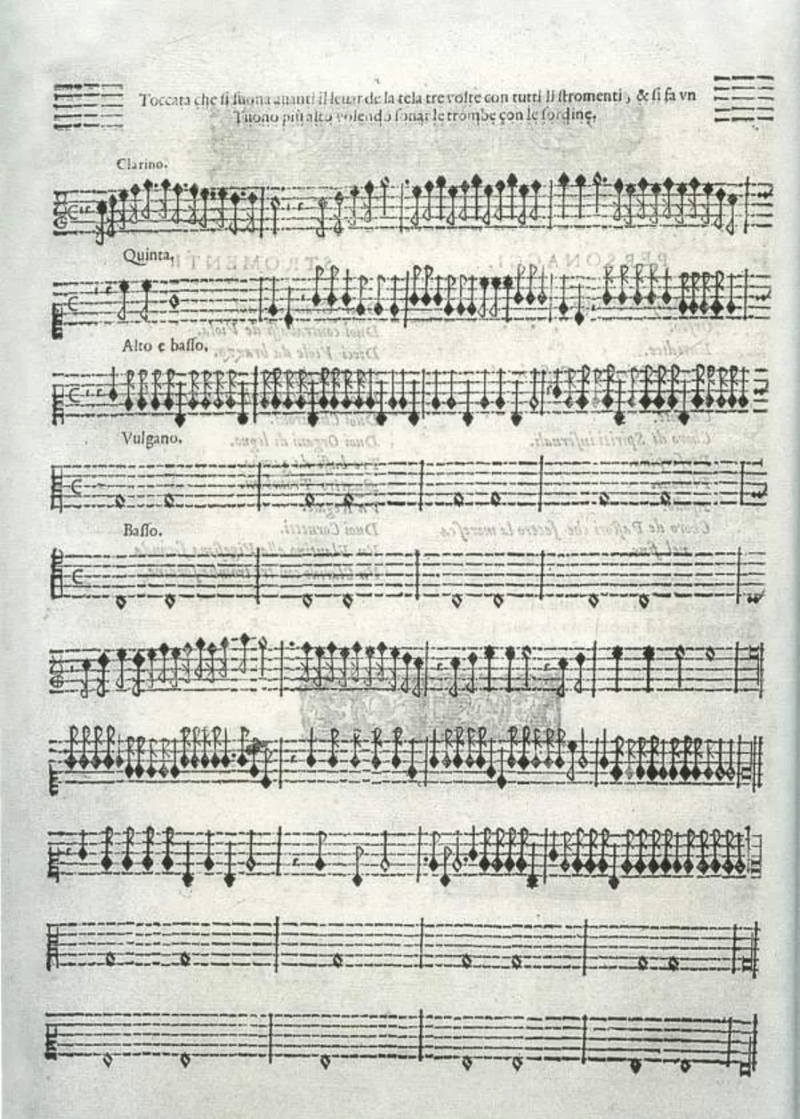
Now play the Toccata from L'Orfeo, all of it, with nobody talking over it. It is the first thing the room heard on that night in 1607, and it does exactly what you have just done: a bass that hardly moves, with all the motion above it.
What changed
For the whole previous century, serious European music meant several voices singing different lines at once. It sounds good and it is hard to write, but it has a problem with no fix: you cannot make out the words. Four voices saying four things means no story.
Around 1600 a group of Italian musicians found the answer, and it is almost suspiciously simple. One voice on top, delivering the text as clearly as speech. Underneath, two or three instruments holding the harmony so that voice is not left bare.
A voice that speaks while singing, following the rhythm of the sentence instead of the rhythm of the bar, is called recitative. It is what makes a sung story possible: when someone recites you know they are talking, and when they break into real singing you know they are feeling something.
What gets written underneath is the genuinely strange part. The composer does not write the accompaniment: only the bass line, with numbers above it. The numbers say which chords to play. Everything else — how to space them, when to spread them, how much to decorate — is decided by the player, that night. That is basso continuo.
It is a division of labour, not a way of saving ink. The composer fixes the harmony and leaves the texture open. That is why the whole period is known as the age of the continuo, and why two recordings of one piece can sound so different without either being wrong.
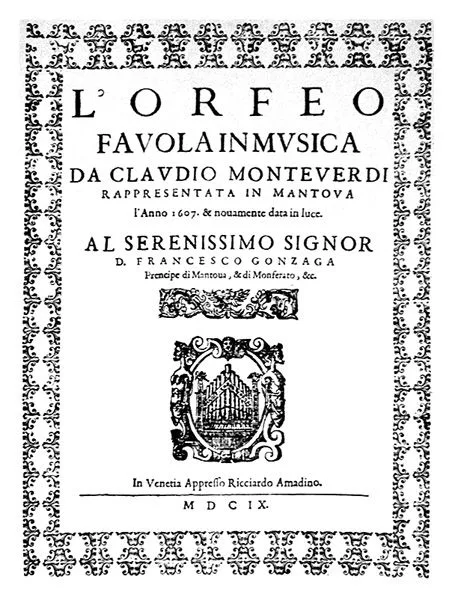
Something else is born here too: a large, organised group of instruments. The score of L'Orfeo printed in Venice in 1609 includes the list, and it is the first time a composer put in writing who is supposed to play.
Claudio Monteverdi, edición de Ricciardo Amadino, Venecia 1609, dominio público, vía Wikimedia Commons
Count the chord instruments on that list: two harpsichords, two wooden organs, a double harp, two chitarroni and a regal. Eight instruments whose only job is to put chords over the bass. Thirty-odd players, and eight of them there to hold it up.
That leaves the money question, which is the one that really changes the music. In 1607 opera is a court festivity: the Duke of Mantua pays for it as carnival entertainment and you see it if you are invited. There are no tickets because there is no public.
Thirty years later, in 1637, the Teatro San Cassiano opens in Venice. It is the first opera house to sell tickets. Until then commercial theatres put on spoken comedies only, and opera stayed private, for courts and aristocrats.
You can hear that change. Once the payer is a stranger who bought a seat, tunes get catchier, singers become famous, and whoever writes the music has to compete with the theatre down the canal. Opera stops being a gift and becomes a business.
Hard facts: L'Orfeo, Mantua, 24 February 1607, for the Gonzaga court, score printed in Venice in 1609. Teatro San Cassiano, Venice, 1637, the first ticket-selling opera house. Ospedale della Pietà, Venice: an orphanage for abandoned girls with a music school, where Vivaldi taught violin and singing from 1703 to 1715 and from 1723 to 1740. His concertos were premiered by the residents.
The same device elsewhere
A bass that holds things up while the player chooses the chords is not a museum curiosity. These three do the same job, and they are worth hearing back to back.
- With or Without You, U2 (1987) — four chords, D, A, B minor and G, repeating from first bar to last without a single detour, over a bass figure that never changes either. Its article in the library calls that an ostinato. The band is not reading a score: it is reading four chords.
- La folía — a chord scheme of Iberian origin, old enough that the playwright Gil Vicente mentions it in 1503 as a shepherds' dance. From the late seventeenth century onwards, musicians all over Europe wrote hundreds of sets of variations on it. It is a chord chart that had already been circulating for two hundred years.
- The tanpura in Indian classical music — four strings sounding the same note without stopping, while everything above is improvised. It is the limit case: a bass with no chords at all. Use it to measure precisely what the European continuo added.
None of them is better than the others. All three solve the same problem: put something steady underneath so the thing on top is free to move.
And here at home?
There was basso continuo here, and one of its manuals was printed in Zaragoza.
Gaspar Sanz was born in Calanda (Teruel); his baptism record is dated 4 April 1640. He spent a long stretch in Rome and Naples, close to the world of Venetian opera, and came back with the method learned.
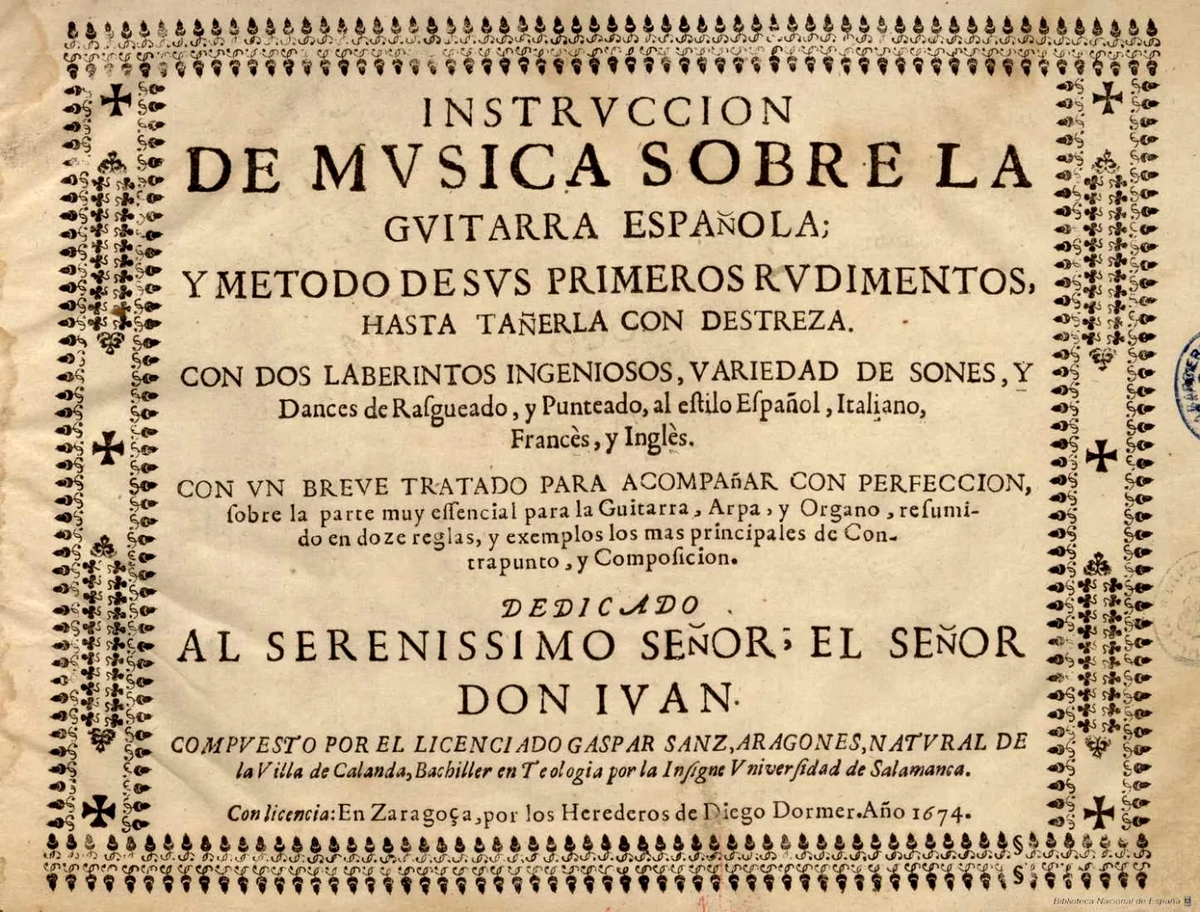
In 1674 he published in Zaragoza, at the press of the Herederos de Diego Dormer, the Instrucción de música sobre la guitarra española. Look at the cover image above and read the small print: it promises "a brief treatise on accompanying with perfection… summed up in twelve rules".
Twelve rules for accompanying, for guitar, harp and organ. That is a continuo manual, written in Spanish and published in Zaragoza, twelve years before Bach was born.
Gaspar Sanz, 1674, Biblioteca Nacional de España, dominio público, vía Wikimedia Commons
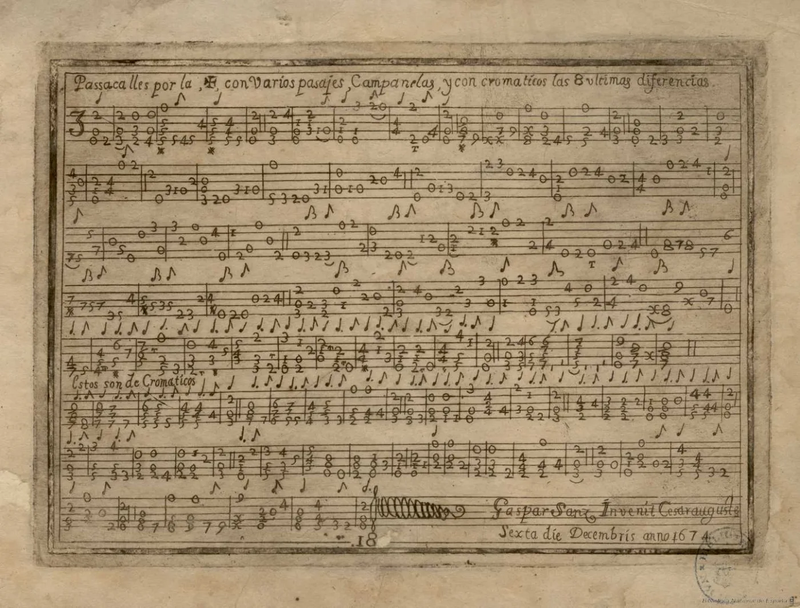
Look at the bottom corner of that plate: "Gaspar Sanz Invenit Cesarauguste. Sexta die Decembris anno 1674". Cesaraugusta is Zaragoza. It is dated 6 December 1674.
Seventy kilometres to the south-west, in Daroca, the organist of the collegiate church of Santa María de los Corporales was Pablo Bruna (1611–1679), blind since the age of five or six. He had been playing there since he was sixteen, officially appointed in 1631, and he kept the post until his death on 26 June 1679.
Here the money question gets a different answer from Venice. Daroca was a pilgrimage town, with people passing through all year. The organist did not sell tickets: he was part of what you came to see. Philip IV and Charles II would stop in Daroca to hear him play.
And not everyone wanted the capital. In 1639 the chapter of El Pilar in Zaragoza offered him the organist's post and Bruna turned it down. He stayed in Daroca his whole life.
What about opera sung in Spanish? It arrived late, and for reasons of state. With the Peace of the Pyrenees and the marriage of the infanta María Teresa to Louis XIV, the Spanish crown wanted to match what the French court was doing, and commissioned two fully sung works from Calderón de la Barca and the composer Juan Hidalgo.
They were La púrpura de la rosa (1659) and Celos aun del aire matan, first performed on 5 December 1660 at the Coliseo del Buen Retiro. The second is the oldest surviving opera of the Spanish-speaking world.
The same circle produced the zarzuela. The name is not a genre's: it is a place's, the Palacio de la Zarzuela near Madrid, where these works were staged. Calderón was the first to call a work of his a zarzuela, El golfo de las sirenas, staged in 1657.
The awkward fact is the one worth saying. Venice had been selling opera tickets since 1637; here, twenty years later, sung drama was still a matter of palaces and churches. The technique arrived fast and the paying audience took a century.
Classroom activities
- While the Toccata from L'Orfeo plays: raise a hand every time you hear the lowest note change. We count the hands afterwards. There will be very few, and that is the answer.
- While Corelli's La folía plays: one sharp tap on the desk each time the bass comes back round to the start. We count how many turns go by before someone loses it.
- While the tanpura plays: write down how many different notes you heard underneath. We compare answers and argue about why they don't match.
- Play: we build With or Without You. Half the class on the four bass notes only, everyone else on the chords above. The chart and the tab are in its own article.
- Create: each group writes a four-note bass line and two different figurings for it. Two groups play the same bass with the figurings swapped and the class picks a favourite. There is no right answer, and that is the point.
Key vocabulary
- Chord — acorde: tres o más notas que suenan a la vez apoyadas en una nota del bajo
- Recitative — recitativo: canto que sigue el ritmo del habla, no el del compás
- Basso continuo — bajo continuo: línea de bajo con cifras que indican los acordes de encima
- Figured bass / chord chart — cifrado: nombrar un acorde sin escribir sus notas
- Ostinato — ostinato: figura de bajo que se repite sin cambiar debajo de todo
Resources
The songs in this unit are in the library, each with its own article and chart: With or Without You, La flaca, Levitating.
Where it all starts — Monteverdi's L'Orfeo, trailer of the Teatro Real production.
What basso continuo is, played and explained — the Netherlands Bach Society takes it apart with the instruments in front of you.
The same bass, turn after turn — Corelli's La folía in Geminiani's arrangement, by Voices of Music on original instruments.
The orphanage orchestra — Vivaldi's Spring, by Voices of Music. Music written to be premiered by the residents of the Pietà.
Here, in 1674 — Gaspar Sanz's Canarios, played by Miguel Rincón on baroque guitar.
Here, in Daroca — a tiento by Pablo Bruna, played by Ángel Montero on the organ.
The bass with no chords — a tanpura demonstration from the Metropolitan Museum of Art.
- Sanz's title page in high resolution — the National Library scan on Wikimedia Commons.
- The instrument list from L'Orfeo — the plate from the 1609 edition, on Wikimedia Commons.


Nos preguntamos
- Si una historia se canta entera, ¿cómo sabes quién está hablando?
- ¿Qué toca exactamente el que «acompaña»?
- ¿Por qué en algunos papeles de música antigua hay números debajo de las notas?
- ¿Quién pagaba a cuarenta músicos para una sola noche?
- ¿Puedes tocar algo bien sin que nadie te haya escrito lo que tienes que tocar?
- Si dos personas leen el mismo papel y sale distinto, ¿está una de las dos equivocada?
No las respondas todavía. Al final de la unidad volvemos a ellas.
El fragmento
Antes de poner ninguna grabación, la clase construye el acompañamiento. Cuatro notas graves y nada más: la, sol, fa, mi. Una nota cada cuatro tiempos, muy despacio, dando la vuelta sin parar.
Primero la tocan todos, al unísono, dos vueltas enteras. Solo el bajo. Suena vacío, y tiene que sonar vacío.
En la segunda parte, tres o cuatro personas con guitarra o teclado ponen acordes encima: la menor, sol, fa, mi. El bajo no ha cambiado ni una nota, y ya suena a canción.
Ahora el truco. Escribimos un 6 debajo del fa. Ese seis significa: sobre esa nota va el acorde de re menor, con el fa abajo. Y otro 6 debajo del sol: ahí va mi menor, con el sol abajo.
Mismas cuatro notas graves. Dos cifras nuevas. Y el acompañamiento es otro. Nadie ha escrito la melodía de la mano derecha: eso lo decide quien toca.
Claudio Monteverdi, dominio público, vía Wikimedia Commons
Ahora sí, la Toccata de L'Orfeo entera y sin comentarios por encima. Es lo primero que se oyó en la sala aquella noche de 1607, y hace exactamente lo que acabáis de hacer: un bajo casi quieto y todo el movimiento encima.
Qué cambió
Durante el siglo anterior, la música seria de Europa consistía en varias voces cantando líneas distintas a la vez. Suena bien y es difícil de hacer, pero tiene un problema que no se arregla: no se entiende el texto. Con cuatro voces diciendo cuatro cosas, no hay historia posible.
Hacia 1600 un grupo de músicos italianos da con la solución, y es de una sencillez casi tramposa. Una sola voz arriba, que dice el texto con la claridad de quien habla. Y debajo, dos o tres instrumentos sosteniendo la armonía para que esa voz no se quede sola.
Esa voz que habla cantando, siguiendo el ritmo de la frase en vez del de un compás, se llama recitativo. Es el invento que hace posible una historia cantada: cuando alguien recita, sabes que está hablando, y cuando se pone a cantar de verdad, sabes que está sintiendo algo.
Lo que se escribe debajo es lo verdaderamente raro. El compositor no escribe el acompañamiento: escribe solo la línea del bajo, y encima de esa línea pone números. Los números dicen qué acordes tocar. El resto —cómo repartirlos, cuándo arpegiarlos, cuánto adornar— lo decide el intérprete esa noche. Eso es el bajo continuo.
Es un reparto de trabajo, no una economía de tinta. El compositor fija la armonía y deja la textura abierta. Por eso el periodo entero se conoce como la era del bajo continuo, y por eso dos grabaciones de la misma obra pueden sonar tan distintas sin que ninguna esté mal.
Y con esto nace algo más: un grupo grande y organizado de instrumentos. La partitura de L'Orfeo que se imprimió en Venecia en 1609 trae la lista, y es la primera vez que un compositor deja por escrito quién tiene que tocar.
Claudio Monteverdi, edición de Ricciardo Amadino, Venecia 1609, dominio público, vía Wikimedia Commons
Cuenta los instrumentos de acordes de esa lista: dos claves, dos órganos de madera, un arpa doble, dos chitarrones y un regal. Ocho instrumentos cuyo único trabajo es poner acordes sobre el bajo. Una treintena larga de músicos, y ocho de ellos dedicados a sostener.
Queda la pregunta del dinero, que es la que de verdad cambia la música. En 1607 la ópera es una fiesta de corte: la paga el duque de Mantua para sus carnavales y la ve quien está invitado. No hay entradas porque no hay público.
Treinta años después, en 1637, abre en Venecia el Teatro San Cassiano. Es el primer teatro de ópera que vende entradas. Hasta entonces los teatros comerciales solo daban comedias habladas, y la ópera era cosa privada de cortes y aristócratas.
Ese cambio se oye. Cuando el que paga es un desconocido que ha comprado su butaca, las melodías se vuelven más pegadizas, los cantantes se vuelven famosos y el que escribe tiene que competir con el teatro de al lado. La ópera deja de ser un regalo y pasa a ser un negocio.
Datos duros: L'Orfeo, Mantua, 24 de febrero de 1607, para la corte de los Gonzaga, partitura impresa en Venecia en 1609. Teatro San Cassiano, Venecia, 1637, primer teatro de ópera de pago. Ospedale della Pietà, Venecia: un orfanato de niñas abandonadas con escuela de música, donde Vivaldi fue profesor de violín y canto de 1703 a 1715 y de 1723 a 1740. Sus conciertos los estrenaban las internas.
El mismo recurso en otros sitios
Un bajo que sostiene y unos acordes que el intérprete decide no es una rareza de museo. Estos tres casos lo hacen igual, y conviene oírlos seguidos.
- With or Without You, U2 (1987) — cuatro acordes, re, la, si menor y sol, que se repiten de principio a fin sin una sola desviación, sobre una figura de bajo que tampoco cambia. Su artículo en la biblioteca llama a eso ostinato. La banda no lee una partitura: lee cuatro acordes.
- La folía — un esquema de acordes de origen ibérico, tan viejo que Gil Vicente ya lo cita en 1503 como danza de pastores. Desde finales del siglo XVII, músicos de toda Europa le escribieron cientos de juegos de variaciones. Es un chart de acordes que llevaba doscientos años circulando.
- La tanpura de la música clásica de la India — cuatro cuerdas que suenan sin parar la misma nota mientras encima se improvisa todo. Es el caso límite: un bajo sin acordes. Sirve para medir exactamente qué añadió el continuo europeo.
Ninguno es mejor que otro. Los tres resuelven lo mismo: poner algo estable debajo para que lo de arriba pueda moverse.
Y aquí, ¿qué?
Aquí hubo bajo continuo, y uno de sus manuales se imprimió en Zaragoza.
Gaspar Sanz nació en Calanda (Teruel); su partida de bautismo es del 4 de abril de 1640. Pasó una temporada larga en Roma y en Nápoles, donde estuvo cerca del mundo de la ópera veneciana, y volvió con el procedimiento aprendido.
En 1674 publicó en Zaragoza, en la imprenta de los Herederos de Diego Dormer, la Instrucción de música sobre la guitarra española. Mira la portada de arriba y lee la letra pequeña: promete «un breve tratado para acompañar con perfección… resumido en doze reglas».
Doce reglas para acompañar, para guitarra, arpa y órgano. Eso es un manual de bajo continuo, escrito en castellano y publicado en Zaragoza, doce años antes de que naciera Bach.
Gaspar Sanz, 1674, Biblioteca Nacional de España, dominio público, vía Wikimedia Commons
Fíjate en la esquina de abajo de esa lámina: «Gaspar Sanz Invenit Cesarauguste. Sexta die Decembris anno 1674». Cesaraugusta es Zaragoza. Está fechado el 6 de diciembre de 1674.
Setenta kilómetros al suroeste, en Daroca, el organista de la colegiata de Santa María de los Corporales era Pablo Bruna (1611–1679), ciego desde los cinco o seis años. Tocaba allí desde los dieciséis, con nombramiento oficial desde 1631, y siguió hasta su muerte el 26 de junio de 1679.
Aquí la pregunta del dinero se responde distinto que en Venecia. Daroca era un centro de peregrinación, y por sus calles pasaba gente todo el año. El organista no vendía entradas: era parte de lo que uno iba a ver. Felipe IV y Carlos II paraban en Daroca para oírle tocar.
Y no todo el mundo quería irse a la capital. En 1639 el cabildo de El Pilar de Zaragoza le ofreció el puesto de organista y Bruna dijo que no. Se quedó en Daroca toda su vida.
¿Y la ópera cantada en castellano? Llegó tarde, y por razones de Estado. Con la Paz de los Pirineos y la boda de la infanta María Teresa con Luis XIV, la corona española quiso igualar lo que se hacía en la corte francesa y encargó dos obras cantadas de principio a fin a Calderón de la Barca y al compositor Juan Hidalgo.
Fueron La púrpura de la rosa (1659) y Celos aun del aire matan, estrenada el 5 de diciembre de 1660 en el Coliseo del Buen Retiro. La segunda es la ópera más antigua del mundo hispano que se conserva.
Del mismo grupo de gente sale la zarzuela. El nombre no es de un género: es de un sitio, el Palacio de la Zarzuela, cerca de Madrid, donde se representaban. Calderón fue el primero que llamó «zarzuela» a una obra suya, El golfo de las sirenas, estrenada en 1657.
El dato incómodo es el que merece decirse. En Venecia se vendían entradas para la ópera desde 1637; aquí, veinte años después, la música cantada seguía siendo cosa de palacio y de iglesia. La técnica llegó rápido y el público de pago tardó un siglo.
Para hacer en clase
- Mientras suena la Toccata de L'Orfeo: levanta la mano cada vez que oigas cambiar la nota más grave. Al final contamos las manos. Van a ser muy pocas, y esa es la respuesta.
- Mientras suena La folía de Corelli: un golpe seco en la mesa cada vez que el bajo vuelve al principio de la vuelta. Contamos cuántas vueltas han pasado antes de que alguien se pierda.
- Mientras suena la tanpura: apunta en el cuaderno cuántas notas distintas has oído debajo. Comparamos las respuestas y discutimos por qué no coinciden.
- Tocar: montamos With or Without You. Media clase solo con las cuatro notas del bajo y el resto con los acordes encima. El chart y la tablatura están en su artículo.
- Crear: cada grupo escribe una línea de bajo de cuatro notas y dos cifrados distintos para ella. Dos grupos tocan el mismo bajo con cifrados cambiados y la clase decide cuál prefiere. No hay respuesta correcta: ese es el asunto.
Vocabulario fundamental
- Acorde — Tres o más notas que suenan a la vez y que se apoyan sobre una nota del bajo.
- Recitativo — Canto que sigue el ritmo del habla en vez del ritmo del compás. Sirve para que se entienda lo que pasa en la historia.
- Bajo continuo — Una línea de bajo con cifras debajo. Las cifras dicen qué acordes van encima; cómo tocarlos lo decide el intérprete.
- Cifrado — El sistema que nombra un acorde sin escribir sus notas. Un número en el Barroco, una letra en un chart de hoy: la misma idea.
- Ostinato — Una figura de bajo que se repite sin cambiar por debajo de todo lo demás.
Recursos
Las canciones de esta unidad están en la biblioteca, cada una con su artículo y su chart: With or Without You, La flaca, Levitating.
Por dónde empieza todo — L'Orfeo de Monteverdi, tráiler de la producción del Teatro Real.
Qué es el bajo continuo, tocado y explicado — la Netherlands Bach Society lo desmonta con los instrumentos delante.
El mismo bajo, vuelta tras vuelta — La folía de Corelli en el arreglo de Geminiani, por Voices of Music con instrumentos originales.
La orquesta del orfanato — La primavera de Vivaldi, por Voices of Music. Música escrita para que la estrenaran las internas de la Pietà.
Aquí, en 1674 — Canarios de Gaspar Sanz, por Miguel Rincón a la guitarra barroca.
Aquí, en Daroca — un tiento de Pablo Bruna, por Ángel Montero al órgano.
El bajo sin acordes — demostración de tanpura del Metropolitan Museum of Art.
- La portada de Sanz, en alta resolución — ficha del escaneo de la Biblioteca Nacional en Wikimedia Commons.
- La lista de instrumentos de L'Orfeo — la lámina de la edición de 1609, en Wikimedia Commons.
We ask ourselves
- If a story is sung all the way through, how do you know who is speaking?
- What exactly does the person who "accompanies" play?
- Why do some pages of old music have numbers written under the notes?
- Who paid forty musicians for a single evening?
- Can you play something well when nobody has written down what you should play?
- If two people read the same page and it comes out different, is one of them wrong?
Don't answer yet. We come back to these at the end.
The fragment
Before any recording, the class builds the accompaniment. Four low notes and nothing else: A, G, F, E. One note every four beats, very slowly, round and round.
First everyone plays it in unison, two full turns. Bass only. It sounds empty, and it is supposed to sound empty.
Then three or four people on guitar or keyboard put chords on top: A minor, G, F, E. The bass has not moved a single note, and already it sounds like a song.
Now the trick. Write a 6 under the F. That six means: over this note, play a D minor chord with the F at the bottom. Write another 6 under the G, and there you play E minor with the G at the bottom.
Same four low notes. Two new digits. A different accompaniment. And nobody wrote the right hand: whoever is playing decides that.
Claudio Monteverdi, dominio público, vía Wikimedia Commons
Now play the Toccata from L'Orfeo, all of it, with nobody talking over it. It is the first thing the room heard on that night in 1607, and it does exactly what you have just done: a bass that hardly moves, with all the motion above it.
What changed
For the whole previous century, serious European music meant several voices singing different lines at once. It sounds good and it is hard to write, but it has a problem with no fix: you cannot make out the words. Four voices saying four things means no story.
Around 1600 a group of Italian musicians found the answer, and it is almost suspiciously simple. One voice on top, delivering the text as clearly as speech. Underneath, two or three instruments holding the harmony so that voice is not left bare.
A voice that speaks while singing, following the rhythm of the sentence instead of the rhythm of the bar, is called recitative. It is what makes a sung story possible: when someone recites you know they are talking, and when they break into real singing you know they are feeling something.
What gets written underneath is the genuinely strange part. The composer does not write the accompaniment: only the bass line, with numbers above it. The numbers say which chords to play. Everything else — how to space them, when to spread them, how much to decorate — is decided by the player, that night. That is basso continuo.
It is a division of labour, not a way of saving ink. The composer fixes the harmony and leaves the texture open. That is why the whole period is known as the age of the continuo, and why two recordings of one piece can sound so different without either being wrong.
Something else is born here too: a large, organised group of instruments. The score of L'Orfeo printed in Venice in 1609 includes the list, and it is the first time a composer put in writing who is supposed to play.
Claudio Monteverdi, edición de Ricciardo Amadino, Venecia 1609, dominio público, vía Wikimedia Commons
Count the chord instruments on that list: two harpsichords, two wooden organs, a double harp, two chitarroni and a regal. Eight instruments whose only job is to put chords over the bass. Thirty-odd players, and eight of them there to hold it up.
That leaves the money question, which is the one that really changes the music. In 1607 opera is a court festivity: the Duke of Mantua pays for it as carnival entertainment and you see it if you are invited. There are no tickets because there is no public.
Thirty years later, in 1637, the Teatro San Cassiano opens in Venice. It is the first opera house to sell tickets. Until then commercial theatres put on spoken comedies only, and opera stayed private, for courts and aristocrats.
You can hear that change. Once the payer is a stranger who bought a seat, tunes get catchier, singers become famous, and whoever writes the music has to compete with the theatre down the canal. Opera stops being a gift and becomes a business.
Hard facts: L'Orfeo, Mantua, 24 February 1607, for the Gonzaga court, score printed in Venice in 1609. Teatro San Cassiano, Venice, 1637, the first ticket-selling opera house. Ospedale della Pietà, Venice: an orphanage for abandoned girls with a music school, where Vivaldi taught violin and singing from 1703 to 1715 and from 1723 to 1740. His concertos were premiered by the residents.
The same device elsewhere
A bass that holds things up while the player chooses the chords is not a museum curiosity. These three do the same job, and they are worth hearing back to back.
- With or Without You, U2 (1987) — four chords, D, A, B minor and G, repeating from first bar to last without a single detour, over a bass figure that never changes either. Its article in the library calls that an ostinato. The band is not reading a score: it is reading four chords.
- La folía — a chord scheme of Iberian origin, old enough that the playwright Gil Vicente mentions it in 1503 as a shepherds' dance. From the late seventeenth century onwards, musicians all over Europe wrote hundreds of sets of variations on it. It is a chord chart that had already been circulating for two hundred years.
- The tanpura in Indian classical music — four strings sounding the same note without stopping, while everything above is improvised. It is the limit case: a bass with no chords at all. Use it to measure precisely what the European continuo added.
None of them is better than the others. All three solve the same problem: put something steady underneath so the thing on top is free to move.
And here at home?
There was basso continuo here, and one of its manuals was printed in Zaragoza.
Gaspar Sanz was born in Calanda (Teruel); his baptism record is dated 4 April 1640. He spent a long stretch in Rome and Naples, close to the world of Venetian opera, and came back with the method learned.
In 1674 he published in Zaragoza, at the press of the Herederos de Diego Dormer, the Instrucción de música sobre la guitarra española. Look at the cover image above and read the small print: it promises "a brief treatise on accompanying with perfection… summed up in twelve rules".
Twelve rules for accompanying, for guitar, harp and organ. That is a continuo manual, written in Spanish and published in Zaragoza, twelve years before Bach was born.
Gaspar Sanz, 1674, Biblioteca Nacional de España, dominio público, vía Wikimedia Commons
Look at the bottom corner of that plate: "Gaspar Sanz Invenit Cesarauguste. Sexta die Decembris anno 1674". Cesaraugusta is Zaragoza. It is dated 6 December 1674.
Seventy kilometres to the south-west, in Daroca, the organist of the collegiate church of Santa María de los Corporales was Pablo Bruna (1611–1679), blind since the age of five or six. He had been playing there since he was sixteen, officially appointed in 1631, and he kept the post until his death on 26 June 1679.
Here the money question gets a different answer from Venice. Daroca was a pilgrimage town, with people passing through all year. The organist did not sell tickets: he was part of what you came to see. Philip IV and Charles II would stop in Daroca to hear him play.
And not everyone wanted the capital. In 1639 the chapter of El Pilar in Zaragoza offered him the organist's post and Bruna turned it down. He stayed in Daroca his whole life.
What about opera sung in Spanish? It arrived late, and for reasons of state. With the Peace of the Pyrenees and the marriage of the infanta María Teresa to Louis XIV, the Spanish crown wanted to match what the French court was doing, and commissioned two fully sung works from Calderón de la Barca and the composer Juan Hidalgo.
They were La púrpura de la rosa (1659) and Celos aun del aire matan, first performed on 5 December 1660 at the Coliseo del Buen Retiro. The second is the oldest surviving opera of the Spanish-speaking world.
The same circle produced the zarzuela. The name is not a genre's: it is a place's, the Palacio de la Zarzuela near Madrid, where these works were staged. Calderón was the first to call a work of his a zarzuela, El golfo de las sirenas, staged in 1657.
The awkward fact is the one worth saying. Venice had been selling opera tickets since 1637; here, twenty years later, sung drama was still a matter of palaces and churches. The technique arrived fast and the paying audience took a century.
Classroom activities
- While the Toccata from L'Orfeo plays: raise a hand every time you hear the lowest note change. We count the hands afterwards. There will be very few, and that is the answer.
- While Corelli's La folía plays: one sharp tap on the desk each time the bass comes back round to the start. We count how many turns go by before someone loses it.
- While the tanpura plays: write down how many different notes you heard underneath. We compare answers and argue about why they don't match.
- Play: we build With or Without You. Half the class on the four bass notes only, everyone else on the chords above. The chart and the tab are in its own article.
- Create: each group writes a four-note bass line and two different figurings for it. Two groups play the same bass with the figurings swapped and the class picks a favourite. There is no right answer, and that is the point.
Key vocabulary
- Chord — acorde: tres o más notas que suenan a la vez apoyadas en una nota del bajo
- Recitative — recitativo: canto que sigue el ritmo del habla, no el del compás
- Basso continuo — bajo continuo: línea de bajo con cifras que indican los acordes de encima
- Figured bass / chord chart — cifrado: nombrar un acorde sin escribir sus notas
- Ostinato — ostinato: figura de bajo que se repite sin cambiar debajo de todo
Resources
The songs in this unit are in the library, each with its own article and chart: With or Without You, La flaca, Levitating.
Where it all starts — Monteverdi's L'Orfeo, trailer of the Teatro Real production.
What basso continuo is, played and explained — the Netherlands Bach Society takes it apart with the instruments in front of you.
The same bass, turn after turn — Corelli's La folía in Geminiani's arrangement, by Voices of Music on original instruments.
The orphanage orchestra — Vivaldi's Spring, by Voices of Music. Music written to be premiered by the residents of the Pietà.
Here, in 1674 — Gaspar Sanz's Canarios, played by Miguel Rincón on baroque guitar.
Here, in Daroca — a tiento by Pablo Bruna, played by Ángel Montero on the organ.
The bass with no chords — a tanpura demonstration from the Metropolitan Museum of Art.
- Sanz's title page in high resolution — the National Library scan on Wikimedia Commons.
- The instrument list from L'Orfeo — the plate from the 1609 edition, on Wikimedia Commons.