Contenidos
¿Qué pasa cuando dejamos de cantar todos lo mismo?
Put on any song you like and try to count how many separate things are sounding at once. For most of the Middle Ages in Europe, inside a church, the honest answer was one. This unit is about the day that stopped being true, and about who paid for the
We ask ourselves
- If a thousand people sing the same tune, how many things are you hearing?
- Why does this music sound old before anyone gives you a date?
- Who paid somebody to sing, eight hundred years ago?
- How did a musician live if the church was not the employer?
- If almost nobody could read, what is the point of writing music down?
- How many voices can you follow at once before you lose them?
Don't answer yet. We come back to these at the end.
The fragment
Before any recording, you make the polyphony yourselves. Three steps, and the order matters.
One: everyone the same. The whole class sings the first phrase of Frère Jacques in unison, slowly. There may be thirty of you, but only one thing is happening.
Two: out of step. Half the class starts again from the top exactly when the other half finishes the first phrase. Nobody changed the tune, yet clashes and meeting points appear that nobody sang. They come from the delay alone.
Three: a fifth apart. Now with no delay. The high group sings do – re – mi – re – do. At the same time the low group sings fa – sol – la – sol – fa, starting underneath. Both lines rise and fall identically, always five steps apart. It sounds hollow, wide and slightly metallic. That is the ninth-century recipe, exactly.
Now listen to Rex caeli, Domine maris, all of it, with nobody talking over it. Then Viderunt omnes, also complete. Save your faces for the end.
What changed
Before naming anything: describe in your own words what happened in step one and what happened in step three. Odd answers are fine. The names come out of them.
When you all sing the same thing, however many of you there are, there is one single line. When the low group sings different notes but in the same rhythm, there are several notes and one block moving as a whole. And when you enter out of step, each group goes its own way and still fits: there are several independent lines. Those three ways of filling the sound are called texture, and they have names: monody, homophony and polyphony.
Texture is not decoration. It decides how much you can follow. One melody can be sung by anyone on first hearing; four independent lines need somebody to have written them down and people trained to read them. So a change of texture drags behind it a change in who gets to make music, and in what it costs.
The first place this trick appears in writing is a ninth-century treatise called Musica enchiriadis. The oldest surviving copy is from the tenth century. The recipe you just performed is in it: the same melody doubled a fourth, a fifth or an octave away. It was called organum, and for two hundred years it was that and little else.
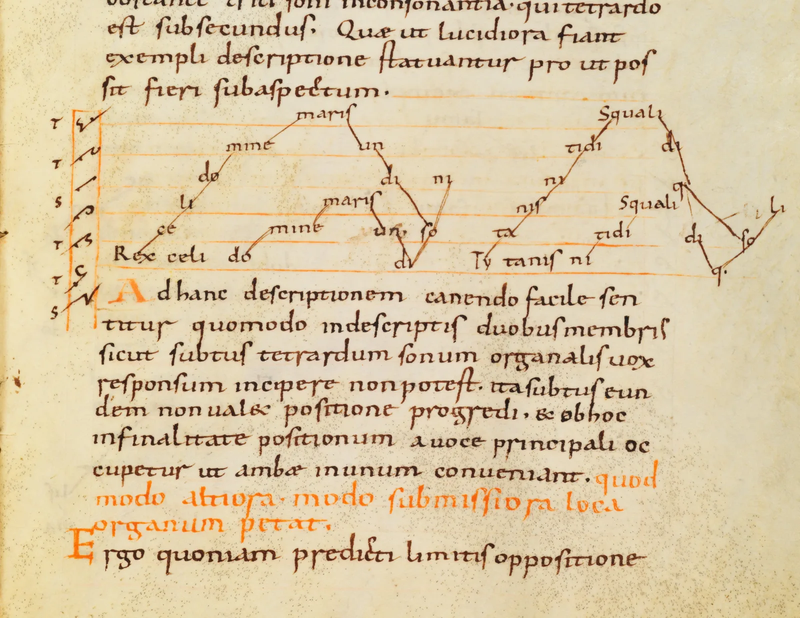
Musica enchiriadis, copia del siglo X. Bamberg, Staatsbibliothek, Msc.Var.1, fol. 57r. Autor desconocido, dominio público, vía Wikimedia Commons
The big jump happens in Paris, at Notre-Dame cathedral, roughly between 1160 and 1250. Two names survive, Léonin and Pérotin, and we know them because an anonymous English student wrote them down a century later. What they did was stretch: the old melody stays underneath holding each syllable for a very long time, and two or three new voices run on top.
Here is the fact that explains what it was for. In 1198 and 1199 the bishop of Paris, Odo de Sully, banned the Feast of Fools — a costumed romp inside the cathedral — and ordered music in three and four voices in its place. Polyphony was not born of an artistic itch: it was commissioned to replace a party somebody wanted stopped. Viderunt omnes belongs to Christmas 1198 and Sederunt principes to St Stephen's Day 1199.
The next change is not about voices, it is about the clock. Around 1320 new treatises appear, and one of them, attributed to Philippe de Vitry (1291–1361), gives the period its name: Ars nova. What they bring is notation able to write ever shorter values, and with it rhythms that could not be fixed on paper before. Guillaume de Machaut (c. 1300–1377) used that tool to write the Messe de Nostre Dame, in four voices, before 1365: the earliest complete Mass Ordinary attributable to one identified composer.
Hard facts: Musica enchiriadis, ninth century. Notre-Dame, c. 1160–1250, up to four voices. Ars nova, treatises around 1320. Machaut, four-voice Mass before 1365.
The same device elsewhere
Several independent lines at once is neither a medieval nor a European invention. Hear these three back to back and don't rank them.
- La Gozadera, Gente de Zona (2015) — the harmony never moves. What moves is that bass, percussion and keyboards each go their own way and still lock together. The bass dodges the strong beat on purpose.
- Bach's Fugue in G minor (BWV 578) — one theme enters alone. When the second voice starts it, the first carries on with something else. That is step two of the fragment, built by a professional.
- Aka polyphony, in Central Africa — several people sing different crossing lines, with no score and no conductor. It has worked that way far longer than any cathedral has stood.
None depends on the others. All three solve the same problem: making more than one thing sound at once without it turning into noise.
And here at home?
In the Iberian peninsula polyphony arrives early and is well documented. The Codex Calixtinus of Santiago cathedral, copied around 1140–1181, carries an appendix of 22 polyphonic pieces. One of them, Congaudeant catholici, is cited as the only known three-voice work of the entire twelfth century — although the third voice is in red ink and was probably added later. The codex was stolen on 5 July 2011 and recovered on 4 July 2012.
Outside the church other people gave the orders. The troubadour composed; the juglar performed and was paid by the job, in coin, clothing or food. And in Aragón the troubadour could be the king himself: Alfonso II, born in Huesca in 1157 and dead in Perpignan in 1196, wrote poetry in Occitan and kept Giraut de Bornelh, Peire Vidal and Arnaut Daniel at his court. His reign, and his son Pedro's, coincide with the high point of troubadour poetry.
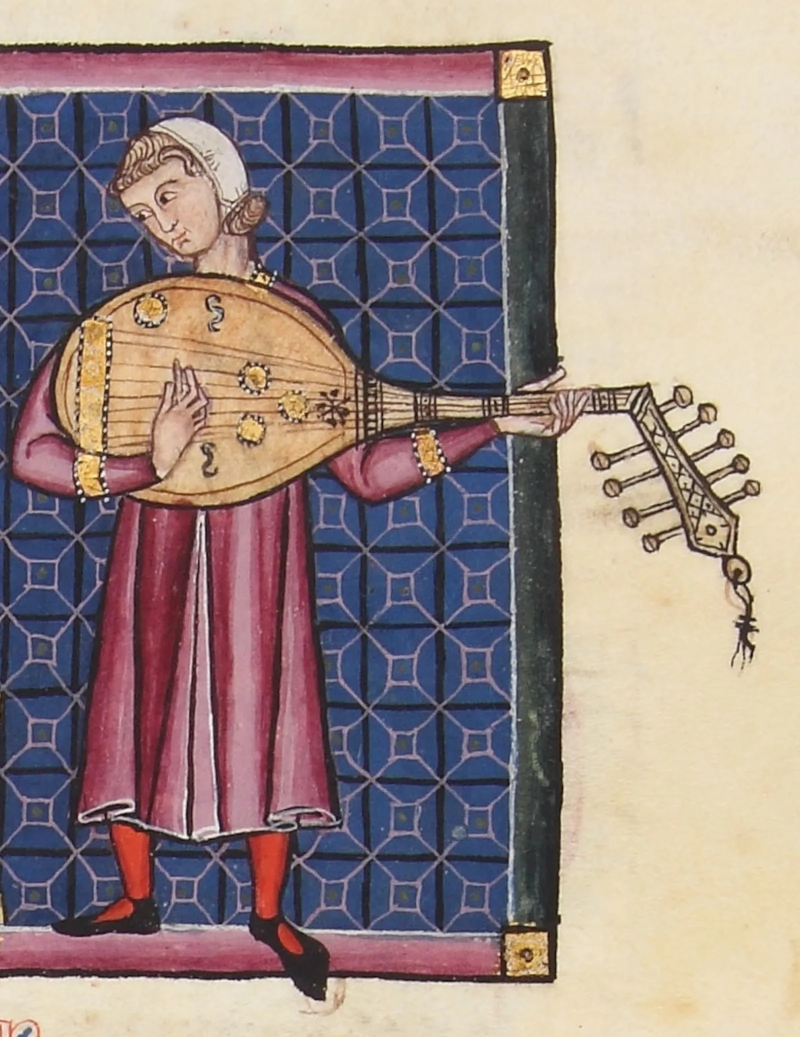
Cantigas de Santa María, Códice de los músicos (El Escorial, b.I.2), fol. 162r, siglo XIII. Autor desconocido, dominio público, vía Wikimedia Commons
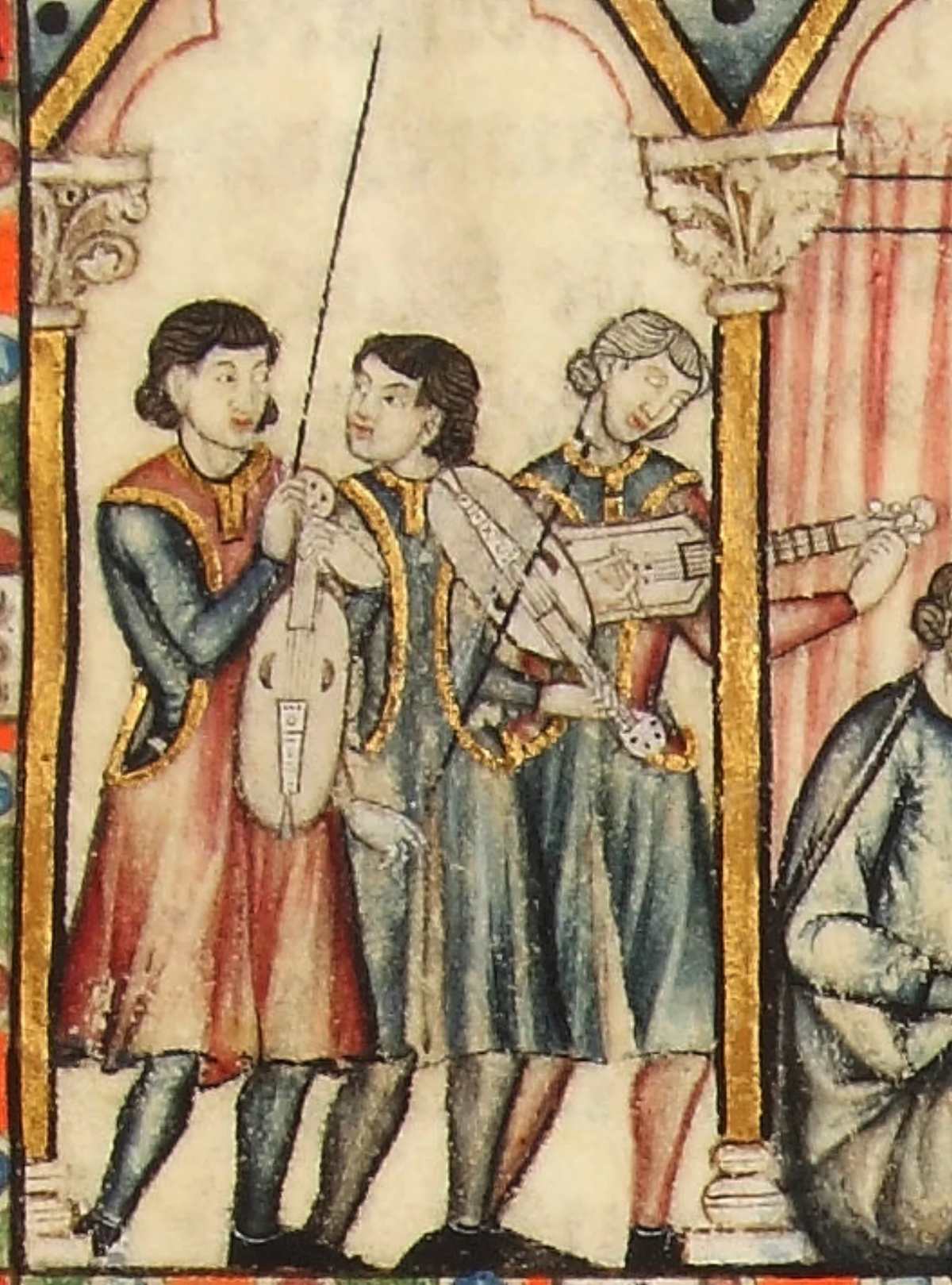
The visual evidence is the Cantigas de Santa María, 417 pieces gathered between 1270 and 1282 at the court of Alfonso X, written in Galician-Portuguese. The Códice Rico carries 1,255 miniatures and the Codex of the musicians 40. The instruments are drawn there: bowed vielles, citoles, lutes. This is not a modern reconstruction: it is thirteenth-century people drawing the musicians in front of them.
Before all that, in Zaragoza. Avempace, born there around 1095 and dead in Fez in 1139, served as vizier around 1115–1117 and wrote a treatise on melodies that has not survived. A composition is attributed to him, but the attribution is disputed and that is worth saying. From those same centuries come the jarchas, Romance verses closing poems written in Arabic or Hebrew: the oldest surviving lyric in a Romance language of Europe starts in the mid-eleventh century, and it is from here.
And something is still alive. In the Aragonese Pyrenees — Yebra de Basa, Jaca, Aragüés del Puerto, Jasa — people play the chiflo and chicotén: the right hand plays the melody on a three-holed pipe while the left strikes a string psaltery. One person, two lines at once. Psalteries of that kind are drawn in the Cantigas, and here they were never abandoned.
Classroom activities
- While the Musica enchiriadis organum plays: raise a hand the moment you hear two rather than one. Afterwards count how many of you raised it in the same place.
- While Viderunt omnes plays: half the class follows only the lowest voice with a finger on the desk, marking each time it changes note. It will hardly change at all. The other half counts how many separate voices they can follow before losing them.
- Sing: go back to step two of the fragment and add a third group. With three staggered entries you can no longer wing it: somebody has to say when each one comes in. That somebody is the problem Notre-Dame solved.
- While the cantiga plays: write down every instrument you think you recognise. Then open the image from the Codex of the musicians and find it drawn.
- Analyse: play We Will Rock You and La Gozadera back to back and classify each one. One is pure monody — everyone singing the same thing — and the other is textbook polyphony. The argument is about what sits in between.
Key vocabulary
- Texture — textura: cuántas líneas suenan a la vez y cómo se relacionan
- Monody — monodia: una sola línea melódica
- Homophony — homofonía: varias voces moviéndose con el mismo ritmo, como un bloque
- Polyphony — polifonía: varias líneas independientes a la vez
- Organum — organum: la primera polifonía escrita de Europa, por duplicación a la cuarta, quinta u octava
Resources
The songs in this unit are in the library, each with its own article, full-band chart and tab: We Will Rock You, La Gozadera, Saturn.
Songs from the library to classify by texture, each with its own article and tab: We Will Rock You (monody: everyone singing the same thing in unison), Saturn (one voice in front, an arpeggio holding it up underneath), La Gozadera (bass, percussion and keyboards, each going its own way).
The oldest written organum — Rex caeli, Domine maris, from the Musica enchiriadis.
Four voices at Notre-Dame — Viderunt omnes, attributed to Pérotin, by The Hilliard Ensemble.
Polyphony in Spain — Congaudeant catholici, from the Codex Calixtinus, by the monks of the Monastery of Silos.
Ars nova, with the original notation on screen — Kyrie from Machaut's Messe de Nostre Dame, by Cappella Romana.
Outside the church — Santa María, strela do día, cantiga 100 of Alfonso X, by Eduardo Paniagua.
A troubadour song — Kalenda maya, by Raimbaut de Vaqueiras, performed by the Martin Best Mediaeval Ensemble.
The same device, three centuries later — Bach's Fugue in G minor BWV 578, by the Netherlands Bach Society.
The same device, with no score — Aka polyphony, in Central Africa.
Two lines and one musician, in Aragón — a gathering of chiflo and salterio players in Lasaosa, Huesca, June 2015.
Nos preguntamos
- Si mil personas cantan la misma melodía, ¿cuántas cosas estás oyendo?
- ¿Por qué esta música suena a «vieja» antes de que te den ninguna fecha?
- ¿Quién pagaba a alguien por cantar hace ochocientos años?
- ¿De qué vivía un músico que no trabajaba para la iglesia?
- Si nadie sabía leer, ¿para qué sirve escribir la música?
- ¿Cuántas voces puedes seguir a la vez antes de perderte?
No las respondas todavía. Al final de la unidad volvemos a ellas.
El fragmento
Antes de poner ninguna grabación, la polifonía la hacéis vosotros. Tres pasos, y el orden importa.
Uno: todos lo mismo. Toda la clase canta la primera frase de Martinillo al unísono, despacio. Aunque seáis treinta, ahí solo está pasando una cosa.
Dos: desfase. Media clase vuelve a empezar desde el principio justo cuando la otra media termina la primera frase. Nadie ha cambiado de melodía y sin embargo aparecen choques y encuentros que nadie ha cantado. Esos encuentros no los ha escrito nadie: salen del desfase.
Tres: a distancia de quinta. Ahora sin desfase. El grupo agudo canta do – re – mi – re – do. El grupo grave canta a la vez fa – sol – la – sol – fa, empezando por debajo. Las dos líneas suben y bajan iguales, siempre separadas por cinco escalones. Suena hueco, ancho y un poco metálico. Eso es exactamente la receta del siglo IX.
Ahora sí, escuchad Rex caeli, Domine maris entera y sin comentar por encima. Después, Viderunt omnes, también entera. Guardad las caras para el final.
Qué cambió
Antes de nombrar nada: describid con vuestras palabras qué pasaba en el paso uno y qué pasaba en el paso tres. Las respuestas raras valen. De ahí salen los nombres.
Cuando cantáis todos lo mismo, por muchos que seáis, hay una sola línea. Cuando el grupo grave canta otras notas pero con el mismo ritmo, hay varias notas y un solo bloque que se mueve entero. Y cuando entráis con desfase, cada grupo va a lo suyo y aun así encaja: hay varias líneas independientes. A esas tres maneras de ocupar el espacio sonoro se las llama textura, y tienen nombre: monodia, homofonía y polifonía.
La textura no es un adorno. Decide cuánto puedes seguir. Una melodía sola la canta cualquiera a la primera; cuatro líneas independientes necesitan a alguien que las haya escrito antes y a gente entrenada para leerlas. Por eso el cambio de textura arrastra detrás un cambio de quién puede hacer música y de cuánto cuesta.
El primer sitio donde aparece escrito ese truco es un tratado del siglo IX llamado Musica enchiriadis. La copia más antigua que se conserva es del siglo X. Ahí está la receta que acabáis de hacer: la misma melodía duplicada a distancia de cuarta, de quinta o de octava. Se llamó organum, y durante doscientos años fue eso y poco más.
Musica enchiriadis, copia del siglo X. Bamberg, Staatsbibliothek, Msc.Var.1, fol. 57r. Autor desconocido, dominio público, vía Wikimedia Commons
El salto gordo ocurre en París, en la catedral de Notre Dame, entre 1160 y 1250 aproximadamente. Dos nombres se conservan, Léonin y Pérotin, y los conocemos porque un estudiante inglés anónimo los citó por escrito un siglo después. Lo que hicieron fue estirar: la melodía antigua se queda abajo sosteniendo cada sílaba durante muchísimo tiempo, y encima corren dos o tres voces nuevas.
Y aquí está el dato que explica para qué servía. En 1198 y 1199 el obispo de París, Odón de Sully, prohibió la Fiesta de los Locos —una juerga disfrazada dentro de la catedral— y mandó poner en su lugar música a tres y cuatro voces. La polifonía no nació de una inquietud artística: se encargó para sustituir una fiesta que molestaba. Viderunt omnes es de la Navidad de 1198 y Sederunt principes de San Esteban de 1199.
El siguiente cambio no es de voces, es de reloj. Hacia 1320 aparecen tratados nuevos, y uno de ellos, atribuido a Philippe de Vitry (1291–1361), da nombre a la época: Ars nova. Lo que traen es notación capaz de escribir valores cada vez más breves, y con ella ritmos que antes no se podían fijar en papel. Guillaume de Machaut (hacia 1300–1377) escribe con esa herramienta la Messe de Nostre Dame, a cuatro voces, antes de 1365: la primera misa completa que se puede atribuir a un solo compositor identificado.
Datos duros: Musica enchiriadis, siglo IX. Notre Dame, hacia 1160–1250, hasta cuatro voces. Ars nova, tratados hacia 1320. Machaut, misa a cuatro voces anterior a 1365.
El mismo recurso en otros sitios
Varias líneas independientes sonando a la vez no es una invención medieval ni europea. Escuchad estos tres seguidos y sin decidir cuál es mejor.
- La Gozadera, Gente de Zona (2015) — la armonía no se mueve en toda la canción. Lo que se mueve es que el bajo, la percusión y los teclados van cada uno por su lado y encajan. El bajo esquiva el tiempo fuerte a propósito.
- Fuga en sol menor de Bach (BWV 578) — un tema entra solo. Cuando el segundo lo empieza, el primero sigue con otra cosa. Es el paso dos del fragmento, montado por un profesional.
- Polifonía de los aka, en Centroáfrica — varias personas cantan líneas distintas que se cruzan, sin partitura y sin director. Lleva funcionando así mucho más tiempo que cualquier catedral.
Ninguno depende de los otros. Los tres resuelven lo mismo: que suene más de una cosa a la vez sin que se convierta en ruido.
Y aquí, ¿qué?
En la península la polifonía llega pronto y se documenta bien. El Códice Calixtino de la catedral de Santiago, copiado hacia 1140–1181, lleva un apéndice con 22 piezas polifónicas. Una, Congaudeant catholici, se cita como la única obra a tres voces conocida de todo el siglo XII, aunque la tercera voz está en tinta roja y probablemente se añadió después. El códice fue robado el 5 de julio de 2011 y recuperado el 4 de julio de 2012.
Fuera de la iglesia mandaban otros. El trovador componía; el juglar interpretaba y cobraba por función, en monedas, en ropa o en comida. Y en Aragón el trovador podía ser el propio rey: Alfonso II, nacido en Huesca en 1157 y muerto en Perpiñán en 1196, escribía poesía en occitano y tuvo en su corte a Giraut de Bornelh, Peire Vidal y Arnaut Daniel. Su reinado y el de su hijo Pedro coinciden con el momento más alto de la poesía trovadoresca.
Cantigas de Santa María, Códice de los músicos (El Escorial, b.I.2), fol. 162r, siglo XIII. Autor desconocido, dominio público, vía Wikimedia Commons
El documento visual son las Cantigas de Santa María, 417 piezas reunidas entre 1270 y 1282 en la corte de Alfonso X, escritas en galaicoportugués. El Códice Rico lleva 1.255 miniaturas y el Códice de los músicos, 40. Ahí están dibujados los instrumentos: vihuelas de arco, cítolas, laúdes. No es una reconstrucción moderna: es gente del siglo XIII dibujando a los músicos que tenía delante.
Antes de todo eso, en Zaragoza. Avempace, nacido allí hacia 1095 y muerto en Fez en 1139, fue visir hacia 1115–1117 y escribió un tratado sobre las melodías que no se conserva. Se le atribuye alguna composición, pero la atribución está discutida y conviene decirlo. De esos mismos siglos son las jarchas, versos en romance al final de poemas en árabe o hebreo: la lírica más antigua que se conserva en una lengua romance de Europa empieza a mediados del siglo XI y está aquí.
Y queda algo vivo. En el Pirineo aragonés —Yebra de Basa, Jaca, Aragüés del Puerto, Jasa— se toca el chiflo y chicotén: la mano derecha hace la melodía en una flauta de tres agujeros y la izquierda golpea un salterio de cuerdas. Una persona, dos líneas a la vez. Salterios de ese tipo están dibujados en las Cantigas, y aquí no se dejaron de tocar nunca.
Para hacer en clase
- Mientras suena el organum de la Musica enchiriadis: levantad la mano cuando oigáis que son dos y no una. Contad después cuántos la levantasteis en el mismo sitio.
- Mientras suena Viderunt omnes: la mitad de la clase sigue solo la voz más grave con un dedo en la mesa, marcando cuándo cambia de nota. Va a cambiar poquísimo. La otra mitad cuenta cuántas voces distintas consigue seguir antes de perderse.
- Cantar: recuperad el paso dos del fragmento y añadid un tercer grupo. Con tres entradas desfasadas ya no se puede ir al tuntún: alguien tiene que decir cuándo entra cada uno. Ese alguien es el problema que resolvió Notre Dame.
- Mientras suena la cantiga: apuntad cada instrumento que creáis reconocer. Después abrid la imagen del Códice de los músicos y buscadlo dibujado.
- Analizar: poned We Will Rock You y La Gozadera seguidas y clasificad cada una. Una es monodia pura —todos cantan lo mismo— y la otra es polifonía de manual. La discusión está en el medio.
Vocabulario fundamental
- Textura — Cuántas líneas suenan a la vez y qué relación tienen entre ellas. No es cuántos músicos hay: mil personas al unísono siguen siendo una línea.
- Monodia — Una sola línea melódica, sin nada más. Es la textura del canto llano y la del estribillo de un estadio.
- Homofonía — Varias voces con notas distintas pero moviéndose con el mismo ritmo. Se oye como un bloque, no como líneas sueltas.
- Polifonía — Varias líneas independientes a la vez, cada una con su ritmo y su dibujo. Hay que escribirla o acordarla antes.
- Organum — La primera polifonía escrita de Europa: una melodía existente duplicada a distancia de cuarta, quinta u octava.
Recursos
Las canciones de esta unidad están en la biblioteca, cada una con su artículo, su chart de banda y su tablatura: We Will Rock You, La Gozadera, Saturn.
Canciones de la biblioteca para clasificar por textura, cada una con su artículo y su tablatura: We Will Rock You (monodia: todos cantan lo mismo al unísono), Saturn (una voz delante y un arpegio que la sostiene debajo), La Gozadera (bajo, percusión y teclados, cada uno por su lado).
El organum más antiguo escrito — Rex caeli, Domine maris, de la Musica enchiriadis.
Cuatro voces en Notre Dame — Viderunt omnes, atribuida a Pérotin, por The Hilliard Ensemble.
La polifonía en España — Congaudeant catholici, del Códice Calixtino, por el Coro de Monjes del Monasterio de Silos.
El Ars nova, con la notación original en pantalla — Kyrie de la Messe de Nostre Dame de Machaut, por Cappella Romana.
Fuera de la iglesia — Santa María, strela do día, cantiga 100 de Alfonso X, por Eduardo Paniagua.
Una canción de trovador — Kalenda maya, de Raimbaut de Vaqueiras, por el Martin Best Mediaeval Ensemble.
El mismo recurso, tres siglos después — Fuga en sol menor BWV 578 de Bach, por la Netherlands Bach Society.
El mismo recurso, sin partitura — polifonía de los aka, en Centroáfrica.
Dos líneas y un solo músico, en Aragón — encuentro de chiflo y salterio en Lasaosa, Huesca, junio de 2015.
We ask ourselves
- If a thousand people sing the same tune, how many things are you hearing?
- Why does this music sound old before anyone gives you a date?
- Who paid somebody to sing, eight hundred years ago?
- How did a musician live if the church was not the employer?
- If almost nobody could read, what is the point of writing music down?
- How many voices can you follow at once before you lose them?
Don't answer yet. We come back to these at the end.
The fragment
Before any recording, you make the polyphony yourselves. Three steps, and the order matters.
One: everyone the same. The whole class sings the first phrase of Frère Jacques in unison, slowly. There may be thirty of you, but only one thing is happening.
Two: out of step. Half the class starts again from the top exactly when the other half finishes the first phrase. Nobody changed the tune, yet clashes and meeting points appear that nobody sang. They come from the delay alone.
Three: a fifth apart. Now with no delay. The high group sings do – re – mi – re – do. At the same time the low group sings fa – sol – la – sol – fa, starting underneath. Both lines rise and fall identically, always five steps apart. It sounds hollow, wide and slightly metallic. That is the ninth-century recipe, exactly.
Now listen to Rex caeli, Domine maris, all of it, with nobody talking over it. Then Viderunt omnes, also complete. Save your faces for the end.
What changed
Before naming anything: describe in your own words what happened in step one and what happened in step three. Odd answers are fine. The names come out of them.
When you all sing the same thing, however many of you there are, there is one single line. When the low group sings different notes but in the same rhythm, there are several notes and one block moving as a whole. And when you enter out of step, each group goes its own way and still fits: there are several independent lines. Those three ways of filling the sound are called texture, and they have names: monody, homophony and polyphony.
Texture is not decoration. It decides how much you can follow. One melody can be sung by anyone on first hearing; four independent lines need somebody to have written them down and people trained to read them. So a change of texture drags behind it a change in who gets to make music, and in what it costs.
The first place this trick appears in writing is a ninth-century treatise called Musica enchiriadis. The oldest surviving copy is from the tenth century. The recipe you just performed is in it: the same melody doubled a fourth, a fifth or an octave away. It was called organum, and for two hundred years it was that and little else.
Musica enchiriadis, copia del siglo X. Bamberg, Staatsbibliothek, Msc.Var.1, fol. 57r. Autor desconocido, dominio público, vía Wikimedia Commons
The big jump happens in Paris, at Notre-Dame cathedral, roughly between 1160 and 1250. Two names survive, Léonin and Pérotin, and we know them because an anonymous English student wrote them down a century later. What they did was stretch: the old melody stays underneath holding each syllable for a very long time, and two or three new voices run on top.
Here is the fact that explains what it was for. In 1198 and 1199 the bishop of Paris, Odo de Sully, banned the Feast of Fools — a costumed romp inside the cathedral — and ordered music in three and four voices in its place. Polyphony was not born of an artistic itch: it was commissioned to replace a party somebody wanted stopped. Viderunt omnes belongs to Christmas 1198 and Sederunt principes to St Stephen's Day 1199.
The next change is not about voices, it is about the clock. Around 1320 new treatises appear, and one of them, attributed to Philippe de Vitry (1291–1361), gives the period its name: Ars nova. What they bring is notation able to write ever shorter values, and with it rhythms that could not be fixed on paper before. Guillaume de Machaut (c. 1300–1377) used that tool to write the Messe de Nostre Dame, in four voices, before 1365: the earliest complete Mass Ordinary attributable to one identified composer.
Hard facts: Musica enchiriadis, ninth century. Notre-Dame, c. 1160–1250, up to four voices. Ars nova, treatises around 1320. Machaut, four-voice Mass before 1365.
The same device elsewhere
Several independent lines at once is neither a medieval nor a European invention. Hear these three back to back and don't rank them.
- La Gozadera, Gente de Zona (2015) — the harmony never moves. What moves is that bass, percussion and keyboards each go their own way and still lock together. The bass dodges the strong beat on purpose.
- Bach's Fugue in G minor (BWV 578) — one theme enters alone. When the second voice starts it, the first carries on with something else. That is step two of the fragment, built by a professional.
- Aka polyphony, in Central Africa — several people sing different crossing lines, with no score and no conductor. It has worked that way far longer than any cathedral has stood.
None depends on the others. All three solve the same problem: making more than one thing sound at once without it turning into noise.
And here at home?
In the Iberian peninsula polyphony arrives early and is well documented. The Codex Calixtinus of Santiago cathedral, copied around 1140–1181, carries an appendix of 22 polyphonic pieces. One of them, Congaudeant catholici, is cited as the only known three-voice work of the entire twelfth century — although the third voice is in red ink and was probably added later. The codex was stolen on 5 July 2011 and recovered on 4 July 2012.
Outside the church other people gave the orders. The troubadour composed; the juglar performed and was paid by the job, in coin, clothing or food. And in Aragón the troubadour could be the king himself: Alfonso II, born in Huesca in 1157 and dead in Perpignan in 1196, wrote poetry in Occitan and kept Giraut de Bornelh, Peire Vidal and Arnaut Daniel at his court. His reign, and his son Pedro's, coincide with the high point of troubadour poetry.
Cantigas de Santa María, Códice de los músicos (El Escorial, b.I.2), fol. 162r, siglo XIII. Autor desconocido, dominio público, vía Wikimedia Commons
The visual evidence is the Cantigas de Santa María, 417 pieces gathered between 1270 and 1282 at the court of Alfonso X, written in Galician-Portuguese. The Códice Rico carries 1,255 miniatures and the Codex of the musicians 40. The instruments are drawn there: bowed vielles, citoles, lutes. This is not a modern reconstruction: it is thirteenth-century people drawing the musicians in front of them.
Before all that, in Zaragoza. Avempace, born there around 1095 and dead in Fez in 1139, served as vizier around 1115–1117 and wrote a treatise on melodies that has not survived. A composition is attributed to him, but the attribution is disputed and that is worth saying. From those same centuries come the jarchas, Romance verses closing poems written in Arabic or Hebrew: the oldest surviving lyric in a Romance language of Europe starts in the mid-eleventh century, and it is from here.
And something is still alive. In the Aragonese Pyrenees — Yebra de Basa, Jaca, Aragüés del Puerto, Jasa — people play the chiflo and chicotén: the right hand plays the melody on a three-holed pipe while the left strikes a string psaltery. One person, two lines at once. Psalteries of that kind are drawn in the Cantigas, and here they were never abandoned.
Classroom activities
- While the Musica enchiriadis organum plays: raise a hand the moment you hear two rather than one. Afterwards count how many of you raised it in the same place.
- While Viderunt omnes plays: half the class follows only the lowest voice with a finger on the desk, marking each time it changes note. It will hardly change at all. The other half counts how many separate voices they can follow before losing them.
- Sing: go back to step two of the fragment and add a third group. With three staggered entries you can no longer wing it: somebody has to say when each one comes in. That somebody is the problem Notre-Dame solved.
- While the cantiga plays: write down every instrument you think you recognise. Then open the image from the Codex of the musicians and find it drawn.
- Analyse: play We Will Rock You and La Gozadera back to back and classify each one. One is pure monody — everyone singing the same thing — and the other is textbook polyphony. The argument is about what sits in between.
Key vocabulary
- Texture — textura: cuántas líneas suenan a la vez y cómo se relacionan
- Monody — monodia: una sola línea melódica
- Homophony — homofonía: varias voces moviéndose con el mismo ritmo, como un bloque
- Polyphony — polifonía: varias líneas independientes a la vez
- Organum — organum: la primera polifonía escrita de Europa, por duplicación a la cuarta, quinta u octava
Resources
The songs in this unit are in the library, each with its own article, full-band chart and tab: We Will Rock You, La Gozadera, Saturn.
Songs from the library to classify by texture, each with its own article and tab: We Will Rock You (monody: everyone singing the same thing in unison), Saturn (one voice in front, an arpeggio holding it up underneath), La Gozadera (bass, percussion and keyboards, each going its own way).
The oldest written organum — Rex caeli, Domine maris, from the Musica enchiriadis.
Four voices at Notre-Dame — Viderunt omnes, attributed to Pérotin, by The Hilliard Ensemble.
Polyphony in Spain — Congaudeant catholici, from the Codex Calixtinus, by the monks of the Monastery of Silos.
Ars nova, with the original notation on screen — Kyrie from Machaut's Messe de Nostre Dame, by Cappella Romana.
Outside the church — Santa María, strela do día, cantiga 100 of Alfonso X, by Eduardo Paniagua.
A troubadour song — Kalenda maya, by Raimbaut de Vaqueiras, performed by the Martin Best Mediaeval Ensemble.
The same device, three centuries later — Bach's Fugue in G minor BWV 578, by the Netherlands Bach Society.
The same device, with no score — Aka polyphony, in Central Africa.
Two lines and one musician, in Aragón — a gathering of chiflo and salterio players in Lasaosa, Huesca, June 2015.