Contenidos
Uptown Funk — Mark Ronson ft. Bruno Mars (2015)
Two chords in four and a half minutes, and neither of them explains anything that happens. What makes this sound like funk is where the hits land.
🏷️ Ficha musical
Why this song
In February 2016 Mars and Ronson played this song at the Super Bowl 50 halftime show, watched by an average of 111.9 million people in the United States alone. Before that it had spent fourteen straight weeks at number one there. You know it whether you chose to or not.
Now open it up. Two chords: D minor and G. They go round and round from start to finish and lead nowhere.
If the harmony never changes, something else is doing the work. That is why this song is on the syllabus.
Historical context
It started as a jam. Bruno Mars and his band, The Hooligans, had been playing a loose groove on the Moonshine Jungle Tour (2013–2014). In a studio session with Mark Ronson and producer Jeff Bhasker, Mars sat at the drums, Bhasker at the keyboard and Ronson on guitar, and they decided to build on it.

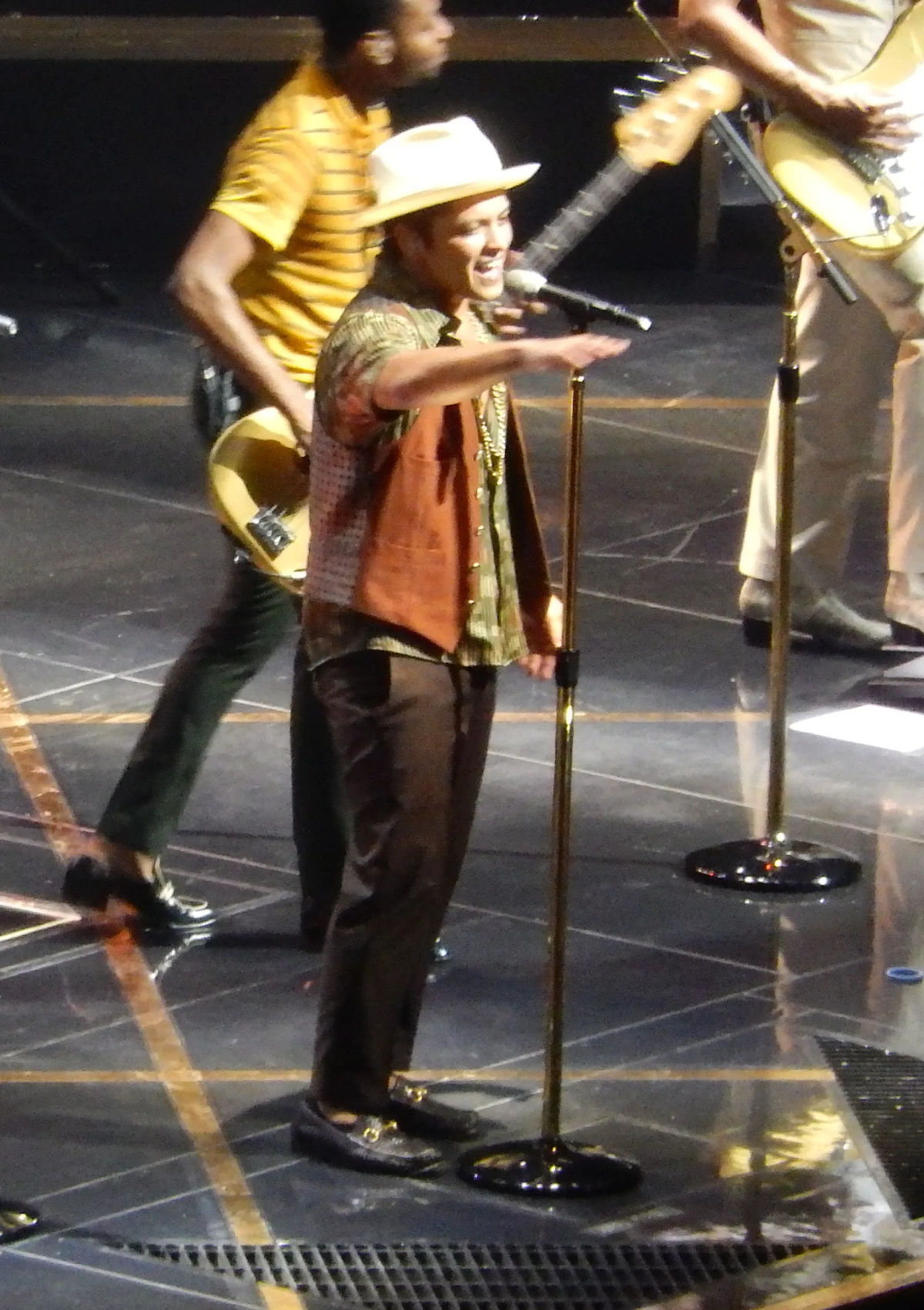
Foto: Su-May, CC BY 2.0, vía Wikimedia Commons
That session produced the opening line, "This hit, that ice cold / Michelle Pfeiffer, that white gold", and with it the feeling of having something. What it did not produce was a song. Ronson worked on it for seven months, recording in six studios across Los Angeles, London, Memphis, New York, Toronto and Vancouver.
Along the way they spent months on a sung chorus and then threw it away. One version had a hard rock breakdown in the middle. At one point they nearly abandoned the whole thing.
Ronson passed out during a session trying to nail the guitar part. He got it two days later in Toronto, playing it in front of The Hooligans, on take 82. The track went past a hundred takes before it was finished.
Musical characteristics
Put the song on and count out loud: one, two, three, four. Almost nothing you hear lands on your numbers. It arrives just before or just after. That is syncopation: the accent goes where you do not expect it.
For syncopation to register, somebody has to hold the ground. That is the snare drum, hitting on two and four: the backbeat. It is the fixed grid you measure everything else against. Without it there is no syncopation, only mess.
The guitar shows this better than any diagram. The right hand never stops: sixteenth notes all the way through. The left hand squeezes and releases the strings, deciding which of those strums sound and which come out as a dead "chuck". What you hear is not the hits — it is the gaps the muting leaves.
Underneath there are two chords and nothing else. D minor and G, round after round. That kind of back-and-forth on two chords is a vamp. In C they are the second and fifth degrees, a ii–V progression, the same one jazz uses to set up the trip home.
Here the trip home never happens. That G never falls onto C, so the chord that ends up feeling like rest is D minor. The song circles on purpose: if the harmony will not resolve, your attention moves entirely to the rhythm.
The bassline at the start was sung by someone who does not play bass. Philip Lawrence came up with it after a show on the tour, engineer Charles Moniz asked him to sing it, and that opening "doh, doh, doh" is his voice.
And the chorus barely has words. After scrapping the sung chorus, Ronson said they kept just a short horn line instead, following the example of Kool & the Gang. You remember the tune without remembering a single lyric there.
Hard facts: key signature with no sharps and no flats, resting on D minor, 4/4, 115 BPM, 4:30. Form: intro, verse, pre-chorus, chorus, verse, pre-chorus, chorus, bridge, chorus and outro.
Trivia and curiosities
- The credits list eleven writers. Four of them wrote it. In 2015 the song was re-registered because of its resemblance to The Gap Band's "Oops Up Side Your Head" (1979), and that song's writers took 17% of the publishing royalties. A rhythmic and textural resemblance costs the same as a copied melody.

Foto: Tore Sætre, CC BY-SA 4.0, vía Wikimedia Commons
- Three more lawsuits followed: the band Collage over "Young Girls" (1983), The Sequence over "Funk You Up" (1979), and Zapp's publisher over "More Bounce to the Ounce" (1980). All three were eventually dropped. When you work inside a whole musical language — late-seventies funk — the line between quoting and copying stops being obvious.
- The first line quotes Trinidad James's "All Gold Everything", which the band had been playing at soundchecks. James and Devon Gallaspy were credited as co-writers before the single even came out: that one they sorted out themselves, with nobody suing anyone.
- Seven months of work, six studios, over a hundred takes and an entire chorus thrown away, for a song that sounds like it fell out of one afternoon. That easiness is the result, not the starting point.
Classroom activities
- Play: D minor and G, two bars each, everybody at once. Guitars and ukuleles keep the right hand moving without ever stopping, muting the strings and releasing them only where the chord belongs. The difficulty is not the chords. It is not stopping your hand.
- Body percussion: half the class claps only on two and four, and never moves off it. The other half comes in half a beat earlier. Then swap. The group holding the backbeat is the one holding the other group up.
- Analyse: count "one and two and three and four and" over the intro with the track playing. Closed question: of the attacks in the sung bassline, how many land on a number and how many land on an "and"?
- Create: take any two chords and write eight bars in which no attack falls on beat one. Steal the procedure, not the song.
Key vocabulary
- Syncopation — síncopa: el acento cae entre los tiempos, no encima
- Backbeat — el golpe de caja en el dos y en el cuatro
- Muting — apagado: tocar sin dejar que la cuerda suene del todo
- Vamp — vamp: dos acordes que se repiten sin llevarte a ninguna parte
- ii–V progression — progresión ii–V (segundo y quinto grados)
Resources
In Year 3 — this song is also used in the unit ¿Cómo sabes por dónde vas en una música que oyes por primera vez?, from the theory and history book.
Where it is explained — this song is studied in the units La sala donde suena esta canción no existe, ¿Por qué no te aburre una canción de un solo acorde?, from the modern music history book.
Official music video
Guitar tutorial — GuitarLessons365. It insists on the thing that matters: the muting counts as much as the chords, and the right hand keeps the sixteenths going.
Bass tutorial — Clay's Bass Lessons, with the tab on screen. This is the line Philip Lawrence sang on the record.
Keyboard tutorial — Marks Piano (PGN Piano), chord version. Two chords and you have the whole song.
Drum tutorial — Liberty Park Music. Starts from the backbeat and stacks the rest on top.
- Full band chart (JamZone, Music Will) — https://jamzone.musicwill.org/songs/inthestyleof-uptownfunk-by-markronson
- Tab — attached below; the button opens it in Songsterr
Por dónde entrar
El videoclip de esta canción está entre los diez vídeos más vistos de la historia de YouTube: más de 5.600 millones de reproducciones en marzo de 2025. La has oído en bodas, en polideportivos y en anuncios sin haberla buscado nunca.
Ahora ábrela por dentro. Dos acordes: Re menor y Sol. Se repiten de principio a fin y no llevan a ningún sitio.
Si la armonía no cambia, el trabajo lo está haciendo otra cosa. Esta canción existe en el temario para demostrar cuál.
Contexto histórico
Empezó siendo un jam. Bruno Mars y su banda, los Hooligans, tocaban una base suelta durante la gira Moonshine Jungle (2013–2014). En una sesión con Mark Ronson y el productor Jeff Bhasker, Mars se puso a la batería, Bhasker al teclado y Ronson a la guitarra, y decidieron trabajar sobre ella.
Foto: Su-May, CC BY 2.0, vía Wikimedia Commons
De ahí salió la primera frase, «This hit, that ice cold / Michelle Pfeiffer, that white gold», y con ella la sensación de tener algo. Lo que no salió fue la canción. Ronson estuvo siete meses con ella y la grabó en seis estudios de Los Ángeles, Londres, Memphis, Nueva York, Toronto y Vancouver.
Por el camino estuvieron meses haciendo un estribillo cantado que acabaron tirando a la basura. Una versión llevaba un corte de rock duro en medio. En algún momento estuvieron a punto de abandonarla entera.
Ronson llegó a desmayarse en una sesión intentando clavar la parte de guitarra. La sacó dos días después en Toronto, tocándola delante de los Hooligans, en la toma 82. La canción completa pasó de las cien tomas antes de darse por terminada.
Cómo suena
Pon la canción y cuenta en voz alta: uno, dos, tres, cuatro. Casi nada de lo que oyes cae encima de tus números. Entra justo antes o justo después. A eso se le llama síncopa: el acento va donde no lo esperas.
Para que la síncopa se note hace falta que alguien marque el sitio de verdad. Es la caja de la batería, golpeando en el dos y en el cuatro: el backbeat. Esa rejilla regular es la referencia contra la que mides todo lo demás. Sin ella no habría síncopa, habría desorden.
La guitarra lo enseña mejor que cualquier dibujo. La mano derecha no para nunca: rasguea semicorcheas de principio a fin. La izquierda aprieta y suelta las cuerdas, y es la que decide cuáles de esos rasgueos suenan y cuáles se quedan en un «chac» apagado. Lo que oyes no son los golpes: son los huecos que deja el apagado.
Debajo hay dos acordes y nada más. Re menor y Sol, una vuelta detrás de otra. A esa ida y vuelta sobre dos acordes se le llama vamp. En Do son el segundo y el quinto grado, una progresión ii–V, la misma con la que el jazz prepara la llegada a casa.
Aquí esa llegada no se produce nunca. El Sol no cae jamás en Do, así que el sitio que acaba sonando a reposo es Re menor. La canción se queda dando vueltas a propósito: si la armonía no resuelve, la atención se va entera al ritmo.
El bajo del principio lo cantó alguien que no toca el bajo. Philip Lawrence propuso la línea al terminar un concierto de la gira, el ingeniero Charles Moniz le pidió que la cantara, y ese «doh, doh, doh» de la entrada es esa voz.
Y el estribillo casi no tiene letra. Después de tirar el estribillo cantado, Ronson contó que optaron por dejar solo una frase corta de la sección de vientos, siguiendo el ejemplo de Kool & the Gang. Te acuerdas de la melodía sin recordar ninguna palabra.
Datos duros: armadura sin sostenidos ni bemoles con el reposo en Re menor, 4/4, 115 BPM, 4:30. Forma: intro, estrofa, pre-estribillo, estribillo, estrofa, pre-estribillo, estribillo, puente, estribillo y coda.
Curiosidades
- La canción salió con cuatro autores y hoy tiene once. En 2015 se volvió a registrar porque se parecía a «Oops Up Side Your Head» (1979) de The Gap Band, y los autores de aquella se llevaron el 17 % de los derechos de edición. Un parecido de ritmo y de textura se paga igual que una melodía copiada.
Foto: Tore Sætre, CC BY-SA 4.0, vía Wikimedia Commons
- Después vinieron tres demandas más: el grupo Collage por «Young Girls» (1983), The Sequence por «Funk You Up» (1979) y la editora de Zapp por «More Bounce to the Ounce» (1980). Las tres acabaron retiradas. Cuando trabajas dentro de un lenguaje entero —el funk de finales de los setenta— la frontera entre citar y copiar deja de estar clara.
- La primera frase cita «All Gold Everything», de Trinidad James, que sonaba en las pruebas de sonido de la gira. Por eso James y Devon Gallaspy figuran como coautores desde antes de que se publicara el single: esa parte la arreglaron ellos mismos, sin que nadie los demandara.
- Siete meses de trabajo, seis estudios, más de cien tomas y un estribillo entero descartado, para una canción que suena a que salió sola en una tarde. Esa sensación de facilidad es el resultado, no el punto de partida.
Para hacer en clase
- Tocar: Re menor y Sol, dos compases cada uno, toda la clase a la vez. Guitarras y ukeleles con la mano derecha sin parar nunca, apagando las cuerdas y soltándolas solo donde toca. La dificultad no está en los acordes: está en no parar la mano.
- Percusión corporal: media clase da palmas solo en el dos y en el cuatro, sin moverse de ahí. La otra media entra media parte antes. Cambiad los papeles. El grupo que hace el backbeat es el que sostiene al otro.
- Analizar: cuenta «uno y dos y tres y cuatro y» sobre la intro, con la canción puesta. Pregunta cerrada: de los ataques del bajo cantado, ¿cuántos caen justo encima de un número y cuántos caen en la «y»?
- Crear: coge dos acordes cualesquiera, los que quieras, y escribe ocho compases en los que ningún ataque caiga en el primer tiempo. Se trata de robar el procedimiento, no la canción.
Vocabulario fundamental
- Síncopa — El acento cae donde no lo esperas, entre los tiempos en vez de encima. Es lo que hace que una música tire de ti hacia delante.
- Backbeat — El golpe de caja en el dos y en el cuatro. Es la rejilla fija contra la que se nota que lo demás va a destiempo.
- Apagado (muting) — Tocar sin dejar que la cuerda suene del todo. Convierte el rasgueo en percusión y decide qué se oye y qué no.
- Vamp — Un par de acordes que se repiten sin llevarte a ninguna parte. Cuando la armonía se queda quieta, el interés se muda al ritmo.
- Progresión ii–V — Los grados segundo y quinto de una tonalidad, que normalmente preparan la vuelta a casa. Aquí esa vuelta no llega nunca.
Recursos
En 3º de ESO — también se usa en la unidad ¿Cómo sabes por dónde vas en una música que oyes por primera vez?, del libro de teoría e historia.
Dónde se explica — esta canción se estudia en las unidades La sala donde suena esta canción no existe, ¿Por qué no te aburre una canción de un solo acorde?, del libro de historia de la música moderna.
Videoclip oficial
Tutorial de guitarra — GuitarLessons365. Insiste en lo que importa: el apagado pesa tanto como los acordes, y la mano derecha mantiene las semicorcheas sin detenerse.
Tutorial de bajo — Clay's Bass Lessons, con la tablatura en pantalla. Es la línea que canta Philip Lawrence en la grabación.
Tutorial de teclado — Marks Piano (PGN Piano), versión por acordes. Con dos acordes se toca entera.
Tutorial de batería — Liberty Park Music. Empieza por el backbeat y va añadiendo lo demás encima.
- Ficha de banda completa (JamZone, Music Will) — https://jamzone.musicwill.org/songs/inthestyleof-uptownfunk-by-markronson
- Tablatura — adjunta abajo; el botón la abre en Songsterr
Why this song
In February 2016 Mars and Ronson played this song at the Super Bowl 50 halftime show, watched by an average of 111.9 million people in the United States alone. Before that it had spent fourteen straight weeks at number one there. You know it whether you chose to or not.
Now open it up. Two chords: D minor and G. They go round and round from start to finish and lead nowhere.
If the harmony never changes, something else is doing the work. That is why this song is on the syllabus.
Historical context
It started as a jam. Bruno Mars and his band, The Hooligans, had been playing a loose groove on the Moonshine Jungle Tour (2013–2014). In a studio session with Mark Ronson and producer Jeff Bhasker, Mars sat at the drums, Bhasker at the keyboard and Ronson on guitar, and they decided to build on it.
Foto: Su-May, CC BY 2.0, vía Wikimedia Commons
That session produced the opening line, "This hit, that ice cold / Michelle Pfeiffer, that white gold", and with it the feeling of having something. What it did not produce was a song. Ronson worked on it for seven months, recording in six studios across Los Angeles, London, Memphis, New York, Toronto and Vancouver.
Along the way they spent months on a sung chorus and then threw it away. One version had a hard rock breakdown in the middle. At one point they nearly abandoned the whole thing.
Ronson passed out during a session trying to nail the guitar part. He got it two days later in Toronto, playing it in front of The Hooligans, on take 82. The track went past a hundred takes before it was finished.
Musical characteristics
Put the song on and count out loud: one, two, three, four. Almost nothing you hear lands on your numbers. It arrives just before or just after. That is syncopation: the accent goes where you do not expect it.
For syncopation to register, somebody has to hold the ground. That is the snare drum, hitting on two and four: the backbeat. It is the fixed grid you measure everything else against. Without it there is no syncopation, only mess.
The guitar shows this better than any diagram. The right hand never stops: sixteenth notes all the way through. The left hand squeezes and releases the strings, deciding which of those strums sound and which come out as a dead "chuck". What you hear is not the hits — it is the gaps the muting leaves.
Underneath there are two chords and nothing else. D minor and G, round after round. That kind of back-and-forth on two chords is a vamp. In C they are the second and fifth degrees, a ii–V progression, the same one jazz uses to set up the trip home.
Here the trip home never happens. That G never falls onto C, so the chord that ends up feeling like rest is D minor. The song circles on purpose: if the harmony will not resolve, your attention moves entirely to the rhythm.
The bassline at the start was sung by someone who does not play bass. Philip Lawrence came up with it after a show on the tour, engineer Charles Moniz asked him to sing it, and that opening "doh, doh, doh" is his voice.
And the chorus barely has words. After scrapping the sung chorus, Ronson said they kept just a short horn line instead, following the example of Kool & the Gang. You remember the tune without remembering a single lyric there.
Hard facts: key signature with no sharps and no flats, resting on D minor, 4/4, 115 BPM, 4:30. Form: intro, verse, pre-chorus, chorus, verse, pre-chorus, chorus, bridge, chorus and outro.
Trivia and curiosities
- The credits list eleven writers. Four of them wrote it. In 2015 the song was re-registered because of its resemblance to The Gap Band's "Oops Up Side Your Head" (1979), and that song's writers took 17% of the publishing royalties. A rhythmic and textural resemblance costs the same as a copied melody.
Foto: Tore Sætre, CC BY-SA 4.0, vía Wikimedia Commons
- Three more lawsuits followed: the band Collage over "Young Girls" (1983), The Sequence over "Funk You Up" (1979), and Zapp's publisher over "More Bounce to the Ounce" (1980). All three were eventually dropped. When you work inside a whole musical language — late-seventies funk — the line between quoting and copying stops being obvious.
- The first line quotes Trinidad James's "All Gold Everything", which the band had been playing at soundchecks. James and Devon Gallaspy were credited as co-writers before the single even came out: that one they sorted out themselves, with nobody suing anyone.
- Seven months of work, six studios, over a hundred takes and an entire chorus thrown away, for a song that sounds like it fell out of one afternoon. That easiness is the result, not the starting point.
Classroom activities
- Play: D minor and G, two bars each, everybody at once. Guitars and ukuleles keep the right hand moving without ever stopping, muting the strings and releasing them only where the chord belongs. The difficulty is not the chords. It is not stopping your hand.
- Body percussion: half the class claps only on two and four, and never moves off it. The other half comes in half a beat earlier. Then swap. The group holding the backbeat is the one holding the other group up.
- Analyse: count "one and two and three and four and" over the intro with the track playing. Closed question: of the attacks in the sung bassline, how many land on a number and how many land on an "and"?
- Create: take any two chords and write eight bars in which no attack falls on beat one. Steal the procedure, not the song.
Key vocabulary
- Syncopation — síncopa: el acento cae entre los tiempos, no encima
- Backbeat — el golpe de caja en el dos y en el cuatro
- Muting — apagado: tocar sin dejar que la cuerda suene del todo
- Vamp — vamp: dos acordes que se repiten sin llevarte a ninguna parte
- ii–V progression — progresión ii–V (segundo y quinto grados)
Resources
In Year 3 — this song is also used in the unit ¿Cómo sabes por dónde vas en una música que oyes por primera vez?, from the theory and history book.
Where it is explained — this song is studied in the units La sala donde suena esta canción no existe, ¿Por qué no te aburre una canción de un solo acorde?, from the modern music history book.
Official music video
Guitar tutorial — GuitarLessons365. It insists on the thing that matters: the muting counts as much as the chords, and the right hand keeps the sixteenths going.
Bass tutorial — Clay's Bass Lessons, with the tab on screen. This is the line Philip Lawrence sang on the record.
Keyboard tutorial — Marks Piano (PGN Piano), chord version. Two chords and you have the whole song.
Drum tutorial — Liberty Park Music. Starts from the backbeat and stacks the rest on top.
- Full band chart (JamZone, Music Will) — https://jamzone.musicwill.org/songs/inthestyleof-uptownfunk-by-markronson
- Tab — attached below; the button opens it in Songsterr