Contenidos
Twist and Shout — The Beatles (1963)
Three chords, a torn voice and a choir that answers every line. The Beatles recorded it in a single take, at the end of a whole day in the studio.
🏷️ Ficha musical
Why it's in this book
You open the year in October with two songs in a row that use the same three chords: "La Bamba" and "Twist and Shout". That is family A in this book, the I–IV–V progression. You play "La Bamba" in C (C, F, G); this one is in D (D, G, A). The chords are different, but each one does the same job, and that is the first lesson of the year: a chord is not a fixed place, it is a role. In the classroom with no instruments you work on call and response a cappella, with the class as the choir, and keep the beat with body percussion. With ukuleles, the three chords and the strum. In the music room, the full band: the solo goes in the part where everything stops on A7, before the "aaah", and the second voice is the choir's answers.
Why this song
If you have seen Ferris Bueller's Day Off (1986), you already know it. It is the parade scene in Chicago: Ferris climbs onto a float, mimes "Twist and Shout", and half the city ends up dancing.
The song was twenty-three years old by then. Even so, the film sent it back into the US charts.
The question on this page is: how can a song with three chords that never change keep getting louder right to the end?
Historical context
"Twist and Shout" is not a Beatles song. Two New York songwriters, Phil Medley and Bert Berns, wrote it in 1961. The twist was the dance craze of the moment, and the song asked for exactly that: dance and shout.
The first recording, by a group called The Top Notes, pleased nobody, Berns included. The next year he produced it himself with the Isley Brothers, a soul group. They added something new: a climb of four notes, sung one on top of the other, ending in a scream. That made the song work.
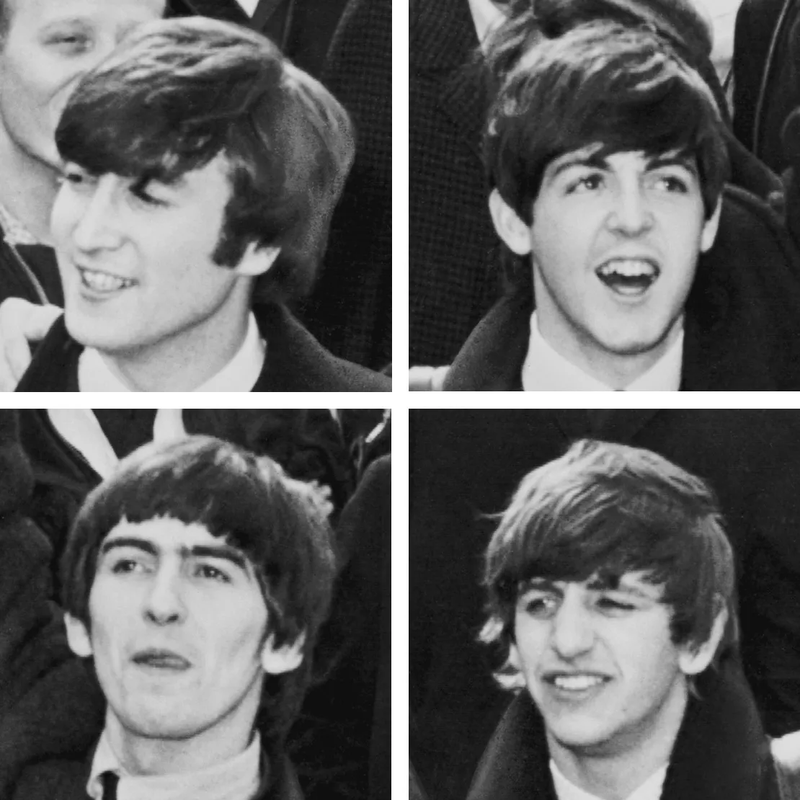
Foto: United Press International, dominio público, vía Wikimedia Commons
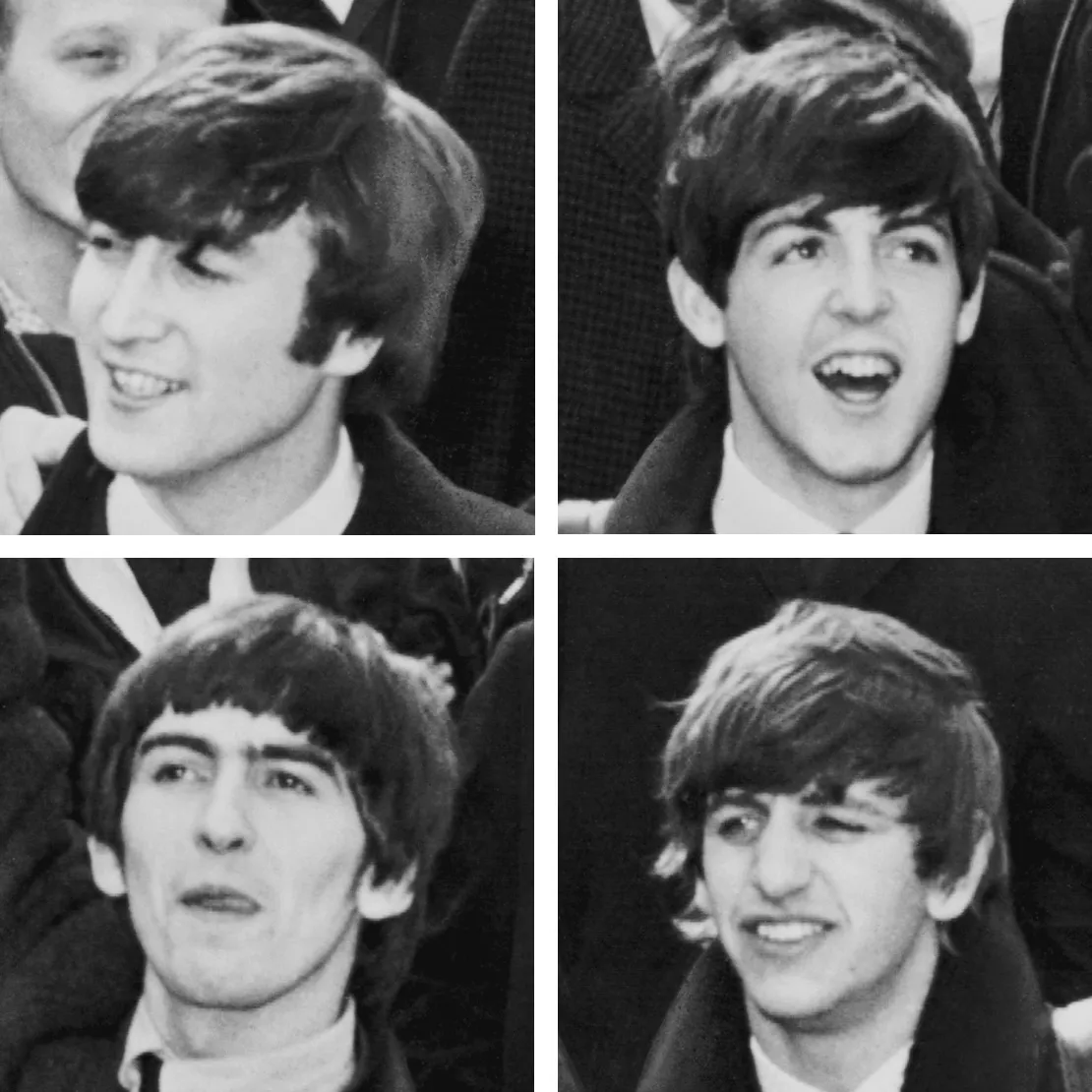
This is how the Beatles arrived in New York in February 1964: top row, John Lennon and Paul McCartney; bottom row, George Harrison and Ringo Starr. A year earlier, in London, they had recorded their first album.
That album was recorded in one day, 11 February 1963. They started at ten in the morning and worked through their live set, song after song. Lennon had a bad cold and spent the day sucking throat sweets. At ten at night, with the studio about to close, they recorded the last one: "Twist and Shout".
They got it on the first take. They tried a second one, but Lennon's voice was gone. What you hear on the record is a voice scraped to its limit, and at the end you can hear him cough. Years later he put it like this: "Every time I swallowed, it was like sandpaper."
Musical characteristics
Three chords that never stop. The whole song circles the same thing: D, G, A, and back to D. Neither the verse nor the ending changes chords. That three-chord loop is called I–IV–V: the first, fourth and fifth chords of the scale. It is the same family as "La Bamba", one tone higher.
One asks, the others answer. Lennon sings a line and, right behind him, Paul and George repeat it like an echo. The whole song works like that. When one voice calls and a group replies, it is called call and response. It comes from African American music, from gospel and blues, and it is the quickest way to get a whole audience singing.
The climb. At one point the band stops circling and holds a single chord: A seventh (A7), the fifth. That chord sounds like an unanswered question: it wants to go back to D. On top of it the voices come in one by one, each higher than the last, four steps in all. When the last one reaches the top, everyone screams and the song starts again. That tension is what makes the song grow without changing chords.
Drums and bass. Ringo hits hardest on 2 and 4: that is the backbeat, the basis of almost all rock. Paul, on bass, follows the three chords note by note. Two simple parts that, together, keep pushing forward.
A cover. What the Beatles recorded is a cover: someone else's song, played their own way. They copied the Isley Brothers' arrangement, climb included, but played it as what they were: a four-piece band, with two guitars, bass and drums.
Hard facts: D major, 4/4, 127 beats per minute, 2:32. The form: call-and-response verses over the same loop, the vocal climb, an instrumental section, another climb and a long final chord.
Guided listening
Play the music video. Before the voice comes in, count the chords on your hand: D, G, A, D. Check that the loop repeats the same way.
In the first verse, notice who sings each part. Lennon throws out the line and the other two answer. Count how many answers there are in one loop.
When everything stops on one chord and the voices start to climb, count the steps. Notice what the drums do meanwhile: they are waiting too.
In the part without voices, listen to what the electric guitar plays. There are no new chords: it is the same loop.
At the end the climb comes back and the song closes on a long chord. Compare that moment with the start. The chords are the same; what has changed is the energy.
Trivia and curiosities
- The Beatles' version reached number 2 in the US in April 1964. It got no higher because number 1 was another of their own songs, "Can't Buy Me Love". That week, the top five places all belonged to the Beatles.
- It is the only song by other writers that the Beatles turned into a million-selling single in the US. Everything else that sold that much they had written themselves.
- On the same day the Beatles auditioned for Decca Records, a London band called Brian Poole and the Tremeloes auditioned too. Decca chose the Tremeloes. Months later they also released "Twist and Shout", copying the Beatles' style.
- In 1993 a Jamaican duo, Chaka Demus & Pliers, turned it into reggae and went to number 1 in the UK. Three chords will carry any style.
Classroom activities
- Call and response with nothing. One person sings the line and the class answers like the choir. Clap the backbeat on 2 and 4 and tap the beat with your foot. Change soloist every loop.
- Play family A. On ukulele, D, G and A, one chord per bar, a downstroke on every beat. Then play "La Bamba" in C, F and G. Compare: which chord in one song takes the place of each chord in the other?
- The climb. The whole class holds A7. Four voices come in one after another, each one step higher, and everyone shouts at the end. Try it without the climb: what is lost?
- Band. Drums on the backbeat, bass following the three chords, keyboard playing the chords that the acoustic guitar plays on the record, electric guitar and voice. The solo goes where everything stops on A7: guitar or keyboard improvises there before the voices come back. To start with, the D major pentatonic scale works.
Key vocabulary
- I–IV–V — I–IV–V: los acordes primero, cuarto y quinto de la escala
- Call and response — llamada y respuesta
- Backbeat — el golpe a contratiempo (2 y 4)
- Seventh chord — acorde de séptima
- Cover — versión
Resources
Official music video — The Beatles on a 1963 TV show, filmed in a cinema in Wales. The sound is the recording from their first album.
Guitar tutorial — JustinGuitar. Chords, strumming, the barre-chord version and the riff, in chapters.
Ukulele tutorial — Cynthia Lin and Ukulenny. A play-along for "Twist and Shout" and "La Bamba" with the same three chords.
Piano tutorial — Bitesize Piano. The chords and the accompaniment for the whole song.
Drum tutorial — Thom Mills. Ringo's part explained step by step.
Bass tutorial — Andy Guitar. For bass beginners. It belongs to the same series as the drum lesson, so you can learn them together.
The Isley Brothers (1962), to compare — The version the Beatles copied. Listen for the climb and compare the two lead voices.
- Harmonic analysis — https://www.hooktheory.com/theorytab/view/the-beatles/twist-and-shout
Por qué está en este libro
Abrís el curso en octubre con dos canciones seguidas que usan los mismos tres acordes: «La Bamba» y «Twist and Shout». Es la familia A del libro, la progresión I–IV–V. En «La Bamba» la tocáis en do (do, fa, sol); aquí, en re (re, sol, la). Los acordes son otros, pero la función de cada uno es la misma, y esa es la primera lección del curso: un acorde no es un sitio fijo, es un papel. En el aula sin nada trabajáis la llamada y la respuesta a capela, con la clase haciendo de coro, y el pulso con percusión corporal. Con ukelele, los tres acordes y el rasgueo. En el aula de música, la banda entera: el solo va en la parte en la que todo se para en el la séptima, antes del «aaah», y la segunda voz son las respuestas del coro.
Por dónde entrar
Si has visto Todo en un día (Ferris Bueller's Day Off, 1986), ya la conoces. Es la escena del desfile por Chicago: Ferris se sube a una carroza y hace como que canta «Twist and Shout», y acaba bailando media ciudad.
La canción tenía entonces veintitrés años. Aun así, gracias a la película volvió a las listas de Estados Unidos.
La pregunta de esta página es: ¿cómo puede una canción de tres acordes, que no cambian nunca, sonar cada vez más fuerte hasta el final?
Contexto histórico
«Twist and Shout» no es de los Beatles. La escribieron dos compositores de Nueva York, Phil Medley y Bert Berns, en 1961. El twist era un baile de moda, y la canción pedía exactamente eso: bailar y gritar.
La primera grabación, de un grupo llamado The Top Notes, no le gustó a nadie, tampoco a Berns. Al año siguiente él mismo la produjo con los Isley Brothers, un grupo de soul. Le añadieron algo nuevo: una subida de cuatro notas, cantadas una encima de otra, que termina en un grito. Con eso la canción funcionó.
Foto: United Press International, dominio público, vía Wikimedia Commons
Así llegaban los Beatles a Nueva York en febrero de 1964: arriba, John Lennon y Paul McCartney; abajo, George Harrison y Ringo Starr. Un año antes, en Londres, habían grabado su primer disco.
Ese disco se grabó en un solo día, el 11 de febrero de 1963. Empezaron a las diez de la mañana y fueron tocando su repertorio de conciertos, canción tras canción. Lennon estaba resfriado y se pasó el día chupando caramelos para la garganta. A las diez de la noche, con el estudio a punto de cerrar, grabaron la última: «Twist and Shout».
Salió a la primera. Intentaron una segunda toma, pero Lennon ya no tenía voz. Lo que oyes en el disco es una voz rasgada al límite, y al final se le oye toser. Años después él lo contaba así: «Cada vez que tragaba, era como papel de lija».
Cómo suena
Tres acordes que no paran. Toda la canción da vueltas a lo mismo: re, sol, la, y otra vez re. Ni la estrofa ni el final cambian de acordes. Esa vuelta de tres se llama I–IV–V: el primer acorde de la escala, el cuarto y el quinto. Es la misma familia de «La Bamba», un tono más arriba.
Uno pregunta, los otros contestan. Lennon canta una frase y, justo detrás, Paul y George la repiten como un eco. Así toda la canción. Cuando una voz lanza y un grupo responde, se llama llamada y respuesta. Viene de la música afroamericana, del gospel y del blues, y es la manera más rápida de que un público entero acabe cantando.
La subida. En un momento, la banda deja de dar vueltas y se queda parada en un solo acorde: la séptima (A7), el quinto. Ese acorde suena a pregunta sin contestar: pide volver a re. Encima, las voces entran una a una, cada una más aguda que la anterior, cuatro escalones en total. Cuando la última llega arriba, gritan todos y la canción vuelve a empezar. Esa tensión es la que hace que la canción crezca sin cambiar de acordes.
La batería y el bajo. Ringo marca los golpes fuertes en el 2 y el 4: es el backbeat, la base de casi todo el rock. Paul, en el bajo, sigue los tres acordes nota a nota. Son dos partes sencillas que, juntas, empujan todo el rato hacia delante.
Una versión. Lo que los Beatles grabaron es una versión: una canción de otros, tocada a su manera. Copiaron el arreglo de los Isley Brothers, con la subida, pero lo tocaron como lo que eran: un grupo de cuatro, con dos guitarras, bajo y batería.
Datos duros: Re mayor, 4/4, 127 pulsos por minuto, 2:32. La forma: estrofas de llamada y respuesta sobre el mismo bucle, subida de voces, parte instrumental, otra subida y un acorde final largo.
Escucha guiada
Pon el videoclip. Antes de que entre la voz, cuenta los acordes con la mano: re, sol, la, re. Comprueba que la vuelta se repite igual.
En la primera estrofa, fíjate en quién canta cada parte. Lennon lanza la frase y los otros dos contestan. Cuenta cuántas respuestas hay en una vuelta.
Cuando todo se para en un acorde y las voces empiezan a subir, cuenta los escalones. Fíjate en lo que hace la batería mientras tanto: también está esperando.
En la parte sin voz, escucha qué toca la guitarra eléctrica. No hay acordes nuevos: es el mismo bucle.
Al final, la subida vuelve y la canción se cierra en un acorde largo. Compara ese momento con el principio. Los acordes son los mismos; lo que ha cambiado es la energía.
Curiosidades
- La versión de los Beatles llegó al número 2 en Estados Unidos en abril de 1964. No pasó del 2 porque el número 1 era otra canción suya, «Can't Buy Me Love». Esa semana, los cinco primeros puestos eran de los Beatles.
- Es la única versión de otro autor que los Beatles convirtieron en un sencillo de un millón de copias en Estados Unidos. Todo lo demás que vendió tanto lo habían escrito ellos.
- El mismo día que los Beatles hicieron su prueba para la discográfica Decca, la hizo también un grupo de Londres, Brian Poole and the Tremeloes. Decca eligió a los Tremeloes. Meses después, ellos también sacaron «Twist and Shout», copiando el estilo de los Beatles.
- En 1993 un dúo jamaicano, Chaka Demus & Pliers, la convirtió en reggae y llegó al número 1 en Reino Unido. Los tres acordes aguantan cualquier estilo.
Para hacer en clase
- Llamada y respuesta sin nada. Una persona canta la frase y la clase contesta como el coro. Marcad el backbeat con palmas en el 2 y el 4, y el pulso con el pie. Cambiad de solista en cada vuelta.
- Tocar la familia A. Con ukelele, re, sol y la, un acorde por compás, rasgueo hacia abajo en cada pulso. Después tocad «La Bamba» en do, fa y sol. Comparad: ¿qué acorde de una ocupa el sitio de cada acorde de la otra?
- La subida. Toda la clase se queda en el la séptima. Cuatro voces entran una detrás de otra, cada una un escalón más arriba, y todos gritan al final. Probad a hacerlo sin la subida: ¿qué se pierde?
- Banda. Batería con backbeat, bajo siguiendo los tres acordes, teclado con los acordes que en el disco hace la guitarra acústica, eléctrica y voz. El solo va donde todo se para en el la séptima: la guitarra o el teclado improvisa ahí antes de que vuelvan las voces. Para empezar, sirve la escala pentatónica de re mayor.
Vocabulario fundamental
- I–IV–V — Los acordes primero, cuarto y quinto de una escala. En re: re, sol, la.
- Llamada y respuesta — Una voz lanza una frase y un grupo le contesta.
- Backbeat — Los golpes fuertes de la batería en el 2 y el 4 del compás.
- Acorde de séptima — Un acorde que suena a pregunta y pide volver a casa. Aquí, el la séptima.
- Versión — Una canción de otros autores tocada a tu manera.
Recursos
Videoclip oficial — Los Beatles en un programa de televisión de 1963, grabado en un cine de Gales. Suena la grabación de su primer disco.
Tutorial de guitarra — JustinGuitar. Los acordes, el rasgueo, la versión con cejilla y el riff, por capítulos.
Tutorial de ukelele — Cynthia Lin y Ukulenny. Una sesión para tocar a la vez «Twist and Shout» y «La Bamba» con los mismos tres acordes.
Tutorial de piano — Bitesize Piano. Los acordes y el acompañamiento de la canción entera.
Tutorial de batería — Thom Mills. La parte de Ringo explicada paso a paso.
Tutorial de bajo — Andy Guitar. Para quien empieza con el bajo. Es de la misma serie que el de batería, así que podéis aprenderlos juntos.
The Isley Brothers (1962), para comparar — La versión de la que copiaron los Beatles. Escucha la subida y compara las dos voces principales.
- Análisis armónico — https://www.hooktheory.com/theorytab/view/the-beatles/twist-and-shout
Why it's in this book
You open the year in October with two songs in a row that use the same three chords: "La Bamba" and "Twist and Shout". That is family A in this book, the I–IV–V progression. You play "La Bamba" in C (C, F, G); this one is in D (D, G, A). The chords are different, but each one does the same job, and that is the first lesson of the year: a chord is not a fixed place, it is a role. In the classroom with no instruments you work on call and response a cappella, with the class as the choir, and keep the beat with body percussion. With ukuleles, the three chords and the strum. In the music room, the full band: the solo goes in the part where everything stops on A7, before the "aaah", and the second voice is the choir's answers.
Why this song
If you have seen Ferris Bueller's Day Off (1986), you already know it. It is the parade scene in Chicago: Ferris climbs onto a float, mimes "Twist and Shout", and half the city ends up dancing.
The song was twenty-three years old by then. Even so, the film sent it back into the US charts.
The question on this page is: how can a song with three chords that never change keep getting louder right to the end?
Historical context
"Twist and Shout" is not a Beatles song. Two New York songwriters, Phil Medley and Bert Berns, wrote it in 1961. The twist was the dance craze of the moment, and the song asked for exactly that: dance and shout.
The first recording, by a group called The Top Notes, pleased nobody, Berns included. The next year he produced it himself with the Isley Brothers, a soul group. They added something new: a climb of four notes, sung one on top of the other, ending in a scream. That made the song work.
Foto: United Press International, dominio público, vía Wikimedia Commons
This is how the Beatles arrived in New York in February 1964: top row, John Lennon and Paul McCartney; bottom row, George Harrison and Ringo Starr. A year earlier, in London, they had recorded their first album.
That album was recorded in one day, 11 February 1963. They started at ten in the morning and worked through their live set, song after song. Lennon had a bad cold and spent the day sucking throat sweets. At ten at night, with the studio about to close, they recorded the last one: "Twist and Shout".
They got it on the first take. They tried a second one, but Lennon's voice was gone. What you hear on the record is a voice scraped to its limit, and at the end you can hear him cough. Years later he put it like this: "Every time I swallowed, it was like sandpaper."
Musical characteristics
Three chords that never stop. The whole song circles the same thing: D, G, A, and back to D. Neither the verse nor the ending changes chords. That three-chord loop is called I–IV–V: the first, fourth and fifth chords of the scale. It is the same family as "La Bamba", one tone higher.
One asks, the others answer. Lennon sings a line and, right behind him, Paul and George repeat it like an echo. The whole song works like that. When one voice calls and a group replies, it is called call and response. It comes from African American music, from gospel and blues, and it is the quickest way to get a whole audience singing.
The climb. At one point the band stops circling and holds a single chord: A seventh (A7), the fifth. That chord sounds like an unanswered question: it wants to go back to D. On top of it the voices come in one by one, each higher than the last, four steps in all. When the last one reaches the top, everyone screams and the song starts again. That tension is what makes the song grow without changing chords.
Drums and bass. Ringo hits hardest on 2 and 4: that is the backbeat, the basis of almost all rock. Paul, on bass, follows the three chords note by note. Two simple parts that, together, keep pushing forward.
A cover. What the Beatles recorded is a cover: someone else's song, played their own way. They copied the Isley Brothers' arrangement, climb included, but played it as what they were: a four-piece band, with two guitars, bass and drums.
Hard facts: D major, 4/4, 127 beats per minute, 2:32. The form: call-and-response verses over the same loop, the vocal climb, an instrumental section, another climb and a long final chord.
Guided listening
Play the music video. Before the voice comes in, count the chords on your hand: D, G, A, D. Check that the loop repeats the same way.
In the first verse, notice who sings each part. Lennon throws out the line and the other two answer. Count how many answers there are in one loop.
When everything stops on one chord and the voices start to climb, count the steps. Notice what the drums do meanwhile: they are waiting too.
In the part without voices, listen to what the electric guitar plays. There are no new chords: it is the same loop.
At the end the climb comes back and the song closes on a long chord. Compare that moment with the start. The chords are the same; what has changed is the energy.
Trivia and curiosities
- The Beatles' version reached number 2 in the US in April 1964. It got no higher because number 1 was another of their own songs, "Can't Buy Me Love". That week, the top five places all belonged to the Beatles.
- It is the only song by other writers that the Beatles turned into a million-selling single in the US. Everything else that sold that much they had written themselves.
- On the same day the Beatles auditioned for Decca Records, a London band called Brian Poole and the Tremeloes auditioned too. Decca chose the Tremeloes. Months later they also released "Twist and Shout", copying the Beatles' style.
- In 1993 a Jamaican duo, Chaka Demus & Pliers, turned it into reggae and went to number 1 in the UK. Three chords will carry any style.
Classroom activities
- Call and response with nothing. One person sings the line and the class answers like the choir. Clap the backbeat on 2 and 4 and tap the beat with your foot. Change soloist every loop.
- Play family A. On ukulele, D, G and A, one chord per bar, a downstroke on every beat. Then play "La Bamba" in C, F and G. Compare: which chord in one song takes the place of each chord in the other?
- The climb. The whole class holds A7. Four voices come in one after another, each one step higher, and everyone shouts at the end. Try it without the climb: what is lost?
- Band. Drums on the backbeat, bass following the three chords, keyboard playing the chords that the acoustic guitar plays on the record, electric guitar and voice. The solo goes where everything stops on A7: guitar or keyboard improvises there before the voices come back. To start with, the D major pentatonic scale works.
Key vocabulary
- I–IV–V — I–IV–V: los acordes primero, cuarto y quinto de la escala
- Call and response — llamada y respuesta
- Backbeat — el golpe a contratiempo (2 y 4)
- Seventh chord — acorde de séptima
- Cover — versión
Resources
Official music video — The Beatles on a 1963 TV show, filmed in a cinema in Wales. The sound is the recording from their first album.
Guitar tutorial — JustinGuitar. Chords, strumming, the barre-chord version and the riff, in chapters.
Ukulele tutorial — Cynthia Lin and Ukulenny. A play-along for "Twist and Shout" and "La Bamba" with the same three chords.
Piano tutorial — Bitesize Piano. The chords and the accompaniment for the whole song.
Drum tutorial — Thom Mills. Ringo's part explained step by step.
Bass tutorial — Andy Guitar. For bass beginners. It belongs to the same series as the drum lesson, so you can learn them together.
The Isley Brothers (1962), to compare — The version the Beatles copied. Listen for the climb and compare the two lead voices.
- Harmonic analysis — https://www.hooktheory.com/theorytab/view/the-beatles/twist-and-shout