Contenidos
Sweet Home Alabama — Lynyrd Skynyrd (1974)
Three chords going round and round, and a two-bar riff that is the whole song. Playing it isn't the hard part: sharing it out between five people is.
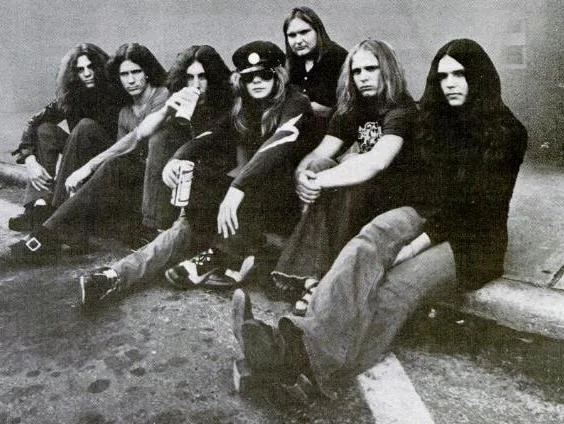
🏷️ Ficha musical
Why this song
The chords never change. Not once in four minutes and forty-three seconds. Verse, chorus and solo all sit on the same two-bar loop, and the song still gets somewhere.
So the useful question isn't how to play it. It's how five people divide up three chords without getting in each other's way. That is exactly the problem a band has to solve in its first rehearsal, and this song puts it in front of you with nothing to hide behind.
Historical context
It was recorded in 1973 at Studio One in Doraville, Georgia, with Al Kooper producing. The basic track took three or four takes and only three people were playing: Ed King on guitar, Leon Wilkeson on bass, Bob Burns on drums. The two rhythm guitars, Billy Powell's piano and the vocal went on afterwards.
The song exists because two other songs came first. Neil Young had released "Southern Man" (1970) and "Alabama" (1972), blaming the whole South for slavery and for what followed. "We thought Neil was shooting all the ducks in order to kill one or two," said Ronnie Van Zant. A song written to reply to another one is called an answer song.
One line still causes trouble: "In Birmingham they love the governor". The governor was George Wallace, a segregationist, and Birmingham was the centre of the 1963 civil rights campaign. Van Zant later said he and Wallace had very little in common and that he didn't like what Wallace said about black people. Ed King, who co-wrote it, posted the opposite in 2009: the line meant what it says.
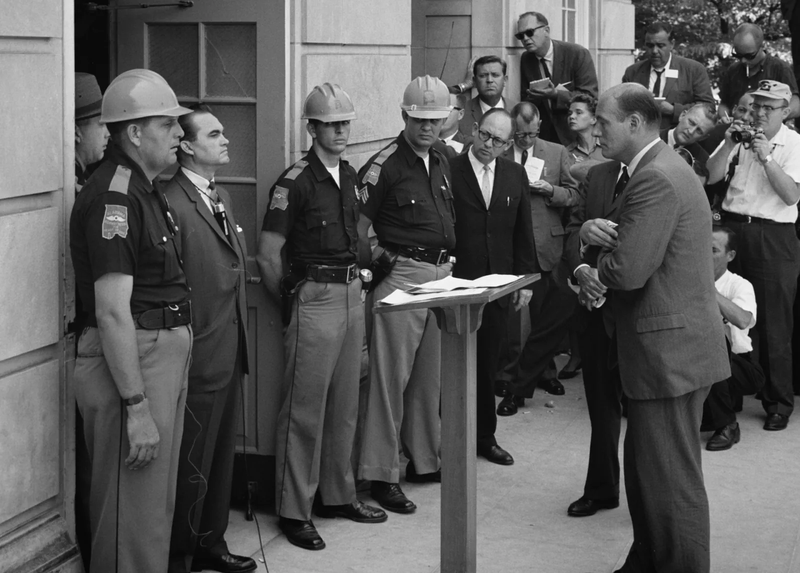
Foto: Warren K. Leffler, U.S. News & World Report, 11 de junio de 1963, dominio público, vía Wikimedia Commons
So the two people who wrote it don't agree on what their own song says. On top of that, the band played for decades with a Confederate flag behind them; in the documentary If I Leave Here Tomorrow (2018) they say the idea came from their label, MCA, to sell their Southern background. On the farewell tour they played in front of the US flag instead.
Musical characteristics
The whole song is one loop of three chords: D, C, G, two bars long. That's it. Verse, chorus and solo all ride the same loop without a single detour.
On top of that loop there is a guitar figure that comes in alone at the start and never leaves. That is a riff: a short phrase that repeats and that you recognise before anyone sings. Here the riff doesn't accompany the song. It is the song.
The interesting part for a band is that the guitar isn't doing one job, it's doing three, and on the record three different people do them. Ed King plays the riff. Allen Collins strums the chords in the left channel and Gary Rossington in the right. Put one earbud in each ear and you can hear them apart.
Leon Wilkeson's bass does something the riff cannot do: say where the chord changes. While the guitar is busy with its figure, the bass puts the bottom note down and tells you whether you are on D, C or G. If the bass gets lost, the loop stops making sense even if everyone else is right.
Bob Burns' drums are in 4/4 with the snare on beats 2 and 4, the weak ones, never on 1 and 3. That hit is called the backbeat, and it is the exact spot where an audience claps without being told. Billy Powell's piano fills the gaps the voice leaves and is left almost alone at the end.
Then the hard question: what key is it in? There is one sharp, F#, which is the key signature of G major. But the chord your ear keeps coming back to is D.
When that happens — the notes of one key circling around a different note of it — you call it a mode, and this one is D Mixolydian: the three chords are I–♭VII–IV. Read it in G major and the same three are V–IV–I. Both readings are in print, and neither is a mistake.
Hard facts: one sharp in the key signature (D Mixolydian, or G major depending on who's reading), 4/4, 98 BPM, 4:43. The vocal melody runs from G3 to D5. The form is standard rock: intro, alternating verses and choruses, a guitar solo in the middle, and an ending with the piano out front.
Trivia and curiosities
- At a Metallica rehearsal in the early eighties, Dave Mustaine started playing this between takes as a joke. Lars Ulrich didn't know the song, liked it, and the riff ended up inside "The Four Horsemen" on a thrash metal album. Three chords travel further than three chords should.
- The first thing you hear wasn't planned. Van Zant says "turn it up", asking for more volume in his headphones, and the "one, two, three" after it is Ed King counting. Both stayed in the mix. A record isn't a clean object: it's a photograph of a room with people in it.
- King said the chords and both solos came to him in a dream after a rehearsal, note for note. The solo on the record is the first one he played. Sounding spontaneous and being spontaneous are not the same thing.
- The backing vocals were sung by black session singers. Merry Clayton said in 2013 that her first answer was a flat no, and that she took the job to "let the music be my protest". The credits are disputed: some studio documentation gives those voices to The Sweet Inspirations. A record gets made by people who don't have to agree with it.
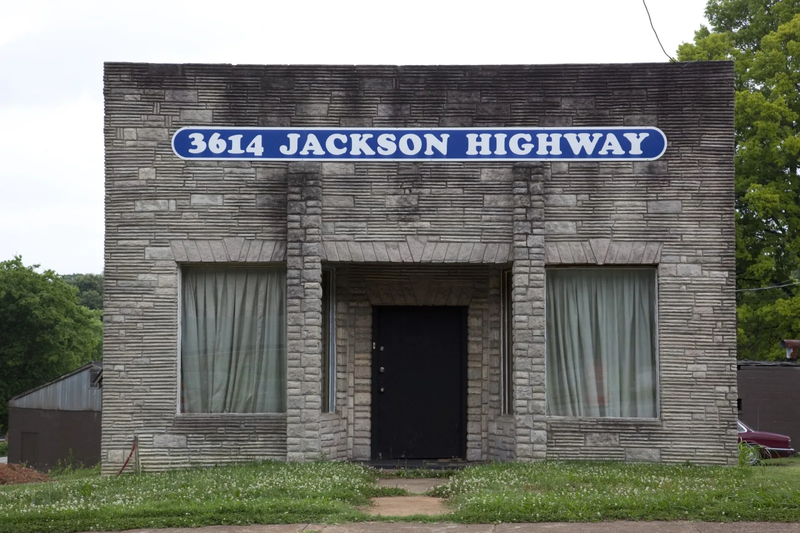
Foto: Carol M. Highsmith, Library of Congress, dominio público, vía Wikimedia Commons
- The lyric boasts about the Swampers, the session players from Muscle Shoals in Alabama. The song was recorded in Georgia, over three hundred kilometres away. A lyric is not a document.
Classroom activities
- Play: build the D–C–G loop with the whole class before anything else. Once it holds on its own, split it up: one guitar on the riff, one on the chords, bass on the roots, drums with the snare on 2 and 4, keyboard filling. The riff goes in last.
- Sing: the melody covers 19 semitones, so it won't fit in every voice. Split it into sections and give the highest part of the chorus to whoever has it comfortably. No forcing.
- Analyse: a closed question. With one earbud in each ear, say which guitar is on the left and which is on the right, and what is different about what they play. Then count how many D–C–G loops fit in one verse.
- Create: take that same three-chord loop and write your own two-bar riff over it. Steal the procedure, not the song.
Key vocabulary
- Riff — riff: una frase corta que se repite y que reconoces enseguida
- Answer song — canción respuesta: una canción escrita para contestar a otra
- Chord progression — progresión de acordes
- Backbeat — el golpe de caja en los tiempos 2 y 4, los débiles
- Mixolydian mode — modo mixolidio: las notas de una tonalidad mayor girando alrededor de su quinto grado
Resources
In Year 3 — this song is also used in the units ¿Cómo mandas una canción a mil kilómetros sin poder escribirla?, ¿Cuándo empieza una melodía a decir de dónde eres?, from the theory and history book.
Where it is explained — this song is studied in the units ¿Por qué todo el mundo da la palmada en el mismo sitio?, Cuatro notas y un amplificador que no aguanta, from the modern music history book.
Official video (with lyrics) — the band's official channel, with the album audio.
Guitar tutorial: the riff — guitarraviva, in Spanish. Five and a half minutes, just the intro figure.
Guitar tutorial: the chords — guitarraviva, in Spanish. The acoustic accompaniment, step by step.
Piano tutorial — MikesMusic123, in English. The piano parts and riffs, complete and free.
Bass tutorial — Super Easy Bass. Simplified arrangement with the tab on screen, and a backing track to play over from 2:21.
Drum tutorial — E7 Music School, in English. Full speed first, then broken down.
- Harmonic analysis — https://www.hooktheory.com/theorytab/view/lynyrd-skynyrd/sweet-home-alabama
- Tab — the button opens it in Songsterr
Por dónde entrar
En un ensayo de Metallica, a principios de los ochenta, Dave Mustaine se puso a tocar esto entre toma y toma por hacer la gracia. Lars Ulrich no la conocía. Le pareció buena idea, y el riff acabó dentro de «The Four Horsemen», en un disco de thrash metal.
Eso es lo que tiene esta canción: son tres acordes y una figura de dos compases, y aguantan casi cualquier cosa que les eches encima. La pregunta para quien la va a tocar en clase es otra. Si no cambia nunca, ¿por qué no aburre?
Contexto histórico
Se grabó en 1973 en Studio One, en Doraville (Georgia), con Al Kooper de productor. La base se sacó en tres o cuatro tomas y solo tocaban tres personas: Ed King a la guitarra, Leon Wilkeson al bajo y Bob Burns a la batería. Las dos guitarras rítmicas, el piano de Billy Powell y la voz se añadieron después, encima.
La canción existe porque antes existieron otras dos. Neil Young había publicado «Southern Man» (1970) y «Alabama» (1972), donde señalaba al Sur entero por la esclavitud y por lo que vino después. «Neil estaba disparando a todos los patos para matar a uno o dos», dijo Ronnie Van Zant. A una canción escrita para contestar a otra se le llama canción respuesta.
Hay un verso que sigue dando problemas: «en Birmingham queremos al gobernador». El gobernador era George Wallace, segregacionista, y Birmingham fue el centro de la campaña por los derechos civiles de 1963. Van Zant dijo después que él y Wallace tenían poco en común y que no le gustaba lo que Wallace decía de la gente negra. Ed King, coautor de la letra, escribió en 2009 justo lo contrario: que el verso iba en serio.
Foto: Warren K. Leffler, U.S. News & World Report, 11 de junio de 1963, dominio público, vía Wikimedia Commons
Es decir: ni los dos que la escribieron se ponen de acuerdo sobre qué dice su propia canción. Encima, el grupo tocó durante décadas con la bandera confederada de telón de fondo; en el documental If I Leave Here Tomorrow (2018) cuentan que la idea vino de la discográfica, MCA, para vender su origen sureño. En la gira de despedida ya tocaban delante de la bandera de Estados Unidos.
Cómo suena
Toda la canción es una vuelta de tres acordes: Re, Do, Sol, dos compases. No hay más. Estrofa, estribillo y solo van encima de la misma vuelta, sin una desviación.
Encima de esa vuelta hay una figura de guitarra que entra sola al principio y ya no se va. Eso es un riff: una frase corta que se repite y que reconoces antes de que cante nadie. Aquí el riff no acompaña a la canción, es la canción.
Lo interesante para tocarla en grupo es que la guitarra no hace una sola cosa: hace tres, y en el disco las hacen tres personas distintas. Ed King toca el riff. Allen Collins rasguea los acordes en el canal izquierdo y Gary Rossington en el derecho. Ponte un auricular en cada oído y lo oyes separado.
El bajo de Leon Wilkeson hace algo que el riff no puede hacer: decir dónde cambia el acorde. Mientras la guitarra está ocupada con su figura, el bajo pone la nota de abajo y te avisa de si estás en Re, en Do o en Sol. Si el bajo se pierde, la vuelta deja de entenderse aunque todos los demás acierten.
La batería de Bob Burns va en 4/4 con la caja en los tiempos 2 y 4, los débiles, nunca en el 1 y el 3. Ese golpe se llama backbeat, y es el sitio exacto donde la gente da palmas sin que nadie se lo diga. El piano de Billy Powell rellena los huecos que deja la voz y se queda casi solo al final.
Queda la pregunta difícil: ¿en qué tono está? Hay un solo sostenido, fa#, que es la armadura de Sol mayor. Pero el acorde que manda al oído es Re.
Cuando pasa eso —las notas de una tonalidad girando alrededor de otra de sus notas— se llama modo, y este es re mixolidio: los tres acordes serían I–♭VII–IV. Quien lo lee en Sol mayor numera los mismos tres como V–IV–I. Las dos lecturas circulan en los análisis publicados, y ninguna es un error.
Datos duros: armadura de un sostenido (re mixolidio, o Sol mayor según quién lo lea), 4/4, 98 BPM, 4:43. La melodía de la voz va de Sol3 a Re5. La forma es la de siempre en el rock: introducción, estrofas y estribillos alternos, un solo de guitarra en medio y un final con el piano por delante.
Curiosidades
- Lo primero que se oye no estaba previsto. Van Zant dice «turn it up» pidiendo más volumen en sus auriculares, y el «uno, dos, tres» que sigue lo cuenta Ed King. Se quedaron en la mezcla. Un disco no es un objeto limpio: es la foto de una habitación con gente dentro.
- King contaba que los acordes y los dos solos se le habían aparecido en un sueño después de un ensayo, nota por nota. El solo que salió publicado fue el primero que grabó. Sonar espontáneo y ser espontáneo no son lo mismo.
- Las voces del fondo las cantaron coristas negras de estudio. Merry Clayton contó en 2013 que su primera reacción fue negarse en redondo, y que acabó aceptando para «dejar que la música fuera mi protesta». Los créditos de esas voces están en discusión: parte de la documentación del estudio se las atribuye a The Sweet Inspirations. Una grabación la hace gente que no tiene por qué estar de acuerdo con lo que graba.
- La letra presume de los Swampers, los músicos de estudio de Muscle Shoals, en Alabama. La canción se grabó en Georgia, a más de trescientos kilómetros. Una letra no es un documento.
Foto: Carol M. Highsmith, Library of Congress, dominio público, vía Wikimedia Commons
- La pelea con Neil Young era bastante menos pelea de lo que parece: Young escribió «Powderfinger» pensando en ellos, y en su autobiografía de 2012 dejó dicho que su propia «Alabama» se merecía de sobra el disparo que le hizo Lynyrd Skynyrd.
Para hacer en clase
- Tocar: montar la vuelta Re–Do–Sol con toda la clase antes de tocar nada más. Cuando se aguante sola, repartir: una guitarra con el riff, otra con los acordes, bajo marcando las fundamentales, batería con la caja en 2 y 4, teclado rellenando. El riff entra el último.
- Cantar: la melodía recorre 19 semitonos, así que no cabe entera en cualquier voz. Repartir por tramos, y dejar la parte más aguda del estribillo a quien la tenga cómoda, sin forzar.
- Analizar: pregunta cerrada. Con un auricular en cada oído, di qué guitarra suena a la izquierda y cuál a la derecha, y en qué se diferencia lo que tocan. Después cuenta cuántas vueltas de Re–Do–Sol caben en una estrofa.
- Crear: coger esa misma vuelta de tres acordes y escribir un riff propio de dos compases encima. Se trata de robar el procedimiento, no la canción.
Vocabulario fundamental
- Riff — Una frase corta que se repite y que reconoces antes de que cante nadie.
- Canción respuesta — Una canción escrita para contestar a otra.
- Progresión de acordes — La vuelta de acordes que se repite. Aquí son tres y no cambian nunca: Re–Do–Sol.
- Backbeat — El golpe de caja en los tiempos 2 y 4, los débiles. Es donde la gente da palmas.
- Modo mixolidio — Las notas de una tonalidad mayor girando alrededor de su quinto grado. Aquí, las de Sol mayor con el peso puesto en Re.
Recursos
En 3º de ESO — también se usa en las unidades ¿Cómo mandas una canción a mil kilómetros sin poder escribirla?, ¿Cuándo empieza una melodía a decir de dónde eres?, del libro de teoría e historia.
Dónde se explica — esta canción se estudia en las unidades ¿Por qué todo el mundo da la palmada en el mismo sitio?, Cuatro notas y un amplificador que no aguanta, del libro de historia de la música moderna.
Vídeo oficial (con la letra) — canal oficial del grupo, con el audio del disco.
Tutorial de guitarra: el riff — guitarraviva, en castellano. Cinco minutos y medio, solo la figura de la introducción.
Tutorial de guitarra: los acordes — guitarraviva, en castellano. La versión de acompañamiento en acústica, paso a paso.
Tutorial de piano — MikesMusic123, en inglés. Las partes de piano y los riffs, completo y gratuito.
Tutorial de bajo — Super Easy Bass. Arreglo simplificado con la tablatura en pantalla y base para tocar encima a partir de 2:21.
Tutorial de batería — E7 Music School, en inglés. Primero a velocidad real, luego desmontado por partes.
- Análisis armónico — https://www.hooktheory.com/theorytab/view/lynyrd-skynyrd/sweet-home-alabama
- Tablatura — el botón la abre en Songsterr
Why this song
The chords never change. Not once in four minutes and forty-three seconds. Verse, chorus and solo all sit on the same two-bar loop, and the song still gets somewhere.
So the useful question isn't how to play it. It's how five people divide up three chords without getting in each other's way. That is exactly the problem a band has to solve in its first rehearsal, and this song puts it in front of you with nothing to hide behind.
Historical context
It was recorded in 1973 at Studio One in Doraville, Georgia, with Al Kooper producing. The basic track took three or four takes and only three people were playing: Ed King on guitar, Leon Wilkeson on bass, Bob Burns on drums. The two rhythm guitars, Billy Powell's piano and the vocal went on afterwards.
The song exists because two other songs came first. Neil Young had released "Southern Man" (1970) and "Alabama" (1972), blaming the whole South for slavery and for what followed. "We thought Neil was shooting all the ducks in order to kill one or two," said Ronnie Van Zant. A song written to reply to another one is called an answer song.
One line still causes trouble: "In Birmingham they love the governor". The governor was George Wallace, a segregationist, and Birmingham was the centre of the 1963 civil rights campaign. Van Zant later said he and Wallace had very little in common and that he didn't like what Wallace said about black people. Ed King, who co-wrote it, posted the opposite in 2009: the line meant what it says.
Foto: Warren K. Leffler, U.S. News & World Report, 11 de junio de 1963, dominio público, vía Wikimedia Commons
So the two people who wrote it don't agree on what their own song says. On top of that, the band played for decades with a Confederate flag behind them; in the documentary If I Leave Here Tomorrow (2018) they say the idea came from their label, MCA, to sell their Southern background. On the farewell tour they played in front of the US flag instead.
Musical characteristics
The whole song is one loop of three chords: D, C, G, two bars long. That's it. Verse, chorus and solo all ride the same loop without a single detour.
On top of that loop there is a guitar figure that comes in alone at the start and never leaves. That is a riff: a short phrase that repeats and that you recognise before anyone sings. Here the riff doesn't accompany the song. It is the song.
The interesting part for a band is that the guitar isn't doing one job, it's doing three, and on the record three different people do them. Ed King plays the riff. Allen Collins strums the chords in the left channel and Gary Rossington in the right. Put one earbud in each ear and you can hear them apart.
Leon Wilkeson's bass does something the riff cannot do: say where the chord changes. While the guitar is busy with its figure, the bass puts the bottom note down and tells you whether you are on D, C or G. If the bass gets lost, the loop stops making sense even if everyone else is right.
Bob Burns' drums are in 4/4 with the snare on beats 2 and 4, the weak ones, never on 1 and 3. That hit is called the backbeat, and it is the exact spot where an audience claps without being told. Billy Powell's piano fills the gaps the voice leaves and is left almost alone at the end.
Then the hard question: what key is it in? There is one sharp, F#, which is the key signature of G major. But the chord your ear keeps coming back to is D.
When that happens — the notes of one key circling around a different note of it — you call it a mode, and this one is D Mixolydian: the three chords are I–♭VII–IV. Read it in G major and the same three are V–IV–I. Both readings are in print, and neither is a mistake.
Hard facts: one sharp in the key signature (D Mixolydian, or G major depending on who's reading), 4/4, 98 BPM, 4:43. The vocal melody runs from G3 to D5. The form is standard rock: intro, alternating verses and choruses, a guitar solo in the middle, and an ending with the piano out front.
Trivia and curiosities
- At a Metallica rehearsal in the early eighties, Dave Mustaine started playing this between takes as a joke. Lars Ulrich didn't know the song, liked it, and the riff ended up inside "The Four Horsemen" on a thrash metal album. Three chords travel further than three chords should.
- The first thing you hear wasn't planned. Van Zant says "turn it up", asking for more volume in his headphones, and the "one, two, three" after it is Ed King counting. Both stayed in the mix. A record isn't a clean object: it's a photograph of a room with people in it.
- King said the chords and both solos came to him in a dream after a rehearsal, note for note. The solo on the record is the first one he played. Sounding spontaneous and being spontaneous are not the same thing.
- The backing vocals were sung by black session singers. Merry Clayton said in 2013 that her first answer was a flat no, and that she took the job to "let the music be my protest". The credits are disputed: some studio documentation gives those voices to The Sweet Inspirations. A record gets made by people who don't have to agree with it.
Foto: Carol M. Highsmith, Library of Congress, dominio público, vía Wikimedia Commons
- The lyric boasts about the Swampers, the session players from Muscle Shoals in Alabama. The song was recorded in Georgia, over three hundred kilometres away. A lyric is not a document.
Classroom activities
- Play: build the D–C–G loop with the whole class before anything else. Once it holds on its own, split it up: one guitar on the riff, one on the chords, bass on the roots, drums with the snare on 2 and 4, keyboard filling. The riff goes in last.
- Sing: the melody covers 19 semitones, so it won't fit in every voice. Split it into sections and give the highest part of the chorus to whoever has it comfortably. No forcing.
- Analyse: a closed question. With one earbud in each ear, say which guitar is on the left and which is on the right, and what is different about what they play. Then count how many D–C–G loops fit in one verse.
- Create: take that same three-chord loop and write your own two-bar riff over it. Steal the procedure, not the song.
Key vocabulary
- Riff — riff: una frase corta que se repite y que reconoces enseguida
- Answer song — canción respuesta: una canción escrita para contestar a otra
- Chord progression — progresión de acordes
- Backbeat — el golpe de caja en los tiempos 2 y 4, los débiles
- Mixolydian mode — modo mixolidio: las notas de una tonalidad mayor girando alrededor de su quinto grado
Resources
In Year 3 — this song is also used in the units ¿Cómo mandas una canción a mil kilómetros sin poder escribirla?, ¿Cuándo empieza una melodía a decir de dónde eres?, from the theory and history book.
Where it is explained — this song is studied in the units ¿Por qué todo el mundo da la palmada en el mismo sitio?, Cuatro notas y un amplificador que no aguanta, from the modern music history book.
Official video (with lyrics) — the band's official channel, with the album audio.
Guitar tutorial: the riff — guitarraviva, in Spanish. Five and a half minutes, just the intro figure.
Guitar tutorial: the chords — guitarraviva, in Spanish. The acoustic accompaniment, step by step.
Piano tutorial — MikesMusic123, in English. The piano parts and riffs, complete and free.
Bass tutorial — Super Easy Bass. Simplified arrangement with the tab on screen, and a backing track to play over from 2:21.
Drum tutorial — E7 Music School, in English. Full speed first, then broken down.
- Harmonic analysis — https://www.hooktheory.com/theorytab/view/lynyrd-skynyrd/sweet-home-alabama
- Tab — the button opens it in Songsterr