Contenidos
Stay — The Kid LAROI y Justin Bieber (2021)
Two minutes and twenty-one seconds without a breather: a rising synth riff, drums that never stop and a chorus to sing at the top of your lungs. Four chords, and you already know three of them.

🏷️ Ficha musical
Why it's in this book
This song comes in January, the month when you learn, with Anti-Hero, that the four-chord loop can start on any of its chords. Stay is the month's second song. Its chords in class are F, G, A minor and E minor: three come from the loop you already play, and the fourth, E minor, replaces C. What you learn here is energy: a fast tempo that forces you to strum cleanly, without missing a stroke, and a chorus you sing almost shouting, with the second voice an octave away. In the room with no instruments you work on the chorus and the kick-drum beat with your feet; in the ukulele room, the four chords at full speed; in the music room, the drums play a kick on every beat and the keyboard plays the chords short and detached.
Why this song
Watch the music video with the sound down. Two singers dance through a city where everyone is frozen. The cars do not move, the people do not move. Only the two of them move.
Now turn it up. The music does the opposite of the picture: it never stops. The song lasts 2:21, shorter than almost any other song in this book, and it does not have a single calm moment.
The question on this page is: what makes a song sound in a hurry? Here the answer has three parts: the tempo, the drums and a riff that climbs.
Historical context
The Kid LAROI is an Australian singer and rapper. When "Stay" came out he was 17. Justin Bieber, from Canada, already had more than ten years of career behind him: his first big hit, "Baby", is also in this book.
The song was born almost by accident. LAROI was at the house of the producer Blake Slatkin with two other musicians, Charlie Puth and Omer Fedi. Puth started playing a melody on a keyboard. LAROI liked it so much that he wanted to build a song on it. Then he thought Bieber's voice would fit, and they recorded it together.
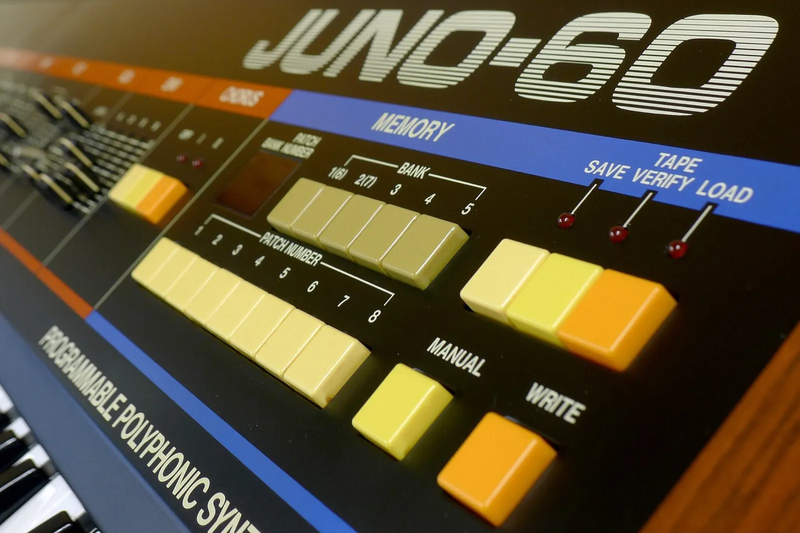
Foto: deepsonic, CC BY 2.0, vía Wikimedia Commons
This is a Roland Juno-60, a synthesizer from the 1980s. The riff in "Stay" was played on one like this, which belonged to Slatkin. A synthesizer is a keyboard that makes its sound electronically: it can imitate other instruments or invent new sounds.
It was number 1 in the United States and in more than twenty countries. In Australia it spent 17 weeks at number 1. In the UK it stopped at number 2, behind an Ed Sheeran song, "Bad Habits".
Musical characteristics
A riff that climbs. The song kicks off with a synth riff: a few quick notes going up, one after another. That riff never goes away. And in the chorus something curious happens: the melody the voices sing is the same one the keyboard was playing. The riff turns into the song.
Four chords, one new. Underneath, four chords repeat the whole time, in the verse and in the chorus. In class they are F, G, A minor and E minor. You already have F, G and A minor from the loop in Love Story or Anti-Hero. The new one is E minor, which takes the place of C. That is why it sounds similar to those songs, but darker: it ends on two minor chords.
Drums that push. The song runs at 170 beats per minute. That is very fast: if it is hard to follow, count only every other beat and you will feel 85, a steady walk. The classroom drummer plays a kick drum on every beat, without skipping one. That beat is called four-on-the-floor: four kick-drum hits per bar, like in dance music.
Voices that leap. Again and again, LAROI and Bieber make a big jump upwards. Down low they sing with their chest voice, the one you speak with. Up high they switch to their head voice, lighter, the one you feel buzzing in your head rather than your chest. That switch is what makes the song sound like a shout.
A warning for when you play. The record is in B♭ minor, with five flats. In class we move it down a semitone, to A minor, which has none: that is transposing. The chords become F, G, A minor and E minor, all easy on the ukulele.
Hard facts: B♭ minor on the record and A minor in class, 4/4, 170 beats per minute (you can feel it at 85), 2:21. The form: intro with the riff, then verses, pre-choruses and choruses that follow one another without a break; one of the verses is sung by Bieber.
Guided listening
Play the music video. In the intro, listen to the synth riff. Do the notes go up or down?
In the first verse, tap the beat with your foot. If it is too fast, tap only every other beat.
When the chorus arrives, compare the vocal melody with the riff from the start. Does it sound familiar?
Listen for the voice leaping upwards. Notice the moment it switches from chest voice to head voice.
When Bieber sings his verse, listen for whether the chords underneath change. Are they the same four?
Trivia and curiosities
- LAROI kept the song for almost a year before releasing it. He even asked his fans to flood the record label boss with messages so that he would let it come out.
- Charlie Puth, who played the melody on the keyboard, is famous for having perfect pitch: he can name any note just by hearing it.
- The whole song leaked online a month before its release. Even so, it reached number 1 in the United States.
- It lasts 2:21. Today many hit songs are under three minutes long: people listen on their phones, and a short song gets replayed more often.
Classroom activities
- Four-on-the-floor with your feet. The whole class stamps on every beat, non-stop, while the song plays. Then add claps on 2 and 4 on top of the stamps.
- Clean strumming. Ukulele: F, G, A minor and E minor, one chord per bar. First at half tempo, counting at 85. When it works with no mistakes, at full speed.
- The chorus in octaves. High voices sing the chorus at their pitch; low voices sing the same melody an octave lower. It is the same song, at two heights.
- From Anti-Hero to Stay. Play the Anti-Hero loop (F, C, G, A minor) and then the Stay loop (F, G, A minor, E minor). Which chords do they share? Which one sounds darker?
- Create. Make up a four-note riff that climbs, in A minor, and play it on the keyboard over the four chords. Could it be sung as a chorus?
Key vocabulary
- Synthesizer — sintetizador
- Riff — riff
- Four-on-the-floor — four-on-the-floor: un golpe de bombo en cada pulso
- Head voice — voz de cabeza
- Transposing — transportar
Resources
Official music video — LAROI and Bieber dance through a city where time has stopped.
Ukulele tutorial — Ricky Somborn. The four chords, with the lyrics to play along.
Guitar tutorial — Kurt Berg (5 Minute Guitar). A version with easy chords.
Keyboard tutorial — PHianonize. An easy version, with the riff and the keys lit up.
Drum tutorial — Steve Howard. The song's drum part, explained section by section.
Por qué está en este libro
Esta canción llega en enero, el mes en el que aprendes, con Anti-Hero, que el bucle de cuatro acordes puede empezar por cualquiera de ellos. Stay es la segunda canción de ese mes. Sus acordes en clase son fa, sol, la menor y mi menor: tres son del bucle que ya tocas, y el cuarto, mi menor, sustituye al do. Lo que aprendes aquí es energía: un tempo rápido que te obliga a rasguear limpio, sin que se te escape ningún golpe, y un estribillo que se canta casi gritando, con la segunda voz a una octava. En el aula sin nada se trabaja el estribillo y el pulso de bombo con los pies; en el aula con ukelele, los cuatro acordes a toda velocidad; en el aula de música, la batería toca un golpe de bombo en cada pulso y el teclado toca los acordes cortos y picados.
Por dónde entrar
Mira el videoclip con el volumen bajado. Dos cantantes bailan por una ciudad en la que todo el mundo se ha quedado congelado. Los coches no se mueven, la gente no se mueve. Solo se mueven ellos dos.
Ahora súbelo. La música hace lo contrario que la imagen: no se para nunca. La canción dura 2:21, menos que casi cualquier canción de este libro, y no tiene ni un momento de calma.
La pregunta de esta página es: ¿qué hace que una canción suene con prisa? Aquí la respuesta tiene tres piezas: el tempo, la batería y un riff que sube.
Contexto histórico
The Kid LAROI es un cantante y rapero australiano. Cuando salió «Stay» tenía 17 años. Justin Bieber, canadiense, ya llevaba más de diez años de carrera: su primer gran éxito, «Baby», también está en este libro.
La canción nació casi por casualidad. LAROI estaba en casa del productor Blake Slatkin con otros dos músicos, Charlie Puth y Omer Fedi. Puth se puso a tocar una melodía en un teclado. A LAROI le gustó tanto que quiso construir una canción encima. Después pensó que la voz de Bieber encajaría, y la grabaron juntos.
Foto: deepsonic, CC BY 2.0, vía Wikimedia Commons
Este es un Roland Juno-60, un sintetizador de los años ochenta. El riff de «Stay» se tocó en uno como este, que era de Slatkin. Un sintetizador es un teclado que fabrica el sonido con electrónica: puede imitar otros instrumentos o inventar sonidos nuevos.
Fue número 1 en Estados Unidos y en más de veinte países. En Australia pasó 17 semanas en el número 1. En el Reino Unido se quedó en el número 2, por detrás de una canción de Ed Sheeran, «Bad Habits».
Cómo suena
Un riff que sube. La canción arranca con un riff de sintetizador: unas pocas notas que suben, rápidas, una detrás de otra. Ese riff no se va nunca. Y en el estribillo pasa algo curioso: la melodía que cantan las voces es la misma que tocaba el teclado. El riff se convierte en canción.
Cuatro acordes, uno nuevo. Debajo, cuatro acordes que se repiten todo el rato, en verso y en estribillo. En clase son fa, sol, la menor y mi menor. Fa, sol y la menor ya los tienes del bucle de Love Story o Anti-Hero. El nuevo es mi menor, que ocupa el sitio del do. Por eso suena parecida a esas canciones, pero más oscura: termina en dos acordes menores.
Una batería que empuja. La canción va a 170 pulsos por minuto. Es muy rápido: si te cuesta seguirlo, cuenta solo uno de cada dos y sentirás 85, un paso tranquilo. La batería del aula toca un golpe de bombo en cada pulso, sin saltarse ninguno. Ese ritmo se llama four-on-the-floor, «cuatro en el suelo»: cuatro golpes de bombo por compás, como en la música de baile.
Voces que saltan. Una y otra vez, LAROI y Bieber dan un salto grande hacia arriba. Abajo cantan con la voz de pecho, la de hablar. Arriba pasan a la voz de cabeza, más ligera, la que se nota vibrar en la cabeza y no en el pecho. Ese cambio es lo que hace que la canción suene a grito.
Un aviso para cuando toques. El disco está en Si♭ menor, con cinco bemoles. En clase lo bajamos un semitono, a La menor, que no tiene ninguno: eso es transportar. Los acordes quedan fa, sol, la menor y mi menor, todos fáciles en ukelele.
Datos duros: Si♭ menor en el disco y La menor en clase, 4/4, 170 pulsos por minuto (se puede sentir a 85), 2:21. La forma: intro con el riff y, después, versos, preestribillos y estribillos que se alternan sin pausa; uno de los versos lo canta Bieber.
Escucha guiada
Pon el videoclip. En la intro, escucha el riff del sintetizador. ¿Las notas suben o bajan?
En el primer verso, marca el pulso con el pie. Si es demasiado rápido, marca solo uno de cada dos.
Cuando llega el estribillo, compara la melodía de la voz con el riff del principio. ¿Te suena?
Escucha los saltos de la voz hacia arriba. Fíjate en el momento en que pasa de la voz de pecho a la voz de cabeza.
Cuando canta Bieber su verso, escucha si los acordes de debajo cambian. ¿Son los mismos cuatro?
Curiosidades
- LAROI tuvo la canción casi un año guardada antes de publicarla. Llegó a pedir a sus seguidores que escribieran en masa al jefe de la discográfica para que la dejara salir.
- Charlie Puth, el que tocó la melodía al teclado, es famoso por tener oído absoluto: reconoce cualquier nota con solo oírla.
- La canción se filtró entera en internet un mes antes de salir. Aun así, fue número 1 en Estados Unidos.
- Dura 2:21. Hoy muchas canciones de éxito duran menos de tres minutos: se escuchan en el móvil, y una canción corta se repite más veces.
Para hacer en clase
- Four-on-the-floor con los pies. Toda la clase da un pisotón en cada pulso, sin parar, mientras suena la canción. Después, palmas en el 2 y el 4 encima de los pisotones.
- Rasgueo limpio. Ukelele: fa, sol, la menor y mi menor, un acorde por compás. Primero a medio tempo, contando a 85. Cuando salga sin fallos, a tempo real.
- El estribillo a la octava. Las voces agudas cantan el estribillo en su altura; las graves, la misma melodía una octava más abajo. Es la misma canción, a dos alturas.
- De Anti-Hero a Stay. Tocad el bucle de Anti-Hero (fa, do, sol, la menor) y luego el de Stay (fa, sol, la menor, mi menor). ¿Qué acordes comparten? ¿Cuál suena más oscuro?
- Crear. Inventad un riff de cuatro notas que suba, en la menor, y tocadlo en el teclado sobre los cuatro acordes. ¿Se podría cantar como estribillo?
Vocabulario fundamental
- Sintetizador — Un teclado que fabrica el sonido con electrónica.
- Riff — Una frase corta que se repite y que hace que reconozcas la canción.
- Four-on-the-floor — Un golpe de bombo en cada pulso, cuatro por compás, como en la música de baile.
- Voz de cabeza — La voz aguda y ligera, que se nota vibrar en la cabeza y no en el pecho.
- Transportar — Pasar una canción entera a otra altura sin cambiar nada más.
Recursos
Videoclip oficial — LAROI y Bieber bailan por una ciudad donde el tiempo se ha parado.
Tutorial de ukelele — Ricky Somborn. Los cuatro acordes, con la letra para tocar encima.
Tutorial de guitarra — Kurt Berg (5 Minute Guitar). Versión con acordes fáciles.
Tutorial de teclado — PHianonize. Versión fácil, con el riff y las teclas iluminadas.
Tutorial de batería — Steve Howard. La batería de la canción, explicada por partes.
Why it's in this book
This song comes in January, the month when you learn, with Anti-Hero, that the four-chord loop can start on any of its chords. Stay is the month's second song. Its chords in class are F, G, A minor and E minor: three come from the loop you already play, and the fourth, E minor, replaces C. What you learn here is energy: a fast tempo that forces you to strum cleanly, without missing a stroke, and a chorus you sing almost shouting, with the second voice an octave away. In the room with no instruments you work on the chorus and the kick-drum beat with your feet; in the ukulele room, the four chords at full speed; in the music room, the drums play a kick on every beat and the keyboard plays the chords short and detached.
Why this song
Watch the music video with the sound down. Two singers dance through a city where everyone is frozen. The cars do not move, the people do not move. Only the two of them move.
Now turn it up. The music does the opposite of the picture: it never stops. The song lasts 2:21, shorter than almost any other song in this book, and it does not have a single calm moment.
The question on this page is: what makes a song sound in a hurry? Here the answer has three parts: the tempo, the drums and a riff that climbs.
Historical context
The Kid LAROI is an Australian singer and rapper. When "Stay" came out he was 17. Justin Bieber, from Canada, already had more than ten years of career behind him: his first big hit, "Baby", is also in this book.
The song was born almost by accident. LAROI was at the house of the producer Blake Slatkin with two other musicians, Charlie Puth and Omer Fedi. Puth started playing a melody on a keyboard. LAROI liked it so much that he wanted to build a song on it. Then he thought Bieber's voice would fit, and they recorded it together.
Foto: deepsonic, CC BY 2.0, vía Wikimedia Commons
This is a Roland Juno-60, a synthesizer from the 1980s. The riff in "Stay" was played on one like this, which belonged to Slatkin. A synthesizer is a keyboard that makes its sound electronically: it can imitate other instruments or invent new sounds.
It was number 1 in the United States and in more than twenty countries. In Australia it spent 17 weeks at number 1. In the UK it stopped at number 2, behind an Ed Sheeran song, "Bad Habits".
Musical characteristics
A riff that climbs. The song kicks off with a synth riff: a few quick notes going up, one after another. That riff never goes away. And in the chorus something curious happens: the melody the voices sing is the same one the keyboard was playing. The riff turns into the song.
Four chords, one new. Underneath, four chords repeat the whole time, in the verse and in the chorus. In class they are F, G, A minor and E minor. You already have F, G and A minor from the loop in Love Story or Anti-Hero. The new one is E minor, which takes the place of C. That is why it sounds similar to those songs, but darker: it ends on two minor chords.
Drums that push. The song runs at 170 beats per minute. That is very fast: if it is hard to follow, count only every other beat and you will feel 85, a steady walk. The classroom drummer plays a kick drum on every beat, without skipping one. That beat is called four-on-the-floor: four kick-drum hits per bar, like in dance music.
Voices that leap. Again and again, LAROI and Bieber make a big jump upwards. Down low they sing with their chest voice, the one you speak with. Up high they switch to their head voice, lighter, the one you feel buzzing in your head rather than your chest. That switch is what makes the song sound like a shout.
A warning for when you play. The record is in B♭ minor, with five flats. In class we move it down a semitone, to A minor, which has none: that is transposing. The chords become F, G, A minor and E minor, all easy on the ukulele.
Hard facts: B♭ minor on the record and A minor in class, 4/4, 170 beats per minute (you can feel it at 85), 2:21. The form: intro with the riff, then verses, pre-choruses and choruses that follow one another without a break; one of the verses is sung by Bieber.
Guided listening
Play the music video. In the intro, listen to the synth riff. Do the notes go up or down?
In the first verse, tap the beat with your foot. If it is too fast, tap only every other beat.
When the chorus arrives, compare the vocal melody with the riff from the start. Does it sound familiar?
Listen for the voice leaping upwards. Notice the moment it switches from chest voice to head voice.
When Bieber sings his verse, listen for whether the chords underneath change. Are they the same four?
Trivia and curiosities
- LAROI kept the song for almost a year before releasing it. He even asked his fans to flood the record label boss with messages so that he would let it come out.
- Charlie Puth, who played the melody on the keyboard, is famous for having perfect pitch: he can name any note just by hearing it.
- The whole song leaked online a month before its release. Even so, it reached number 1 in the United States.
- It lasts 2:21. Today many hit songs are under three minutes long: people listen on their phones, and a short song gets replayed more often.
Classroom activities
- Four-on-the-floor with your feet. The whole class stamps on every beat, non-stop, while the song plays. Then add claps on 2 and 4 on top of the stamps.
- Clean strumming. Ukulele: F, G, A minor and E minor, one chord per bar. First at half tempo, counting at 85. When it works with no mistakes, at full speed.
- The chorus in octaves. High voices sing the chorus at their pitch; low voices sing the same melody an octave lower. It is the same song, at two heights.
- From Anti-Hero to Stay. Play the Anti-Hero loop (F, C, G, A minor) and then the Stay loop (F, G, A minor, E minor). Which chords do they share? Which one sounds darker?
- Create. Make up a four-note riff that climbs, in A minor, and play it on the keyboard over the four chords. Could it be sung as a chorus?
Key vocabulary
- Synthesizer — sintetizador
- Riff — riff
- Four-on-the-floor — four-on-the-floor: un golpe de bombo en cada pulso
- Head voice — voz de cabeza
- Transposing — transportar
Resources
Official music video — LAROI and Bieber dance through a city where time has stopped.
Ukulele tutorial — Ricky Somborn. The four chords, with the lyrics to play along.
Guitar tutorial — Kurt Berg (5 Minute Guitar). A version with easy chords.
Keyboard tutorial — PHianonize. An easy version, with the riff and the keys lit up.
Drum tutorial — Steve Howard. The song's drum part, explained section by section.