Contenidos
Cuatro notas y un amplificador que no aguanta
Some songs you recognise in two seconds, before anyone has sung a note. What you recognised is almost always a guitar playing a short phrase with a broken sound.
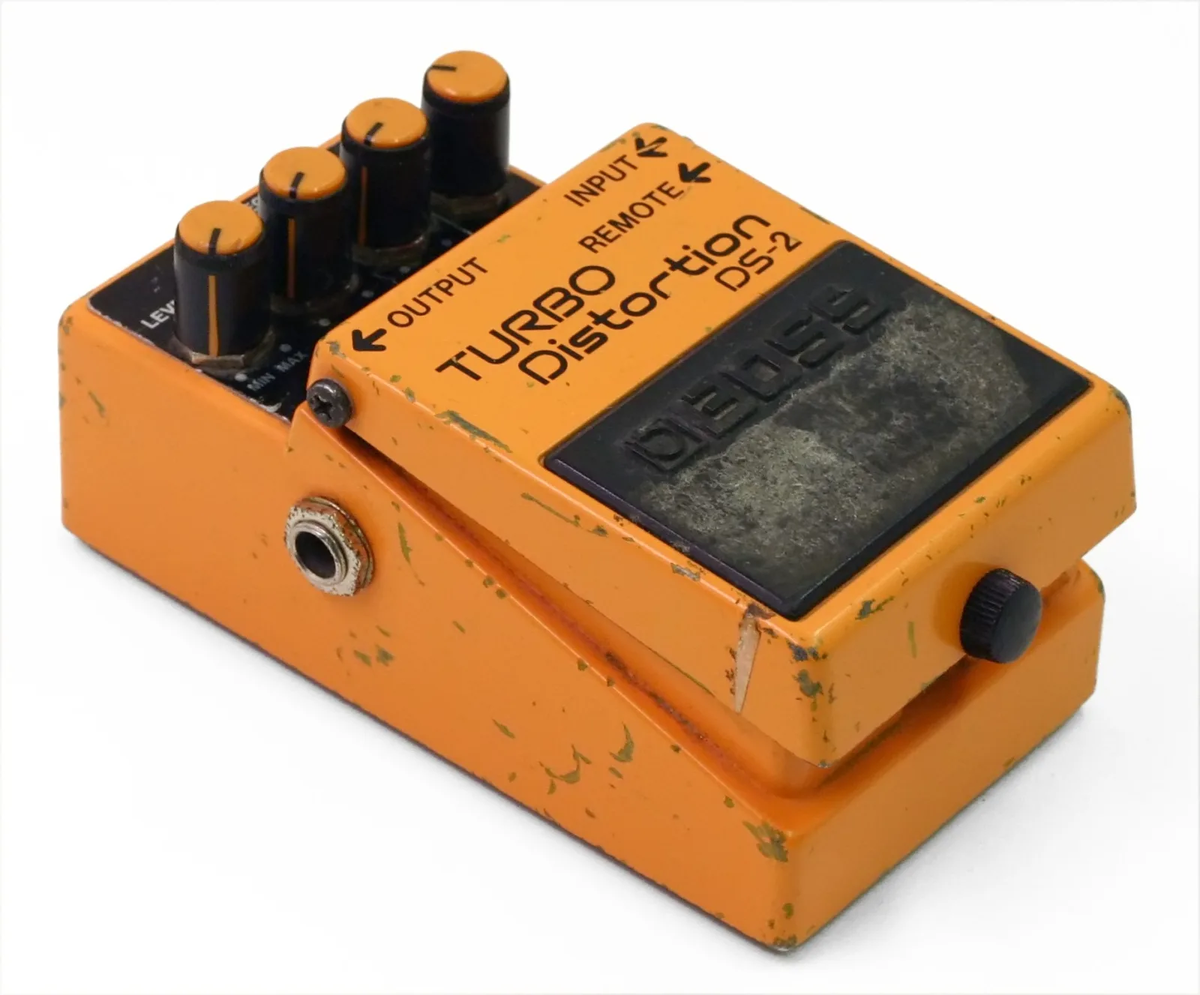
We ask ourselves
- Why do you know the song before the singing starts?
- Why does an electric guitar sound dirty on purpose, when on any other instrument that would be a fault?
- Is the distortion made by the guitar, by the amplifier, or by a separate box?
- If the riff is what you remember, what are the chords underneath for?
- Why is almost no famous riff difficult to play?
- In a rock song, how many guitars are sounding at once?
Don't answer yet. We come back to these at the end.
The fragment
We start with the figure the class band is already playing: the Sweet Home Alabama riff.
It lasts two bars and sits on top of a three-chord turnaround, D–C–G, which never changes in the whole song. On the record it comes in alone, before anyone else, and then it never leaves.
First, without instruments: sing it. If the whole class sings it back at the first attempt, you have just found out something about what a riff is for.
Now the test. One person plays it alone, with no drums, no bass and no chords. If you still recognise the song, that figure is the song. If you need what is underneath to know which song it is, it was decoration.
And a second test, which opens the other half of the unit. Play the same riff twice: once with the amp clean, once with the pedal down. The notes are exactly the same. Say in your own words what changed, before anybody says the word "distortion".
Then Sweet Home Alabama, all of it, with nobody talking over it.
What changed
For the first half of the twentieth century the guitar was the floor. It strummed chords under a voice, and what people walked out singing was the melody. Short repeated phrases did exist, but the horns played them behind the soloist: jazz in the 1920s already called them riffs, though nobody has managed to explain where the word comes from.
The change starts with a breakdown. In 1951 Willie Kizart's amplifier arrived at the studio with its speaker cone damaged in transit, and "Rocket 88" was recorded with that broken sound.
In 1958 Link Wray did it deliberately: he poked the cone with a pencil and recorded "Rumble", an instrumental with not one word in it, which several stations refused to play because of the title.
In 1964 Dave Davies slashed the cone of his Elpico amp with a razor blade, plugged it into a Vox AC30, and out came the riff of "You Really Got Me", number one in the UK. The same story three times: the sound is born by damaging the equipment.
What happens inside has a name. A clean amplifier copies the wave it is given; ask it for more than it can deliver and it shears the peaks off, so the wave comes out flat-topped. That is clipping, and it has two consequences. Harmonics appear that the string never had, which is why it sounds dirty. And the note takes far longer to die away, because the loud peaks get squashed and the quiet ones don't. That second thing is called sustain.
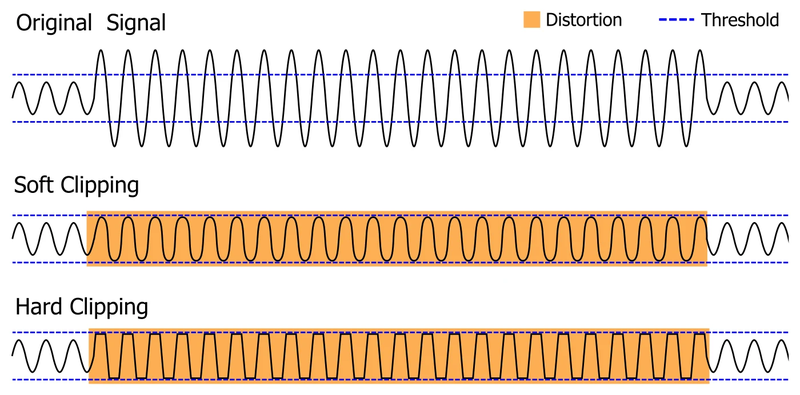
Diagrama: Iainf, obra derivada de Mikhail Ryazanov, CC BY 3.0, vía Wikimedia Commons
And that is where the guitar stops accompanying. With notes that last and that cut through everything else, a four-note phrase no longer needs anybody to hold it up: it can be the tune. In jazz the riff went behind the soloist; in rock it goes out in front.
Link Wray also brought the power chord into rock: two notes, with the middle one missing — the one that decides whether a chord sounds happy or sad. Without that note the chord takes no side, and it survives any amount of distortion without turning to mud.
The three songs in the book tell the rest, and they do not say the same thing.
In Sweet Home Alabama (1974) the riff rules and the distortion is barely there: the sound is only half dirty. What is interesting is the division of labour. The guitar does three jobs at once, and on the record three people do them: Ed King plays the riff, Allen Collins strums the chords in the left channel and Gary Rossington in the right. One earbud in each ear and you hear them apart.
In We Will Rock You (1977) the distortion comes from no pedal at all: it comes from the amplifier. Brian May plays a guitar he built with his father Harold between August 1963 and October 1964, using the wood of a fireplace mantel around a hundred years old, and plugs it into a Vox AC30 turned full up with a treble booster in front. The guitar had a distortion circuit built into it and May took it out: he preferred the way the amplifier broke up.
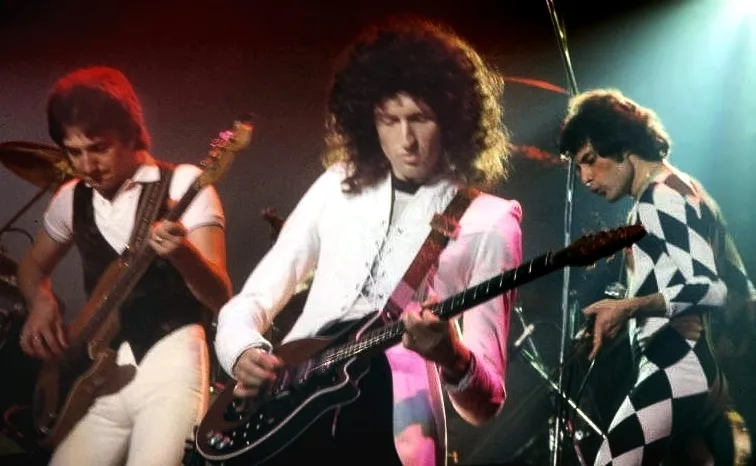
Foto: Carl Lender, CC BY-SA 3.0, vía Wikimedia Commons
In Smells Like Teen Spirit (1991) the pedal is a switch, and the shape of the song is stepping on it. The verses are clean, with a chorus pedal. The choruses come in distorted, with the guitar recorded twice on top of itself. The riff is four power chords strummed off the beat, in sixteenth notes. Cobain said he was copying the Pixies: "We used their sense of dynamics, being soft and quiet and then loud and hard."
Hard facts: "Rocket 88", 1951, cone damaged in transit. "Rumble", Link Wray, 31 March 1958, instrumental. "You Really Got Me", The Kinks, 4 August 1964 in the UK, number one there and number seven in the United States. Maestro FZ-1 Fuzz-Tone, 1962, the first commercially successful mass-produced guitar pedal: stock sold out by the end of 1965, after "Satisfaction". "Smells Like Teen Spirit", 10 September 1991, from Nevermind, produced by Butch Vig.
The same device elsewhere
A riff is not a rock thing, and not a guitar thing. It is a procedure: put a short repeating phrase underneath, and everything else fits on top. These three do it, and they are worth hearing back to back.
- Feel It Still, Portugal. The Man (2017) — what you recognise is the bass. That line was the first thing written, and the song was built on top of it. The sung melody above it is borrowed, from "Please Mr. Postman" of 1961, and it is credited. The riff is not.
- Grieg's In the Hall of the Mountain King (1875) — a phrase of a few notes in B minor that starts in the cellos, double basses and bassoons, almost inaudible, and repeats again and again, speeding up and getting louder until it ends prestissimo with the whole orchestra. The piece has nothing else in it: the piece is the phrase.
- The kumbengo of the kora, in West Africa — the kora is a twenty-one-string harp played by Mandinka griot families in the Gambia, Mali, Senegal and Guinea. The player holds a repeating pattern with one hand, the kumbengo, while improvising over it with the other, the birimintingo. The riff and the solo at once, in one person.
None of the three depends on the others. All three do the same job: put something unchanging underneath, so that what happens on top can mean something.
And here at home?
The riff in Spanish arrives late. In 1978, fourteen years after "You Really Got Me", Rosendo Mercado puts together Leño in Madrid from what was left of Ñu. The name for it was rock urbano: distorted guitar, working-class lyrics and a Madrid accent nobody bothered to hide. "Maneras de vivir" is still the song everybody knows.
Two years later, in 1980, the brothers Carlos and Armando de Castro found Barón Rojo. Their second album, Volumen Brutal, was recorded in 1982 at Kingsway Studios in London, Ian Gillan's place, and came out in two versions: one in Spanish and one in English.
In Aragón there is an exact date. On 23, 24 and 25 March 1984, in the French Pavilion of the Zaragoza trade fair, the Muestra de Pop, Rock y Otros Rollos was held: fifty local bands and more than twenty-five thousand people. Zumo de Vidrio played there, with the Valdivia brothers; Proceso Entrópico, with Enrique Bunbury; and Golden Zippers.
Almost everything that followed comes out of those three names. Héroes del Silencio played their first concert on 16 December 1984. Golden Zippers became Más Birras and in 1987 released "Apuesta por el rock and roll" on the mini-LP Al este del Moncayo; years later Héroes del Silencio covered it, and that is the version most people know. The Muestra also produced a record label to put all of it out, Grabaciones Interferencias.
And here is a judgement, because the dates alone don't say it: the Aragonese guitar of the eighties is not a riff guitar. Juan Valdivia was self-taught and played by ear, and what he does is long, tangled arpeggios over a firm rhythm section, not a short phrase that hits you in the face. It is harder to play and harder to remember. Zaragoza did not copy the American riff: it put the guitar to a different job.
Classroom activities
- While Smells Like Teen Spirit plays: raise your hand every time the guitar goes from clean to dirty, and lower it when it cleans up again. Afterwards we count the changes and check whether they line up with the changes of section.
- While Sweet Home Alabama plays: sing the riff over it, without stopping, to the end. When you have attention to spare, hold up one finger for each different thing the guitars are doing at the same time.
- While We Will Rock You plays: almost the whole song has no instruments. Raise your hand at the exact moment the first guitar appears, and say whether it is clean or distorted.
- Play: we build the Sweet Home Alabama riff with the band and split it up the way the record does — one person on the riff, two on the chords, bass marking the roots. The full-band chart and the tab are attached to its own article.
- Create: write a two-bar riff using four notes at most. Record it on your phone twice, clean and distorted, and decide which of the two versions the lyrics you wrote are asking for. Steal the procedure, not the song.
Key vocabulary
- Riff — riff: una frase corta e instrumental que se repite y se reconoce sola
- Distortion — distorsión: el sonido sucio de la guitarra eléctrica, hecho por el amplificador o por un pedal
- Clipping — recorte: las puntas de la onda aplastadas al pasarse del límite
- Sustain — sustain: cuánto tarda una nota en apagarse
- Power chord — acorde de quinta: dos notas, sin la del medio, que es la que dice si es mayor o menor
Resources
The songs in this unit are in the library, each with its own article, full-band chart and tab: Sweet Home Alabama, We Will Rock You, Smells Like Teen Spirit.
The song of the unit — Sweet Home Alabama, Lynyrd Skynyrd (1974). Its article, with the full-band chart and the tab, is in the library.
The pedal as a switch — Smells Like Teen Spirit, Nirvana (1991). Also in the library, with its own article.
The first distortion anybody went looking for — Rumble, Link Wray (1958). An instrumental: not one word in the whole piece.
The riff that opened the door — You Really Got Me, The Kinks (1964), recorded with a slashed speaker.
The riff in the orchestra — Grieg's In the Hall of the Mountain King, London Symphony Orchestra. Count how many times the phrase repeats before the end.
The riff without electricity — "Hamadoun Toure", by Toumani and Sidiki Diabaté, father and son, on two koras. Watch the hand that never stops.
The riff in Spanish — Maneras de vivir, Leño. Rosendo Mercado and the rock urbano of Madrid.
The riff in Zaragoza — Apuesta por el rock and roll, Más Birras (1987).
- More from this era — "1970s Progressive Rock and Disco" and "1990s Grunge and Hip Hop", in the library.
- The guitar at the edge of the amplifier — "We Will Rock You", Queen (1977), in the library: the solo at the end.
- The riff that is not a guitar — "Feel It Still", Portugal. The Man (2017), in the library.
Nos preguntamos
- ¿Por qué reconoces una canción antes de que entre la voz?
- ¿Por qué una guitarra eléctrica suena sucia a propósito, si en cualquier otro instrumento eso sería un defecto?
- La distorsión, ¿la hace la guitarra, el amplificador o un aparato aparte?
- Si lo que recuerdas es el riff, ¿para qué están los acordes de debajo?
- ¿Por qué casi ningún riff famoso es difícil de tocar?
- En una canción de rock, ¿cuántas guitarras suenan a la vez?
No las respondas todavía. Al final de la unidad volvemos a ellas.
El fragmento
Empezamos por la figura que la banda de clase ya está tocando: el riff de Sweet Home Alabama.
Dura dos compases y va encima de una vuelta de tres acordes, Re–Do–Sol, que no cambia en toda la canción. En el disco entra sola, antes que nadie, y ya no se va.
Primero, sin instrumento: cantadla. Si la clase entera la canta a la primera, ya habéis averiguado algo sobre para qué sirve un riff.
Ahora la prueba. Que una persona lo toque sola, sin batería, sin bajo y sin acordes. Si seguís reconociendo la canción, esa figura es la canción. Si hace falta lo de debajo para saber cuál es, era un adorno.
Y una segunda prueba, la que abre la otra mitad de la unidad. Tocad el mismo riff dos veces: la primera con el amplificador limpio, la segunda con el pedal pisado. Las notas son exactamente las mismas. Decid con vuestras palabras qué ha cambiado, antes de que nadie diga la palabra «distorsión».
Después, Sweet Home Alabama entera, sin comentarios por encima.
Qué cambió
Durante la primera mitad del siglo XX la guitarra hacía de suelo. Rasgueaba los acordes debajo de una voz, y lo que la gente salía cantando era la melodía. Las frases cortas repetidas existían, pero las tocaban los vientos detrás del solista: el jazz de los años veinte ya las llamaba riffs, aunque nadie ha podido aclarar de dónde sale la palabra.
El cambio empieza por una avería. En 1951 el amplificador de Willie Kizart llegó al estudio con el cono del altavoz dañado en el transporte, y «Rocket 88» se grabó con ese sonido roto.
En 1958 Link Wray lo hizo a propósito: agujereó el cono con un lápiz y grabó «Rumble», una pieza instrumental, sin una sola palabra, que varias emisoras se negaron a poner por el título.
En 1964 Dave Davies rajó el cono de su amplificador Elpico con una cuchilla, lo enchufó a un Vox AC30, y de ahí salió el riff de «You Really Got Me», número uno en el Reino Unido. Tres veces la misma historia: el sonido nace de estropear el aparato.
Lo que pasa dentro tiene nombre. Un amplificador limpio copia la onda que le llega; cuando le pides más de lo que puede dar, le corta las puntas y la onda sale con la cabeza plana. Eso es el recorte, y trae dos consecuencias. Aparecen armónicos que la cuerda no tenía, y por eso suena sucio. Y la nota tarda muchísimo más en apagarse, porque los picos fuertes se aplastan y los flojos no. A eso segundo se le llama sustain.
Diagrama: Iainf, obra derivada de Mikhail Ryazanov, CC BY 3.0, vía Wikimedia Commons
Y ahí es donde la guitarra deja de acompañar. Con notas que duran y que se oyen por encima de todo lo demás, una frase de cuatro notas ya no necesita que nadie la sostenga: puede ser el tema. En el jazz el riff iba detrás del solista; en el rock se pone delante.
Link Wray metió además en el rock el acorde de quinta: dos notas, sin la de en medio, que es justo la que decide si un acorde suena alegre o triste. Sin esa nota el acorde no toma partido, y aguanta toda la distorsión que le eches sin emborronarse.
Las tres canciones del libro cuentan el resto, y no dicen lo mismo.
En Sweet Home Alabama (1974) el riff manda y la distorsión casi no está: el sonido está sucio a medias. Lo interesante es el reparto. La guitarra hace tres trabajos a la vez y en el disco los hacen tres personas: Ed King toca el riff, Allen Collins rasguea los acordes en el canal izquierdo y Gary Rossington en el derecho. Un auricular en cada oído y se oye separado.
En We Will Rock You (1977) la distorsión no sale de ningún pedal: sale del amplificador. Brian May toca una guitarra que construyó con su padre Harold entre agosto de 1963 y octubre de 1964, con la madera de la repisa de una chimenea de unos cien años, y la enchufa a un Vox AC30 puesto a tope con un realzador de agudos delante. La guitarra llevaba dentro un circuito de distorsión y May lo quitó: prefería cómo se rompía el amplificador.
Foto: Carl Lender, CC BY-SA 3.0, vía Wikimedia Commons
En Smells Like Teen Spirit (1991) el pedal es un interruptor, y la forma de la canción consiste en pisarlo. Las estrofas van limpias, con un pedal de coro. Los estribillos entran distorsionados y con la guitarra grabada dos veces encima de sí misma. El riff son cuatro acordes de quinta rasgueados a contratiempo, en semicorcheas. Cobain contó que estaba copiando a los Pixies: «Usamos su sentido de la dinámica, primero suave y bajo, luego alto y fuerte».
Datos duros: «Rocket 88», 1951, cono dañado en el transporte. «Rumble», Link Wray, 31 de marzo de 1958, instrumental. «You Really Got Me», The Kinks, 4 de agosto de 1964 en el Reino Unido, número uno allí y número siete en Estados Unidos. Maestro FZ-1 Fuzz-Tone, 1962, el primer pedal de guitarra fabricado en serie con éxito: las existencias se agotaron a finales de 1965, después de «Satisfaction». «Smells Like Teen Spirit», 10 de septiembre de 1991, del disco Nevermind, producido por Butch Vig.
El mismo recurso en otros sitios
Un riff no es cosa del rock ni de la guitarra eléctrica. Es un procedimiento: pon abajo una frase corta que se repita, y encima cabe todo lo demás. Estos tres lo hacen, y conviene oírlos seguidos.
- Feel It Still, Portugal. The Man (2017) — lo que reconoces es el bajo. Esa línea fue lo primero que se escribió, y la canción se construyó encima de ella. La melodía que cantas encima sí es prestada, de «Please Mr. Postman», de 1961, y está acreditada. El riff, no.
- En la gruta del rey de la montaña, de Grieg (1875) — una frase de pocas notas en si menor que arranca en los violonchelos, los contrabajos y los fagotes, casi en silencio, y se repite una y otra vez acelerando y subiendo de volumen hasta acabar en prestissimo con la orquesta entera. La pieza no tiene otra cosa: la pieza es la frase.
- El kumbengo de la kora, en África occidental — la kora es un arpa de veintiuna cuerdas de las familias de griots mandinga de Gambia, Malí, Senegal y Guinea. Quien la toca sostiene con una mano un patrón que se repite, el kumbengo, mientras con la otra improvisa encima, el birimintingo. El riff y el solo, a la vez, en la misma persona.
Ninguno de los tres depende de los otros. Los tres hacen lo mismo: poner debajo algo que no cambia, para que lo de encima signifique algo.
Y aquí, ¿qué?
El riff en castellano llega tarde. En 1978, catorce años después de «You Really Got Me», Rosendo Mercado monta Leño en Madrid con lo que quedaba de Ñu. A eso se le llamó rock urbano: guitarra distorsionada, letras de barrio y acento de Madrid sin disimular. «Maneras de vivir» sigue siendo la canción que todo el mundo se sabe.
Dos años después, en 1980, los hermanos Carlos y Armando de Castro fundan Barón Rojo. Su segundo disco, Volumen Brutal, se grabó en 1982 en los estudios Kingsway de Londres, los de Ian Gillan, y salió en dos versiones: una en castellano y otra en inglés.
En Aragón hay una fecha exacta. Los días 23, 24 y 25 de marzo de 1984, en el Pabellón Francés de la Feria de Muestras de Zaragoza, se celebró la Muestra de Pop, Rock y Otros Rollos: cincuenta grupos locales y más de veinticinco mil personas. Allí tocaron Zumo de Vidrio, con los hermanos Valdivia; Proceso Entrópico, con Enrique Bunbury; y Golden Zippers.
De esos tres nombres sale casi todo lo que vino después. Héroes del Silencio dio su primer concierto el 16 de diciembre de 1984. Golden Zippers pasó a llamarse Más Birras y en 1987 publicó «Apuesta por el rock and roll» en el mini-LP Al este del Moncayo; años más tarde la versionó Héroes del Silencio, y así es como la conoce casi todo el mundo. De la Muestra salió también un sello para editar todo aquello, Grabaciones Interferencias.
Y aquí va un juicio, porque el dato solo no lo dice: la guitarra aragonesa de los ochenta no es una guitarra de riffs. Juan Valdivia era autodidacta y tocaba de oído, y lo suyo son arpegios largos y enredados encima de una base firme, no una frase corta que te golpea en la cara. Es más difícil de tocar y más difícil de recordar. Zaragoza no copió el riff americano: puso la guitarra a hacer otra cosa.
Para hacer en clase
- Mientras suena Smells Like Teen Spirit: levanta la mano cada vez que la guitarra pase de limpia a sucia, y bájala cuando vuelva a limpiarse. Al final contamos cuántos cambios ha habido y si coinciden con los cambios de sección.
- Mientras suena Sweet Home Alabama: canta el riff encima, sin parar, hasta el final. Cuando te sobre atención, levanta un dedo por cada cosa distinta que estén haciendo las guitarras a la vez.
- Mientras suena We Will Rock You: casi toda la canción va sin instrumentos. Levanta la mano en el instante exacto en que aparece la primera guitarra, y di si está limpia o distorsionada.
- Tocar: montamos el riff de Sweet Home Alabama con la banda y lo repartimos como en el disco: una persona con el riff, dos con los acordes, el bajo marcando las fundamentales. El chart de banda y la tablatura están en su artículo.
- Crear: escribid un riff de dos compases con cuatro notas como mucho. Grabadlo con el móvil dos veces, limpio y distorsionado, y decidid cuál de las dos versiones pide la letra que habéis escrito. Se trata de robar el procedimiento, no la canción.
Vocabulario fundamental
- Riff — Una frase corta e instrumental que se repite y que reconoces antes de que cante nadie. Cuando sostiene la canción entera, deja de ser acompañamiento.
- Distorsión — El sonido sucio de la guitarra eléctrica. No lo hace la guitarra: lo hace el amplificador, o un pedal, cuando se les pide más de lo que pueden dar.
- Recorte — Lo que le pasa a la onda al pasarse del límite: se le aplastan las puntas. Es la causa física de la distorsión.
- Sustain — Cuánto tarda una nota en apagarse. Con distorsión dura muchísimo más, y por eso una frase de cuatro notas puede llenar una canción.
- Acorde de quinta — Un acorde de dos notas al que se le ha quitado la de en medio, la que dice si es mayor o menor. Aguanta la distorsión sin emborronarse.
Recursos
Las canciones de esta unidad están en la biblioteca, cada una con su artículo, su chart de banda y su tablatura: Sweet Home Alabama, We Will Rock You, Smells Like Teen Spirit.
La canción de la unidad — Sweet Home Alabama, Lynyrd Skynyrd (1974). El artículo, con su chart de banda y su tablatura, está en la biblioteca.
El pedal como interruptor — Smells Like Teen Spirit, Nirvana (1991). También en la biblioteca, con su artículo.
La primera distorsión buscada a propósito — Rumble, Link Wray (1958). Instrumental: no hay una sola palabra en toda la pieza.
El riff que abrió la puerta — You Really Got Me, The Kinks (1964), grabada con el altavoz rajado.
El riff en la orquesta — En la gruta del rey de la montaña, de Grieg, por la London Symphony Orchestra. Cuenta cuántas veces se repite la frase antes del final.
El riff sin electricidad — «Hamadoun Toure», de Toumani y Sidiki Diabaté, padre e hijo, a dos koras. Fíjate en la mano que no para nunca.
El riff en castellano — Maneras de vivir, Leño. Rosendo Mercado y el rock urbano de Madrid.
El riff en Zaragoza — Apuesta por el rock and roll, Más Birras (1987).
- Más de esta época — «1970s Progressive Rock and Disco» y «1990s Grunge and Hip Hop», en la biblioteca.
- La guitarra al límite del amplificador — «We Will Rock You», Queen (1977), en la biblioteca: el solo del final.
- El riff que no es de guitarra — «Feel It Still», Portugal. The Man (2017), en la biblioteca.
We ask ourselves
- Why do you know the song before the singing starts?
- Why does an electric guitar sound dirty on purpose, when on any other instrument that would be a fault?
- Is the distortion made by the guitar, by the amplifier, or by a separate box?
- If the riff is what you remember, what are the chords underneath for?
- Why is almost no famous riff difficult to play?
- In a rock song, how many guitars are sounding at once?
Don't answer yet. We come back to these at the end.
The fragment
We start with the figure the class band is already playing: the Sweet Home Alabama riff.
It lasts two bars and sits on top of a three-chord turnaround, D–C–G, which never changes in the whole song. On the record it comes in alone, before anyone else, and then it never leaves.
First, without instruments: sing it. If the whole class sings it back at the first attempt, you have just found out something about what a riff is for.
Now the test. One person plays it alone, with no drums, no bass and no chords. If you still recognise the song, that figure is the song. If you need what is underneath to know which song it is, it was decoration.
And a second test, which opens the other half of the unit. Play the same riff twice: once with the amp clean, once with the pedal down. The notes are exactly the same. Say in your own words what changed, before anybody says the word "distortion".
Then Sweet Home Alabama, all of it, with nobody talking over it.
What changed
For the first half of the twentieth century the guitar was the floor. It strummed chords under a voice, and what people walked out singing was the melody. Short repeated phrases did exist, but the horns played them behind the soloist: jazz in the 1920s already called them riffs, though nobody has managed to explain where the word comes from.
The change starts with a breakdown. In 1951 Willie Kizart's amplifier arrived at the studio with its speaker cone damaged in transit, and "Rocket 88" was recorded with that broken sound.
In 1958 Link Wray did it deliberately: he poked the cone with a pencil and recorded "Rumble", an instrumental with not one word in it, which several stations refused to play because of the title.
In 1964 Dave Davies slashed the cone of his Elpico amp with a razor blade, plugged it into a Vox AC30, and out came the riff of "You Really Got Me", number one in the UK. The same story three times: the sound is born by damaging the equipment.
What happens inside has a name. A clean amplifier copies the wave it is given; ask it for more than it can deliver and it shears the peaks off, so the wave comes out flat-topped. That is clipping, and it has two consequences. Harmonics appear that the string never had, which is why it sounds dirty. And the note takes far longer to die away, because the loud peaks get squashed and the quiet ones don't. That second thing is called sustain.
Diagrama: Iainf, obra derivada de Mikhail Ryazanov, CC BY 3.0, vía Wikimedia Commons
And that is where the guitar stops accompanying. With notes that last and that cut through everything else, a four-note phrase no longer needs anybody to hold it up: it can be the tune. In jazz the riff went behind the soloist; in rock it goes out in front.
Link Wray also brought the power chord into rock: two notes, with the middle one missing — the one that decides whether a chord sounds happy or sad. Without that note the chord takes no side, and it survives any amount of distortion without turning to mud.
The three songs in the book tell the rest, and they do not say the same thing.
In Sweet Home Alabama (1974) the riff rules and the distortion is barely there: the sound is only half dirty. What is interesting is the division of labour. The guitar does three jobs at once, and on the record three people do them: Ed King plays the riff, Allen Collins strums the chords in the left channel and Gary Rossington in the right. One earbud in each ear and you hear them apart.
In We Will Rock You (1977) the distortion comes from no pedal at all: it comes from the amplifier. Brian May plays a guitar he built with his father Harold between August 1963 and October 1964, using the wood of a fireplace mantel around a hundred years old, and plugs it into a Vox AC30 turned full up with a treble booster in front. The guitar had a distortion circuit built into it and May took it out: he preferred the way the amplifier broke up.
Foto: Carl Lender, CC BY-SA 3.0, vía Wikimedia Commons
In Smells Like Teen Spirit (1991) the pedal is a switch, and the shape of the song is stepping on it. The verses are clean, with a chorus pedal. The choruses come in distorted, with the guitar recorded twice on top of itself. The riff is four power chords strummed off the beat, in sixteenth notes. Cobain said he was copying the Pixies: "We used their sense of dynamics, being soft and quiet and then loud and hard."
Hard facts: "Rocket 88", 1951, cone damaged in transit. "Rumble", Link Wray, 31 March 1958, instrumental. "You Really Got Me", The Kinks, 4 August 1964 in the UK, number one there and number seven in the United States. Maestro FZ-1 Fuzz-Tone, 1962, the first commercially successful mass-produced guitar pedal: stock sold out by the end of 1965, after "Satisfaction". "Smells Like Teen Spirit", 10 September 1991, from Nevermind, produced by Butch Vig.
The same device elsewhere
A riff is not a rock thing, and not a guitar thing. It is a procedure: put a short repeating phrase underneath, and everything else fits on top. These three do it, and they are worth hearing back to back.
- Feel It Still, Portugal. The Man (2017) — what you recognise is the bass. That line was the first thing written, and the song was built on top of it. The sung melody above it is borrowed, from "Please Mr. Postman" of 1961, and it is credited. The riff is not.
- Grieg's In the Hall of the Mountain King (1875) — a phrase of a few notes in B minor that starts in the cellos, double basses and bassoons, almost inaudible, and repeats again and again, speeding up and getting louder until it ends prestissimo with the whole orchestra. The piece has nothing else in it: the piece is the phrase.
- The kumbengo of the kora, in West Africa — the kora is a twenty-one-string harp played by Mandinka griot families in the Gambia, Mali, Senegal and Guinea. The player holds a repeating pattern with one hand, the kumbengo, while improvising over it with the other, the birimintingo. The riff and the solo at once, in one person.
None of the three depends on the others. All three do the same job: put something unchanging underneath, so that what happens on top can mean something.
And here at home?
The riff in Spanish arrives late. In 1978, fourteen years after "You Really Got Me", Rosendo Mercado puts together Leño in Madrid from what was left of Ñu. The name for it was rock urbano: distorted guitar, working-class lyrics and a Madrid accent nobody bothered to hide. "Maneras de vivir" is still the song everybody knows.
Two years later, in 1980, the brothers Carlos and Armando de Castro found Barón Rojo. Their second album, Volumen Brutal, was recorded in 1982 at Kingsway Studios in London, Ian Gillan's place, and came out in two versions: one in Spanish and one in English.
In Aragón there is an exact date. On 23, 24 and 25 March 1984, in the French Pavilion of the Zaragoza trade fair, the Muestra de Pop, Rock y Otros Rollos was held: fifty local bands and more than twenty-five thousand people. Zumo de Vidrio played there, with the Valdivia brothers; Proceso Entrópico, with Enrique Bunbury; and Golden Zippers.
Almost everything that followed comes out of those three names. Héroes del Silencio played their first concert on 16 December 1984. Golden Zippers became Más Birras and in 1987 released "Apuesta por el rock and roll" on the mini-LP Al este del Moncayo; years later Héroes del Silencio covered it, and that is the version most people know. The Muestra also produced a record label to put all of it out, Grabaciones Interferencias.
And here is a judgement, because the dates alone don't say it: the Aragonese guitar of the eighties is not a riff guitar. Juan Valdivia was self-taught and played by ear, and what he does is long, tangled arpeggios over a firm rhythm section, not a short phrase that hits you in the face. It is harder to play and harder to remember. Zaragoza did not copy the American riff: it put the guitar to a different job.
Classroom activities
- While Smells Like Teen Spirit plays: raise your hand every time the guitar goes from clean to dirty, and lower it when it cleans up again. Afterwards we count the changes and check whether they line up with the changes of section.
- While Sweet Home Alabama plays: sing the riff over it, without stopping, to the end. When you have attention to spare, hold up one finger for each different thing the guitars are doing at the same time.
- While We Will Rock You plays: almost the whole song has no instruments. Raise your hand at the exact moment the first guitar appears, and say whether it is clean or distorted.
- Play: we build the Sweet Home Alabama riff with the band and split it up the way the record does — one person on the riff, two on the chords, bass marking the roots. The full-band chart and the tab are attached to its own article.
- Create: write a two-bar riff using four notes at most. Record it on your phone twice, clean and distorted, and decide which of the two versions the lyrics you wrote are asking for. Steal the procedure, not the song.
Key vocabulary
- Riff — riff: una frase corta e instrumental que se repite y se reconoce sola
- Distortion — distorsión: el sonido sucio de la guitarra eléctrica, hecho por el amplificador o por un pedal
- Clipping — recorte: las puntas de la onda aplastadas al pasarse del límite
- Sustain — sustain: cuánto tarda una nota en apagarse
- Power chord — acorde de quinta: dos notas, sin la del medio, que es la que dice si es mayor o menor
Resources
The songs in this unit are in the library, each with its own article, full-band chart and tab: Sweet Home Alabama, We Will Rock You, Smells Like Teen Spirit.
The song of the unit — Sweet Home Alabama, Lynyrd Skynyrd (1974). Its article, with the full-band chart and the tab, is in the library.
The pedal as a switch — Smells Like Teen Spirit, Nirvana (1991). Also in the library, with its own article.
The first distortion anybody went looking for — Rumble, Link Wray (1958). An instrumental: not one word in the whole piece.
The riff that opened the door — You Really Got Me, The Kinks (1964), recorded with a slashed speaker.
The riff in the orchestra — Grieg's In the Hall of the Mountain King, London Symphony Orchestra. Count how many times the phrase repeats before the end.
The riff without electricity — "Hamadoun Toure", by Toumani and Sidiki Diabaté, father and son, on two koras. Watch the hand that never stops.
The riff in Spanish — Maneras de vivir, Leño. Rosendo Mercado and the rock urbano of Madrid.
The riff in Zaragoza — Apuesta por el rock and roll, Más Birras (1987).
- More from this era — "1970s Progressive Rock and Disco" and "1990s Grunge and Hip Hop", in the library.
- The guitar at the edge of the amplifier — "We Will Rock You", Queen (1977), in the library: the solo at the end.
- The riff that is not a guitar — "Feel It Still", Portugal. The Man (2017), in the library.