Contenidos
Perfect — Ed Sheeran (2017)
A love song written to dance to slowly. Four chords you already know, a guitar, and a beat that sways: that is why it is played at so many weddings.

🏷️ Ficha musical
Why this song
Put on "Perfect" and move without thinking. You probably will not tap the beat with sharp hits, as in a dance song. You sway from side to side.
That sway has an explanation. Each beat in this song is split into three parts, not two.
The question on this page is: what does it take for a song to sound calm and romantic? Here the answer fits into four chords and a "one-two-three".
Historical context
Ed Sheeran is an English singer and guitarist. He started out playing alone, with an acoustic guitar, in small pubs. Today he fills stadiums.
In 2017 he released his third album. It is called ÷, the division sign. His albums are named after maths operations: before it he had released + and ×.
"Perfect" is on that album. Sheeran wrote it for Cherry Seaborn, his girlfriend, who later became his wife. The idea came from a memory with her: barefoot on the grass, listening to their favourite song. Then he booked a studio for a day and finished the song. That image is in the lyrics: "Barefoot on the grass, listening to our favourite song".
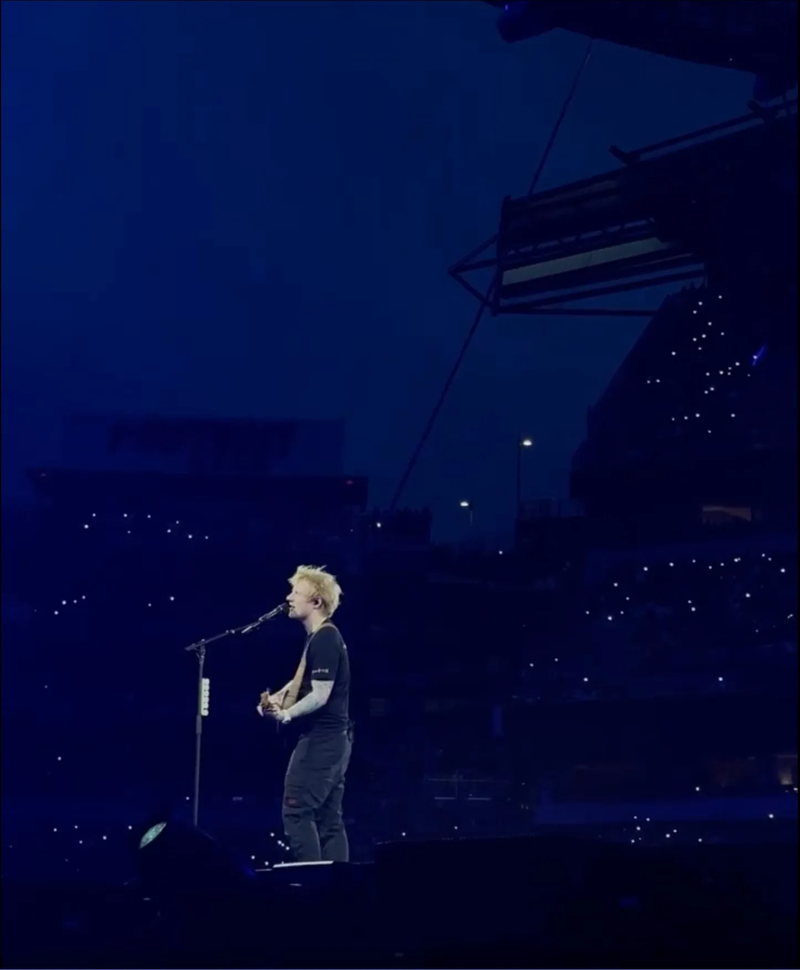
Foto: Patrick Cristiano, CC BY-SA 4.0, vía Wikimedia Commons
This is how Sheeran plays live: one person, one guitar and a whole stadium. The photo is from 2023, in Philadelphia (United States). The lights in the background are the audience's phones.
The song was a huge hit. It was number 1 in the UK for six weeks and was the Christmas number 1 of 2017. That same December he released two new versions: one sung with Beyoncé and one with the Italian tenor Andrea Bocelli. With Beyoncé it reached number 1 in the United States.
In 2023 he was asked which of his songs he would like to be remembered for. He answered with one word: "Perfect".
Musical characteristics
A beat that sways. Count the beats: there are four in each bar, and they are slow. Now listen to the guitar: between one beat and the next it plays three strums, not two. "ONE-two-three, TWO-two-three, THREE-two-three, FOUR-two-three". When each beat is split into three, it is called triple subdivision. It gives the song the feel of a slow waltz. In the score it is written as 12/8: four beats of three quavers, twelve quavers in all.
Four chords. The verses use only four chords: G, E minor, C and D. They go in that order and repeat. This chord progression is very old in pop: it was already used in songs from the 1950s, like "Stand by Me".
In the chorus, the same four chords change order: E minor, C, G, D. Starting on the minor chord changes the colour: it sounds more emotional, less calm. With four chords and two different orders, the song already has a verse and a chorus.
How it grows. The song starts with little more than a guitar and the voice. Little by little more instruments join in, and the recording also has a string orchestra. The string arrangement was written by Matthew, Ed's brother. Notice that the song does not change chords to grow: what changes is how many instruments play at once.
A warning for when you play. The record is in A♭ major. The attached PDF is in G major, one semitone lower, because in G the chords are very easy on guitar. If you want to play along with the record, put a capo on the first fret. A capo is a clamp that presses down all the strings: with it, the same fingers sound one semitone higher. It is a way to transpose without learning new chords.
A curious fact: in concert, Sheeran plays it in G, without a capo. In other words, just like the PDF.
Hard facts: A♭ major on the record and G major in the PDF, 12/8, 63 beats per minute, 4:23. The form: intro, verse, pre-chorus, chorus, verse, pre-chorus, chorus, interlude, chorus and ending.
Guided listening
Play the music video. In the intro, count "one-two-three" quietly on each beat. If the guitar fits your count, you have found the triple subdivision.
In the first verse, notice which instruments are playing. Almost only the guitar and the voice.
When the chorus arrives ("Baby, I'm dancing in the dark"), listen to the first chord. It is minor, and it sounds different from the verse.
In the second verse, count how many new instruments you hear that were not there before.
At the end, in the last chorus, look for the string orchestra. Compare that moment with the start: the same chords, but the song sounds much bigger.
Trivia and curiosities
- The "favourite song" in the lyrics is real: it is "March Madness", by the American rapper Future. A rap song inside a romantic ballad.
- The music video was filmed on a glacier in Austria, in the snow. The actress is Zoey Deutch.
- Sheeran's three main albums from those years are called +, × and ÷. Later came = and −. Together they make a maths album series.
- In Spain it reached number 13, but it has sold so much that it has gone platinum eight times.
Classroom activities
- Count in three. The whole class taps the beat with their feet and says "one-two-three" on each beat while the song plays. Then try counting "one-two" on each beat. Which one does the guitar fit?
- Play the four chords. Guitar and ukulele: G, E minor, C, D, one chord per bar. The guitar diagrams are in the attached PDF. Start with downstrokes only, one per beat. When that works, move on to the strumming in the PDF.
- Change the order. Play the four chords in the verse order (G, E minor, C, D) and then in the chorus order (E minor, C, G, D). Which order sounds calmer? Answer with one word: verse or chorus.
- Play along with the record. Guitar players put the capo on the first fret and play the same chords along with the recording. Without the capo, you will be one semitone lower and it will not fit.
- Create. With the same four chords, in groups of three, make up a four-bar phrase to sing on top. It must have triple subdivision: count "one-two-three" while you sing it.
Key vocabulary
- Ballad — balada: canción lenta, normalmente de amor
- Triple subdivision — subdivisión ternaria: cada pulso dividido en tres
- Chord progression — progresión de acordes
- Capo — cejilla
- Transposing — transportar: pasar la canción entera a otra altura
Resources
Official music video — Filmed in the snow, on a glacier in Austria.
Guitar tutorial — Bernadette Teaches Music. An easy version, with the chords G, E minor, C and D.
Ukulele tutorial — Lara Markowitz. Four ways to play it, from the easiest strumming to fingerpicking.
Keyboard tutorial — Key by Key. A beginner version, with one hand only.
"Perfect Duet", with Beyoncé, to compare — The same song sung by two voices. Listen for when each one sings and when they sing together.
- Tab — the Songsterr button opens it with the tracks separated out: voice, guitars, bass, piano, strings and drums.
- Chords and strumming — the attached PDF has the guitar chord diagrams, the three strumming patterns and the lyrics with the chords above.
Por dónde entrar
Pon «Perfect» y mueve el cuerpo sin pensar. Es probable que no marques el pulso con golpes secos, como en una canción de baile. Te balanceas de un lado a otro.
Ese balanceo tiene una explicación. Cada pulso de esta canción se divide en tres partes, no en dos.
La pregunta de esta página es: ¿qué hace falta para que una canción suene tranquila y romántica? Aquí la respuesta cabe en cuatro acordes y en un «un-dos-tres».
Contexto histórico
Ed Sheeran es un cantante y guitarrista inglés. Empezó tocando solo, con una guitarra acústica, en bares pequeños. Hoy llena estadios.
En 2017 publicó su tercer disco. Se llama ÷, el signo de dividir. Sus discos tienen nombres de operaciones de matemáticas: antes había sacado + y ×.
«Perfect» está en ese disco. Sheeran la escribió para Cherry Seaborn, su novia, que después fue su mujer. La idea le vino de un recuerdo con ella: descalzos sobre la hierba, escuchando su canción favorita. Después reservó un estudio para un día y terminó la canción. Esa imagen está en la letra: «Barefoot on the grass, listening to our favourite song».
Foto: Patrick Cristiano, CC BY-SA 4.0, vía Wikimedia Commons
Así toca Sheeran en directo: una persona, una guitarra y un estadio entero. La foto es de 2023, en Filadelfia (Estados Unidos). Las luces del fondo son los móviles del público.
La canción tuvo mucho éxito. Fue número 1 en el Reino Unido durante seis semanas y fue la canción número 1 de la Navidad de 2017. Ese mismo diciembre sacó dos versiones nuevas: una cantada con Beyoncé y otra con el tenor italiano Andrea Bocelli. Con Beyoncé llegó al número 1 en Estados Unidos.
En 2023 le preguntaron qué canción suya quería que se recordara. Contestó con una palabra: «Perfect».
Cómo suena
Un compás que se balancea. Cuenta los pulsos: hay cuatro en cada compás, y van lentos. Ahora escucha la guitarra: entre pulso y pulso hace tres golpes, no dos. «UN-dos-tres, DOS-dos-tres, TRES-dos-tres, CUA-dos-tres». Cuando cada pulso se divide en tres, se llama subdivisión ternaria. Es lo que da a la canción ese aire de vals lento. En la partitura se escribe 12/8: cuatro pulsos de tres corcheas, doce corcheas en total.
Cuatro acordes. Las estrofas usan solo cuatro acordes: sol, mi menor, do y re. Van en ese orden y se repiten. Esta progresión de acordes es muy antigua en el pop: se usaba ya en las canciones de los años cincuenta, como «Stand by Me».
En el estribillo, los mismos cuatro acordes cambian de orden: mi menor, do, sol, re. Empezar por el acorde menor cambia el color: suena más emocionado, menos tranquilo. Con cuatro acordes y dos órdenes distintos, la canción ya tiene estrofa y estribillo.
Cómo crece. La canción empieza casi solo con una guitarra y la voz. Poco a poco se suman más instrumentos, y en la grabación hay también una orquesta de cuerda. Los arreglos de cuerda los escribió Matthew, el hermano de Ed. Fíjate en que la canción no cambia de acordes para crecer: lo que cambia es cuántos instrumentos suenan a la vez.
Un aviso para cuando toques. El disco suena en La♭ mayor. El PDF adjunto está en Sol mayor, un semitono más grave, porque en Sol los acordes son muy fáciles en guitarra. Si quieres tocar encima del disco, pon una cejilla en el primer traste. La cejilla es una pinza que aprieta todas las cuerdas: con ella, los mismos dedos suenan un semitono más agudos. Es una forma de transportar sin aprender acordes nuevos.
Una curiosidad: en sus conciertos, Sheeran la toca en Sol, sin cejilla. Es decir, igual que el PDF.
Datos duros: La♭ mayor en el disco y Sol mayor en el PDF, 12/8, 63 pulsos por minuto, 4:23. La forma: intro, estrofa, preestribillo, estribillo, estrofa, preestribillo, estribillo, interludio, estribillo y final.
Escucha guiada
Pon el videoclip. En la intro, cuenta en voz baja «un-dos-tres» por cada pulso. Si la guitarra encaja con tu cuenta, has encontrado la subdivisión ternaria.
En la primera estrofa, fíjate en qué instrumentos suenan. Casi solo la guitarra y la voz.
Cuando llegue el estribillo («Baby, I'm dancing in the dark»), escucha el primer acorde. Es menor, y suena distinto al de la estrofa.
En la segunda estrofa, cuenta cuántos instrumentos nuevos oyes que antes no estaban.
Al final, en el último estribillo, busca la orquesta de cuerda. Compara ese momento con el principio: los mismos acordes, pero la canción suena mucho más grande.
Curiosidades
- La «canción favorita» de la letra existe: es «March Madness», del rapero estadounidense Future. Una canción de rap dentro de una balada romántica.
- El videoclip se rodó en un glaciar de Austria, en la nieve. La actriz es Zoey Deutch.
- Los tres discos principales de Sheeran de esos años se llaman +, × y ÷. Después sacó = y −. Juntos forman un disco de matemáticas.
- En España llegó al número 13, pero se ha vendido tanto que tiene ocho discos de platino.
Para hacer en clase
- Contar en tres. Toda la clase marca el pulso con el pie y dice «un-dos-tres» en cada pulso mientras suena la canción. Después, probad a contar «un-dos» en cada pulso. ¿Con cuál encaja la guitarra?
- Tocar los cuatro acordes. Guitarra y ukelele: sol, mi menor, do, re, un acorde por compás. Los diagramas de guitarra están en el PDF adjunto. Empezad solo con golpes hacia abajo, uno por pulso. Cuando salga, pasad al rasgueo del PDF.
- Cambiar el orden. Tocad los cuatro acordes en el orden de la estrofa (sol, mi menor, do, re) y después en el del estribillo (mi menor, do, sol, re). ¿Qué orden suena más tranquilo? Contestad con una palabra: estrofa o estribillo.
- Tocar encima del disco. Quien toque guitarra, que ponga la cejilla en el primer traste y toque los mismos acordes encima de la grabación. Sin cejilla, sonará un semitono por debajo y no encajará.
- Crear. Con los mismos cuatro acordes, en grupos de tres, inventad una frase de cuatro compases para cantar encima. Tiene que tener subdivisión ternaria: contad «un-dos-tres» mientras la cantáis.
Vocabulario fundamental
- Balada — Una canción lenta, normalmente de amor, en la que manda la voz.
- Subdivisión ternaria — Cuando cada pulso se divide en tres partes. Aquí, «un-dos-tres» en cada pulso.
- Progresión de acordes — Una serie de acordes que se repite en el mismo orden. En la estrofa: sol, mi menor, do, re.
- Cejilla — Una pinza que se pone en el mástil de la guitarra y sube todas las cuerdas a la vez.
- Transportar — Pasar una canción entera a otra altura sin cambiar nada más.
Recursos
Videoclip oficial — Rodado en la nieve, en un glaciar de Austria.
Tutorial de guitarra — Bernadette Teaches Music. Versión fácil, con los acordes de sol, mi menor, do y re.
Tutorial de ukelele — Lara Markowitz. Cuatro maneras de tocarla, del rasgueo más fácil al punteo.
Tutorial de teclado — Key by Key. Versión para principiantes, con una sola mano.
«Perfect Duet», con Beyoncé, para comparar — La misma canción cantada a dos voces. Escucha cuándo canta cada uno y cuándo cantan juntos.
- Tablatura — el botón de Songsterr la abre con las pistas separadas: voz, guitarras, bajo, piano, cuerdas y batería.
- Acordes y rasgueo — el PDF adjunto trae los diagramas de guitarra, los tres rasgueos y la letra con los acordes encima.
Why this song
Put on "Perfect" and move without thinking. You probably will not tap the beat with sharp hits, as in a dance song. You sway from side to side.
That sway has an explanation. Each beat in this song is split into three parts, not two.
The question on this page is: what does it take for a song to sound calm and romantic? Here the answer fits into four chords and a "one-two-three".
Historical context
Ed Sheeran is an English singer and guitarist. He started out playing alone, with an acoustic guitar, in small pubs. Today he fills stadiums.
In 2017 he released his third album. It is called ÷, the division sign. His albums are named after maths operations: before it he had released + and ×.
"Perfect" is on that album. Sheeran wrote it for Cherry Seaborn, his girlfriend, who later became his wife. The idea came from a memory with her: barefoot on the grass, listening to their favourite song. Then he booked a studio for a day and finished the song. That image is in the lyrics: "Barefoot on the grass, listening to our favourite song".
Foto: Patrick Cristiano, CC BY-SA 4.0, vía Wikimedia Commons
This is how Sheeran plays live: one person, one guitar and a whole stadium. The photo is from 2023, in Philadelphia (United States). The lights in the background are the audience's phones.
The song was a huge hit. It was number 1 in the UK for six weeks and was the Christmas number 1 of 2017. That same December he released two new versions: one sung with Beyoncé and one with the Italian tenor Andrea Bocelli. With Beyoncé it reached number 1 in the United States.
In 2023 he was asked which of his songs he would like to be remembered for. He answered with one word: "Perfect".
Musical characteristics
A beat that sways. Count the beats: there are four in each bar, and they are slow. Now listen to the guitar: between one beat and the next it plays three strums, not two. "ONE-two-three, TWO-two-three, THREE-two-three, FOUR-two-three". When each beat is split into three, it is called triple subdivision. It gives the song the feel of a slow waltz. In the score it is written as 12/8: four beats of three quavers, twelve quavers in all.
Four chords. The verses use only four chords: G, E minor, C and D. They go in that order and repeat. This chord progression is very old in pop: it was already used in songs from the 1950s, like "Stand by Me".
In the chorus, the same four chords change order: E minor, C, G, D. Starting on the minor chord changes the colour: it sounds more emotional, less calm. With four chords and two different orders, the song already has a verse and a chorus.
How it grows. The song starts with little more than a guitar and the voice. Little by little more instruments join in, and the recording also has a string orchestra. The string arrangement was written by Matthew, Ed's brother. Notice that the song does not change chords to grow: what changes is how many instruments play at once.
A warning for when you play. The record is in A♭ major. The attached PDF is in G major, one semitone lower, because in G the chords are very easy on guitar. If you want to play along with the record, put a capo on the first fret. A capo is a clamp that presses down all the strings: with it, the same fingers sound one semitone higher. It is a way to transpose without learning new chords.
A curious fact: in concert, Sheeran plays it in G, without a capo. In other words, just like the PDF.
Hard facts: A♭ major on the record and G major in the PDF, 12/8, 63 beats per minute, 4:23. The form: intro, verse, pre-chorus, chorus, verse, pre-chorus, chorus, interlude, chorus and ending.
Guided listening
Play the music video. In the intro, count "one-two-three" quietly on each beat. If the guitar fits your count, you have found the triple subdivision.
In the first verse, notice which instruments are playing. Almost only the guitar and the voice.
When the chorus arrives ("Baby, I'm dancing in the dark"), listen to the first chord. It is minor, and it sounds different from the verse.
In the second verse, count how many new instruments you hear that were not there before.
At the end, in the last chorus, look for the string orchestra. Compare that moment with the start: the same chords, but the song sounds much bigger.
Trivia and curiosities
- The "favourite song" in the lyrics is real: it is "March Madness", by the American rapper Future. A rap song inside a romantic ballad.
- The music video was filmed on a glacier in Austria, in the snow. The actress is Zoey Deutch.
- Sheeran's three main albums from those years are called +, × and ÷. Later came = and −. Together they make a maths album series.
- In Spain it reached number 13, but it has sold so much that it has gone platinum eight times.
Classroom activities
- Count in three. The whole class taps the beat with their feet and says "one-two-three" on each beat while the song plays. Then try counting "one-two" on each beat. Which one does the guitar fit?
- Play the four chords. Guitar and ukulele: G, E minor, C, D, one chord per bar. The guitar diagrams are in the attached PDF. Start with downstrokes only, one per beat. When that works, move on to the strumming in the PDF.
- Change the order. Play the four chords in the verse order (G, E minor, C, D) and then in the chorus order (E minor, C, G, D). Which order sounds calmer? Answer with one word: verse or chorus.
- Play along with the record. Guitar players put the capo on the first fret and play the same chords along with the recording. Without the capo, you will be one semitone lower and it will not fit.
- Create. With the same four chords, in groups of three, make up a four-bar phrase to sing on top. It must have triple subdivision: count "one-two-three" while you sing it.
Key vocabulary
- Ballad — balada: canción lenta, normalmente de amor
- Triple subdivision — subdivisión ternaria: cada pulso dividido en tres
- Chord progression — progresión de acordes
- Capo — cejilla
- Transposing — transportar: pasar la canción entera a otra altura
Resources
Official music video — Filmed in the snow, on a glacier in Austria.
Guitar tutorial — Bernadette Teaches Music. An easy version, with the chords G, E minor, C and D.
Ukulele tutorial — Lara Markowitz. Four ways to play it, from the easiest strumming to fingerpicking.
Keyboard tutorial — Key by Key. A beginner version, with one hand only.
"Perfect Duet", with Beyoncé, to compare — The same song sung by two voices. Listen for when each one sings and when they sing together.
- Tab — the Songsterr button opens it with the tracks separated out: voice, guitars, bass, piano, strings and drums.
- Chords and strumming — the attached PDF has the guitar chord diagrams, the three strumming patterns and the lyrics with the chords above.