Contenidos
Marta, Sebas, Guille y los demás — Amaral (2005)
A song from Zaragoza about lifelong friends, built on the same four chords as half the charts. On the ukulele they are C, G, A minor and F.
🏷️ Ficha musical
Why this song
In Spain this is the song everyone sings at village fiestas, weddings and on long car journeys. The names in the title are real people. Marta is Eva Amaral's best friend from childhood. And Guille, the friend the song says she lost touch with, called the record label when he heard it so they could get back in contact.
Historical context
Amaral is a duo. Eva Amaral comes from Zaragoza and Juan Aguirre from San Sebastián. They met in 1992 in a bar in Zaragoza. She played drums in a local punk band and he played guitar in another group. They started playing their own songs together, and in 1997 they moved to Madrid and signed with a major label, EMI.
Eight years later, in 2005, they released Pájaros en la cabeza (Birds in the head), their fourth album. They recorded it in London, and it was the best-selling album in Spain that year. Marta, Sebas, Guille y los demás came out as a single on 29 August 2005 and reached number 1 in early 2006.

Photo: Pravdaverita, CC BY-SA 3.0, via Wikimedia Commons
Amaral is only two people, but on stage they are a full band: drums, bass, guitars and keyboards. That is exactly what we are going to put together in class.
If you have read the unit on the Madrid and Aragon movida, Amaral is what came next. Héroes del Silencio opened the way in the eighties. In the nineties and 2000s, Amaral proved that a band from Zaragoza could reach number 1 across the whole country.
Musical characteristics
Listen to the chorus and count the chords. There are four, always in the same order: D, A, B minor, G. Several notes sounding together, like a cushion under the melody, make a chord. The path those chords follow, round after round, is a chord progression.
This progression is written I – V – vi – IV, because it uses the first, fifth, sixth and fourth degrees of the D scale. D sounds like home. A pulls away strongly. B minor is the only minor chord and adds a touch of sadness. G opens the door back home. It is the same loop as U2's With or Without You, in the same key, and the loop of hundreds of pop songs. Your ear already knows it, even if you do not know you know it.
The verses use almost the same chords. So the difference between verse and chorus is not the harmony but the energy: in the chorus more cymbals come in and everything sounds a little fuller. In the bridge, the different section that arrives near the end, the loop starts on G instead of D. It is a small change, but your ear notices that something has moved just before the last choruses.
In class we play it in C major: the same loop becomes C, G, A minor, F, four of the easiest chords on the ukulele. If you want to play along with the record, put a capo on the 2nd fret.
Facts: D major, 4/4, about 103 BPM, 3:44. Form: short intro, two verses, chorus, third verse, chorus, bridge and two choruses to finish.
Trivia and curiosities
- The people are real. Marta is Eva's best friend from childhood. Guille contacted the record label when the song came out, and that is how they started talking again. A song can work like a letter.
- Written far from home. The song was written in Santiago de Chile, more than ten thousand kilometres from Zaragoza. Missing your friends is easier to write about from far away.
- Four chords, thousands of songs. The I – V – vi – IV loop is so common that comedians have strung together dozens of hits in a row without changing chords. It is not a lack of imagination: it works because the ear recognises the path and goes along with it.
- Twenty years on, still the most played. Two decades after its release, it is still Amaral's most streamed song.
- Eva started on drums. Before singing in Amaral she played drums in a punk band in Zaragoza. Singers who front a band usually know very well what every instrument is doing.
Guided listening
On the official music video linked in Resources (3:44).
- 0:00 — A very short intro: G, D, A. Five seconds and you are in.
- 0:05 — The voice comes in with the first verse. Notice how close the chords are to the chorus that is coming: D, A, B minor, G.
- 1:00 — First chorus. The harmony hardly changes, but everything sounds fuller: more cymbals come in and the mix gets a little louder. That is the difference between verse and chorus in this song.
- 2:20 — The bridge. The loop starts on G instead of D and the cymbals almost disappear. The song takes a breath before the end.
- 2:36 — Two choruses in a row until the end. Time for everyone to sing: nothing new to learn here, just energy.
Classroom activities
- Play: C – G – A minor – F on the ukulele, one chord per bar, strumming down on every beat. When that works, switch to down-down-up-up-down-up. The bass plays only the note that names each chord. The drummer has the verse and chorus grooves in the lyrics with chords in the class session.
- Sing: the chorus, the whole group. In C it sits one tone lower than the record, which is easier for voices that are changing.
- Analyse: listen from 0:05 to 1:22 and put your hand up when the chorus starts. Then explain how you knew, when the chords are almost the same.
- Create: write a verse about your own friends, with real names, and sing it over the same four-chord loop.
Key vocabulary
- Chord — acorde
- Chord progression — progresión de acordes
- Chorus — estribillo
- Bridge — puente
Resources
Official music video — uploaded by Warner Music Spain.
Ukulele tutorial — 100 Lecciones de Ukelele. In Spanish, step by step.
Guitar tutorial without barre chords — Fran Brea, Más que Guitarra school. In Spanish, with chords adapted for beginners.
Bass — Javi Bass. Bass cover with the tab on screen.
Drums — CarlosDrums. Drum cover over the recording.
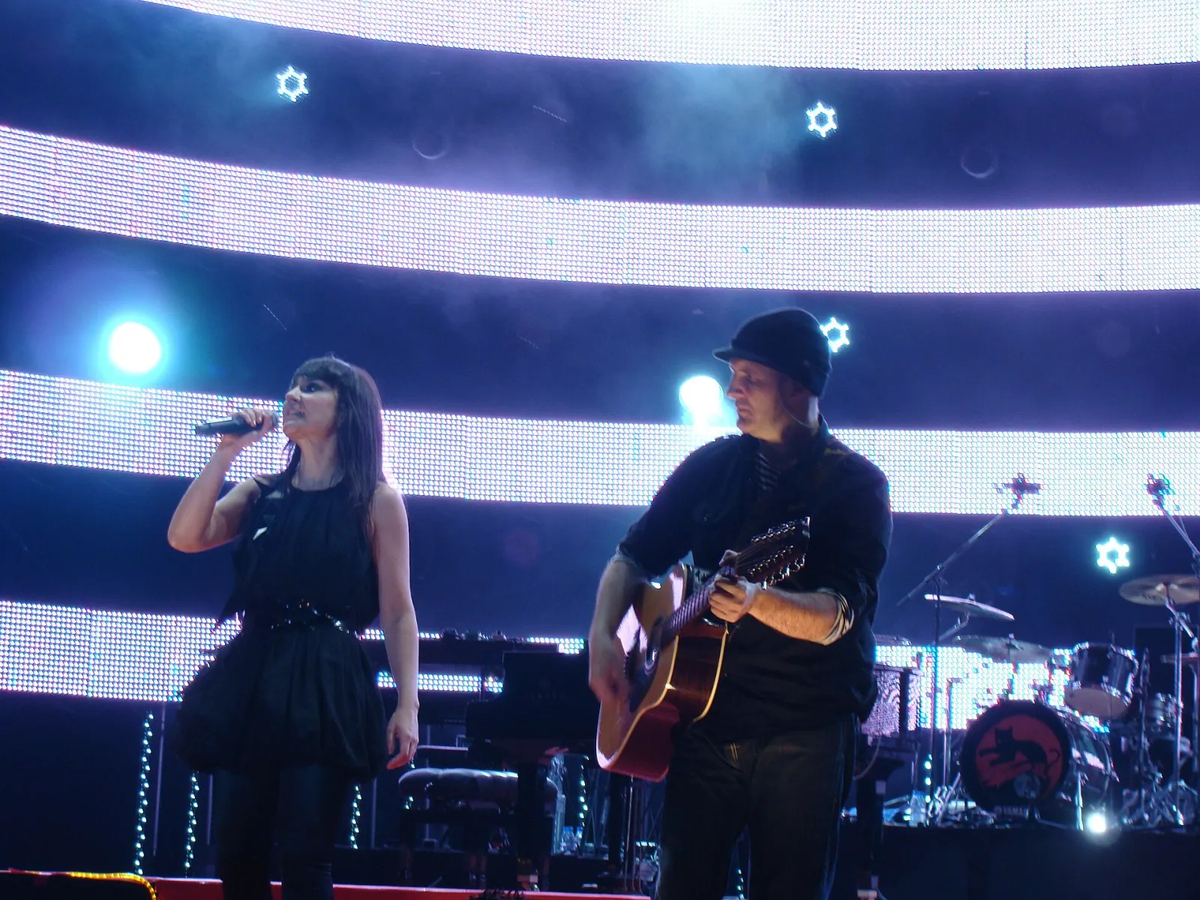
- Cover image — Eva Amaral and Juan Aguirre live in Barcelona, 2008. Photo: Alberto Cabello, CC BY 2.0, via Wikimedia Commons
Por dónde entrar
Es probable que la hayas oído en una fiesta del pueblo, en una boda o en el coche de tus padres, cuando todo el mundo se pone a cantar el estribillo. Lo curioso es que los nombres del título son de verdad. Marta es la mejor amiga de infancia de Eva Amaral. Y Guille, a quien la canción echa de menos, llamó a la discográfica cuando la oyó para recuperar el contacto.
Contexto histórico
Amaral es un dúo. Eva Amaral es de Zaragoza y Juan Aguirre de San Sebastián. Se conocieron en 1992 en un bar de Zaragoza. Ella tocaba la batería en un grupo punk de la ciudad, y él la guitarra en otro grupo. Empezaron a tocar juntos sus propias canciones, y en 1997 se fueron a Madrid y firmaron con una discográfica grande, EMI.
Ocho años después, en 2005, publicaron Pájaros en la cabeza, su cuarto disco. Lo grabaron en Londres y fue el disco más vendido en España ese año. Marta, Sebas, Guille y los demás salió como sencillo el 29 de agosto de 2005 y llegó al número 1 a principios de 2006.
Foto: Pravdaverita, CC BY-SA 3.0, vía Wikimedia Commons
Amaral es solo dos personas, pero en el escenario son una banda: batería, bajo, guitarras y teclados. Es justo lo que vamos a montar en clase.
Si has leído la unidad de la movida madrileña y aragonesa, Amaral es lo que vino después. Héroes del Silencio abrió el camino en los ochenta. Amaral demostró en los noventa y dos mil que un grupo de Zaragoza podía llegar al número 1 en todo el país.
Cómo suena
Escucha el estribillo y cuenta los acordes. Son cuatro, siempre en el mismo orden: Re, La, Si menor, Sol. Varias notas que suenan a la vez y hacen de colchón a la melodía forman un acorde. Y el camino que siguen esos acordes, vuelta tras vuelta, es una progresión de acordes.
Esta progresión se escribe I – V – vi – IV, porque usa los grados primero, quinto, sexto y cuarto de la escala de Re. Re suena a casa. La se aleja con fuerza. Si menor es el único acorde menor y pone el punto triste. Sol abre la puerta para volver a casa. Es la misma vuelta de With or Without You de U2, en la misma tonalidad, y la de cientos de canciones pop. Tu oído ya se la sabe aunque no lo sepas.
Las estrofas usan casi los mismos acordes. Por eso estrofa y estribillo no se distinguen por la armonía, sino por la energía: en el estribillo entran más platos y todo suena un poco más lleno. En el puente, la parte distinta que llega casi al final, la vuelta empieza por Sol en vez de por Re. Es un cambio pequeño, pero el oído nota que algo se ha movido justo antes de los últimos estribillos.
En clase la tocamos en Do mayor: la misma vuelta se convierte en Do, Sol, La menor, Fa, cuatro de los acordes más fáciles del ukelele. Si queréis tocar encima del disco, poned una cejilla en el traste 2.
Datos: Re mayor, 4/4, unos 103 BPM, 3:44. Forma: introducción corta, dos estrofas, estribillo, tercera estrofa, estribillo, puente y dos estribillos para terminar.
Curiosidades
- Las personas existen. Marta es la mejor amiga de la infancia de Eva. Guille se puso en contacto con la discográfica cuando salió la canción, y así volvieron a hablar. Una canción puede hacer de carta.
- Escrita lejos de casa. La canción se escribió en Santiago de Chile, a más de diez mil kilómetros de Zaragoza. Echar de menos a los amigos se escribe mejor desde lejos.
- Cuatro acordes, miles de canciones. La vuelta I – V – vi – IV es tan común que hay humoristas que han encadenado decenas de éxitos seguidos sin cambiar de acordes. No es falta de imaginación: funciona porque el oído reconoce el camino y se deja llevar.
- Veinte años después, la más escuchada. Dos décadas después de salir, sigue siendo la canción de Amaral con más reproducciones en las plataformas.
- Eva empezó tocando la batería. Antes de cantar en Amaral tocaba la batería en un grupo punk de Zaragoza. Quien canta con banda suele saber muy bien lo que hace cada instrumento.
Escucha guiada
Sobre el videoclip oficial enlazado en Recursos (3:44).
- 0:00 — Introducción muy corta: Sol, Re, La. En cinco segundos ya estás dentro.
- 0:05 — Entra la voz con la primera estrofa. Fíjate en que los acordes se parecen mucho a los del estribillo que vendrá: Re, La, Si menor, Sol.
- 1:00 — Primer estribillo. La armonía apenas cambia, pero todo suena más lleno: entran más platos y la mezcla sube un poco. Esa es la diferencia entre estrofa y estribillo en esta canción.
- 2:20 — El puente. La vuelta empieza por Sol en vez de por Re y los platos casi desaparecen. La canción toma aire antes del final.
- 2:36 — Dos estribillos seguidos hasta el final. Es el momento de cantar todos: aquí no hay nada nuevo que aprender, solo energía.
Para hacer en clase
- Tocar: Do – Sol – La menor – Fa en el ukelele, un acorde por compás, rasgueando abajo en cada pulso. Cuando salga, cambia a abajo-abajo-arriba-arriba-abajo-arriba. El bajo toca solo la nota que da nombre a cada acorde. La batería tiene el ritmo de estrofa y estribillo en la letra con acordes de la sesión de clase.
- Cantar: el estribillo, todo el grupo. En Do queda un tono más grave que el disco y es más cómodo para las voces que están cambiando.
- Analizar: escucha desde 0:05 hasta 1:22 y levanta la mano cuando empiece el estribillo. Luego explica cómo lo has sabido, si los acordes son casi los mismos.
- Crear: escribid una estrofa sobre vuestros propios amigos, con nombres reales, y cantadla sobre la misma vuelta de cuatro acordes.
Vocabulario fundamental
- Acorde — Varias notas que suenan a la vez y hacen de colchón para la melodía.
- Progresión de acordes — El camino de acordes que se repite en una canción. Aquí, I – V – vi – IV.
- Estribillo — La parte que vuelve con la misma letra y que canta todo el mundo.
- Puente — Una parte distinta que llega casi al final y prepara los últimos estribillos.
Recursos
Videoclip oficial — subido por Warner Music Spain.
Tutorial de ukelele — 100 Lecciones de Ukelele. En castellano, paso a paso.
Tutorial de guitarra sin cejilla — Fran Brea, escuela Más que Guitarra. Acordes adaptados para quien empieza.
Bajo — Javi Bass. Versión de bajo con la tablatura en pantalla.
Batería — CarlosDrums. Versión de batería sobre la grabación.
- Portada — Eva Amaral y Juan Aguirre en directo en Barcelona, 2008. Foto: Alberto Cabello, CC BY 2.0, vía Wikimedia Commons
Why this song
In Spain this is the song everyone sings at village fiestas, weddings and on long car journeys. The names in the title are real people. Marta is Eva Amaral's best friend from childhood. And Guille, the friend the song says she lost touch with, called the record label when he heard it so they could get back in contact.
Historical context
Amaral is a duo. Eva Amaral comes from Zaragoza and Juan Aguirre from San Sebastián. They met in 1992 in a bar in Zaragoza. She played drums in a local punk band and he played guitar in another group. They started playing their own songs together, and in 1997 they moved to Madrid and signed with a major label, EMI.
Eight years later, in 2005, they released Pájaros en la cabeza (Birds in the head), their fourth album. They recorded it in London, and it was the best-selling album in Spain that year. Marta, Sebas, Guille y los demás came out as a single on 29 August 2005 and reached number 1 in early 2006.
Photo: Pravdaverita, CC BY-SA 3.0, via Wikimedia Commons
Amaral is only two people, but on stage they are a full band: drums, bass, guitars and keyboards. That is exactly what we are going to put together in class.
If you have read the unit on the Madrid and Aragon movida, Amaral is what came next. Héroes del Silencio opened the way in the eighties. In the nineties and 2000s, Amaral proved that a band from Zaragoza could reach number 1 across the whole country.
Musical characteristics
Listen to the chorus and count the chords. There are four, always in the same order: D, A, B minor, G. Several notes sounding together, like a cushion under the melody, make a chord. The path those chords follow, round after round, is a chord progression.
This progression is written I – V – vi – IV, because it uses the first, fifth, sixth and fourth degrees of the D scale. D sounds like home. A pulls away strongly. B minor is the only minor chord and adds a touch of sadness. G opens the door back home. It is the same loop as U2's With or Without You, in the same key, and the loop of hundreds of pop songs. Your ear already knows it, even if you do not know you know it.
The verses use almost the same chords. So the difference between verse and chorus is not the harmony but the energy: in the chorus more cymbals come in and everything sounds a little fuller. In the bridge, the different section that arrives near the end, the loop starts on G instead of D. It is a small change, but your ear notices that something has moved just before the last choruses.
In class we play it in C major: the same loop becomes C, G, A minor, F, four of the easiest chords on the ukulele. If you want to play along with the record, put a capo on the 2nd fret.
Facts: D major, 4/4, about 103 BPM, 3:44. Form: short intro, two verses, chorus, third verse, chorus, bridge and two choruses to finish.
Trivia and curiosities
- The people are real. Marta is Eva's best friend from childhood. Guille contacted the record label when the song came out, and that is how they started talking again. A song can work like a letter.
- Written far from home. The song was written in Santiago de Chile, more than ten thousand kilometres from Zaragoza. Missing your friends is easier to write about from far away.
- Four chords, thousands of songs. The I – V – vi – IV loop is so common that comedians have strung together dozens of hits in a row without changing chords. It is not a lack of imagination: it works because the ear recognises the path and goes along with it.
- Twenty years on, still the most played. Two decades after its release, it is still Amaral's most streamed song.
- Eva started on drums. Before singing in Amaral she played drums in a punk band in Zaragoza. Singers who front a band usually know very well what every instrument is doing.
Guided listening
On the official music video linked in Resources (3:44).
- 0:00 — A very short intro: G, D, A. Five seconds and you are in.
- 0:05 — The voice comes in with the first verse. Notice how close the chords are to the chorus that is coming: D, A, B minor, G.
- 1:00 — First chorus. The harmony hardly changes, but everything sounds fuller: more cymbals come in and the mix gets a little louder. That is the difference between verse and chorus in this song.
- 2:20 — The bridge. The loop starts on G instead of D and the cymbals almost disappear. The song takes a breath before the end.
- 2:36 — Two choruses in a row until the end. Time for everyone to sing: nothing new to learn here, just energy.
Classroom activities
- Play: C – G – A minor – F on the ukulele, one chord per bar, strumming down on every beat. When that works, switch to down-down-up-up-down-up. The bass plays only the note that names each chord. The drummer has the verse and chorus grooves in the lyrics with chords in the class session.
- Sing: the chorus, the whole group. In C it sits one tone lower than the record, which is easier for voices that are changing.
- Analyse: listen from 0:05 to 1:22 and put your hand up when the chorus starts. Then explain how you knew, when the chords are almost the same.
- Create: write a verse about your own friends, with real names, and sing it over the same four-chord loop.
Key vocabulary
- Chord — acorde
- Chord progression — progresión de acordes
- Chorus — estribillo
- Bridge — puente
Resources
Official music video — uploaded by Warner Music Spain.
Ukulele tutorial — 100 Lecciones de Ukelele. In Spanish, step by step.
Guitar tutorial without barre chords — Fran Brea, Más que Guitarra school. In Spanish, with chords adapted for beginners.
Bass — Javi Bass. Bass cover with the tab on screen.
Drums — CarlosDrums. Drum cover over the recording.
- Cover image — Eva Amaral and Juan Aguirre live in Barcelona, 2008. Photo: Alberto Cabello, CC BY 2.0, via Wikimedia Commons