Contenidos
Mannish Boy — Muddy Waters (1955)
A whole song built on one chord. What organises the time here is not the harmony: it is a short figure that repeats, and the gaps it leaves when it stops.
🏷️ Ficha musical
Why this song
Put it on and count the chords. You will finish the song having counted one.
That is the question this record answers: how little do you need before something is music rather than an exercise. One chord, as long as something else is moving.
Muddy Waters made it in Chicago in 1955, and the figure he used has been travelling ever since. George Thorogood borrowed the hook and part of the words for Bad to the Bone in 1982. That riff is seventy years old and still in circulation.
Historical context
Muddy Waters was born McKinley Morganfield and grew up on a Mississippi plantation, playing guitar at country parties. In 1943 he moved to Chicago, like millions of Black Americans in those years.
The blues changed there, for a practical reason. Chicago clubs were loud and crowded. He put it like this: "When I went into the clubs, the first thing I wanted was an amplifier. Couldn't nobody hear you with an acoustic."
In 1944 he bought his first electric guitar and put together his first electric band. That decision — taken to be heard, not to invent anything — is where Chicago blues comes from: country blues run through loudspeakers.
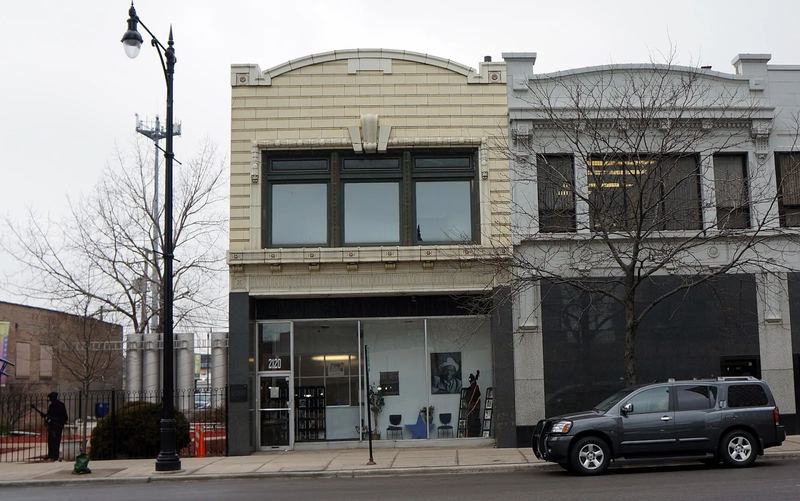
Foto: Steve Browne & John Verkleir, CC BY 2.0, vía Wikimedia Commons
This is the Chess Records building, the label that released the song. Chess moved in here in May 1957, so Mannish Boy, recorded in 1955, was not made in this room. It is a museum now.
The song did not appear out of nowhere. In 1954 Muddy recorded Hoochie Coochie Man, built on a figure that kept stopping dead. In March 1955 Bo Diddley took that figure for I'm a Man.
Two months later Muddy answered back with this one, calling "boy" a musician more than ten years younger than him. All three are relatives, and both Muddy and Bo Diddley are credited as writers of Mannish Boy.
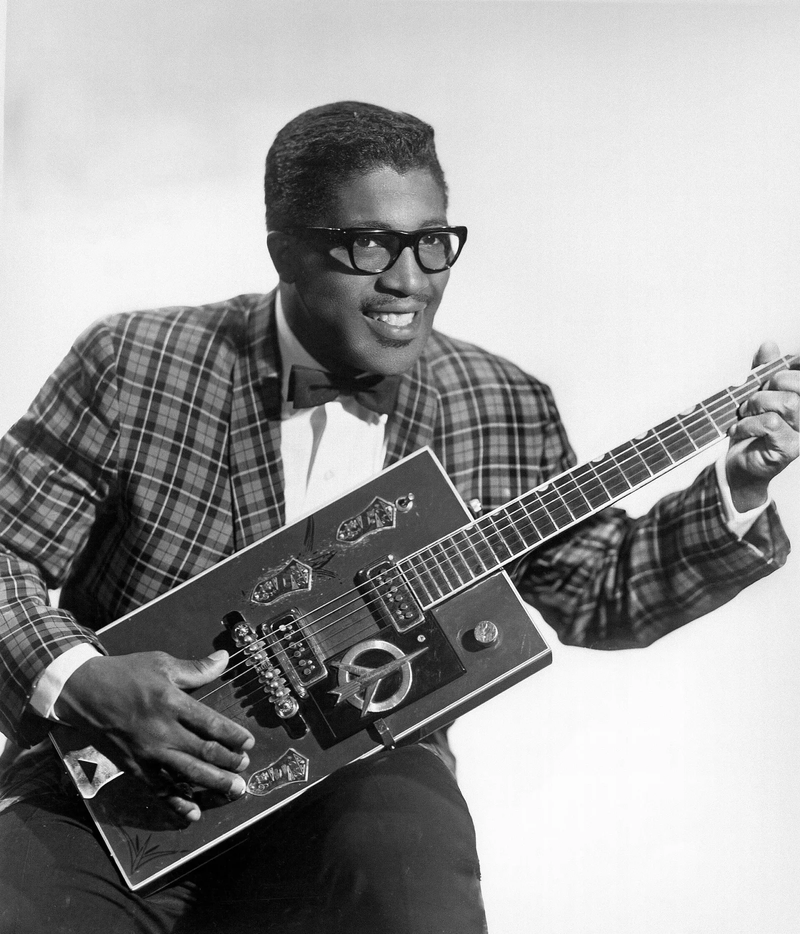
Retrato de promoción publicado por Chess Records, 1957, dominio público, vía Wikimedia Commons
Musical characteristics
Listen to the opening. A short figure plays, everything stops, the voice carries on alone, and the figure comes back. Again and again, to the end.
That short repeated figure you recognise instantly is a riff. What is odd about this one is that it accompanies nothing: it is the skeleton. With no chord changes and no chorus coming, the only thing telling you where you are is how many times the riff has gone round. The riff is doing the job of form.
The gaps matter as much as the notes. The band hits, stops dead, and leaves the voice alone in the silence. It sounds as if the music has slowed down, but the pulse never moves: when they come back in, they come back exactly on time. That device is called stop-time.
There is one chord, and it is not just any chord. It is A7: an A major with an extra note that does not quite fit and leaves the feeling that something is still waiting to resolve. Since it never resolves, the tension never goes away. That extra note is the seventh, and it is the basic colour of the blues.
On top of all that there is a harmonica. In Chicago the harmonica stopped sounding rural because players cupped it against a cheap microphone and pushed the amplifier into distortion. It comes out thick and dirty, closer to a broken saxophone than to a pocket instrument.
Hard facts: A major over an A7 chord, 4/4, 72 BPM, 2:55. The form is the riff and its stops, repeated, with no chorus and no bridge.
Trivia and curiosities
- Muddy's regular harmonica player was Little Walter, but he was on tour with his own number one, My Babe, and could not make the session. Junior Wells played instead. It is the only Muddy Waters recording between 1953 and 1957 without Little Walter, and it happens to be the famous one.
- The lyric spells the word out: "I'm a man, M, A, child, N." It sounds like bragging, but in the American South a grown Black man was called "boy". Spelling that word into a microphone in 1955 was saying something else.
- Three names sign the song: Muddy Waters, Mel London and Bo Diddley. The writer of the song this one answers ended up being paid by it. When two songs are this close, the argument ends at the copyright office, not on stage.
- Bad to the Bone (1982) adapts the hook and the words of this one. Its video stars George Thorogood playing pool against Bo Diddley, appearing as himself. A fairly open loan, with the lender as a guest.
- The famous version is not the 1955 one. In 1977, well past sixty, Muddy recorded it again with Johnny Winter for the album Hard Again. That is the take used in Goodfellas and in a Levi's advert, and the one that in 1988 gave him his only appearance in the UK charts, thirty-three years later. Which recording becomes "the" recording gets decided long after the session.
Classroom activities
- Play: the class chart is in C and it is one chord. Ukulele and guitar can take the riff together. There is no chord change to get wrong: the hard part is starting and stopping in the same place.
- The stop experiment: play it through twice. First with the stop-time gaps. Then fill the gaps, with the backing sounding all the way through. Ask the class which version sounds bigger, and why.
- Analyse: a closed question. If the harmony never changes, how do you know a new section has started? Listen to a long stretch and write down what changes each time (who plays, who drops out, what the voice does).
- Create: pick one chord, just one, and invent a two-bar figure with a silence in it. Repeat it and build a minute of music by changing only who plays on each time round. Steal the procedure, not the song.
Key vocabulary
- Riff — riff: una figura corta que se repite y reconoces enseguida
- Form — forma: cómo está organizada la canción por dentro
- Stop-time — la banda ataca y se para en seco, y el pulso sigue por debajo
- Seventh — séptima: la nota de más que hace que un acorde suene a blues
- Chicago blues — blues de Chicago: el blues del campo tocado con instrumentos amplificados
Resources
In the theory and history book — this song fits ¿Cómo sabes por dónde vas en una música que oyes por primera vez?, because here the form is not marked by the harmony, and ¿Cómo se guarda algo que solo existe mientras suena?: without the Chess records, this blues never leaves Chicago.
About the chart — there is no ukulele part for this song in JamZone. It has bass, drums, guitar and keyboard, and nothing else, so do not go looking. For the ukulele, use the tutorial below.
Official audio — Muddy Waters' official channel. Nobody made music videos in 1955. Also, this recording is not the 1955 one: it is the 1977 remake, nearly twice as long and with the full band. It is the one most people carry in their heads.
Guitar tutorial — Marcos García, in Spanish, aimed at beginners and with the tab on screen.
Ukulele tutorial — TenThumbs Productions. He gets the riff onto the ukulele, which is exactly what the chart is missing.
Bass tutorial — Bradley Fish, three minutes for beginners. He teaches this figure next to the Bad to the Bone one, which is its child.
Drums — Drumscribe. Not a spoken lesson: the drum score scrolls past in time with the song.
- Tab — https://www.songsterr.com/a/wsa/muddy-waters-mannish-boy-tab-s47915
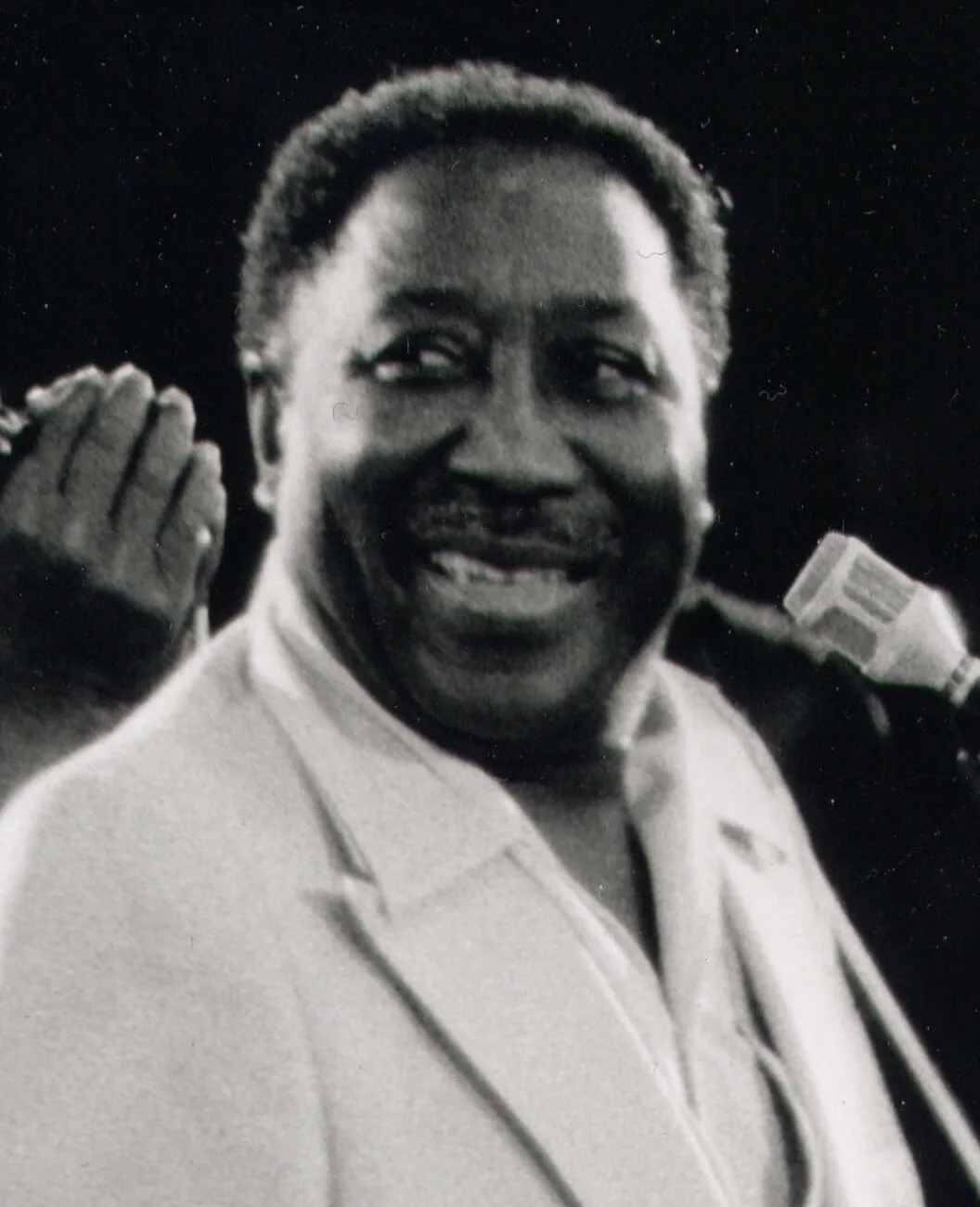
- Cover image — Muddy Waters at Ontario Place, Toronto, June 1978. Foto: Jean-Luc Ourlin, CC BY-SA 2.0, vía Wikimedia Commons
Por dónde entrar
Ponla y cuenta los acordes. Al acabar habrás contado uno.
Esa es la pregunta que responde esta canción: cuántos acordes hacen falta para que algo sea música y no un ejercicio. Uno, si lo que se mueve es otra cosa.
Y probablemente ya la has oído sin saberlo. En 1982 George Thorogood escribió Bad to the Bone copiando el gancho y parte de la letra de esta; esa es la que suena en Terminator 2 cuando aparece Schwarzenegger. El riff tiene setenta años y sigue circulando.
Contexto histórico
Muddy Waters se llamaba McKinley Morganfield y creció en una plantación de Misisipi, tocando la guitarra en fiestas de campo. En 1943 se fue a Chicago. Millones de personas negras del sur hicieron ese mismo viaje en aquellos años.
Allí el blues cambió, y cambió por un motivo práctico. Los clubes de Chicago eran ruidosos y estaban llenos. Él lo contó así: «Lo primero que quise al entrar en los clubes fue un amplificador. Con una acústica no te oía nadie».
En 1944 se compró su primera guitarra eléctrica y montó el primer grupo eléctrico. Esa decisión —tomada para que se le oyera, no para inventar nada— es el origen de lo que hoy llamamos blues de Chicago: el blues del campo pasado por altavoces.
Foto: Steve Browne & John Verkleir, CC BY 2.0, vía Wikimedia Commons
Este edificio es la sede de Chess Records, el sello que publicó la canción. Chess se mudó aquí en mayo de 1957, así que Mannish Boy, grabada en 1955, no se hizo en esta sala. Hoy es un museo.
La canción no nació sola. En 1954 Muddy grabó Hoochie Coochie Man, con una figura que se paraba cada dos por tres. En marzo de 1955 Bo Diddley cogió esa figura para I'm a Man.
Dos meses después Muddy le contestó con esta, llamándole «niño» a un músico más de diez años más joven que él. Las tres son parientes, y en los créditos de Mannish Boy firman tanto Muddy como Bo Diddley.
Retrato de promoción publicado por Chess Records, 1957, dominio público, vía Wikimedia Commons
Cómo suena
Escucha el principio. Suena una figura corta, se calla todo, canta la voz sola, y vuelve la figura. Una y otra vez, hasta el final.
Esa figura corta que se repite y que reconoces enseguida es un riff. Lo que tiene de raro este es que no acompaña a nada: es el esqueleto. Cuando ya no hay acordes que cambien ni estribillo que llegue, lo único que te dice por dónde vas es cuántas veces ha sonado el riff. El riff hace de forma.
Los huecos importan tanto como las notas. La banda ataca, se para en seco y deja que la voz siga sola en el silencio. Parece que la música se ha frenado, pero el pulso sigue igual: cuando vuelven a entrar, entran exactamente donde tocaba. Ese recurso se llama stop-time.
El acorde es uno y no es un acorde cualquiera. Es La7: un La mayor al que se le añade una nota que no pega del todo y deja la sensación de que algo falta por resolver. Como nunca resuelve, la tensión no se va nunca. A eso se le llama acorde de séptima, y es el color básico del blues.
Encima de todo eso hay una armónica. En Chicago la armónica dejó de sonar a campo porque los músicos la tocaban pegada a un micrófono barato metido en la mano, con el amplificador saturado. Sale gruesa y sucia, más parecida a un saxo roto que a una armónica de bolsillo.
Datos duros: La mayor sobre un acorde de La7, 4/4, 72 BPM, 2:55. La forma es la repetición del riff con sus paradas, sin estribillo y sin puente.
Curiosidades
- El armonicista habitual de Muddy era Little Walter, pero andaba de gira con su propio número uno, My Babe, y no pudo ir a la sesión. Tocó Junior Wells. Es la única grabación de Muddy entre 1953 y 1957 sin Little Walter, y es justo la que todo el mundo conoce.
- La letra deletrea «I'm a man, M, A, child, N» — «soy un hombre, se escribe H, O, M... niño... B, R, E». Suena a chulería, pero en el sur de Estados Unidos a un hombre negro adulto se le llamaba «boy», niño. Deletrear la palabra delante de un micrófono en 1955 era decir otra cosa.
- La canción firma tres nombres: Muddy Waters, Mel London y Bo Diddley. Es decir, el autor de la canción a la que esta contesta acabó cobrando de ella. Cuando dos canciones se parecen tanto, la discusión no acaba en el escenario sino en el registro.
- Bad to the Bone (1982) adapta el gancho y la letra de esta. Su vídeo lo protagoniza George Thorogood jugando al billar contra Bo Diddley, que sale haciendo de sí mismo. Un préstamo bastante descarado, con el prestamista de invitado.
- La versión famosa no es la de 1955. En 1977, con más de sesenta años, Muddy volvió a grabarla con Johnny Winter para el disco Hard Again. Esa es la que se metió en Uno de los nuestros y en un anuncio de vaqueros Levi's, y la que en 1988 le dio su única entrada en las listas británicas, treinta y tres años después. Cuál es «la» grabación de una canción se decide mucho después de grabarla.
Para hacer en clase
- Tocar: el chart de clase está en Do y es un acorde. Ukelele y guitarra pueden hacer el riff a la vez. No hay cambio de acorde que fallar: lo difícil aquí es arrancar y parar todos en el mismo sitio.
- El experimento de la parada: tocad el tema dos veces. La primera, con los huecos del stop-time. La segunda, rellenando los huecos con el acompañamiento sonando siempre. Que la clase diga qué versión suena más grande y por qué.
- Analizar: pregunta cerrada. Si la armonía no cambia nunca, ¿cómo sabes que ha empezado una parte nueva? Escuchad un trozo largo y apuntad qué es lo que cambia cada vez (quién toca, quién se calla, qué hace la voz).
- Crear: elegid un acorde, uno solo, e inventad una figura de dos compases que incluya un silencio. Repetidla y montad un minuto de música cambiando únicamente quién toca en cada vuelta. Se trata de robar el procedimiento, no la canción.
Vocabulario fundamental
- Riff — Una figura corta que se repite y que reconoces enseguida. Aquí no acompaña: sostiene la canción entera.
- Forma — Cómo está organizada una canción por dentro. En esta no la marcan los acordes sino las vueltas del riff.
- Stop-time — Cuando la banda ataca y se para en seco dejando huecos, mientras el pulso sigue corriendo por debajo.
- Séptima — La nota de más que convierte un acorde en un acorde de blues: suena a que falta algo por resolver.
- Blues de Chicago — El blues del campo tocado con instrumentos amplificados en los clubes de la ciudad.
Recursos
En el libro de teoría e historia — esta canción viene bien para ¿Cómo sabes por dónde vas en una música que oyes por primera vez?, porque aquí la forma no la marca la armonía, y para ¿Cómo se guarda algo que solo existe mientras suena?: sin discos de Chess, este blues no habría salido de Chicago.
Ojo con el chart — en JamZone esta canción no tiene parte de ukelele. Hay bajo, batería, guitarra y teclado, y nada más: no lo busquéis. Para el ukelele está el tutorial de abajo.
Audio oficial — canal oficial de Muddy Waters. En 1955 no se hacían videoclips. Además, esta grabación no es la de 1955: es la regrabación de 1977, casi el doble de larga y con la banda al completo. Es la que casi todo el mundo tiene en la cabeza.
Tutorial de guitarra — Marcos García, en castellano, para principiantes y con la tablatura en pantalla.
Tutorial de ukelele — TenThumbs Productions. Saca el riff en el ukelele, que es justo lo que le falta al chart.
Tutorial de bajo — Bradley Fish, tres minutos para principiantes. Enseña esta figura junto a la de Bad to the Bone, que es su hija.
Batería — Drumscribe. No es una clase hablada: es la partitura de batería pasando en pantalla al ritmo de la canción.
- Tablatura — https://www.songsterr.com/a/wsa/muddy-waters-mannish-boy-tab-s47915
- Imagen de portada — Muddy Waters en Ontario Place, Toronto, en junio de 1978. Foto: Jean-Luc Ourlin, CC BY-SA 2.0, vía Wikimedia Commons
Why this song
Put it on and count the chords. You will finish the song having counted one.
That is the question this record answers: how little do you need before something is music rather than an exercise. One chord, as long as something else is moving.
Muddy Waters made it in Chicago in 1955, and the figure he used has been travelling ever since. George Thorogood borrowed the hook and part of the words for Bad to the Bone in 1982. That riff is seventy years old and still in circulation.
Historical context
Muddy Waters was born McKinley Morganfield and grew up on a Mississippi plantation, playing guitar at country parties. In 1943 he moved to Chicago, like millions of Black Americans in those years.
The blues changed there, for a practical reason. Chicago clubs were loud and crowded. He put it like this: "When I went into the clubs, the first thing I wanted was an amplifier. Couldn't nobody hear you with an acoustic."
In 1944 he bought his first electric guitar and put together his first electric band. That decision — taken to be heard, not to invent anything — is where Chicago blues comes from: country blues run through loudspeakers.
Foto: Steve Browne & John Verkleir, CC BY 2.0, vía Wikimedia Commons
This is the Chess Records building, the label that released the song. Chess moved in here in May 1957, so Mannish Boy, recorded in 1955, was not made in this room. It is a museum now.
The song did not appear out of nowhere. In 1954 Muddy recorded Hoochie Coochie Man, built on a figure that kept stopping dead. In March 1955 Bo Diddley took that figure for I'm a Man.
Two months later Muddy answered back with this one, calling "boy" a musician more than ten years younger than him. All three are relatives, and both Muddy and Bo Diddley are credited as writers of Mannish Boy.
Retrato de promoción publicado por Chess Records, 1957, dominio público, vía Wikimedia Commons
Musical characteristics
Listen to the opening. A short figure plays, everything stops, the voice carries on alone, and the figure comes back. Again and again, to the end.
That short repeated figure you recognise instantly is a riff. What is odd about this one is that it accompanies nothing: it is the skeleton. With no chord changes and no chorus coming, the only thing telling you where you are is how many times the riff has gone round. The riff is doing the job of form.
The gaps matter as much as the notes. The band hits, stops dead, and leaves the voice alone in the silence. It sounds as if the music has slowed down, but the pulse never moves: when they come back in, they come back exactly on time. That device is called stop-time.
There is one chord, and it is not just any chord. It is A7: an A major with an extra note that does not quite fit and leaves the feeling that something is still waiting to resolve. Since it never resolves, the tension never goes away. That extra note is the seventh, and it is the basic colour of the blues.
On top of all that there is a harmonica. In Chicago the harmonica stopped sounding rural because players cupped it against a cheap microphone and pushed the amplifier into distortion. It comes out thick and dirty, closer to a broken saxophone than to a pocket instrument.
Hard facts: A major over an A7 chord, 4/4, 72 BPM, 2:55. The form is the riff and its stops, repeated, with no chorus and no bridge.
Trivia and curiosities
- Muddy's regular harmonica player was Little Walter, but he was on tour with his own number one, My Babe, and could not make the session. Junior Wells played instead. It is the only Muddy Waters recording between 1953 and 1957 without Little Walter, and it happens to be the famous one.
- The lyric spells the word out: "I'm a man, M, A, child, N." It sounds like bragging, but in the American South a grown Black man was called "boy". Spelling that word into a microphone in 1955 was saying something else.
- Three names sign the song: Muddy Waters, Mel London and Bo Diddley. The writer of the song this one answers ended up being paid by it. When two songs are this close, the argument ends at the copyright office, not on stage.
- Bad to the Bone (1982) adapts the hook and the words of this one. Its video stars George Thorogood playing pool against Bo Diddley, appearing as himself. A fairly open loan, with the lender as a guest.
- The famous version is not the 1955 one. In 1977, well past sixty, Muddy recorded it again with Johnny Winter for the album Hard Again. That is the take used in Goodfellas and in a Levi's advert, and the one that in 1988 gave him his only appearance in the UK charts, thirty-three years later. Which recording becomes "the" recording gets decided long after the session.
Classroom activities
- Play: the class chart is in C and it is one chord. Ukulele and guitar can take the riff together. There is no chord change to get wrong: the hard part is starting and stopping in the same place.
- The stop experiment: play it through twice. First with the stop-time gaps. Then fill the gaps, with the backing sounding all the way through. Ask the class which version sounds bigger, and why.
- Analyse: a closed question. If the harmony never changes, how do you know a new section has started? Listen to a long stretch and write down what changes each time (who plays, who drops out, what the voice does).
- Create: pick one chord, just one, and invent a two-bar figure with a silence in it. Repeat it and build a minute of music by changing only who plays on each time round. Steal the procedure, not the song.
Key vocabulary
- Riff — riff: una figura corta que se repite y reconoces enseguida
- Form — forma: cómo está organizada la canción por dentro
- Stop-time — la banda ataca y se para en seco, y el pulso sigue por debajo
- Seventh — séptima: la nota de más que hace que un acorde suene a blues
- Chicago blues — blues de Chicago: el blues del campo tocado con instrumentos amplificados
Resources
In the theory and history book — this song fits ¿Cómo sabes por dónde vas en una música que oyes por primera vez?, because here the form is not marked by the harmony, and ¿Cómo se guarda algo que solo existe mientras suena?: without the Chess records, this blues never leaves Chicago.
About the chart — there is no ukulele part for this song in JamZone. It has bass, drums, guitar and keyboard, and nothing else, so do not go looking. For the ukulele, use the tutorial below.
Official audio — Muddy Waters' official channel. Nobody made music videos in 1955. Also, this recording is not the 1955 one: it is the 1977 remake, nearly twice as long and with the full band. It is the one most people carry in their heads.
Guitar tutorial — Marcos García, in Spanish, aimed at beginners and with the tab on screen.
Ukulele tutorial — TenThumbs Productions. He gets the riff onto the ukulele, which is exactly what the chart is missing.
Bass tutorial — Bradley Fish, three minutes for beginners. He teaches this figure next to the Bad to the Bone one, which is its child.
Drums — Drumscribe. Not a spoken lesson: the drum score scrolls past in time with the song.
- Tab — https://www.songsterr.com/a/wsa/muddy-waters-mannish-boy-tab-s47915
- Cover image — Muddy Waters at Ontario Place, Toronto, June 1978. Foto: Jean-Luc Ourlin, CC BY-SA 2.0, vía Wikimedia Commons