Contenidos
¿Cuándo empieza una melodía a decir de dónde eres?
Some melodies mean nothing on their own, and yet a whole city will claim them. This unit is about when that started, and about what is gained and what is lost when street music walks into a hall with seats.
We ask ourselves
- How do you know where a phrase ends in music that has no words?
- Why do whole regions adopt songs that nobody from there actually wrote?
- If two people play the same notes, what tells you who is who?
- What happens to a folk dance when forty musicians play it off a score?
- Who decided that the jota is played on guitar, bandurria and lute?
- Can a song defend something at a time when saying it out loud is banned?
Don't answer yet. We come back to these at the end.
The fragment
Before we play anything, we sing. On the board, an ordinary jota stanza:
- Si tuvieras olivares
- como tienes fantasía,
- los molinos del aceite
- por tu cuenta correrían.
Four lines. But a jota does not sing them four times: it sings them seven, and not in the order on the page. First line two, as the way in; then lines one, two, three and four; then line four again; and it closes on line one. That pattern has a name: 2-1-2-3-4-4-1.
What we do in class is simple. We count 1-2-3 with a hand, because a jota is in triple metre, and we sing the seven phrases straight through. Tuning does not matter. What matters is noticing something else: where you need to breathe. That is where a phrase ends.
Now the same melody somewhere else. The Jota from Falla's Siete canciones populares españolas is a jota with a piano, written in 1914 to be sung in a drawing room or a concert hall. Listen to all of it with nobody talking over it. Then we decide together what has been gained and what has been lost.
What changed
For centuries the question of what music was for had a short answer: whatever the payer wanted. The church paid for masses, the court paid for entertainments, the theatre paid for operas. In the nineteenth century a new customer shows up, and it is a strange one, because it has no face: people who want to recognise themselves in something.
Look at the extreme case. Poland disappears from the map as a state at the end of the eighteenth century, and for more than a hundred years there is no Polish flag you can carry down a street. What you can do is play the piano. Chopin writes at least 58 mazurkas and 23 polonaises, and those two dances end up doing the job a state could not.
And what exactly is Polish about them? One very small, very specific thing: where the accent lands. The mazurka is in triple metre, like the waltz, but it stresses the second and third beats instead of the first. Count 1-2-3 and feel the push arrive in the wrong place, and you have heard the difference without knowing anything about Poland.
This is where the technical part of the unit comes in, and it is the part that pays for everything else. A melody is not a row of notes: it is a row of phrases. A musical phrase is a unit that makes sense on its own, like a spoken sentence, and you know where it ends because that is where the singer breathes. Playing in a way that respects those phrases is called phrasing.
On top of that skeleton the nineteenth century puts two different tools for making a note stand out. You know the first one: dynamics, accenting with volume, louder or softer. The second rarely gets named in class and does half the work: agogics, accenting with time.
Accenting with time means holding a note longer, easing off before an arrival, or coming in slightly early. The theorist Hugo Riemann called it the agogic accent: a note stands out because it lasts longer, not because it is louder. Do that continuously and flexibly and you get rubato, which is Italian for "stolen".
Carl Mikuli, who studied with Chopin, wrote down how his teacher did it: the accompanying hand kept strict time while the other hesitated or ran ahead, "as in passionate speech". The time one hand steals, the other gives back. Two people playing the same notes sound different because of this, and not because of anything else.
At the same time, in German-speaking countries, folk song walks into the middle-class drawing room through the Lied: a poem, one voice and a piano, with none of the opera house's display. Schubert develops it from 1814 and Beethoven writes the first cycle in 1816. The melody stops decorating the text and becomes the argument.
It is worth saying what is not settled, because that is the interesting part. In 1852 Liszt wrote that Chopin drew straight from Polish folk music, and readers took "national" to mean "folk". Out of that came what Chopin scholarship calls its longest-standing myth: most likely he heard this music in the city, in Warsaw, not in a village.
That does not make it worth less. It moves it. A musical identity is partly collected and partly built, and the nineteenth century did both at once without asking permission.
Hard facts: Chopin, at least 58 published mazurkas written between 1824 and 1849, and at least 23 polonaises for solo piano, the first in 1817 at the age of seven and the last in 1846. Lied: voice and piano on a poem, with Schubert from 1814 and Beethoven's first cycle in 1816. Agogic accent, Riemann's term; rubato, as described by Mikuli.
The same device elsewhere
A melody working as a flag is not a nineteenth-century or a European idea. These three do it on three continents a hundred years apart, and they are worth hearing back to back:
- Sweet Home Alabama, Lynyrd Skynyrd (1974) — three chords and a two-bar figure that an entire state took as its own. It also brings the problem along: it is an answer song, and a line about Alabama's governor is still argued over. Flag melodies carry politics inside them.
- Finlandia, Sibelius (1899) — written while Russia was cutting back Finnish autonomy. It circulated under invented titles to dodge the tsarist censors; the music was the same, the title was not. Finland still has no official anthem.
- El cóndor pasa, Daniel Alomía Robles (1913) — an Andean melody placed inside a zarzuela premiered in Lima. Peru declared it national cultural heritage in 2004, and in 1970 Simon & Garfunkel turned it into a worldwide hit in English.
All three do the same job: give a group of people something they can sing all the way through, from memory, together.
And here at home?
Here the answer has a name of its own, and it deserves telling slowly, because it is the best documented of the lot.
What a jota is, from the inside. Triple metre, a diatonic scale, major mode, and a harmony of alarming simplicity: tonic and dominant seventh, and not much else. It opens with the llamada, four strummed chords from the whole band on the tonic, and it ends with four heavily marked chords.
In between, two things alternate. The variaciones are instrumental, eight bars long, half on the tonic and half on the dominant, and they are where the players show off. The coplas are what the singer sings: the four-line stanza spread across the seven phrases you built in the previous section.
One detail you hear the moment someone points it out: the opening phrase is sung on the dominant, which is why it sounds as if nothing has started yet. Older singers used a different order of lines, 1-1-2-3-4-4-1. Today's 2-1-2-3-4-4-1 is the modern one.
Who plays it. Today's rondalla is plucked strings: the guitar takes the bass and is strummed, the bandurria carries the melodies up top, the lute does the counterpoint, and castanets and tambourines mark the beat. What tends to go unsaid is that this is a selection.
Folklore research documents that the jota was also played on the gaita de boto (the Aragonese bagpipe), the chiflo, the dulzaina, violins, flutes and even accordions, with drums and earthenware jars for percussion. The plucked-string band that now looks like "the" jota was fixed that way partly by the standardisation the genre went through under Franco. What you hear at a competition is not everything that used to be sung.
How far back. Less far than you would think, and with gaps. The name is not securely documented until the end of the seventeenth century, in a codex called Cifras para arpa found in Ávila, at the head of folio 25. Demetrio Galán Bergua proposed an earlier trace from 1666: a villancico by José Ruiz de Samaniego, chapel master at El Pilar, which already has the jota's typical sixteen-bar opening.
Antonio Beltrán Martínez, one of its sharpest scholars, holds that the genre is not born before the eighteenth century and spreads across the peninsula in the nineteenth. One fact helps: no jota lyrics are known from before the nineteenth century. It was danced first, and sung a good while later.
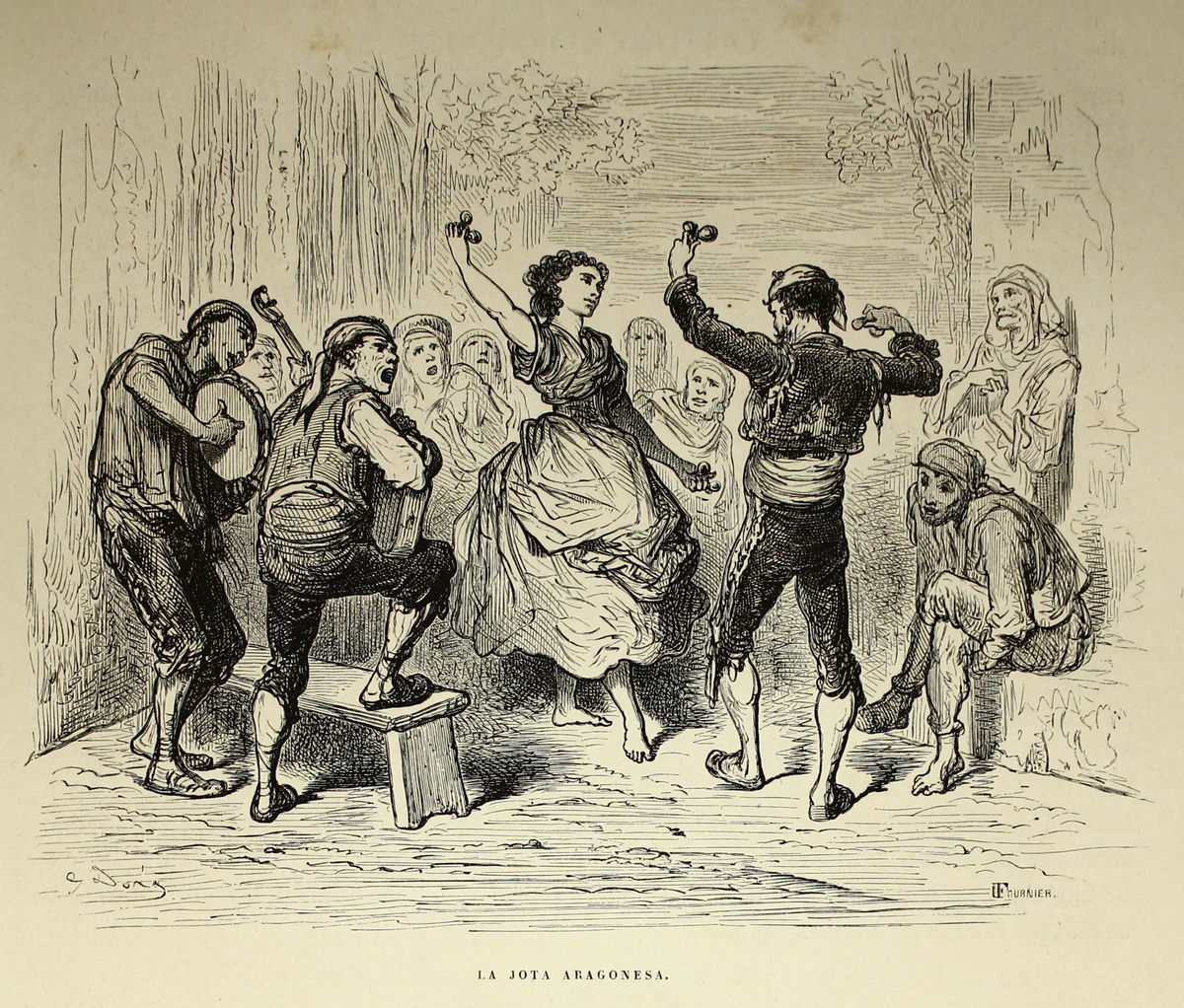
The oldest scene we can describe in detail is from 1828. An account of a commemoration held in Zaragoza in honour of Fernando VII records young men going out at midnight to sing jotas outside girls' houses, with guitars, requintos, bandurrias, violas, violins, bassoons and flutes. That is the street: at night, free, and with no stage.
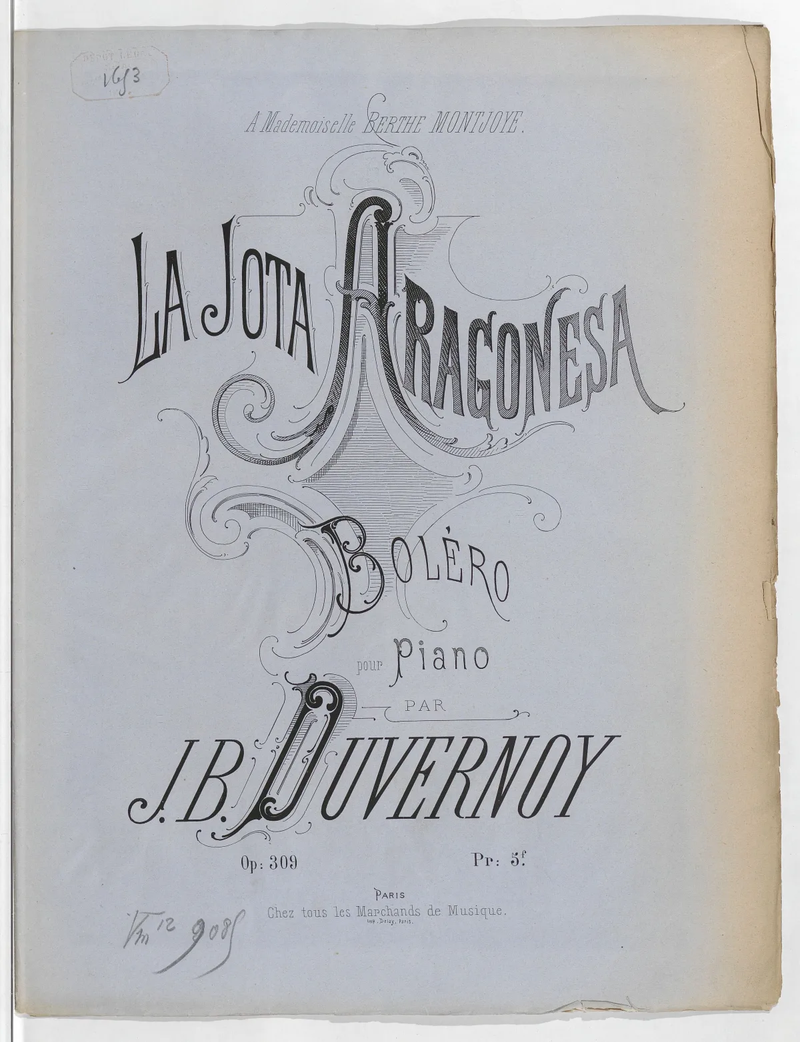
Imagen: Bibliothèque nationale de France, dominio público, vía Wikimedia Commons
How it reached the hall. The first step is taken by an Aragonese man at a piano. Florencio Lahoz y Otal, born in Alagón in 1815, moves to Madrid in 1840 and publishes his Nueva Jota Aragonesa there: five sung sections, forty-two variations and a coda, built on tunes from the Ribera Alta del Ebro. It was reprinted and expanded across Spain and Europe.
The second step is taken by a Russian. Mikhail Glinka travels through Spain and in 1845 writes the Capriccio brillante on the Jota aragonesa, known today as his Spanish Overture No. 1. It is a jota for symphony orchestra, played by people who had never seen a night serenade.
The third step is taken by the market. In 1874 a Paris press publishes La Jota aragonesa, boléro pour piano by J. B. Duvernoy, opus 309, priced at five francs and dedicated to a young lady. Look at the label: the French publisher calls it a boléro, which is a different dance in a different metre. For selling in Paris it made no difference; what was being sold was Spain, not the jota.
1894 is the year the jota gets organised. On 26 March, at the Hotel Inglés in Madrid, the Aragonese journalists Eusebio Blasco and Mariano de Cavia put on a "Fiesta a la Jota". The bandurria player Ángel Sola and Santiago Lapuente perform, and out of it comes the Lapuente-Sola collection, the genre's first major songbook.
That same year Zaragoza launches the Certamen Oficial de Jota, run by the city council during the Pilar festival and held every year since. It has been interrupted only three times: in 1898 for the Cuban war, in 1918 for the flu, and from 1936 to 1939 for the Civil War. The first winner was Blas Mora, born in Teruel in 1861.
A competition changes a music. From the moment there is a jury, a stage and a first prize, singing well stops being something done at night in a street and becomes something you prepare. You gain technique and a fixed repertoire; you lose the person who sang badly and sang anyway.
1895: the rondalla climbs onto an opera stage. Tomás Bretón premieres La Dolores on 16 March 1895 at the Teatro de la Zarzuela in Madrid. It is set in Calatayud, and in the first act a rondalla walks on stage and everyone sings a jota. Bretón had studied the jota in 1890 in order to write it.
It worked as few things have worked here: 53 consecutive days in Madrid and 103 at the Tívoli in Barcelona, then the Teatro Real, the Liceo, Prague and Buenos Aires. A jota from Calatayud, sung in Italian in Milan.
1919: the jota ends up in London. The final dance of Manuel de Falla's The Three-Cornered Hat is a jota. It opened on 21 July 1919 at the Alhambra Theatre with Diaghilev's Ballets Russes, choreography by Léonide Massine, conducted by Ernest Ansermet, with sets and costumes by Pablo Picasso.
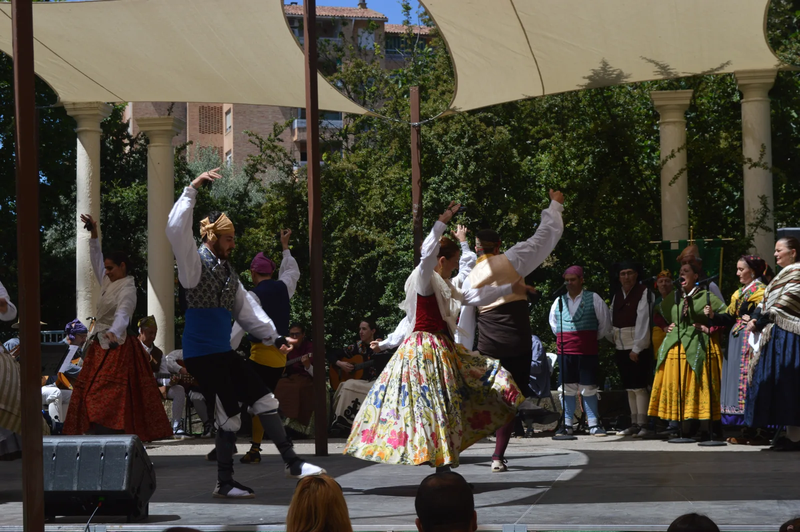
Foto: Azahara00, CC BY-SA 4.0, vía Wikimedia Commons
And the way back. In 1940 Zaragoza city council founds the Escuela Municipal de Jota, whose first singing teacher was Pascuala Perié until 1950; Huesca opens its own in 1975 and schools follow across Aragón. Since 2017 the Fonoteca de la Jota, in the Biblioteca de Aragón, has held more than two thousand recordings.
Spain, at the same time. In 1891 Felipe Pedrell publishes Por nuestra música, arguing that Spain will have a music of its own the day it builds one on its popular song instead of imitating Italy. It is not a piece of music: it is a commission, and his students take it on.
The three names are his. Isaac Albéniz writes Iberia between 1906 and 1909; Enrique Granados writes Goyescas in 1911; and Manuel de Falla writes the Siete canciones populares españolas in 1914, whose fourth song is, of all things, a jota. The same one you sang at the start of this unit, with a piano answering it between phrases.
Classroom activities
- While the Certamen jota plays: everyone counts the sung phrases of one copla on their fingers, in silence. Afterwards we compare. Anyone who reaches seven has heard the whole structure.
- While the Chopin mazurka plays: we count 1-2-3 with a foot and clap only when the accent does not land on beat 1. We will get it wrong at first; twenty seconds later, not.
- While Schubert's Erlkönig plays: there are four characters and one singer. We raise a hand each time the character changes. The clue is not the words, it is the pitch and the force of the voice.
- While Falla's Jota plays: we breathe when the singer breathes, without singing. Counting breaths is counting phrases, and it is the fastest way to hear phrasing.
- Play: we build the jota copla with whatever instruments are in the room, first in unison and then with a two-chord accompaniment. Then we build Sweet Home Alabama, whose chart and tab are in the library, and compare two melodies that serve as flags.
- Create: take a melody the whole class knows and play it twice. The second time, change no notes at all: change only the dynamics and the agogics. If anyone notices the difference, the unit has done its job.
Key vocabulary
- Phrase — frase: una unidad de melodía con sentido completo; acaba donde el cantante respira
- Phrasing — fraseo: la manera de tocar respetando esas frases
- Dynamics — dinámica: acentuar con el volumen
- Agogics — agógica: acentuar con el tiempo (alargar, frenar, adelantarse); rubato es «tiempo robado»
- Copla — la cuarteta que canta el cantador de jota, repartida en siete frases musicales
Resources
The songs in this unit are in the library, each with its own article, full-band chart and tab: La flaca, Sweet Home Alabama, La Gozadera.
Songs in the library that are also flags, each with its own article, chart and tab: Sweet Home Alabama, La Gozadera, La flaca.
The sung jota, today and with a jury — Lucía Claver's prize-winning jotas, on Aragón Play. Count the phrases in one copla.
Who is playing behind — how the rondalla for Zaragoza's Certamen Oficial de Jota is put together. Guitar, bandurria and lute, each with its own job.
The same jota, with a piano and in a hall — Jota, from Falla's Siete canciones populares españolas (1914), sung by José Manuel Montero with Aurelio Viribay. This is the listening for "The fragment".
The jota for orchestra, written by a Russian — Glinka's Capriccio brillante on the Jota aragonesa (1845), by the Orchestre de la Suisse Romande.
A rondalla inside an opera — the jota from Tomás Bretón's La Dolores (1895), conducted by Miguel Roa. The action takes place in Calatayud.
The jota in London, with sets by Picasso — final dance from Falla's The Three-Cornered Hat (1919), by ADDA·Simfònica.
Where the accent lands — Chopin's Mazurka in A minor Op. 17 No. 4, played by Eric Lu, on the Chopin Institute channel in Warsaw. Count 1-2-3 and hunt for the push.
Four characters and one voice — Schubert's Erlkönig, by Konstantin Krimmel and Ammiel Bushakevitz. This is the listening for the third activity.
A melody that dodged the censors — Sibelius's Finlandia (1899), by the BBC at the Proms.
An Andean melody that went round the world — El cóndor pasa, by Daniel Alomía Robles (1913), on charango, quena and zampoña.
- The element that comes before this one — "How do you know where you are in music you have never heard before?", on musical form, in the library.
Nos preguntamos
- ¿Cómo sabes dónde acaba una frase en una música sin letra?
- ¿Por qué hay canciones que un pueblo entero considera suyas aunque no las haya escrito nadie de allí?
- Si dos personas tocan las mismas notas, ¿en qué se nota quién es cada una?
- ¿Qué le pasa a una jota cuando la tocan cuarenta músicos leyendo una partitura?
- ¿Quién decidió que la jota se toca con guitarra, bandurria y laúd?
- ¿Sirve una canción para defender algo cuando está prohibido decirlo?
No las respondas todavía. Al final de la unidad volvemos a ellas.
El fragmento
Antes de poner nada, cantamos. En la pizarra, una copla de jota de las de siempre:
- Si tuvieras olivares
- como tienes fantasía,
- los molinos del aceite
- por tu cuenta correrían.
Son cuatro versos. Pero la jota no los canta cuatro veces: los canta siete, y en un orden que no es el del papel. Primero el segundo verso, que hace de entrada; luego el primero, el segundo, el tercero y el cuarto; luego el cuarto otra vez, que es la vuelta; y se cierra con el primero. Esa distribución tiene nombre: 2-1-2-3-4-4-1.
Lo que hacemos en clase es sencillo. Marcamos el 1-2-3 con la mano, porque la jota va en compás ternario, y cantamos las siete frases seguidas. Da igual la afinación. Lo que hay que notar es otra cosa: dónde te hace falta respirar. Ahí acaba una frase.
Ahora la misma melodía, pero en otro sitio. La Jota de las Siete canciones populares españolas de Falla es una jota con piano, escrita en 1914 para cantarse en un salón o en una sala de conciertos. Escúchala entera y sin comentarios por encima. Después decidimos entre todos qué se ha ganado y qué se ha perdido.
Qué cambió
Durante siglos, la pregunta de para qué servía la música tenía una respuesta corta: para lo que quisiera quien pagaba. La iglesia pagaba misas, la corte pagaba divertimentos, el teatro pagaba óperas. En el siglo XIX aparece un cliente nuevo, y es raro, porque no tiene cara: la gente que quiere reconocerse en algo.
Fíjate en el caso extremo. Polonia desaparece del mapa como estado a finales del XVIII, y durante más de cien años no hay bandera polaca que se pueda sacar a la calle. Lo que sí se puede es tocar el piano. Chopin escribe al menos 58 mazurcas y 23 polonesas, y esas dos danzas acaban haciendo el trabajo que un estado no podía hacer.
¿Y qué tienen de polaco? Una cosa muy concreta y muy pequeña: dónde cae el acento. La mazurca va en compás ternario, como el vals, pero acentúa el segundo y el tercer tiempo en vez del primero. Si marcas el 1-2-3 y el golpe no llega donde lo esperas, ya has oído la diferencia sin saber nada de Polonia.
Aquí entra la parte técnica de la unidad, y es la que de verdad sirve para todo lo demás. Una melodía no es una fila de notas: es una fila de frases. Una frase musical es una unidad con sentido, como una frase hablada, y sabes dónde acaba porque es donde el cantante respira. A la manera de tocar respetando esas frases se le llama fraseo.
Sobre ese esqueleto, el siglo XIX coloca dos herramientas distintas para destacar una nota. La primera la conoces: la dinámica, que es acentuar con el volumen, tocando más fuerte o más flojo. La segunda no suele nombrarse en clase y hace la mitad del trabajo: la agógica, que es acentuar con el tiempo.
Acentuar con el tiempo significa alargar una nota, frenar antes de una llegada o adelantarse un poco. El teórico Hugo Riemann lo llamó acento agógico: una nota destaca porque dura más, no porque suene más fuerte. Y cuando eso se hace de forma continua y flexible, se llama rubato, que en italiano es «robado».
Carl Mikuli, que fue alumno de Chopin, dejó escrito cómo lo hacía su maestro: la mano que acompañaba iba a tiempo estricto, mientras la otra dudaba o se adelantaba, «como en el habla apasionada». Es decir, el tiempo que una mano roba, la otra lo devuelve. Dos personas tocando las mismas notas suenan distinto por esto, no por otra cosa.
Al mismo tiempo, en los países de lengua alemana, la canción popular se mete en el salón burgués por la puerta del lied: un poema, una voz sola y un piano, sin florituras de ópera. Schubert lo desarrolla desde 1814 y Beethoven escribe el primer ciclo en 1816. La melodía deja de ser un adorno del texto y pasa a ser el argumento.
Conviene decir también lo que no está claro, porque es lo más interesante. En 1852 Liszt escribió que Chopin bebía directamente de la música popular polaca, y quien lo leyó entendió «popular» donde ponía «nacional». De ahí sale lo que la investigación sobre Chopin llama su mito más duradero: lo más probable es que oyera esa música en la ciudad, en Varsovia, no en una era de pueblo.
Eso no le quita valor. Lo cambia de sitio. Una identidad musical se recoge en parte y en parte se construye, y el siglo XIX hizo las dos cosas a la vez sin pedir permiso.
Datos duros: Chopin, al menos 58 mazurcas publicadas entre 1824 y 1849, y al menos 23 polonesas para piano solo, la primera en 1817 con siete años y la última en 1846. Lied: voz y piano sobre un poema, con Schubert desde 1814 y el primer ciclo de Beethoven en 1816. Acento agógico, término de Riemann; rubato, descrito por Mikuli.
El mismo recurso en otros sitios
Una melodía que funciona como bandera no es cosa del XIX ni de Europa. Estos tres lo hacen en tres continentes y con cien años de diferencia, y conviene oírlos seguidos:
- Sweet Home Alabama, de Lynyrd Skynyrd (1974) — tres acordes y una figura de dos compases que un estado entero adoptó como suya. Y trae el problema de propina: es una canción respuesta, con un verso sobre el gobernador de Alabama que sigue dando discusiones. Las melodías-bandera llevan política dentro.
- Finlandia, de Sibelius (1899) — escrita cuando Rusia recortaba la autonomía finlandesa. Circuló con títulos inventados para burlar a la censura zarista; la música era la misma, el título no. Finlandia sigue sin tener himno oficial.
- El cóndor pasa, de Daniel Alomía Robles (1913) — una melodía andina metida en una zarzuela estrenada en Lima. Perú la declaró Patrimonio Cultural de la Nación en 2004, y en 1970 Simon & Garfunkel la convirtieron en un éxito mundial en inglés.
Los tres hacen el mismo trabajo: dar a un grupo de gente algo que se puede cantar entero, de memoria y a la vez.
Y aquí, ¿qué?
Aquí la respuesta tiene nombre propio y hay que contarla despacio, porque es la mejor documentada de todas.
Qué es una jota, por dentro. Va en compás ternario, en escala diatónica y en modo mayor, y su armonía es de una simplicidad que asusta: tónica y dominante con séptima, poco más. Empieza con la llamada, cuatro rasgueos de toda la rondalla sobre el acorde de tónica, y termina con cuatro acordes muy marcados.
Entre medias alternan dos cosas. Las variaciones son instrumentales, duran ocho compases y se reparten mitad de tónica y mitad de dominante; son el sitio donde se lucen los de la rondalla. Y las coplas o cantas son lo que canta el cantador: la cuarteta repartida en siete frases que has montado en el apartado anterior.
Una precisión que se oye en cuanto te la dicen: la entrada se canta en el tono de la dominante, y por eso suena a que aún no ha empezado nada. Los cantadores antiguos usaban otra distribución de versos, 1-1-2-3-4-4-1. La de hoy, la 2-1-2-3-4-4-1, es la moderna.
Quién la toca. La rondalla de ahora es de cuerda pulsada: la guitarra hace el grave y va rasgueada, la bandurria lleva las melodías en el agudo, el laúd hace el contrapunto, y las castañuelas y las panderetas marcan. Lo que no suele decirse es que eso es una selección.
La investigación sobre folclore documenta que la jota se tocaba también con gaita de boto, chiflo, dulzaina, violines, flautas y hasta acordeones, con tambores y cántaros de percusión. La rondalla de cuerda que hoy parece «la» jota quedó fijada así en parte por la estandarización que el género sufrió durante el franquismo. Lo que se oye en un certamen no es todo lo que se cantaba.
Desde cuándo. Menos de lo que parece, y con huecos. El nombre no aparece documentado con seguridad hasta finales del siglo XVII, en un códice llamado Cifras para arpa hallado en Ávila, en el encabezado del folio 25. Demetrio Galán Bergua propuso un precedente de 1666: un villancico de José Ruiz de Samaniego, maestro de capilla de El Pilar, que ya trae los dieciséis compases de entrada típicos.
Antonio Beltrán Martínez, que es de los que mejor la estudiaron, sostiene que el género no nace antes del siglo XVIII y que se extiende por la Península en el XIX. Un dato ayuda a entenderlo: no se conocen letras de jota anteriores al XIX. Primero se bailó, y bastante después se cantó.
La escena más antigua que se puede describir con detalle es de 1828. En la narración de una conmemoración celebrada en Zaragoza en honor de Fernando VII queda documentada la costumbre de los mozos de rondar a medianoche cantando jotas ante las casas de las jóvenes, con guitarras, requintos, bandurrias, violas, violines, fagots y flautas. Eso es la calle: de noche, gratis y sin escenario.
Imagen: Bibliothèque nationale de France, dominio público, vía Wikimedia Commons
Cómo llegó a la sala. El primer paso lo da un aragonés y lo da con un piano. Florencio Lahoz y Otal, nacido en Alagón en 1815, se marcha a Madrid en 1840 y publica allí la Nueva Jota Aragonesa: cinco cantos, cuarenta y dos variaciones y una coda, sobre melodías de la Ribera Alta del Ebro. Se reeditó y se amplió por España y por Europa.
El segundo paso lo da un ruso. Mijaíl Glinka viaja por España y en 1845 escribe el Capricho brillante sobre la jota aragonesa, que hoy se conoce como su Obertura española n.º 1. Es una jota para orquesta sinfónica, tocada por gente que no sabía lo que era una ronda.
El tercero lo da el mercado. En 1874 una imprenta de París publica La Jota aragonesa, boléro pour piano, de J. B. Duvernoy, opus 309, a cinco francos, dedicada a una señorita. Fíjate en la etiqueta: el editor francés la llama boléro, que es otra danza y otro compás. Para vender en París daba igual; lo que se vendía era España, no la jota.
1894 es el año en que la jota se organiza. El 26 de marzo, en el Hotel Inglés de Madrid, los periodistas aragoneses Eusebio Blasco y Mariano de Cavia montan la «Fiesta a la Jota». Tocan el bandurrista Ángel Sola y Santiago Lapuente, y de ahí sale la Recopilación Lapuente-Sola, el primer gran cancionero del género.
Ese mismo año arranca en Zaragoza el Certamen Oficial de Jota, que convoca el Ayuntamiento durante las fiestas del Pilar y que se celebra desde entonces todos los años. Solo se ha interrumpido tres veces: en 1898 por la guerra de Cuba, en 1918 por la gripe y entre 1936 y 1939 por la Guerra Civil. El primero lo ganó Blas Mora, nacido en Teruel en 1861.
Un certamen cambia una música. A partir del momento en que hay un jurado, un escenario y un primer premio, cantar bien deja de ser una cosa que se hace de noche en una calle y pasa a ser una cosa que se prepara. Se gana nivel técnico y repertorio fijado; se pierde el que cantaba regular y cantaba igual.
1895: la rondalla se sube a un teatro de ópera. Tomás Bretón estrena La Dolores el 16 de marzo de 1895 en el Teatro de la Zarzuela de Madrid. La acción pasa en Calatayud, y en el primer acto entra una rondalla en escena y todos cantan una jota. Bretón había estudiado la jota en 1890 para poder escribirla.
Funcionó como pocas cosas han funcionado aquí: 53 días seguidos en Madrid y 103 en el Tívoli de Barcelona, y después Teatro Real, Liceo, Praga y Buenos Aires. Una jota de Calatayud cantada en italiano en Milán.
1919: la jota acaba en Londres. La danza final de El sombrero de tres picos de Manuel de Falla es una jota. Se estrenó el 21 de julio de 1919 en el Alhambra Theatre con los Ballets Rusos de Diáguilev, coreografía de Léonide Massine, dirección de Ernest Ansermet y decorados y figurines de Pablo Picasso.
Foto: Azahara00, CC BY-SA 4.0, vía Wikimedia Commons
Y el camino de vuelta. En 1940 el Ayuntamiento de Zaragoza crea la Escuela Municipal de Jota, cuya primera profesora de canto fue Pascuala Perié hasta 1950; Huesca abre la suya en 1975 y detrás vienen escuelas por todo Aragón. Desde 2017 la Fonoteca de la Jota, en la Biblioteca de Aragón, guarda más de dos mil grabaciones.
Lo español, a la vez. En 1891 Felipe Pedrell publica Por nuestra música, donde sostiene que España tendrá una música propia el día que la construya sobre su canto popular en vez de imitar a Italia. No es una obra: es un encargo, y sus alumnos lo aceptan.
Los tres nombres son suyos. Isaac Albéniz escribe Iberia entre 1906 y 1909; Enrique Granados, Goyescas en 1911; y Manuel de Falla, las Siete canciones populares españolas en 1914, donde la cuarta canción es, precisamente, una jota. La misma que has cantado al principio de la unidad, con un piano contestándole entre frase y frase.
Para hacer en clase
- Mientras suena la jota del Certamen: cada uno cuenta con los dedos las frases cantadas de una copla, sin decir nada. Al final comparamos. Quien llegue a siete ha oído la estructura entera.
- Mientras suena la mazurca de Chopin: marcamos el 1-2-3 con el pie y damos una palmada solo cuando el acento no caiga en el 1. Al principio fallaremos; a los veinte segundos, no.
- Mientras suena el Erlkönig de Schubert: hay cuatro personajes y un solo cantante. Levantamos la mano cada vez que cambia de personaje. La pista no es la letra, es la altura y la fuerza de la voz.
- Mientras suena la Jota de Falla: respiramos cuando respira el cantante, sin cantar. Contar respiraciones es contar frases, y es la forma más rápida de oír un fraseo.
- Tocar: montamos la copla de jota con los instrumentos que haya, primero a una sola voz y después con un acompañamiento de dos acordes. Y luego montamos Sweet Home Alabama, que tiene su chart y su tablatura en la biblioteca, para comparar dos melodías que sirven de bandera.
- Crear: coge una melodía que se sepa toda la clase y tócala dos veces seguidas. La segunda vez no cambies ni una nota: cambia solo la dinámica y la agógica. Si alguien nota la diferencia, la unidad ha funcionado.
Vocabulario fundamental
- Frase — Una unidad de melodía con sentido completo, como una frase hablada. Se reconoce porque al final de ella el que canta respira.
- Fraseo — La manera de tocar o cantar respetando esas frases, decidiendo dónde se junta y dónde se separa. Es lo que hace que dos personas con las mismas notas suenen distinto.
- Dinámica — Acentuar con el volumen: más fuerte, más flojo, creciendo o apagándose.
- Agógica — Acentuar con el tiempo: alargar una nota, frenar antes de una llegada, adelantarse. Cuando se hace de forma continua y flexible se llama rubato, «tiempo robado».
- Copla — En la jota, la cuarteta que canta el cantador. Cuatro versos repartidos en siete frases musicales, con entrada, vuelta y final.
Recursos
Las canciones de esta unidad están en la biblioteca, cada una con su artículo, su chart de banda y su tablatura: La flaca, Sweet Home Alabama, La Gozadera.
Canciones de la biblioteca que también son banderas, cada una con su artículo, su chart y su tablatura: Sweet Home Alabama, La Gozadera, La flaca.
La jota cantada, hoy y con jurado — las jotas ganadoras de Lucía Claver, en Aragón Play. Cuenta las frases de una copla.
Quién toca detrás — cómo se prepara la rondalla del Certamen Oficial de Jota de Zaragoza. Guitarra, bandurria y laúd, cada una con su trabajo.
La misma jota, con piano y en una sala — Jota, de las Siete canciones populares españolas de Falla (1914), por José Manuel Montero y Aurelio Viribay. Es la audición del apartado «El fragmento».
La jota para orquesta, escrita por un ruso — Capricho brillante sobre la jota aragonesa, de Glinka (1845), por la Orchestre de la Suisse Romande.
Una rondalla dentro de una ópera — la jota de La Dolores, de Tomás Bretón (1895), dirigida por Miguel Roa. La acción pasa en Calatayud.
La jota en Londres, con decorados de Picasso — danza final de El sombrero de tres picos, de Falla (1919), por la ADDA·Simfònica.
Dónde cae el acento — Mazurca en la menor op. 17 n.º 4 de Chopin, por Eric Lu, en el canal del Instituto Chopin de Varsovia. Marca el 1-2-3 y busca el golpe.
Cuatro personajes y una sola voz — Erlkönig de Schubert, por Konstantin Krimmel y Ammiel Bushakevitz. Es la audición de la tercera actividad.
Una melodía que burló a la censura — Finlandia de Sibelius (1899), por la BBC en los Proms.
Una melodía andina que dio la vuelta al mundo — El cóndor pasa, de Daniel Alomía Robles (1913), con charango, quena y zampoña.
- El elemento que va antes — «¿Cómo sabes por dónde vas en una música que oyes por primera vez?», sobre la forma, en la biblioteca.
We ask ourselves
- How do you know where a phrase ends in music that has no words?
- Why do whole regions adopt songs that nobody from there actually wrote?
- If two people play the same notes, what tells you who is who?
- What happens to a folk dance when forty musicians play it off a score?
- Who decided that the jota is played on guitar, bandurria and lute?
- Can a song defend something at a time when saying it out loud is banned?
Don't answer yet. We come back to these at the end.
The fragment
Before we play anything, we sing. On the board, an ordinary jota stanza:
- Si tuvieras olivares
- como tienes fantasía,
- los molinos del aceite
- por tu cuenta correrían.
Four lines. But a jota does not sing them four times: it sings them seven, and not in the order on the page. First line two, as the way in; then lines one, two, three and four; then line four again; and it closes on line one. That pattern has a name: 2-1-2-3-4-4-1.
What we do in class is simple. We count 1-2-3 with a hand, because a jota is in triple metre, and we sing the seven phrases straight through. Tuning does not matter. What matters is noticing something else: where you need to breathe. That is where a phrase ends.
Now the same melody somewhere else. The Jota from Falla's Siete canciones populares españolas is a jota with a piano, written in 1914 to be sung in a drawing room or a concert hall. Listen to all of it with nobody talking over it. Then we decide together what has been gained and what has been lost.
What changed
For centuries the question of what music was for had a short answer: whatever the payer wanted. The church paid for masses, the court paid for entertainments, the theatre paid for operas. In the nineteenth century a new customer shows up, and it is a strange one, because it has no face: people who want to recognise themselves in something.
Look at the extreme case. Poland disappears from the map as a state at the end of the eighteenth century, and for more than a hundred years there is no Polish flag you can carry down a street. What you can do is play the piano. Chopin writes at least 58 mazurkas and 23 polonaises, and those two dances end up doing the job a state could not.
And what exactly is Polish about them? One very small, very specific thing: where the accent lands. The mazurka is in triple metre, like the waltz, but it stresses the second and third beats instead of the first. Count 1-2-3 and feel the push arrive in the wrong place, and you have heard the difference without knowing anything about Poland.
This is where the technical part of the unit comes in, and it is the part that pays for everything else. A melody is not a row of notes: it is a row of phrases. A musical phrase is a unit that makes sense on its own, like a spoken sentence, and you know where it ends because that is where the singer breathes. Playing in a way that respects those phrases is called phrasing.
On top of that skeleton the nineteenth century puts two different tools for making a note stand out. You know the first one: dynamics, accenting with volume, louder or softer. The second rarely gets named in class and does half the work: agogics, accenting with time.
Accenting with time means holding a note longer, easing off before an arrival, or coming in slightly early. The theorist Hugo Riemann called it the agogic accent: a note stands out because it lasts longer, not because it is louder. Do that continuously and flexibly and you get rubato, which is Italian for "stolen".
Carl Mikuli, who studied with Chopin, wrote down how his teacher did it: the accompanying hand kept strict time while the other hesitated or ran ahead, "as in passionate speech". The time one hand steals, the other gives back. Two people playing the same notes sound different because of this, and not because of anything else.
At the same time, in German-speaking countries, folk song walks into the middle-class drawing room through the Lied: a poem, one voice and a piano, with none of the opera house's display. Schubert develops it from 1814 and Beethoven writes the first cycle in 1816. The melody stops decorating the text and becomes the argument.
It is worth saying what is not settled, because that is the interesting part. In 1852 Liszt wrote that Chopin drew straight from Polish folk music, and readers took "national" to mean "folk". Out of that came what Chopin scholarship calls its longest-standing myth: most likely he heard this music in the city, in Warsaw, not in a village.
That does not make it worth less. It moves it. A musical identity is partly collected and partly built, and the nineteenth century did both at once without asking permission.
Hard facts: Chopin, at least 58 published mazurkas written between 1824 and 1849, and at least 23 polonaises for solo piano, the first in 1817 at the age of seven and the last in 1846. Lied: voice and piano on a poem, with Schubert from 1814 and Beethoven's first cycle in 1816. Agogic accent, Riemann's term; rubato, as described by Mikuli.
The same device elsewhere
A melody working as a flag is not a nineteenth-century or a European idea. These three do it on three continents a hundred years apart, and they are worth hearing back to back:
- Sweet Home Alabama, Lynyrd Skynyrd (1974) — three chords and a two-bar figure that an entire state took as its own. It also brings the problem along: it is an answer song, and a line about Alabama's governor is still argued over. Flag melodies carry politics inside them.
- Finlandia, Sibelius (1899) — written while Russia was cutting back Finnish autonomy. It circulated under invented titles to dodge the tsarist censors; the music was the same, the title was not. Finland still has no official anthem.
- El cóndor pasa, Daniel Alomía Robles (1913) — an Andean melody placed inside a zarzuela premiered in Lima. Peru declared it national cultural heritage in 2004, and in 1970 Simon & Garfunkel turned it into a worldwide hit in English.
All three do the same job: give a group of people something they can sing all the way through, from memory, together.
And here at home?
Here the answer has a name of its own, and it deserves telling slowly, because it is the best documented of the lot.
What a jota is, from the inside. Triple metre, a diatonic scale, major mode, and a harmony of alarming simplicity: tonic and dominant seventh, and not much else. It opens with the llamada, four strummed chords from the whole band on the tonic, and it ends with four heavily marked chords.
In between, two things alternate. The variaciones are instrumental, eight bars long, half on the tonic and half on the dominant, and they are where the players show off. The coplas are what the singer sings: the four-line stanza spread across the seven phrases you built in the previous section.
One detail you hear the moment someone points it out: the opening phrase is sung on the dominant, which is why it sounds as if nothing has started yet. Older singers used a different order of lines, 1-1-2-3-4-4-1. Today's 2-1-2-3-4-4-1 is the modern one.
Who plays it. Today's rondalla is plucked strings: the guitar takes the bass and is strummed, the bandurria carries the melodies up top, the lute does the counterpoint, and castanets and tambourines mark the beat. What tends to go unsaid is that this is a selection.
Folklore research documents that the jota was also played on the gaita de boto (the Aragonese bagpipe), the chiflo, the dulzaina, violins, flutes and even accordions, with drums and earthenware jars for percussion. The plucked-string band that now looks like "the" jota was fixed that way partly by the standardisation the genre went through under Franco. What you hear at a competition is not everything that used to be sung.
How far back. Less far than you would think, and with gaps. The name is not securely documented until the end of the seventeenth century, in a codex called Cifras para arpa found in Ávila, at the head of folio 25. Demetrio Galán Bergua proposed an earlier trace from 1666: a villancico by José Ruiz de Samaniego, chapel master at El Pilar, which already has the jota's typical sixteen-bar opening.
Antonio Beltrán Martínez, one of its sharpest scholars, holds that the genre is not born before the eighteenth century and spreads across the peninsula in the nineteenth. One fact helps: no jota lyrics are known from before the nineteenth century. It was danced first, and sung a good while later.
The oldest scene we can describe in detail is from 1828. An account of a commemoration held in Zaragoza in honour of Fernando VII records young men going out at midnight to sing jotas outside girls' houses, with guitars, requintos, bandurrias, violas, violins, bassoons and flutes. That is the street: at night, free, and with no stage.
Imagen: Bibliothèque nationale de France, dominio público, vía Wikimedia Commons
How it reached the hall. The first step is taken by an Aragonese man at a piano. Florencio Lahoz y Otal, born in Alagón in 1815, moves to Madrid in 1840 and publishes his Nueva Jota Aragonesa there: five sung sections, forty-two variations and a coda, built on tunes from the Ribera Alta del Ebro. It was reprinted and expanded across Spain and Europe.
The second step is taken by a Russian. Mikhail Glinka travels through Spain and in 1845 writes the Capriccio brillante on the Jota aragonesa, known today as his Spanish Overture No. 1. It is a jota for symphony orchestra, played by people who had never seen a night serenade.
The third step is taken by the market. In 1874 a Paris press publishes La Jota aragonesa, boléro pour piano by J. B. Duvernoy, opus 309, priced at five francs and dedicated to a young lady. Look at the label: the French publisher calls it a boléro, which is a different dance in a different metre. For selling in Paris it made no difference; what was being sold was Spain, not the jota.
1894 is the year the jota gets organised. On 26 March, at the Hotel Inglés in Madrid, the Aragonese journalists Eusebio Blasco and Mariano de Cavia put on a "Fiesta a la Jota". The bandurria player Ángel Sola and Santiago Lapuente perform, and out of it comes the Lapuente-Sola collection, the genre's first major songbook.
That same year Zaragoza launches the Certamen Oficial de Jota, run by the city council during the Pilar festival and held every year since. It has been interrupted only three times: in 1898 for the Cuban war, in 1918 for the flu, and from 1936 to 1939 for the Civil War. The first winner was Blas Mora, born in Teruel in 1861.
A competition changes a music. From the moment there is a jury, a stage and a first prize, singing well stops being something done at night in a street and becomes something you prepare. You gain technique and a fixed repertoire; you lose the person who sang badly and sang anyway.
1895: the rondalla climbs onto an opera stage. Tomás Bretón premieres La Dolores on 16 March 1895 at the Teatro de la Zarzuela in Madrid. It is set in Calatayud, and in the first act a rondalla walks on stage and everyone sings a jota. Bretón had studied the jota in 1890 in order to write it.
It worked as few things have worked here: 53 consecutive days in Madrid and 103 at the Tívoli in Barcelona, then the Teatro Real, the Liceo, Prague and Buenos Aires. A jota from Calatayud, sung in Italian in Milan.
1919: the jota ends up in London. The final dance of Manuel de Falla's The Three-Cornered Hat is a jota. It opened on 21 July 1919 at the Alhambra Theatre with Diaghilev's Ballets Russes, choreography by Léonide Massine, conducted by Ernest Ansermet, with sets and costumes by Pablo Picasso.
Foto: Azahara00, CC BY-SA 4.0, vía Wikimedia Commons
And the way back. In 1940 Zaragoza city council founds the Escuela Municipal de Jota, whose first singing teacher was Pascuala Perié until 1950; Huesca opens its own in 1975 and schools follow across Aragón. Since 2017 the Fonoteca de la Jota, in the Biblioteca de Aragón, has held more than two thousand recordings.
Spain, at the same time. In 1891 Felipe Pedrell publishes Por nuestra música, arguing that Spain will have a music of its own the day it builds one on its popular song instead of imitating Italy. It is not a piece of music: it is a commission, and his students take it on.
The three names are his. Isaac Albéniz writes Iberia between 1906 and 1909; Enrique Granados writes Goyescas in 1911; and Manuel de Falla writes the Siete canciones populares españolas in 1914, whose fourth song is, of all things, a jota. The same one you sang at the start of this unit, with a piano answering it between phrases.
Classroom activities
- While the Certamen jota plays: everyone counts the sung phrases of one copla on their fingers, in silence. Afterwards we compare. Anyone who reaches seven has heard the whole structure.
- While the Chopin mazurka plays: we count 1-2-3 with a foot and clap only when the accent does not land on beat 1. We will get it wrong at first; twenty seconds later, not.
- While Schubert's Erlkönig plays: there are four characters and one singer. We raise a hand each time the character changes. The clue is not the words, it is the pitch and the force of the voice.
- While Falla's Jota plays: we breathe when the singer breathes, without singing. Counting breaths is counting phrases, and it is the fastest way to hear phrasing.
- Play: we build the jota copla with whatever instruments are in the room, first in unison and then with a two-chord accompaniment. Then we build Sweet Home Alabama, whose chart and tab are in the library, and compare two melodies that serve as flags.
- Create: take a melody the whole class knows and play it twice. The second time, change no notes at all: change only the dynamics and the agogics. If anyone notices the difference, the unit has done its job.
Key vocabulary
- Phrase — frase: una unidad de melodía con sentido completo; acaba donde el cantante respira
- Phrasing — fraseo: la manera de tocar respetando esas frases
- Dynamics — dinámica: acentuar con el volumen
- Agogics — agógica: acentuar con el tiempo (alargar, frenar, adelantarse); rubato es «tiempo robado»
- Copla — la cuarteta que canta el cantador de jota, repartida en siete frases musicales
Resources
The songs in this unit are in the library, each with its own article, full-band chart and tab: La flaca, Sweet Home Alabama, La Gozadera.
Songs in the library that are also flags, each with its own article, chart and tab: Sweet Home Alabama, La Gozadera, La flaca.
The sung jota, today and with a jury — Lucía Claver's prize-winning jotas, on Aragón Play. Count the phrases in one copla.
Who is playing behind — how the rondalla for Zaragoza's Certamen Oficial de Jota is put together. Guitar, bandurria and lute, each with its own job.
The same jota, with a piano and in a hall — Jota, from Falla's Siete canciones populares españolas (1914), sung by José Manuel Montero with Aurelio Viribay. This is the listening for "The fragment".
The jota for orchestra, written by a Russian — Glinka's Capriccio brillante on the Jota aragonesa (1845), by the Orchestre de la Suisse Romande.
A rondalla inside an opera — the jota from Tomás Bretón's La Dolores (1895), conducted by Miguel Roa. The action takes place in Calatayud.
The jota in London, with sets by Picasso — final dance from Falla's The Three-Cornered Hat (1919), by ADDA·Simfònica.
Where the accent lands — Chopin's Mazurka in A minor Op. 17 No. 4, played by Eric Lu, on the Chopin Institute channel in Warsaw. Count 1-2-3 and hunt for the push.
Four characters and one voice — Schubert's Erlkönig, by Konstantin Krimmel and Ammiel Bushakevitz. This is the listening for the third activity.
A melody that dodged the censors — Sibelius's Finlandia (1899), by the BBC at the Proms.
An Andean melody that went round the world — El cóndor pasa, by Daniel Alomía Robles (1913), on charango, quena and zampoña.
- The element that comes before this one — "How do you know where you are in music you have never heard before?", on musical form, in the library.