Contenidos
Hound Dog — Big Mama Thornton (1952)
Twelve bars and three chords: the frame that holds up most of the rock that came after it. It was recorded by a woman who could not read music and was barely paid for it.
🏷️ Ficha musical
Why this song
Count to twelve, then start again. That is the whole song.
The frame is called the twelve-bar blues, and once you can play it you can play hundreds of other songs. In class you will play it with three chords: G, C and D.
There is a second story underneath. This recording is from 1952. Four years later another singer recorded the same song and sold twenty times more copies. Before the end you will know who got paid.
Historical context
Los Angeles, August 1952. Johnny Otis runs a rhythm and blues band and has just signed a 25-year-old singer, Willie Mae Thornton, known to everyone as Big Mama. He needs a song for her.
So he calls two nineteen-year-olds, Jerry Leiber and Mike Stoller. They come to his house, listen to her rehearse and leave to write. It took them about twelve minutes. Leiber scribbled the words in pencil in the car, without writing down a single note.
Esquema: Yehuda Lichtenstein Music, CC BY-SA 4.0, vía Wikimedia Commons (recortado)
The next day, 13 August, they recorded it in a Los Angeles studio. The line-up is tiny: voice, electric guitar, double bass and drums. No honking saxophones, no hammering piano, which was the normal sound of rhythm and blues back then.
That is why you hear the guitar so clearly: it has nothing to compete with. It is very nearly the line-up you will be playing with.
Johnny Otis himself sat down at the drums because the hired drummer could not catch the feel. Since he was under contract to another label, he signed the record with a false name: "Kansas City Bill". They cut two takes and released the second.
At the rehearsal Leiber told Thornton how he wanted her to sing it. She answered: "White boy, don't you be tellin' me how to sing the blues."
Thornton could not read music. She had taught herself: harmonica by watching her older brother, drums by watching other people. She left school in third grade, when her mother fell ill.
The record came out in February 1953 and spent seven weeks at number one on the rhythm and blues chart. Peacock, the label, had three pressing plants running to keep up.
Musical characteristics
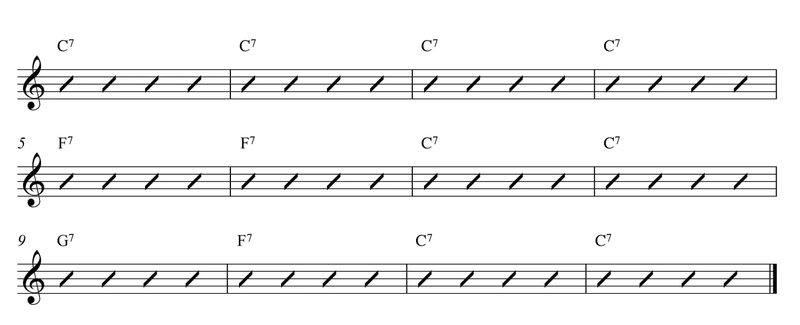
Count four beats in a row: that is a bar. Now count twelve bars. You have just gone through the whole song once, and after twelve you go back to one.
Inside those twelve bars there are only three chords, and they always arrive at the same point. Four bars on the first one. Two on the second. Two back on the first. And the last four are the closing move: one on the third chord, one on the second, two on the first.
That frame is the twelve-bar blues, and it is the same in thousands of songs.
In G, which is how you will play it, those three chords are G, C and D. The 1952 record is not in G: it is in E flat, and the same three slots are filled by E flat, A flat and B flat. The frame has not changed; it has only moved up or down in pitch. That is what transposing means.
The swing in the rhythm comes from how the beat is split. Split each beat in two and it sounds square, like a march. Here it is split in three, with the first half longer than the second, which gives you that slightly limping "daaa-da, daaa-da". It is called a shuffle.
The double bass does not walk in a straight line either: it moves with a Latin lilt. When the record came out, Billboard called it "a wild and exciting rhumba blues".
The best part of the record happens during the solo. The guitar plays, and instead of keeping quiet she answers it: she growls, she talks, she laughs over the top. One side proposes, the other replies. That is call and response, and it comes from singing together in a group.
At the end the whole band barks and howls. Her idea.
Hard facts: E flat major, 4/4, 75 BPM, 2:52. Form: the same twelve-bar turn from beginning to end, with a long guitar solo in the middle and barking at the end. The classroom chart transposes it to G and runs faster, at 102 BPM.
Trivia and curiosities
- Who wrote this song depends on which piece of paper you look at. The copyright application from September 1952 names Willie Mae Thornton and Don Robey, the label owner, as the authors. The record label itself says "Leiber-Stroller-Otis", typo included. After the lawsuits the recognised writers were Leiber and Stoller, and neither Thornton nor Robey. Signing a form and having made the song are not the same thing.
- Leiber and Stoller sued Robey and won. He handed them a cheque for 1,200 dollars and the cheque bounced. So they started their own label and their own publishing company. They had learned where the money actually sits: not in the record, in the rights.
- Nobody knows for certain how many copies it sold. Thornton said more than two million. Robey, the label owner, estimated between 500,000 and 750,000. Stoller said a million. All three cannot be true at once, and that is exactly the point: nobody was showing the books. The one number she always repeated the same way is what she was paid: "One cheque for 500 dollars and I never saw another."
- She did write a song of her own, Ball and Chain. Janis Joplin made it famous in the late sixties and sold millions. Thornton was not paid for that either, because she did not hold the publishing rights. Writing a song and owning a song are two different things.
- Elvis did not learn Hound Dog from Thornton's record. He heard it in Las Vegas in 1956 from a showband, Freddie Bell and the Bellboys, who had rewritten the words: where she sings to a man living off her, they sing to an actual dog. Elvis copied that version, not hers. He recorded his own on 2 July 1956 and sold around ten million.
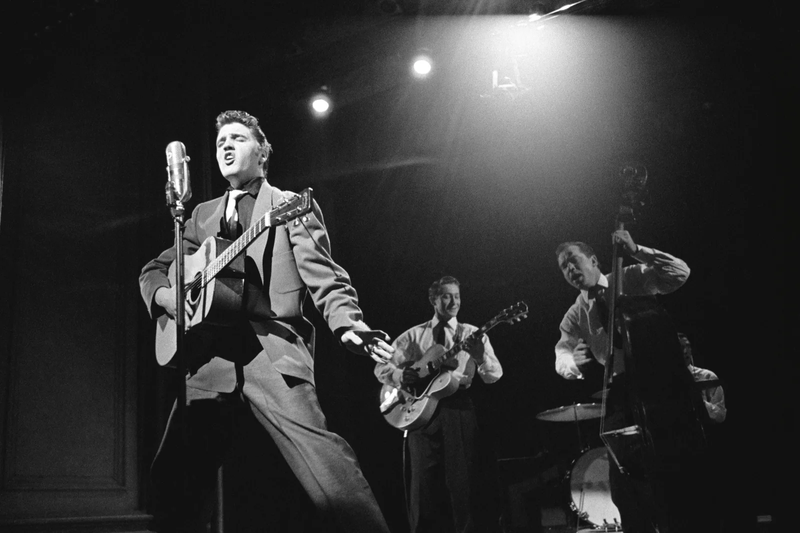
Foto: sin acreditar, revista TV Radio Mirror, septiembre de 1956. Dominio público, vía Wikimedia Commons
- Thornton died in 1984 in a boarding house in Los Angeles, with no money. She entered the Rock and Roll Hall of Fame in 2024, forty years later. In 2021 Rolling Stone rebuilt its list of the 500 greatest songs and swapped one version for the other: Elvis out, hers in.
Classroom activities
- Play: G, C and D in the order of the twelve bars. Ukuleles and guitar take the chords, the bass plays only the note each chord is named after, and the drums keep the shuffle. Once the turn comes out without looking at the paper, change key: the same twelve bars in C are C, F and G.
- Analyse: a closed question. Listen to the record, tap the pulse with your hand and count from one to twelve. How many complete turns go by before the guitar solo comes in? Honest warning: some turns have thirteen bars instead of twelve, because she takes her time. If you lose the count, it is not your fault.
- Create: write new words over the same twelve bars. That is exactly what happened in 1953: Rufus Thomas answered this song with Bear Cat, same frame and new words. It cost his record company a lawsuit. Compare your versions and look at what stayed the same — not the words, the frame.
Key vocabulary
- Bar — compás
- Twelve-bar blues — blues de doce compases: el armazón de doce compases con tres acordes
- To transpose — transportar (cambiar de altura sin cambiar la forma)
- Shuffle — shuffle: el balanceo de partir cada tiempo en tres
- Call and response — pregunta y respuesta
Resources
In the theory and history book — this song illustrates ¿Cómo sabes por dónde vas en una música que oyes por primera vez? and ¿Cómo se guarda algo que solo existe mientras suena?.
The 1952 recording — there were no music videos in 1952. This is the record.
Thornton singing it live, with Buddy Guy on guitar (1970)
The Elvis version (1956) — the one that sold ten million. Compare the rhythm and the words.
Guitar tutorial — Andy Guitar, three chords. It follows the Elvis version.
Ukulele tutorial — TenThumbs Productions. He explains the blues strum, which is the hard part.
Bass tutorial — TrueFire, twelve-bar blues in G. Not this song: the frame itself, in the key you will be playing in.
Drum tutorial — Love To Learn Drums. How to back a twelve-bar blues without losing count.
- Harmonic analysis — https://www.hooktheory.com/theorytab/view/big-mama-thornton/hound-dog
- Tab — the button opens it in Songsterr
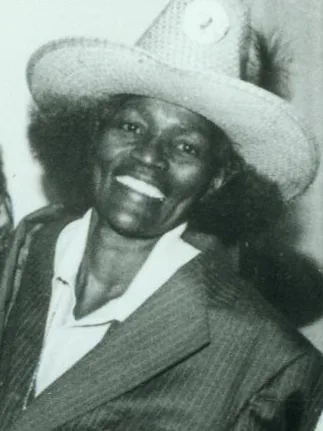
- Cover image — Big Mama Thornton at the "Blues Is A Woman" concert, Newport Jazz Festival, 1980. Photo: Barbara Weinberg Barefield, CC BY-SA 3.0, via Wikimedia Commons
Por dónde entrar
Vas a tocar esta canción con tres acordes: Sol, Do y Re. Cuando los tengas, tendrás también el armazón de cientos de canciones más.
El armazón se llama blues de doce compases. Cuentas hasta doce y vuelves a empezar. La canción entera es eso, dando vueltas.
Y hay una segunda historia detrás. Esta grabación es de 1952. Cuatro años después otro cantante grabó la misma canción y vendió veinte veces más. Antes del final sabrás quién cobró.
Contexto histórico
Los Ángeles, agosto de 1952. Johnny Otis dirige una orquesta de rhythm and blues y acaba de fichar a una cantante de 25 años, Willie Mae Thornton, a la que todos llaman Big Mama. Necesita una canción para ella.
Llama a dos chavales de 19 años, Jerry Leiber y Mike Stoller. Van a su casa, la oyen ensayar y se marchan a escribir. Tardaron unos doce minutos. Leiber apuntó la letra a lápiz en el coche, sin una sola nota escrita.
Esquema: Yehuda Lichtenstein Music, CC BY-SA 4.0, vía Wikimedia Commons (recortado)
Al día siguiente, 13 de agosto, la graban en un estudio de Los Ángeles. La plantilla es mínima: voz, guitarra eléctrica, contrabajo y batería. Nada de saxofones ni de piano aporreado, que era lo normal en el rhythm and blues de entonces.
Por eso la guitarra se oye tanto: no tiene con quién competir. Es prácticamente la formación con la que vais a tocar vosotros.
A la batería se sentó el propio Johnny Otis, porque el baterista contratado no cogía el aire. Como tenía contrato con otro sello, firmó el disco con nombre falso: «Kansas City Bill». Hicieron dos tomas y publicaron la segunda.
En el ensayo, Leiber le explicó a Thornton cómo quería que cantase. Ella le contestó: «Chaval blanco, no me digas a mí cómo se canta el blues».
Thornton no sabía leer música. Había aprendido sola: la armónica mirando a su hermano mayor, la batería mirando a otros. Dejó la escuela en tercero, cuando enfermó su madre.
El disco salió en febrero de 1953 y estuvo siete semanas en el número uno de la lista de rhythm and blues. Peacock, el sello, puso tres fábricas a prensar copias para dar abasto.
Cómo suena
Cuenta cuatro tiempos seguidos: eso es un compás. Ahora cuenta doce compases. Con eso has recorrido la canción entera una vez, y al llegar al doce se vuelve al uno.
Dentro de esos doce compases solo hay tres acordes, y entran siempre en el mismo sitio. Cuatro compases con el primero. Dos con el segundo. Dos otra vez con el primero. Y los cuatro últimos son el cierre: uno con el tercero, uno con el segundo y dos con el primero.
Esa planta es el blues de doce compases, y es la misma en miles de canciones.
En Sol, que es como lo vais a tocar, esos tres acordes son Sol, Do y Re. El disco de 1952 no está en Sol: está en Mi bemol, y los mismos tres sitios los ocupan Mi bemol, La bemol y Si bemol. La planta no ha cambiado; solo ha subido o bajado de altura. Eso es transportar.
El balanceo del ritmo sale de cómo se parte el tiempo. Si partes cada tiempo en dos, suena cuadrado, como una marcha. Aquí se parte en tres, y la primera mitad dura más que la segunda: de ahí ese «taaa-ta, taaa-ta» que cojea un poco. Se llama shuffle.
El contrabajo tampoco camina recto: se mueve con un aire latino. Cuando salió el disco, la revista Billboard lo describió como «un blues de rumba salvaje y emocionante».
Lo mejor del disco pasa en el solo. La guitarra toca y ella, en vez de callarse, contesta: gruñe, habla, se ríe encima. Uno propone y el otro responde. Se llama pregunta y respuesta, y viene de cantar en grupo.
Al final, la banda entera ladra y aúlla. Esa idea era suya.
Datos duros: Mi bemol mayor, 4/4, 75 BPM, 2:52. Forma: la misma vuelta de doce compases de principio a fin, con un solo de guitarra largo en medio y ladridos al final. En el chart de clase está transportada a Sol y va más rápida, a 102 BPM.
Curiosidades
- Quién firma esta canción cambia según el papel que mires. En la solicitud de registro de septiembre de 1952 constan como autores Willie Mae Thornton y Don Robey, el dueño del sello. En la etiqueta del disco pone «Leiber-Stroller-Otis», con la errata incluida. Tras los pleitos, los autores reconocidos fueron Leiber y Stoller, y ni Thornton ni Robey. Firmar un papel y haber hecho la canción no son lo mismo.
- Leiber y Stoller denunciaron a Robey y ganaron. Les entregó un cheque de 1.200 dólares y el cheque no tenía fondos. Así que montaron su propio sello y su propia editorial. Aprendieron dónde estaba el dinero: no en el disco, en los derechos.
- Cuánto vendió el disco no lo sabe nadie con certeza. Thornton decía más de dos millones. Robey, el dueño del sello, calculaba entre 500.000 y 750.000. Stoller hablaba de un millón. Las tres cifras no pueden ser ciertas a la vez, y esa es justamente la historia: nadie enseñaba las cuentas. Lo que sí contó ella siempre igual es lo que cobró: «Un cheque de 500 dólares y nunca vi otro».
- Ella sí escribió una canción suya, Ball and Chain. Janis Joplin la hizo famosa a finales de los sesenta y vendió millones de copias. Thornton tampoco cobró, porque no tenía los derechos de edición. Escribir una canción y ser dueño de una canción son cosas distintas.
- Elvis no aprendió Hound Dog del disco de Thornton. La oyó en Las Vegas en 1956 a un grupo de espectáculo, Freddie Bell and the Bellboys, que había cambiado la letra: donde ella le canta a un hombre que vive de ella, ellos le cantan literalmente a un perro. Elvis copió esa versión, no la de ella. Grabó la suya el 2 de julio de 1956 y vendió unos diez millones.
Foto: sin acreditar, revista TV Radio Mirror, septiembre de 1956. Dominio público, vía Wikimedia Commons
- Thornton murió en 1984 en una pensión de Los Ángeles, sin dinero. Entró en el Salón de la Fama del Rock and Roll en 2024, cuarenta años después. En 2021 la revista Rolling Stone rehízo su lista de las 500 mejores canciones y cambió una versión por la otra: quitó la de Elvis y puso la de ella.
Para hacer en clase
- Tocar: Sol, Do y Re en el orden de los doce compases. Ukeleles y guitarra hacen los acordes, el bajo toca solo la nota que da nombre a cada uno y la batería lleva el shuffle. Cuando la vuelta salga sin mirar el papel, cambiad de tonalidad: los mismos doce compases en Do son Do, Fa y Sol.
- Analizar: pregunta cerrada. Escucha el disco marcando el pulso con la mano y cuenta de uno a doce. ¿Cuántas vueltas completas dan antes de que entre el solo de guitarra? Aviso honesto: alguna vuelta tiene trece compases en vez de doce, porque ella se los toma. Si te descuadra, no es culpa tuya.
- Crear: escribid otra letra sobre los mismos doce compases. Es exactamente lo que hicieron en 1953: Rufus Thomas contestó a esta canción con Bear Cat, misma planta y letra nueva. Le costó un pleito a su discográfica. Comparad vuestras versiones y mirad qué se ha quedado igual: no la letra, la planta.
Vocabulario fundamental
- Compás — El grupo de tiempos que cuentas una y otra vez. Aquí son cuatro.
- Blues de doce compases — Doce compases con tres acordes que entran siempre en el mismo sitio. Es el armazón, no la canción.
- Transportar — Tocar lo mismo más arriba o más abajo. Cambia la altura; la forma se queda igual.
- Shuffle — El balanceo que sale de partir cada tiempo en tres en vez de en dos.
- Pregunta y respuesta — Uno propone y otro contesta. Aquí, ella y la guitarra durante el solo.
Recursos
En el libro de teoría e historia — esta canción ilustra ¿Cómo sabes por dónde vas en una música que oyes por primera vez? y ¿Cómo se guarda algo que solo existe mientras suena?.
La grabación de 1952 — en 1952 no había videoclips. Esto es el disco.
Ella cantándola en directo, con Buddy Guy a la guitarra (1970)
La versión de Elvis (1956) — la que vendió diez millones. Compara el ritmo y la letra.
Tutorial de guitarra — Andy Guitar, con tres acordes. Va sobre la versión de Elvis.
Tutorial de ukelele — TenThumbs Productions. Explica el rasgueo de blues, que es lo que cuesta.
Tutorial de bajo — TrueFire, blues de doce compases en Sol. No es de esta canción: es de la planta, y en la tonalidad en la que vais a tocar.
Tutorial de batería — Love To Learn Drums. Cómo acompañar un blues de doce compases sin perder la cuenta.
- Análisis armónico — https://www.hooktheory.com/theorytab/view/big-mama-thornton/hound-dog
- Tablatura — el botón la abre en Songsterr
- Imagen de portada — Big Mama Thornton en el concierto «Blues Is A Woman», Newport Jazz Festival, 1980. Foto: Barbara Weinberg Barefield, CC BY-SA 3.0, vía Wikimedia Commons
Why this song
Count to twelve, then start again. That is the whole song.
The frame is called the twelve-bar blues, and once you can play it you can play hundreds of other songs. In class you will play it with three chords: G, C and D.
There is a second story underneath. This recording is from 1952. Four years later another singer recorded the same song and sold twenty times more copies. Before the end you will know who got paid.
Historical context
Los Angeles, August 1952. Johnny Otis runs a rhythm and blues band and has just signed a 25-year-old singer, Willie Mae Thornton, known to everyone as Big Mama. He needs a song for her.
So he calls two nineteen-year-olds, Jerry Leiber and Mike Stoller. They come to his house, listen to her rehearse and leave to write. It took them about twelve minutes. Leiber scribbled the words in pencil in the car, without writing down a single note.
Esquema: Yehuda Lichtenstein Music, CC BY-SA 4.0, vía Wikimedia Commons (recortado)
The next day, 13 August, they recorded it in a Los Angeles studio. The line-up is tiny: voice, electric guitar, double bass and drums. No honking saxophones, no hammering piano, which was the normal sound of rhythm and blues back then.
That is why you hear the guitar so clearly: it has nothing to compete with. It is very nearly the line-up you will be playing with.
Johnny Otis himself sat down at the drums because the hired drummer could not catch the feel. Since he was under contract to another label, he signed the record with a false name: "Kansas City Bill". They cut two takes and released the second.
At the rehearsal Leiber told Thornton how he wanted her to sing it. She answered: "White boy, don't you be tellin' me how to sing the blues."
Thornton could not read music. She had taught herself: harmonica by watching her older brother, drums by watching other people. She left school in third grade, when her mother fell ill.
The record came out in February 1953 and spent seven weeks at number one on the rhythm and blues chart. Peacock, the label, had three pressing plants running to keep up.
Musical characteristics
Count four beats in a row: that is a bar. Now count twelve bars. You have just gone through the whole song once, and after twelve you go back to one.
Inside those twelve bars there are only three chords, and they always arrive at the same point. Four bars on the first one. Two on the second. Two back on the first. And the last four are the closing move: one on the third chord, one on the second, two on the first.
That frame is the twelve-bar blues, and it is the same in thousands of songs.
In G, which is how you will play it, those three chords are G, C and D. The 1952 record is not in G: it is in E flat, and the same three slots are filled by E flat, A flat and B flat. The frame has not changed; it has only moved up or down in pitch. That is what transposing means.
The swing in the rhythm comes from how the beat is split. Split each beat in two and it sounds square, like a march. Here it is split in three, with the first half longer than the second, which gives you that slightly limping "daaa-da, daaa-da". It is called a shuffle.
The double bass does not walk in a straight line either: it moves with a Latin lilt. When the record came out, Billboard called it "a wild and exciting rhumba blues".
The best part of the record happens during the solo. The guitar plays, and instead of keeping quiet she answers it: she growls, she talks, she laughs over the top. One side proposes, the other replies. That is call and response, and it comes from singing together in a group.
At the end the whole band barks and howls. Her idea.
Hard facts: E flat major, 4/4, 75 BPM, 2:52. Form: the same twelve-bar turn from beginning to end, with a long guitar solo in the middle and barking at the end. The classroom chart transposes it to G and runs faster, at 102 BPM.
Trivia and curiosities
- Who wrote this song depends on which piece of paper you look at. The copyright application from September 1952 names Willie Mae Thornton and Don Robey, the label owner, as the authors. The record label itself says "Leiber-Stroller-Otis", typo included. After the lawsuits the recognised writers were Leiber and Stoller, and neither Thornton nor Robey. Signing a form and having made the song are not the same thing.
- Leiber and Stoller sued Robey and won. He handed them a cheque for 1,200 dollars and the cheque bounced. So they started their own label and their own publishing company. They had learned where the money actually sits: not in the record, in the rights.
- Nobody knows for certain how many copies it sold. Thornton said more than two million. Robey, the label owner, estimated between 500,000 and 750,000. Stoller said a million. All three cannot be true at once, and that is exactly the point: nobody was showing the books. The one number she always repeated the same way is what she was paid: "One cheque for 500 dollars and I never saw another."
- She did write a song of her own, Ball and Chain. Janis Joplin made it famous in the late sixties and sold millions. Thornton was not paid for that either, because she did not hold the publishing rights. Writing a song and owning a song are two different things.
- Elvis did not learn Hound Dog from Thornton's record. He heard it in Las Vegas in 1956 from a showband, Freddie Bell and the Bellboys, who had rewritten the words: where she sings to a man living off her, they sing to an actual dog. Elvis copied that version, not hers. He recorded his own on 2 July 1956 and sold around ten million.
Foto: sin acreditar, revista TV Radio Mirror, septiembre de 1956. Dominio público, vía Wikimedia Commons
- Thornton died in 1984 in a boarding house in Los Angeles, with no money. She entered the Rock and Roll Hall of Fame in 2024, forty years later. In 2021 Rolling Stone rebuilt its list of the 500 greatest songs and swapped one version for the other: Elvis out, hers in.
Classroom activities
- Play: G, C and D in the order of the twelve bars. Ukuleles and guitar take the chords, the bass plays only the note each chord is named after, and the drums keep the shuffle. Once the turn comes out without looking at the paper, change key: the same twelve bars in C are C, F and G.
- Analyse: a closed question. Listen to the record, tap the pulse with your hand and count from one to twelve. How many complete turns go by before the guitar solo comes in? Honest warning: some turns have thirteen bars instead of twelve, because she takes her time. If you lose the count, it is not your fault.
- Create: write new words over the same twelve bars. That is exactly what happened in 1953: Rufus Thomas answered this song with Bear Cat, same frame and new words. It cost his record company a lawsuit. Compare your versions and look at what stayed the same — not the words, the frame.
Key vocabulary
- Bar — compás
- Twelve-bar blues — blues de doce compases: el armazón de doce compases con tres acordes
- To transpose — transportar (cambiar de altura sin cambiar la forma)
- Shuffle — shuffle: el balanceo de partir cada tiempo en tres
- Call and response — pregunta y respuesta
Resources
In the theory and history book — this song illustrates ¿Cómo sabes por dónde vas en una música que oyes por primera vez? and ¿Cómo se guarda algo que solo existe mientras suena?.
The 1952 recording — there were no music videos in 1952. This is the record.
Thornton singing it live, with Buddy Guy on guitar (1970)
The Elvis version (1956) — the one that sold ten million. Compare the rhythm and the words.
Guitar tutorial — Andy Guitar, three chords. It follows the Elvis version.
Ukulele tutorial — TenThumbs Productions. He explains the blues strum, which is the hard part.
Bass tutorial — TrueFire, twelve-bar blues in G. Not this song: the frame itself, in the key you will be playing in.
Drum tutorial — Love To Learn Drums. How to back a twelve-bar blues without losing count.
- Harmonic analysis — https://www.hooktheory.com/theorytab/view/big-mama-thornton/hound-dog
- Tab — the button opens it in Songsterr
- Cover image — Big Mama Thornton at the "Blues Is A Woman" concert, Newport Jazz Festival, 1980. Photo: Barbara Weinberg Barefield, CC BY-SA 3.0, via Wikimedia Commons