Contenidos
Fotos y Recuerdos — Selena (1994)
The same tune, twelve years and two languages apart: "Fotos y Recuerdos" is the Pretenders' "Back on the Chain Gang" with new Spanish words and a cumbia underneath.
🏷️ Ficha musical
Why this song
Here is a test you can run in one minute. Play twenty seconds of the 1982 video below, then twenty seconds of the 1994 one.
They are the same song.
The voice sings exactly the same notes in both. Everything that changed is underneath: the rhythm, the instruments and the language. This page is about that — how much of a song you can swap before it stops being that song.
Historical context
In 1982 the English band the Pretenders almost stopped existing. They fired their bass player over a drug problem, and two days later their guitarist, James Honeyman-Scott, died. He was twenty-five.
Two people were left: singer and songwriter Chrissie Hynde, and the drummer. On 20 July 1982 they walked into a London studio with hired musicians filling the gaps and recorded "Back on the Chain Gang". Hynde wrote it for the guitarist who had died. It sounds cheerful. It is not.
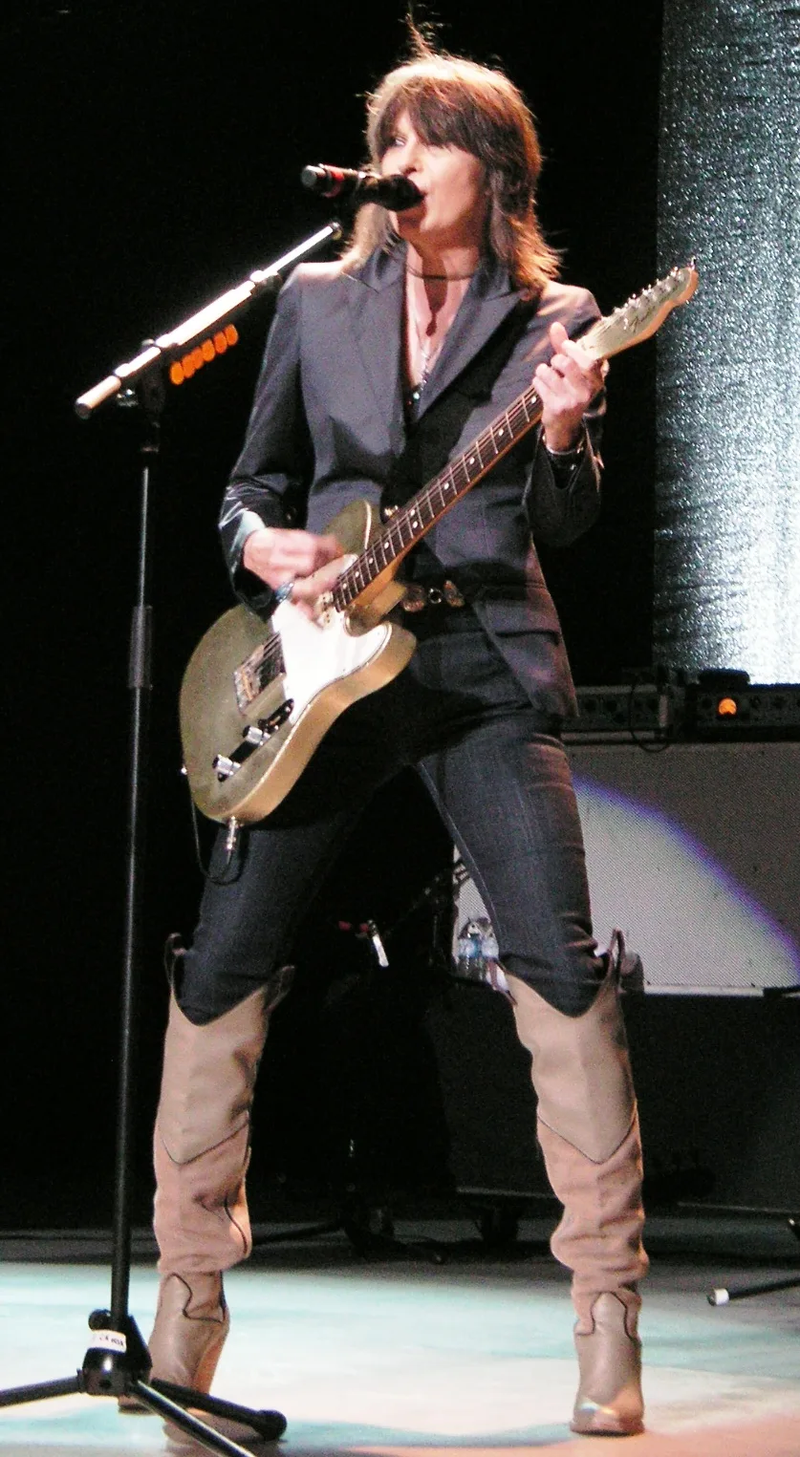
Chrissie Hynde, autora de «Back on the Chain Gang», en Santa Bárbara (California) en 2007. Foto: John Slonaker, CC BY-SA 3.0, vía Wikimedia Commons
Twelve years later, in Corpus Christi, Texas, A.B. Quintanilla — Selena's brother and producer — heard that song on the radio on a flight home from New York. He was short of material for his sister's album and thought it could work as a cumbia in Spanish. The band's keyboard player, Ricky Vela, wrote the new words.
Then the album nearly died. Amor Prohibido was already pressed, due out on 13 March 1994, when distribution was stopped: they had no permission. Hynde's publishers warned her, and she refused to clear it until somebody translated the Spanish lyrics back into English so she could read what her song was now saying. Only then did she agree.
The single came out in January 1995. Selena died on 31 March that year. The following week "Fotos y Recuerdos" reached number one on Billboard's Hot Latin Songs chart and stayed there for seven weeks.
Musical characteristics
Start with what does not change, because it is most of what makes a song recognisable.
The tune is identical, note for note. Underneath it, four chords loop from start to finish. In the version you will play, in D major, they are D, A, Em and G. A set of chords that always repeats in the same order is a chord progression, and this is one of the most used there is: in numbers, I–V–ii–IV.
What changes is the accompaniment — everything playing under the voice. In the original, the English band plays electric guitars holding long chords while the drums hit a dry, regular beat. A rock band playing like a rock band.
In Selena's version those same four chords come out as short keyboard stabs, with a violin over the top carried by the synthesiser. And the rhythm underneath is no longer rock: it is a cumbia, a dance that started in Colombia and became the party music of Mexico and Texas.
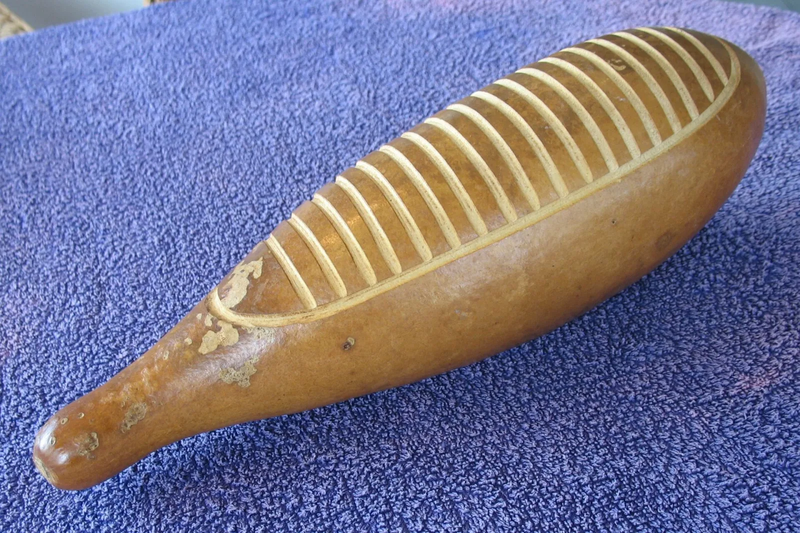
Güiro cubano de calabaza, de unos 35 cm. Foto: Miguel Andrade, dominio público, vía Wikimedia Commons
What tells you it is a cumbia within two seconds is a scraper like the one in the photo: a ridged instrument played with a stick, always off the beat, between the drum hits. That steady scratching is the signature.
The size of the story changes too. The English lyric is about a death; the Spanish one is about someone kissing a photograph before falling asleep. Same subject — missing somebody — with the edge taken off.
Hard facts: E flat major on the record (D major in your version), 4/4, 180 BPM on the chart, 2:36. Careful with the tempo: 180 looks fast because the chart counts every half beat; tap the pulse with your foot and you get 90. Same speed, counted two ways.
The form has ten stretches: intro, three rounds of verse and chorus, an interlude — an instrumental stretch with no singing — one more chorus, and a coda.
Trivia and curiosities
- Chrissie Hynde did not ask for money first. She asked for a translation. She wanted to read what her song would say in another language before letting it say it.
- The whole album sat in a warehouse because of this one track. A cover version is neither free nor automatic: the tune has an owner, and the owner can say no.
- In the 1982 original, the metallic clanging in the chorus was made by hitting the 11 kg weights the studio used to hold microphone stands down. It was a nod to Sam Cooke's "Chain Gang", from 1960. Songs were borrowing from each other long before samplers existed.
- George Harrison of the Beatles said in 1992 that "Back on the Chain Gang" used a chord he had invented for one of his own songs in 1966. So the song Selena covered had already taken something from somebody else. There is nearly always someone before.
- It is the shortest track on Amor Prohibido: 2 minutes 36 seconds. It does not need more, because the same four-chord round comes past about thirty times.
Classroom activities
- Play: the four-chord loop in D major — D, A, Em, G — without stopping. Ukuleles and electric guitar take the chords, the bass plays only the note each chord is named after, the drums hold the rhythm. It is the same loop all the way through, so once one round works, the whole song works.
- Compare: the same loop, twice. First as rock, drums hitting dry and steady, guitars holding long chords. Then as cumbia, short stabs and the scraper off the beat. Nothing different is played: it is played differently.
- Analyse: two columns in your notebook, "same" and "different". Listen to both versions right through and sort the tune, the words, the chords, the drums, the instruments and the speed into those columns. Then answer in writing: how many things would you have to change before it stops being the same song?
- Create: take a song you can already play and change only the accompaniment — different rhythm, different instruments — without touching a single note of the melody. That is exactly what A.B. Quintanilla did.
Key vocabulary
- Cover version — versión (volver a grabar una canción que ya existía, con tu propio arreglo)
- Chord progression — progresión de acordes
- Accompaniment — acompañamiento (todo lo que suena debajo de la voz)
- Cumbia — cumbia (ritmo de baile colombiano, adoptado en México y Texas)
- Interlude — interludio (tramo instrumental, sin voz)
Resources
Where it is explained — this song feeds the unit ¿Cuándo empieza una melodía a decir de dónde eres?, from the Year 3 theory and history book. If it caught your interest, Year 4 has a whole page on the same question: ¿De quién es la melodía que estás cantando?.
Official audio — Selena (1994)
The original — The Pretenders, "Back on the Chain Gang" (1982)
Guitar — Requintos Tab. The intro riff with the tab scrolling on screen. It lasts 46 seconds: it is the intro, not the whole song.
Ukulele — Marian Danely. A full tutorial, chord by chord, six and a half minutes.
Bass — Víctor Hugo. Not a lesson: the bass line played right through with the tab underneath. Made for copying by eye.
Drums — Alfonso Gurrola. Not a lesson either, a cover: you can see the whole kit and what each hand does through the song.
- Tab — Songsterr link in the file header
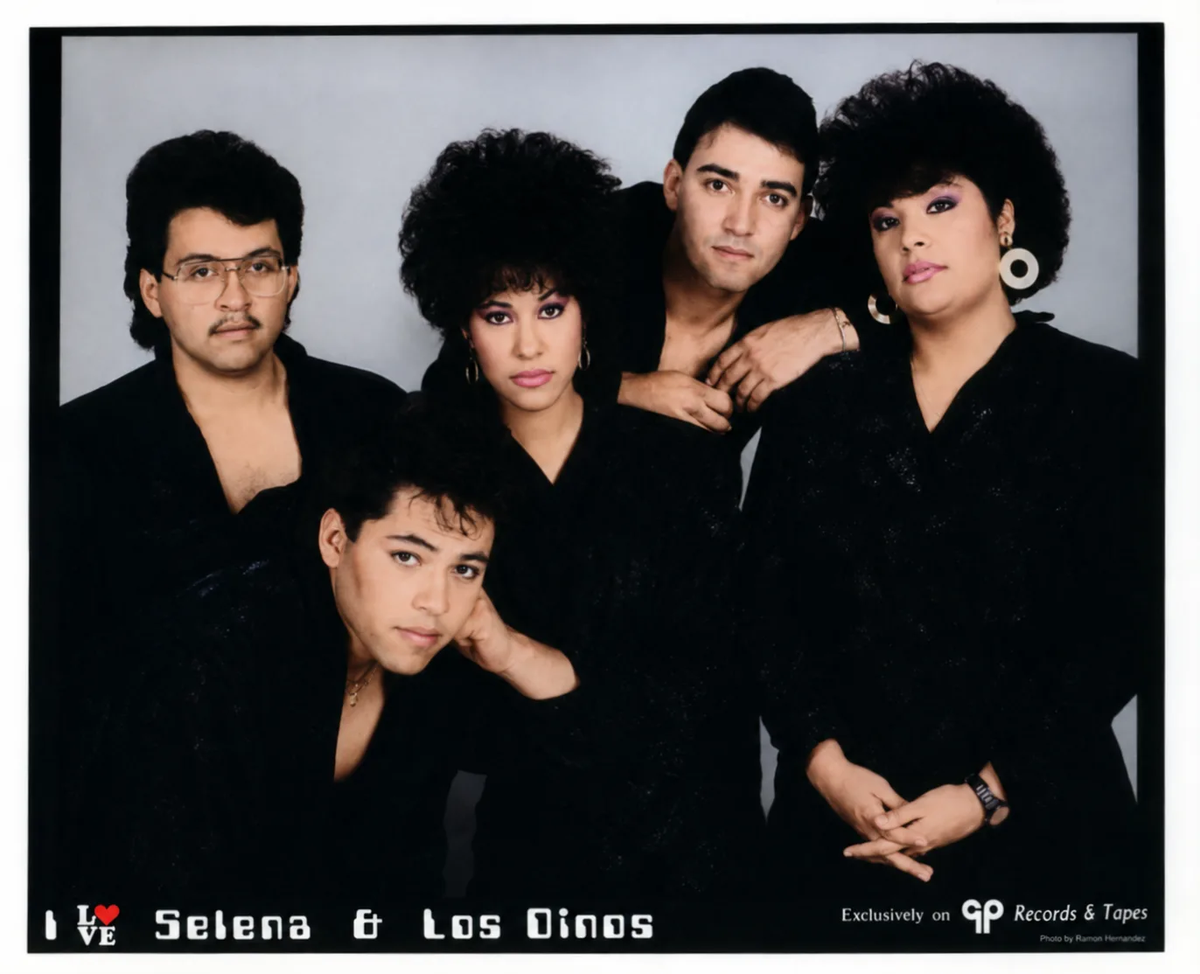
- Cover image — Selena y Los Dinos en 1986. Foto: Ramon Hernandez, dominio público, vía Wikimedia Commons
Por dónde entrar
Pon los dos vídeos de abajo seguidos, veinte segundos de cada uno. El de 1982 es de un grupo inglés de rock. El de 1994 es de una cantante de Texas.
Son la misma canción.
La voz canta exactamente las mismas notas en los dos. Lo que ha cambiado está debajo: el ritmo, los instrumentos y el idioma de la letra. Esta página va de eso — de qué se puede cambiar en una canción sin que deje de ser ella.
Contexto histórico
En 1982 el grupo inglés The Pretenders se quedó casi sin banda. Despidieron al bajista por un problema con las drogas y dos días después murió el guitarrista, James Honeyman-Scott, con veinticinco años.
Quedaban dos personas: la cantante y compositora, Chrissie Hynde, y el batería. El 20 de julio de 1982 entraron en unos estudios de Londres con músicos contratados para rellenar los huecos y grabaron «Back on the Chain Gang». Hynde la escribió en memoria del guitarrista muerto. Suena alegre; no lo es.
Chrissie Hynde, autora de «Back on the Chain Gang», en Santa Bárbara (California) en 2007. Foto: John Slonaker, CC BY-SA 3.0, vía Wikimedia Commons
Doce años después, en Corpus Christi (Texas), A.B. Quintanilla —hermano y productor de Selena— iba en un avión de vuelta de Nueva York y oyó esa canción en la radio. Le faltaba material para el disco de su hermana y se le ocurrió que aquello podía ser una cumbia en castellano. El teclista del grupo, Ricky Vela, escribió la letra nueva.
Y aquí viene lo que casi tira el disco. Amor Prohibido ya estaba prensado, con fecha de salida el 13 de marzo de 1994, cuando se paró la distribución: no tenían permiso. Los editores avisaron a Chrissie Hynde, que no autorizó nada hasta que le tradujeron al inglés la letra española para saber qué estaba diciendo su canción. Solo entonces dio el visto bueno.
El single salió en enero de 1995. Selena murió el 31 de marzo de ese año. La semana siguiente «Fotos y Recuerdos» llegó al número uno de la lista Hot Latin Songs de Billboard y se quedó siete semanas seguidas.
Cómo suena
Empecemos por lo que no cambia, porque es casi todo lo que hace reconocible una canción.
La melodía es la misma, nota por nota. Y debajo hay cuatro acordes que se repiten en bucle de principio a fin. En la versión que vais a tocar, en Re mayor, son Re, La, Mim y Sol. Cuando un grupo de acordes se repite siempre en el mismo orden se le llama progresión de acordes, y esta es de las más usadas que existen: en números, I–V–ii–IV.
Lo que cambia es el acompañamiento: todo lo que suena debajo de la voz. En el original, la banda inglesa toca guitarras eléctricas con acordes largos y la batería marca un golpe seco y regular. Es un grupo de rock tocando como un grupo de rock.
En la versión de Selena, esos mismos cuatro acordes se tocan a base de golpes cortos de teclado, con un violín por encima llevado por el sintetizador. Y el ritmo de debajo ya no es de rock: es una cumbia, un baile que nació en Colombia y que en México y Texas se convirtió en la música de fiesta de todo el mundo.
Güiro cubano de calabaza, de unos 35 cm. Foto: Miguel Andrade, dominio público, vía Wikimedia Commons
Lo que identifica una cumbia en dos segundos es un rascador como el de la foto: un instrumento estriado que se raspa con una varilla, siempre a contratiempo, entre golpe y golpe de la batería. Ese «chas-chas» constante es la marca de la casa.
Cambia también el tamaño de la historia. La letra inglesa habla de una muerte; la castellana, de alguien que besa una foto antes de dormirse. Es el mismo tema —echar de menos— con el filo quitado.
Datos duros: Mi bemol mayor en la grabación (Re mayor en vuestra versión), 4/4, 180 BPM en la ficha, 2:36. Ojo con el tempo: 180 es rápido porque la ficha cuenta cada medio tiempo; si marcas el pulso con el pie, te saldrán 90. Es la misma velocidad contada de dos maneras.
La forma tiene diez tramos: intro, tres vueltas de estrofa y estribillo, un interludio —un trozo instrumental, sin voz, que sirve de descanso—, otro estribillo y una coda final.
Curiosidades
- El disco entero se quedó parado en el almacén por culpa de esta canción. Una versión no es gratis ni automática: la melodía tiene dueña, y la dueña puede decir que no.
- Hynde no pidió dinero primero: pidió la traducción. Quería leer qué iba a decir su canción en otro idioma antes de dejar que lo dijera. Lo que se negocia en una versión no es solo el permiso, es el significado.
- En el original de 1982, el golpeteo metálico que suena en el estribillo se hizo aporreando las pesas de 11 kilos que el estudio usaba de contrapeso para los pies de micro. Y era un guiño a «Chain Gang», de Sam Cooke, de 1960. Las canciones se copiaban unas a otras mucho antes de que existiera el sampler.
- George Harrison, de los Beatles, contó en 1992 que «Back on the Chain Gang» usaba un acorde que él se había inventado para una canción suya de 1966. Es decir: la canción de la que Selena hizo una versión ya le había cogido algo a otro. Casi siempre hay alguien antes.
- Es la canción más corta de Amor Prohibido: 2 minutos y 36 segundos. No le hace falta más, porque la misma vuelta de cuatro acordes suena unas treinta veces.
Para hacer en clase
- Tocar: el bucle de cuatro acordes en Re mayor —Re, La, Mim, Sol— sin parar. Ukeleles y guitarra eléctrica hacen los acordes, el bajo toca solo la nota que da nombre a cada uno, la batería marca el ritmo. Es el mismo bucle toda la canción, así que en cuanto os salga una vuelta, os sale entera.
- Comparar: la misma vuelta de acordes, dos veces. Primero como rock, con la batería marcando golpes secos y las guitarras con acordes largos. Después como cumbia, con golpes cortos y el rascador a contratiempo. No se toca nada distinto: se toca distinto.
- Analizar: dos columnas en el cuaderno, «igual» y «distinto». Escuchad las dos versiones enteras y repartid en esas columnas la melodía, la letra, los acordes, la batería, los instrumentos y la velocidad. Pregunta para responder por escrito: ¿cuántas cosas hay que cambiar para que deje de ser la misma canción?
- Crear: coged una canción que sepáis tocar y cambiadle solo el acompañamiento —otro ritmo, otros instrumentos— sin tocar ni una nota de la melodía. Es exactamente lo que hizo A.B. Quintanilla.
Vocabulario fundamental
- Versión — Volver a grabar una canción que ya existía, con tu propio arreglo. La melodía es prestada; lo que pones tú es cómo suena.
- Progresión de acordes — Un grupo de acordes que se repite siempre en el mismo orden. Aquí son cuatro y no cambian en toda la canción.
- Acompañamiento — Todo lo que suena debajo de la voz. Es lo único que separa esta canción del original inglés.
- Cumbia — Ritmo de baile nacido en Colombia y adoptado en México y Texas. Se reconoce por el rascador a contratiempo.
- Interludio — Un tramo instrumental, sin voz, entre dos partes cantadas.
Recursos
Dónde se explica — esta canción sirve para la unidad ¿Cuándo empieza una melodía a decir de dónde eres?, del libro de teoría e historia de 3.º. Y si te ha picado la curiosidad, en 4.º hay una página entera sobre lo mismo: ¿De quién es la melodía que estás cantando?.
Audio oficial — Selena (1994)
El original — The Pretenders, «Back on the Chain Gang» (1982)
Guitarra — Requintos Tab. El punteo de la entrada con la tablatura en pantalla. Dura 46 segundos: es la entrada, no la canción entera.
Ukelele — Marian Danely. Tutorial completo, acorde a acorde, de seis minutos y medio.
Bajo — Víctor Hugo. No es una clase: es la línea de bajo tocada entera con la tablatura debajo. Para copiarla mirando.
Batería — Alfonso Gurrola. Tampoco es una clase, es un cover: se ve el kit completo y lo que hace cada mano durante la canción.
- Tablatura — enlace a Songsterr en la ficha de arriba
- Portada — Selena y Los Dinos en 1986. Foto: Ramon Hernandez, dominio público, vía Wikimedia Commons
Why this song
Here is a test you can run in one minute. Play twenty seconds of the 1982 video below, then twenty seconds of the 1994 one.
They are the same song.
The voice sings exactly the same notes in both. Everything that changed is underneath: the rhythm, the instruments and the language. This page is about that — how much of a song you can swap before it stops being that song.
Historical context
In 1982 the English band the Pretenders almost stopped existing. They fired their bass player over a drug problem, and two days later their guitarist, James Honeyman-Scott, died. He was twenty-five.
Two people were left: singer and songwriter Chrissie Hynde, and the drummer. On 20 July 1982 they walked into a London studio with hired musicians filling the gaps and recorded "Back on the Chain Gang". Hynde wrote it for the guitarist who had died. It sounds cheerful. It is not.
Chrissie Hynde, autora de «Back on the Chain Gang», en Santa Bárbara (California) en 2007. Foto: John Slonaker, CC BY-SA 3.0, vía Wikimedia Commons
Twelve years later, in Corpus Christi, Texas, A.B. Quintanilla — Selena's brother and producer — heard that song on the radio on a flight home from New York. He was short of material for his sister's album and thought it could work as a cumbia in Spanish. The band's keyboard player, Ricky Vela, wrote the new words.
Then the album nearly died. Amor Prohibido was already pressed, due out on 13 March 1994, when distribution was stopped: they had no permission. Hynde's publishers warned her, and she refused to clear it until somebody translated the Spanish lyrics back into English so she could read what her song was now saying. Only then did she agree.
The single came out in January 1995. Selena died on 31 March that year. The following week "Fotos y Recuerdos" reached number one on Billboard's Hot Latin Songs chart and stayed there for seven weeks.
Musical characteristics
Start with what does not change, because it is most of what makes a song recognisable.
The tune is identical, note for note. Underneath it, four chords loop from start to finish. In the version you will play, in D major, they are D, A, Em and G. A set of chords that always repeats in the same order is a chord progression, and this is one of the most used there is: in numbers, I–V–ii–IV.
What changes is the accompaniment — everything playing under the voice. In the original, the English band plays electric guitars holding long chords while the drums hit a dry, regular beat. A rock band playing like a rock band.
In Selena's version those same four chords come out as short keyboard stabs, with a violin over the top carried by the synthesiser. And the rhythm underneath is no longer rock: it is a cumbia, a dance that started in Colombia and became the party music of Mexico and Texas.
Güiro cubano de calabaza, de unos 35 cm. Foto: Miguel Andrade, dominio público, vía Wikimedia Commons
What tells you it is a cumbia within two seconds is a scraper like the one in the photo: a ridged instrument played with a stick, always off the beat, between the drum hits. That steady scratching is the signature.
The size of the story changes too. The English lyric is about a death; the Spanish one is about someone kissing a photograph before falling asleep. Same subject — missing somebody — with the edge taken off.
Hard facts: E flat major on the record (D major in your version), 4/4, 180 BPM on the chart, 2:36. Careful with the tempo: 180 looks fast because the chart counts every half beat; tap the pulse with your foot and you get 90. Same speed, counted two ways.
The form has ten stretches: intro, three rounds of verse and chorus, an interlude — an instrumental stretch with no singing — one more chorus, and a coda.
Trivia and curiosities
- Chrissie Hynde did not ask for money first. She asked for a translation. She wanted to read what her song would say in another language before letting it say it.
- The whole album sat in a warehouse because of this one track. A cover version is neither free nor automatic: the tune has an owner, and the owner can say no.
- In the 1982 original, the metallic clanging in the chorus was made by hitting the 11 kg weights the studio used to hold microphone stands down. It was a nod to Sam Cooke's "Chain Gang", from 1960. Songs were borrowing from each other long before samplers existed.
- George Harrison of the Beatles said in 1992 that "Back on the Chain Gang" used a chord he had invented for one of his own songs in 1966. So the song Selena covered had already taken something from somebody else. There is nearly always someone before.
- It is the shortest track on Amor Prohibido: 2 minutes 36 seconds. It does not need more, because the same four-chord round comes past about thirty times.
Classroom activities
- Play: the four-chord loop in D major — D, A, Em, G — without stopping. Ukuleles and electric guitar take the chords, the bass plays only the note each chord is named after, the drums hold the rhythm. It is the same loop all the way through, so once one round works, the whole song works.
- Compare: the same loop, twice. First as rock, drums hitting dry and steady, guitars holding long chords. Then as cumbia, short stabs and the scraper off the beat. Nothing different is played: it is played differently.
- Analyse: two columns in your notebook, "same" and "different". Listen to both versions right through and sort the tune, the words, the chords, the drums, the instruments and the speed into those columns. Then answer in writing: how many things would you have to change before it stops being the same song?
- Create: take a song you can already play and change only the accompaniment — different rhythm, different instruments — without touching a single note of the melody. That is exactly what A.B. Quintanilla did.
Key vocabulary
- Cover version — versión (volver a grabar una canción que ya existía, con tu propio arreglo)
- Chord progression — progresión de acordes
- Accompaniment — acompañamiento (todo lo que suena debajo de la voz)
- Cumbia — cumbia (ritmo de baile colombiano, adoptado en México y Texas)
- Interlude — interludio (tramo instrumental, sin voz)
Resources
Where it is explained — this song feeds the unit ¿Cuándo empieza una melodía a decir de dónde eres?, from the Year 3 theory and history book. If it caught your interest, Year 4 has a whole page on the same question: ¿De quién es la melodía que estás cantando?.
Official audio — Selena (1994)
The original — The Pretenders, "Back on the Chain Gang" (1982)
Guitar — Requintos Tab. The intro riff with the tab scrolling on screen. It lasts 46 seconds: it is the intro, not the whole song.
Ukulele — Marian Danely. A full tutorial, chord by chord, six and a half minutes.
Bass — Víctor Hugo. Not a lesson: the bass line played right through with the tab underneath. Made for copying by eye.
Drums — Alfonso Gurrola. Not a lesson either, a cover: you can see the whole kit and what each hand does through the song.
- Tab — Songsterr link in the file header
- Cover image — Selena y Los Dinos en 1986. Foto: Ramon Hernandez, dominio público, vía Wikimedia Commons