Contenidos
Every Breath You Take — The Police (1983)
It sounds like a love song, but it is a song about watching someone. Four chords from the 1950s, a bass that never stops walking, and a guitar riff that every guitarist ends up learning.

🏷️ Ficha musical
Why it's in this book
This is the second song of November, the one the band can choose alongside "Don't Stop Believin'". Both use the same four chords (I, V, vi and IV), but in a different order: here they go I–vi–IV–V, the loop from "Stand by Me". What the five-piece band learns here is something you cannot learn in the choir: the guitarist learns add9 arpeggios; the bassist learns to hold up a whole song with quavers on the same note; the drummer learns that playing little, and playing it very evenly, is the hard part. In class we play it in G, G–Em–C–D, which is a reduced version: the record is in A♭ and has a bridge that turns minor. In the classroom with no instruments, we sing the melody in unison, add a second voice a third away on "I'll be watching you", and play the bass quavers on our thighs. With ukuleles, the four chords with a gentle strum. In the music room, the full band with the riff.
Why this song
If you have watched Stranger Things, you already know it: it plays at the Snow Ball in season two, when Eleven and Mike dance. There it works as a slow love song.
The man who wrote it disagrees. Sting has said many times that the lyrics are sinister: the singer is someone watching another person's every move. The question on this page is how a song can sound tender and say something unsettling at the same time. The answer is in the guitar.
Historical context
The Police were an English trio: Sting on bass and vocals, Andy Summers on guitar and Stewart Copeland on drums. They started in 1977, in the middle of the punk years, and mixed rock with reggae. By 1983 they were one of the biggest bands in the world.
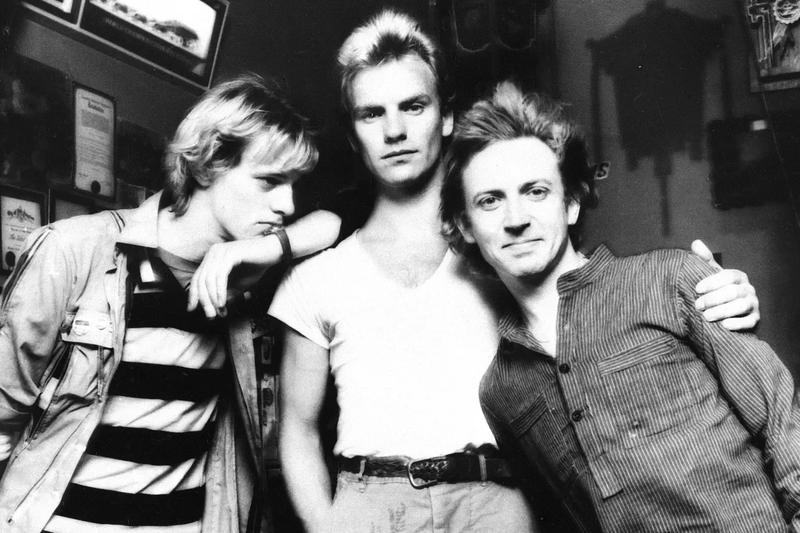
Foto: A&M Records, dominio público, vía Wikimedia Commons
The three of them in a 1979 publicity photo: Copeland on the left, Sting in the middle, Summers on the right. Four years later they recorded their last album.
Sting wrote the song in Jamaica in half an hour, sitting at the desk where Ian Fleming had written the James Bond novels. The demo was very different: Sting singing over a Hammond organ. Summers said it did not sound like The Police at all.
The band recorded it in 1983 on Montserrat, a Caribbean island with a recording studio. The three of them got on badly: the producer said Sting and Copeland hated each other. They spent about six weeks on the drums and bass alone. Then Sting told Summers just one thing: "make it your own". Summers had been practising violin duets by the Hungarian composer Béla Bartók, and that is where the riff came from. He recorded it in a single take.
It was the best-selling single of 1983 in the United States and appeared on Synchronicity, the band's last album. In 2019 it was named the most played song in radio history in the catalogue of BMI, the American organisation that collects songwriters' royalties.
Musical characteristics
A chord that cannot make up its mind. Listen to the guitar at the start. It does not strum: it plays the notes of the chord one after another, in a loop. That is an arpeggio. But there is a strange note inside. A normal chord has three notes. Summers adds a fourth one, a whole tone above the bottom note, and it rubs against the others without quite clashing. This is called an add9 chord ("added ninth"). It has an open, slightly floating colour, neither happy nor sad. That is why the song sounds tender and a little unsettling at once.
Your fingers have to stretch. To play the add9 shapes on guitar you have to stretch your hand across frets that are far apart. That is the real difficulty of the riff, and the challenge for the band's guitarist.
Four very old chords. Under the riff there is a progression from the 1950s: I–vi–IV–V. On the record, A♭, F minor, D♭ and E♭. In class, G, E minor, C and D. It is the same chord progression as "Stand by Me". Sting admitted it: he called the tune "generic", the sum of hundreds of other songs. What is different is everything else.
A bass that keeps walking. Sting plays quavers, eight to a bar, almost always on the lowest note of the chord. No fills. It is like a clock, and that steady ticking is part of the feeling of being watched.
Drums that do not show off. Copeland, who usually fills every gap, plays almost nothing here: bass drum and a snare hit on 2 and 4. That hit on the weak beats is the backbeat. According to Wikipedia, the bass drum came from a drum machine, and the snare was recorded together with a gong drum. Copeland said later that it looked easy and was harder than it sounds.
The bridge turns dark. Halfway through, the song suddenly changes colour. The chords turn minor, and a piano repeats a single note. This is the bridge: a section that appears only once and sets up the return. Here the music shifts into the minor mode of the same home note, which is why the change is so striking. In the class version, in G, we leave it out at first; when the band asks for it, we add it.
Hard facts: A♭ major on the record and G major in class, 4/4, 117 beats per minute, 4:13. The form: intro, verses, chorus, bridge, back to the verses, and ending.
Guided listening
Play the music video. At the start, before Sting sings, listen only to the guitar. Count how many notes it plays on each chord before it changes. That is the arpeggio.
When the voice comes in, switch instruments: listen only to the bass. Try saying "ta-ta-ta-ta-ta-ta-ta-ta" along with it. If it fits, you are saying Sting's quavers.
In the chorus ("Oh, can't you see"), notice the first chord. It is no longer the home chord: the section starts away from home, on IV, and that sounds like a question.
Then comes the bridge. Look for the piano repeating one note and hear how everything turns darker. Afterwards, when the guitar riff returns, feel the relief: you are home again.
In the last verses, listen to the same phrase repeating over and over. The song does not end: it fades out while the phrase carries on.
Trivia and curiosities
- In Summers's own words, the riff became "a kind of immortal guitar part that all guitar players have to learn". He was not credited as a writer, and for decades he claimed a share. In January 2026 Sting agreed to pay Summers and Copeland £600,000 in unpaid royalties. It shows what an arrangement is worth: the chords already existed, the riff did not.
- According to Wikipedia, the record is tuned with A at 432 Hz rather than 440. If you play along with a guitar tuned to a normal tuner, you will notice it does not quite fit.
- In the video Sting does not play an ordinary electric bass: he plays an electric double bass. The video is in black and white, and its cinematographer won MTV's very first award for best cinematography.
- In 1997 Puff Daddy and Faith Evans sampled the song for "I'll Be Missing You", a tribute to a murdered rapper. It was number 1 in the US for eleven weeks. Same riff, new lyrics, a completely different meaning.
- In 2000 Copeland called it Sting's best song with the band's worst arrangement, except for the guitar. They made millions from it anyway.
Classroom activities
- The bass with your body. Classroom with no instruments: half the class taps quavers on their thighs ("ta-ta-ta-ta…"), a quarter claps only on 2 and 4 (the backbeat) and the rest sing the melody. Then the second voice looks for the third on "I'll be watching you".
- Ukulele. G–Em–C–D, one chord per bar. Start with four soft downstrokes per bar. If you want a challenge, try the arpeggio: pluck the four strings one by one instead of strumming.
- Band. Guitar: add9 arpeggios (the Marty Music tutorial explains the stretches). Bass: quavers on the lowest note of each chord, no fills. Drums: bass drum, snare on 2 and 4, nothing else. Keyboard: long chords, and the repeated note in the bridge. The test is holding 117 beats per minute without speeding up.
- Analyse. Play this song and "Don't Stop Believin'" back to back. Same four chords. Which one starts its chorus away from home? Write down the first chord of each chorus.
- Create. With G–Em–C–D, swap the strum for an arpeggio and write four bars of lyrics that say something unsettling over calm music.
Key vocabulary
- Arpeggio — arpegio: las notas del acorde una detrás de otra
- Add9 chord — acorde add9, con novena añadida
- Chord progression — progresión de acordes
- Backbeat — el golpe de caja en los tiempos 2 y 4
- Bridge — puente
Resources
Official music video — In black and white, from The Police's own channel. Watch Sting's double bass.
Guitar tutorial — Marty Music. Explains the riff with the add9 shapes and how to place your hand for the stretches.
Bass tutorial — eBassGuitar. A slow, step-by-step lesson on the quaver line.
Drum tutorial — Stephen Taylor. He presents it as a first song to learn on drums, and explains why playing so little is harder than it looks.
Ukulele tutorial — Ukulele Cheats. The chords and a picking pattern for ukulele.
Piano tutorial — Piano with Nate. The chord accompaniment, useful for the band's keyboard player.
- Harmonic analysis — https://www.hooktheory.com/theorytab/view/the-police/every-breath-you-take
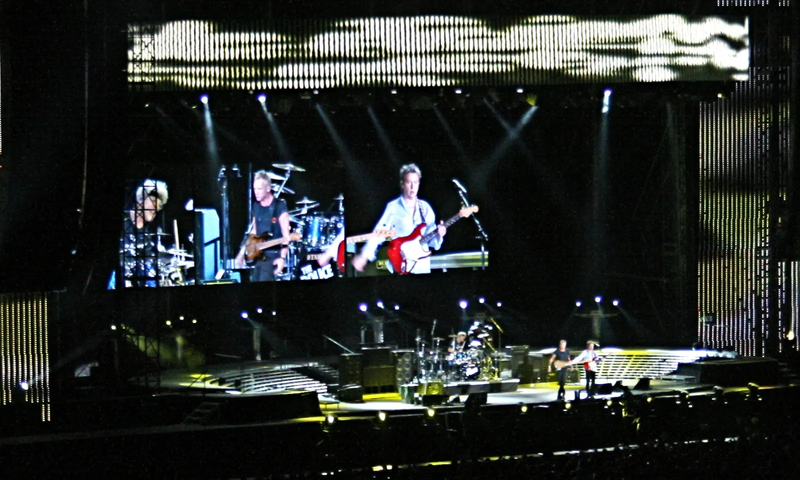
Foto: Alessio Bragadini, CC BY-SA 2.0, vía Wikimedia Commons
The Police got back together in 2007, more than twenty years later. This is the reunion tour in Turin (Italy): three musicians on a stadium stage.
Por qué está en este libro
Es la segunda canción de noviembre, la que la banda puede elegir junto a «Don't Stop Believin'». Las dos usan los mismos cuatro acordes (I, V, vi y IV), pero en otro orden: aquí van I–vi–IV–V, el bucle de «Stand by Me». Lo que aprende la banda de cinco es algo que no se aprende en el coro: el guitarrista, los arpegios add9; el bajista, a sostener una canción entera con corcheas en la misma nota; el batería, que tocar poco y muy igual es lo difícil. En clase la tocamos en Sol, G–Em–C–D, que es la versión reducida: el disco está en La♭ y tiene un puente que se va al modo menor. En el aula sin nada, la melodía al unísono, la segunda voz a una tercera en «I'll be watching you» y el bajo en corcheas con los muslos. Con ukelele, los cuatro acordes con un rasgueo suave. En el aula de música, la banda entera con el riff.
Por dónde entrar
Si has visto Stranger Things, ya la conoces: es la canción del baile de invierno de la segunda temporada, cuando bailan Eleven y Mike. Ahí funciona como canción de amor lenta.
Su autor no está de acuerdo. Sting ha dicho muchas veces que la letra es siniestra: habla alguien que vigila cada paso de otra persona. La pregunta de esta página es cómo una canción puede sonar tierna y decir algo inquietante a la vez. La respuesta está en la guitarra.
Contexto histórico
The Police era un trío inglés: Sting al bajo y la voz, Andy Summers a la guitarra y Stewart Copeland a la batería. Empezaron en 1977, en plena época del punk, y mezclaron el rock con el reggae. En 1983 eran uno de los grupos más grandes del mundo.
Foto: A&M Records, dominio público, vía Wikimedia Commons
Los tres, en una foto de promoción de 1979: Copeland a la izquierda, Sting en el centro, Summers a la derecha. Cuatro años después grabaron su último disco.
Sting escribió la canción en Jamaica, en media hora, sentado en la mesa donde Ian Fleming había escrito las novelas de James Bond. La maqueta era muy distinta: Sting cantando sobre un órgano Hammond. Summers dijo que aquello no sonaba a The Police.
El grupo la grabó en 1983 en Montserrat, una isla del Caribe donde había un estudio. Los tres se llevaban muy mal: el productor contó que Sting y Copeland se odiaban. Pasaron unas seis semanas solo con la batería y el bajo. Entonces Sting le dijo a Summers una sola cosa: «hazla tuya». Summers estaba practicando dúos para violín del compositor húngaro Béla Bartók, y de ahí sacó el riff. Lo grabó de una sola toma.
La canción fue la más vendida de 1983 en Estados Unidos y salió en Synchronicity, el último disco del grupo. En 2019 la contaron como la canción más radiada de la historia en el catálogo de BMI, la sociedad que cobra los derechos en Estados Unidos.
Cómo suena
Un acorde que no se decide. Escucha la guitarra al empezar. No rasguea: toca las notas del acorde una detrás de otra, en bucle. Eso es un arpegio. Pero hay una nota rara dentro. En un acorde normal hay tres notas. Summers añade una cuarta, un tono por encima de la de abajo, y esa nota roza con las demás sin llegar a chocar. Se llama acorde add9 («con novena añadida»). Da un color abierto, un poco suspendido, que no es ni alegre ni triste. Por eso la canción suena tierna y un poco inquietante a la vez.
Los dedos tienen que abrirse mucho. Para tocar el add9 en la guitarra hay que estirar la mano entre trastes muy separados. Es la dificultad real del riff, y el reto del guitarrista de la banda.
Cuatro acordes muy antiguos. Debajo del riff hay una progresión de los años cincuenta: I–vi–IV–V. En el disco, La♭, Fa menor, Re♭ y Mi♭. En clase, Sol, Mi menor, Do y Re. Es la misma progresión de acordes de «Stand by Me». Sting lo admitía: decía que la melodía era «genérica», la suma de cientos de canciones. Lo distinto es todo lo demás.
Un bajo que camina sin parar. Sting toca corcheas, ocho por compás, casi siempre en la nota más grave del acorde. No hace adornos. Es como un reloj, y ese tic-tac constante es parte de la sensación de vigilancia.
Una batería que no presume. Copeland, que suele llenar todo de golpes, aquí toca casi nada: bombo y un golpe de caja en el 2 y el 4. Ese golpe en los tiempos débiles es el backbeat. Según Wikipedia, el bombo salía de una caja de ritmos, y la caja se grabó sonando a la vez que un gong. Copeland dijo después que parecía fácil y que era más difícil de lo que suena.
El puente se oscurece. Hacia la mitad, la canción cambia de color de golpe. Los acordes se vuelven menores, y suena un piano que repite una sola nota. Es el puente: una sección que solo aparece una vez y prepara la vuelta. Aquí la música pasa al modo menor de la misma nota, y por eso se nota tanto. En la versión de clase, en Sol, lo dejamos fuera al principio; cuando la banda lo pida, se monta.
Datos duros: La♭ mayor en el disco y Sol mayor en clase, 4/4, 117 pulsos por minuto, 4:13. La forma: intro, versos, estribillo, puente, vuelta a los versos y final.
Escucha guiada
Pon el videoclip. Al empezar, antes de que cante Sting, escucha solo la guitarra. Cuenta cuántas notas toca por acorde antes de cambiar. Eso es el arpegio.
Cuando entre la voz, cambia de instrumento: escucha solo el bajo. Prueba a decir «ta-ta-ta-ta-ta-ta-ta-ta» a la vez. Si encaja, estás diciendo las corcheas de Sting.
En el estribillo («Oh, can't you see»), fíjate en el primer acorde. Ya no es el de casa: la canción empieza esta sección fuera, en el IV, y eso da sensación de pregunta.
Llega el puente. Busca el piano que repite una sola nota y escucha cómo todo se vuelve más oscuro. Después, cuando vuelve el riff de la guitarra, nota el alivio: has vuelto a casa.
En los últimos versos, escucha cómo se repite la misma frase una y otra vez. La canción no termina: se va apagando mientras la frase sigue.
Curiosidades
- El riff tiene hoy el sello de «parte que todo guitarrista tiene que aprender», en palabras del propio Summers. Él no firmó la canción, y durante décadas reclamó parte de la autoría. En enero de 2026 Sting aceptó pagar 600.000 libras a Summers y Copeland por derechos atrasados. Demuestra cuánto vale un arreglo: los acordes ya existían, el riff no.
- Según Wikipedia, el disco está afinado con el La a 432 Hz, no a 440. Si tocas encima con la guitarra afinada con un afinador normal, vas a notar que no encaja del todo.
- En el videoclip Sting no toca un bajo eléctrico normal: toca un contrabajo eléctrico. El vídeo está grabado en blanco y negro, y su director de fotografía ganó el primer premio de la MTV a la mejor fotografía.
- En 1997 Puff Daddy y Faith Evans usaron un trozo de la canción para «I'll Be Missing You», dedicada a un rapero asesinado. Fue número 1 en Estados Unidos once semanas. El mismo riff, otra letra, otro significado.
- Copeland dijo en el año 2000 que era la mejor canción de Sting con el peor arreglo del grupo, salvo la guitarra. Ganaron millones con ella.
Para hacer en clase
- El bajo con el cuerpo. Aula sin nada: media clase da corcheas en los muslos («ta-ta-ta-ta…»), un cuarto da palmas solo en 2 y 4 (el backbeat) y el resto canta la melodía. Después la segunda voz busca la tercera en «I'll be watching you».
- Ukelele. G–Em–C–D, un acorde por compás. Empezad con cuatro golpes hacia abajo por compás, suaves. Quien quiera, que pruebe el arpegio: las cuatro cuerdas una a una en lugar de rasguear.
- Banda. Guitarra: arpegios add9 (el tutorial de Marty Music explica los estiramientos). Bajo: corcheas en la nota más grave de cada acorde, sin adornos. Batería: bombo, caja en 2 y 4, nada más. Teclado: acordes largos, y en el puente la nota repetida. La prueba es aguantar 117 pulsos por minuto sin acelerar.
- Analizar. Poned seguidas esta canción y «Don't Stop Believin'». Mismos cuatro acordes. ¿Cuál de las dos empieza el estribillo fuera de casa? Escribid el primer acorde de cada estribillo.
- Crear. Con G–Em–C–D, cambiad el rasgueo por un arpegio y escribid cuatro compases de letra que digan algo inquietante con música tranquila.
Vocabulario fundamental
- Arpegio — Las notas de un acorde tocadas una detrás de otra, no a la vez.
- Acorde add9 — Un acorde con una nota más, un tono por encima de la de abajo. Suena abierto, sin decidirse.
- Progresión de acordes — Una serie de acordes que se repite en el mismo orden. Aquí, I–vi–IV–V.
- Backbeat — El golpe de caja en los tiempos 2 y 4.
- Puente — Una sección que aparece una sola vez, cambia el color de la canción y prepara la vuelta.
Recursos
Videoclip oficial — En blanco y negro, del canal de The Police. Fíjate en el contrabajo de Sting.
Tutorial de guitarra — Marty Music. Explica el riff con los acordes add9 y cómo colocar la mano para los estiramientos.
Tutorial de bajo — eBassGuitar. Lección paso a paso de la línea de corcheas, despacio.
Tutorial de batería — Stephen Taylor. La presenta como primera canción para aprender batería, y explica por qué tocar tan poco tiene su dificultad.
Tutorial de ukelele — Ukulele Cheats. Los acordes y un patrón de arpegio para ukelele.
Tutorial de piano — Piano with Nate. El acompañamiento con acordes, útil para el teclista de la banda.
- Análisis armónico — https://www.hooktheory.com/theorytab/view/the-police/every-breath-you-take
Foto: Alessio Bragadini, CC BY-SA 2.0, vía Wikimedia Commons
The Police se volvieron a juntar en 2007, más de veinte años después. Esta es la gira de reunión, en Turín (Italia): tres músicos en un escenario de estadio.
Why it's in this book
This is the second song of November, the one the band can choose alongside "Don't Stop Believin'". Both use the same four chords (I, V, vi and IV), but in a different order: here they go I–vi–IV–V, the loop from "Stand by Me". What the five-piece band learns here is something you cannot learn in the choir: the guitarist learns add9 arpeggios; the bassist learns to hold up a whole song with quavers on the same note; the drummer learns that playing little, and playing it very evenly, is the hard part. In class we play it in G, G–Em–C–D, which is a reduced version: the record is in A♭ and has a bridge that turns minor. In the classroom with no instruments, we sing the melody in unison, add a second voice a third away on "I'll be watching you", and play the bass quavers on our thighs. With ukuleles, the four chords with a gentle strum. In the music room, the full band with the riff.
Why this song
If you have watched Stranger Things, you already know it: it plays at the Snow Ball in season two, when Eleven and Mike dance. There it works as a slow love song.
The man who wrote it disagrees. Sting has said many times that the lyrics are sinister: the singer is someone watching another person's every move. The question on this page is how a song can sound tender and say something unsettling at the same time. The answer is in the guitar.
Historical context
The Police were an English trio: Sting on bass and vocals, Andy Summers on guitar and Stewart Copeland on drums. They started in 1977, in the middle of the punk years, and mixed rock with reggae. By 1983 they were one of the biggest bands in the world.
Foto: A&M Records, dominio público, vía Wikimedia Commons
The three of them in a 1979 publicity photo: Copeland on the left, Sting in the middle, Summers on the right. Four years later they recorded their last album.
Sting wrote the song in Jamaica in half an hour, sitting at the desk where Ian Fleming had written the James Bond novels. The demo was very different: Sting singing over a Hammond organ. Summers said it did not sound like The Police at all.
The band recorded it in 1983 on Montserrat, a Caribbean island with a recording studio. The three of them got on badly: the producer said Sting and Copeland hated each other. They spent about six weeks on the drums and bass alone. Then Sting told Summers just one thing: "make it your own". Summers had been practising violin duets by the Hungarian composer Béla Bartók, and that is where the riff came from. He recorded it in a single take.
It was the best-selling single of 1983 in the United States and appeared on Synchronicity, the band's last album. In 2019 it was named the most played song in radio history in the catalogue of BMI, the American organisation that collects songwriters' royalties.
Musical characteristics
A chord that cannot make up its mind. Listen to the guitar at the start. It does not strum: it plays the notes of the chord one after another, in a loop. That is an arpeggio. But there is a strange note inside. A normal chord has three notes. Summers adds a fourth one, a whole tone above the bottom note, and it rubs against the others without quite clashing. This is called an add9 chord ("added ninth"). It has an open, slightly floating colour, neither happy nor sad. That is why the song sounds tender and a little unsettling at once.
Your fingers have to stretch. To play the add9 shapes on guitar you have to stretch your hand across frets that are far apart. That is the real difficulty of the riff, and the challenge for the band's guitarist.
Four very old chords. Under the riff there is a progression from the 1950s: I–vi–IV–V. On the record, A♭, F minor, D♭ and E♭. In class, G, E minor, C and D. It is the same chord progression as "Stand by Me". Sting admitted it: he called the tune "generic", the sum of hundreds of other songs. What is different is everything else.
A bass that keeps walking. Sting plays quavers, eight to a bar, almost always on the lowest note of the chord. No fills. It is like a clock, and that steady ticking is part of the feeling of being watched.
Drums that do not show off. Copeland, who usually fills every gap, plays almost nothing here: bass drum and a snare hit on 2 and 4. That hit on the weak beats is the backbeat. According to Wikipedia, the bass drum came from a drum machine, and the snare was recorded together with a gong drum. Copeland said later that it looked easy and was harder than it sounds.
The bridge turns dark. Halfway through, the song suddenly changes colour. The chords turn minor, and a piano repeats a single note. This is the bridge: a section that appears only once and sets up the return. Here the music shifts into the minor mode of the same home note, which is why the change is so striking. In the class version, in G, we leave it out at first; when the band asks for it, we add it.
Hard facts: A♭ major on the record and G major in class, 4/4, 117 beats per minute, 4:13. The form: intro, verses, chorus, bridge, back to the verses, and ending.
Guided listening
Play the music video. At the start, before Sting sings, listen only to the guitar. Count how many notes it plays on each chord before it changes. That is the arpeggio.
When the voice comes in, switch instruments: listen only to the bass. Try saying "ta-ta-ta-ta-ta-ta-ta-ta" along with it. If it fits, you are saying Sting's quavers.
In the chorus ("Oh, can't you see"), notice the first chord. It is no longer the home chord: the section starts away from home, on IV, and that sounds like a question.
Then comes the bridge. Look for the piano repeating one note and hear how everything turns darker. Afterwards, when the guitar riff returns, feel the relief: you are home again.
In the last verses, listen to the same phrase repeating over and over. The song does not end: it fades out while the phrase carries on.
Trivia and curiosities
- In Summers's own words, the riff became "a kind of immortal guitar part that all guitar players have to learn". He was not credited as a writer, and for decades he claimed a share. In January 2026 Sting agreed to pay Summers and Copeland £600,000 in unpaid royalties. It shows what an arrangement is worth: the chords already existed, the riff did not.
- According to Wikipedia, the record is tuned with A at 432 Hz rather than 440. If you play along with a guitar tuned to a normal tuner, you will notice it does not quite fit.
- In the video Sting does not play an ordinary electric bass: he plays an electric double bass. The video is in black and white, and its cinematographer won MTV's very first award for best cinematography.
- In 1997 Puff Daddy and Faith Evans sampled the song for "I'll Be Missing You", a tribute to a murdered rapper. It was number 1 in the US for eleven weeks. Same riff, new lyrics, a completely different meaning.
- In 2000 Copeland called it Sting's best song with the band's worst arrangement, except for the guitar. They made millions from it anyway.
Classroom activities
- The bass with your body. Classroom with no instruments: half the class taps quavers on their thighs ("ta-ta-ta-ta…"), a quarter claps only on 2 and 4 (the backbeat) and the rest sing the melody. Then the second voice looks for the third on "I'll be watching you".
- Ukulele. G–Em–C–D, one chord per bar. Start with four soft downstrokes per bar. If you want a challenge, try the arpeggio: pluck the four strings one by one instead of strumming.
- Band. Guitar: add9 arpeggios (the Marty Music tutorial explains the stretches). Bass: quavers on the lowest note of each chord, no fills. Drums: bass drum, snare on 2 and 4, nothing else. Keyboard: long chords, and the repeated note in the bridge. The test is holding 117 beats per minute without speeding up.
- Analyse. Play this song and "Don't Stop Believin'" back to back. Same four chords. Which one starts its chorus away from home? Write down the first chord of each chorus.
- Create. With G–Em–C–D, swap the strum for an arpeggio and write four bars of lyrics that say something unsettling over calm music.
Key vocabulary
- Arpeggio — arpegio: las notas del acorde una detrás de otra
- Add9 chord — acorde add9, con novena añadida
- Chord progression — progresión de acordes
- Backbeat — el golpe de caja en los tiempos 2 y 4
- Bridge — puente
Resources
Official music video — In black and white, from The Police's own channel. Watch Sting's double bass.
Guitar tutorial — Marty Music. Explains the riff with the add9 shapes and how to place your hand for the stretches.
Bass tutorial — eBassGuitar. A slow, step-by-step lesson on the quaver line.
Drum tutorial — Stephen Taylor. He presents it as a first song to learn on drums, and explains why playing so little is harder than it looks.
Ukulele tutorial — Ukulele Cheats. The chords and a picking pattern for ukulele.
Piano tutorial — Piano with Nate. The chord accompaniment, useful for the band's keyboard player.
- Harmonic analysis — https://www.hooktheory.com/theorytab/view/the-police/every-breath-you-take
Foto: Alessio Bragadini, CC BY-SA 2.0, vía Wikimedia Commons
The Police got back together in 2007, more than twenty years later. This is the reunion tour in Turin (Italy): three musicians on a stadium stage.