Contenidos
¿Cómo mandas una canción a mil kilómetros sin poder escribirla?
For centuries, learning a song meant hearing someone sing it to you. This unit is about the day that stopped being enough, about how two and then four voices at once had to be written down, and about what we gained and lost by inventing the written s
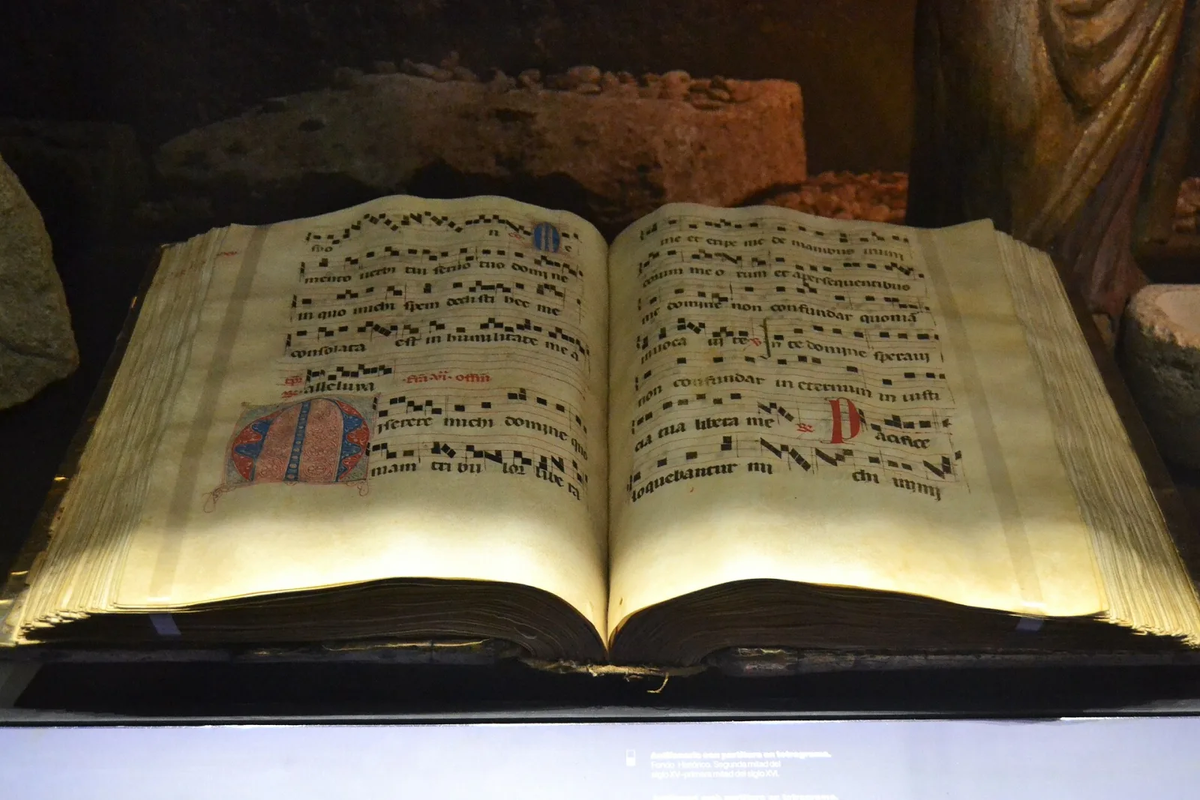
We ask ourselves
- If you have never heard a song, can you sing it off a piece of paper?
- How many songs do you know all the way through with nothing to look at?
- Who decides that a song is sung the same way in two different places?
- If I write a melody down, which part of the sound stays off the page?
- Can written music exist that nobody knows how to read any more?
- If four people sing different things at once, how do you write down how long each note lasts so they stay together?
- Why would anyone spend their life singing eight times a day?
Don't answer yet. We come back to these at the end.
The fragment
We are not starting by listening today. We are starting with an impossible commission.
First, by ear. The teacher sings a short phrase, seven or eight notes, and says nothing else. The class repeats it until it comes out the same three times in a row. No words, no title, no paper.
Then the commission. Each of you, on a sheet of paper and in silence, writes instructions so that somebody who was not in the room can sing that phrase exactly. Writing the note names is not allowed: hardly anyone knows them yet, and that is the point.
Now the test. Swap sheets between groups. Each group tries to sing whatever sheet it got, as it stands, without asking anything.
What comes out is always the same: arrows up and down, higher and lower marks, numbers, little drawings. And they half work. They work for anyone who already heard the phrase, because they jog the memory. They fail for anyone who never heard it, because they never say where you start or how far you climb.
Keep those sheets. In a few minutes it will turn out the class has just reinvented, in ten minutes, the system Europe used for two centuries.
What changed
Listen now to an introit sung by the monks of Silos. No instruments, no harmony, nobody keeping time. A single line of voices, all singing the same thing. That is plainchant.
Spiritus Domini, introit in mode VIII, by the Choir of Monks of the Monastery of Silos
That singing was not a concert: it was a timetable. In a monastery the office was sung at fixed hours, from before dawn to just before bed, every day of the year, including the middle of the night. Terce at nine, sext at noon, none at three in the afternoon, vespers from five. Every day in the calendar had its own texts and its own melodies.
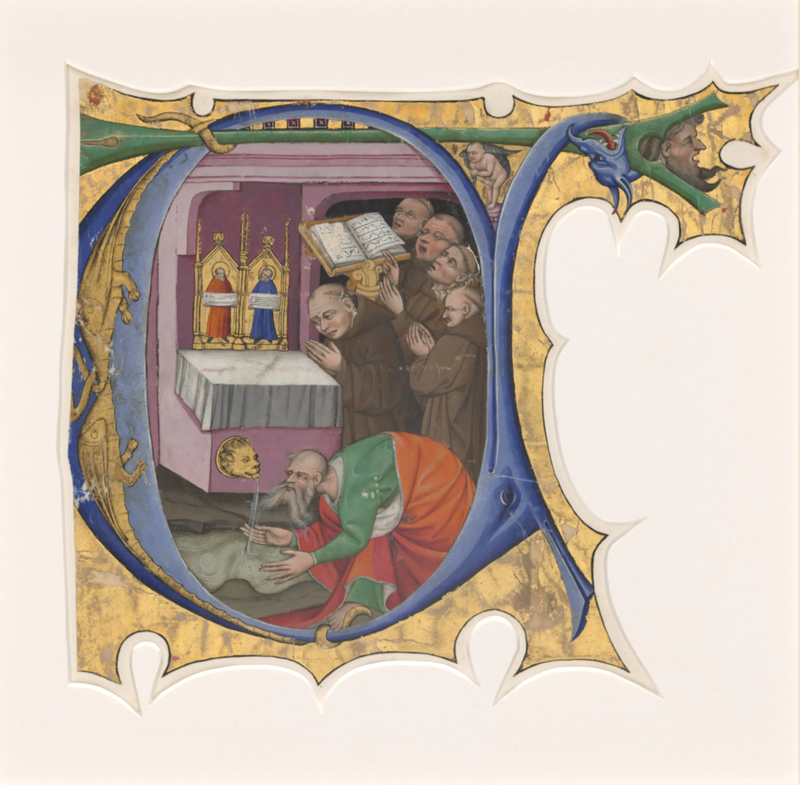
Maestro de los Cipreses, inicial T con monjes cantando, década de 1430, CC0, National Gallery of Art, vía Wikimedia Commons
Do the arithmetic on what that asks of a memory. Thousands of pieces, each tied to its day, sung by a group that keeps turning over as the old ones die and new boys arrive. And there the real problem appears, and it is political before it is musical.
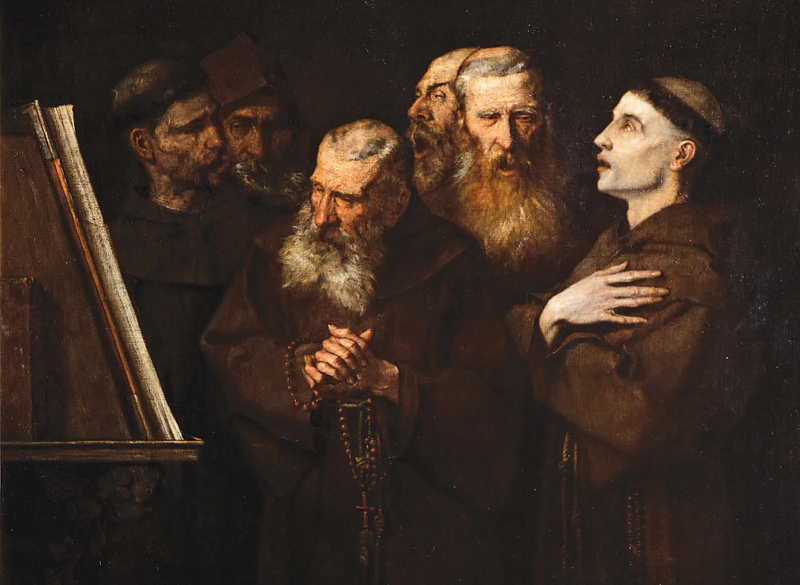
Óleo de Ignacio Merino, 1861, dominio público, vía Wikimedia Commons
The problem was logistics. Charlemagne's father abolished the local rite of his lands and took Rome's instead, to bind himself to Rome. Between 785 and 786, at Charlemagne's request, Pope Adrian I sent a book of Roman chant to the Frankish court. Charlemagne, by then emperor, pushed it across his empire: one repertory, sung the same way from the Rhine to the Pyrenees, is a cheap way of showing who is in charge.
Ordering it is one thing and getting it is another. A cantor from Metz could not travel to every abbey to teach two thousand melodies. So somebody, in the ninth century, did exactly what you did with your sheets: draw the movement of the voice above the words. Those drawings are called neumes.
From memory to neumes, told by Juan Velázquez (in Spanish) — the video starts at that point, and we come back to it at every step of the story
Neumes say a great deal and keep quiet about the one thing that matters. They say whether the voice rises, whether it falls, whether two notes run together, whether one is held. They do not say which note you start on or how far up you go. They are a reminder for someone who already knows the tune, not a recipe for someone who has never heard it. They fail exactly as your sheets failed, and for the same reason.
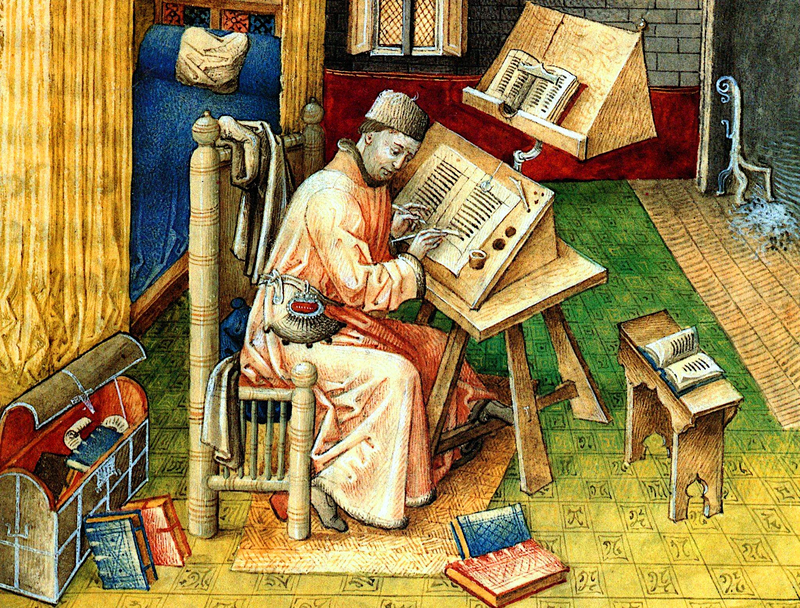
Jean Miélot copiando un manuscrito, Biblioteca Real de Bruselas MS 9278, siglo XV, dominio público, vía Wikimedia Commons
Every book was copied like this, by hand, letter by letter. A copying slip in one neume was repeated in every copy made from that one.
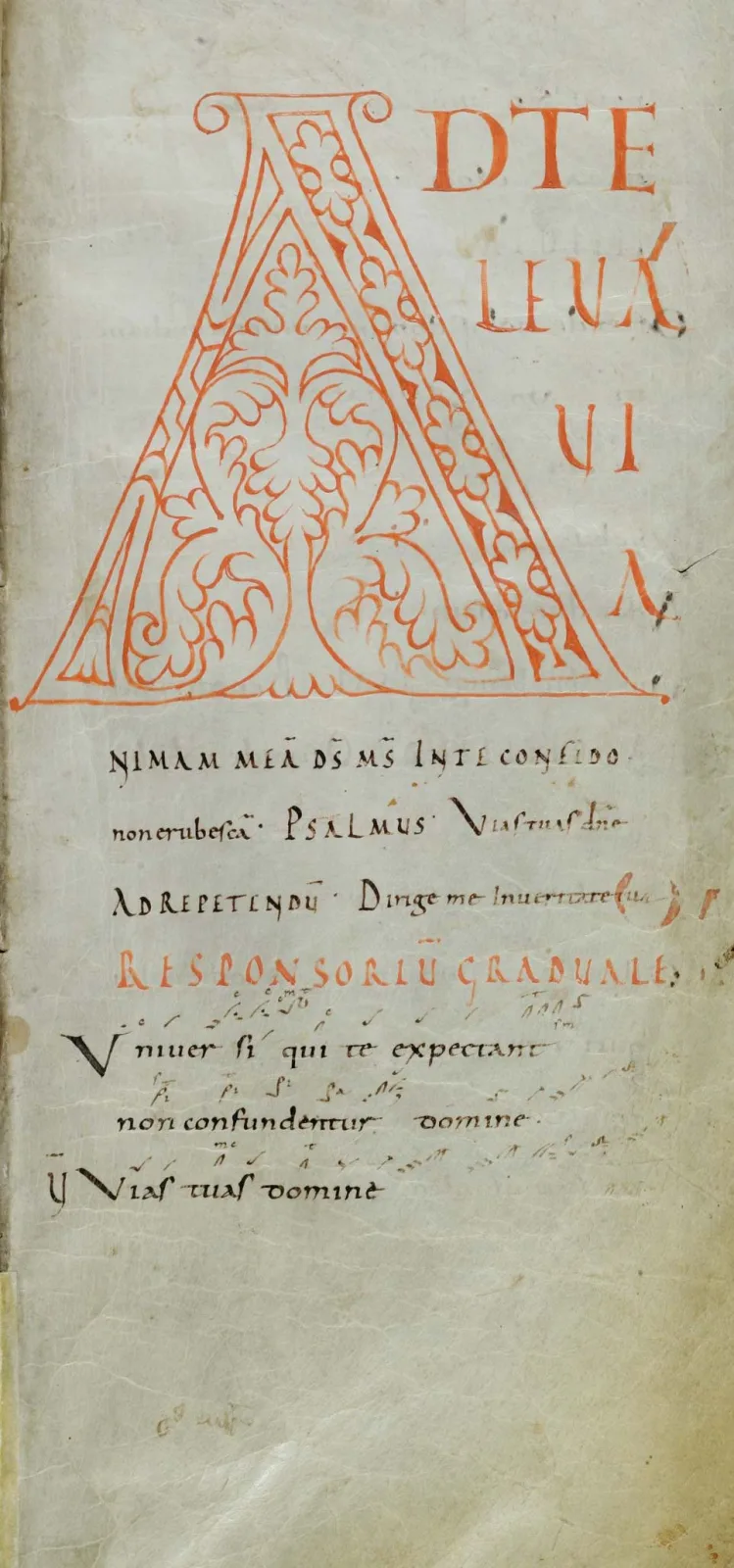
Copiado en San Galo entre 922 y 925, Cod. Sang. 359, p. 25, dominio público, vía Wikimedia Commons
And this is not an opinion: we have the proof. From the Hispanic liturgy, the one sung in the Iberian Peninsula before the eleventh century, manuscripts survive with almost the whole repertory. And it cannot be read.
The notation does not show intervals, so we know where the voice went up but not by how much. Out of all of it, only twenty-one chants can be read, because someone copied them in the twelfth century in a notation that did fix pitches. The rest are written down and silent.
A system like that lasts only as long as somebody alive knows the songs by heart. When those people die, the drawing is left without its key. It is written music nobody can read any more.
The fix fits in one sentence: a line on the page is a fixed note. Draw a line, agree that the line means one particular sound, and any sign you put above or below it now has a measurable height. What was a drawing becomes a measurement.
By the first half of the eleventh century this was already being done in Aquitaine, and around 1025 a Benedictine monk teaching the singers of Arezzo cathedral turned it into a method, with four lines: the tetragram. It is the modern stave minus one line, and plainchant still uses it.
From one line to four — same video, further on
The same monk solved the other half of the problem, which was what to call what you see. He took a hymn to John the Baptist, Ut queant laxis, in which every line starts one step higher than the last, and used the first syllable of each line as the name of that step: ut, re, mi, fa, sol, la.
Ut queant laxis: every line starts one step above the last
The hymn works as a ladder that hands you your starting pitch. Si came later, from the initials of Sancte Ioannes, and in the seventeenth century Giovanni Battista Doni swapped ut for do, which ends in a vowel and sings better.
The result was measured in time, which is the only measure that interests whoever is paying. Training a capable cantor took ten years. With lines and syllables it came down to one or two. He is also credited with the Guidonian hand, reading notes off the joints of your fingers; treat that with some suspicion, because he only describes a rudimentary version and the full system is a century later.
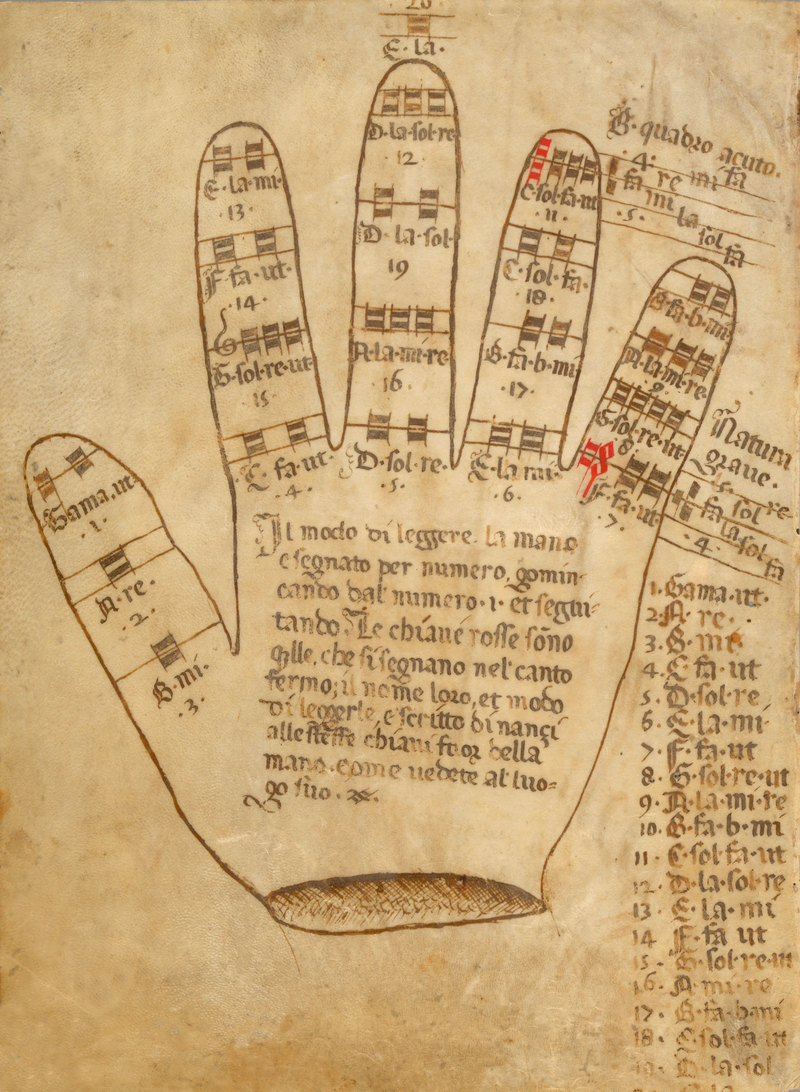
Mano guidoniana, UC Berkeley Music Library MS 1087, siglo XVI, dominio público, vía Wikimedia Commons
This hand is from the sixteenth century, five hundred years after Guido: the system stayed in use all that time.
Now the awkward part. What the tetragram writes well is which note and in what order. What it leaves out is nearly everything else: exactly how long, how loud, with what ornament, how the voice bends at the end of a phrase. The old neumes drew that gesture in extraordinary detail, and squaring the notes onto lines threw the detail away. We gained pitch and lost gesture.
And then, two voices at once. While some people were learning to write down a single melody, others were already singing two. Around 895 an anonymous treatise, the Musica enchiriadis, gives the simplest recipe: one voice sings the chant and another doubles it underneath, a fifth or a fourth lower, moving in step. That is called organum, and it is the earliest polyphony with written rules that we have.
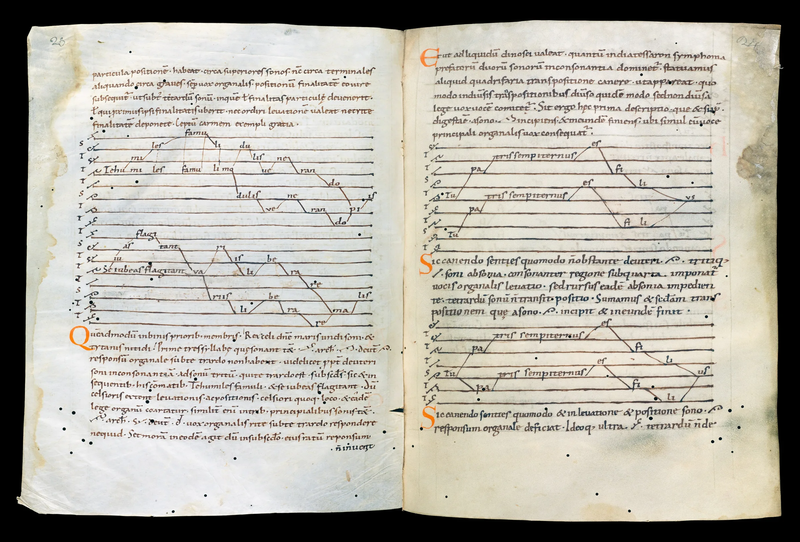
Musica enchiriadis, Einsiedeln Cod. 79, fol. 24v-25r, siglo X, dominio público, vía Wikimedia Commons
Twenty seconds of parallel organum, with the score on screen. The second voice sticks to the first like a shadow
Look at how it is written: no neumes, just syllables placed at different heights between lines. To sing two voices at once, a drawing is no longer enough: you have to measure the gap between them.
From doubling to decoration. In the twelfth century the chant voice slows right down: it holds each note while the other voice draws a new line on top, packed with notes, like a garland. This is the florid organum of Saint-Martial in Limoges, in Aquitaine, the same place where reliable pitches started being written down.
Many notes against one — organum Jubilemus, exsultemus, Saint-Martial de Limoges, twelfth century, with score and translation
Notre Dame and the Ars Antiqua. In 1163 the first stone of Notre Dame in Paris is laid, and its choir turns into the laboratory of polyphony. From the 1160s two-voice organum is sung there. An English student of the thirteenth century, whom we call Anonymous IV, says Léonin put together a great book of organum, the Magnus liber organi.
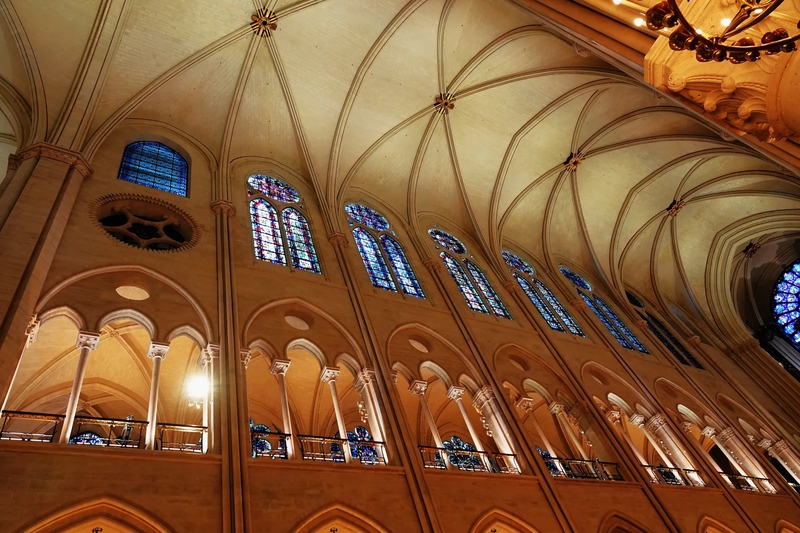
Nave de Notre-Dame de París, foto de Ibex73 (2024), CC BY 4.0, vía Wikimedia Commons
Historians call the music of this period, roughly 1170 to 1310, the Ars Antiqua, "the old art". The name only makes sense next to the Ars Nova that came after it.
A premiere with a date: Christmas 1198. The bishop of Paris, Odo de Sully, ordered in 1198 and 1199 that certain chants for Christmas and St Stephen's Day be sung in organum for three or four voices. Those orders suggest Pérotin's four-voice Viderunt omnes was written for Christmas 1198. The cathedral was paying, and what it was buying was awe.
Viderunt omnes, by Pérotin — the video starts right at the excerpt
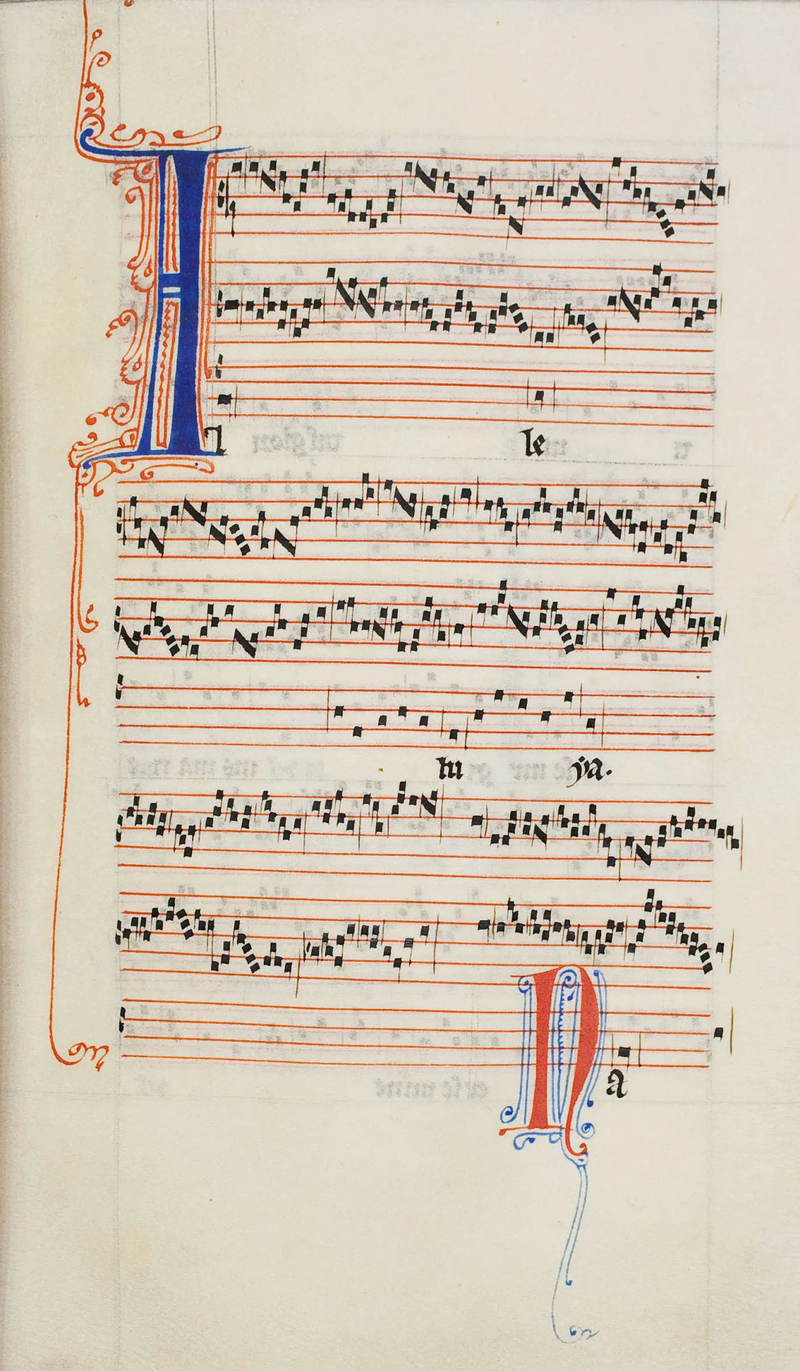
Pérotin, Alleluia Nativitas, códice W2 de Wolfenbüttel, siglo XIII, dominio público, vía Wikimedia Commons
The new problem: how long is each note? With one voice, the words carried the rhythm. With four voices that have to fit together, somebody has to say how long every note lasts, or they drift apart. At Notre Dame they did not change the shape of the notes: they changed how the notes were grouped.
Depending on how the notes were tied into groups, called ligatures, the singer knew which pattern of long and short came next. These fixed patterns are the rhythmic modes. Think of Morse code: one dot means nothing on its own, the group says everything.
The Notre Dame rhythmic modes, explained by Juan Velázquez (in Spanish) — the video starts at that point
Franco of Cologne: the shape gives the length. Around 1250 a treatise, Franco of Cologne's Ars cantus mensurabilis, puts forward the idea we still use: a note's length should be read from its shape, not worked out from its neighbours. The longa is long because it has a stem; the breve is a plain square. This is mensural notation, notation that measures.
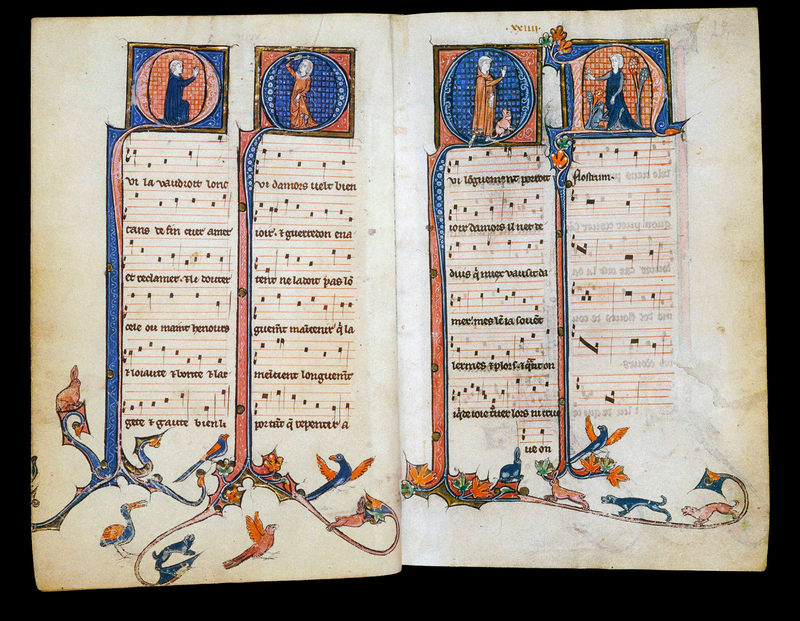
Códice de Montpellier, Ms H196, fol. 23v-24r, hacia 1300, dominio público, vía Wikimedia Commons
Franco's idea in sixteen seconds — same video, further on
Ars Nova: shorter notes, freer rhythm. Around 1320 some writings attributed to Philippe de Vitry circulate in Paris and give the period its name: Ars Nova, "the new art". What was new was, once again, notation. It allowed rhythms that no longer fitted the modes, it said whether each note split into two or three, and it used a shorter value: the minima, "the smallest one". Our minim, the half note, descends from it.
From Ars Antiqua to Ars Nova — the video carries on from where we left it
Those signs that said whether the rhythm went in threes or twos are where the "C" at the start of a piece in 4/4 comes from.
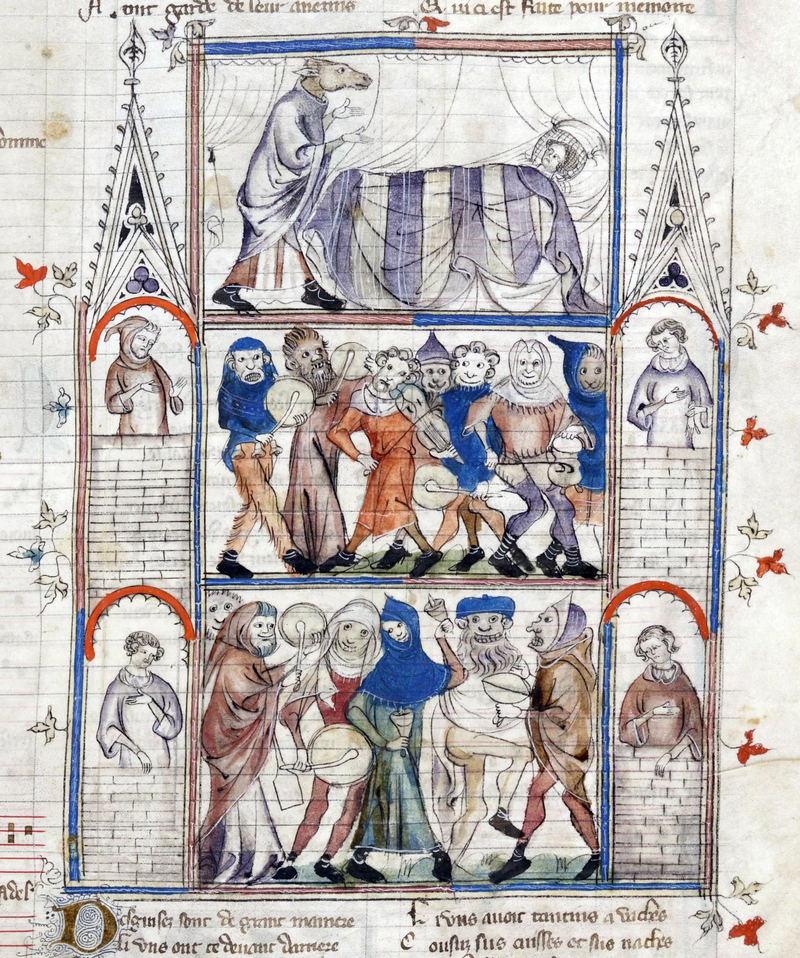
Charivari, Roman de Fauvel (BnF fr. 146), hacia 1316-1318, dominio público, vía Wikimedia Commons
The first big shop window for the new music is a satirical book, the Roman de Fauvel. Around 1316-1317 it was expanded with 169 pieces of music, and some of them are linked to Vitry.
Garrit gallus, a motet from the Roman de Fauvel, with the score taken from the manuscript
The work that sums up the Ars Nova best is Guillaume de Machaut's Mass of Our Lady, written before 1365. It is the earliest complete polyphonic Mass that can be credited to a single composer; before it, a polyphonic Mass was assembled from pieces by different people.
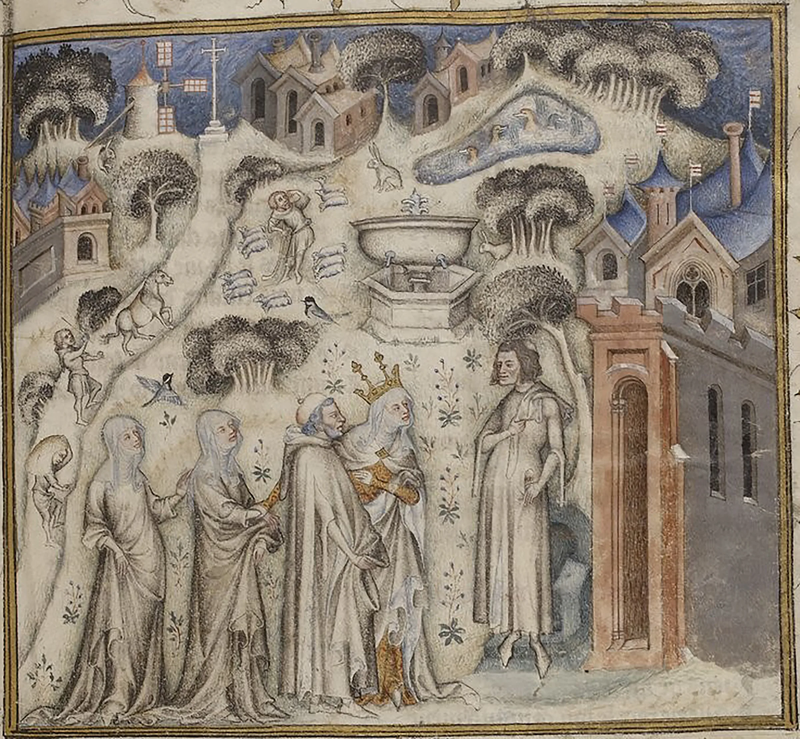
Naturaleza presenta a Machaut Sentido, Retórica y Música, Maestro de la Biblia de Jean de Sy, 1372-1377, dominio público, vía Wikimedia Commons
Machaut's Kyrie with the original notation on screen: this is how music was read in the fourteenth century
And once again something gets lost. With every note measured, the singer no longer stretches a syllable because the words ask for it: they sing what is written. The score gains precision and the singer loses room.
Hard facts: earliest surviving notated sources, around 930. Reliable pitches on lines, first half of the eleventh century. Tetragram and syllables, around 1025. Square notation on four lines in general use by the thirteenth century, which is what still fills the choirbooks of any cathedral. First written rules for polyphony, around 895. Viderunt omnes, Christmas 1198. A note's shape gives its length, around 1250. Ars Nova and the minima, around 1320. Modern bars, over the seventeenth century.
The same device elsewhere
Writing music always means writing one part of it and trusting that you already know the rest. The neume is an extreme case, not a medieval oddity. These three make the point:
- A guitar tab. It gives you string and fret, and never gives you the rhythm. Take the tab for Sweet Home Alabama and try playing it having never heard the song: you will get the notes and you will not get the song. Exactly like a neume.
- A Bach score. In much of his music there are no tempo or dynamic markings at all: the page says which notes and how long, and says nothing else. That is why two recordings of the same page last different lengths and sound like different pieces.
- The Chinese guqin. Its jianzi pu tablature notes which string, which finger and which technique, and does not note the pitch, nor, in most cases, the rhythm. There are written pieces that have gone unplayed for centuries, waiting for somebody to reconstruct how they sounded.
None of the three is badly made. All three write down what needs writing and leave the rest inside the player's head. The useful question is not whether a score is complete, because none is: it is what that score chose to leave out.
And here at home?
Here something happened that can be dated to the day, and it happened in the province of Huesca.
On 22 March 1071, at the monastery of San Juan de la Peña, the first Roman-rite mass in Spain was celebrated. That same year King Sancho Ramírez handed the monastery over to the monks of Cluny. The change was then made official across the rest of the kingdom of Aragón. From outside it looks like a liturgical detail; from inside the choir it is an entire songbook replaced by royal order.
What stopped being sung that year is precisely the repertory we cannot read today. It was not lost through carelessness: it was replaced. And since nobody sang it again, it lost the one thing keeping it alive, which was somebody able to pitch it from memory.
What came afterwards we know well, because it arrived written with pitches. The Codex Las Huelgas, copied in the early fourteenth century at the Cistercian nunnery in Burgos, is the only polyphonic manuscript of the Middle Ages still kept where it was made. Enclosed nuns sang from it, which is worth remembering whenever medieval music gets told as a story about monks.
Polyphony has an anchor in Spain too, and an early one. The Codex Calixtinus, kept in Santiago de Compostela cathedral and compiled between 1135 and 1173, most likely around 1140, contains Congaudeant catholici, regarded as the earliest known piece for three voices. Some scholars think the third voice was never meant to sound together with the other two, because all three clash badly.
Congaudeant catholici, from the Codex Calixtinus, with the score and a translation of each verse
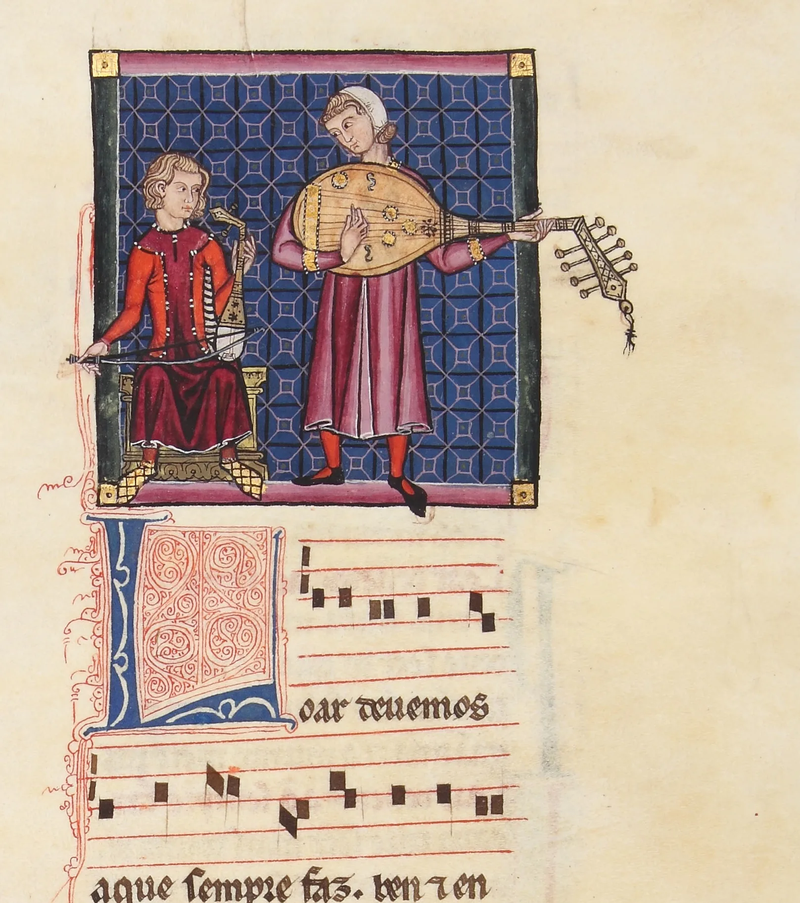
Cantigas de Santa María, Códice de los músicos (El Escorial b-I-2), fol. 162r, hacia 1280, dominio público, vía Wikimedia Commons
About thirty years after Franco's treatise, at the court of Alfonso X, the Cantigas de Santa María were being copied, with the music written on staves and miniatures of musicians playing. This page, from around 1280, shows a lute and a rebec right above the song itself.
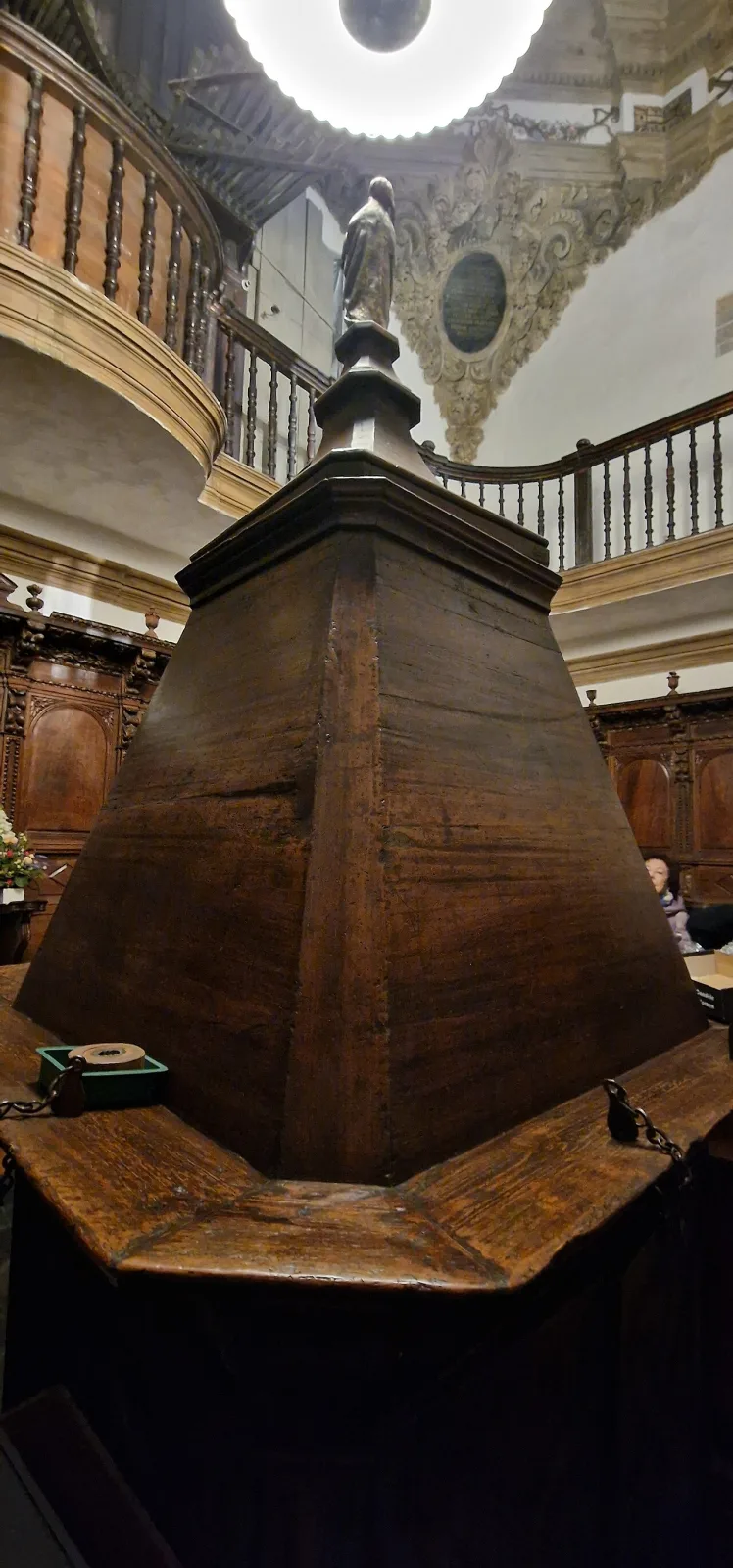
Foto: Ecelan, CC BY-SA 4.0, vía Wikimedia Commons
In Zaragoza you can see the size of the problem without leaving the old town. The choir of La Seo was commissioned between 1445 and 1447 by Archbishop Dalmau de Mur, and it has 117 stalls. A hundred and seventeen people and, in the middle, one lectern.
That is where the giant choirbooks come from. When a single book has to be read from several metres away, the notes get drawn the size of a thumb and the book ends up weighing what it weighs. The lectern in the church of La Magdalena is still standing there and gives you the measurement.
Classroom activities
- While the Silos introit plays: raise your hand every time the voice moves to a higher sound. Afterwards we compare who raised their hand at the same points. Drawn on paper, that is a neume.
- While Ut queant laxis plays: count the line openings on your fingers. There are six, and each starts one step higher. Anyone who wants to can sing those six syllables on their own, one after another.
- While the Las Huelgas chant plays: half the class follows one voice and half follows the other. Raise your hand when the two land on the same note.
- Sing in organum: half the class sings a phrase of chant and the other half sings the same phrase a fifth lower, at the same time. You have just sung the Musica enchiriadis recipe.
- Franco's problem: invent three note shapes, one long, one short and one very short, and use them to write the rhythm of a song you know. The group next to you has to clap it without hearing it.
- Play: we put the opening phrase together on recorder or keyboard, this time with the note names, and compare it with the sheets you wrote. The point is to see which parts of those drawings were right.
- Write: repeat the opening commission with a new melody, but now with four lines drawn on the sheet and one agreed note. Check whether the group next to you sings it correctly first time.
Key vocabulary
- Plainchant — canto llano: una sola línea melódica, sin instrumentos y sin armonía
- Neume — neuma: signo que dibuja el movimiento de la voz encima del texto
- Tetragram — tetragrama: pauta de cuatro líneas para escribir el canto llano
- Organum — organum: la primera polifonía escrita, voces añadidas a un canto llano
- Mensural notation — notación mensural: la forma de la nota indica su duración
Resources
The songs in this unit are in the library, each with its own article, full-band chart and tab: Sweet Home Alabama, Saturn.
The repertory whose key we lost — Hispanic chant from the Toledo Cantatorium, by Eduardo Paniagua.
A Spanish manuscript, in full — the Codex Las Huelgas by the ensemble Psallentes, in the Fundación Juan March series.
Viderunt omnes, complete — Pérotin by The Hilliard Ensemble, eleven and a half minutes to listen to properly.
The whole history of notation in four and a half minutes — from neumes to the modern note, with drawings.
- The tab that keeps quiet about rhythm — Sweet Home Alabama, in the library, with its chart and its tab.
- A modern score that does write it all down — Saturn, in the library, to compare how much gets notated today.
- The other half of the story — What happens when we stop all singing the same thing?: texture, troubadours and the sound of polyphony, in another unit of this book.
Nos preguntamos
- Si nunca has oído una canción, ¿puedes cantarla mirando un papel?
- ¿Cuántas canciones te sabes enteras sin mirar nada?
- ¿Quién decide que una canción se cante igual en dos sitios distintos?
- Si escribo una melodía, ¿qué parte de lo que suena se queda fuera del papel?
- ¿Puede existir una música escrita que nadie sepa ya leer?
- Si cuatro personas cantan cosas distintas a la vez, ¿cómo escribes cuánto dura cada nota para que no se descuadren?
- ¿Para qué querría alguien pasarse la vida cantando ocho veces al día?
No las respondas todavía. Al final de la unidad volvemos a ellas.
El fragmento
Hoy no empezamos escuchando. Empezamos con un encargo imposible.
Primero, de oído. El profesor canta una frase corta, siete u ocho notas, sin decir nada más. La clase la repite hasta que sale igual tres veces seguidas. No hay letra, no hay nombre, no hay papel.
Después, el encargo. Cada uno, en un folio y en silencio, escribe instrucciones para que alguien que no ha estado aquí cante esa frase exactamente igual. Prohibido escribir el nombre de las notas: casi nadie lo sabe todavía, y ese es el sentido del ejercicio.
Y ahora, la prueba. Se intercambian los folios entre grupos. Cada grupo intenta cantar el folio que le ha tocado, tal cual, sin preguntar nada.
Lo que sale siempre es lo mismo: flechas arriba y abajo, rayas más altas y más bajas, números, muñecos. Y funcionan a medias. Funcionan para quien ya oyó la frase, porque le recuerdan el dibujo. No funcionan para quien no la oyó nunca, porque no dicen desde dónde se empieza ni cuánto se sube.
Guardad los folios. Dentro de un rato resultará que la clase acaba de reinventar, en diez minutos, el sistema que Europa usó durante dos siglos.
Qué cambió
Escuchad ahora un introito cantado por los monjes de Silos. No hay instrumentos, no hay armonía, no hay nadie llevando el compás. Una sola línea de voces, todas cantando lo mismo. Eso es el canto llano.
Spiritus Domini, introito en modo VIII, por el Coro de Monjes del Monasterio de Silos
Ese canto no era un concierto: era un horario. En un monasterio se cantaba el oficio a horas fijas, desde antes del amanecer hasta antes de acostarse, todos los días del año, incluida la madrugada. Tercia a las nueve, sexta a las doce, nona a las tres de la tarde, vísperas a partir de las cinco. Cada día del calendario tenía sus textos y sus melodías propias.
Maestro de los Cipreses, inicial T con monjes cantando, década de 1430, CC0, National Gallery of Art, vía Wikimedia Commons
Haz la cuenta de lo que eso pide a una memoria. Miles de piezas, cada una con su día, y un grupo de personas que se renueva cuando los viejos mueren y entran chavales nuevos. Y ahí llega el problema de verdad, que es político antes que musical.
Óleo de Ignacio Merino, 1861, dominio público, vía Wikimedia Commons
El problema era de logística. El padre de Carlomagno suprimió el rito propio de sus territorios y adoptó el de Roma, para atarse a Roma. Entre 785 y 786, a petición de Carlomagno, el papa Adriano I mandó a la corte franca un libro con el canto romano. Carlomagno, ya emperador, lo extendió por todo el imperio: un mismo repertorio, cantado igual desde el Rin hasta los Pirineos, es una forma barata de demostrar que mandas.
Pero una cosa es ordenarlo y otra conseguirlo. Un cantor de Metz no podía viajar a cada abadía a enseñar dos mil melodías. Así que alguien, en el siglo IX, hizo exactamente lo que habéis hecho vosotros con el folio: dibujar encima de las palabras el movimiento de la voz. A esos dibujos se les llama neumas.
De la memoria al neuma, contado por Juan Velázquez — el vídeo empieza en ese punto, y volveremos a él en cada paso de la historia
Los neumas dicen mucho y callan lo esencial. Dicen si la voz sube, si baja, si dos notas van pegadas, si una se alarga. No dicen desde qué nota empiezas ni cuánto subes exactamente. Son un recordatorio para quien ya se sabe la melodía, no una receta para quien no la ha oído. Funcionan igual de mal que vuestros folios, y por la misma razón.
Jean Miélot copiando un manuscrito, Biblioteca Real de Bruselas MS 9278, siglo XV, dominio público, vía Wikimedia Commons
Cada libro se copiaba así, a mano y letra a letra. Un error de copia en un neuma se repetía en todas las copias que salían de esa.
Copiado en San Galo entre 922 y 925, Cod. Sang. 359, p. 25, dominio público, vía Wikimedia Commons
Y esto no es una opinión: tenemos la prueba. De la liturgia hispánica, la que se cantaba en la península antes del siglo XI, se conservan manuscritos con casi todo el repertorio. Y no se puede leer.
La notación no indica los intervalos, así que sabemos dónde subía la voz pero no cuánto. De todo ese repertorio solo pueden leerse veintiún cantos, porque alguien los copió en el siglo XII con una notación que sí marcaba alturas. Los demás están escritos y son mudos.
Un sistema así solo aguanta mientras viva alguien que se sepa las canciones de memoria. Cuando esa gente muere, el dibujo se queda sin clave. Es una música escrita que nadie sabe ya leer.
La solución cabe en una frase: una raya en el papel es una nota fija. Si trazas una línea y acuerdas que esa línea es un sonido concreto, cualquier signo que pongas encima o debajo ya tiene altura medible. Lo que era un dibujo pasa a ser una medida.
En la primera mitad del siglo XI eso ya se hacía en Aquitania, y hacia 1025 un monje benedictino que enseñaba a los cantores de la catedral de Arezzo lo convirtió en método, con cuatro líneas: el tetragrama. Es el pentagrama menos una línea, y todavía se usa para el canto llano.
De una línea a cuatro — mismo vídeo, más adelante
El mismo monje resolvió la otra mitad del problema, que era cómo nombrar lo que ves. Cogió un himno a san Juan Bautista, Ut queant laxis, en el que cada verso empieza un grado más arriba, y usó la primera sílaba de cada verso como nombre de ese escalón: ut, re, mi, fa, sol, la.
Ut queant laxis: cada verso empieza un grado más arriba que el anterior
El himno funciona como una escalera que te da el tono de salida. El si llegó después, de las iniciales de Sancte Ioannes, y en el siglo XVII Giovanni Battista Doni cambió ut por do, que termina en vocal y se canta mejor.
El resultado se midió en tiempo, que es la única medida que le importa a quien paga. Formar a un cantor capaz llevaba diez años. Con líneas y sílabas pasó a llevar uno o dos. También se le atribuye la mano guidoniana, la de leer las notas en las articulaciones de los dedos; de eso conviene desconfiar un poco, porque él solo describe una versión rudimentaria y el sistema completo es de un siglo después.
Mano guidoniana, UC Berkeley Music Library MS 1087, siglo XVI, dominio público, vía Wikimedia Commons
Esta mano es del siglo XVI, quinientos años después de Guido: el sistema se siguió usando todo ese tiempo.
Ahora la parte incómoda. Lo que el tetragrama escribe bien es qué nota y en qué orden. Lo que deja fuera es casi todo lo demás: cuánto dura exactamente, con qué fuerza, con qué adorno, cómo se dobla la voz al final de la frase. Los neumas antiguos dibujaban ese gesto con muchísimo detalle, y al pasar a notas cuadradas sobre líneas, ese detalle se perdió. Ganamos la altura y perdimos el gesto.
Y entonces, dos voces a la vez. Mientras unos aprendían a escribir una sola melodía, otros ya cantaban dos. Hacia 895 un tratado anónimo, la Musica enchiriadis, da la receta más sencilla: una voz canta el canto llano y otra lo dobla por debajo, a distancia de quinta o de cuarta, moviéndose a la vez. A eso se le llama organum, y es la primera polifonía con reglas escritas que conservamos.
Musica enchiriadis, Einsiedeln Cod. 79, fol. 24v-25r, siglo X, dominio público, vía Wikimedia Commons
Veinte segundos de organum paralelo, con la partitura en pantalla. La segunda voz va pegada a la primera como una sombra
Fijaos en cómo está escrito: no hay neumas, hay sílabas colocadas a distintas alturas entre líneas. Para cantar dos voces a la vez el dibujo ya no basta: hay que medir la distancia entre ellas.
Del doble al adorno. En el siglo XII la voz del canto se frena: sostiene cada nota mientras la otra dibuja encima una línea nueva, llena de notas, como una guirnalda. Es el organum florido de Saint-Martial de Limoges, en Aquitania, el mismo sitio donde se empezaron a escribir alturas fiables.
Muchas notas contra una — organum Jubilemus, exsultemus, Saint-Martial de Limoges, siglo XII, con la partitura y la traducción
Notre Dame y el Ars Antiqua. En 1163 se pone la primera piedra de la catedral de Notre Dame de París, y su coro se convierte en el laboratorio de la polifonía. Desde la década de 1160 se canta allí organum a dos voces. Un estudiante inglés del siglo XIII, al que llamamos Anónimo IV, cuenta que Léonin reunió un gran libro de organum, el Magnus liber organi.
Nave de Notre-Dame de París, foto de Ibex73 (2024), CC BY 4.0, vía Wikimedia Commons
A la música de esta época, de 1170 a 1310 más o menos, los historiadores la llaman Ars Antiqua, «el arte antiguo». El nombre se usa por oposición al Ars Nova, que viene después.
Un estreno con fecha: la Navidad de 1198. El obispo de París, Odo de Sully, ordenó en 1198 y 1199 que ciertos cantos de Navidad y de San Esteban se cantaran en organum a tres o a cuatro voces. Esas órdenes sugieren que el Viderunt omnes de Pérotin, a cuatro voces, se escribió para la Navidad de 1198. Quien pagaba era la catedral, y lo que compraba era asombro.
Viderunt omnes, de Pérotin — el vídeo arranca justo en el fragmento (en inglés, la música habla sola)
Pérotin, Alleluia Nativitas, códice W2 de Wolfenbüttel, siglo XIII, dominio público, vía Wikimedia Commons
El problema nuevo: cuánto dura cada nota. Con una sola voz, el ritmo lo llevaba el texto. Con cuatro voces que tienen que encajar, alguien tiene que decir cuánto dura cada nota, o se descuadran. En Notre Dame no cambiaron la forma de las notas: cambiaron cómo las agrupaban.
Según cómo se ataran las notas en grupos, las ligaduras, el cantor sabía qué patrón de larga y breve le tocaba. Eran patrones fijos, los modos rítmicos. Es como un código de Morse: la nota no dice nada sola, el grupo lo dice todo.
Los modos rítmicos de Notre Dame, contados por Juan Velázquez — el vídeo empieza en ese punto
Franco de Colonia: la forma dice la duración. Hacia 1250 un tratado, el Ars cantus mensurabilis de Franco de Colonia, propone la idea que todavía usamos: que la duración de una nota se lea en su forma y no en lo que tiene alrededor. La longa es larga porque lleva plica; la breve es un cuadrado sin ella. Es la notación mensural, la que mide.
Códice de Montpellier, Ms H196, fol. 23v-24r, hacia 1300, dominio público, vía Wikimedia Commons
La idea de Franco, en dieciséis segundos — mismo vídeo, más adelante
Ars Nova: notas más cortas y ritmo libre. Hacia 1320 circulan en París unos escritos, atribuidos a Philippe de Vitry, que dan nombre a la época: Ars Nova, «el arte nuevo». Lo nuevo era, otra vez, la notación. Permitía ritmos que ya no cabían en los modos, decía si cada nota se dividía en dos o en tres, y usaba una figura más corta: la mínima, «la más pequeña». Nuestra blanca desciende de ella.
Del Ars Antiqua al Ars Nova — el vídeo sigue donde lo dejamos
De aquellos signos que decían si el ritmo iba en tres o en dos sale la «C» que todavía se escribe al principio de una partitura en 4/4.
Charivari, Roman de Fauvel (BnF fr. 146), hacia 1316-1318, dominio público, vía Wikimedia Commons
El primer gran escaparate de esa música nueva es un libro satírico, el Roman de Fauvel. Hacia 1316-1317 se amplió con 169 piezas musicales, y algunas se relacionan con Vitry.
Garrit gallus, un motete del Roman de Fauvel, con la partitura sacada del manuscrito
La obra que mejor resume el Ars Nova es la Misa de Nuestra Señora de Guillaume de Machaut, escrita antes de 1365. Es la primera misa completa a varias voces que se puede atribuir a un solo compositor; antes, una misa polifónica se armaba juntando piezas de autores distintos.
Naturaleza presenta a Machaut Sentido, Retórica y Música, Maestro de la Biblia de Jean de Sy, 1372-1377, dominio público, vía Wikimedia Commons
El Kyrie de Machaut con la notación original en pantalla: así se leía la música en el siglo XIV
Y otra vez hay algo que se pierde. Con cada nota medida, el cantor ya no alarga una sílaba porque el texto se lo pide: canta lo que pone. La partitura gana precisión y el cantor pierde margen.
Datos duros: primeras fuentes conservadas con notación, hacia 930. Alturas fiables sobre líneas, primera mitad del siglo XI. Tetragrama y sílabas, hacia 1025. Notación cuadrada sobre cuatro líneas generalizada en el siglo XIII, que es la que sigue en los cantorales de cualquier catedral. Primeras reglas escritas de la polifonía, hacia 895. Viderunt omnes, Navidad de 1198. La forma de la nota dice su duración, hacia 1250. Ars Nova y la mínima, hacia 1320. Compás moderno, a lo largo del siglo XVII.
El mismo recurso en otros sitios
Escribir música es siempre escribir una parte y fiarse de que el resto ya lo sabes. El neuma es un caso extremo, pero no es una rareza medieval. Estos tres lo demuestran:
- Una tablatura de guitarra. Te dice cuerda y traste, y no te dice el ritmo. Coge la tablatura de Sweet Home Alabama e intenta tocarla sin haber oído nunca la canción: sacarás las notas y no sacarás la canción. Igual que un neuma.
- Una partitura de Bach. En muchas de sus obras no hay indicaciones de velocidad ni de intensidad: la página dice qué notas y cuánto duran, y se calla el resto. Por eso dos grabaciones de la misma página duran distinto y suenan a cosas distintas.
- El guqin chino. Su tablatura, el jianzi pu, anota qué cuerda, qué dedo y qué técnica, y no anota la nota ni, casi nunca, el ritmo. Hay piezas escritas que llevan siglos sin tocarse, esperando a que alguien reconstruya cómo sonaban.
Ninguno de los tres está mal hecho. Los tres escriben lo que hace falta escribir y dejan el resto en la cabeza de quien toca. La pregunta útil no es si una partitura es completa, porque ninguna lo es: es qué decidió callarse.
Y aquí, ¿qué?
Aquí pasó algo que se puede fechar al día, y ocurrió en Huesca.
El 22 de marzo de 1071, en el monasterio de San Juan de la Peña, se celebró la primera misa de rito romano de España. Ese mismo año el rey Sancho Ramírez cedió el monasterio a los monjes de Cluny. A continuación el cambio se oficializó en el resto del reino de Aragón. Visto desde fuera es un asunto de liturgia; visto desde el coro es un cambio de cancionero entero, por orden real.
Lo que se dejó de cantar aquel año es justo el repertorio que hoy no sabemos leer. No se perdió por descuido: se sustituyó. Y como nadie volvió a cantarlo, se quedó sin la única cosa que lo mantenía vivo, que era alguien capaz de entonarlo de memoria.
De lo que vino después sí sabemos mucho, porque llegó escrito con alturas. El Códice de las Huelgas, copiado a comienzos del siglo XIV en el monasterio cisterciense de monjas de Burgos, es el único manuscrito polifónico de la Edad Media que se conserva en el mismo sitio donde se hizo. Lo cantaban monjas de clausura, dato que conviene no pasar por alto cuando se cuenta que la música medieval la hacían monjes.
La polifonía también tiene un ancla en la península, y es de las primeras. El Códice Calixtino, que se conserva en la catedral de Santiago de Compostela y se compiló entre 1135 y 1173, probablemente hacia 1140, contiene el Congaudeant catholici, considerado la primera composición conocida a tres voces. Algunos estudiosos creen que la tercera voz no se pensó para sonar a la vez que las otras dos, porque juntas chocan mucho.
Congaudeant catholici, del Códice Calixtino, con la partitura y la traducción de cada estrofa
Cantigas de Santa María, Códice de los músicos (El Escorial b-I-2), fol. 162r, hacia 1280, dominio público, vía Wikimedia Commons
Unos treinta años después del tratado de Franco, en la corte de Alfonso X se copiaban las Cantigas de Santa María, con la música escrita sobre pautas y miniaturas de músicos tocando. Este folio, de hacia 1280, enseña un laúd y un rabel encima de la propia canción.
Foto: Ecelan, CC BY-SA 4.0, vía Wikimedia Commons
En Zaragoza se ve el tamaño del problema sin salir del centro. El coro de La Seo se mandó construir entre 1445 y 1447 por el arzobispo Dalmau de Mur, y tiene 117 sillas. Ciento diecisiete personas y, en medio, un atril.
De ahí salen los cantorales gigantes. Cuando un solo libro tiene que leerse desde varios metros, las notas se dibujan del tamaño de un pulgar y el libro acaba pesando lo que pesa. El facistol de la iglesia de la Magdalena sigue en su sitio y da la medida.
Para hacer en clase
- Mientras suena el introito de Silos: levantad la mano cada vez que la voz se mueva a un sonido más agudo. Al final comparamos quién levantó la mano en los mismos puntos. Eso, dibujado, es un neuma.
- Mientras suena Ut queant laxis: contad con los dedos los comienzos de verso. Son seis, y cada uno arranca un escalón más arriba. El que quiera, que cante solo esas seis primeras sílabas seguidas.
- Mientras suena el canto del Códice de las Huelgas: una mitad de la clase sigue una voz y la otra mitad sigue otra. Levantáis la mano cuando las dos coincidan en la misma nota.
- Cantar en organum: la mitad de la clase canta una frase de canto llano y la otra mitad la misma frase una quinta por debajo, a la vez. Acabáis de cantar la receta de la Musica enchiriadis.
- El problema de Franco: inventad tres figuras, una larga, una breve y una muy breve, y escribid con ellas el ritmo de una canción que os sepáis. El grupo de al lado tiene que palmearlo sin oírla.
- Tocar: montamos la frase del principio en la flauta o en el teclado, ahora con el nombre de las notas, y la comparamos con los folios que escribisteis. Se trata de ver qué tenía razón de aquellos dibujos.
- Escribir: repetid el encargo del principio con una melodía nueva, pero ahora con cuatro líneas dibujadas en el folio y una nota acordada. Comprobad si el grupo de al lado la canta bien a la primera.
Vocabulario fundamental
- Canto llano — Canto de una sola línea melódica, sin instrumentos y sin armonía, con la música supeditada al texto.
- Neuma — Signo escrito encima del texto que dibuja el movimiento de la voz. Indica si sube o baja, no desde dónde ni cuánto.
- Tetragrama — Pauta de cuatro líneas sobre la que se escribe el canto llano. La altura en el papel es la altura del sonido.
- Organum — La primera polifonía escrita: una o varias voces añadidas a un canto llano, primero en paralelo y después con su propia línea.
- Notación mensural — Notación en la que la forma de cada nota indica su duración. De ella vienen nuestras figuras.
Recursos
Las canciones de esta unidad están en la biblioteca, cada una con su artículo, su chart de banda y su tablatura: Sweet Home Alabama, Saturn.
El repertorio que perdimos la llave de leer — canto hispánico del Cantatorio Toletano, por Eduardo Paniagua.
Un manuscrito español, entero — el Códice de las Huelgas por el conjunto Psallentes, en el ciclo de la Fundación Juan March.
Viderunt omnes, entero — Pérotin por The Hilliard Ensemble, once minutos y medio para escuchar con calma.
Toda la historia de la notación en cuatro minutos y medio — de los neumas a la nota moderna, con dibujos (en inglés, con subtítulos en castellano).
- La tablatura que se calla el ritmo — Sweet Home Alabama, en la biblioteca, con su chart y su tablatura.
- Una partitura moderna que sí lo escribe todo — Saturn, en la biblioteca, para comparar cuánto se anota hoy.
- La otra mitad de la historia — ¿Qué pasa cuando dejamos de cantar todos lo mismo?: la textura, los trovadores y el oído de la polifonía, en otra unidad de este libro.
We ask ourselves
- If you have never heard a song, can you sing it off a piece of paper?
- How many songs do you know all the way through with nothing to look at?
- Who decides that a song is sung the same way in two different places?
- If I write a melody down, which part of the sound stays off the page?
- Can written music exist that nobody knows how to read any more?
- If four people sing different things at once, how do you write down how long each note lasts so they stay together?
- Why would anyone spend their life singing eight times a day?
Don't answer yet. We come back to these at the end.
The fragment
We are not starting by listening today. We are starting with an impossible commission.
First, by ear. The teacher sings a short phrase, seven or eight notes, and says nothing else. The class repeats it until it comes out the same three times in a row. No words, no title, no paper.
Then the commission. Each of you, on a sheet of paper and in silence, writes instructions so that somebody who was not in the room can sing that phrase exactly. Writing the note names is not allowed: hardly anyone knows them yet, and that is the point.
Now the test. Swap sheets between groups. Each group tries to sing whatever sheet it got, as it stands, without asking anything.
What comes out is always the same: arrows up and down, higher and lower marks, numbers, little drawings. And they half work. They work for anyone who already heard the phrase, because they jog the memory. They fail for anyone who never heard it, because they never say where you start or how far you climb.
Keep those sheets. In a few minutes it will turn out the class has just reinvented, in ten minutes, the system Europe used for two centuries.
What changed
Listen now to an introit sung by the monks of Silos. No instruments, no harmony, nobody keeping time. A single line of voices, all singing the same thing. That is plainchant.
Spiritus Domini, introit in mode VIII, by the Choir of Monks of the Monastery of Silos
That singing was not a concert: it was a timetable. In a monastery the office was sung at fixed hours, from before dawn to just before bed, every day of the year, including the middle of the night. Terce at nine, sext at noon, none at three in the afternoon, vespers from five. Every day in the calendar had its own texts and its own melodies.
Maestro de los Cipreses, inicial T con monjes cantando, década de 1430, CC0, National Gallery of Art, vía Wikimedia Commons
Do the arithmetic on what that asks of a memory. Thousands of pieces, each tied to its day, sung by a group that keeps turning over as the old ones die and new boys arrive. And there the real problem appears, and it is political before it is musical.
Óleo de Ignacio Merino, 1861, dominio público, vía Wikimedia Commons
The problem was logistics. Charlemagne's father abolished the local rite of his lands and took Rome's instead, to bind himself to Rome. Between 785 and 786, at Charlemagne's request, Pope Adrian I sent a book of Roman chant to the Frankish court. Charlemagne, by then emperor, pushed it across his empire: one repertory, sung the same way from the Rhine to the Pyrenees, is a cheap way of showing who is in charge.
Ordering it is one thing and getting it is another. A cantor from Metz could not travel to every abbey to teach two thousand melodies. So somebody, in the ninth century, did exactly what you did with your sheets: draw the movement of the voice above the words. Those drawings are called neumes.
From memory to neumes, told by Juan Velázquez (in Spanish) — the video starts at that point, and we come back to it at every step of the story
Neumes say a great deal and keep quiet about the one thing that matters. They say whether the voice rises, whether it falls, whether two notes run together, whether one is held. They do not say which note you start on or how far up you go. They are a reminder for someone who already knows the tune, not a recipe for someone who has never heard it. They fail exactly as your sheets failed, and for the same reason.
Jean Miélot copiando un manuscrito, Biblioteca Real de Bruselas MS 9278, siglo XV, dominio público, vía Wikimedia Commons
Every book was copied like this, by hand, letter by letter. A copying slip in one neume was repeated in every copy made from that one.
Copiado en San Galo entre 922 y 925, Cod. Sang. 359, p. 25, dominio público, vía Wikimedia Commons
And this is not an opinion: we have the proof. From the Hispanic liturgy, the one sung in the Iberian Peninsula before the eleventh century, manuscripts survive with almost the whole repertory. And it cannot be read.
The notation does not show intervals, so we know where the voice went up but not by how much. Out of all of it, only twenty-one chants can be read, because someone copied them in the twelfth century in a notation that did fix pitches. The rest are written down and silent.
A system like that lasts only as long as somebody alive knows the songs by heart. When those people die, the drawing is left without its key. It is written music nobody can read any more.
The fix fits in one sentence: a line on the page is a fixed note. Draw a line, agree that the line means one particular sound, and any sign you put above or below it now has a measurable height. What was a drawing becomes a measurement.
By the first half of the eleventh century this was already being done in Aquitaine, and around 1025 a Benedictine monk teaching the singers of Arezzo cathedral turned it into a method, with four lines: the tetragram. It is the modern stave minus one line, and plainchant still uses it.
From one line to four — same video, further on
The same monk solved the other half of the problem, which was what to call what you see. He took a hymn to John the Baptist, Ut queant laxis, in which every line starts one step higher than the last, and used the first syllable of each line as the name of that step: ut, re, mi, fa, sol, la.
Ut queant laxis: every line starts one step above the last
The hymn works as a ladder that hands you your starting pitch. Si came later, from the initials of Sancte Ioannes, and in the seventeenth century Giovanni Battista Doni swapped ut for do, which ends in a vowel and sings better.
The result was measured in time, which is the only measure that interests whoever is paying. Training a capable cantor took ten years. With lines and syllables it came down to one or two. He is also credited with the Guidonian hand, reading notes off the joints of your fingers; treat that with some suspicion, because he only describes a rudimentary version and the full system is a century later.
Mano guidoniana, UC Berkeley Music Library MS 1087, siglo XVI, dominio público, vía Wikimedia Commons
This hand is from the sixteenth century, five hundred years after Guido: the system stayed in use all that time.
Now the awkward part. What the tetragram writes well is which note and in what order. What it leaves out is nearly everything else: exactly how long, how loud, with what ornament, how the voice bends at the end of a phrase. The old neumes drew that gesture in extraordinary detail, and squaring the notes onto lines threw the detail away. We gained pitch and lost gesture.
And then, two voices at once. While some people were learning to write down a single melody, others were already singing two. Around 895 an anonymous treatise, the Musica enchiriadis, gives the simplest recipe: one voice sings the chant and another doubles it underneath, a fifth or a fourth lower, moving in step. That is called organum, and it is the earliest polyphony with written rules that we have.
Musica enchiriadis, Einsiedeln Cod. 79, fol. 24v-25r, siglo X, dominio público, vía Wikimedia Commons
Twenty seconds of parallel organum, with the score on screen. The second voice sticks to the first like a shadow
Look at how it is written: no neumes, just syllables placed at different heights between lines. To sing two voices at once, a drawing is no longer enough: you have to measure the gap between them.
From doubling to decoration. In the twelfth century the chant voice slows right down: it holds each note while the other voice draws a new line on top, packed with notes, like a garland. This is the florid organum of Saint-Martial in Limoges, in Aquitaine, the same place where reliable pitches started being written down.
Many notes against one — organum Jubilemus, exsultemus, Saint-Martial de Limoges, twelfth century, with score and translation
Notre Dame and the Ars Antiqua. In 1163 the first stone of Notre Dame in Paris is laid, and its choir turns into the laboratory of polyphony. From the 1160s two-voice organum is sung there. An English student of the thirteenth century, whom we call Anonymous IV, says Léonin put together a great book of organum, the Magnus liber organi.
Nave de Notre-Dame de París, foto de Ibex73 (2024), CC BY 4.0, vía Wikimedia Commons
Historians call the music of this period, roughly 1170 to 1310, the Ars Antiqua, "the old art". The name only makes sense next to the Ars Nova that came after it.
A premiere with a date: Christmas 1198. The bishop of Paris, Odo de Sully, ordered in 1198 and 1199 that certain chants for Christmas and St Stephen's Day be sung in organum for three or four voices. Those orders suggest Pérotin's four-voice Viderunt omnes was written for Christmas 1198. The cathedral was paying, and what it was buying was awe.
Viderunt omnes, by Pérotin — the video starts right at the excerpt
Pérotin, Alleluia Nativitas, códice W2 de Wolfenbüttel, siglo XIII, dominio público, vía Wikimedia Commons
The new problem: how long is each note? With one voice, the words carried the rhythm. With four voices that have to fit together, somebody has to say how long every note lasts, or they drift apart. At Notre Dame they did not change the shape of the notes: they changed how the notes were grouped.
Depending on how the notes were tied into groups, called ligatures, the singer knew which pattern of long and short came next. These fixed patterns are the rhythmic modes. Think of Morse code: one dot means nothing on its own, the group says everything.
The Notre Dame rhythmic modes, explained by Juan Velázquez (in Spanish) — the video starts at that point
Franco of Cologne: the shape gives the length. Around 1250 a treatise, Franco of Cologne's Ars cantus mensurabilis, puts forward the idea we still use: a note's length should be read from its shape, not worked out from its neighbours. The longa is long because it has a stem; the breve is a plain square. This is mensural notation, notation that measures.
Códice de Montpellier, Ms H196, fol. 23v-24r, hacia 1300, dominio público, vía Wikimedia Commons
Franco's idea in sixteen seconds — same video, further on
Ars Nova: shorter notes, freer rhythm. Around 1320 some writings attributed to Philippe de Vitry circulate in Paris and give the period its name: Ars Nova, "the new art". What was new was, once again, notation. It allowed rhythms that no longer fitted the modes, it said whether each note split into two or three, and it used a shorter value: the minima, "the smallest one". Our minim, the half note, descends from it.
From Ars Antiqua to Ars Nova — the video carries on from where we left it
Those signs that said whether the rhythm went in threes or twos are where the "C" at the start of a piece in 4/4 comes from.
Charivari, Roman de Fauvel (BnF fr. 146), hacia 1316-1318, dominio público, vía Wikimedia Commons
The first big shop window for the new music is a satirical book, the Roman de Fauvel. Around 1316-1317 it was expanded with 169 pieces of music, and some of them are linked to Vitry.
Garrit gallus, a motet from the Roman de Fauvel, with the score taken from the manuscript
The work that sums up the Ars Nova best is Guillaume de Machaut's Mass of Our Lady, written before 1365. It is the earliest complete polyphonic Mass that can be credited to a single composer; before it, a polyphonic Mass was assembled from pieces by different people.
Naturaleza presenta a Machaut Sentido, Retórica y Música, Maestro de la Biblia de Jean de Sy, 1372-1377, dominio público, vía Wikimedia Commons
Machaut's Kyrie with the original notation on screen: this is how music was read in the fourteenth century
And once again something gets lost. With every note measured, the singer no longer stretches a syllable because the words ask for it: they sing what is written. The score gains precision and the singer loses room.
Hard facts: earliest surviving notated sources, around 930. Reliable pitches on lines, first half of the eleventh century. Tetragram and syllables, around 1025. Square notation on four lines in general use by the thirteenth century, which is what still fills the choirbooks of any cathedral. First written rules for polyphony, around 895. Viderunt omnes, Christmas 1198. A note's shape gives its length, around 1250. Ars Nova and the minima, around 1320. Modern bars, over the seventeenth century.
The same device elsewhere
Writing music always means writing one part of it and trusting that you already know the rest. The neume is an extreme case, not a medieval oddity. These three make the point:
- A guitar tab. It gives you string and fret, and never gives you the rhythm. Take the tab for Sweet Home Alabama and try playing it having never heard the song: you will get the notes and you will not get the song. Exactly like a neume.
- A Bach score. In much of his music there are no tempo or dynamic markings at all: the page says which notes and how long, and says nothing else. That is why two recordings of the same page last different lengths and sound like different pieces.
- The Chinese guqin. Its jianzi pu tablature notes which string, which finger and which technique, and does not note the pitch, nor, in most cases, the rhythm. There are written pieces that have gone unplayed for centuries, waiting for somebody to reconstruct how they sounded.
None of the three is badly made. All three write down what needs writing and leave the rest inside the player's head. The useful question is not whether a score is complete, because none is: it is what that score chose to leave out.
And here at home?
Here something happened that can be dated to the day, and it happened in the province of Huesca.
On 22 March 1071, at the monastery of San Juan de la Peña, the first Roman-rite mass in Spain was celebrated. That same year King Sancho Ramírez handed the monastery over to the monks of Cluny. The change was then made official across the rest of the kingdom of Aragón. From outside it looks like a liturgical detail; from inside the choir it is an entire songbook replaced by royal order.
What stopped being sung that year is precisely the repertory we cannot read today. It was not lost through carelessness: it was replaced. And since nobody sang it again, it lost the one thing keeping it alive, which was somebody able to pitch it from memory.
What came afterwards we know well, because it arrived written with pitches. The Codex Las Huelgas, copied in the early fourteenth century at the Cistercian nunnery in Burgos, is the only polyphonic manuscript of the Middle Ages still kept where it was made. Enclosed nuns sang from it, which is worth remembering whenever medieval music gets told as a story about monks.
Polyphony has an anchor in Spain too, and an early one. The Codex Calixtinus, kept in Santiago de Compostela cathedral and compiled between 1135 and 1173, most likely around 1140, contains Congaudeant catholici, regarded as the earliest known piece for three voices. Some scholars think the third voice was never meant to sound together with the other two, because all three clash badly.
Congaudeant catholici, from the Codex Calixtinus, with the score and a translation of each verse
Cantigas de Santa María, Códice de los músicos (El Escorial b-I-2), fol. 162r, hacia 1280, dominio público, vía Wikimedia Commons
About thirty years after Franco's treatise, at the court of Alfonso X, the Cantigas de Santa María were being copied, with the music written on staves and miniatures of musicians playing. This page, from around 1280, shows a lute and a rebec right above the song itself.
Foto: Ecelan, CC BY-SA 4.0, vía Wikimedia Commons
In Zaragoza you can see the size of the problem without leaving the old town. The choir of La Seo was commissioned between 1445 and 1447 by Archbishop Dalmau de Mur, and it has 117 stalls. A hundred and seventeen people and, in the middle, one lectern.
That is where the giant choirbooks come from. When a single book has to be read from several metres away, the notes get drawn the size of a thumb and the book ends up weighing what it weighs. The lectern in the church of La Magdalena is still standing there and gives you the measurement.
Classroom activities
- While the Silos introit plays: raise your hand every time the voice moves to a higher sound. Afterwards we compare who raised their hand at the same points. Drawn on paper, that is a neume.
- While Ut queant laxis plays: count the line openings on your fingers. There are six, and each starts one step higher. Anyone who wants to can sing those six syllables on their own, one after another.
- While the Las Huelgas chant plays: half the class follows one voice and half follows the other. Raise your hand when the two land on the same note.
- Sing in organum: half the class sings a phrase of chant and the other half sings the same phrase a fifth lower, at the same time. You have just sung the Musica enchiriadis recipe.
- Franco's problem: invent three note shapes, one long, one short and one very short, and use them to write the rhythm of a song you know. The group next to you has to clap it without hearing it.
- Play: we put the opening phrase together on recorder or keyboard, this time with the note names, and compare it with the sheets you wrote. The point is to see which parts of those drawings were right.
- Write: repeat the opening commission with a new melody, but now with four lines drawn on the sheet and one agreed note. Check whether the group next to you sings it correctly first time.
Key vocabulary
- Plainchant — canto llano: una sola línea melódica, sin instrumentos y sin armonía
- Neume — neuma: signo que dibuja el movimiento de la voz encima del texto
- Tetragram — tetragrama: pauta de cuatro líneas para escribir el canto llano
- Organum — organum: la primera polifonía escrita, voces añadidas a un canto llano
- Mensural notation — notación mensural: la forma de la nota indica su duración
Resources
The songs in this unit are in the library, each with its own article, full-band chart and tab: Sweet Home Alabama, Saturn.
The repertory whose key we lost — Hispanic chant from the Toledo Cantatorium, by Eduardo Paniagua.
A Spanish manuscript, in full — the Codex Las Huelgas by the ensemble Psallentes, in the Fundación Juan March series.
Viderunt omnes, complete — Pérotin by The Hilliard Ensemble, eleven and a half minutes to listen to properly.
The whole history of notation in four and a half minutes — from neumes to the modern note, with drawings.
- The tab that keeps quiet about rhythm — Sweet Home Alabama, in the library, with its chart and its tab.
- A modern score that does write it all down — Saturn, in the library, to compare how much gets notated today.
- The other half of the story — What happens when we stop all singing the same thing?: texture, troubadours and the sound of polyphony, in another unit of this book.