Contenidos
drivers license — Olivia Rodrigo (2021)
A piano ballad that starts with a car engine and ends in a shout. Three chords for the verse, four for the chorus, and a lesson in how to get from a whisper to a scream.
🏷️ Ficha musical
Why it's in this book
This song comes in May, when the four-chord loop is already in your hands. In class the verse uses three chords: C, A minor and F. The chorus uses the four chords of the loop: F, C, G and A minor. They are the same chords as Love Story, Anti-Hero and Perfect, just in a different order. The record has more chords than fit in Year 7, especially in the chorus, so we play this reduced version. What you learn here is how to sing solo: it is the soloist's song for May, and it teaches you to go from very soft to very loud. In the room with no instruments you work on the melody a cappella and the staggered entries in the bridge; in the ukulele room, the chords; in the music room, the keyboard starts alone and the drums come in at the chorus.
Why this song
The song does not start with music. It starts with a car: the engine turns over and you hear the beep that warns you a door is open. Then the piano comes in.
That car belongs to Olivia Rodrigo's mum. The song is about what happens when you finally get your driving licence and the person you wanted to drive around with is gone.
The question on this page is: how does a song grow if it hardly changes chords? Here the answer is volume.
Historical context
Olivia Rodrigo is an American singer and actor. Before this song, people knew her from a Disney+ series, High School Musical: The Musical: The Series. She was 17 when she released "drivers license".
It was her first single. It came out on 8 January 2021, in the middle of the pandemic. She wrote it with Dan Nigro, who also produced it. She has said that her favourite thing is sitting at the piano in her bedroom and writing sad songs. This one came from exactly there: a break-up song written at the piano.
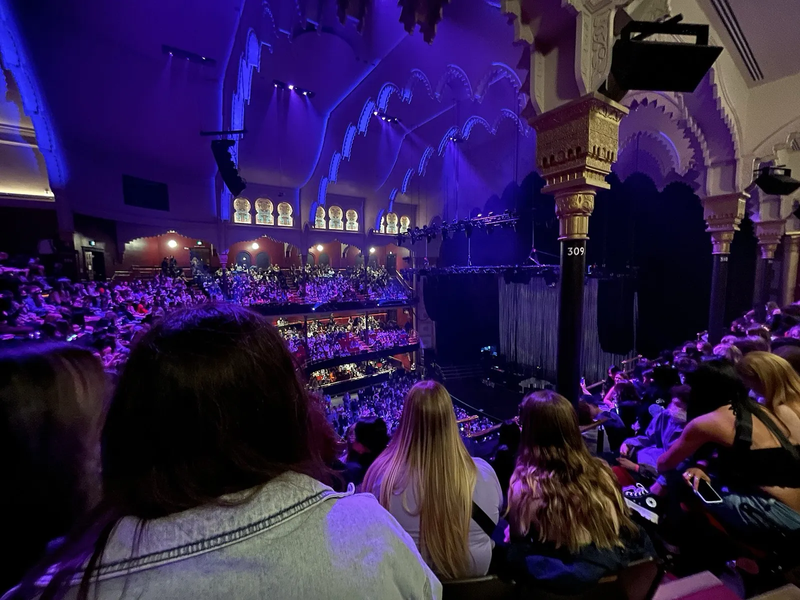
Foto: Dillan Payne, CC BY-SA 2.0, vía Wikimedia Commons
A year after the song, Rodrigo was already filling venues like this one, Massey Hall in Toronto (Canada). The photo is from April 2022, with the audience already in their seats.
What happened next took everyone by surprise. On its fourth day, the song was played more than 15 million times on Spotify in a single day, a record for a song that was not a Christmas song. In the United States it went straight in at number 1 and stayed there for eight weeks. The following year it won a Grammy.
Musical characteristics
Almost a whisper. At the start there is only piano and voice. Rodrigo sings quietly, as if talking to herself. In music, playing or singing very softly is called piano (written p). Yes, it is the same word as the instrument.
Three chords you already know. The verse moves around three chords. In the class version they are C, A minor and F. They are three of the four chords of the most common loop in pop. Because the tenser chords are missing, the verse sounds still, as if it were waiting for something.
Growing without changing. Listen to how the song builds little by little. Voices, claps and more instruments join in. She sings louder and louder. Getting gradually louder is called a crescendo. All the changes of volume in a song are called its dynamics.
The bridge. Near the end comes a different part, which is neither verse nor chorus. It is the bridge. Here Rodrigo's voice is recorded several times, one on top of another, and she is almost shouting. It is the loudest moment of the song: what musicians call forte (f). Billboard magazine chose it as the third best bridge of the 21st century.
A warning for when you play. The record is in B♭ major, an awkward key for the ukulele. In class we play it in C major, one tone higher. Moving a whole song to a different pitch is called transposing. The melody stays the same; only how high or low it sounds changes.
Hard facts: B♭ major on the record and C major in class, 4/4, 72 beats per minute (the beat you feel; counted double, 144), 4:02. The form: intro, verse, pre-chorus, chorus, verse, pre-chorus, chorus, bridge and final chorus.
Guided listening
Play the music video and stay quiet at the start. Listen to the engine and the car's beep. Notice how the beep turns into a piano note.
In the first verse, count how many instruments you can hear. Almost only one: the piano.
When the first chorus arrives, compare its volume with the verse. Is she singing louder? Has something been added?
In the bridge, listen for how many Rodrigo voices are singing at once. It is the loudest part of the song.
After the bridge, listen to the ending. Compare it with the beginning: does the song end loud, or does it drop back down?
Trivia and curiosities
- Nobody that young had reached number 1 in the United States since Billie Eilish with "Bad Guy", another song in this book. And nobody younger than Rodrigo had ever gone straight in at number 1.
- The noise at the start is not a sound effect from a library: it is her mum's car. The song starts telling the story before a single word is sung.
- The title is all lower case, "drivers license". It is a style choice, like typing a text message.
- Critics compared her to Taylor Swift, for the way she tells a story, and to Lorde, for the way it sounds. Taylor Swift is in this book too, with Love Story and Anti-Hero.
Classroom activities
- From piano to forte. Sing the verse very softly, almost whispering, and the chorus loudly. Then the other way round. Which one sounds like the real song? Write p and f on the board in the right places.
- Play the chords. Ukulele: verse with C, A minor and F; chorus with F, C, G and A minor. One downstroke per beat, no rush: it is slow.
- The staggered bridge. Split the class into three groups. In the bridge, the first group starts alone; the second comes in a few bars later; then the third. Listen to the volume grow without anyone shouting.
- The soloist. One person sings the verse alone, with the keyboard. The band comes in at the chorus, with the drums. What changes when the drums come in?
- Create. Think of a real-life sound that could start a song, like the car in this one. Record it on a phone and play the three verse chords over it.
Key vocabulary
- Piano (p) — piano: tocar o cantar muy suave
- Crescendo — crescendo: subir el volumen poco a poco
- Dynamics — dinámica
- Bridge — puente
- Transposing — transportar: pasar la canción entera a otra altura
Resources
Official music video — Rodrigo drives around her neighbourhood at night, with her brand-new licence.
Ukulele tutorial — Abby Lyons. An easy version, with chords and strumming.
Guitar tutorial — Easy 2 Play Music. Chords and lyrics on screen.
Keyboard tutorial — PHianonize. An easy version, with the keys lit up.
Por qué está en este libro
Esta canción llega en mayo, cuando ya tienes el bucle de cuatro acordes en la mano. En clase el verso se toca con tres acordes, do, la menor y fa. El estribillo, con los cuatro del bucle: fa, do, sol y la menor. Son los mismos de Love Story, Anti-Hero y Perfect, colocados en otro orden. El disco tiene más acordes de los que caben en 1.º, sobre todo en el estribillo, así que tocamos esa versión reducida. Lo que aprendes aquí es a cantar sola o solo: es la canción del solista de mayo, y te enseña a ir de muy suave a muy fuerte. En el aula sin nada se trabaja la melodía a capela y las entradas escalonadas del puente; en el aula con ukelele, los acordes; en el aula de música, el teclado empieza solo y la batería entra en el estribillo.
Por dónde entrar
La canción no empieza con música. Empieza con un coche: el motor arranca y suena el pitido que avisa de que una puerta está abierta. Después entra el piano.
Ese coche es el de la madre de Olivia Rodrigo. La canción cuenta lo que pasa cuando por fin te sacas el carné de conducir y la persona con la que ibas a estrenarlo ya no está.
La pregunta de esta página es: ¿cómo crece una canción si casi no cambia de acordes? Aquí la respuesta es el volumen.
Contexto histórico
Olivia Rodrigo es una cantante y actriz estadounidense. Antes de esta canción era conocida por una serie de Disney+, High School Musical: El Musical: La Serie. Tenía 17 años cuando publicó «drivers license».
Fue su primer sencillo. Salió el 8 de enero de 2021, en plena pandemia, y lo escribió con Dan Nigro, que también la produjo. Ella misma ha contado que lo que más le gusta es sentarse al piano de su habitación y escribir canciones tristes. Esta salió de ahí: una canción de desamor compuesta al piano.
Foto: Dillan Payne, CC BY-SA 2.0, vía Wikimedia Commons
Un año después de la canción, Rodrigo ya llenaba teatros como este, Massey Hall, en Toronto (Canadá). La foto es de abril de 2022, con el público ya en sus asientos.
Lo que pasó después no lo esperaba nadie. En su cuarto día, la canción tuvo más de 15 millones de escuchas en Spotify en un solo día, un récord para una canción que no fuera navideña. En Estados Unidos entró directamente en el número 1 y se quedó allí ocho semanas. Al año siguiente ganó un Grammy.
Cómo suena
Casi un susurro. Al principio solo hay piano y voz. Rodrigo canta bajito, como si hablara para sí misma. En música, tocar o cantar muy suave se llama piano (se escribe p). Sí: es la misma palabra que el instrumento.
Tres acordes que ya conoces. El verso gira sobre tres acordes. En la versión de clase son do, la menor y fa. Son tres de los cuatro del bucle más usado del pop. Como faltan los acordes más tensos, el verso suena quieto, como si esperara algo.
Crecer sin cambiar. Escucha cómo la canción va subiendo poco a poco. Se suman voces, palmas, más instrumentos. Ella canta cada vez más fuerte. A ese subir de volumen poco a poco se le llama crescendo. Y al conjunto de cambios de volumen de una canción, dinámica.
El puente. Hacia el final llega una parte distinta, que no es ni verso ni estribillo. Es el puente. Aquí la voz de Rodrigo está grabada varias veces, una encima de otra, y canta casi gritando. Es el momento más fuerte de la canción: lo que en música se llama forte (f). La revista Billboard lo eligió como el tercer mejor puente del siglo XXI.
Un aviso para cuando toques. El disco suena en Si♭ mayor, una tonalidad incómoda para el ukelele. En clase la tocamos en Do mayor, un tono más arriba. Pasar una canción entera a otra altura se llama transportar. La melodía es la misma; solo cambia lo aguda o grave que suena.
Datos duros: Si♭ mayor en el disco y Do mayor en clase, 4/4, 72 pulsos por minuto (lo que se siente; contado al doble, 144), 4:02. La forma: intro, verso, preestribillo, estribillo, verso, preestribillo, estribillo, puente y estribillo final.
Escucha guiada
Pon el videoclip y no hables al principio. Escucha el motor y el pitido del coche. Fíjate en cómo el pitido se convierte en una nota de piano.
En el primer verso, cuenta cuántos instrumentos oyes. Casi solo uno: el piano.
Cuando llega el primer estribillo, compara el volumen con el del verso. ¿Canta más fuerte? ¿Se ha sumado algo?
En el puente, escucha cuántas voces de Rodrigo suenan a la vez. Es la parte más fuerte de la canción.
Después del puente, escucha el final. Compáralo con el principio: ¿la canción acaba fuerte o vuelve a bajar?
Curiosidades
- Desde Billie Eilish con «Bad Guy», otra canción de este libro, nadie tan joven había llegado al número 1 en Estados Unidos. Y nadie más joven que Rodrigo había entrado directamente en el número 1.
- El ruido del principio no es un efecto de una biblioteca de sonidos: es el coche de su madre. La canción empieza contando la historia antes de cantar una sola palabra.
- El título va todo en minúsculas, «drivers license». Es una decisión de estilo, como escribir un mensaje en el móvil.
- La crítica la comparó con Taylor Swift, por cómo cuenta una historia, y con Lorde, por cómo suena. Taylor Swift también está en este libro, con Love Story y Anti-Hero.
Para hacer en clase
- De piano a forte. Cantad el verso muy suave, casi susurrando, y el estribillo fuerte. Después al revés. ¿Cuál suena a la canción de verdad? Escribid en la pizarra p y f donde toque.
- Tocar los acordes. Ukelele: verso con do, la menor y fa; estribillo con fa, do, sol y la menor. Un golpe hacia abajo por pulso, sin prisa: va lenta.
- El puente escalonado. Dividid la clase en tres grupos. En el puente, el primer grupo empieza solo; el segundo entra unos compases después; el tercero, después. Escuchad cómo crece el volumen sin que nadie grite.
- El solista. Una persona canta el verso sola, con el teclado. La banda entra en el estribillo, con la batería. ¿Qué cambia cuando entra la batería?
- Crear. Pensad un sonido de la vida real que pueda empezar una canción, como el coche de esta. Grabadlo con el móvil y tocad encima los tres acordes del verso.
Vocabulario fundamental
- Piano (p) — Tocar o cantar muy suave.
- Crescendo — Subir el volumen poco a poco.
- Dinámica — Los cambios de volumen a lo largo de una canción.
- Puente — Una parte distinta, que no es ni verso ni estribillo, y que suele llegar antes del final.
- Transportar — Pasar una canción entera a otra altura sin cambiar nada más.
Recursos
Videoclip oficial — Rodrigo conduce de noche por su barrio, recién sacado el carné.
Tutorial de ukelele — Abby Lyons. Versión fácil, con acordes y rasgueo.
Tutorial de guitarra — Easy 2 Play Music. Acordes y letra en pantalla.
Tutorial de teclado — PHianonize. Versión fácil, con las teclas iluminadas.
Why it's in this book
This song comes in May, when the four-chord loop is already in your hands. In class the verse uses three chords: C, A minor and F. The chorus uses the four chords of the loop: F, C, G and A minor. They are the same chords as Love Story, Anti-Hero and Perfect, just in a different order. The record has more chords than fit in Year 7, especially in the chorus, so we play this reduced version. What you learn here is how to sing solo: it is the soloist's song for May, and it teaches you to go from very soft to very loud. In the room with no instruments you work on the melody a cappella and the staggered entries in the bridge; in the ukulele room, the chords; in the music room, the keyboard starts alone and the drums come in at the chorus.
Why this song
The song does not start with music. It starts with a car: the engine turns over and you hear the beep that warns you a door is open. Then the piano comes in.
That car belongs to Olivia Rodrigo's mum. The song is about what happens when you finally get your driving licence and the person you wanted to drive around with is gone.
The question on this page is: how does a song grow if it hardly changes chords? Here the answer is volume.
Historical context
Olivia Rodrigo is an American singer and actor. Before this song, people knew her from a Disney+ series, High School Musical: The Musical: The Series. She was 17 when she released "drivers license".
It was her first single. It came out on 8 January 2021, in the middle of the pandemic. She wrote it with Dan Nigro, who also produced it. She has said that her favourite thing is sitting at the piano in her bedroom and writing sad songs. This one came from exactly there: a break-up song written at the piano.
Foto: Dillan Payne, CC BY-SA 2.0, vía Wikimedia Commons
A year after the song, Rodrigo was already filling venues like this one, Massey Hall in Toronto (Canada). The photo is from April 2022, with the audience already in their seats.
What happened next took everyone by surprise. On its fourth day, the song was played more than 15 million times on Spotify in a single day, a record for a song that was not a Christmas song. In the United States it went straight in at number 1 and stayed there for eight weeks. The following year it won a Grammy.
Musical characteristics
Almost a whisper. At the start there is only piano and voice. Rodrigo sings quietly, as if talking to herself. In music, playing or singing very softly is called piano (written p). Yes, it is the same word as the instrument.
Three chords you already know. The verse moves around three chords. In the class version they are C, A minor and F. They are three of the four chords of the most common loop in pop. Because the tenser chords are missing, the verse sounds still, as if it were waiting for something.
Growing without changing. Listen to how the song builds little by little. Voices, claps and more instruments join in. She sings louder and louder. Getting gradually louder is called a crescendo. All the changes of volume in a song are called its dynamics.
The bridge. Near the end comes a different part, which is neither verse nor chorus. It is the bridge. Here Rodrigo's voice is recorded several times, one on top of another, and she is almost shouting. It is the loudest moment of the song: what musicians call forte (f). Billboard magazine chose it as the third best bridge of the 21st century.
A warning for when you play. The record is in B♭ major, an awkward key for the ukulele. In class we play it in C major, one tone higher. Moving a whole song to a different pitch is called transposing. The melody stays the same; only how high or low it sounds changes.
Hard facts: B♭ major on the record and C major in class, 4/4, 72 beats per minute (the beat you feel; counted double, 144), 4:02. The form: intro, verse, pre-chorus, chorus, verse, pre-chorus, chorus, bridge and final chorus.
Guided listening
Play the music video and stay quiet at the start. Listen to the engine and the car's beep. Notice how the beep turns into a piano note.
In the first verse, count how many instruments you can hear. Almost only one: the piano.
When the first chorus arrives, compare its volume with the verse. Is she singing louder? Has something been added?
In the bridge, listen for how many Rodrigo voices are singing at once. It is the loudest part of the song.
After the bridge, listen to the ending. Compare it with the beginning: does the song end loud, or does it drop back down?
Trivia and curiosities
- Nobody that young had reached number 1 in the United States since Billie Eilish with "Bad Guy", another song in this book. And nobody younger than Rodrigo had ever gone straight in at number 1.
- The noise at the start is not a sound effect from a library: it is her mum's car. The song starts telling the story before a single word is sung.
- The title is all lower case, "drivers license". It is a style choice, like typing a text message.
- Critics compared her to Taylor Swift, for the way she tells a story, and to Lorde, for the way it sounds. Taylor Swift is in this book too, with Love Story and Anti-Hero.
Classroom activities
- From piano to forte. Sing the verse very softly, almost whispering, and the chorus loudly. Then the other way round. Which one sounds like the real song? Write p and f on the board in the right places.
- Play the chords. Ukulele: verse with C, A minor and F; chorus with F, C, G and A minor. One downstroke per beat, no rush: it is slow.
- The staggered bridge. Split the class into three groups. In the bridge, the first group starts alone; the second comes in a few bars later; then the third. Listen to the volume grow without anyone shouting.
- The soloist. One person sings the verse alone, with the keyboard. The band comes in at the chorus, with the drums. What changes when the drums come in?
- Create. Think of a real-life sound that could start a song, like the car in this one. Record it on a phone and play the three verse chords over it.
Key vocabulary
- Piano (p) — piano: tocar o cantar muy suave
- Crescendo — crescendo: subir el volumen poco a poco
- Dynamics — dinámica
- Bridge — puente
- Transposing — transportar: pasar la canción entera a otra altura
Resources
Official music video — Rodrigo drives around her neighbourhood at night, with her brand-new licence.
Ukulele tutorial — Abby Lyons. An easy version, with chords and strumming.
Guitar tutorial — Easy 2 Play Music. Chords and lyrics on screen.
Keyboard tutorial — PHianonize. An easy version, with the keys lit up.