Contenidos
Al cantar — Platero y Tú (1997)
Four chords and not one more in four and a half minutes. What makes the song grow is not the harmony: it is that the band waits a minute and a half before coming in.
🏷️ Ficha musical
Why this song
C, G, Am, F. If you have ever picked up a guitar, you already know all four. They hold up hundreds of songs in English and in Spanish, and there are comedy acts built on chaining hit after hit without moving your hand.
What is interesting here is what the song does with them. It does not add a fifth chord to lift the chorus. It leaves them where they are and moves something else.
Historical context
Platero y Tú formed in Bilbao in the late eighties around Fito Cabrales, who sang and played guitar, and Iñaki Antón, known to everyone as Uoho. They recorded their first album in 1991. Through the nineties they were one of the reference bands of Spanish rock, with close ties to Extremoduro: in 1996 the two bands toured together.
Al cantar came out the following year on 7, released by DRO on 29 September 1997. The band produced the record themselves, with no outside producer. That matters for what you are about to hear: the decision to hold back the drums for ninety seconds was not taken by an outsider chasing radio play. They took it.

Photo: Alterna2, CC BY 2.0, via Wikimedia Commons
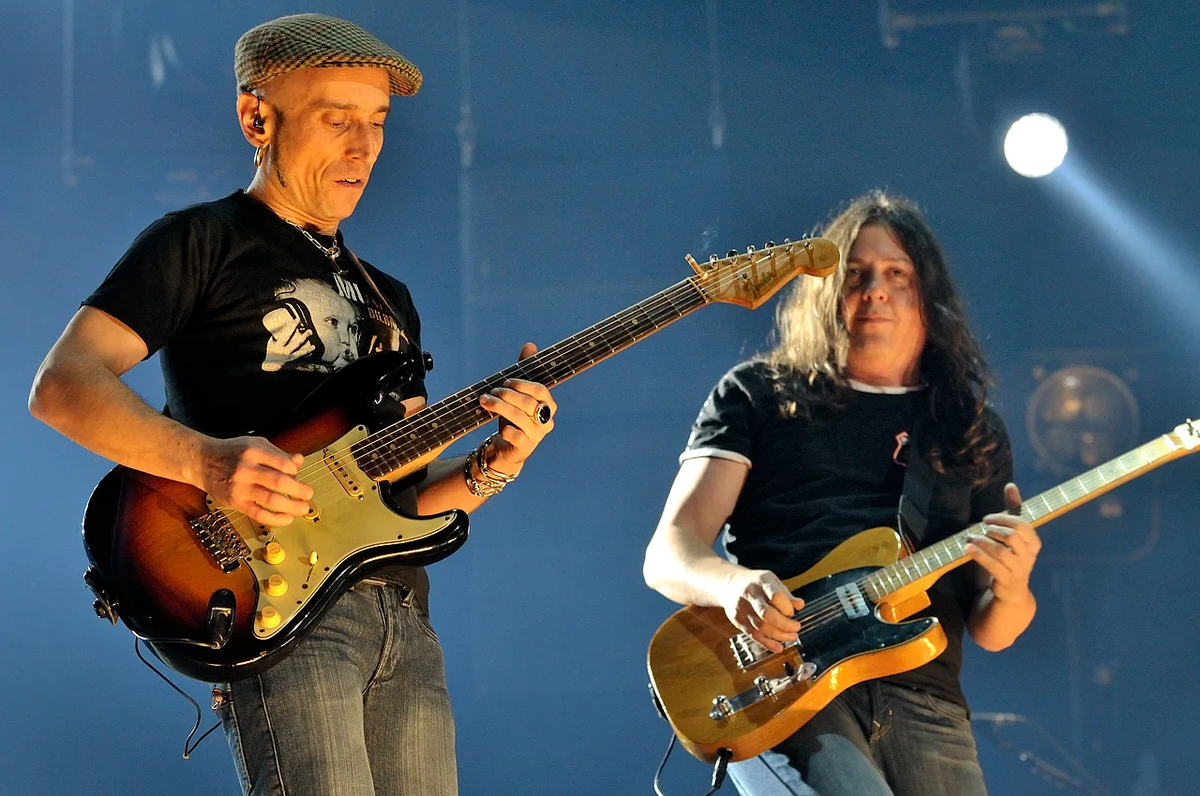
The band split up in 2001, on good terms. Fito had already started Fito & Fitipaldis in 1998 for the songs that did not fit here, and Uoho ended up in Extremoduro. The photographs on this page are from a 2009 Fito & Fitipaldis concert, because no freely licensed picture exists from the Platero years.
Musical characteristics
Pick up a guitar and play C, G, Am, F, four beats each, then start again. That is the whole verse.
Now the interesting part. The chorus does not change chords: it changes the order. It starts on F, then G, then Am. The same four, reshuffled. The closing section puts them in a third order, Am, G, F, C, which is the same road downhill. Three different sections, one handful of chords. When a song gets different feelings out of the same material and the only thing it moves is the order, what you are hearing is the work of the arrangement, not the harmony.
And the arrangement here has one single, very large idea: wait. The song starts with voice and guitar, and stays that way for a minute and a half. No drums keeping time, no bass pushing. Just someone singing with strings behind them.
At 1:29 the rest of the band comes in. The weight of the low frequencies doubles at a stroke and never drops again. Not one chord has changed; what has changed is how many people are playing. That — how many things sound at once and what job each one does — is called texture, and in this song it is the only thing that really moves.
Notice what that does to the words. The first part, the one saying that singing lets you forget the bad moments, is sung by one person alone. By the time "no es placer, es necesidad" arrives, there is a whole band behind it. The music is saying the same thing as the text without a word.
One more thing about the four chords. C is the home chord: when the song lands there, it rests. G is the one that asks to go back, which is why phrases pass through it before closing. A chord that builds tension and pushes back home is called the dominant. Am is the same material as C but darker, and F is the one that opens things up. That particular combination — home, dominant, the dark one, the one that opens — is written in Roman numerals as I – V – vi – IV, and it is the most repeated turn in popular music of the last fifty years.
Hard facts: C major, 4/4, 103 BPM, 4:49. The key and the tempo were measured from the audio of the video below, not copied from a chord chart found online.
Trivia and curiosities
- The chord chart handed out with this article was not written by a publisher: somebody posted it online, dedication and all ("this song is for Nerea, on her 20th birthday"). It shows where almost everything people play actually comes from, and why it is worth checking the key before trusting it.
- All four chords are first position and the chart rates the difficulty as beginner. The song still runs for nearly five minutes without getting dull. How hard something is to play and how interesting it is to hear are not the same thing.
- The band produced the record with no outside producer. Holding back the drums for ninety seconds is exactly the kind of decision a radio-minded producer tends to cut.
- The song is credited to Uoho and Fito. Uoho went on to play guitar in Extremoduro and Fito started Fito & Fitipaldis: two different paths, both signatures on this one track.
- La Fuga, a band from Cantabria, have played it too. A four-chord song travels well: any band can put it together in one rehearsal.
Guided listening
The timings are from the official video in Resources.
- 0:00 — it starts singing almost without preamble. Guitar and voice, nothing else. The song does not introduce itself: it walks in.
- 1:29 — the rest of the band arrives. The weight of the low end doubles and never drops. The chords are exactly the ones from before. The only thing that changed is how many people are playing: that is texture.
- 2:55 — the fullest point of the track. Voice and cymbals both high at once. Compare it in your head with minute one and measure how far the song has travelled without changing chords.
- 4:30 — it lets go. The band drops away and the song fades out the way it came in.
Classroom activities
- Play: C – G – Am – F in a loop, four beats per chord. Guitar, ukulele and keyboard together. Once it comes out without thinking, switch to the chorus order (F – G – Am) without breaking the pulse.
- Sing: the verse sits in a comfortable range and the words are syllabic, one note per syllable. A good place for the whole class to sing without straining, especially for voices that are changing.
- Analyse: a closed question. Listen to the first minute and a half and write down which instruments you hear. After 1:29, write them down again. Which new chord appeared? None. Let them check it themselves.
- Create: take the four chords and build three sections by reordering them, the way the song does. One section has to start on the home chord and another on any other one. Compare which of the two sounds like a chorus.
Key vocabulary
- Arrangement — arreglo
- Texture — textura
- Dominant — dominante, el acorde que empuja de vuelta al principal
- I – V – vi – IV — la vuelta de acordes escrita con números romanos
Resources
Official music video — Warner Music Spain channel.
Guitar tutorial — Musicatulado channel. Takes the four chords and the strumming slowly, and hands out a separate PDF.
Guitar tutorial, simplified version — Fran Brea, Más Que Guitarra school. Cuts the right hand down to the minimum. This is the one to use if someone is still fighting the chord changes.
Por dónde entrar
Do, Sol, Lam, Fa. Si has tocado la guitarra alguna vez, ya sabes los cuatro. Son los mismos que sostienen cientos de canciones en inglés y en castellano, y hay grupos que han hecho un número cómico encadenando decenas de éxitos sin cambiar la mano.
La gracia de esta canción es lo que hace con ellos. No añade un quinto acorde para animar el estribillo. Los deja quietos y mueve otra cosa.
Contexto histórico
Platero y Tú se formó en Bilbao a finales de los ochenta, alrededor de Fito Cabrales, que cantaba y tocaba la guitarra, y de Iñaki Antón, al que todo el mundo llama Uoho. Grabaron el primer disco en 1991. Durante los noventa fueron uno de los grupos de referencia del rock estatal, con una relación estrecha con Extremoduro: en 1996 los dos grupos hicieron una gira juntos.
Al cantar sale al año siguiente, en 7, publicado por DRO el 29 de septiembre de 1997. El disco lo produjo el propio grupo, sin productor de fuera. Eso importa para lo que vas a oír: la decisión de aguantar minuto y medio sin batería no la tomó un profesional externo buscando una radio fórmula, la tomaron ellos.
Foto: Alterna2, CC BY 2.0, vía Wikimedia Commons
El grupo se separó en 2001, de buenas maneras. Fito ya había montado Fito & Fitipaldis en 1998 para las canciones que no encajaban aquí, y Uoho acabó integrado en Extremoduro. Las fotos de esta página son de 2009, de un concierto de Fito & Fitipaldis, porque de la época de Platero no hay ninguna con licencia libre.
Cómo suena
Coge la guitarra y toca Do, Sol, Lam, Fa, cuatro tiempos cada uno, y vuelve a empezar. Ya tienes las estrofas enteras.
Ahora lo interesante. El estribillo no cambia de acordes: cambia el orden. Empieza por Fa y sigue Sol, Lam. Los mismos cuatro, barajados. Y la parte final los pone en otro orden más, Lam, Sol, Fa, Do, que es el mismo camino pero cuesta abajo. Tres partes distintas, un solo puñado de acordes. Cuando una canción saca sensaciones distintas del mismo material y lo único que mueve es el orden, lo que estás oyendo es el trabajo del arreglo, no el de la armonía.
Y el arreglo aquí tiene una sola idea, muy grande: esperar. La canción arranca con voz y guitarra, y así se queda un minuto y medio. No hay batería marcando, no hay un bajo empujando. Solo alguien cantando y unas cuerdas detrás.
A 1:29 entra el resto de la banda. El peso de los graves se dobla de golpe y ya no vuelve a bajar hasta el final. No ha cambiado ni un acorde; lo que ha cambiado es cuánta gente está tocando. A eso —cuántas cosas suenan a la vez y qué papel tiene cada una— se le llama textura, y en esta canción es lo único que se mueve de verdad.
Fíjate en lo que eso le hace a la letra. La primera parte, la que dice que al cantar se le olvidan los malos momentos, la canta una persona sola. Cuando llega el «no es placer, es necesidad», ya hay una banda entera detrás. La música está diciendo lo mismo que el texto sin decir una palabra.
Una cosa más sobre los cuatro acordes. Do es el acorde de casa: cuando la canción cae ahí, descansa. Sol es el que pide volver, y por eso las frases suelen pasar por él antes de cerrar. A ese acorde que crea tensión y empuja de vuelta a casa se le llama dominante. Lam es el mismo material que Do pero suena oscuro, y Fa es el que abre. Esa combinación concreta —casa, dominante, el oscuro, el que abre— se escribe con números romanos como I – V – vi – IV, y es la progresión más repetida de la música popular de los últimos cincuenta años.
Datos duros: Do mayor, 4/4, 103 BPM, 4:49. La tonalidad y el tempo están medidos sobre el audio del vídeo que tienes abajo, no copiados de un cifrado de internet.
Curiosidades
- El cifrado que se reparte con este artículo no lo escribió una editorial: lo colgó alguien en internet, con una dedicatoria dentro («esta canción se la dedico a Nerea, por sus 20 años»). Sirve para ver de dónde sale casi todo lo que se toca por ahí, y por qué conviene comprobar la tonalidad antes de fiarse.
- Los cuatro acordes son de primera posición y el cifrado marca la dificultad como de principiante. Aun así la canción dura casi cinco minutos y no aburre. Demuestra que la dificultad de tocar y el interés de escuchar no son la misma cosa.
- El grupo produjo el disco sin productor externo. Aguantar noventa segundos sin batería es la clase de decisión que un productor de radio fórmula suele cortar.
- La canción la firman Uoho y Fito. Uoho terminó de guitarrista en Extremoduro y Fito montó Fito & Fitipaldis: los dos siguieron por caminos distintos, y las dos firmas están en el mismo tema.
- La Fuga, grupo cántabro, la ha tocado también. Una canción de cuatro acordes viaja bien: cualquier banda puede montarla en un ensayo.
Escucha guiada
Los minutos son los del videoclip oficial que tienes en Recursos.
- 0:00 — empieza cantando casi sin preámbulo. Guitarra y voz, nada más. La canción no se presenta: entra.
- 1:29 — entra el resto de la banda. El peso de los graves se dobla y ya no baja. Los acordes son exactamente los mismos de antes. Lo único que ha cambiado es cuánta gente toca: eso es la textura.
- 2:55 — el punto más lleno del tema. Voz y platos arriba a la vez. Compáralo mentalmente con el minuto uno y mide la distancia que ha recorrido la canción sin cambiar de acordes.
- 4:30 — se descuelga. La banda va soltando y la canción se apaga por donde vino.
Para hacer en clase
- Tocar: Do – Sol – Lam – Fa en bucle, cuatro tiempos cada acorde. Guitarra, ukelele y teclado a la vez. Cuando salga sin pensar, cambiad al orden del estribillo (Fa – Sol – Lam) sin parar el pulso.
- Cantar: la estrofa se mueve en un registro cómodo y la letra es silábica, una nota por sílaba. Buen sitio para cantar toda la clase sin forzar, sobre todo con las voces en muda.
- Analizar: pregunta cerrada. Escuchad el primer minuto y medio y apuntad qué instrumentos oís. Después del 1:29, apuntad otra vez. ¿Qué acorde nuevo ha aparecido? Ninguno. Que lo comprueben ellos.
- Crear: coged los cuatro acordes y montad tres partes cambiándoles el orden, como hace la canción. Una parte tiene que empezar por el acorde de casa y otra por otro cualquiera. Comparad cuál de las dos suena a estribillo.
Vocabulario fundamental
- Arreglo — Las decisiones sobre quién toca, qué toca y cuándo entra. Aquí es lo que hace crecer la canción, porque los acordes no cambian nunca.
- Textura — Cuántas cosas suenan a la vez y qué papel tiene cada una. En esta canción es lo único que se mueve de verdad.
- Dominante — El acorde que crea tensión y empuja de vuelta al acorde principal. Aquí, el Sol que devuelve al Do.
- I – V – vi – IV — La manera de escribir una vuelta de acordes con números, para poder tocarla en cualquier tonalidad. En Do son Do, Sol, Lam y Fa.
Recursos
Videoclip oficial — canal de Warner Music Spain.
Tutorial de guitarra — canal Musicatulado. Va despacio con los cuatro acordes y el rasgueo, y reparte un PDF aparte.
Tutorial de guitarra, versión simplificada — Fran Brea, escuela Más Que Guitarra. Reduce la mano derecha al mínimo. Es el que conviene si alguien todavía pelea con el cambio de acorde.
Why this song
C, G, Am, F. If you have ever picked up a guitar, you already know all four. They hold up hundreds of songs in English and in Spanish, and there are comedy acts built on chaining hit after hit without moving your hand.
What is interesting here is what the song does with them. It does not add a fifth chord to lift the chorus. It leaves them where they are and moves something else.
Historical context
Platero y Tú formed in Bilbao in the late eighties around Fito Cabrales, who sang and played guitar, and Iñaki Antón, known to everyone as Uoho. They recorded their first album in 1991. Through the nineties they were one of the reference bands of Spanish rock, with close ties to Extremoduro: in 1996 the two bands toured together.
Al cantar came out the following year on 7, released by DRO on 29 September 1997. The band produced the record themselves, with no outside producer. That matters for what you are about to hear: the decision to hold back the drums for ninety seconds was not taken by an outsider chasing radio play. They took it.
Photo: Alterna2, CC BY 2.0, via Wikimedia Commons
The band split up in 2001, on good terms. Fito had already started Fito & Fitipaldis in 1998 for the songs that did not fit here, and Uoho ended up in Extremoduro. The photographs on this page are from a 2009 Fito & Fitipaldis concert, because no freely licensed picture exists from the Platero years.
Musical characteristics
Pick up a guitar and play C, G, Am, F, four beats each, then start again. That is the whole verse.
Now the interesting part. The chorus does not change chords: it changes the order. It starts on F, then G, then Am. The same four, reshuffled. The closing section puts them in a third order, Am, G, F, C, which is the same road downhill. Three different sections, one handful of chords. When a song gets different feelings out of the same material and the only thing it moves is the order, what you are hearing is the work of the arrangement, not the harmony.
And the arrangement here has one single, very large idea: wait. The song starts with voice and guitar, and stays that way for a minute and a half. No drums keeping time, no bass pushing. Just someone singing with strings behind them.
At 1:29 the rest of the band comes in. The weight of the low frequencies doubles at a stroke and never drops again. Not one chord has changed; what has changed is how many people are playing. That — how many things sound at once and what job each one does — is called texture, and in this song it is the only thing that really moves.
Notice what that does to the words. The first part, the one saying that singing lets you forget the bad moments, is sung by one person alone. By the time "no es placer, es necesidad" arrives, there is a whole band behind it. The music is saying the same thing as the text without a word.
One more thing about the four chords. C is the home chord: when the song lands there, it rests. G is the one that asks to go back, which is why phrases pass through it before closing. A chord that builds tension and pushes back home is called the dominant. Am is the same material as C but darker, and F is the one that opens things up. That particular combination — home, dominant, the dark one, the one that opens — is written in Roman numerals as I – V – vi – IV, and it is the most repeated turn in popular music of the last fifty years.
Hard facts: C major, 4/4, 103 BPM, 4:49. The key and the tempo were measured from the audio of the video below, not copied from a chord chart found online.
Trivia and curiosities
- The chord chart handed out with this article was not written by a publisher: somebody posted it online, dedication and all ("this song is for Nerea, on her 20th birthday"). It shows where almost everything people play actually comes from, and why it is worth checking the key before trusting it.
- All four chords are first position and the chart rates the difficulty as beginner. The song still runs for nearly five minutes without getting dull. How hard something is to play and how interesting it is to hear are not the same thing.
- The band produced the record with no outside producer. Holding back the drums for ninety seconds is exactly the kind of decision a radio-minded producer tends to cut.
- The song is credited to Uoho and Fito. Uoho went on to play guitar in Extremoduro and Fito started Fito & Fitipaldis: two different paths, both signatures on this one track.
- La Fuga, a band from Cantabria, have played it too. A four-chord song travels well: any band can put it together in one rehearsal.
Guided listening
The timings are from the official video in Resources.
- 0:00 — it starts singing almost without preamble. Guitar and voice, nothing else. The song does not introduce itself: it walks in.
- 1:29 — the rest of the band arrives. The weight of the low end doubles and never drops. The chords are exactly the ones from before. The only thing that changed is how many people are playing: that is texture.
- 2:55 — the fullest point of the track. Voice and cymbals both high at once. Compare it in your head with minute one and measure how far the song has travelled without changing chords.
- 4:30 — it lets go. The band drops away and the song fades out the way it came in.
Classroom activities
- Play: C – G – Am – F in a loop, four beats per chord. Guitar, ukulele and keyboard together. Once it comes out without thinking, switch to the chorus order (F – G – Am) without breaking the pulse.
- Sing: the verse sits in a comfortable range and the words are syllabic, one note per syllable. A good place for the whole class to sing without straining, especially for voices that are changing.
- Analyse: a closed question. Listen to the first minute and a half and write down which instruments you hear. After 1:29, write them down again. Which new chord appeared? None. Let them check it themselves.
- Create: take the four chords and build three sections by reordering them, the way the song does. One section has to start on the home chord and another on any other one. Compare which of the two sounds like a chorus.
Key vocabulary
- Arrangement — arreglo
- Texture — textura
- Dominant — dominante, el acorde que empuja de vuelta al principal
- I – V – vi – IV — la vuelta de acordes escrita con números romanos
Resources
Official music video — Warner Music Spain channel.
Guitar tutorial — Musicatulado channel. Takes the four chords and the strumming slowly, and hands out a separate PDF.
Guitar tutorial, simplified version — Fran Brea, Más Que Guitarra school. Cuts the right hand down to the minimum. This is the one to use if someone is still fighting the chord changes.