Contenidos
The 30th — Billie Eilish (2022)
A guitar, a voice and a story that happened on the 30th of a month. Billie Eilish released it without warning, and almost all its power lies in how little you hear.
🏷️ Ficha musical
Why this song
You know Billie Eilish for tracks full of deep bass and effects, built on her brother's computer. This is the opposite: a fingerpicked acoustic guitar and a voice. That is why the record it came out on is simply called Guitar Songs.
And yet, near the end, the song comes to sound like a panic attack. So the question is how: how do you make a single guitar sound like distress?
Historical context
On 30 November 2021 someone close to Billie Eilish was in a car accident. She saw it up close and called it "the most indescribable thing" she had ever had to witness. A month later, on 30 December, she wrote this song with her brother Finneas O'Connell. It was the first thing they wrote together after the album Happier Than Ever. The title is that date.
The song tells what happened almost like a film: the ambulance, the hospital and, at the end, the moment of the accident itself.

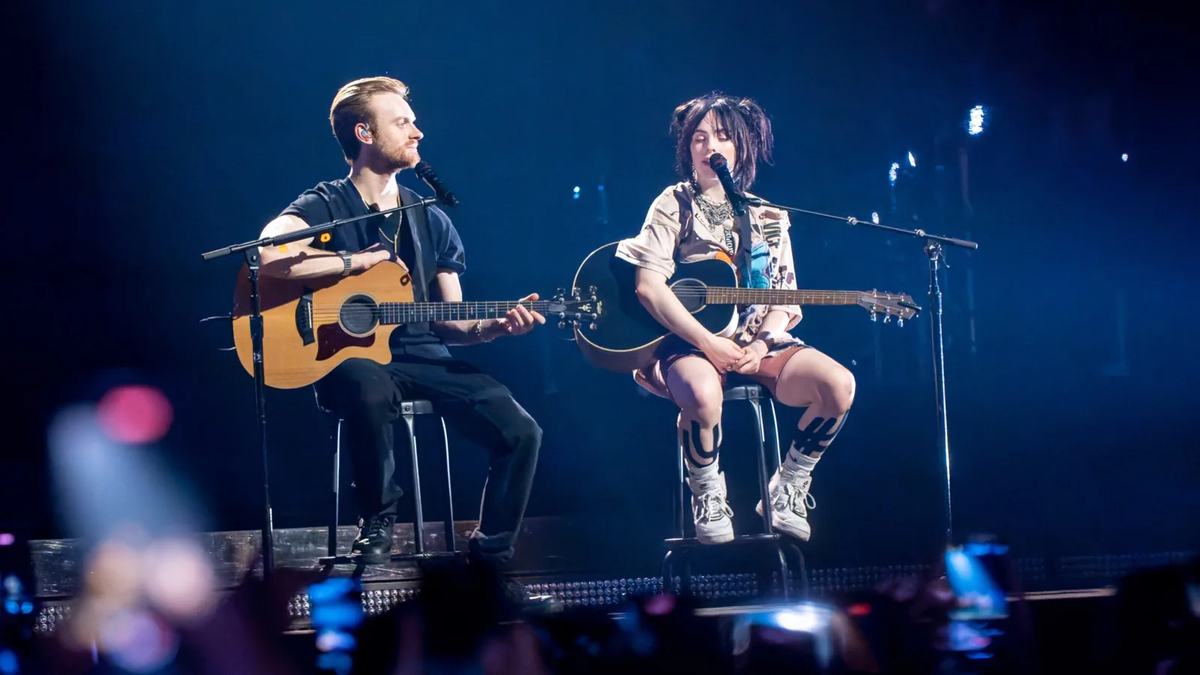
Photo: Raph_PH, CC BY 2.0, via Wikimedia Commons
They had planned to keep it for the next album. But Billie wanted to say it "right now", so on 21 July 2022 she released it, unannounced, together with another song, "TV". Two songs on their own make an EP, a short record. She first played it live on 13 August, in Manila.
Musical characteristics
Listen to how many things sound at once: almost always just two, guitar and voice. When there are few layers and lots of space between them, the texture is called light. It is light here on purpose: nothing distracts from the story.
The guitar doesn't strum, it picks: it plays the strings one at a time. And underneath, in the first round, the bass walks down step by step: G, F sharp, E. It is a downward path the ear follows without noticing.
Now listen to the end of the chorus. There is a chord that doesn't belong to the key: C minor, where G major would normally have C major. One note changes and everything goes dark at once. Taking a chord from the minor key and using it in a major one is called a borrowed chord, and it is one of the most common tricks for making something sound sad without saying so.
Something similar happens in the bridge, but slower. The G chord stays put while a single inner note moves up and down by semitones: G, G augmented, G sixth, G augmented again. It is like a needle that won't stop moving inside something that isn't going anywhere.
And on top of that, the song grows. The guitar plays louder and louder and the voice becomes more intense, for almost half a minute without a break, up to the loudest point of the whole song. That gradual rise in volume is called a crescendo. Then it cuts off.
The ending has no fixed pulse: the score marks it rubato, meaning the tempo stretches and shrinks as the player chooses.
Hard data: G major, 4/4 felt in 2, about 73 BPM, 3:36. Form: intro, verse and chorus twice, bridge and free ending.
Trivia and curiosities
- The title is a date, and the date happens twice. What it describes happened on a 30th, and she wrote it on the 30th of the next month. A song can also be a chronicle: it tells events in order, like a news report.
- The record is called "Guitar Songs", and Finneas played far more than guitar. The credits also list him on bass, drums, piano and synthesizer. Yet what you hear is almost only guitar and voice. Taking things out is a production decision, just like adding them.
- One song, two tempos. The attached score writes it at 148 crotchets per minute; Musicnotes at about 73, "in 2". They don't contradict each other: they count the same pulse in two ways. What you feel when you clap along is the pulse, and it doesn't always match the written number.
- The scream isn't done by the voice alone, it's done by the crescendo. On the recording the loudest point comes near the end, after half a minute of rising without a break, and then drops to almost nothing in three seconds. Contrast matters more than volume: if the whole song were loud, that moment wouldn't stand out.
- She didn't play it live until after releasing it. She premiered it on 13 August 2022 in Manila, three weeks later. In September she filmed a live version in Singapore's Cloud Forest greenhouse, which is in Resources: compare it with the studio one.
Guided listening
The timings are from the official lyric video in Resources.
- 0:00 — the guitar alone. Picked, soft, with the bass walking down step by step. That is how little you need to begin.
- 2:15 — it starts to rise. From here, guitar and voice grow without stopping for almost half a minute. This is the bridge: notice that the chords barely change; what changes is the intensity.
- 2:41 — it cuts off. After the loudest point of the whole song, it drops to almost nothing in three seconds. That sudden silence is part of the music.
- 2:46 — the ending. What is left is calm and fades away into silence. Compare this moment with 2:39: it is the same song at the two extremes of dynamics.
Classroom activities
- Play: the intro and verse round on guitar or keyboard: G – G/F♯ – Em – Am – G – D. The bass only needs the falling line: G, F sharp, E. The guitar score is in the class resources.
- Sing: the melody sits in a middle range, from low G to high D. The verse can be sung as a group, softly, almost spoken.
- Analyse: a closed question. With the video in front of you, mark the second where the sound starts to grow and the second where it cuts off. Then check whether the chords changed between those two moments.
- Create: play a four-chord round in G major that ends on C major. Repeat it, changing only that last chord to C minor. Write one sentence on what changes for the ear. Steal the procedure, not the song.
Key vocabulary
- Texture — textura
- Borrowed chord — acorde prestado
- Crescendo — crescendo (aumentar el volumen poco a poco)
- Rubato — rubato (tocar sin pulso fijo)
Resources
Official lyric video — Billie Eilish channel.
Live from Singapore's Cloud Forest — BillieEilishVEVO channel, September 2022. To compare with the studio version.
Guitar tutorial — Andy Hillier. A full lesson, with the fingerpicking explained slowly.
Guitar tutorial, easy version — Easy 2 Play Music, with chords and lyrics on screen. The one to use if the picking is still hard.
Piano tutorial — Atlantic Notes, easy version.
- Guitar score — on MuseScore, the same one in the class resources.
- Images — Billie Eilish and Finneas O'Connell at the O2 in London, 16 June 2022. Photos: Raph_PH, CC BY 2.0, via Wikimedia Commons.
Por dónde entrar
A Billie Eilish la conoces por canciones llenas de bajos y de efectos, hechas en el ordenador de su hermano. Esta es lo contrario: una guitarra acústica punteada y una voz. Por eso el disco en el que salió se llama, sin más, Guitar Songs, «canciones de guitarra».
Y aun así, hacia el final, la canción llega a sonar como un ataque de pánico. La pregunta es cómo: ¿cómo se hace que una sola guitarra suene a angustia?
Contexto histórico
El 30 de noviembre de 2021, una persona cercana a Billie Eilish tuvo un accidente de coche. Ella lo vivió de cerca y lo describió como «lo más indescriptible» que le había tocado presenciar. Un mes después, el 30 de diciembre, escribió esta canción con su hermano Finneas O'Connell. Fue lo primero que escribieron juntos después del disco Happier Than Ever. El título es esa fecha.
La canción cuenta lo que pasó en orden casi de película: la ambulancia, el hospital y, al final, el momento del accidente.
Foto: Raph_PH, CC BY 2.0, vía Wikimedia Commons
Pensaban guardarla para su siguiente disco. Pero Billie quería decirla «ahora», así que el 21 de julio de 2022 la publicó, sin anunciarla, junto a otra canción, «TV». Dos canciones solas forman un EP, un disco corto. La tocó en directo por primera vez el 13 de agosto, en Manila.
Cómo suena
Escucha cuántas cosas suenan a la vez: casi siempre, solo dos, la guitarra y la voz. Cuando hay pocas capas y mucho espacio entre ellas, se dice que la textura es ligera. Aquí lo es a propósito: nada distrae de la historia.
La guitarra no rasguea, puntea: toca las cuerdas una a una. Y debajo, en la primera vuelta, el bajo va bajando paso a paso: sol, fa sostenido, mi. Es un camino hacia abajo que el oído sigue sin darse cuenta.
Ahora fíjate en el final del estribillo. Hay un acorde que no pertenece a la tonalidad: Do menor, cuando lo esperable en Sol mayor sería Do mayor. Cambia una sola nota y todo se oscurece de golpe. Tomar un acorde de la tonalidad menor y meterlo en una mayor se llama acorde prestado, y es uno de los trucos más usados para que algo suene triste sin decirlo.
En el puente pasa algo parecido, pero más lento. El acorde de Sol se queda quieto y una sola nota interior sube y baja por semitonos: Sol, Sol aumentado, Sol con sexta, Sol aumentado otra vez. Es como una aguja que no para de moverse dentro de algo que no avanza.
Y encima de eso, la canción crece. La guitarra toca cada vez más fuerte y la voz se hace más intensa, durante casi medio minuto seguido, hasta el punto más fuerte de toda la canción. Ese aumento progresivo de volumen se llama crescendo. Después, se corta de golpe.
El final va sin pulso fijo: la partitura lo marca rubato, es decir, que el tempo se estira y se encoge a voluntad de quien toca.
Datos duros: Sol mayor, 4/4 sentido en 2, unos 73 BPM, 3:36. Forma: intro, estrofa y estribillo dos veces, puente y final libre.
Curiosidades
- El título es una fecha, y la fecha es dos veces la misma. Lo que cuenta pasó un día 30 y la escribió el 30 del mes siguiente. Una canción también puede ser una crónica: cuenta hechos en orden, como un reportaje.
- El disco se llama «Guitar Songs» y Finneas tocó mucho más que guitarra. En los créditos aparece también con bajo, batería, piano y sintetizador. Y aun así lo que se oye es casi solo guitarra y voz. Quitar es una decisión de producción, igual que añadir.
- Una misma canción, dos tempos. La partitura adjunta la escribe a 148 negras por minuto; Musicnotes, a unos 73, «en 2». No se contradicen: cuentan el mismo pulso de dos maneras. Lo que tú sientes al dar palmas es el pulso, y no siempre coincide con el número escrito.
- El grito no lo hace la voz sola, lo hace el crescendo. En la grabación, el punto más fuerte llega casi al final, tras medio minuto subiendo sin parar, y después cae a casi nada en tres segundos. El contraste pesa más que el volumen: si toda la canción fuera fuerte, ese momento no destacaría.
- No la tocó en directo hasta después de publicarla. La estrenó el 13 de agosto de 2022 en Manila, tres semanas más tarde. En septiembre grabó una versión en directo en el invernadero Cloud Forest de Singapur, que está en Recursos: compárala con la de estudio.
Escucha guiada
Los minutos son los del vídeo oficial con letra que tienes en Recursos.
- 0:00 — la guitarra sola. Punteada, suave, con el bajo bajando paso a paso. Así de poco se necesita para empezar.
- 2:15 — empieza a subir. Desde aquí, la guitarra y la voz crecen sin parar durante casi medio minuto. Es el puente: fíjate en que los acordes casi no cambian; lo que cambia es la intensidad.
- 2:41 — se corta. Tras el punto más fuerte de toda la canción, en tres segundos cae a casi nada. Ese silencio repentino es parte de la música.
- 2:46 — el final. Lo que queda es tranquilo y se va apagando hasta el silencio. Compara este momento con el 2:39: es la misma canción en los dos extremos de la dinámica.
Para hacer en clase
- Tocar: la vuelta de la intro y la estrofa en guitarra o teclado: Sol – Sol/Fa♯ – Mi menor – La menor – Sol – Re. El bajo solo necesita la línea que baja: sol, fa sostenido, mi. La partitura de guitarra está entre los recursos de clase.
- Cantar: la melodía se mueve en una tesitura media, de sol grave a re agudo. Se puede cantar en grupo la estrofa, suave, casi hablada.
- Analizar: pregunta cerrada. Con el vídeo delante, marcad el segundo en el que empieza a crecer el sonido y el segundo en el que se corta. Después comprobad si los acordes han cambiado entre esos dos momentos.
- Crear: tocad una vuelta de cuatro acordes en Sol mayor que acabe en Do mayor. Repetidla cambiando solo ese último acorde por Do menor. Escribid en una frase qué cambia en el oído. Se roba el procedimiento, no la canción.
Vocabulario fundamental
- Textura — Cuántas capas suenan a la vez y cuánto espacio queda entre ellas. Aquí es ligera: guitarra y voz.
- Acorde prestado — Un acorde tomado de la tonalidad menor dentro de una mayor. El Do menor de esta canción oscurece todo con una sola nota cambiada.
- Crescendo — Aumentar el volumen poco a poco. El puente crece durante casi medio minuto.
- Rubato — Tocar sin pulso fijo, estirando y encogiendo el tempo. Así va el final.
Recursos
Vídeo oficial con letra — canal de Billie Eilish.
En directo desde el Cloud Forest de Singapur — canal BillieEilishVEVO, septiembre de 2022. Para comparar con la versión de estudio.
Tutorial de guitarra — Andy Hillier. Lección completa, con el punteo explicado despacio.
Tutorial de guitarra, versión fácil — Easy 2 Play Music, con acordes y letra en pantalla. El que sirve si todavía cuesta el punteo.
Tutorial de piano — Atlantic Notes, versión fácil.
- Partitura de guitarra — en MuseScore, la misma que tienes entre los recursos de clase.
- Imágenes — Billie Eilish y Finneas O'Connell en el O2 de Londres, 16 de junio de 2022. Fotos: Raph_PH, CC BY 2.0, vía Wikimedia Commons.
Why this song
You know Billie Eilish for tracks full of deep bass and effects, built on her brother's computer. This is the opposite: a fingerpicked acoustic guitar and a voice. That is why the record it came out on is simply called Guitar Songs.
And yet, near the end, the song comes to sound like a panic attack. So the question is how: how do you make a single guitar sound like distress?
Historical context
On 30 November 2021 someone close to Billie Eilish was in a car accident. She saw it up close and called it "the most indescribable thing" she had ever had to witness. A month later, on 30 December, she wrote this song with her brother Finneas O'Connell. It was the first thing they wrote together after the album Happier Than Ever. The title is that date.
The song tells what happened almost like a film: the ambulance, the hospital and, at the end, the moment of the accident itself.
Photo: Raph_PH, CC BY 2.0, via Wikimedia Commons
They had planned to keep it for the next album. But Billie wanted to say it "right now", so on 21 July 2022 she released it, unannounced, together with another song, "TV". Two songs on their own make an EP, a short record. She first played it live on 13 August, in Manila.
Musical characteristics
Listen to how many things sound at once: almost always just two, guitar and voice. When there are few layers and lots of space between them, the texture is called light. It is light here on purpose: nothing distracts from the story.
The guitar doesn't strum, it picks: it plays the strings one at a time. And underneath, in the first round, the bass walks down step by step: G, F sharp, E. It is a downward path the ear follows without noticing.
Now listen to the end of the chorus. There is a chord that doesn't belong to the key: C minor, where G major would normally have C major. One note changes and everything goes dark at once. Taking a chord from the minor key and using it in a major one is called a borrowed chord, and it is one of the most common tricks for making something sound sad without saying so.
Something similar happens in the bridge, but slower. The G chord stays put while a single inner note moves up and down by semitones: G, G augmented, G sixth, G augmented again. It is like a needle that won't stop moving inside something that isn't going anywhere.
And on top of that, the song grows. The guitar plays louder and louder and the voice becomes more intense, for almost half a minute without a break, up to the loudest point of the whole song. That gradual rise in volume is called a crescendo. Then it cuts off.
The ending has no fixed pulse: the score marks it rubato, meaning the tempo stretches and shrinks as the player chooses.
Hard data: G major, 4/4 felt in 2, about 73 BPM, 3:36. Form: intro, verse and chorus twice, bridge and free ending.
Trivia and curiosities
- The title is a date, and the date happens twice. What it describes happened on a 30th, and she wrote it on the 30th of the next month. A song can also be a chronicle: it tells events in order, like a news report.
- The record is called "Guitar Songs", and Finneas played far more than guitar. The credits also list him on bass, drums, piano and synthesizer. Yet what you hear is almost only guitar and voice. Taking things out is a production decision, just like adding them.
- One song, two tempos. The attached score writes it at 148 crotchets per minute; Musicnotes at about 73, "in 2". They don't contradict each other: they count the same pulse in two ways. What you feel when you clap along is the pulse, and it doesn't always match the written number.
- The scream isn't done by the voice alone, it's done by the crescendo. On the recording the loudest point comes near the end, after half a minute of rising without a break, and then drops to almost nothing in three seconds. Contrast matters more than volume: if the whole song were loud, that moment wouldn't stand out.
- She didn't play it live until after releasing it. She premiered it on 13 August 2022 in Manila, three weeks later. In September she filmed a live version in Singapore's Cloud Forest greenhouse, which is in Resources: compare it with the studio one.
Guided listening
The timings are from the official lyric video in Resources.
- 0:00 — the guitar alone. Picked, soft, with the bass walking down step by step. That is how little you need to begin.
- 2:15 — it starts to rise. From here, guitar and voice grow without stopping for almost half a minute. This is the bridge: notice that the chords barely change; what changes is the intensity.
- 2:41 — it cuts off. After the loudest point of the whole song, it drops to almost nothing in three seconds. That sudden silence is part of the music.
- 2:46 — the ending. What is left is calm and fades away into silence. Compare this moment with 2:39: it is the same song at the two extremes of dynamics.
Classroom activities
- Play: the intro and verse round on guitar or keyboard: G – G/F♯ – Em – Am – G – D. The bass only needs the falling line: G, F sharp, E. The guitar score is in the class resources.
- Sing: the melody sits in a middle range, from low G to high D. The verse can be sung as a group, softly, almost spoken.
- Analyse: a closed question. With the video in front of you, mark the second where the sound starts to grow and the second where it cuts off. Then check whether the chords changed between those two moments.
- Create: play a four-chord round in G major that ends on C major. Repeat it, changing only that last chord to C minor. Write one sentence on what changes for the ear. Steal the procedure, not the song.
Key vocabulary
- Texture — textura
- Borrowed chord — acorde prestado
- Crescendo — crescendo (aumentar el volumen poco a poco)
- Rubato — rubato (tocar sin pulso fijo)
Resources
Official lyric video — Billie Eilish channel.
Live from Singapore's Cloud Forest — BillieEilishVEVO channel, September 2022. To compare with the studio version.
Guitar tutorial — Andy Hillier. A full lesson, with the fingerpicking explained slowly.
Guitar tutorial, easy version — Easy 2 Play Music, with chords and lyrics on screen. The one to use if the picking is still hard.
Piano tutorial — Atlantic Notes, easy version.
- Guitar score — on MuseScore, the same one in the class resources.
- Images — Billie Eilish and Finneas O'Connell at the O2 in London, 16 June 2022. Photos: Raph_PH, CC BY 2.0, via Wikimedia Commons.