Contenidos
Siyahamba — Tradicional zulú (1952)
A song from South Africa that you sing while walking. One phrase, three chords and a question that always gets an answer.
🏷️ Ficha musical
Why it's in this book
Siyahamba comes in November, when we work on echo and call and response in class: someone sings a phrase and everyone else answers. It is a two-part song where the second part comes for free, because it is written into the song itself. Its three chords, C, F and G, are the I–IV–V family, the same as Three Little Birds and Lean On Me, which are also in this book. In the room with no instruments we sing it while walking and keep the step with our bodies. In the ukulele room we play the three chords. And in the music room the hand drum and the xylophones join in with a drone, one note that never moves.
Why this song
You may well have sung it without knowing where it came from. Siyahamba is sung by children's and school choirs all over the world, in Zulu and in translation.
The question on this page is simple: how can such a short song last so long? The answer is in the way it repeats.
Historical context
Zulu is one of the languages of South Africa. "Siyahamba" means "we are walking" or "we are marching". The full line says that we are marching in the light of God.
Nobody knows who wrote it. The first person to put it on paper was Andries Van Tonder, in 1952, in a town in Natal. Maybe he made it up. Maybe he wrote down a song people were already singing. Both are possible, and nobody has settled it.
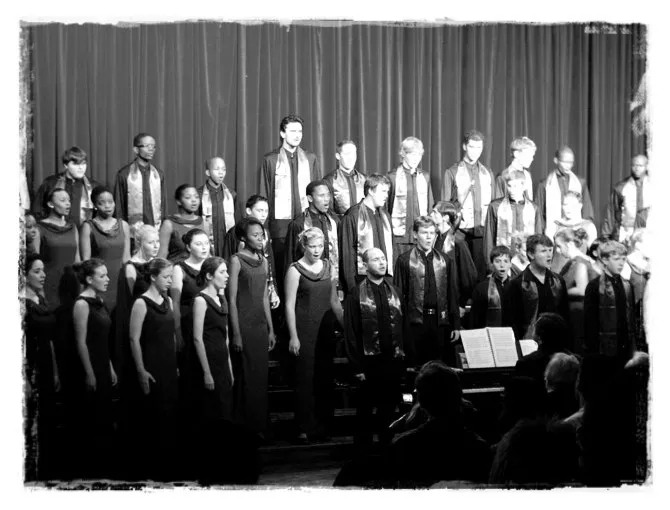
Foto: GraceAddict, CC BY-SA 3.0, vía Wikimedia Commons
The KwaZulu-Natal Youth Choir in 2011. Natal, the region where "Siyahamba" first appeared, is now part of KwaZulu-Natal.
In 1978 a Swedish choir toured South Africa. Its director, Anders Nyberg, heard it at a girls' school and recorded it. In 1984 he published it in Europe in a book of South African songs. From there it reached choirs all over the world.
In those years South Africa lived under apartheid, a system that separated people by the colour of their skin. The song was not written as a protest, but many people sang it against apartheid. Today it is sung at rallies, processions and concerts.
Musical characteristics
One phrase that repeats. The whole song is almost a single phrase. You sing it, repeat it, and on each round one word changes: marching, singing, praying. In English this is called a "zipper song", because each round slots into the last one like the teeth of a zip. That repetition is why anyone can join in the second time round.
Question and answer. Listen to how the phrase is shared out. One group sings a piece and the other group answers or repeats it. When one voice sings and another replies, it is called call and response. If the reply copies exactly what it has just heard, it is an echo.
Three chords. Under the melody, C, F and G are enough. They are the first, fourth and fifth chords of the C scale, which is why they are written I–IV–V. Thousands of folk songs are accompanied with them.
A note that stays still. In the music room, the xylophones play a drone: a low note that repeats the whole time, like a floor. On top, the melody can go wherever it likes.
Facts: there is no original record, so there is no official key or tempo. In class we sing it in C major, in 4/4. The form is one phrase repeated with words swapped.
Guided listening
Play the Mwamba Children's Choir performance. In the first round, count how many times the whole phrase repeats before something changes.
Find the moment when one group sings and another answers. Raise your hand every time you hear the answer.
Notice whether they change language or swap a word in any round. That is the zip.
At the end, step in time with your feet while you listen. If it fits, that is because this song is made to be sung while walking.
Trivia and curiosities
- Nobody knows for sure who wrote it. Van Tonder's name is on the first written version, but it may be a Zulu folk song that he only wrote down.
- It was not born as a protest song. It became one because people sang it against apartheid. A song is also what people do with it.
- It reached Europe thanks to a Swedish choir that heard some pupils singing it at their school. In other words, it travelled the same way it is travelling to your class now: from students to students.
Classroom activities
- Echo. The teacher sings a piece of the phrase and the class repeats it exactly. Then a student leads and the class answers.
- Walk and sing. In the room with no instruments, sing while walking in a circle. One step on each beat, no running.
- Three chords. On ukulele: C, F and G. First one chord per bar, downstrokes only. Listen for the moment the melody "asks" for a change.
- Drone. In the music room, a group of xylophones plays the note C on every beat. Everyone else sings on top. Does it fit the whole song?
- Create. Swap the zipper word for another action (dancing, jumping) and sing a new round.
Key vocabulary
- Call and response — llamada-respuesta
- Echo — eco: la respuesta copia lo que acaba de oír
- I–IV–V — los acordes primero, cuarto y quinto: aquí, Do, Fa y Sol
- Drone — bordón
Resources
Performance — The Mwamba Children's Choir, live.
Another performance, to compare — Angel City Chorale, a large choir from Los Angeles.
Ukulele tutorial — Euge Barker, in Spanish.
Guitar tutorial — Abel Stewart. An easy version, in English ("We Are Marching in the Light of God").
Keyboard tutorial — The Hungarian Coverist. The melody with the keys lighting up.
Por qué está en este libro
Siyahamba llega en noviembre, cuando en clase trabajamos el eco y la llamada-respuesta: alguien canta una frase y el resto contesta. Es una canción a dos voces que salen solas, porque la segunda voz viene escrita dentro de la propia canción. Sus tres acordes, Do, Fa y Sol, son la familia I–IV–V, la misma de Three Little Birds y Lean On Me, que también están en este libro. En el aula sin instrumentos la cantamos andando y marcando el paso con el cuerpo. En el aula de ukeleles tocamos los tres acordes. Y en el aula de música entran el tambor de mano y los xilófonos con un bordón, una nota que no se mueve.
Por dónde entrar
Es probable que la hayas cantado sin saber de dónde venía. Siyahamba la cantan coros infantiles y escolares de medio mundo, en zulú y traducida a otras lenguas.
La pregunta de esta página es sencilla: ¿cómo puede una canción tan corta durar tanto? La respuesta está en cómo se repite.
Contexto histórico
El zulú es una de las lenguas de Sudáfrica. «Siyahamba» quiere decir «caminamos». La frase completa dice que caminamos en la luz de Dios.
No sabemos quién la compuso. La primera persona que la escribió en papel fue Andries Van Tonder, en 1952, en un pueblo de Natal. Puede que la inventara él. Puede que copiara una canción que ya cantaba la gente. Las dos cosas son posibles, y nadie lo ha aclarado.
Foto: GraceAddict, CC BY-SA 3.0, vía Wikimedia Commons
El Coro Juvenil de KwaZulu-Natal en 2011. Natal, la región donde apareció «Siyahamba», hoy forma parte de KwaZulu-Natal.
En 1978, un coro sueco viajó a Sudáfrica. Su director, Anders Nyberg, la oyó en una escuela de chicas y la grabó. En 1984 la publicó en Europa en un libro de canciones sudafricanas. Desde ahí llegó a coros de medio mundo.
En aquellos años Sudáfrica vivía bajo el apartheid, un sistema que separaba a las personas por el color de su piel. La canción no se escribió como protesta, pero muchos la cantaron contra el apartheid. Hoy se canta en manifestaciones, procesiones y conciertos.
Cómo suena
Una frase que se repite. Toda la canción es casi una sola frase. Se canta, se repite, y en cada vuelta cambia una palabra: caminamos, cantamos, rezamos. En inglés lo llaman «canción cremallera», porque cada vuelta encaja en la anterior como los dientes de una cremallera. Esa repetición es la que permite que la cante cualquiera a la segunda vez.
Pregunta y respuesta. Escucha cómo se reparten la frase. Un grupo lanza un trozo y el otro grupo contesta, o repite. Cuando una voz canta y otra le responde, se llama llamada-respuesta. Si la respuesta copia exactamente lo que ha oído, es un eco.
Tres acordes. Debajo de la melodía basta con Do, Fa y Sol. Son los acordes primero, cuarto y quinto de la escala de Do, y por eso se escriben I–IV–V. Con ellos se acompañan miles de canciones populares.
Una nota que no se mueve. En el aula de música, los xilófonos tocan un bordón: una nota grave que se repite todo el rato, como un suelo. Encima, la melodía puede ir donde quiera.
Datos: no hay disco original, así que no hay tonalidad ni tempo oficiales. En clase la cantamos en Do mayor, en 4/4. La forma es una frase repetida con cambios de palabra.
Escucha guiada
Pon la interpretación del Coro Infantil Mwamba. En la primera vuelta, cuenta cuántas veces se repite la frase completa antes de que cambie algo.
Busca el momento en que un grupo canta y otro responde. Levanta la mano cada vez que oigas la respuesta.
Fíjate en si cambian de idioma o de palabra en alguna vuelta. Esa es la cremallera.
Al final, marca el paso con los pies mientras escuchas. Si encaja, es porque esta canción está hecha para cantarla caminando.
Curiosidades
- Nadie sabe con seguridad quién la escribió. El nombre de Van Tonder aparece en la primera partitura, pero también puede ser una canción popular zulú que él solo copió.
- No nació como canción de protesta. Se convirtió en una porque la gente la cantó contra el apartheid. Una canción también es lo que la gente hace con ella.
- Llegó a Europa gracias a un coro sueco que la oyó cantar a unas alumnas en una escuela. Es decir, viajó igual que viaja ahora a tu clase: de unos estudiantes a otros.
Para hacer en clase
- Eco. El profesor canta un trozo de la frase y la clase lo repite igual. Después, un alumno hace de guía y la clase contesta.
- Caminar y cantar. En el aula sin instrumentos, cantad andando en círculo. Un paso en cada pulso, sin correr.
- Tres acordes. Con ukelele: Do, Fa y Sol. Primero un acorde por compás, solo hacia abajo. Escuchad en qué momento la melodía «pide» cambiar.
- Bordón. En el aula de música, un grupo de xilófonos toca la nota Do en cada pulso. El resto canta encima. ¿Suena bien en toda la canción?
- Crear. Cambiad la palabra de la cremallera por otra acción (bailamos, saltamos) y cantad una vuelta nueva.
Vocabulario fundamental
- Llamada-respuesta — Una voz canta y otra le contesta, como una conversación.
- Eco — La respuesta copia exactamente lo que acaba de oír.
- I–IV–V — Los tres acordes más usados de la música popular: aquí, Do, Fa y Sol.
- Bordón — Una nota grave que se repite sin moverse, como un suelo bajo la melodía.
Recursos
Interpretación — El Coro Infantil Mwamba, en directo.
Otra interpretación, para comparar — Angel City Chorale, un coro grande de Los Ángeles.
Tutorial de ukelele — Euge Barker, en castellano.
Tutorial de guitarra — Abel Stewart. Versión fácil, en inglés («We Are Marching in the Light of God»).
Tutorial de teclado — The Hungarian Coverist. La melodía con las teclas iluminadas.
Why it's in this book
Siyahamba comes in November, when we work on echo and call and response in class: someone sings a phrase and everyone else answers. It is a two-part song where the second part comes for free, because it is written into the song itself. Its three chords, C, F and G, are the I–IV–V family, the same as Three Little Birds and Lean On Me, which are also in this book. In the room with no instruments we sing it while walking and keep the step with our bodies. In the ukulele room we play the three chords. And in the music room the hand drum and the xylophones join in with a drone, one note that never moves.
Why this song
You may well have sung it without knowing where it came from. Siyahamba is sung by children's and school choirs all over the world, in Zulu and in translation.
The question on this page is simple: how can such a short song last so long? The answer is in the way it repeats.
Historical context
Zulu is one of the languages of South Africa. "Siyahamba" means "we are walking" or "we are marching". The full line says that we are marching in the light of God.
Nobody knows who wrote it. The first person to put it on paper was Andries Van Tonder, in 1952, in a town in Natal. Maybe he made it up. Maybe he wrote down a song people were already singing. Both are possible, and nobody has settled it.
Foto: GraceAddict, CC BY-SA 3.0, vía Wikimedia Commons
The KwaZulu-Natal Youth Choir in 2011. Natal, the region where "Siyahamba" first appeared, is now part of KwaZulu-Natal.
In 1978 a Swedish choir toured South Africa. Its director, Anders Nyberg, heard it at a girls' school and recorded it. In 1984 he published it in Europe in a book of South African songs. From there it reached choirs all over the world.
In those years South Africa lived under apartheid, a system that separated people by the colour of their skin. The song was not written as a protest, but many people sang it against apartheid. Today it is sung at rallies, processions and concerts.
Musical characteristics
One phrase that repeats. The whole song is almost a single phrase. You sing it, repeat it, and on each round one word changes: marching, singing, praying. In English this is called a "zipper song", because each round slots into the last one like the teeth of a zip. That repetition is why anyone can join in the second time round.
Question and answer. Listen to how the phrase is shared out. One group sings a piece and the other group answers or repeats it. When one voice sings and another replies, it is called call and response. If the reply copies exactly what it has just heard, it is an echo.
Three chords. Under the melody, C, F and G are enough. They are the first, fourth and fifth chords of the C scale, which is why they are written I–IV–V. Thousands of folk songs are accompanied with them.
A note that stays still. In the music room, the xylophones play a drone: a low note that repeats the whole time, like a floor. On top, the melody can go wherever it likes.
Facts: there is no original record, so there is no official key or tempo. In class we sing it in C major, in 4/4. The form is one phrase repeated with words swapped.
Guided listening
Play the Mwamba Children's Choir performance. In the first round, count how many times the whole phrase repeats before something changes.
Find the moment when one group sings and another answers. Raise your hand every time you hear the answer.
Notice whether they change language or swap a word in any round. That is the zip.
At the end, step in time with your feet while you listen. If it fits, that is because this song is made to be sung while walking.
Trivia and curiosities
- Nobody knows for sure who wrote it. Van Tonder's name is on the first written version, but it may be a Zulu folk song that he only wrote down.
- It was not born as a protest song. It became one because people sang it against apartheid. A song is also what people do with it.
- It reached Europe thanks to a Swedish choir that heard some pupils singing it at their school. In other words, it travelled the same way it is travelling to your class now: from students to students.
Classroom activities
- Echo. The teacher sings a piece of the phrase and the class repeats it exactly. Then a student leads and the class answers.
- Walk and sing. In the room with no instruments, sing while walking in a circle. One step on each beat, no running.
- Three chords. On ukulele: C, F and G. First one chord per bar, downstrokes only. Listen for the moment the melody "asks" for a change.
- Drone. In the music room, a group of xylophones plays the note C on every beat. Everyone else sings on top. Does it fit the whole song?
- Create. Swap the zipper word for another action (dancing, jumping) and sing a new round.
Key vocabulary
- Call and response — llamada-respuesta
- Echo — eco: la respuesta copia lo que acaba de oír
- I–IV–V — los acordes primero, cuarto y quinto: aquí, Do, Fa y Sol
- Drone — bordón
Resources
Performance — The Mwamba Children's Choir, live.
Another performance, to compare — Angel City Chorale, a large choir from Los Angeles.
Ukulele tutorial — Euge Barker, in Spanish.
Guitar tutorial — Abel Stewart. An easy version, in English ("We Are Marching in the Light of God").
Keyboard tutorial — The Hungarian Coverist. The melody with the keys lighting up.