Contenidos
Sin documentos — Los Rodríguez (1993)
Two Argentinians and two Spaniards in Madrid, a song nobody wanted to release as a single, and an arrangement added to spoil it that ended up being the part everyone remembers. Rock with a rumba feel, in a minor key.
🏷️ Ficha musical
Why it's in this book
This song sits in October for a reason: it shares its loop with La Bamba, Twist and Shout and Johnny B. Goode. Three chords in the same positions: the first, the fourth and the fifth. The difference is that here the loop is in minor, and that changes the colour of everything. Family A sounds like a party; this one sounds like a party with a shadow over it.
It sounds like a party, so it is easy to assume it is in a major key. Listen carefully: the record is in G minor. In class we move it up a whole tone to A minor, which is the key of the ukuleles and xylophones: Am, Dm and E7, plus an F in the intro.
In the room with no instruments, we sing the chorus with a second voice a third above and keep the beat with body percussion. In the ukulele room, we play the Am–E7–Dm–E7 loop with a strum that has some rumba in it. In the music room, the whole band: drums and bass hold it down, and the guitarist gets a real solo over the loop.
Why this song
In Spain this is the song that gets played at the end of weddings and village fiestas, when everyone is already dancing. Most people who sing along could not tell you who the band is.
The question on this page is a different one: how does a song its own band nearly threw away become an anthem?
Historical context
In September 1990, Andrés Calamaro arrived in Madrid from Buenos Aires with a keyboard and about nine hundred dollars. In Argentina he had written songs for Los Abuelos de la Nada, but his solo records did not sell. In Madrid an Argentinian friend was waiting for him: guitarist Ariel Rot, who had already been successful in Spain with the band Tequila.
With two Spaniards, Julián Infante on guitar and Germán Vilella on drums, they formed Los Rodríguez. The name is a joke. In Spain, "estar de Rodríguez" means staying home alone while your partner is away. Calamaro had left his girlfriend behind in Argentina.
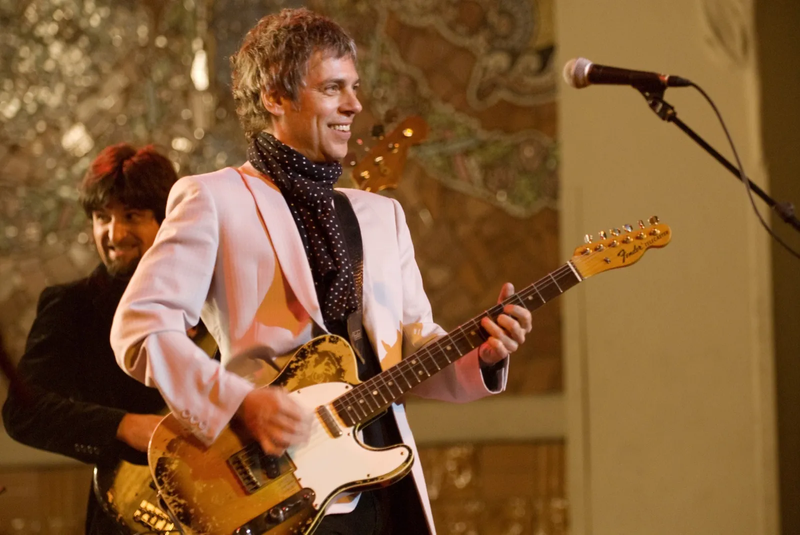
Foto: livepict.com, CC BY-SA 3.0, vía Wikimedia Commons
This is Ariel Rot in 2007, playing a Telecaster. He is the band's lead guitarist and co-wrote "Sin documentos".
Their first album went nowhere: the label went bust a few days after it came out. All four were around thirty and short of money. In spring 1993 they recorded the second album in a Madrid studio in exactly one month. Record labels had turned down the demo again and again.
This time it worked. "Sin documentos" was the first song from the album to be played on every radio station, and the band became one of the big names in Spanish-language rock.
Musical characteristics
A chord that pulls you home. Listen to the chorus and focus on the chord just before it goes back to the start. It sounds tense, like a question waiting for an answer. That is the chord on the fifth degree, the dominant. In G minor it is D major, and it contains a note that is not in the ordinary minor scale: F sharp. That note is a semitone below G, which is why it pulls so hard towards home. When a minor scale raises that note, it is called the harmonic minor scale. It is also the sound we tend to link with flamenco.
Same three degrees, different colour. The verse goes round four chords: Gm, D7, Cm, D7. Count the degrees and you get the first, the fifth and the fourth: the same positions as La Bamba, but in a minor key. That is why it sounds like part of the same family and, at the same time, more serious.
Rock with a rumba feel. The beat is around 96 per minute, but the rhythm guitar strums much faster, with accents that come from rumba. Los Rodríguez mixed Rolling Stones-style rock with the rumba and flamenco they heard in Madrid. Here you get both at once: rock drums underneath, a rumba strum on top.
The arrangement that was not supposed to be there. Years later the drummer explained that nobody in the band thought this song was a hit. Germán Vilella added an arrangement to make it "ugly" so it would get dropped. That arrangement opens the song, and it is the first thing anyone recognises. An arrangement is everything decided about a song beyond its melody and chords: who plays what, when and how.
The solo. Towards the end, Ariel Rot plays an electric guitar solo over the same loop. No new chords: what is new is the melody he invents on top.
Hard facts: G minor on the record and A minor in class, 4/4, probably 96 beats per minute, 4:47. Verse Gm–D7–Cm–D7, bridge Cm–D, chorus Gm–D–Cm–D.
Guided listening
Play the music video. In the intro, before the voice comes in, listen to the arrangement that opens the song. It is the one Vilella added to spoil it. Decide for yourself whether he succeeded.
When the first verse starts, tap the beat with your foot. Now listen to the rhythm guitar: it strums several times for every tap of your foot. That is the rumba.
When the bridge arrives, the chords keep swinging between just two, Cm and D. The song hangs in the air, as if taking a run-up. Listen to how the chorus releases that tension.
In the chorus, listen to the last chord of each round, the D. Sing an F sharp over it and feel how it wants to rise a semitone to G.
When the guitar solo starts, count the bars. Listen for whether Rot repeats an idea or whether every phrase is new.
Trivia and curiosities
- The song the band nearly dropped is now its best-known. What it shows: an arrangement can matter more than the melody when it comes to a song sticking in people's heads.
- Several record companies rejected the demo before a small one, Gasa, took it. In its first three months in Argentina the album sold around seventy thousand copies.
- The band's name is a pun only Spaniards get. For two Argentinians who had just arrived, it was also a way of saying where they now lived.
- The song is in the 1995 Argentinian film Caballos salvajes. It is one of the few Spanish-language rock songs that is equally well known on both sides of the Atlantic.
Classroom activities
- Sing in two parts. In the room with no instruments, half the class sings the chorus melody and the other half a third above. Clap the beat on 2 and 4.
- Play the loop in A minor. On ukulele: Am, E7, Dm, E7, one chord per bar. First downstrokes only, one per beat. Then two quick strums per beat, accenting the first, to get the rumba feel.
- Compare families. Play La Bamba (C–F–G) and then this loop (Am–Dm–E7). How are they alike? What changes? Answer in two words: "same degrees", plus the colour you would give each one.
- Band and solo. In the music room, the drums play a rock beat at 96, the bass plays the root of each chord and the keyboard plays the loop. The guitarist improvises eight bars on top using the A minor scale; on the last chord, try a G sharp.
- Analyse the arrangement. Listen to the intro and list which instruments you hear. Then make up your own four-bar intro that "uglifies" the song. Can you come up with something people will remember?
Key vocabulary
- Dominant — dominante: el acorde del quinto grado
- Harmonic minor scale — escala menor armónica
- Minor key — tonalidad menor
- Arrangement — arreglo
- Solo — solo
Resources
Official music video — From the Warner Music Spain channel.
Guitar tutorial — Guitarraviva. Chords and rhythm, step by step, in Spanish.
The guitar solo — DuoMusic Academy. Just the solo, with the tab on screen. This is the band guitarist's goal.
Ukulele tutorial — Fabián Chacón. An easy version in A minor, the key we play it in class.
Piano tutorial — Alexacho Music. Explains the chords and the G harmonic minor scale, in the key of the record.
Drums — Abraham Maturana, a school music teacher in Chile. A drum lesson made for his class repertoire.
Bass — Mauro Bass Colombia. A cover with the bass tab on screen.
Por qué está en este libro
Esta canción está en octubre por una razón: comparte bucle con La Bamba, Twist and Shout y Johnny B. Goode. Son tres acordes en las mismas posiciones, el primero, el cuarto y el quinto. La diferencia es que aquí el bucle está en menor, y eso cambia el color de todo: la familia A suena a fiesta; esta suena a fiesta con algo de sombra.
Suena a fiesta, y por eso es fácil pensar que está en mayor. Escúchala con cuidado: el disco está en Sol menor. En clase la subimos un tono, a La menor, que es la tonalidad del ukelele y de los xilófonos: Am, Dm y E7, más un F en la intro.
En el aula sin nada, se canta el estribillo con la segunda voz en terceras y se marca el pulso con el cuerpo. En el aula con ukelele, se toca el bucle Am–E7–Dm–E7 con un rasgueo que tenga algo de rumba. En el aula de música, la banda entera: la batería y el bajo sostienen, y el guitarrista tiene un solo de verdad sobre el bucle.
Por dónde entrar
Si has estado en una boda o en unas fiestas de pueblo, es muy probable que la hayas oído al final de la noche, cuando ya baila todo el mundo. Es de esas canciones que se cantan en grupo sin saber muy bien quién la canta.
La pregunta de esta página es otra: ¿cómo se convierte en un himno una canción que su propia banda casi tira a la basura?
Contexto histórico
En septiembre de 1990, Andrés Calamaro llegó a Madrid desde Buenos Aires. Traía un teclado y unos novecientos dólares. En Argentina había compuesto para Los Abuelos de la Nada, pero sus discos en solitario no vendían. En Madrid le esperaba un amigo argentino, el guitarrista Ariel Rot, que había triunfado en España con Tequila.
Con dos españoles, Julián Infante a la guitarra y Germán Vilella a la batería, formaron Los Rodríguez. El nombre es un chiste: «estar de Rodríguez» es quedarse solo en casa mientras la pareja está fuera. Calamaro había dejado a su novia en Argentina.
Foto: livepict.com, CC BY-SA 3.0, vía Wikimedia Commons
Este es Ariel Rot en 2007, con una Telecaster. Es el guitarrista solista de la banda y coautor de «Sin documentos».
Su primer disco salió mal: el sello quebró a los pocos días. Los cuatro rondaban los treinta años y necesitaban dinero. En la primavera de 1993 grabaron el segundo en un estudio de Madrid, en un mes justo. Las discográficas habían rechazado la maqueta una y otra vez.
Esta vez funcionó. «Sin documentos» fue la primera canción del disco que sonó en todas las radios, y la banda pasó a ser una de las grandes del rock en castellano.
Cómo suena
Un acorde que tira hacia casa. Escucha el estribillo y fíjate en el acorde que llega justo antes de volver al principio. Suena tenso, como una pregunta que pide respuesta. Es el acorde del quinto grado, la dominante. En Sol menor, ese acorde es Re mayor, y tiene una nota que no está en la escala menor normal: fa sostenido. Esa nota está a medio tono de sol, y por eso empuja tanto hacia casa. Cuando una escala menor sube esa nota, se llama escala menor armónica. Es también el sonido que asociamos al flamenco.
Los mismos tres grados, otro color. La estrofa da vueltas a cuatro acordes: Gm, D7, Cm, D7. Si cuentas los grados, son el primero, el quinto y el cuarto. Son las mismas posiciones que en La Bamba, pero en tonalidad menor. Por eso la reconoces como de la misma familia y, a la vez, suena más seria.
Rock con aire de rumba. El pulso va a unos 96 golpes por minuto, pero la guitarra rítmica rasguea mucho más deprisa, con acentos que recuerdan a la rumba. Los Rodríguez mezclaban el rock de los Rolling Stones con la rumba y el flamenco que oían en Madrid. Aquí se oyen las dos cosas a la vez: batería de rock debajo, rasgueo de rumba encima.
El arreglo que no tenía que estar. Según contó años después el batería, nadie en la banda veía esta canción como un éxito. Germán Vilella le añadió un arreglo para «afearla» y que la descartaran. Ese arreglo abre la canción, y es lo primero que reconoce cualquiera que la oye. Un arreglo es todo lo que se decide sobre una canción además de la melodía y los acordes: quién toca qué, cuándo y cómo.
El solo. Hacia el final, Ariel Rot toca un solo de guitarra eléctrica sobre el mismo bucle. No hay acordes nuevos: lo nuevo es la melodía que inventa encima.
Datos duros: Sol menor en el disco y La menor en clase, 4/4, probablemente 96 pulsos por minuto, 4:47. Estrofa Gm–D7–Cm–D7, puente Cm–D, estribillo Gm–D–Cm–D.
Escucha guiada
Pon el videoclip. En la intro, antes de que entre la voz, escucha el arreglo que abre la canción. Es el que Vilella metió para estropearla. Decide tú si lo consiguió.
Cuando entre la primera estrofa, marca el pulso con el pie. Ahora fíjate en la guitarra rítmica: rasguea varias veces por cada golpe de tu pie. Ahí está la rumba.
Cuando llegue el puente, los acordes se quedan dando vueltas entre dos, Cm y D. La canción se queda en suspenso, como cogiendo carrerilla. Escucha cómo el estribillo resuelve esa tensión.
En el estribillo, escucha el último acorde de cada vuelta, el D. Cántale encima la nota fa sostenido y nota cómo quiere subir medio tono a sol.
Cuando llegue el solo de guitarra, cuenta los compases. Escucha si Rot repite alguna idea o si cada frase es nueva.
Curiosidades
- La canción que casi descartan es hoy la más conocida de la banda. Lo que demuestra: el arreglo puede pesar más que la melodía a la hora de que una canción se quede en la memoria.
- La maqueta del disco fue rechazada por varias discográficas antes de que una pequeña, Gasa, la aceptara. En sus tres primeros meses en Argentina vendió unos setenta mil discos.
- El nombre de la banda es un juego de palabras con una expresión que solo se entiende en España. Para dos argentinos recién llegados, era también una manera de decir de dónde estaban.
- La canción suena en la película argentina Caballos salvajes, de 1995. Es una de las canciones de rock en castellano que se conocen igual a los dos lados del Atlántico.
Para hacer en clase
- Cantar a dos voces. En el aula sin nada, la mitad de la clase canta la melodía del estribillo y la otra mitad, una tercera por encima. Marcad el pulso con palmas en el 2 y el 4.
- Tocar el bucle en La menor. Con ukelele: Am, E7, Dm, E7, un acorde por compás. Primero solo golpes hacia abajo, uno por pulso. Después, dos rasgueos rápidos por pulso, con el acento en el primero, para que suene a rumba.
- Comparar familias. Tocad La Bamba (C–F–G) y después este bucle (Am–Dm–E7). ¿En qué se parecen? ¿Qué cambia? Contestad con dos palabras: «mismos grados» y el color que le pondríais a cada una.
- Banda y solo. En el aula de música, la batería lleva un ritmo de rock a 96, el bajo toca la nota de cada acorde y el teclado el bucle. El guitarrista improvisa ocho compases encima con la escala de La menor; para el último acorde, prueba la nota sol sostenido.
- Analizar el arreglo. Escuchad la intro y haced una lista de qué instrumentos suenan. Después, inventad vosotros una intro de cuatro compases que «afee» la canción. ¿Se os ocurre algo que se quede en la memoria?
Vocabulario fundamental
- Dominante — El acorde del quinto grado. Crea tensión y pide volver al primero.
- Escala menor armónica — Escala menor con la séptima nota subida medio tono. Le da al acorde de dominante su fuerza.
- Tonalidad menor — Cuando la música gira alrededor de un acorde menor. Suena más oscura o seria que la mayor.
- Arreglo — Todo lo que se decide sobre una canción además de la melodía y los acordes: quién toca qué y cómo.
- Solo — Pasaje en el que un instrumento inventa una melodía sobre los acordes mientras el resto acompaña.
Recursos
Videoclip oficial — Del canal de Warner Music Spain.
Tutorial de guitarra — Guitarraviva. Acordes y ritmo, en castellano, paso a paso.
El solo de guitarra — DuoMusic Academy. Solo el solo, con la tablatura en pantalla. Es el objetivo del guitarrista de la banda.
Tutorial de ukelele — Fabián Chacón. Versión fácil en La menor, el tono en el que la tocamos en clase.
Tutorial de piano — Alexacho Music. Explica los acordes y la escala menor armónica de Sol, en el tono del disco.
Batería — Profesor Abraham Maturana. Lección de batería de un colegio de Chile, pensada para su repertorio de clase.
Bajo — Mauro Bass Colombia. Cover con la tablatura de bajo en pantalla.
Why it's in this book
This song sits in October for a reason: it shares its loop with La Bamba, Twist and Shout and Johnny B. Goode. Three chords in the same positions: the first, the fourth and the fifth. The difference is that here the loop is in minor, and that changes the colour of everything. Family A sounds like a party; this one sounds like a party with a shadow over it.
It sounds like a party, so it is easy to assume it is in a major key. Listen carefully: the record is in G minor. In class we move it up a whole tone to A minor, which is the key of the ukuleles and xylophones: Am, Dm and E7, plus an F in the intro.
In the room with no instruments, we sing the chorus with a second voice a third above and keep the beat with body percussion. In the ukulele room, we play the Am–E7–Dm–E7 loop with a strum that has some rumba in it. In the music room, the whole band: drums and bass hold it down, and the guitarist gets a real solo over the loop.
Why this song
In Spain this is the song that gets played at the end of weddings and village fiestas, when everyone is already dancing. Most people who sing along could not tell you who the band is.
The question on this page is a different one: how does a song its own band nearly threw away become an anthem?
Historical context
In September 1990, Andrés Calamaro arrived in Madrid from Buenos Aires with a keyboard and about nine hundred dollars. In Argentina he had written songs for Los Abuelos de la Nada, but his solo records did not sell. In Madrid an Argentinian friend was waiting for him: guitarist Ariel Rot, who had already been successful in Spain with the band Tequila.
With two Spaniards, Julián Infante on guitar and Germán Vilella on drums, they formed Los Rodríguez. The name is a joke. In Spain, "estar de Rodríguez" means staying home alone while your partner is away. Calamaro had left his girlfriend behind in Argentina.
Foto: livepict.com, CC BY-SA 3.0, vía Wikimedia Commons
This is Ariel Rot in 2007, playing a Telecaster. He is the band's lead guitarist and co-wrote "Sin documentos".
Their first album went nowhere: the label went bust a few days after it came out. All four were around thirty and short of money. In spring 1993 they recorded the second album in a Madrid studio in exactly one month. Record labels had turned down the demo again and again.
This time it worked. "Sin documentos" was the first song from the album to be played on every radio station, and the band became one of the big names in Spanish-language rock.
Musical characteristics
A chord that pulls you home. Listen to the chorus and focus on the chord just before it goes back to the start. It sounds tense, like a question waiting for an answer. That is the chord on the fifth degree, the dominant. In G minor it is D major, and it contains a note that is not in the ordinary minor scale: F sharp. That note is a semitone below G, which is why it pulls so hard towards home. When a minor scale raises that note, it is called the harmonic minor scale. It is also the sound we tend to link with flamenco.
Same three degrees, different colour. The verse goes round four chords: Gm, D7, Cm, D7. Count the degrees and you get the first, the fifth and the fourth: the same positions as La Bamba, but in a minor key. That is why it sounds like part of the same family and, at the same time, more serious.
Rock with a rumba feel. The beat is around 96 per minute, but the rhythm guitar strums much faster, with accents that come from rumba. Los Rodríguez mixed Rolling Stones-style rock with the rumba and flamenco they heard in Madrid. Here you get both at once: rock drums underneath, a rumba strum on top.
The arrangement that was not supposed to be there. Years later the drummer explained that nobody in the band thought this song was a hit. Germán Vilella added an arrangement to make it "ugly" so it would get dropped. That arrangement opens the song, and it is the first thing anyone recognises. An arrangement is everything decided about a song beyond its melody and chords: who plays what, when and how.
The solo. Towards the end, Ariel Rot plays an electric guitar solo over the same loop. No new chords: what is new is the melody he invents on top.
Hard facts: G minor on the record and A minor in class, 4/4, probably 96 beats per minute, 4:47. Verse Gm–D7–Cm–D7, bridge Cm–D, chorus Gm–D–Cm–D.
Guided listening
Play the music video. In the intro, before the voice comes in, listen to the arrangement that opens the song. It is the one Vilella added to spoil it. Decide for yourself whether he succeeded.
When the first verse starts, tap the beat with your foot. Now listen to the rhythm guitar: it strums several times for every tap of your foot. That is the rumba.
When the bridge arrives, the chords keep swinging between just two, Cm and D. The song hangs in the air, as if taking a run-up. Listen to how the chorus releases that tension.
In the chorus, listen to the last chord of each round, the D. Sing an F sharp over it and feel how it wants to rise a semitone to G.
When the guitar solo starts, count the bars. Listen for whether Rot repeats an idea or whether every phrase is new.
Trivia and curiosities
- The song the band nearly dropped is now its best-known. What it shows: an arrangement can matter more than the melody when it comes to a song sticking in people's heads.
- Several record companies rejected the demo before a small one, Gasa, took it. In its first three months in Argentina the album sold around seventy thousand copies.
- The band's name is a pun only Spaniards get. For two Argentinians who had just arrived, it was also a way of saying where they now lived.
- The song is in the 1995 Argentinian film Caballos salvajes. It is one of the few Spanish-language rock songs that is equally well known on both sides of the Atlantic.
Classroom activities
- Sing in two parts. In the room with no instruments, half the class sings the chorus melody and the other half a third above. Clap the beat on 2 and 4.
- Play the loop in A minor. On ukulele: Am, E7, Dm, E7, one chord per bar. First downstrokes only, one per beat. Then two quick strums per beat, accenting the first, to get the rumba feel.
- Compare families. Play La Bamba (C–F–G) and then this loop (Am–Dm–E7). How are they alike? What changes? Answer in two words: "same degrees", plus the colour you would give each one.
- Band and solo. In the music room, the drums play a rock beat at 96, the bass plays the root of each chord and the keyboard plays the loop. The guitarist improvises eight bars on top using the A minor scale; on the last chord, try a G sharp.
- Analyse the arrangement. Listen to the intro and list which instruments you hear. Then make up your own four-bar intro that "uglifies" the song. Can you come up with something people will remember?
Key vocabulary
- Dominant — dominante: el acorde del quinto grado
- Harmonic minor scale — escala menor armónica
- Minor key — tonalidad menor
- Arrangement — arreglo
- Solo — solo
Resources
Official music video — From the Warner Music Spain channel.
Guitar tutorial — Guitarraviva. Chords and rhythm, step by step, in Spanish.
The guitar solo — DuoMusic Academy. Just the solo, with the tab on screen. This is the band guitarist's goal.
Ukulele tutorial — Fabián Chacón. An easy version in A minor, the key we play it in class.
Piano tutorial — Alexacho Music. Explains the chords and the G harmonic minor scale, in the key of the record.
Drums — Abraham Maturana, a school music teacher in Chile. A drum lesson made for his class repertoire.
Bass — Mauro Bass Colombia. A cover with the bass tab on screen.