Contenidos
Shape of You — Ed Sheeran (2017)
A song that starts with four marimba notes and does not let go of them for four minutes. The same four notes you can play on the classroom xylophone.
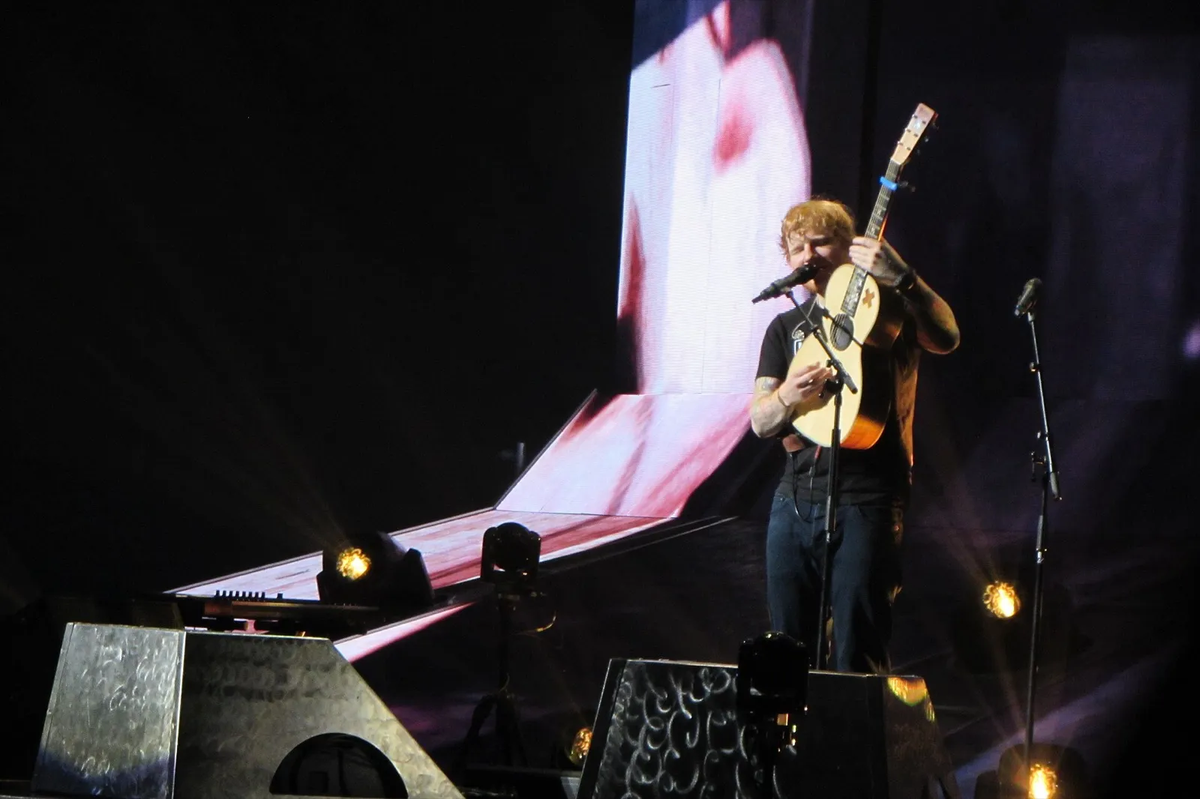
🏷️ Ficha musical
Why it's in this book
This is February's anchor song, the one you will spend most time on that month. It is in the book because of its riff: four marimba notes that repeat from start to finish and fit completely on an Orff xylophone. On top of that, the whole song uses the same four chords, which in class are A minor, D minor, F and G. It is a minor loop, a cousin of the major loop in Love Story or Perfect: it starts on a minor chord and sounds darker. Like Bad Guy, it shows that a riff can be the whole song. In the room with no instruments you work on the voice and on the tresillo rhythm with your body; in the ukulele room, the four chords; in the music room, the xylophones play the riff, the ukulele bass doubles it and the drums play a tropical beat.
Why this song
Listen to the first few seconds of the song. Before Ed Sheeran sings anything, you hear an instrument with wooden bars. It is a marimba, the big sister of the xylophone in your classroom.
A month after releasing it, Sheeran played it on American TV with classroom music instruments: the same kind many schools have. It worked just as well. That video is in Resources.
The question on this page is: can a whole song stand on four notes? Here the answer is yes, and you can check it on the xylophone.
Historical context
Ed Sheeran is an English singer and guitarist. He started out playing alone in pubs, with an acoustic guitar and a pedal that records loops: he plays something, the machine repeats it, and he plays on top. That way one person can sound like a whole band.
"Shape of You" came out on 6 January 2017, the same day as another of his songs, "Castle on the Hill". They were the first two songs from his third album, ÷ (the division sign). "Perfect", which is also in this book, is from the same album.
The song was not meant to be his. He started writing it with two songwriters, Steve Mac and Johnny McDaid, with other artists in mind, such as Rihanna. Steve Mac played the first notes on the keyboard and Sheeran started tapping on his guitar as if it were a drum. Halfway through the session they decided to keep it.
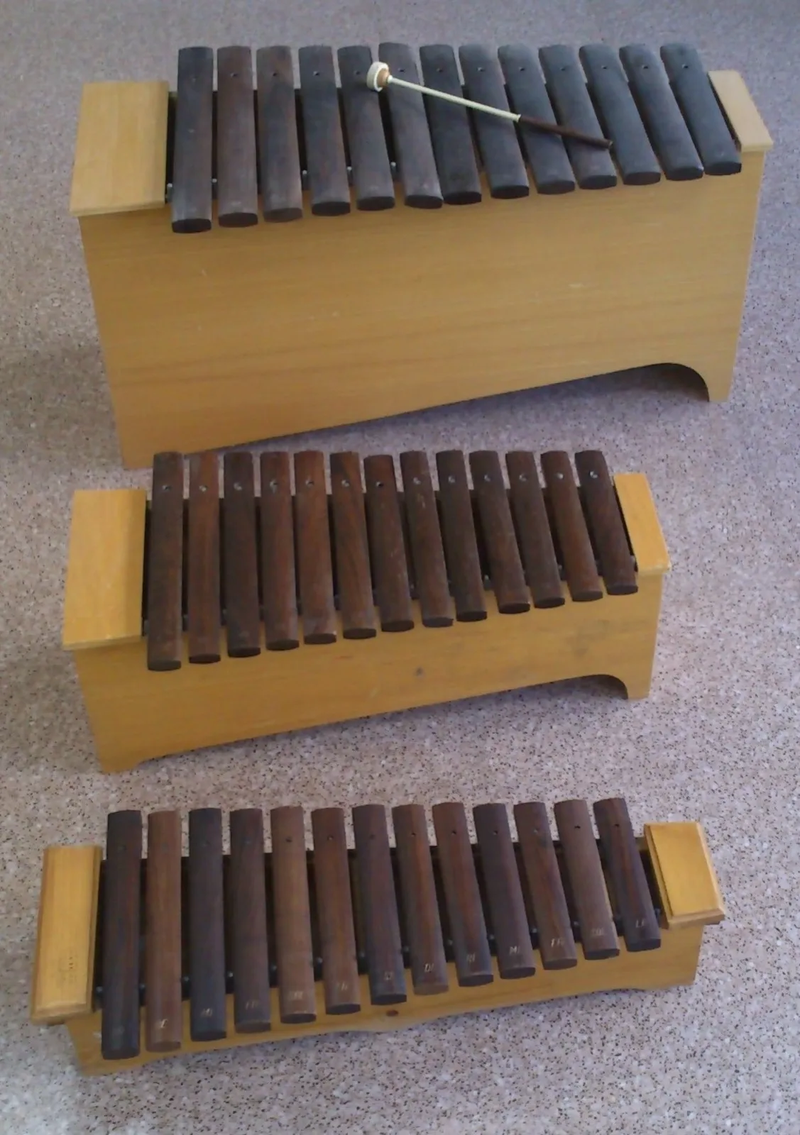
Foto: Ferbr1, CC BY-SA 3.0, vía Wikimedia Commons
These are Orff xylophones, like the ones in the music room: wooden bars played with mallets. The riff in "Shape of You" is played on a marimba, which is a bigger, deeper xylophone. The notes are played the same way.
It was number 1 in 34 countries. In December 2018 it became the first song in history to reach 2 billion plays on Spotify. In Spain it has gone platinum eleven times.
Musical characteristics
A riff that never stops. A riff is a short phrase that repeats over and over. The one in this song is played on a marimba and uses only four different notes. When a figure repeats like this through a whole song, it is also called an ostinato, Italian for "stubborn". Listen to it: it never goes away.
Four chords, the whole song. Under the riff there are four chords. They are always the same and always in the same order: in the verse, in the chorus and at the end. In class they are A minor, D minor, F and G. The first two are minor, which is why the song sounds a little dark even though you can dance to it. This repeated set of chords is a chord progression.
The rhythm that limps. Clap along and listen to the rhythm of the marimba and the percussion. It does not move in equal hits. It goes in groups of three, three and two: "ONE-two-three, ONE-two-three, ONE-two". That rhythm is called the tresillo. It comes from African and Caribbean music, and it is the base of styles like reggaeton and dancehall.
A piece of another song. One line in the pre-chorus recalls "No Scrubs", a 1999 hit by the group TLC. Using a piece of another song's melody by singing it again is called interpolation. That is why its writers are also credited as writers of "Shape of You".
A warning for when you play. The record is in C♯ minor, a key with four sharps. In class we play it in A minor, which has none. We move everything down four semitones: that is transposing. That way the riff fits on the xylophone bars without any sharps or flats.
Hard facts: C♯ minor on the record and A minor in class, 4/4, 96 beats per minute, 3:54. The form: intro, verse, pre-chorus, chorus, verse, pre-chorus, chorus, bridge and final chorus.
Guided listening
Play the music video. In the intro, listen only to the marimba. Count how many times it repeats the same phrase before the voice comes in.
When the first verse starts, try to keep hearing the marimba under the voice. Is it still there?
In the chorus, clap the "three, three and two" rhythm. If it fits, you have found the tresillo.
Listen to the "oh I, oh I" chorus. Everyone sings the same note at the same time: that is singing in unison.
At the end, listen for whether the chords have changed at any point. Compare the last chorus with the first: what is new?
Trivia and curiosities
- In 2022 Sheeran went to court because two other musicians said he had copied a phrase from their song "Oh Why". The judge ruled in his favour. Sheeran said there are very few chords in pop and only twelve notes, so coincidences are bound to happen. It is the same idea as this book: lots of songs share chords.
- In the music video, Sheeran trains as a boxer and fights a real sumo wrestler, Yamamotoyama. It is a tribute to the Rocky films.
- He first wrote it with Rihanna in mind. He changed his mind when he heard himself singing a line about putting Van Morrison on the jukebox: "she's not really going to sing that, is she?"
- For years it was the most-played song on Spotify. Today only "Blinding Lights" by The Weeknd beats it.
Classroom activities
- The riff on xylophone. Work out the riff by ear on the xylophone, in A minor. It uses four notes from the A minor scale, all on the natural bars. When you have it, play it non-stop while another group sings.
- Body tresillo. The whole class claps "three, three and two", counting out loud "ONE-two-three, ONE-two-three, ONE-two". Then feet keep the beat while hands play the tresillo, at the same time.
- Play the four chords. Ukulele: A minor, D minor, F and G, one chord per bar. Since they never change, you can play the whole song with those four.
- The band. Xylophones on the riff, ukulele bass doubling the riff an octave lower, drums with the tropical beat. Everyone else sings the "oh I, oh I" chorus in unison.
- Create. Make up your own four-note riff in A minor and play it over the same four chords. Can it hold up a whole song?
Key vocabulary
- Marimba — marimba: un xilófono grande y más grave
- Riff — riff
- Ostinato — ostinato
- Tresillo — tresillo: ritmo de tres, tres y dos
- Unison — unísono
Resources
Official music video — Sheeran trains as a boxer and takes on a sumo wrestler.
With classroom instruments — Sheeran, Jimmy Fallon and The Roots play it on classroom instruments, in February 2017.
Built with a loop pedal — Sheeran and Fallon build the song layer by layer with a looping station.
Ukulele tutorial — The Ukulele Teacher. The four chords and the strumming.
Guitar tutorial — Kurt Berg (5 Minute Guitar). An easy version, with simple chords.
Keyboard tutorial — Betacustic. A beginner version, with sheet music.
Drum tutorial — LearnSomeDrums. The song's beat, part by part.
Por qué está en este libro
Esta es la canción ancla de febrero, la que más tiempo vas a trabajar ese mes. Está en el libro por su riff: cuatro notas de marimba que se repiten de principio a fin y que caben enteras en un xilófono Orff. Además, toda la canción usa los mismos cuatro acordes, que en clase son la menor, re menor, fa y sol. Es un bucle menor, primo del bucle mayor de Love Story o Perfect: empieza en un acorde menor y suena más oscuro. Comparte con Bad Guy la idea de que un riff puede ser la canción entera. En el aula sin nada se trabaja la voz y el ritmo del tresillo con el cuerpo; en el aula con ukelele, los cuatro acordes; en el aula de música, los xilófonos llevan el riff, el ukebajo lo dobla y la batería toca un ritmo tropical.
Por dónde entrar
Escucha los primeros segundos de la canción. Antes de que Ed Sheeran cante nada, suena un instrumento de láminas de madera. Es una marimba, la hermana mayor del xilófono que tienes en el aula.
Un mes después de publicarla, Sheeran la tocó en la televisión estadounidense con instrumentos de clase de música: los mismos que hay en muchos institutos. Funcionaba igual. Ese vídeo está en Recursos.
La pregunta de esta página es: ¿puede una canción entera sostenerse sobre cuatro notas? Aquí la respuesta es sí, y se puede comprobar en el xilófono.
Contexto histórico
Ed Sheeran es un cantante y guitarrista inglés. Empezó tocando solo en bares, con una guitarra acústica y un pedal que graba bucles: toca algo, lo repite la máquina y él toca encima. Así puede sonar como una banda entera siendo una sola persona.
«Shape of You» salió el 6 de enero de 2017, el mismo día que otra canción suya, «Castle on the Hill». Las dos fueron las primeras de su tercer disco, ÷ (el signo de dividir). De ese mismo disco es «Perfect», que también está en este libro.
La canción no iba a ser suya. La empezó a escribir con dos compositores, Steve Mac y Johnny McDaid, pensando en otros artistas, como Rihanna. Steve Mac tocó las primeras notas al teclado y Sheeran se puso a dar golpes en la guitarra como si fuera un tambor. A mitad de la sesión decidieron quedársela.
Foto: Ferbr1, CC BY-SA 3.0, vía Wikimedia Commons
Estos son xilófonos Orff, como los del aula: láminas de madera que se tocan con baquetas. El riff de «Shape of You» suena en una marimba, que es un xilófono más grande y más grave. Las notas se tocan igual.
Fue número 1 en 34 países. En diciembre de 2018 fue la primera canción de la historia en llegar a 2000 millones de escuchas en Spotify. En España tiene once discos de platino.
Cómo suena
Un riff que no para. El riff es una frase corta que se repite sin parar. La de esta canción la toca una marimba y usa solo cuatro notas distintas. Cuando una figura se repite así durante toda una canción, se llama también ostinato, que en italiano significa «obstinado». Escúchala: no se va nunca.
Cuatro acordes, toda la canción. Debajo del riff hay cuatro acordes. Son siempre los mismos y siempre en el mismo orden: en el verso, en el estribillo y al final. En clase son la menor, re menor, fa y sol. Los dos primeros son menores, por eso la canción suena algo oscura aunque se pueda bailar. Esta repetición de acordes es una progresión.
El ritmo que cojea. Da palmas con la canción y fíjate en el ritmo de la marimba y la percusión. No va en golpes iguales. Va en grupos de tres, tres y dos: «UN-dos-tres, UN-dos-tres, UN-dos». Ese ritmo se llama tresillo. Viene de la música africana y del Caribe, y es la base de estilos como el reguetón o el dancehall.
Un trozo de otra canción. Hay una frase del preestribillo que recuerda a «No Scrubs», un éxito del grupo TLC de 1999. Usar un trozo de melodía de otra canción, cantándolo de nuevo, se llama interpolación. Por eso sus autoras aparecen también como autoras de «Shape of You».
Un aviso para cuando toques. El disco suena en Do♯ menor, una tonalidad con cuatro sostenidos. En el aula la tocamos en La menor, que no tiene ninguno. Bajamos todo cuatro semitonos: eso es transportar. Así el riff cabe en las láminas del xilófono sin necesidad de notas alteradas.
Datos duros: Do♯ menor en el disco y La menor en clase, 4/4, 96 pulsos por minuto, 3:54. La forma: intro, verso, preestribillo, estribillo, verso, preestribillo, estribillo, puente y estribillo final.
Escucha guiada
Pon el videoclip. En la intro, escucha solo la marimba. Cuenta cuántas veces repite la misma frase antes de que entre la voz.
Cuando entra el primer verso, intenta seguir oyendo la marimba debajo de la voz. ¿Sigue ahí?
En el estribillo, da palmas con el ritmo de «tres, tres y dos». Si encajan, has encontrado el tresillo.
Escucha el coro de «oh I, oh I» del estribillo. Todos cantan la misma nota a la vez: eso es cantar al unísono.
Al final, escucha si los acordes han cambiado en algún momento. Compara el último estribillo con el primero: ¿qué hay de nuevo?
Curiosidades
- En 2022, Sheeran fue a juicio porque otros dos músicos decían que había copiado una frase de su canción «Oh Why». El juez falló a su favor. Sheeran dijo que en el pop hay muy pocos acordes y solo doce notas, así que las coincidencias son inevitables. Es la misma idea que este libro: muchas canciones comparten acordes.
- En el videoclip, Sheeran entrena como boxeador y pelea contra un luchador de sumo de verdad, Yamamotoyama. Es un homenaje a las películas de Rocky.
- La canción la grabó primero pensando en Rihanna. Cambió de idea cuando se oyó a sí mismo cantando una frase sobre poner a Van Morrison en la máquina de discos: «eso no lo va a cantar ella».
- Durante años fue la canción más escuchada de Spotify. Hoy solo la supera «Blinding Lights», de The Weeknd.
Para hacer en clase
- El riff en xilófono. Sacad de oído el riff en el xilófono, en la menor. Son cuatro notas de la escala de la menor, todas sin alteraciones. Cuando salga, tocadlo sin parar mientras otro grupo canta.
- Tresillo con el cuerpo. Toda la clase marca «tres, tres y dos» con palmas, contando en voz alta «UN-dos-tres, UN-dos-tres, UN-dos». Después, los pies marcan el pulso y las manos el tresillo, a la vez.
- Tocar los cuatro acordes. Ukelele: la menor, re menor, fa y sol, un acorde por compás. Como no cambian nunca, se puede tocar la canción entera con esos cuatro.
- La banda. Xilófonos con el riff, ukebajo doblando el riff una octava más grave, batería con el ritmo tropical. El resto, el coro «oh I, oh I» al unísono.
- Crear. Inventad un riff propio de cuatro notas en la menor y tocadlo sobre los mismos cuatro acordes. ¿Se puede sostener una canción entera?
Vocabulario fundamental
- Marimba — Un instrumento de láminas de madera, como un xilófono grande y más grave.
- Riff — Una frase corta que se repite y que hace que reconozcas la canción.
- Ostinato — Una figura que se repite durante toda la pieza sin cambiar.
- Tresillo — Un ritmo de tres, tres y dos golpes que viene de la música africana y caribeña.
- Unísono — Cuando todos cantan la misma nota a la vez.
Recursos
Videoclip oficial — Sheeran entrena como boxeador y se enfrenta a un luchador de sumo.
Con instrumentos de clase — Sheeran, Jimmy Fallon y The Roots la tocan con instrumentos de aula, en febrero de 2017.
Construida con un pedal de bucles — Sheeran y Fallon montan la canción capa a capa con una estación de bucles.
Tutorial de ukelele — The Ukulele Teacher. Los cuatro acordes y el rasgueo.
Tutorial de guitarra — Kurt Berg (5 Minute Guitar). Versión fácil, con acordes sencillos.
Tutorial de teclado — Betacustic. Versión para principiantes, con partitura.
Tutorial de batería — LearnSomeDrums. El ritmo de la canción, por partes.
Why it's in this book
This is February's anchor song, the one you will spend most time on that month. It is in the book because of its riff: four marimba notes that repeat from start to finish and fit completely on an Orff xylophone. On top of that, the whole song uses the same four chords, which in class are A minor, D minor, F and G. It is a minor loop, a cousin of the major loop in Love Story or Perfect: it starts on a minor chord and sounds darker. Like Bad Guy, it shows that a riff can be the whole song. In the room with no instruments you work on the voice and on the tresillo rhythm with your body; in the ukulele room, the four chords; in the music room, the xylophones play the riff, the ukulele bass doubles it and the drums play a tropical beat.
Why this song
Listen to the first few seconds of the song. Before Ed Sheeran sings anything, you hear an instrument with wooden bars. It is a marimba, the big sister of the xylophone in your classroom.
A month after releasing it, Sheeran played it on American TV with classroom music instruments: the same kind many schools have. It worked just as well. That video is in Resources.
The question on this page is: can a whole song stand on four notes? Here the answer is yes, and you can check it on the xylophone.
Historical context
Ed Sheeran is an English singer and guitarist. He started out playing alone in pubs, with an acoustic guitar and a pedal that records loops: he plays something, the machine repeats it, and he plays on top. That way one person can sound like a whole band.
"Shape of You" came out on 6 January 2017, the same day as another of his songs, "Castle on the Hill". They were the first two songs from his third album, ÷ (the division sign). "Perfect", which is also in this book, is from the same album.
The song was not meant to be his. He started writing it with two songwriters, Steve Mac and Johnny McDaid, with other artists in mind, such as Rihanna. Steve Mac played the first notes on the keyboard and Sheeran started tapping on his guitar as if it were a drum. Halfway through the session they decided to keep it.
Foto: Ferbr1, CC BY-SA 3.0, vía Wikimedia Commons
These are Orff xylophones, like the ones in the music room: wooden bars played with mallets. The riff in "Shape of You" is played on a marimba, which is a bigger, deeper xylophone. The notes are played the same way.
It was number 1 in 34 countries. In December 2018 it became the first song in history to reach 2 billion plays on Spotify. In Spain it has gone platinum eleven times.
Musical characteristics
A riff that never stops. A riff is a short phrase that repeats over and over. The one in this song is played on a marimba and uses only four different notes. When a figure repeats like this through a whole song, it is also called an ostinato, Italian for "stubborn". Listen to it: it never goes away.
Four chords, the whole song. Under the riff there are four chords. They are always the same and always in the same order: in the verse, in the chorus and at the end. In class they are A minor, D minor, F and G. The first two are minor, which is why the song sounds a little dark even though you can dance to it. This repeated set of chords is a chord progression.
The rhythm that limps. Clap along and listen to the rhythm of the marimba and the percussion. It does not move in equal hits. It goes in groups of three, three and two: "ONE-two-three, ONE-two-three, ONE-two". That rhythm is called the tresillo. It comes from African and Caribbean music, and it is the base of styles like reggaeton and dancehall.
A piece of another song. One line in the pre-chorus recalls "No Scrubs", a 1999 hit by the group TLC. Using a piece of another song's melody by singing it again is called interpolation. That is why its writers are also credited as writers of "Shape of You".
A warning for when you play. The record is in C♯ minor, a key with four sharps. In class we play it in A minor, which has none. We move everything down four semitones: that is transposing. That way the riff fits on the xylophone bars without any sharps or flats.
Hard facts: C♯ minor on the record and A minor in class, 4/4, 96 beats per minute, 3:54. The form: intro, verse, pre-chorus, chorus, verse, pre-chorus, chorus, bridge and final chorus.
Guided listening
Play the music video. In the intro, listen only to the marimba. Count how many times it repeats the same phrase before the voice comes in.
When the first verse starts, try to keep hearing the marimba under the voice. Is it still there?
In the chorus, clap the "three, three and two" rhythm. If it fits, you have found the tresillo.
Listen to the "oh I, oh I" chorus. Everyone sings the same note at the same time: that is singing in unison.
At the end, listen for whether the chords have changed at any point. Compare the last chorus with the first: what is new?
Trivia and curiosities
- In 2022 Sheeran went to court because two other musicians said he had copied a phrase from their song "Oh Why". The judge ruled in his favour. Sheeran said there are very few chords in pop and only twelve notes, so coincidences are bound to happen. It is the same idea as this book: lots of songs share chords.
- In the music video, Sheeran trains as a boxer and fights a real sumo wrestler, Yamamotoyama. It is a tribute to the Rocky films.
- He first wrote it with Rihanna in mind. He changed his mind when he heard himself singing a line about putting Van Morrison on the jukebox: "she's not really going to sing that, is she?"
- For years it was the most-played song on Spotify. Today only "Blinding Lights" by The Weeknd beats it.
Classroom activities
- The riff on xylophone. Work out the riff by ear on the xylophone, in A minor. It uses four notes from the A minor scale, all on the natural bars. When you have it, play it non-stop while another group sings.
- Body tresillo. The whole class claps "three, three and two", counting out loud "ONE-two-three, ONE-two-three, ONE-two". Then feet keep the beat while hands play the tresillo, at the same time.
- Play the four chords. Ukulele: A minor, D minor, F and G, one chord per bar. Since they never change, you can play the whole song with those four.
- The band. Xylophones on the riff, ukulele bass doubling the riff an octave lower, drums with the tropical beat. Everyone else sings the "oh I, oh I" chorus in unison.
- Create. Make up your own four-note riff in A minor and play it over the same four chords. Can it hold up a whole song?
Key vocabulary
- Marimba — marimba: un xilófono grande y más grave
- Riff — riff
- Ostinato — ostinato
- Tresillo — tresillo: ritmo de tres, tres y dos
- Unison — unísono
Resources
Official music video — Sheeran trains as a boxer and takes on a sumo wrestler.
With classroom instruments — Sheeran, Jimmy Fallon and The Roots play it on classroom instruments, in February 2017.
Built with a loop pedal — Sheeran and Fallon build the song layer by layer with a looping station.
Ukulele tutorial — The Ukulele Teacher. The four chords and the strumming.
Guitar tutorial — Kurt Berg (5 Minute Guitar). An easy version, with simple chords.
Keyboard tutorial — Betacustic. A beginner version, with sheet music.
Drum tutorial — LearnSomeDrums. The song's beat, part by part.