Contenidos
Shake It Off — Taylor Swift (2014)
Three chords, a stomping beat and saxophones that never stop. A song for shaking off what other people say about you.
🏷️ Ficha musical
Why it's in this book
"Shake It Off" is the second song of April, next to Sofía. It is here for two reasons. The first is call and response: the chorus repeats words ("shake, shake") and the backing voices answer, so half the class sings and the other half replies. The second is that it works with just three chords you have had in your hand since the first term: A minor, C and G. You play it just like the record, without transposing. They are three of the four chords of the loop you have been playing all year, in a different order. In the classroom with no instruments you make the stomp-and-clap beat with your body; with ukuleles you strum the three chords; and in the music room the drummer plays a marching pattern and the xylophones take the saxophone part.
Why this song
Listen to the first few seconds. Before anything else comes in, there is a beat of dry thumps and claps. It is not a drum kit: it is two producers stomping on a wooden floor.
That means you can play the start of this song with no instruments at all. Just your feet and your hands.
The question on this page is: how do you make a three-chord song that never gets boring?
Historical context
Until 2012, Taylor Swift was a country singer. With her 2014 album 1989, she announced that she was moving to pop. The album is named after the year she was born.
To do it she called Max Martin, a Swedish producer who had been making pop hits for twenty years, and his partner Shellback. Swift went into the studio with no melody, just an idea: she wanted a song that would get the one person at a wedding who has not left their chair all night up and dancing.
The lyrics are about criticism. Swift had spent years reading things about herself in the press. Instead of complaining, she decided to laugh: the haters are going to hate, and she is going to shake it off by dancing.
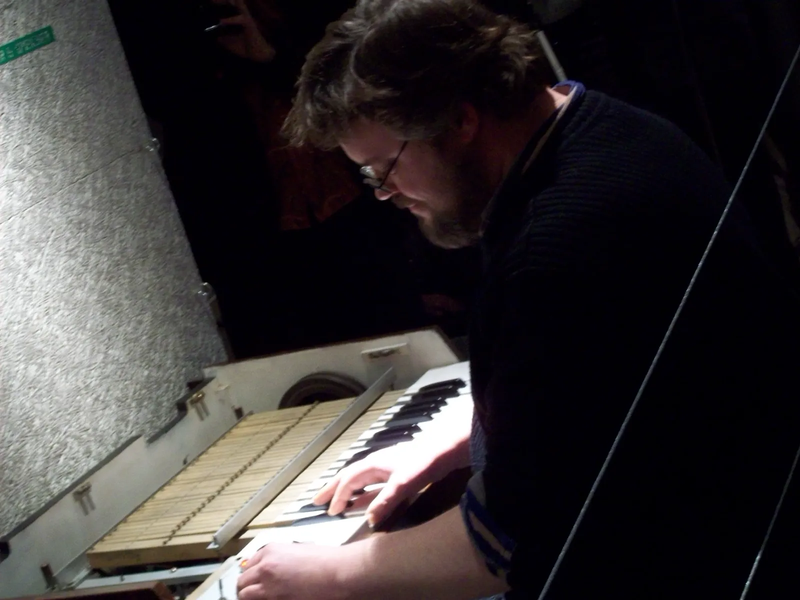
Foto: andrew garton, CC BY-SA 2.0, vía Wikimedia Commons
A 1972 Mellotron M400. It is a keyboard with a trick: each key starts a piece of tape recorded with a real instrument. The main saxophone line in Shake It Off came from a Mellotron set to a brass sound.
The song reached number 1 in the United States and is still her biggest hit there: it spent 50 weeks in the top 100.
Musical characteristics
A beat made with the body. The pattern at the start, stomp and clap, repeats through the whole song. It is body percussion, even if they then recorded it and looped it on the computer. It is fast: 160 beats per minute.
Three chords on a loop. Underneath everything there are three chords: A minor, C and G. Always the same, always in that order. Because the song always comes home to G and F sharp never appears, it is in an old mode called Mixolydian: like G major, but with one note changed. To the ear, it sounds a little more relaxed than a normal G major.
Saxophones that never stop. Over the beat there is a short saxophone phrase, with clipped notes, repeating like clockwork. Shellback says he started by playing something "bad on purpose" and Max Martin loved it. In the choruses a brass trio joins in: saxophone, trumpet and trombone.
Call and response. Swift sings a line and a choir of voices answers behind her. On top of that, the chorus repeats the same word five times. That repetition is the bit everyone sings.
A spoken bridge. In the bridge the music drops almost to nothing: claps and Swift's voice speaking, not singing. Then the chorus comes back at full power.
Hard facts: G (Mixolydian mode), 4/4, 160 beats per minute, 3:39. The form: verse, pre-chorus, chorus, verse, pre-chorus, chorus, spoken bridge and final chorus.
Guided listening
Play the music video. At the start, copy the beat: stomp, clap. How many hits before it repeats?
When the saxophone comes in, hum its phrase. It is short and repeats the same way many times.
In the verse, the music feels loose. In the pre-chorus, listen to how the music tightens, as if getting ready for something.
When the chorus arrives, count how many times the same word repeats. Then listen to the voices answering behind.
In the bridge, the music almost disappears: just claps and a speaking voice. Get ready for the chorus to come back.
Trivia and curiosities
- In the video, Swift tries to dance with ballerinas, cheerleaders and breakdancers, and gets it wrong on purpose. The idea was: it is fine not to fit in everywhere.
- The phrase "this sick beat", which she says in the bridge, is a registered trademark in her name in the United States.
- Swedish saxophonist Jonas Thander recorded the alto and tenor saxophones at home. It took him one night and the next day to put all the parts together.
- In 2023 she recorded it again from scratch for her own version of 1989, "Taylor's Version".
Classroom activities
- The beat with your body. Stomp on beats 1 and 3, clap on 2 and 4. Slowly first, then at the record's tempo.
- Three chords. Ukulele: A minor, C, G, one per bar. Use a short, dry strum, like the saxophones.
- Call and response. One group sings the chorus line and the rest answer. Then swap.
- Brass on xylophone. The xylophones play a short, repeated phrase over the chords, the way the saxophones do.
- Band. The drummer plays a marching pattern built on the stomp-and-clap beat. The ukulele bass plays the bottom note of each chord: A, C, G.
Key vocabulary
- Body percussion — percusión corporal
- Mode — modo: una forma de ordenar las notas de la escala
- Brass — metales
- Call and response — llamada y respuesta
Resources
Official music video — Swift dancing, badly on purpose, with ballet, cheerleaders and breakdance.
Ukulele tutorial — The Ukulele Teacher. Chords and strumming, quick and clear.
Guitar tutorial — JustinGuitar. A full beginner lesson.
Piano tutorial — PHianonize. An easy version.
Drum tutorial — The Drum Fix. The song's beat in four steps.
Por qué está en este libro
«Shake It Off» es la segunda canción de abril, al lado de Sofía. Está aquí por dos cosas. La primera es la llamada y respuesta: el estribillo repite palabras («shake, shake») y el coro contesta, así que media clase canta y la otra media responde. La segunda es que se sostiene con solo tres acordes que ya tienes en la mano desde el primer trimestre: la menor, do y sol. Se toca igual que en el disco, sin transportar. Son tres de los cuatro acordes del bucle que llevas todo el curso tocando, en otro orden. En el aula sin instrumentos haces el ritmo de pisotones y palmas con el cuerpo; con ukelele, rasgueas los tres acordes; y en el aula de música la batería toca el patrón de marcha y los xilófonos hacen la parte de los saxos.
Por dónde entrar
Escucha los primeros segundos. Antes de que entre nada, suena un ritmo de golpes secos y palmas. No es una batería: son dos productores dando pisotones en un suelo de madera.
Eso significa que puedes tocar el principio de esta canción sin ningún instrumento. Solo con los pies y las manos.
La pregunta de esta página es: ¿cómo se consigue que una canción con tres acordes no aburra nunca?
Contexto histórico
Hasta 2012, Taylor Swift era una cantante de country. Con su disco 1989, de 2014, anunció que se pasaba al pop. El disco se llama como el año en que ella nació.
Para hacerlo llamó a Max Martin, un productor sueco que llevaba veinte años haciendo éxitos de pop, y a su compañero Shellback. Swift llegó al estudio sin melodía, solo con una idea: quería una canción que hiciera bailar en una boda a la persona que no se ha levantado de la silla en toda la noche.
La letra habla de las críticas. Swift había pasado años leyendo cosas sobre ella en la prensa. En vez de quejarse, decidió reírse: los que odian van a odiar, y ella se lo va a quitar de encima bailando.
Foto: andrew garton, CC BY-SA 2.0, vía Wikimedia Commons
Un Mellotron M400 de 1972. Es un teclado con trucos: cada tecla pone en marcha un trozo de cinta grabado con un instrumento de verdad. El saxofón principal de Shake It Off salió de un Mellotron con un sonido de metales.
La canción fue número 1 en Estados Unidos y sigue siendo su mayor éxito allí: pasó 50 semanas entre las cien canciones más escuchadas.
Cómo suena
Un ritmo hecho con el cuerpo. El patrón del principio, pisotón y palmada, se repite durante toda la canción. Es percusión corporal, aunque luego la grabaran y la repitieran con el ordenador. Va rápido: 160 pulsos por minuto.
Tres acordes en bucle. Debajo de todo suenan tres acordes: la menor, do y sol. Siempre los mismos, siempre en ese orden. Como la canción acaba siempre en sol y no aparece nunca el fa sostenido, suena en un modo antiguo llamado mixolidio: como Sol mayor, pero con una nota cambiada. Al oído, suena un poco más relajado que un Sol mayor normal.
Saxos que no paran. Encima del ritmo hay una frase corta de saxofón, con notas picadas, que se repite como un reloj. Shellback dice que empezó tocando algo «mal a propósito» y que a Max Martin le encantó. En los estribillos se suma un trío de metales: saxofón, trompeta y trombón.
Llamada y respuesta. Swift canta una frase y detrás contesta un coro de voces. Además, el estribillo repite cinco veces la misma palabra. Esa repetición es la que todo el mundo canta.
Un puente hablado. En el puente la música se queda casi en nada: palmas y la voz de Swift hablando, no cantando. Después vuelve el estribillo con todo.
Datos duros: Sol (modo mixolidio), 4/4, 160 pulsos por minuto, 3:39. La forma: estrofa, preestribillo, estribillo, estrofa, preestribillo, estribillo, puente hablado y estribillo final.
Escucha guiada
Pon el videoclip. Al principio, imita el ritmo: pisotón, palmada. ¿Cuántos golpes hay antes de que se repita?
Cuando entre el saxofón, tararea su frase. Es corta y se repite igual muchas veces.
En la estrofa, la música va suelta. En el preestribillo, escucha cómo la música se aprieta, como si se preparara para algo.
Cuando llegue el estribillo, cuenta cuántas veces se repite la misma palabra. Luego escucha las voces que contestan detrás.
En el puente, la música casi desaparece: solo palmas y voz hablada. Prepárate para la vuelta del estribillo.
Curiosidades
- En el videoclip, Swift intenta bailar con bailarinas de ballet, animadoras y bailarines de breakdance, y le sale mal a propósito. La idea era decir: no pasa nada por no encajar en todo.
- La expresión «this sick beat» que dice en el puente es una marca registrada a su nombre en Estados Unidos.
- El saxofonista sueco Jonas Thander grabó en su casa los saxos alto y tenor. Tardó una noche y el día siguiente en montar todas las partes.
- En 2023 la volvió a grabar entera para su versión de 1989, «Taylor's Version».
Para hacer en clase
- El ritmo con el cuerpo. Pisotón en los pulsos 1 y 3, palmada en el 2 y el 4. Primero despacio, luego al tempo del disco.
- Tres acordes. Ukelele: la menor, do, sol, uno por compás. Con un rasgueo corto y seco, como los saxos.
- Llamada y respuesta. Un grupo canta la frase del estribillo y el resto responde. Después cambiad los papeles.
- Los metales en xilófono. Los xilófonos tocan una frase corta y repetida encima de los acordes, como hacen los saxos.
- Banda. La batería toca un patrón de marcha que se apoye en el ritmo de pisotones y palmas. El ukebajo, la nota de abajo de cada acorde: la, do, sol.
Vocabulario fundamental
- Percusión corporal — Hacer ritmo con el cuerpo: pies, palmas, pecho, muslos.
- Modo — Una forma de ordenar las notas de la escala. El mixolidio es como el mayor con una nota más baja.
- Metales — Instrumentos de viento como la trompeta y el trombón. El saxofón suele tocar con ellos.
- Llamada y respuesta — Una voz canta una frase y otras contestan.
Recursos
Videoclip oficial — Swift bailando, a propósito mal, con ballet, animadoras y breakdance.
Tutorial de ukelele — The Ukulele Teacher. Los acordes y el rasgueo, rápido y claro.
Tutorial de guitarra — JustinGuitar. Lección completa para principiantes.
Tutorial de piano — PHianonize. Versión fácil.
Tutorial de batería — The Drum Fix. El ritmo de la canción en cuatro pasos.
Why it's in this book
"Shake It Off" is the second song of April, next to Sofía. It is here for two reasons. The first is call and response: the chorus repeats words ("shake, shake") and the backing voices answer, so half the class sings and the other half replies. The second is that it works with just three chords you have had in your hand since the first term: A minor, C and G. You play it just like the record, without transposing. They are three of the four chords of the loop you have been playing all year, in a different order. In the classroom with no instruments you make the stomp-and-clap beat with your body; with ukuleles you strum the three chords; and in the music room the drummer plays a marching pattern and the xylophones take the saxophone part.
Why this song
Listen to the first few seconds. Before anything else comes in, there is a beat of dry thumps and claps. It is not a drum kit: it is two producers stomping on a wooden floor.
That means you can play the start of this song with no instruments at all. Just your feet and your hands.
The question on this page is: how do you make a three-chord song that never gets boring?
Historical context
Until 2012, Taylor Swift was a country singer. With her 2014 album 1989, she announced that she was moving to pop. The album is named after the year she was born.
To do it she called Max Martin, a Swedish producer who had been making pop hits for twenty years, and his partner Shellback. Swift went into the studio with no melody, just an idea: she wanted a song that would get the one person at a wedding who has not left their chair all night up and dancing.
The lyrics are about criticism. Swift had spent years reading things about herself in the press. Instead of complaining, she decided to laugh: the haters are going to hate, and she is going to shake it off by dancing.
Foto: andrew garton, CC BY-SA 2.0, vía Wikimedia Commons
A 1972 Mellotron M400. It is a keyboard with a trick: each key starts a piece of tape recorded with a real instrument. The main saxophone line in Shake It Off came from a Mellotron set to a brass sound.
The song reached number 1 in the United States and is still her biggest hit there: it spent 50 weeks in the top 100.
Musical characteristics
A beat made with the body. The pattern at the start, stomp and clap, repeats through the whole song. It is body percussion, even if they then recorded it and looped it on the computer. It is fast: 160 beats per minute.
Three chords on a loop. Underneath everything there are three chords: A minor, C and G. Always the same, always in that order. Because the song always comes home to G and F sharp never appears, it is in an old mode called Mixolydian: like G major, but with one note changed. To the ear, it sounds a little more relaxed than a normal G major.
Saxophones that never stop. Over the beat there is a short saxophone phrase, with clipped notes, repeating like clockwork. Shellback says he started by playing something "bad on purpose" and Max Martin loved it. In the choruses a brass trio joins in: saxophone, trumpet and trombone.
Call and response. Swift sings a line and a choir of voices answers behind her. On top of that, the chorus repeats the same word five times. That repetition is the bit everyone sings.
A spoken bridge. In the bridge the music drops almost to nothing: claps and Swift's voice speaking, not singing. Then the chorus comes back at full power.
Hard facts: G (Mixolydian mode), 4/4, 160 beats per minute, 3:39. The form: verse, pre-chorus, chorus, verse, pre-chorus, chorus, spoken bridge and final chorus.
Guided listening
Play the music video. At the start, copy the beat: stomp, clap. How many hits before it repeats?
When the saxophone comes in, hum its phrase. It is short and repeats the same way many times.
In the verse, the music feels loose. In the pre-chorus, listen to how the music tightens, as if getting ready for something.
When the chorus arrives, count how many times the same word repeats. Then listen to the voices answering behind.
In the bridge, the music almost disappears: just claps and a speaking voice. Get ready for the chorus to come back.
Trivia and curiosities
- In the video, Swift tries to dance with ballerinas, cheerleaders and breakdancers, and gets it wrong on purpose. The idea was: it is fine not to fit in everywhere.
- The phrase "this sick beat", which she says in the bridge, is a registered trademark in her name in the United States.
- Swedish saxophonist Jonas Thander recorded the alto and tenor saxophones at home. It took him one night and the next day to put all the parts together.
- In 2023 she recorded it again from scratch for her own version of 1989, "Taylor's Version".
Classroom activities
- The beat with your body. Stomp on beats 1 and 3, clap on 2 and 4. Slowly first, then at the record's tempo.
- Three chords. Ukulele: A minor, C, G, one per bar. Use a short, dry strum, like the saxophones.
- Call and response. One group sings the chorus line and the rest answer. Then swap.
- Brass on xylophone. The xylophones play a short, repeated phrase over the chords, the way the saxophones do.
- Band. The drummer plays a marching pattern built on the stomp-and-clap beat. The ukulele bass plays the bottom note of each chord: A, C, G.
Key vocabulary
- Body percussion — percusión corporal
- Mode — modo: una forma de ordenar las notas de la escala
- Brass — metales
- Call and response — llamada y respuesta
Resources
Official music video — Swift dancing, badly on purpose, with ballet, cheerleaders and breakdance.
Ukulele tutorial — The Ukulele Teacher. Chords and strumming, quick and clear.
Guitar tutorial — JustinGuitar. A full beginner lesson.
Piano tutorial — PHianonize. An easy version.
Drum tutorial — The Drum Fix. The song's beat in four steps.