Contenidos
Save Tonight — Eagle-Eye Cherry (1997)
Four chords, an acoustic guitar and a goodbye. This is the song where the band learns to play the same loop at 120 from start to finish without stopping.
🏷️ Ficha musical
Why it's in this book
It is January's anchor song. Its loop, A minor, F, C and G, belongs to family C: in Year 9 you played it in Zombie, Despacito or El universo sobre mí, so you already know this ground. In Year 10 you share it with Californication and Numb. We chose it because it is played with four chords that fit on the ukulele, it can be sung all the way through a cappella and, at 120 beats per minute, it is the road to Sweet Home Alabama, the goal for May. In the room with no instruments you sing it with body percussion and prepare the second voice, a third above in the chorus. With ukuleles, strumming and singing at the same time. In the music room, the solo goes over the loop with the A minor pentatonic.
Why this song
This song will remind you of ten others. That is no accident.
Play A minor, F, C and G, in that order, and repeat. Now start the same circle on C: C, G, A minor, F. That is the most famous loop in pop, the one behind hundreds of songs you know. They are the same four chords. The only thing that changes is where you step into the circle.
Historical context
Eagle-Eye Cherry is Swedish. He comes from a family of musicians: his father, Don Cherry, was an important jazz trumpeter, and his sister is the singer Neneh Cherry.
In 1997 he released his first album, Desireless. "Save Tonight" was the first track and the first single. It reached number 2 in Sweden, number 5 in the United States and number 6 in the UK. A debut like that is rare.
The song is about a goodbye: two people with one last night before one of them leaves. That is why the title asks to "save" tonight.
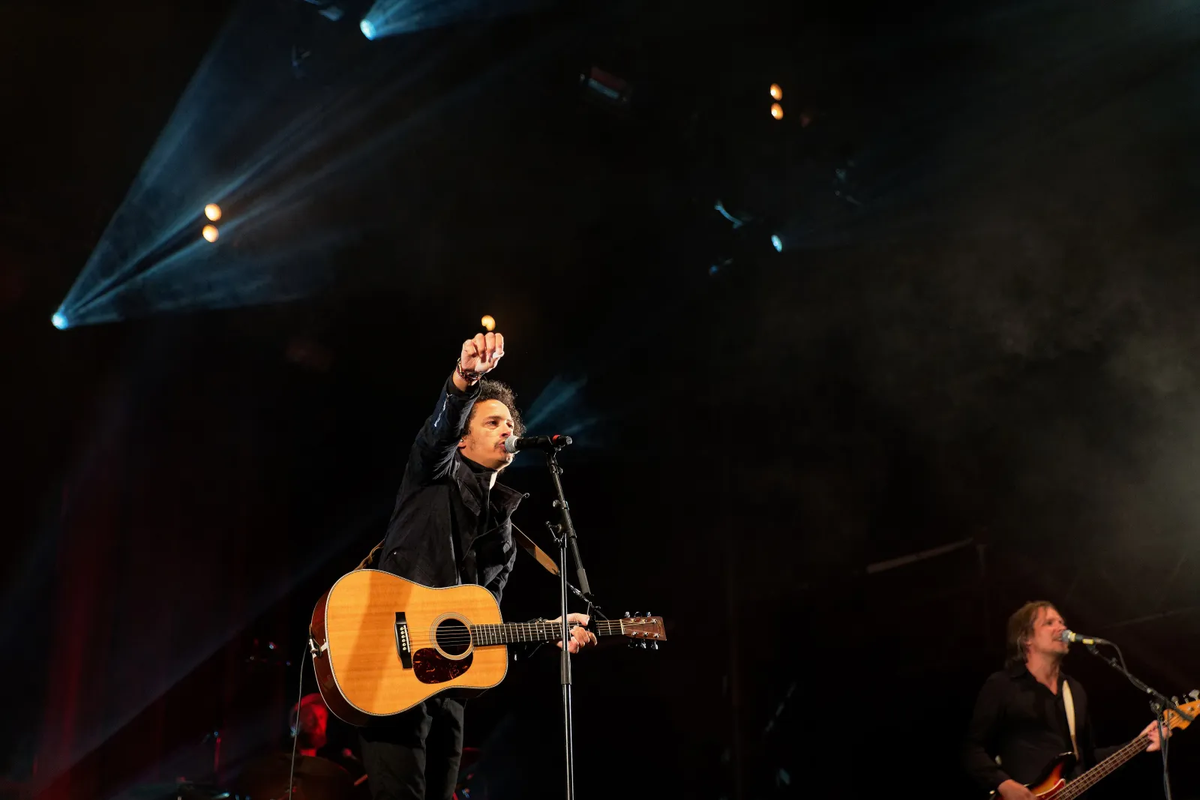
Foto: Thesupermat, CC BY-SA 4.0, vía Wikimedia Commons
This is how he still plays it, with the acoustic guitar on his shoulder. The photo is from 2019, at a festival in Brittany, France, twenty-two years after the album. Behind him is the line-up you are going to use: guitars, bass and drums.
The black-and-white music video was filmed on a street in Stockholm. Cherry plays several characters at once: the man getting ready for a date, the butcher, a robber, the driver of a pickup truck. It is edited to look like one single take, with no cuts.
Musical characteristics
A loop that never breaks. The whole song uses four chords: A minor, F, C and G. They repeat in the same order, never straying, from start to finish. That repetition is a chord loop.
Minor, but bright. The song is in A minor. But three of its four chords (F, C and G) are major, and C major is the relative key of A minor: the same notes, a different home. That is why the song sounds sad and eager at the same time. It sits in between.
Rotating the loop. The intro starts the circle on A minor. The verse and chorus, according to Hooktheory's analysis, start it on C: C, G, A minor, F. Starting on a different chord of the same circle is called rotation. In Year 7 you saw it with Anti-Hero; here you have it inside a single song.
Acoustic in front, electric behind. The base is a strummed acoustic guitar. On top, an electric guitar drops short phrases between the vocal lines. It is the same split you will use in class: ukulele or Spanish guitar on the strumming, the electric answering.
Where the solo goes. The A minor pentatonic fits over the loop: A, C, D, E, G. All five notes work with all four chords.
Hard facts: A minor, 4/4, 120 beats per minute, 3:55 on the album. The form: an intro, then verses and choruses taking turns. All on the same loop.
Guided listening
Play the music video. In the intro, count how many beats each chord lasts. That number is what you need to change in time on the ukulele.
In the first verse, look for the electric guitar. Does it play at the same time as the voice, or does it use the gaps the voice leaves?
When the chorus arrives, listen for a change of chords. There is none: the change is in the melody. Work out what it does differently.
In the last chorus, try singing above the melody. That is the second voice you will do in class.
Trivia and curiosities
- Cherry plays almost every part in the video, including the robber and the driver who runs him over. It is the same story seen from several sides.
- "Save Tonight" won him the Rockbjörnen award for Swedish song of the year in 1997.
- Two electric guitarists play on the record, besides the acoustic. One of them, Klas Åhlund, later became a Swedish pop producer.
- Cherry's first album is called Desireless. The most wanted song on it is the first one.
Classroom activities
- Sing and keep time. Room with no instruments: the whole class sings the chorus with the beat in their feet and a clap on 2 and 4. One group looks for the third above in the chorus.
- Play the loop. Ukulele: A minor, F, C, G, changing after as many beats as you counted in the guided listening. Downstrokes first; then the strum down, down-up, up-down-up.
- Rotate. Play the loop starting on A minor. Then starting on C. Which sounds happier? Why, if the chords are the same?
- Band and solo. Music room: drums with a rock beat at 120, bass on the root of each chord, keyboard on the chords. The electric guitar improvises two rounds on the A minor pentatonic. Then it is the keyboard's turn.
Key vocabulary
- Chord loop — bucle armónico
- Relative key — tonalidad relativa: mismas notas, distinto centro
- Rotation — rotación: empezar el mismo círculo de acordes por otro acorde
- Pentatonic scale — escala pentatónica
Resources
Official music video — In black and white. Count how many characters Cherry plays.
Guitar tutorial — JustinGuitar. The four chords and the strumming, in an easy version.
Ukulele tutorial — Ukulele Cheats. Chords, strumming and a track to play along with.
Piano tutorial — PHianonize. An easy version.
Drums, with score — NoiseCraft. The drum score scrolls while the song plays.
Bass, with tab — Backwards Bass. The bass line with the tab on screen.
- Harmonic analysis — Hooktheory: https://www.hooktheory.com/theorytab/view/eagle-eye-cherry/save-tonight
Por qué está en este libro
Es la canción ancla de enero. Su bucle, la menor, fa, do y sol, es el de la familia C: en 3º lo tocasteis en Zombie, Despacito o El universo sobre mí, así que este terreno ya lo conocéis. En 4º lo compartís con Californication y Numb. La elegimos porque se toca con cuatro acordes que caben en el ukelele, se canta entera a capela y, a 120 pulsos por minuto, es el camino hacia Sweet Home Alabama, la meta de mayo. En el aula sin instrumentos se canta con percusión corporal y se prepara la segunda voz, una tercera por encima en el estribillo. Con ukelele, el rasgueo y el canto a la vez. En el aula de música, el solo va encima del bucle con la pentatónica de la menor.
Por dónde entrar
Esta canción te va a sonar a otras diez. No es casualidad.
Toca la menor, fa, do y sol, en ese orden, y repítelo. Ahora empieza el mismo círculo por do: do, sol, la menor, fa. Es el bucle más famoso del pop, el de cientos de canciones que conoces. Son los mismos cuatro acordes. Lo único que cambia es por dónde entras en el círculo.
Contexto histórico
Eagle-Eye Cherry es sueco. Viene de una familia de músicos: su padre, Don Cherry, fue un trompetista de jazz importante, y su hermana es la cantante Neneh Cherry.
En 1997 publicó su primer disco, Desireless. «Save Tonight» era la primera canción y el primer sencillo. Fue número 2 en Suecia, número 5 en Estados Unidos y número 6 en el Reino Unido. Un debut así es raro.
La canción cuenta una despedida: dos personas que tienen una sola noche antes de que una se vaya. Por eso el título pide «salvar» esta noche.
Foto: Thesupermat, CC BY-SA 4.0, vía Wikimedia Commons
Así la sigue tocando, con la guitarra acústica colgada. La foto es de 2019, en un festival de Bretaña (Francia), veintidós años después del disco. Detrás de él está la formación que vais a usar vosotros: guitarras, bajo y batería.
El videoclip, en blanco y negro, se rodó en una calle de Estocolmo. Cherry hace de varios personajes a la vez: el que se prepara para la cita, el carnicero, un ladrón, el conductor de una camioneta. El montaje está hecho para que parezca una sola toma, sin cortes.
Cómo suena
Un bucle que no se rompe. Toda la canción usa cuatro acordes: la menor, fa, do y sol. Se repiten en el mismo orden, sin desviarse, de principio a fin. Esa repetición es un bucle armónico.
Menor, pero luminosa. La canción está en la menor. Pero tres de sus cuatro acordes (fa, do y sol) son mayores, y do mayor es la tonalidad relativa de la menor: las mismas notas, otro centro. Por eso la canción suena triste y a la vez con ganas. Está en medio.
Rotar el bucle. La intro empieza el círculo en la menor. La estrofa y el estribillo, según el análisis de Hooktheory, lo empiezan en do: do, sol, la menor, fa. Empezar en otro acorde del mismo círculo se llama rotación. En 1º lo visteis con Anti-Hero; aquí lo tenéis dentro de una sola canción.
Acústica delante, eléctrica detrás. La base es una guitarra acústica rasgueando. Por encima, una guitarra eléctrica deja frases cortas entre las líneas de la voz. Es el reparto que usaréis en clase: el ukelele o la española llevan el rasgueo, la eléctrica responde.
Dónde va el solo. Encima del bucle cabe la pentatónica de la menor: la, do, re, mi, sol. Las cinco notas encajan con los cuatro acordes.
Datos duros: la menor, 4/4, 120 pulsos por minuto, 3:55 en el disco. La forma: intro y estrofas y estribillos que se alternan. Todo sobre el mismo bucle.
Escucha guiada
Pon el videoclip. En la intro, cuenta cuántos pulsos dura cada acorde. Ese número es el que necesitas para cambiar a tiempo en el ukelele.
En la primera estrofa, busca la guitarra eléctrica. ¿Toca a la vez que la voz o aprovecha los huecos que deja?
Cuando llegue el estribillo, escucha si cambian los acordes. No cambian: el cambio está en la melodía. Descubre qué hace distinto.
En el último estribillo, intenta cantar por encima de la melodía. Esa es la segunda voz que haréis en clase.
Curiosidades
- Cherry hace casi todos los papeles del videoclip, incluido el ladrón y el conductor que lo atropella. Es la misma historia vista desde varios lados.
- Con «Save Tonight» ganó el premio Rockbjörnen a la canción sueca del año 1997.
- En el disco tocan dos guitarristas eléctricos, además de la acústica. Uno de ellos, Klas Åhlund, se convirtió después en productor de pop sueco.
- El primer disco de Cherry se llama Desireless, «sin deseo». La canción más deseada de ese disco es la primera.
Para hacer en clase
- Cantar y marcar. Aula sin instrumentos: toda la clase canta el estribillo con el pulso en los pies y una palmada en el 2 y el 4. Un grupo busca la tercera por encima en el estribillo.
- Tocar el bucle. Ukelele: la menor, fa, do, sol, cambiando cada tantos pulsos como hayáis contado en la escucha guiada. Primero golpes hacia abajo; después, el rasgueo abajo, abajo-arriba, arriba-abajo-arriba.
- Rotar. Tocad el bucle empezando en la menor. Luego empezando en do. ¿Cuál suena más alegre? ¿Por qué, si los acordes son los mismos?
- Banda y solo. Aula de música: la batería con un ritmo de rock a 120, el bajo con la nota de cada acorde, el teclado con los acordes. La eléctrica improvisa dos vueltas con la pentatónica de la menor. Luego, turno del teclado.
Vocabulario fundamental
- Bucle armónico — Unos pocos acordes que se repiten sin parar y sostienen toda la canción.
- Tonalidad relativa — Dos tonalidades con las mismas notas y distinto centro, como la menor y do mayor.
- Rotación — Tocar el mismo círculo de acordes empezando por otro acorde.
- Escala pentatónica — Cinco notas que encajan sobre todo el bucle. En la menor: la, do, re, mi, sol.
Recursos
Videoclip oficial — En blanco y negro. Cuenta cuántos personajes hace Cherry.
Tutorial de guitarra — JustinGuitar. Los cuatro acordes y el rasgueo, en versión fácil.
Tutorial de ukelele — Ukulele Cheats. Acordes, rasgueo y una pista para tocar encima.
Tutorial de piano — PHianonize. Versión fácil.
Batería, con partitura — NoiseCraft. La partitura de batería avanza mientras suena la canción.
Bajo, con tablatura — Backwards Bass. La línea de bajo con la tablatura en pantalla.
- Análisis armónico — Hooktheory: https://www.hooktheory.com/theorytab/view/eagle-eye-cherry/save-tonight
Why it's in this book
It is January's anchor song. Its loop, A minor, F, C and G, belongs to family C: in Year 9 you played it in Zombie, Despacito or El universo sobre mí, so you already know this ground. In Year 10 you share it with Californication and Numb. We chose it because it is played with four chords that fit on the ukulele, it can be sung all the way through a cappella and, at 120 beats per minute, it is the road to Sweet Home Alabama, the goal for May. In the room with no instruments you sing it with body percussion and prepare the second voice, a third above in the chorus. With ukuleles, strumming and singing at the same time. In the music room, the solo goes over the loop with the A minor pentatonic.
Why this song
This song will remind you of ten others. That is no accident.
Play A minor, F, C and G, in that order, and repeat. Now start the same circle on C: C, G, A minor, F. That is the most famous loop in pop, the one behind hundreds of songs you know. They are the same four chords. The only thing that changes is where you step into the circle.
Historical context
Eagle-Eye Cherry is Swedish. He comes from a family of musicians: his father, Don Cherry, was an important jazz trumpeter, and his sister is the singer Neneh Cherry.
In 1997 he released his first album, Desireless. "Save Tonight" was the first track and the first single. It reached number 2 in Sweden, number 5 in the United States and number 6 in the UK. A debut like that is rare.
The song is about a goodbye: two people with one last night before one of them leaves. That is why the title asks to "save" tonight.
Foto: Thesupermat, CC BY-SA 4.0, vía Wikimedia Commons
This is how he still plays it, with the acoustic guitar on his shoulder. The photo is from 2019, at a festival in Brittany, France, twenty-two years after the album. Behind him is the line-up you are going to use: guitars, bass and drums.
The black-and-white music video was filmed on a street in Stockholm. Cherry plays several characters at once: the man getting ready for a date, the butcher, a robber, the driver of a pickup truck. It is edited to look like one single take, with no cuts.
Musical characteristics
A loop that never breaks. The whole song uses four chords: A minor, F, C and G. They repeat in the same order, never straying, from start to finish. That repetition is a chord loop.
Minor, but bright. The song is in A minor. But three of its four chords (F, C and G) are major, and C major is the relative key of A minor: the same notes, a different home. That is why the song sounds sad and eager at the same time. It sits in between.
Rotating the loop. The intro starts the circle on A minor. The verse and chorus, according to Hooktheory's analysis, start it on C: C, G, A minor, F. Starting on a different chord of the same circle is called rotation. In Year 7 you saw it with Anti-Hero; here you have it inside a single song.
Acoustic in front, electric behind. The base is a strummed acoustic guitar. On top, an electric guitar drops short phrases between the vocal lines. It is the same split you will use in class: ukulele or Spanish guitar on the strumming, the electric answering.
Where the solo goes. The A minor pentatonic fits over the loop: A, C, D, E, G. All five notes work with all four chords.
Hard facts: A minor, 4/4, 120 beats per minute, 3:55 on the album. The form: an intro, then verses and choruses taking turns. All on the same loop.
Guided listening
Play the music video. In the intro, count how many beats each chord lasts. That number is what you need to change in time on the ukulele.
In the first verse, look for the electric guitar. Does it play at the same time as the voice, or does it use the gaps the voice leaves?
When the chorus arrives, listen for a change of chords. There is none: the change is in the melody. Work out what it does differently.
In the last chorus, try singing above the melody. That is the second voice you will do in class.
Trivia and curiosities
- Cherry plays almost every part in the video, including the robber and the driver who runs him over. It is the same story seen from several sides.
- "Save Tonight" won him the Rockbjörnen award for Swedish song of the year in 1997.
- Two electric guitarists play on the record, besides the acoustic. One of them, Klas Åhlund, later became a Swedish pop producer.
- Cherry's first album is called Desireless. The most wanted song on it is the first one.
Classroom activities
- Sing and keep time. Room with no instruments: the whole class sings the chorus with the beat in their feet and a clap on 2 and 4. One group looks for the third above in the chorus.
- Play the loop. Ukulele: A minor, F, C, G, changing after as many beats as you counted in the guided listening. Downstrokes first; then the strum down, down-up, up-down-up.
- Rotate. Play the loop starting on A minor. Then starting on C. Which sounds happier? Why, if the chords are the same?
- Band and solo. Music room: drums with a rock beat at 120, bass on the root of each chord, keyboard on the chords. The electric guitar improvises two rounds on the A minor pentatonic. Then it is the keyboard's turn.
Key vocabulary
- Chord loop — bucle armónico
- Relative key — tonalidad relativa: mismas notas, distinto centro
- Rotation — rotación: empezar el mismo círculo de acordes por otro acorde
- Pentatonic scale — escala pentatónica
Resources
Official music video — In black and white. Count how many characters Cherry plays.
Guitar tutorial — JustinGuitar. The four chords and the strumming, in an easy version.
Ukulele tutorial — Ukulele Cheats. Chords, strumming and a track to play along with.
Piano tutorial — PHianonize. An easy version.
Drums, with score — NoiseCraft. The drum score scrolls while the song plays.
Bass, with tab — Backwards Bass. The bass line with the tab on screen.
- Harmonic analysis — Hooktheory: https://www.hooktheory.com/theorytab/view/eagle-eye-cherry/save-tonight