Contenidos
Riptide — Vance Joy (2013)
A generation's ukulele song: three chords, a fast strum and lyrics that race along. It was written by a former Australian football player.

🏷️ Ficha musical
Why it's in this book
"Riptide" is the anchor song for January. It is here because it is probably the most-played ukulele song of the last ten years, and because three chords are enough to sing the whole thing: in class, A minor, G and C. They are three of the four chords of the loop you have been playing since October, now starting on A minor; in the same month, Anti-Hero teaches you to rotate the full loop. On the record it sounds one semitone higher, in D flat; we bring it down to C so the chords are the easy ones. The bridge adds a fourth chord, F, which you already know. What is new here is the right hand: the strum is fast and the words race along, almost spoken, so the challenge is not to slow down. In the classroom with no instruments we sing it with claps; with ukuleles it is our strumming song; and in the music room the drummer plays with claps and the ukulele bass takes the low notes. The second voice answers in the chorus, on the word "lady".
Why this song
If you have ever picked up a ukulele, someone has probably told you: "play Riptide". It is the song almost everyone learns after their first chords.
A riptide is a rip current: water flowing back out to sea from the shore that pulls you away from the beach. There are signs warning about it on beaches.
The question on this page is: why did a song with three chords and no shouted chorus become a worldwide hit?
Historical context
Vance Joy's real name is James Keogh. He was born in Melbourne, Australia, in 1987. Before music he played Australian rules football almost at professional level, and he studied law at university.
His stage name comes from a novel: in "Bliss", by the Australian writer Peter Carey, Vance Joy is the main character's grandfather, an old man who tells stories.
He wrote the first chords of "Riptide" in 2008 and left it unfinished. Four years later, another song he was writing reminded him of that fragment, and he joined the two. He recorded it in a single afternoon with a drummer friend. The title comes from a motel called Riptide where his family stayed on summer holidays.
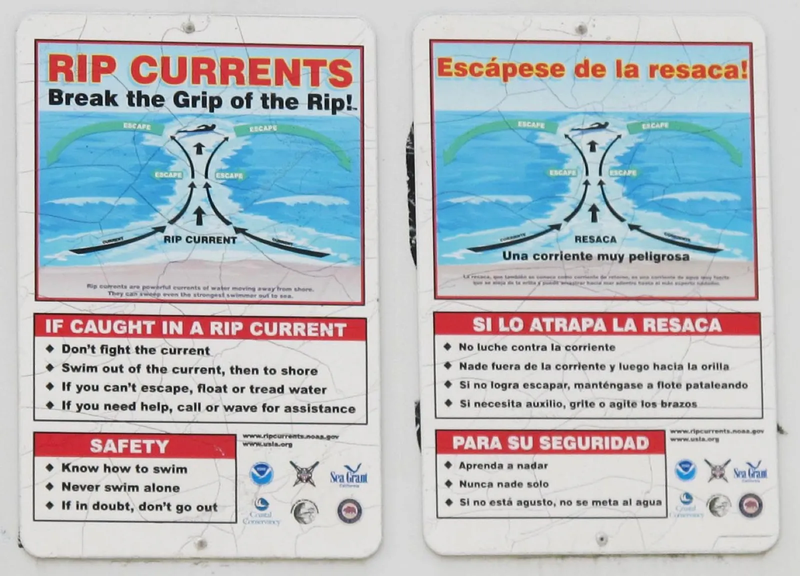
Foto: Invertzoo, CC BY-SA 4.0, vía Wikimedia Commons
Signs in English and Spanish at Mission Beach in San Diego, United States. "Rip current" and "riptide" mean the same thing. The drawing shows how to get out: swim parallel to the shore.
In Australia, the song spent 120 weeks in a row in the charts, longer than any other song in history. Taylor Swift covered it on piano on British radio in 2014, and the following year Vance Joy opened the shows on her tour.
Musical characteristics
A ukulele that never stops. The song is built on a very fast strummed ukulele. Listen to the right hand: it goes up and down all the time, with some muted hits. The tempo is 100 beats per minute, but because the strumming splits each beat into smaller hits, it feels much faster.
Three chords. Almost the whole song uses three chords that repeat: on the record, B flat minor, A flat and D flat. In class, A minor, G and C. This progression starts on a minor chord and ends on a major one, as if each time round it stepped out of the shade into the sun.
Lower in class. The record is in D flat major, one semitone above C. To play it in C, we bring it down a semitone: that is called transposing. The chords change names, but the song is the same.
Lyrics that race. Vance Joy sings lots of words very close together, almost speaking. The lines chain images together: being scared of dentists and the dark, a film, a magician's assistant. The video draws them one by one.
The bridge. Near the end a fourth chord appears, F in class, and the song takes a breath before the last chorus.
Hard facts: D flat major on the record and C major in class, 4/4, 100 beats per minute, 3:24. Form: verse, pre-chorus, chorus, verse, pre-chorus, chorus, bridge, instrumental and chorus.
Guided listening
Play the music video. In the intro, listen only to the ukulele. Try to follow the strum by moving your hand in the air, up and down.
In the first verse, notice how many words there are in each line. Try saying one line at the speed of the record.
When the chorus arrives ("Lady, running down to the riptide"), count the chords: there are three, and they repeat.
In the bridge, listen for the new chord. It sounds more open than the other three.
While you watch, notice how each picture draws what the lyrics are saying at that moment.
Trivia and curiosities
- Before becoming a singer, Vance Joy played two seasons in his state's Australian football league, and won the award for best first-year player.
- The first version he posted on Facebook had only the first verse and the chorus. Encouragement from his family and friends convinced him to keep going.
- In 2023 it was the most-played Australian song of the year on Spotify, ten years after it came out.
- In 2023 a version was used in adverts for the "Percy Jackson" series: the hero's sword is called Riptide, like the song.
Classroom activities
- The strum, no chords. Mute the strings with your left hand and practise down-down-up-up-down-up until it comes without thinking.
- The three chords. Ukulele: A minor, G, C. One strum per chord first, then the full pattern.
- Say the lyrics. Read a verse aloud at the record's speed, without singing. It is harder than it looks.
- Second voice. One group sings the chorus and another answers on the word "lady".
- Band. The drummer keeps the beat with claps or the snare. The ukulele bass plays the bottom note of each chord: A, G, C.
Key vocabulary
- Strumming — rasgueo
- Chord progression — progresión de acordes
- Transposing — transportar: pasar la canción entera a otra altura
- Bridge — puente
Resources
Official music video — Each picture draws a word of the lyrics. From the Mushroom label's channel.
Ukulele tutorial — UNI Modern Band. A play-along designed for the classroom.
Guitar tutorial — Lee John Blackmore. An easy lesson, step by step.
Piano tutorial — Atlantic Notes. An easy keyboard version.
Acoustic version, to compare — Vance Joy on his own. Listen to what is left when everything but the essentials is stripped away.
Por qué está en este libro
«Riptide» es la canción ancla de enero. Está aquí porque es, probablemente, la canción más tocada con ukelele de los últimos diez años, y porque con tres acordes se canta entera: en clase, la menor, sol y do. Son tres de los cuatro acordes del bucle que llevas desde octubre, ahora empezando por la menor; el mismo mes, Anti-Hero te enseña a rotar el bucle completo. En el disco la canción suena un semitono más aguda, en Re♭; la bajamos a Do para que los acordes sean los fáciles. El puente añade un cuarto acorde, fa, que ya conoces. Lo nuevo aquí es la mano derecha: el rasgueo es rápido y la letra corre casi hablada, así que el reto es no frenar. En el aula sin instrumentos se canta con palmas; con ukelele, es nuestra canción de rasgueo; y en el aula de música la batería toca con palmas y el ukebajo lleva las notas graves. La segunda voz responde en el estribillo, sobre la palabra «lady».
Por dónde entrar
Si alguna vez has cogido un ukelele, es muy probable que alguien te haya dicho: «toca Riptide». Es la canción que aprende casi todo el mundo después de sus primeros acordes.
Un «riptide» es una corriente de resaca: el agua que vuelve al mar desde la orilla y te arrastra hacia dentro. En la playa hay carteles que avisan de ella.
La pregunta de esta página es: ¿por qué una canción con tres acordes y sin estribillo gritado se convirtió en un éxito mundial?
Contexto histórico
Vance Joy se llama en realidad James Keogh. Nació en Melbourne, Australia, en 1987. Antes de la música jugó al fútbol australiano casi como profesional, y estudió Derecho en la universidad.
Su nombre artístico viene de una novela: en «Bliss», del escritor australiano Peter Carey, Vance Joy es el abuelo del protagonista, un viejo que cuenta historias.
Los primeros acordes de «Riptide» los escribió en 2008 y la dejó a medias. Cuatro años después, otra canción que estaba escribiendo le recordó aquel trozo, y juntó las dos. La grabó en una sola tarde con un batería amigo. El título viene de un motel llamado Riptide donde paraba su familia en las vacaciones de verano.
Foto: Invertzoo, CC BY-SA 4.0, vía Wikimedia Commons
Carteles en inglés y en castellano en Mission Beach (San Diego, Estados Unidos). «Rip current» y «riptide» son lo mismo: la resaca. El dibujo explica cómo se sale de ella: nadando en paralelo a la orilla.
En Australia, la canción estuvo 120 semanas seguidas en la lista de ventas, más que ninguna otra en la historia. Taylor Swift la versionó al piano en la radio británica en 2014, y al año siguiente Vance Joy abrió los conciertos de su gira.
Cómo suena
Un ukelele que no para. La canción se apoya en un ukelele rasgueado muy rápido. Escucha la mano derecha: sube y baja todo el rato, con algunos golpes apagados. Va a 100 pulsos por minuto, pero como el rasgueo divide cada pulso en golpes más pequeños, parece mucho más rápida.
Tres acordes. Casi toda la canción usa tres acordes que se repiten: en el disco, si bemol menor, la bemol y re bemol. En clase, la menor, sol y do. Esta progresión empieza en un acorde menor y termina en uno mayor, como si cada vuelta saliera de la sombra al sol.
Más grave en clase. El disco suena en Re♭ mayor, un semitono por encima de Do. Para tocarla en Do, la bajamos un semitono: eso se llama transportar. Los acordes cambian de nombre, pero la canción es la misma.
Una letra que corre. Vance Joy canta muchas palabras muy seguidas, casi hablando. Las frases encadenan imágenes: el miedo a los dentistas y a la oscuridad, una película, la ayudante de un mago. El vídeo las dibuja una a una.
El puente. Hacia el final aparece un cuarto acorde, fa en clase, y la canción respira un poco antes del último estribillo.
Datos duros: Re♭ mayor en el disco y Do mayor en clase, 4/4, 100 pulsos por minuto, 3:24. Forma: estrofa, preestribillo, estribillo, estrofa, preestribillo, estribillo, puente, instrumental y estribillo.
Escucha guiada
Pon el videoclip. En la intro, escucha solo el ukelele. Intenta seguir el rasgueo moviendo la mano en el aire, arriba y abajo.
En la primera estrofa, fíjate en la cantidad de palabras por frase. Intenta decir una frase a la velocidad del disco.
Cuando llegue el estribillo («Lady, running down to the riptide»), cuenta los acordes: son tres y se repiten.
En el puente, escucha el acorde nuevo. Suena más abierto que los otros tres.
Mientras ves el vídeo, busca cómo cada imagen dibuja lo que dice la letra en ese momento.
Curiosidades
- Antes de ser cantante, Vance Joy jugó dos temporadas en la liga de fútbol australiano de su estado, y ganó el premio al mejor jugador de primer año.
- La primera versión que subió a Facebook solo tenía la primera estrofa y el estribillo. Los ánimos de su familia y amigos le convencieron de seguir.
- En 2023 fue la canción australiana más escuchada del año en Spotify, diez años después de salir.
- En 2023 se usó una versión en los anuncios de la serie «Percy Jackson»: la espada del protagonista se llama Riptide, como la canción.
Para hacer en clase
- El rasgueo, sin acordes. Con las cuerdas apagadas con la mano izquierda, practicad abajo-abajo-arriba-arriba-abajo-arriba hasta que salga sin pensar.
- Los tres acordes. Ukelele: la menor, sol, do. Primero un golpe por acorde, luego el rasgueo completo.
- Decir la letra. Leed en voz alta una estrofa al ritmo del disco, sin cantar. Es más difícil de lo que parece.
- Segunda voz. Un grupo canta el estribillo y otro contesta en la palabra «lady».
- Banda. La batería marca el pulso con palmas o con la caja. El ukebajo toca la nota de abajo de cada acorde: la, sol, do.
Vocabulario fundamental
- Rasgueo — Pasar los dedos por todas las cuerdas a la vez, arriba y abajo.
- Progresión — Una serie de acordes que se repite en el mismo orden. Aquí: la menor, sol, do.
- Transportar — Pasar una canción entera a otra altura. Aquí, un semitono más abajo.
- Puente — La parte distinta que llega casi al final y lleva al último estribillo.
Recursos
Videoclip oficial — Cada imagen dibuja una palabra de la letra. Del canal del sello Mushroom.
Tutorial de ukelele — UNI Modern Band. Para tocar encima de la canción, pensado para clase.
Tutorial de guitarra — Lee John Blackmore. Lección fácil, paso a paso.
Tutorial de piano — Atlantic Notes. Versión fácil para teclado.
Versión acústica, para comparar — Vance Joy solo. Escucha qué queda cuando se quita todo menos lo esencial.
Why it's in this book
"Riptide" is the anchor song for January. It is here because it is probably the most-played ukulele song of the last ten years, and because three chords are enough to sing the whole thing: in class, A minor, G and C. They are three of the four chords of the loop you have been playing since October, now starting on A minor; in the same month, Anti-Hero teaches you to rotate the full loop. On the record it sounds one semitone higher, in D flat; we bring it down to C so the chords are the easy ones. The bridge adds a fourth chord, F, which you already know. What is new here is the right hand: the strum is fast and the words race along, almost spoken, so the challenge is not to slow down. In the classroom with no instruments we sing it with claps; with ukuleles it is our strumming song; and in the music room the drummer plays with claps and the ukulele bass takes the low notes. The second voice answers in the chorus, on the word "lady".
Why this song
If you have ever picked up a ukulele, someone has probably told you: "play Riptide". It is the song almost everyone learns after their first chords.
A riptide is a rip current: water flowing back out to sea from the shore that pulls you away from the beach. There are signs warning about it on beaches.
The question on this page is: why did a song with three chords and no shouted chorus become a worldwide hit?
Historical context
Vance Joy's real name is James Keogh. He was born in Melbourne, Australia, in 1987. Before music he played Australian rules football almost at professional level, and he studied law at university.
His stage name comes from a novel: in "Bliss", by the Australian writer Peter Carey, Vance Joy is the main character's grandfather, an old man who tells stories.
He wrote the first chords of "Riptide" in 2008 and left it unfinished. Four years later, another song he was writing reminded him of that fragment, and he joined the two. He recorded it in a single afternoon with a drummer friend. The title comes from a motel called Riptide where his family stayed on summer holidays.
Foto: Invertzoo, CC BY-SA 4.0, vía Wikimedia Commons
Signs in English and Spanish at Mission Beach in San Diego, United States. "Rip current" and "riptide" mean the same thing. The drawing shows how to get out: swim parallel to the shore.
In Australia, the song spent 120 weeks in a row in the charts, longer than any other song in history. Taylor Swift covered it on piano on British radio in 2014, and the following year Vance Joy opened the shows on her tour.
Musical characteristics
A ukulele that never stops. The song is built on a very fast strummed ukulele. Listen to the right hand: it goes up and down all the time, with some muted hits. The tempo is 100 beats per minute, but because the strumming splits each beat into smaller hits, it feels much faster.
Three chords. Almost the whole song uses three chords that repeat: on the record, B flat minor, A flat and D flat. In class, A minor, G and C. This progression starts on a minor chord and ends on a major one, as if each time round it stepped out of the shade into the sun.
Lower in class. The record is in D flat major, one semitone above C. To play it in C, we bring it down a semitone: that is called transposing. The chords change names, but the song is the same.
Lyrics that race. Vance Joy sings lots of words very close together, almost speaking. The lines chain images together: being scared of dentists and the dark, a film, a magician's assistant. The video draws them one by one.
The bridge. Near the end a fourth chord appears, F in class, and the song takes a breath before the last chorus.
Hard facts: D flat major on the record and C major in class, 4/4, 100 beats per minute, 3:24. Form: verse, pre-chorus, chorus, verse, pre-chorus, chorus, bridge, instrumental and chorus.
Guided listening
Play the music video. In the intro, listen only to the ukulele. Try to follow the strum by moving your hand in the air, up and down.
In the first verse, notice how many words there are in each line. Try saying one line at the speed of the record.
When the chorus arrives ("Lady, running down to the riptide"), count the chords: there are three, and they repeat.
In the bridge, listen for the new chord. It sounds more open than the other three.
While you watch, notice how each picture draws what the lyrics are saying at that moment.
Trivia and curiosities
- Before becoming a singer, Vance Joy played two seasons in his state's Australian football league, and won the award for best first-year player.
- The first version he posted on Facebook had only the first verse and the chorus. Encouragement from his family and friends convinced him to keep going.
- In 2023 it was the most-played Australian song of the year on Spotify, ten years after it came out.
- In 2023 a version was used in adverts for the "Percy Jackson" series: the hero's sword is called Riptide, like the song.
Classroom activities
- The strum, no chords. Mute the strings with your left hand and practise down-down-up-up-down-up until it comes without thinking.
- The three chords. Ukulele: A minor, G, C. One strum per chord first, then the full pattern.
- Say the lyrics. Read a verse aloud at the record's speed, without singing. It is harder than it looks.
- Second voice. One group sings the chorus and another answers on the word "lady".
- Band. The drummer keeps the beat with claps or the snare. The ukulele bass plays the bottom note of each chord: A, G, C.
Key vocabulary
- Strumming — rasgueo
- Chord progression — progresión de acordes
- Transposing — transportar: pasar la canción entera a otra altura
- Bridge — puente
Resources
Official music video — Each picture draws a word of the lyrics. From the Mushroom label's channel.
Ukulele tutorial — UNI Modern Band. A play-along designed for the classroom.
Guitar tutorial — Lee John Blackmore. An easy lesson, step by step.
Piano tutorial — Atlantic Notes. An easy keyboard version.
Acoustic version, to compare — Vance Joy on his own. Listen to what is left when everything but the essentials is stripped away.