Contenidos
Oye como va — Santana (1970)
Two chords for four minutes and nobody gets bored. A New York cha-cha-chá that a San Francisco rock band turned into something else, and the place where every member of your band gets a solo.
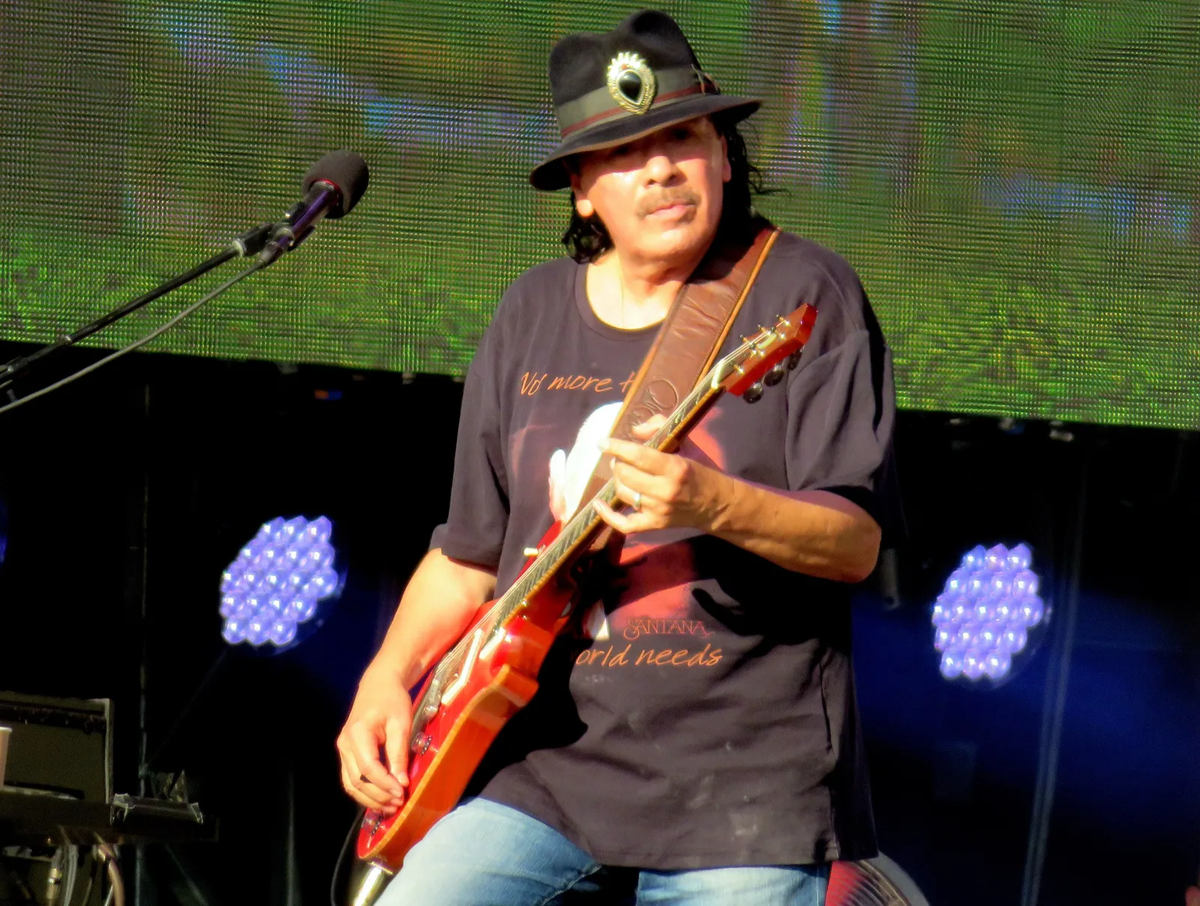
🏷️ Ficha musical
Why it's in this book
It is April's anchor song, and the month has one job: taking solos in turns. The whole song is a vamp, two chords repeating non-stop, A minor seventh and D. That makes it the best place for guitar, keyboard, bass and drums to improvise one after another without the band getting lost. It belongs to the family where the riff is in charge, with Seven Nation Army and Smoke on the Water, and it shares the two-chord vamp with Billie Jean, which comes in June. It used to be played in Year 9 too; now Year 9's solo ground is Uptown Funk and Oye como va is yours. In the room with no instruments you sing it in unison, which is its second voice, and learn the cha-cha-chá rhythm with your body. With ukuleles, the two chords. In the music room, the round of solos. It shares April with Californication.
Why this song
You have probably heard it without knowing the title: an electric guitar that sings, an organ repeating two chords and a choir saying "oye como va". Films and TV series have used it for decades.
What hardly anyone knows is that the song has two owners. It was written by a New York musician from a Puerto Rican family, Tito Puente, in 1962. And it was made famous around the world by a Mexican guitarist living in San Francisco, Carlos Santana, in 1970.
Historical context
Tito Puente was a timbales player and bandleader. In 1950s and 60s New York, his orchestra played mambo and cha-cha-chá for dancing. In 1962 he recorded "Oye como va": a cha-cha-chá with piano, flute, brass, percussion and a choir.
The piano does not play a melody: it repeats a chord figure that never changes throughout the song. That repeated figure is called a tumbao. And it probably was not entirely his: it is very close to the one in "Chanchullo", a 1957 mambo by the Cuban bassist Cachao that Puente had recorded a few years earlier.
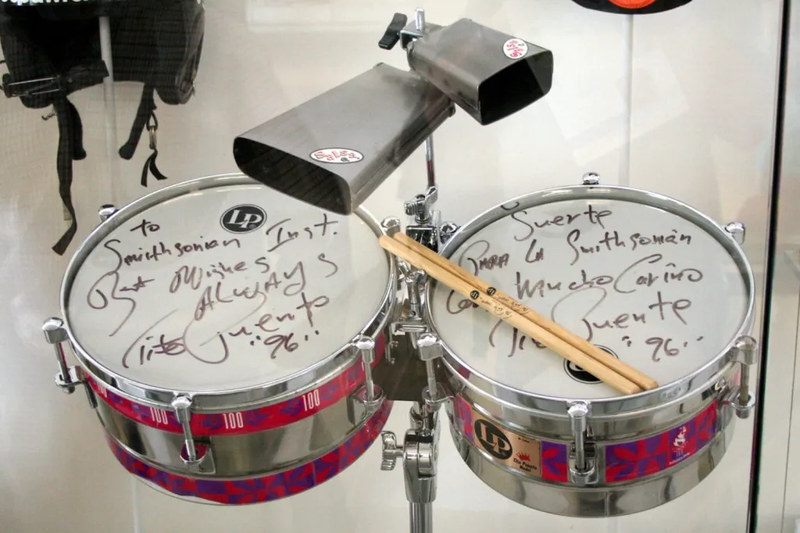
Foto: RadioFan, CC BY-SA 3.0, vía Wikimedia Commons
These are Tito Puente's timbales. He played them at the closing ceremony of the 1996 Atlanta Olympic Games, and on the heads he signed a dedication to the Smithsonian Institution in Washington. Timbales are played with thin sticks, on the head and on the metal side. The cowbells on top keep the rhythm.
Eight years later, in 1970, Carlos Santana's band recorded it for their album Abraxas. Santana mixed San Francisco rock with Latin percussion. He dropped the brass and the flute, brought in an electric guitar, a Hammond organ and a rock drum kit. The guitar sings the melody the flute used to play.
At first Puente was angry: a rock band had taken his song. He got over it when his first royalty cheque arrived. Years later, in the spoken intro to one of his recordings, he publicly thanked Santana for taking his music around the world and for crediting him as the composer.
Musical characteristics
Two chords. The whole song rests on A minor seventh and D. One, the other, one, the other. A two-chord base that repeats so people can sing or improvise on top is a vamp.
A special colour. The song is in A, but not in ordinary A minor. The D major chord brings a note that normal A minor does not have: F sharp. That note gives a less sad, more open colour. That scale, a minor scale with a raised sixth, is called the Dorian mode.
The organ plays the tumbao. In Santana's version, the Hammond organ plays the repeated chord figure that the piano played in the original. It is the song's tumbao. In your band, the keyboard plays it.
The guitar melody. The electric guitar plays the main melody, the one the flute played in 1962. Then come the solos: Santana improvises several times over the vamp, and the organ gets one too. While one person improvises, the rest of the band changes nothing.
The choir. "Oye como va" is sung by a group of voices together, on the same melody. It is a unison, and it is this song's second voice in class.
Hard facts: A Dorian, 4/4, 129 beats per minute, 4:17. The form alternates the guitar melody, the choir and the guitar and organ solos. All on the same vamp.
Guided listening
Play the official recording. In the intro, listen to the organ. Say "one" on the A minor chord and "two" on the D. Does it ever change chords?
When the guitar comes in with the melody, hum it. Then play Tito Puente's original, in Resources, and find which instrument plays that same melody.
When the choir arrives, sing "oye como va" with them. Are they singing in harmony or all on the same melody?
In the solos, raise your hand every time the improvising instrument changes. Notice that the base never changes: that is what lets everyone have a turn.
Trivia and curiosities
- The song is Cuban, Puerto Rican, New York and Californian all at once: written by a New Yorker of Puerto Rican descent in a Cuban style, and made famous by a Mexican in San Francisco.
- Tito Puente kept playing it all his life, but in Santana's style. On one of his albums he joked that since that day, everything they played was Santana music.
- The cha-cha-chá is said to be named after the sound of the dancers' feet sliding across the floor in the quick step: cha, cha, chá.
- In 2021, Rolling Stone put it among the 500 greatest songs of all time. A two-chord song.
Classroom activities
- Cha-cha-chá with your body. Room with no instruments: the beat in your feet and, on 4 and 1, three quick steps: cha, cha, chá. On top, the "oye como va" chorus in unison.
- Two chords on ukulele. A minor seventh and D, one chord per bar. Try plain A minor instead of A minor seventh, and D minor instead of D. What colour do you lose?
- Round of solos. Music room: the keyboard keeps the tumbao, bass and drums hold the vamp. Each soloist gets four bars on the A minor pentatonic: guitar, keyboard, bass, drums and round again. Nobody stops the music. Record it and listen for who leaves the most space between phrases.
- Compare versions. Listen to Puente's original and Santana's version. List the instruments in each. Which of Puente's instruments is replaced by which of Santana's?
Key vocabulary
- Cha-cha-chá — chachachá: baile cubano con un paso rápido de tres pisadas
- Tumbao — tumbao: la figura repetida que sostiene la canción
- Vamp — vamp: base de dos acordes que se repite
- Dorian mode — modo dórico
- Solo — solo
Resources
Official recording — From Santana's channel. No music video was made in 1970.
Santana live — From Santana's official channel. Count how many solos there are.
Tito Puente's original (1962), to compare — From Tito Puente's channel. Listen for the flute.
Guitar tutorial — Carlos Santana explains it himself, in a clip from his masterclass.
Ukulele tutorial — Ukulele Underground. To play along with the song.
Keyboard tutorial — Piano Vampire. The notes on screen, key by key.
Drums, played along — Thierry Morel. Not a lesson, but you can see the whole drum part.
Bass tutorial — EricBlackmonGuitar. The bass line explained.
- Harmonic analysis — Hooktheory: https://www.hooktheory.com/theorytab/view/santana/oye-como-va
Por qué está en este libro
Es la canción ancla de abril, y el trabajo del mes es uno: solos por turnos. Toda la canción es un vamp, dos acordes que se repiten sin parar, la menor con séptima y re. Por eso es el mejor sitio para que la guitarra, el teclado, el bajo y la batería improvisen uno detrás de otro sin que la banda se pierda. Es de la familia en la que manda el riff, con Seven Nation Army y Smoke on the Water, y comparte el vamp de dos acordes con Billie Jean, que llega en junio. Antes se tocaba también en 3º; ahora el campo de solos de 3º es Uptown Funk y Oye como va es vuestra. En el aula sin instrumentos la cantáis al unísono, que es su segunda voz, y aprendéis el ritmo del cha-cha-chá con el cuerpo. Con ukelele, los dos acordes. En el aula de música, la ronda de solos. Comparte abril con Californication.
Por dónde entrar
Es probable que la hayas oído sin saber el título: una guitarra eléctrica que canta, un órgano que repite dos acordes y un coro que dice «oye como va». La han usado películas y series durante décadas.
Lo que casi nadie sabe es que la canción tiene dos dueños. La escribió un músico de Nueva York de familia puertorriqueña, Tito Puente, en 1962. Y la hizo famosa en todo el mundo un guitarrista mexicano de San Francisco, Carlos Santana, en 1970.
Contexto histórico
Tito Puente era timbalero y director de orquesta. En los años cincuenta y sesenta, en Nueva York, su orquesta tocaba mambo y cha-cha-chá para bailar. En 1962 grabó «Oye como va»: un cha-cha-chá con piano, flauta, metales, percusión y un coro.
El piano no toca melodía: repite una figura de acordes que no cambia en toda la canción. A esa figura repetida se le llama tumbao. Y probablemente no era del todo suya: se parece mucho a la de «Chanchullo», un mambo de 1957 del cubano Cachao que Puente había grabado unos años antes.
Foto: RadioFan, CC BY-SA 3.0, vía Wikimedia Commons
Estos son los timbales de Tito Puente. Los tocó en la ceremonia de clausura de los Juegos Olímpicos de Atlanta, en 1996, y en los parches los firmó con una dedicatoria a la Institución Smithsonian, en Washington. Un timbal se toca con baquetas finas, sobre el parche y sobre el metal del lateral. Los cencerros de arriba marcan el ritmo.
Ocho años después, en 1970, la banda de Carlos Santana la grabó para su disco Abraxas. Santana mezclaba el rock de San Francisco con la percusión latina. Quitó los metales y la flauta, puso una guitarra eléctrica y un órgano Hammond, y una batería de rock. La guitarra canta la melodía que antes hacía la flauta.
Puente se enfadó al principio: una banda de rock había cogido su canción. Se le pasó cuando le llegó el primer cheque de derechos de autor. Años después, en la introducción de una de sus grabaciones, dio las gracias a Santana en público por haber llevado su música por todo el mundo y por haberle reconocido como autor.
Cómo suena
Dos acordes. Toda la canción descansa sobre la menor con séptima y re. Uno, otro, uno, otro. Una base de dos acordes que se repite para que se cante o se improvise encima es un vamp.
Un color especial. La canción está en la, pero no en la menor de siempre. El acorde de re mayor trae una nota que la menor normal no tiene: fa sostenido. Esa nota da un color menos triste, más abierto. A esa escala, menor con la sexta subida, se la llama modo dórico.
El órgano lleva el tumbao. En la versión de Santana, el órgano Hammond toca la figura repetida de acordes que en el original hacía el piano. Es el tumbao de la canción. En vuestra banda lo lleva el teclado.
La melodía de la guitarra. La guitarra eléctrica toca la melodía principal, la que en 1962 tocaba la flauta. Después llegan los solos: Santana improvisa varias veces sobre el vamp, y el órgano tiene también el suyo. Mientras uno improvisa, el resto de la banda no cambia nada.
El coro. «Oye como va» lo canta un grupo de voces a la vez, la misma melodía. Es un unísono, y es la segunda voz de esta canción en clase.
Datos duros: la dórico, 4/4, 129 pulsos por minuto, 4:17. La forma alterna la melodía de la guitarra, el coro y los solos de guitarra y de órgano. Todo sobre el mismo vamp.
Escucha guiada
Pon la grabación oficial. En la intro, escucha el órgano. Di «uno» en el acorde de la menor y «dos» en el de re. ¿Cambia alguna vez de acordes?
Cuando entra la guitarra con la melodía, tararéala. Después pon el original de Tito Puente, en Recursos, y busca qué instrumento toca esa misma melodía.
Cuando llega el coro, canta «oye como va» con ellos. ¿Cantan a varias voces o todos la misma melodía?
En los solos, levanta la mano cada vez que cambie el instrumento que improvisa. Fíjate en que la base no cambia nunca: eso es lo que permite a cada uno tener su turno.
Curiosidades
- La canción es cubana, puertorriqueña, neoyorquina y californiana a la vez: la escribió un neoyorquino de familia puertorriqueña sobre un estilo cubano, y la hizo famosa un mexicano de San Francisco.
- Tito Puente siguió tocándola toda su vida, pero adaptada al estilo de Santana. En uno de sus discos lo dijo en broma: desde aquel día, todo lo que tocaban era música de Santana.
- Se dice que el cha-cha-chá debe su nombre al ruido de los pies de los bailarines arrastrándose por el suelo en el paso rápido: cha, cha, chá.
- En 2021, Rolling Stone la incluyó entre las 500 mejores canciones de la historia. Una canción de dos acordes.
Para hacer en clase
- El cha-cha-chá con el cuerpo. Aula sin instrumentos: pulso con los pies y, en el 4 y en el 1, tres pasos rápidos: cha, cha, chá. Encima, el coro «oye como va» al unísono.
- Dos acordes en el ukelele. La menor con séptima y re, un acorde por compás. Probad a tocar la menor normal en vez de la menor con séptima, y re menor en vez de re. ¿Qué color se pierde?
- Ronda de solos. Aula de música: el teclado mantiene el tumbao, el bajo y la batería sostienen el vamp. Cada solista, cuatro compases con la pentatónica de la menor: guitarra, teclado, bajo, batería y vuelta a empezar. Nadie para la música. Grabadlo y escuchad quién deja más silencio entre frase y frase.
- Comparar versiones. Escuchad el original de Puente y la versión de Santana. Haced una lista de los instrumentos de cada uno. ¿Qué instrumento de Puente sustituye a cuál de Santana?
Vocabulario fundamental
- Cha-cha-chá — Baile cubano de ritmo medio, con un paso rápido de tres pisadas: cha, cha, chá.
- Tumbao — La figura repetida que sostiene la canción. Aquí, los acordes del piano o del órgano.
- Vamp — Base de dos acordes que se repite para que se cante o se improvise encima.
- Modo dórico — Una escala menor con la sexta subida. Suena menor, pero más abierta.
- Solo — El momento en que un instrumento improvisa y el resto lo sostiene.
Recursos
Grabación oficial — Del canal de Santana. En 1970 no se hizo videoclip.
Santana en directo — Del canal oficial de Santana. Fíjate en cuántos solos hay.
El original de Tito Puente (1962), para comparar — Del canal de Tito Puente. Busca la flauta.
Tutorial de guitarra — Carlos Santana la explica él mismo, en un fragmento de su clase magistral.
Tutorial de ukelele — Ukulele Underground. Para tocar encima de la canción.
Tutorial de teclado — Piano Vampire. Las notas en pantalla, tecla a tecla.
Batería, versión tocada — Thierry Morel. No es una lección, pero se ve entera la parte de batería.
Tutorial de bajo — EricBlackmonGuitar. La línea de bajo explicada.
- Análisis armónico — Hooktheory: https://www.hooktheory.com/theorytab/view/santana/oye-como-va
Why it's in this book
It is April's anchor song, and the month has one job: taking solos in turns. The whole song is a vamp, two chords repeating non-stop, A minor seventh and D. That makes it the best place for guitar, keyboard, bass and drums to improvise one after another without the band getting lost. It belongs to the family where the riff is in charge, with Seven Nation Army and Smoke on the Water, and it shares the two-chord vamp with Billie Jean, which comes in June. It used to be played in Year 9 too; now Year 9's solo ground is Uptown Funk and Oye como va is yours. In the room with no instruments you sing it in unison, which is its second voice, and learn the cha-cha-chá rhythm with your body. With ukuleles, the two chords. In the music room, the round of solos. It shares April with Californication.
Why this song
You have probably heard it without knowing the title: an electric guitar that sings, an organ repeating two chords and a choir saying "oye como va". Films and TV series have used it for decades.
What hardly anyone knows is that the song has two owners. It was written by a New York musician from a Puerto Rican family, Tito Puente, in 1962. And it was made famous around the world by a Mexican guitarist living in San Francisco, Carlos Santana, in 1970.
Historical context
Tito Puente was a timbales player and bandleader. In 1950s and 60s New York, his orchestra played mambo and cha-cha-chá for dancing. In 1962 he recorded "Oye como va": a cha-cha-chá with piano, flute, brass, percussion and a choir.
The piano does not play a melody: it repeats a chord figure that never changes throughout the song. That repeated figure is called a tumbao. And it probably was not entirely his: it is very close to the one in "Chanchullo", a 1957 mambo by the Cuban bassist Cachao that Puente had recorded a few years earlier.
Foto: RadioFan, CC BY-SA 3.0, vía Wikimedia Commons
These are Tito Puente's timbales. He played them at the closing ceremony of the 1996 Atlanta Olympic Games, and on the heads he signed a dedication to the Smithsonian Institution in Washington. Timbales are played with thin sticks, on the head and on the metal side. The cowbells on top keep the rhythm.
Eight years later, in 1970, Carlos Santana's band recorded it for their album Abraxas. Santana mixed San Francisco rock with Latin percussion. He dropped the brass and the flute, brought in an electric guitar, a Hammond organ and a rock drum kit. The guitar sings the melody the flute used to play.
At first Puente was angry: a rock band had taken his song. He got over it when his first royalty cheque arrived. Years later, in the spoken intro to one of his recordings, he publicly thanked Santana for taking his music around the world and for crediting him as the composer.
Musical characteristics
Two chords. The whole song rests on A minor seventh and D. One, the other, one, the other. A two-chord base that repeats so people can sing or improvise on top is a vamp.
A special colour. The song is in A, but not in ordinary A minor. The D major chord brings a note that normal A minor does not have: F sharp. That note gives a less sad, more open colour. That scale, a minor scale with a raised sixth, is called the Dorian mode.
The organ plays the tumbao. In Santana's version, the Hammond organ plays the repeated chord figure that the piano played in the original. It is the song's tumbao. In your band, the keyboard plays it.
The guitar melody. The electric guitar plays the main melody, the one the flute played in 1962. Then come the solos: Santana improvises several times over the vamp, and the organ gets one too. While one person improvises, the rest of the band changes nothing.
The choir. "Oye como va" is sung by a group of voices together, on the same melody. It is a unison, and it is this song's second voice in class.
Hard facts: A Dorian, 4/4, 129 beats per minute, 4:17. The form alternates the guitar melody, the choir and the guitar and organ solos. All on the same vamp.
Guided listening
Play the official recording. In the intro, listen to the organ. Say "one" on the A minor chord and "two" on the D. Does it ever change chords?
When the guitar comes in with the melody, hum it. Then play Tito Puente's original, in Resources, and find which instrument plays that same melody.
When the choir arrives, sing "oye como va" with them. Are they singing in harmony or all on the same melody?
In the solos, raise your hand every time the improvising instrument changes. Notice that the base never changes: that is what lets everyone have a turn.
Trivia and curiosities
- The song is Cuban, Puerto Rican, New York and Californian all at once: written by a New Yorker of Puerto Rican descent in a Cuban style, and made famous by a Mexican in San Francisco.
- Tito Puente kept playing it all his life, but in Santana's style. On one of his albums he joked that since that day, everything they played was Santana music.
- The cha-cha-chá is said to be named after the sound of the dancers' feet sliding across the floor in the quick step: cha, cha, chá.
- In 2021, Rolling Stone put it among the 500 greatest songs of all time. A two-chord song.
Classroom activities
- Cha-cha-chá with your body. Room with no instruments: the beat in your feet and, on 4 and 1, three quick steps: cha, cha, chá. On top, the "oye como va" chorus in unison.
- Two chords on ukulele. A minor seventh and D, one chord per bar. Try plain A minor instead of A minor seventh, and D minor instead of D. What colour do you lose?
- Round of solos. Music room: the keyboard keeps the tumbao, bass and drums hold the vamp. Each soloist gets four bars on the A minor pentatonic: guitar, keyboard, bass, drums and round again. Nobody stops the music. Record it and listen for who leaves the most space between phrases.
- Compare versions. Listen to Puente's original and Santana's version. List the instruments in each. Which of Puente's instruments is replaced by which of Santana's?
Key vocabulary
- Cha-cha-chá — chachachá: baile cubano con un paso rápido de tres pisadas
- Tumbao — tumbao: la figura repetida que sostiene la canción
- Vamp — vamp: base de dos acordes que se repite
- Dorian mode — modo dórico
- Solo — solo
Resources
Official recording — From Santana's channel. No music video was made in 1970.
Santana live — From Santana's official channel. Count how many solos there are.
Tito Puente's original (1962), to compare — From Tito Puente's channel. Listen for the flute.
Guitar tutorial — Carlos Santana explains it himself, in a clip from his masterclass.
Ukulele tutorial — Ukulele Underground. To play along with the song.
Keyboard tutorial — Piano Vampire. The notes on screen, key by key.
Drums, played along — Thierry Morel. Not a lesson, but you can see the whole drum part.
Bass tutorial — EricBlackmonGuitar. The bass line explained.
- Harmonic analysis — Hooktheory: https://www.hooktheory.com/theorytab/view/santana/oye-como-va