Contenidos
Million Dollar Baby — Tommy Richman (2024)
Three chords, two and a half minutes, and a key in which the guitar has no open strings at all. Easy to listen to, awkward to play, and for reasons that have nothing to do with each other.
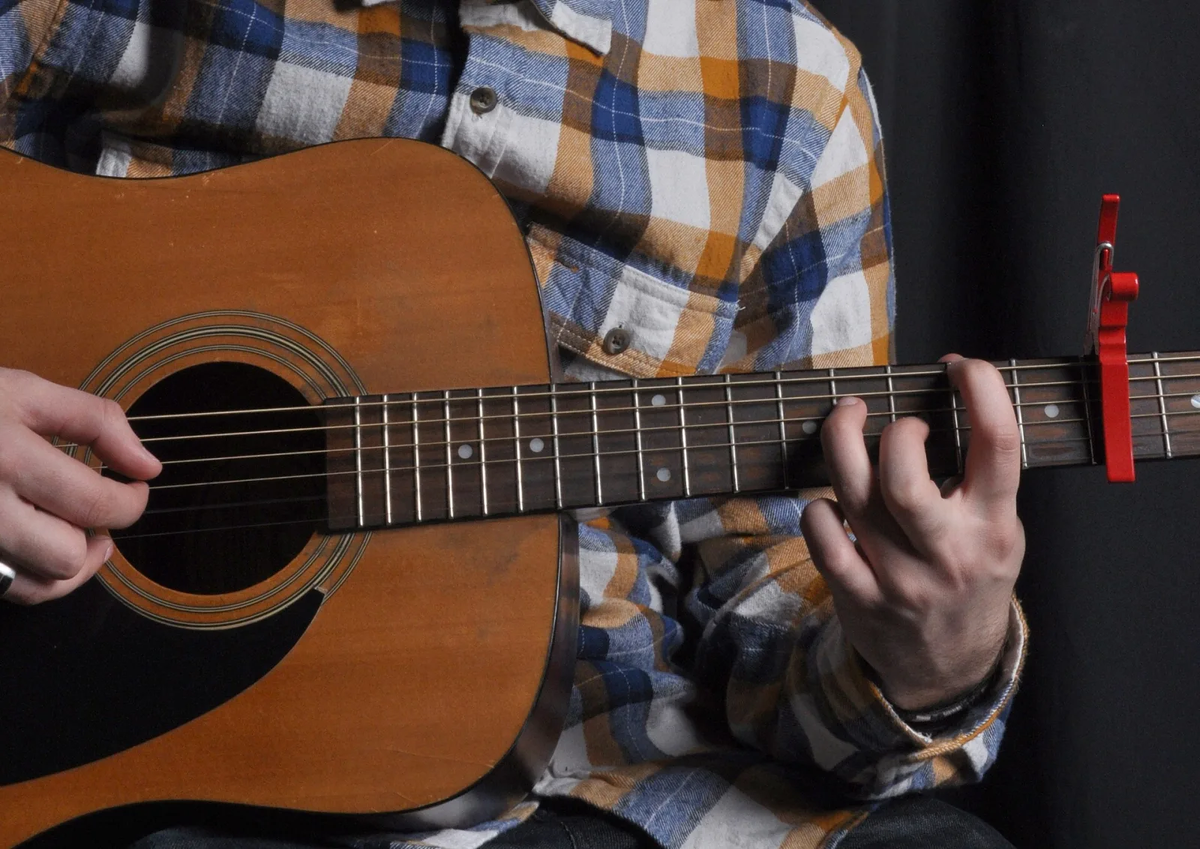
🏷️ Ficha musical
Why this song
Count the chords. There are three, and there are never any more — and yet the chart catalogue files this one as advanced level, which is not a typo.
Now go back to the first two seconds: that low, dragging voice is not Tommy Richman, it is a fragment one of his producers pulled out of a sample pack he found on Reddit.
Historical context
Tommy Richman is from Woodbridge, Virginia, and moved to Los Angeles in 2022. In 2023 the singer Brent Faiyaz signed him as the first artist on his label, ISO Supremacy. Before this song he had never appeared on a sales chart.

Fotograma de una entrevista a Tommy Richman en 2025. Foto: Industry Plants, CC BY 4.0, vía Wikimedia Commons
What went viral was not the song. It was footage of the song being recorded. On 22 April 2024 Richman started posting clips of the studio sessions shot to look like VHS tape. In under a week the snippet passed 9.5 million views on TikTok. The song itself came out on the 26th.
It took 4.6 million US streams on release day and entered the Billboard Hot 100 straight at number 2, from an artist who had never been on that chart at all. It went to number one in New Zealand and Australia, and spent ten straight weeks on top of the TikTok chart — the longest run that chart has ever had.
Musical characteristics
The first thing in is that slowed-down, almost spoken voice, with a synth bass bouncing underneath it. The hi-hats come in short, fast taps: that part is trap.
The rest comes from somewhere else and some other decade. The cowbell, the staccato synths and the falsetto are eighties funk and R&B procedures — Stereogum called it "the Jimmy Jam and Terry Lewis cowbell", after the two producers who filled eighties radio with that sound.
Now the harmony, which is where the trouble starts. Four bars on a loop, one chord per bar: F sharp minor, G sharp minor, B minor, back to F sharp minor. Three different chords, and there are no others anywhere in the song.
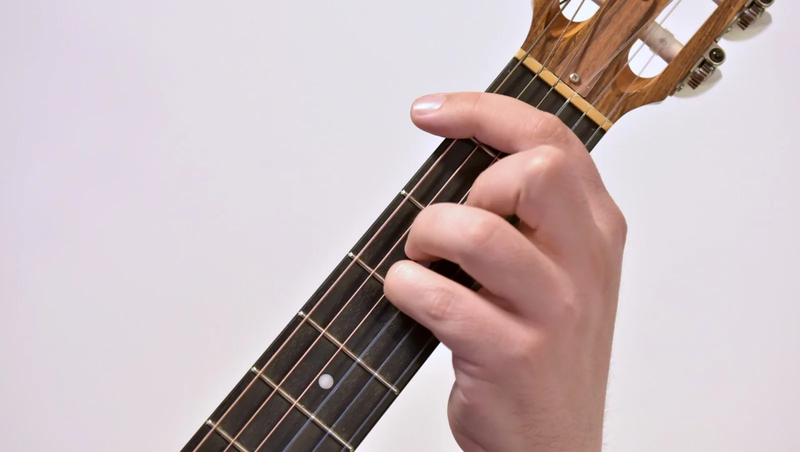
Acorde de La sostenido menor con ceja en guitarra clásica. Foto: Lucian Popescu, CC BY-SA 4.0, vía Wikimedia Commons
The song is in F sharp minor, which carries three sharps in the key signature: F, C and G. For a classroom guitar that means one very concrete thing. None of the three chords can be played with open strings. All three need a barre — the index finger laid flat across all six strings, doing the job the nut does in other keys. On the band chart they sit at frets 2, 4 and 2: three barres, and you have to move them around the neck.
There is a way out, and it is not cheating. Put a capo on the second fret and, without a single sounding note changing, the shapes become E minor shapes: open E minor, open A minor, and one shape in between. That is exactly what the guitar tutorial below does.
Careful with the other option. You can transpose the song into E minor for real, and then it plays itself — but you can no longer play along with the record, because you would be a whole tone below it. Playing along and playing comfortably are two different things, and the capo is the only thing that gives you both.
That leaves the G sharp minor, which is the chord doing the colouring. In a textbook F sharp minor that second degree would be a diminished chord, tense and passing. Here it is a plain G sharp minor, and that smuggles in a D sharp that does not belong to the scale. It is why the loop never quite settles into sad.
One last oddity, this one on the clock. The published figure for the track is 138 beats per minute, but tap your foot and you get half that, which is why some catalogues file it at 70. Both numbers describe the same music: the strong drum hits land at half the rate of the hi-hats. That is called half-time.
Hard facts: F sharp minor (three sharps), 4/4, 138 BPM (70 counted in half-time), 2:35, chords i–ii–iv–i. The form is intro, chorus, verse, chorus, bridge, verse, chorus. The chorus arrives before the verse, which is what you want when the first thing anyone hears is fifteen loose seconds.
Trivia and curiosities
- Nobody sang the hook for this song. Kavi, one of the five credited producers, was going through a sample pack by Canadian producer DJ Smokey that he had found on Reddit, and pulled the low, pitched-down vocal from it. "I was just like, 'Oh, this is sort of hard!'", he told Billboard. "And Tommy agreed." The thing that identifies the whole record was never recorded for it.
- The promotional material was the making-of, not the video. The clips that set the song off are shots of the recording session filmed to look like VHS tape. The object being promoted has stopped being the finished song.
- Afterwards Richman released an official mix called "VHS" that imitates the sound of the TikTok teaser, with a more blown-out bass. The rough copy of his own teaser became something you can buy.
- Three chords and advanced level at once. The difficulty is not in the harmony, it is in where those three chords sit on the neck. A chart catalogue measures what something costs to play, not what it costs to understand.
Classroom activities
- Play: capo on the second fret, then E minor and A minor shapes plus the one in between. With the record underneath it has to line up in tune. The guitar tutorial gives all three fingerings.
- Transpose: write the loop as it is (F#m – G#m – Bm – F#m) and then transposed to E minor. Closed question: why does the E minor version not work with the record, and what do you have to do to make it work without changing it?
- Analyse: tap the pulse through the chorus and count how many hi-hat taps fit between two strong drum hits. Use that number to explain why some charts say 70 BPM and others say 138.
- Create: take three chords from a key with sharps, loop them, and record fifteen seconds that work on their own with no introduction in front. Steal the procedure, not the song.
Key vocabulary
- Sample — sample: un trozo de sonido ya grabado reutilizado en otra canción
- Key signature — armadura
- Barre — ceja (el índice tumbado sobre todas las cuerdas)
- Capo — cejilla de pinza
- Half-time — medio tiempo (los golpes fuertes cada dos tiempos)
Resources
Where it is explained — this song is studied in ¿Por qué las canciones ya no te hacen esperar?, from the modern music history book.
Official video
Guitar tutorial — BMartinSounds. Gives the fingerings with a capo on the second fret, which is the version a class can actually play.
Piano tutorial — PHianonize, easy version with the notes falling on screen.
Bass tutorial — RezaBass, with the tab on screen. This is the line the whole song leans on.
Drums — Steve Howard. He plays the groove up to speed and then takes it apart section by section; it is two bars on repeat.
- Full band chart — https://jamzone.musicwill.org/songs/million-dollar-baby
- Tab — attached below; the button opens it in Songsterr
Por dónde entrar
Es un baile de Fortnite y suena en el Madden NFL 25, así que lo más probable es que ya la tengas en el oído.
Vuelve a los dos primeros segundos: esa voz grave y arrastrada no es la de Tommy Richman, sino un trozo de voz que uno de sus productores encontró en un paquete de samples colgado en Reddit.
Y lo raro es esto: la canción tiene tres acordes y el catálogo de partituras la clasifica como nivel avanzado. No es una errata.
Contexto histórico
Tommy Richman es de Woodbridge, en Virginia, y se mudó a Los Ángeles en 2022. En 2023 el cantante Brent Faiyaz lo fichó como primer artista de su sello, ISO Supremacy. Hasta esta canción no había pisado ninguna lista de ventas.
Fotograma de una entrevista a Tommy Richman en 2025. Foto: Industry Plants, CC BY 4.0, vía Wikimedia Commons
Lo que se hizo viral no fue la canción: fue el vídeo de la canción grabándose. El 22 de abril de 2024 Richman empezó a publicar imágenes de las sesiones filmadas con estética de VHS. En menos de una semana el trozo pasaba de 9,5 millones de reproducciones en TikTok. La canción salió el día 26.
El día del estreno acumuló 4,6 millones de escuchas solo en Estados Unidos, y entró directa al número 2 del Billboard Hot 100 sin que su autor hubiera aparecido nunca antes en esa lista. Diez semanas seguidas en el número uno del ranking de TikTok: el récord de esa lista.
Cómo suena
Lo primero que entra es esa voz ralentizada, casi hablada, y debajo un bajo de sintetizador que no para de botar. Los charles van a golpecitos muy rápidos: eso viene del trap.
Lo demás viene de otro sitio y de otra década. El cencerro, los sintetizadores picados y el falsete son procedimientos del funk y el R&B de los ochenta; la revista Stereogum llegó a llamar al cencerro «el cencerro de Jimmy Jam y Terry Lewis», por los dos productores que llenaron la radio de los ochenta con ese sonido.
Ahora la armonía, que es donde está el problema. Cuatro compases en bucle, un acorde por compás: fa sostenido menor, sol sostenido menor, si menor y vuelta a fa sostenido menor. Tres acordes distintos, y no hay ninguno más en toda la canción.
Acorde de La sostenido menor con ceja en guitarra clásica. Foto: Lucian Popescu, CC BY-SA 4.0, vía Wikimedia Commons
La canción está en fa sostenido menor, que lleva tres sostenidos en la armadura: fa, do y sol. Para una guitarra de clase eso significa algo muy concreto: ninguno de los tres acordes se deja tocar con cuerdas al aire. Los tres piden ceja —el índice tumbado sobre las seis cuerdas, haciendo el trabajo que en otras tonalidades hace la cejuela—. En el chart de banda caen en los trastes 2, 4 y 2: los tres con ceja, y encima moviéndose por el mástil.
Hay una salida, y no es hacer trampa. Pon una cejilla de pinza en el traste 2 y, sin que cambie una sola nota de lo que suena, las posiciones pasan a ser las de mi menor: mi menor al aire, la menor al aire, y una sola forma intermedia. Es exactamente lo que hace el tutorial de guitarra que tienes abajo.
Ojo con la otra opción. Puedes transportar la canción a mi menor de verdad, y entonces se toca sola; pero ya no podrás tocarla con el disco puesto, porque irías un tono por debajo. Tocar con el disco y tocar cómodo son dos cosas distintas, y la pinza es lo único que te da las dos a la vez.
Queda el sol sostenido menor, que es el acorde que pinta. En un fa sostenido menor de manual ese segundo grado tendría que ser un acorde disminuido, tenso y de paso. Aquí es un sol sostenido menor normal, y eso cuela un re sostenido que no pertenece a la escala. Por eso el bucle no acaba de sonar triste: hay una nota tirando hacia arriba todo el rato.
Y una última rareza, esta en el reloj. El dato publicado del corte son 138 pulsos por minuto, pero si marcas el pulso con el pie te sale la mitad, y por eso hay catálogos que la fichan a 70. Las dos cifras describen la misma música: los golpes fuertes de la batería caen a la mitad de velocidad que los charles. A eso se le llama medio tiempo.
Datos duros: fa sostenido menor (tres sostenidos), 4/4, 138 BPM (70 contado a medio tiempo), 2:35, acordes i–ii–iv–i. La forma es intro, estribillo, estrofa, estribillo, puente, estrofa, estribillo. El estribillo llega antes que la estrofa, que es lo que conviene cuando lo primero que va a oír la gente son quince segundos sueltos.
Curiosidades
- El gancho de la canción no lo cantó nadie para esta canción. Kavi, uno de los cinco productores acreditados, iba escuchando un paquete de samples del productor canadiense DJ Smokey que había encontrado en Reddit y sacó de ahí el corte de voz grave del principio. «Pensé: esto está duro», contó a Billboard. «Y Tommy estuvo de acuerdo». Lo que identifica el tema entero es un fragmento que no se grabó para él.
- El material de promoción fue el making of, no el videoclip. Las imágenes que dispararon la canción son planos de la sesión de grabación filmados con aspecto de cinta VHS. El objeto que se promociona ha dejado de ser la canción terminada.
- Después del éxito, Richman publicó una mezcla oficial llamada «VHS» que imita el sonido del adelanto de TikTok, con el bajo más reventado. La copia sucia de un adelanto pasó a venderse como producto.
- Tres acordes y nivel avanzado a la vez. La dificultad no está en la armonía sino en dónde caen esos tres acordes en el mástil. Un catálogo de partituras mide lo que cuesta tocar algo, no lo que cuesta entenderlo.
Para hacer en clase
- Tocar: cejilla de pinza en el traste 2 y las posiciones de mi menor y la menor, más la forma intermedia. Con el disco de fondo tiene que encajar sin desafinar. El tutorial de guitarra da las tres digitaciones.
- Transportar: escribe el bucle tal cual (fa#m – sol#m – sim – fa#m) y después transportado a mi menor. Pregunta cerrada: ¿por qué la versión en mi menor no sirve para tocar con el disco, y qué hay que hacer para que sirva sin cambiarla?
- Analizar: marca el pulso con el pie durante el estribillo y cuenta cuántos golpes de charles caben entre dos golpes fuertes de batería. Con ese número, explica por qué unas fichas dicen 70 BPM y otras 138.
- Crear: coge tres acordes de una tonalidad con sostenidos, ponlos en bucle y graba quince segundos que funcionen solos, sin introducción por delante. Se trata de robar el procedimiento, no la canción.
Vocabulario fundamental
- Sample — Un trozo de sonido ya grabado que se coge y se usa como material dentro de otra canción.
- Armadura — Los sostenidos o bemoles escritos al principio del pentagrama, que valen para toda la pieza. Fa sostenido menor lleva tres.
- Ceja (cejilla) — El índice tumbado sobre todas las cuerdas a la vez, haciendo de cejuela móvil. También se llama cejilla al aparato de pinza que hace lo mismo sin gastar dedo.
- Transportar — Mover toda la música a otra tonalidad, subiendo o bajando lo mismo todas las notas.
- Medio tiempo — Marcar los golpes fuertes cada dos tiempos en lugar de cada uno, de modo que la música parece ir a la mitad de velocidad sin cambiar el tempo.
Recursos
Dónde se explica — esta canción se estudia en ¿Por qué las canciones ya no te hacen esperar?, del libro de historia de la música moderna.
Videoclip oficial
Tutorial de guitarra — BMartinSounds. Da las digitaciones con cejilla de pinza en el traste 2, que es la vía practicable en clase.
Tutorial de piano — PHianonize, versión fácil con las notas cayendo en pantalla.
Tutorial de bajo — RezaBass, con la tablatura en pantalla. Es la línea que sostiene la canción entera.
Batería — Steve Howard. Toca el groove a velocidad y luego lo desmonta sección por sección; son dos compases que se repiten.
- Ficha de banda completa — https://jamzone.musicwill.org/songs/million-dollar-baby
- Tablatura — adjunta abajo; el botón la abre en Songsterr
Why this song
Count the chords. There are three, and there are never any more — and yet the chart catalogue files this one as advanced level, which is not a typo.
Now go back to the first two seconds: that low, dragging voice is not Tommy Richman, it is a fragment one of his producers pulled out of a sample pack he found on Reddit.
Historical context
Tommy Richman is from Woodbridge, Virginia, and moved to Los Angeles in 2022. In 2023 the singer Brent Faiyaz signed him as the first artist on his label, ISO Supremacy. Before this song he had never appeared on a sales chart.
Fotograma de una entrevista a Tommy Richman en 2025. Foto: Industry Plants, CC BY 4.0, vía Wikimedia Commons
What went viral was not the song. It was footage of the song being recorded. On 22 April 2024 Richman started posting clips of the studio sessions shot to look like VHS tape. In under a week the snippet passed 9.5 million views on TikTok. The song itself came out on the 26th.
It took 4.6 million US streams on release day and entered the Billboard Hot 100 straight at number 2, from an artist who had never been on that chart at all. It went to number one in New Zealand and Australia, and spent ten straight weeks on top of the TikTok chart — the longest run that chart has ever had.
Musical characteristics
The first thing in is that slowed-down, almost spoken voice, with a synth bass bouncing underneath it. The hi-hats come in short, fast taps: that part is trap.
The rest comes from somewhere else and some other decade. The cowbell, the staccato synths and the falsetto are eighties funk and R&B procedures — Stereogum called it "the Jimmy Jam and Terry Lewis cowbell", after the two producers who filled eighties radio with that sound.
Now the harmony, which is where the trouble starts. Four bars on a loop, one chord per bar: F sharp minor, G sharp minor, B minor, back to F sharp minor. Three different chords, and there are no others anywhere in the song.
Acorde de La sostenido menor con ceja en guitarra clásica. Foto: Lucian Popescu, CC BY-SA 4.0, vía Wikimedia Commons
The song is in F sharp minor, which carries three sharps in the key signature: F, C and G. For a classroom guitar that means one very concrete thing. None of the three chords can be played with open strings. All three need a barre — the index finger laid flat across all six strings, doing the job the nut does in other keys. On the band chart they sit at frets 2, 4 and 2: three barres, and you have to move them around the neck.
There is a way out, and it is not cheating. Put a capo on the second fret and, without a single sounding note changing, the shapes become E minor shapes: open E minor, open A minor, and one shape in between. That is exactly what the guitar tutorial below does.
Careful with the other option. You can transpose the song into E minor for real, and then it plays itself — but you can no longer play along with the record, because you would be a whole tone below it. Playing along and playing comfortably are two different things, and the capo is the only thing that gives you both.
That leaves the G sharp minor, which is the chord doing the colouring. In a textbook F sharp minor that second degree would be a diminished chord, tense and passing. Here it is a plain G sharp minor, and that smuggles in a D sharp that does not belong to the scale. It is why the loop never quite settles into sad.
One last oddity, this one on the clock. The published figure for the track is 138 beats per minute, but tap your foot and you get half that, which is why some catalogues file it at 70. Both numbers describe the same music: the strong drum hits land at half the rate of the hi-hats. That is called half-time.
Hard facts: F sharp minor (three sharps), 4/4, 138 BPM (70 counted in half-time), 2:35, chords i–ii–iv–i. The form is intro, chorus, verse, chorus, bridge, verse, chorus. The chorus arrives before the verse, which is what you want when the first thing anyone hears is fifteen loose seconds.
Trivia and curiosities
- Nobody sang the hook for this song. Kavi, one of the five credited producers, was going through a sample pack by Canadian producer DJ Smokey that he had found on Reddit, and pulled the low, pitched-down vocal from it. "I was just like, 'Oh, this is sort of hard!'", he told Billboard. "And Tommy agreed." The thing that identifies the whole record was never recorded for it.
- The promotional material was the making-of, not the video. The clips that set the song off are shots of the recording session filmed to look like VHS tape. The object being promoted has stopped being the finished song.
- Afterwards Richman released an official mix called "VHS" that imitates the sound of the TikTok teaser, with a more blown-out bass. The rough copy of his own teaser became something you can buy.
- Three chords and advanced level at once. The difficulty is not in the harmony, it is in where those three chords sit on the neck. A chart catalogue measures what something costs to play, not what it costs to understand.
Classroom activities
- Play: capo on the second fret, then E minor and A minor shapes plus the one in between. With the record underneath it has to line up in tune. The guitar tutorial gives all three fingerings.
- Transpose: write the loop as it is (F#m – G#m – Bm – F#m) and then transposed to E minor. Closed question: why does the E minor version not work with the record, and what do you have to do to make it work without changing it?
- Analyse: tap the pulse through the chorus and count how many hi-hat taps fit between two strong drum hits. Use that number to explain why some charts say 70 BPM and others say 138.
- Create: take three chords from a key with sharps, loop them, and record fifteen seconds that work on their own with no introduction in front. Steal the procedure, not the song.
Key vocabulary
- Sample — sample: un trozo de sonido ya grabado reutilizado en otra canción
- Key signature — armadura
- Barre — ceja (el índice tumbado sobre todas las cuerdas)
- Capo — cejilla de pinza
- Half-time — medio tiempo (los golpes fuertes cada dos tiempos)
Resources
Where it is explained — this song is studied in ¿Por qué las canciones ya no te hacen esperar?, from the modern music history book.
Official video
Guitar tutorial — BMartinSounds. Gives the fingerings with a capo on the second fret, which is the version a class can actually play.
Piano tutorial — PHianonize, easy version with the notes falling on screen.
Bass tutorial — RezaBass, with the tab on screen. This is the line the whole song leans on.
Drums — Steve Howard. He plays the groove up to speed and then takes it apart section by section; it is two bars on repeat.
- Full band chart — https://jamzone.musicwill.org/songs/million-dollar-baby
- Tab — attached below; the button opens it in Songsterr