Contenidos
Me gustas tú — Manu Chao (2001)
A list of things he likes, three chords that never change and a guitar that plays right between the beats. With that recipe, Manu Chao went to number 1 in Spain in 2001.

🏷️ Ficha musical
Why it's in this book
"Me gustas tú" comes in May, at the end of the year, next to "Someone You Loved". It is the only song in the book with the i–♭VII–iv loop: three chords, A minor, G and D minor in the class version, repeated from start to finish. Because the harmony never changes, all your attention can go somewhere else: the words. The lyrics are a list, and here you write your own list and speak it over the loop. In the room with no instruments, the skank goes in off-beat claps and the choir answers "¿qué voy a hacer?". In the ukulele room, the three chords with a reggae strum. In the music room, the whole band plays the skank.
Why this song
You have probably heard it without knowing who it was by: in a café, on a beach, on a summer playlist. In 2025 Dua Lipa sang it at a concert in Madrid, and that same year the Italian singer Alfa used its chorus in a new song that went to number 1 in Italy. Twenty-five years on, it is still around.
The question on this page is: can you build a whole song on three chords that never change? Here the answer is yes, and the trick is precisely that they don't change.
Historical context
Manu Chao was born in Paris in 1961 to Spanish parents. In the late eighties he started Mano Negra, a band that mixed punk, rock, rumba and reggae and sang in several languages. When the band split up, he travelled around Latin America with a recorder, collecting sounds and songs.
His solo music came out of that trip. "Me gustas tú" is on his second album, Próxima estación: Esperanza, from 2001. It came out as a single on 14 May 2001 and was number 1 in Spain until 11 June, almost a month.
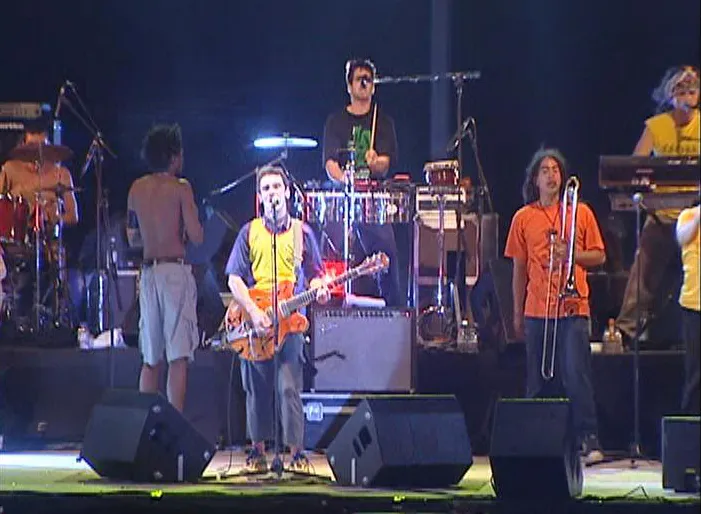
Foto: Mikel González, CC BY-SA 2.5 es, vía Wikimedia Commons
Manu Chao in Gijón, Spain, in September 2001, the year of "Me gustas tú". Look at the band: drums, percussion, a trombone and a keyboard. On the record everything sounds much smaller.
The album works like a collage. There are radio voices, street noises and backing tracks that come back from one song to another. The backing music of "Me gustas tú" is the same as in two other songs on the album, "La primavera" and "Infinita tristeza". Manu Chao doesn't write a new backing for each song: he reuses the same one and puts new words on top.
Musical characteristics
A radio voice. The song opens with a voice giving the time, like a news bulletin. It comes from Radio Reloj, a Cuban station. It is a found sound, not a sung one: Manu Chao sticks it into the song the way you might stick a photo into a notebook.
Three chords on a loop. Underneath everything there are three chords: B minor, A and E minor. They repeat in that order from start to finish. A set of chords that comes round again and again is a chord loop. The verse and the chorus use exactly the same one. In scale degrees it is i–♭VII–iv: the first degree, the one a tone below it, and the fourth.
The missing beat. Listen to the guitar. It doesn't play when you clap on the beat, but right between two claps. Playing in that gap is called playing on the off-beat, and in reggae it has its own name: the skank. It gives the song its lazy sway.
Fast and slow at once. If you count every little tap of the percussion, you get a fast count of about 176 per minute. But your foot doesn't go that fast: it marks one in two, about 88. That's why the song seems to run and stroll at the same time.
A list instead of a story. The lyrics don't tell a story. They are a list of things he likes, and each round ends on the same idea: but it's you I like. When a phrase repeats the same way while everything else changes, it works like an ostinato made of words.
In class. The record is in B minor. In class we take it down a tone, to A minor: A minor, G and D minor, three easy ukulele chords. The melody also drops a tone and sits more comfortably for voices that are changing.
Hard facts: B minor, 4/4, 176 beats per minute in the fast count (88 at walking pace), 3:58. The form: radio voice at the start, list verses and chorus, all on the same three-chord loop.
Guided listening
Play the album version, the official audio. The music video is cut short.
At the very start, before he sings, listen to the voice giving the time. Does it sound sung, or recorded off the radio?
When the first verse comes in, clap on every beat. Now listen to the guitar: it plays in the gap between your claps. That is the skank.
During the verse, sing "B minor, A, E minor" in your head at each change. Check that the loop never breaks.
When the chorus arrives, notice the language. It switches to another language without the music changing.
At the end, ask yourself what has changed since the beginning. Not the chords. Look for what has: the voices, the effects, the sounds stuck on top.
Trivia and curiosities
- One backing, three songs. "Me gustas tú", "La primavera" and "Infinita tristeza" share the same backing music. On the album, one fades into the next. Proof that one loop can carry many different lyrics.
- Havana time. The voices at the start give the time in Havana and in San Salvador. They come from Radio Reloj, a Cuban station that broadcasts the time and the news non-stop.
- Filmed in Colombia. The music video was shot in Urrao, a town in Antioquia, Colombia. At the end the Spanish actress Paz Gómez dances in it.
- Twenty-five years later. In 2025 the Italian singer Alfa released "A me mi piace", featuring Manu Chao, which picks up the melody of the chorus. It went to number 1 in Italy, just like the original in 2001.
Classroom activities
- The skank in your body. In the room with no instruments: feet mark the slow beat and hands clap in the gap, on the off-beat. When it works, play the song and check that your claps line up with the guitar.
- Three chords, non-stop. Ukulele: A minor, G, D minor, over and over. First, a downstroke on every beat. Then only on the off-beat, muting the strings with your palm between strokes.
- Your list. In groups of four, write a list of eight things you like, one per line, and close every two lines with the same phrase. Speak it, with no melody, over the loop.
- Answering choir. While one group speaks its list, everyone else answers with the "¿qué voy a hacer?" chorus at the end of each round.
- Band. In the music room: drums and bass keep the slow beat, electric guitar and keyboard play the skank, and everyone else stays on ukulele. The spoken list goes on top.
Key vocabulary
- Chord loop — bucle armónico
- Off-beat — contratiempo: in the gap between two beats
- Skank — skank: the off-beat guitar stroke of reggae
- Ostinato — ostinato: something repeated the same way again and again
Resources
Official music video — Filmed in Urrao, Colombia. It is a shortened version of the song.
Official audio — The full album version, with the radio voice at the start. Use this one for the guided listening.
Ukulele tutorial — 100 Lecciones de Ukelele, in Spanish. An easy version.
Guitar tutorial — Karma Guitar, in Spanish. An easy version for beginners.
Piano tutorial — PHianonize. An easy version.
Drums — FaAaBNorriS. A drum version over the recording.
Por qué está en este libro
«Me gustas tú» llega en mayo, al final del curso, junto a «Someone You Loved». Es la única canción del libro con la vuelta i–♭VII–iv: tres acordes, la menor, sol y re menor en la versión de clase, que se repiten de principio a fin. Como la armonía no cambia nunca, toda tu atención puede ir a otra cosa: el texto. La letra es una lista, y aquí la escribís vosotros, con vuestra propia lista, y la decís con voz hablada encima del bucle. En el aula sin nada, el skank va en palmas a contratiempo y el coro responde «¿qué voy a hacer?». En el aula de ukeleles, los tres acordes con el rasgueo del reggae. En el aula de música, la banda entera toca el skank.
Por dónde entrar
Es probable que la hayas oído sin saber de quién era: en un bar, en una playa, en una lista de canciones del verano. En 2025 Dua Lipa la cantó en un concierto en Madrid, y ese mismo año el italiano Alfa la usó de estribillo para una canción nueva que fue número 1 en Italia. Veinticinco años después, sigue viva.
La pregunta de esta página es: ¿se puede hacer una canción entera con tres acordes que nunca cambian? Aquí la respuesta es sí, y además el truco es que no cambien.
Contexto histórico
Manu Chao nació en París en 1961, hijo de padres españoles. A finales de los ochenta montó Mano Negra, un grupo que mezclaba punk, rock, rumba y reggae y cantaba en varios idiomas. Cuando el grupo se deshizo, empezó a viajar por América Latina con una grabadora, recogiendo sonidos y canciones.
De ese viaje salió su música en solitario. «Me gustas tú» está en su segundo disco, Próxima estación: Esperanza, de 2001. Salió como sencillo el 14 de mayo de 2001 y fue número 1 en España hasta el 11 de junio, casi un mes.
Foto: Mikel González, CC BY-SA 2.5 es, vía Wikimedia Commons
Manu Chao en Gijón, en septiembre de 2001, el año de «Me gustas tú». Fíjate en la banda: batería, percusión, trombón y teclado. En el disco suena todo mucho más pequeño.
El disco funciona como un collage. Hay voces de radio, ruidos de calle y bases que vuelven de una canción a otra. La música de fondo de «Me gustas tú» es la misma que la de otras dos canciones del disco, «La primavera» e «Infinita tristeza». Manu Chao no compone una base para cada canción: reutiliza la misma y le pone otra letra encima.
Cómo suena
Una voz de radio. La canción empieza con una voz que da la hora, como en un boletín de noticias. Es de Radio Reloj, una emisora cubana. Es un sonido encontrado, no cantado: Manu Chao lo pega en la canción como quien pega una foto en un cuaderno.
Tres acordes en bucle. Debajo de todo hay tres acordes: si menor, la y mi menor. Se repiten en ese orden de principio a fin, sin descanso. Una serie de acordes que vuelve una y otra vez es un bucle armónico. La estrofa y el estribillo usan exactamente el mismo. Si los grados te suenan, es i–♭VII–iv: el primero de la escala, el que está un tono por debajo, y el cuarto.
El golpe que falta. Escucha la guitarra. No toca cuando tú das la palmada en el pulso, sino justo entre dos palmadas. Tocar en ese hueco se llama tocar a contratiempo, y en el reggae tiene nombre propio: skank. Es lo que da a la canción ese balanceo perezoso.
Rápida y lenta a la vez. Si cuentas todos los golpecitos de la percusión, sale una cuenta rápida, de unos 176 por minuto. Pero tu pie no va a esa velocidad: marca uno de cada dos, unos 88. Por eso la canción parece que corre y que pasea al mismo tiempo.
Una lista en vez de una historia. La letra no cuenta nada. Es una lista de cosas que le gustan, y cada vuelta termina en la misma idea: me gustas tú. Cuando una frase se repite igual una y otra vez mientras todo lo demás cambia, funciona como un ostinato hecho con palabras.
En clase. El disco está en Si menor. En clase la bajamos un tono, a La menor: la menor, sol y re menor, tres acordes fáciles de ukelele. Además, la melodía baja también un tono y queda más cómoda para las voces que están cambiando.
Datos duros: Si menor, 4/4, 176 pulsos por minuto en la cuenta rápida (88 al paso), 3:58. La forma: voz de radio al principio, estrofas en lista y estribillo, todo sobre el mismo bucle de tres acordes.
Escucha guiada
Pon la versión del disco, la del audio oficial. El videoclip está recortado.
Al principio, antes de que cante, escucha la voz que da la hora. ¿Te parece cantada o grabada de una radio?
Cuando entre la primera estrofa, da una palmada en cada pulso. Ahora escucha la guitarra: toca en el hueco entre tus palmadas. Eso es el skank.
Durante la estrofa, canta por dentro «si menor, la, mi menor» con cada cambio. Comprueba que la vuelta no se rompe nunca.
Cuando llegue el estribillo, fíjate en el idioma. Cambia a otra lengua sin que cambie la música.
Al final, pregúntate qué ha cambiado desde el principio. Los acordes no. Busca lo que sí: las voces, los efectos, los sonidos pegados encima.
Curiosidades
- Una base para tres canciones. «Me gustas tú», «La primavera» e «Infinita tristeza» tienen la misma música de fondo. En el disco, una se funde con la siguiente. Es la prueba de que un bucle puede sostener muchas letras distintas.
- La hora de La Habana. Las voces del principio dan la hora en La Habana y en San Salvador. Son de Radio Reloj, una emisora cubana que da la hora y las noticias sin parar.
- Rodado en Colombia. El videoclip se grabó en Urrao, un pueblo de Antioquia, en Colombia. Al final aparece bailando la actriz española Paz Gómez.
- Veinticinco años después. En 2025, el cantante italiano Alfa sacó «A me mi piace», con Manu Chao, que retoma la melodía del estribillo. Llegó al número 1 en Italia, igual que la original en 2001.
Para hacer en clase
- El skank en el cuerpo. En el aula sin nada: los pies marcan el pulso lento y las palmas van en el hueco, a contratiempo. Cuando salga, poned la canción y comprobad que vuestras palmas coinciden con la guitarra.
- Tres acordes, sin parar. Ukelele: la menor, sol, re menor, una y otra vez. Primero rasgueo hacia abajo en cada pulso. Después, solo en el contratiempo, apagando las cuerdas con la palma entre golpe y golpe.
- Vuestra lista. En grupos de cuatro, escribid una lista de ocho cosas que os gustan, una por línea, y cerrad cada dos líneas con la misma frase. Decidla con voz hablada, sin melodía, encima del bucle.
- Coro de respuesta. Mientras un grupo dice su lista, el resto responde con el coro «¿qué voy a hacer?» al final de cada vuelta.
- Banda. En el aula de música: batería y bajo marcan el pulso lento, la guitarra eléctrica y el teclado tocan el skank y el resto sigue con ukelele. La lista hablada va encima.
Vocabulario fundamental
- Bucle armónico — Una serie de acordes que se repite sin parar. Aquí, si menor, la y mi menor.
- Contratiempo — Tocar en el hueco entre dos pulsos, no encima de ellos.
- Skank — El golpe de guitarra a contratiempo del reggae.
- Ostinato — Algo que se repite igual una y otra vez. Aquí, hasta la frase del título.
Recursos
Videoclip oficial — Rodado en Urrao (Colombia). Es una versión recortada de la canción.
Audio oficial — La versión entera del disco, con la voz de radio del principio. Para la escucha guiada, usa esta.
Tutorial de ukelele — 100 Lecciones de Ukelele, en castellano. Versión fácil.
Tutorial de guitarra — Karma Guitar, en castellano. Versión fácil para principiantes.
Tutorial de piano — PHianonize. Versión fácil.
Batería — FaAaBNorriS. Versión de batería sobre la grabación.
Why it's in this book
"Me gustas tú" comes in May, at the end of the year, next to "Someone You Loved". It is the only song in the book with the i–♭VII–iv loop: three chords, A minor, G and D minor in the class version, repeated from start to finish. Because the harmony never changes, all your attention can go somewhere else: the words. The lyrics are a list, and here you write your own list and speak it over the loop. In the room with no instruments, the skank goes in off-beat claps and the choir answers "¿qué voy a hacer?". In the ukulele room, the three chords with a reggae strum. In the music room, the whole band plays the skank.
Why this song
You have probably heard it without knowing who it was by: in a café, on a beach, on a summer playlist. In 2025 Dua Lipa sang it at a concert in Madrid, and that same year the Italian singer Alfa used its chorus in a new song that went to number 1 in Italy. Twenty-five years on, it is still around.
The question on this page is: can you build a whole song on three chords that never change? Here the answer is yes, and the trick is precisely that they don't change.
Historical context
Manu Chao was born in Paris in 1961 to Spanish parents. In the late eighties he started Mano Negra, a band that mixed punk, rock, rumba and reggae and sang in several languages. When the band split up, he travelled around Latin America with a recorder, collecting sounds and songs.
His solo music came out of that trip. "Me gustas tú" is on his second album, Próxima estación: Esperanza, from 2001. It came out as a single on 14 May 2001 and was number 1 in Spain until 11 June, almost a month.
Foto: Mikel González, CC BY-SA 2.5 es, vía Wikimedia Commons
Manu Chao in Gijón, Spain, in September 2001, the year of "Me gustas tú". Look at the band: drums, percussion, a trombone and a keyboard. On the record everything sounds much smaller.
The album works like a collage. There are radio voices, street noises and backing tracks that come back from one song to another. The backing music of "Me gustas tú" is the same as in two other songs on the album, "La primavera" and "Infinita tristeza". Manu Chao doesn't write a new backing for each song: he reuses the same one and puts new words on top.
Musical characteristics
A radio voice. The song opens with a voice giving the time, like a news bulletin. It comes from Radio Reloj, a Cuban station. It is a found sound, not a sung one: Manu Chao sticks it into the song the way you might stick a photo into a notebook.
Three chords on a loop. Underneath everything there are three chords: B minor, A and E minor. They repeat in that order from start to finish. A set of chords that comes round again and again is a chord loop. The verse and the chorus use exactly the same one. In scale degrees it is i–♭VII–iv: the first degree, the one a tone below it, and the fourth.
The missing beat. Listen to the guitar. It doesn't play when you clap on the beat, but right between two claps. Playing in that gap is called playing on the off-beat, and in reggae it has its own name: the skank. It gives the song its lazy sway.
Fast and slow at once. If you count every little tap of the percussion, you get a fast count of about 176 per minute. But your foot doesn't go that fast: it marks one in two, about 88. That's why the song seems to run and stroll at the same time.
A list instead of a story. The lyrics don't tell a story. They are a list of things he likes, and each round ends on the same idea: but it's you I like. When a phrase repeats the same way while everything else changes, it works like an ostinato made of words.
In class. The record is in B minor. In class we take it down a tone, to A minor: A minor, G and D minor, three easy ukulele chords. The melody also drops a tone and sits more comfortably for voices that are changing.
Hard facts: B minor, 4/4, 176 beats per minute in the fast count (88 at walking pace), 3:58. The form: radio voice at the start, list verses and chorus, all on the same three-chord loop.
Guided listening
Play the album version, the official audio. The music video is cut short.
At the very start, before he sings, listen to the voice giving the time. Does it sound sung, or recorded off the radio?
When the first verse comes in, clap on every beat. Now listen to the guitar: it plays in the gap between your claps. That is the skank.
During the verse, sing "B minor, A, E minor" in your head at each change. Check that the loop never breaks.
When the chorus arrives, notice the language. It switches to another language without the music changing.
At the end, ask yourself what has changed since the beginning. Not the chords. Look for what has: the voices, the effects, the sounds stuck on top.
Trivia and curiosities
- One backing, three songs. "Me gustas tú", "La primavera" and "Infinita tristeza" share the same backing music. On the album, one fades into the next. Proof that one loop can carry many different lyrics.
- Havana time. The voices at the start give the time in Havana and in San Salvador. They come from Radio Reloj, a Cuban station that broadcasts the time and the news non-stop.
- Filmed in Colombia. The music video was shot in Urrao, a town in Antioquia, Colombia. At the end the Spanish actress Paz Gómez dances in it.
- Twenty-five years later. In 2025 the Italian singer Alfa released "A me mi piace", featuring Manu Chao, which picks up the melody of the chorus. It went to number 1 in Italy, just like the original in 2001.
Classroom activities
- The skank in your body. In the room with no instruments: feet mark the slow beat and hands clap in the gap, on the off-beat. When it works, play the song and check that your claps line up with the guitar.
- Three chords, non-stop. Ukulele: A minor, G, D minor, over and over. First, a downstroke on every beat. Then only on the off-beat, muting the strings with your palm between strokes.
- Your list. In groups of four, write a list of eight things you like, one per line, and close every two lines with the same phrase. Speak it, with no melody, over the loop.
- Answering choir. While one group speaks its list, everyone else answers with the "¿qué voy a hacer?" chorus at the end of each round.
- Band. In the music room: drums and bass keep the slow beat, electric guitar and keyboard play the skank, and everyone else stays on ukulele. The spoken list goes on top.
Key vocabulary
- Chord loop — bucle armónico
- Off-beat — contratiempo: in the gap between two beats
- Skank — skank: the off-beat guitar stroke of reggae
- Ostinato — ostinato: something repeated the same way again and again
Resources
Official music video — Filmed in Urrao, Colombia. It is a shortened version of the song.
Official audio — The full album version, with the radio voice at the start. Use this one for the guided listening.
Ukulele tutorial — 100 Lecciones de Ukelele, in Spanish. An easy version.
Guitar tutorial — Karma Guitar, in Spanish. An easy version for beginners.
Piano tutorial — PHianonize. An easy version.
Drums — FaAaBNorriS. A drum version over the recording.