Contenidos
¿Cuánto cuesta una canción cuando hay que copiarla a mano?
Your phone holds more music than any king in Europe could own in 1500. Not because he was poor, but because every single copy had to be written out by hand. This unit is about the years that stopped being true.
We ask ourselves
- What does it mean to own a song, when owning it means owning the only written copy?
- How long does one person take to copy a whole book of music by hand?
- Who paid musicians when there were no tickets, no records and no streaming?
- Why is almost all the music of this period in four voices, and not three or seven?
- Your voice is an instrument you did not choose and cannot swap. What do you do when it changes shape on you?
- If nobody writes a piece of music down, is it lost?
Don't answer yet. We come back to these at the end.
The fragment
Before any music, we measure ourselves. Everyone sings one comfortable note and holds it. Then down to the lowest note you can hold without it breaking, then up to the highest you can hold without shouting.
What lies between those two ends is your range. The middle part, where the sound comes out easily and you could sing for a while, is your tessitura. They are not the same thing, and the one used to divide a choir is the second.
With that we draw four columns on the board: soprano, alto, tenor and bass. Names of parts, not labels for people. If you have done it honestly, yours is where singing is easy, not where you wish you could reach.
Here one thing has to be said without any drama. For several of you the tessitura is moving this year. In boys the change usually falls between eleven and fifteen, averaging around fourteen and a half, and the difference between a boy's voice and a man's is an octave. In girls it comes earlier and is smaller: roughly a third.
So today's column is not the same as the one in three months. You stand where it feels easy today, and we measure again next term. The one thing worth avoiding during those months is forcing: pushing on notes that no longer come out.
Now the duet. We sing No tienen vado mis males, by Juan del Encina, in two parts: the two low columns take the bottom line, the two high columns take the top. We learn it by ear, phrase by phrase, from the recording.
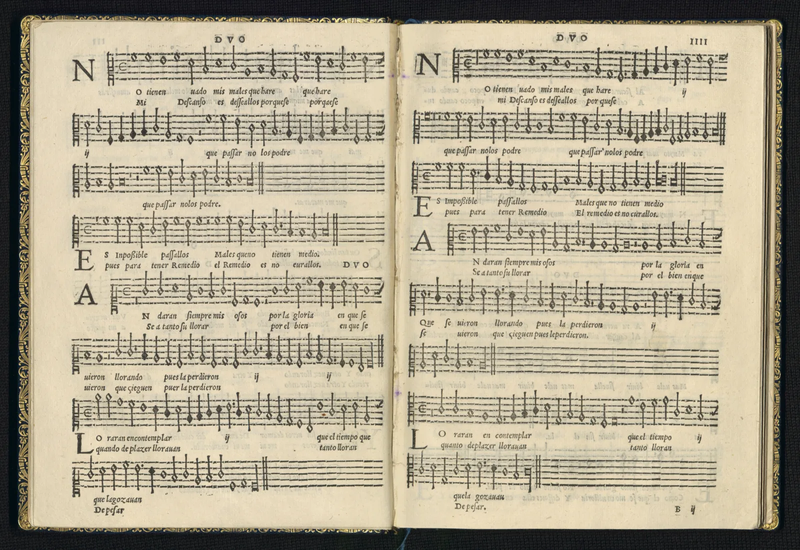
Foto: Uppsala universitetsbibliotek, dominio público, vía Wikimedia Commons
That is the page we sing it from, exactly as it was sold. It was printed in Venice in 1556, and the word across the top of both pages is DVO: duet, two voices, one per page. Each singer reads their own, and a different duet starts below.
And then the whole piece with nobody talking over it: "Cucú, cucú" by Encina, four voices and four people.
What changed
Start with what came before. The Cancionero de Palacio collects the music sung at the court of the Catholic Monarchs. Its index announces 548 pieces; 469 survive, and Juan del Encina signs 63 of them.
Of that songbook there is one manuscript. One. It sits in the Real Biblioteca in Madrid under the shelfmark MS II-1335. For that music to sound anywhere else, somebody had to copy the whole thing by hand, stave by stave. One book, one court, one place.
In 1498 a printer called Ottaviano Petrucci asked the Doge of Venice for the exclusive right to print music for twenty years. Nobody asks for a twenty-year monopoly on something that makes no money. That single fact explains most of what follows.
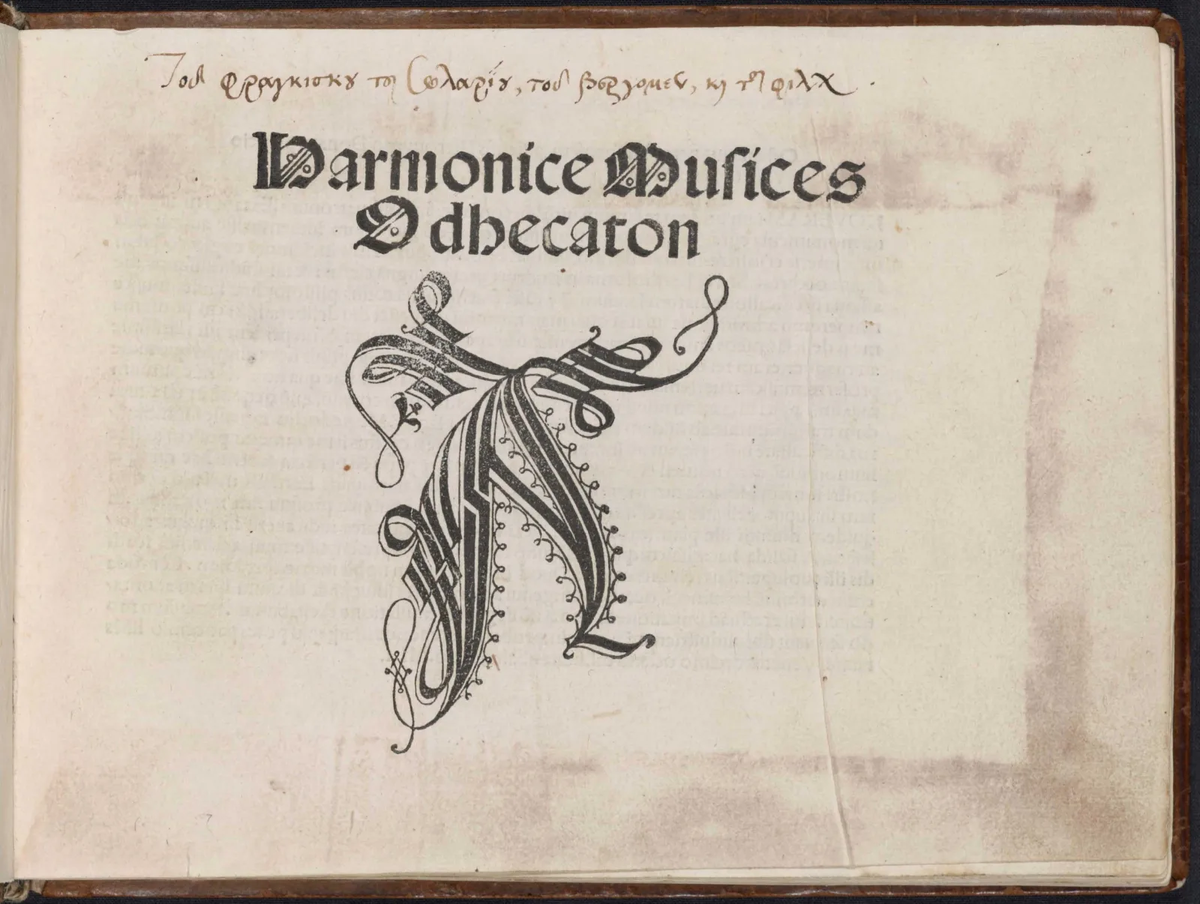
His first book appears in 1501 and is called Harmonice Musices Odhecaton: ninety-six songs, with a dedication dated 15 May. You will often read that it was the first printed music, and it was not: Ulrich Han had already printed a Missale Romanum with movable type in 1476. Petrucci's first was something else, and harder: polyphony, several different voices sounding at once.
Hard because his method put every sheet through the press three times. Once for the staves, once for the notes, once for the words. Three passes, three chances for the sheet to come out crooked. It was slow and expensive, and it still multiplied: where a copyist made one copy, the press made a run.
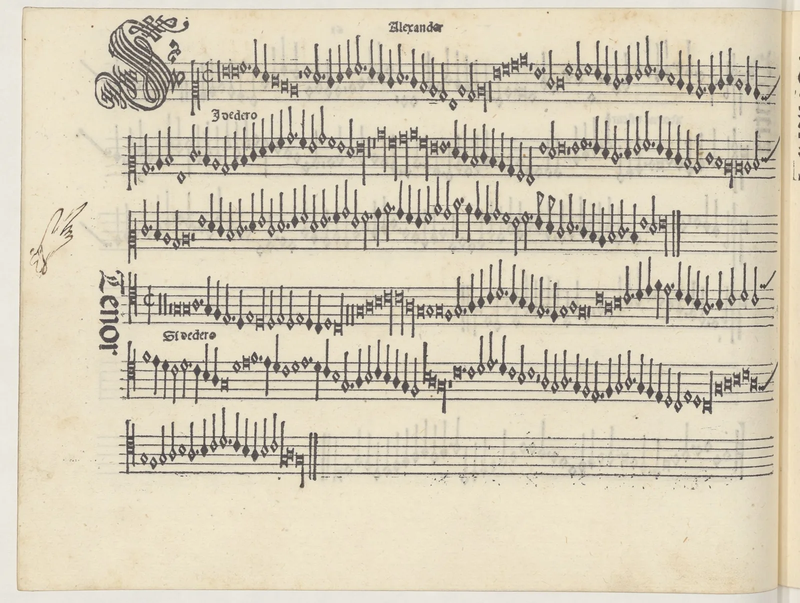
Foto: Bibliothèque nationale de France, dominio público, vía Wikimedia Commons
Look at the page and count. Petrucci printed two voices on the left-hand page and two on the right, so four people could read from the same open book. Four is also the normal number of voices in this music.
Did one cause the other? I don't know, and anyone who tells you they are sure is overreaching. What can be said is that the shape of the object and the shape of the music fit together suspiciously well.
Those four voices had names, and this is the part that matters to us. From top to bottom: Cantus or Superius, Contratenor Altus, Tenor and Contratenor Bassus. In time the Altus stayed Altus and the Bassus stayed Bassus.
The Tenor was not the one singing high and showing off. It was the voice that held the borrowed melody, the tune that already existed before the rest was written. The other three were built around it.
Those four names are the four on your board: soprano from the top line, alto from the Altus, tenor from the Tenor, bass from the Bassus. The words you use to split a choir today are the names of lines in a sixteenth-century book.
And it changed who gets paid. Josquin des Prez earned 200 ducats in the ducal chapel of Ferrara, the highest salary a member of that chapel had ever had. He was also the first Western composer to keep his fame after death, which is no coincidence: his name was printed on books that went on circulating.
Hard facts. Petrucci, Venice: privilege requested 1498, first book 1501, three passes through the press. Before that: Ulrich Han, Missale Romanum, 1476. The manuscript songbook: 548 pieces in the index, 469 surviving, a single copy. The four voices: Superius, Altus, Tenor, Bassus.
The same device elsewhere
The device is splitting several independent voices by pitch, each with its own line. The Renaissance did not invent it and printing was never required for it. These three are worth hearing back to back:
- Birds of a Feather, Billie Eilish — several voices sound at once in the chorus. Count how many you hear, then decide how many people you think are in the room. Those are not the same number, and finding out why is the point.
- O magnum mysterium, Tomás Luis de Victoria — four voices, four people, no equipment. Each one enters separately and you can follow them one at a time.
- Georgian polyphonic singing — three independent voices passed on by ear, from parents to children. It never needed printing and it is still sung.
None is better than the others. All three split voices by pitch. One solves it with a machine, one with a book and one with memory, and all three work.
And here at home?
In this century Spain is not behind: it is ahead. Tomás Luis de Victoria (c. 1548-1611) published his books in Venice in 1572 and 1576, in Rome in 1581, 1583 and 1585, and in Madrid in 1600 and 1605, the last of these on the royal press and in editions described as sumptuous.
Look at whom they are dedicated to, because that is the answer to who paid: a cardinal, a duke, a pope, Philip II, Philip III, Princess Margaret. A printed book needed a name on the front page willing to put up the money.
Victoria also handed books out. In 1573 he gave Ávila cathedral six bound volumes of music, and did it again in 1577, 1584, 1587 and 1593. A composer giving his own output to the institutions that could perform it: that is distribution, even if nobody called it that.
Francisco Guerrero, chapel master at Seville from 1574 to 1599, travelled to Venice in 1581 and stayed until 1582 preparing his own editions. His music ended up being sung in the cathedrals of Puebla and Cuzco. Printed music crossed the Atlantic ahead of almost anything Spanish that was not an order or a tax.
The most awkward case is the Cancionero de Upsala, the book our duet comes from. They are villancicos in Spanish, printed in Venice in 1556 by Girolamo Scotto: seventy pieces, of which 54 are villancicos for two, three, four and five voices.
The title page says who it is for: "para que puedan aprovechar los que a cantar comenzaren" — so that beginners at singing may profit from it. A book of Spanish songs, manufactured in Italy, sold to people who were still learning. That is an industry, with its customer named on the cover.
One single copy survives anywhere in the world. The musicologist Rafael Mitjana found it around 1907 in the university library of Uppsala, in Sweden, which is where the name comes from. Spanish music, printed abroad and preserved abroad: the price of having no press of your own.
In Zaragoza the question of who pays is answered by looking at two buildings. La Seo and the Pilar each had their own musical chapel and had been at odds for centuries. The Pilar had an organ in 1463, built by Enrique de Colonia, and in 1537 Martín de Córdoba built it a new one to compete with the cathedral's. Paying for music was a way of winning the argument.
Melchor Robledo (c. 1510-1586) was chapel master at the Pilar and, from 2 July 1569 until his death, at La Seo. His work survives scattered across the cathedrals of Ávila, Huesca, Palencia, Tarazona, Toledo and Valladolid and the collegiate churches of Calatayud and Alquézar. Scattered and copied: it travelled the way everything travelled before Petrucci, by hand and from cathedral to cathedral.
Pedro Ruimonte went the other way: he left. He was born in Zaragoza on 16 May 1565 and from 1601 was music master to the chapel of the archdukes Albert and Isabella Clara Eugenia in Brussels. There he did get printed: Missae Sex in Antwerp in 1604, Cantiones sex vocum in 1607 and the Parnaso español de madrigales y villancicos in 1614, from the Phalesius press. He returned to Zaragoza that same year and died here in 1627.
That is the fact that sums up the century in Aragón. To get printed, you had to leave. The one who stayed travelled as a hand copy; the one who went to Flanders came back with books.
And it ends well. Sebastián Aguilera de Heredia, baptised in Zaragoza on 15 August 1561, organist of Huesca cathedral from 1585 and of La Seo from 29 September 1603, published his Canticum Beatissimae Virginis in Zaragoza, on Pedro Cabarte's press, in 1618. A hundred and seventeen years after Petrucci, music was being printed here. Late, but printed.
Classroom activities
- While "Cucú, cucú" plays: follow only the person singing your part and raise a hand every time that voice stops. Afterwards we compare: the bottom one hardly ever rests.
- While the vocal cords video plays: watch how far they open and close on the superius and on the bassus. Same gesture, different speeds. That is tessitura seen from the inside.
- While the duet plays: half the class sings the low line and half the high one; halfway through, you swap. The second half does not come out the same, and that is the lesson.
- While Chain of Fools plays: point every time the backing voices answer the lead. Different people with different tessituras, exactly like the four columns on the board.
- Play: we build Birds of a Feather with the band, splitting the chorus voices by real tessitura instead of everyone singing in unison. The chart and the tab are attached to its own article.
- Copy: take the 1556 page and copy it out by hand with a fine pen, taking your time. Time yourself on one system. Multiply by the pages of a whole book. There is your answer to the title of this unit, and no fact gave it to you.
Key vocabulary
- Range — extensión: todas las notas que tu voz puede producir, aunque cuesten
- Tessitura — tesitura: la parte cómoda de tu extensión, la que decide tu cuerda
- Voice change — muda de la voz: el cambio de la pubertad, una octava en ellos y una tercera en ellas
- Polyphony — polifonía: varias voces independientes a la vez, cada una con su línea
- Tenor — la voz que sostenía la melodía prestada, y de ahí el nombre de la cuerda
Resources
The songs in this unit are in the library, each with its own article, full-band chart and tab: Birds of a Feather, Chain of Fools.
The piece of the unit — "Cucú, cucú", Juan del Encina, from the Cancionero de Palacio. Four voices and four people, sung by Cantoría.
The duet from the fragment — "No tienen vado mis males", Juan del Encina, exactly as printed in the Cancionero de Upsala.
The four voices from the inside — the vocal cords of a superius, an altus, a tenor and a bassus singing the Kyrie of Victoria's Mass "O magnum mysterium".
Four voices, four people — "O magnum mysterium", Tomás Luis de Victoria, by Voices of Music.
The name that sold books — "El grillo", Josquin des Prez, the composer Petrucci gave most space to, reissued again and again.
Polyphony without printing — polyphonies of Georgia by Ensemble Basiani, at the Fundación Juan March. Three voices passed on by ear.
Why your voice changes — an explanation of the voice change, from the UNAM.
- The whole book, digitised — the Bibliothèque nationale de France copy of the Odhecaton can be turned page by page on Gallica.
Nos preguntamos
- Si de una canción solo existe un ejemplar escrito, ¿de quién es esa canción?
- ¿Cuánto tarda una persona en copiar a mano un libro de música entero?
- ¿Quién pagaba a los músicos cuando no había entradas, ni discos, ni plataformas?
- ¿Por qué casi toda la música de esta época va a cuatro voces, y no a tres o a siete?
- ¿Por qué mi voz no llega este curso a donde llegaba el anterior?
- Si nadie escribe una música, ¿se pierde?
No las respondas todavía. Al final de la unidad volvemos a ellas.
El fragmento
Antes de poner música, nos medimos. Cada uno canta una nota cómoda y la sostiene. Luego baja hasta la última nota que aguanta sin que se le rompa, y sube hasta la última que aguanta sin gritar.
Lo que hay entre esos dos extremos es tu extensión. La parte del medio, donde suena sin esfuerzo y puedes cantar un rato largo, es tu tesitura. No son lo mismo, y la que se usa para repartir un coro es la segunda.
Con eso hacemos cuatro columnas en la pizarra: soprano, contralto, tenor y bajo. Nombres de cuerdas, no etiquetas de persona. Si lo has hecho bien, la tuya está donde te resulta fácil, no donde te gustaría llegar.
Aquí toca decir una cosa sin dramatizarla. A varios de vosotros la tesitura se os está moviendo este curso. En los chicos la mutación suele caer entre los once y los quince años, de media hacia los catorce y medio, y la diferencia entre la voz de niño y la de hombre es de una octava. En las chicas el cambio llega antes y es más pequeño: una tercera aproximadamente.
Eso significa que la columna de hoy no es la de dentro de tres meses. Te colocas donde estés cómodo hoy, y nos volvemos a medir en el segundo trimestre. Lo único que conviene evitar durante esos meses es forzar: cantar apretado en notas que ya no te salen.
Ahora el dúo. Cantamos No tienen vado mis males, de Juan del Encina, a dos voces: las dos columnas graves llevan la línea de abajo y las dos agudas la de arriba. Lo aprendemos de oído, por frases, con la grabación.
Foto: Uppsala universitetsbibliotek, dominio público, vía Wikimedia Commons
Esa es la página de la que lo cantamos, tal y como se vendió. Se imprimió en Venecia en 1556 y la palabra que aparece encima de las dos páginas es DVO: dúo, dos voces, una por página. Cada cantante lee la suya, y debajo empieza otro dúo distinto.
Y después, la pieza entera sin comentarios por encima: «Cucú, cucú», de Encina, a cuatro voces y cuatro personas.
Qué cambió
Empecemos por lo que había antes. El Cancionero de Palacio reúne la música que se cantaba en la corte de los Reyes Católicos. Su índice anuncia 548 piezas; se conservan 469, y Juan del Encina firma 63 de ellas.
De ese cancionero existe un manuscrito. Uno. Está en la Real Biblioteca de Madrid con la signatura MS II-1335. Para que esa música sonara en otro sitio, alguien tenía que copiarla entera a mano, pentagrama a pentagrama. Un libro, una corte, un lugar.
En 1498 un impresor llamado Ottaviano Petrucci pidió al Dux de Venecia el derecho exclusivo a imprimir música durante veinte años. Nadie pide un monopolio de veinte años sobre algo que no da dinero. Ese es el dato que mejor explica lo que viene después.
Su primer libro sale en 1501 y se llama Harmonice Musices Odhecaton: noventa y seis canciones, con una dedicatoria fechada el 15 de mayo. Se repite mucho que fue la primera música impresa, y no es verdad: Ulrich Han ya había impreso un Missale Romanum con tipos móviles en 1476. Lo primero de Petrucci es otra cosa, y es más difícil: la polifonía, varias voces distintas sonando a la vez.
Difícil porque su método pasaba cada hoja por la prensa tres veces. Una para los pentagramas, otra para las notas y otra para las palabras. Tres pasadas, tres oportunidades de que la hoja quede torcida. Era lento y caro, y aun así multiplicaba: donde el copista hacía un ejemplar, la prensa hacía una tirada.
Foto: Bibliothèque nationale de France, dominio público, vía Wikimedia Commons
Mira la página y cuenta. Petrucci imprimía dos voces en la página de la izquierda y dos en la de la derecha, de modo que cuatro personas podían leer del mismo libro abierto. Cuatro es también el número normal de voces de esta música.
¿Una cosa causó la otra? No lo sé, y quien te lo asegure se está pasando de listo. Lo que sí se puede decir es que el formato del objeto y la forma de la música encajan sospechosamente bien.
Esas cuatro voces tenían nombre, y aquí está lo que nos interesa. De arriba abajo: Cantus o Superius, Contratenor Altus, Tenor y Contratenor Bassus. Con el tiempo el Altus se quedó en Altus y el Bassus en Bassus.
El Tenor no era el que cantaba agudo y lucido. Era la voz que sostenía la melodía prestada, la que ya existía antes de que se compusiera el resto. Las otras tres se construían alrededor de ella.
De esos cuatro nombres salen los cuatro de tu pizarra: soprano viene de la de arriba, contralto del Altus, tenor del Tenor y bajo del Bassus. Los nombres con los que repartes hoy un coro son nombres de líneas de un libro del siglo XVI.
Y cambió quién cobra. Josquin des Prez llegó a ganar 200 ducados en la capilla ducal de Ferrara, el salario más alto que había tenido allí un miembro de la capilla. Fue también el primer compositor occidental que mantuvo su fama después de muerto, y no es casualidad: su nombre estaba impreso en libros que seguían circulando.
Datos duros. Petrucci, Venecia: privilegio pedido en 1498, primer libro en 1501, tres pasadas por la prensa. Antes: Ulrich Han, Missale Romanum, 1476. El cancionero manuscrito: 548 piezas en el índice, 469 conservadas, un solo ejemplar. Las cuatro voces: Superius, Altus, Tenor, Bassus.
El mismo recurso en otros sitios
El recurso es repartir varias voces independientes por altura, cada una con su línea. No lo inventó el Renacimiento ni lo necesitó nunca la imprenta. Estos tres conviene oírlos seguidos:
- Birds of a Feather, de Billie Eilish — en el estribillo suenan varias voces a la vez. Cuenta cuántas oyes, y luego decide cuántas personas crees que hay. No es la misma respuesta.
- O magnum mysterium, de Tomás Luis de Victoria — cuatro voces, cuatro personas, ningún aparato. Cada una entra por separado y puedes seguirlas de una en una.
- El canto polifónico georgiano — tres voces independientes que se transmiten de oído, de padres a hijos. Nunca hizo falta imprimirlo y sigue sonando.
Ninguno es mejor que otro. Los tres reparten voces por altura. Uno lo resuelve con una máquina, otro con un libro y el tercero con la memoria, y los tres suenan.
Y aquí, ¿qué?
En este siglo España no va por detrás: va delante. Tomás Luis de Victoria (c. 1548-1611) publicó sus libros en Venecia en 1572 y 1576, en Roma en 1581, 1583 y 1585, y en Madrid en 1600 y 1605, este último con la tipografía regia y en ediciones descritas como suntuosas.
Fíjate a quién van dedicados, porque ahí está la respuesta a quién pagaba: un cardenal, un duque, un papa, Felipe II, Felipe III, la princesa Margarita. Un libro impreso necesitaba un nombre delante dispuesto a soltar el dinero.
Victoria además repartía. A la catedral de Ávila le llevó en 1573 seis cuerpos de libros de música encuadernados, y volvió a hacerlo en 1577, 1584, 1587 y 1593. Un compositor regalando su propia producción a las instituciones que podían interpretarla: eso es distribución, aunque entonces no se llamara así.
Francisco Guerrero, maestro de capilla de Sevilla entre 1574 y 1599, se fue a Venecia en 1581 y se quedó hasta 1582 preparando sus propias ediciones. Su música acabó cantándose en las catedrales de Puebla y de Cuzco. La música impresa cruzó el Atlántico antes que casi ninguna otra cosa española que no fuera una orden o un impuesto.
El caso más incómodo es el Cancionero de Upsala, el libro del que sale nuestro dúo. Son villancicos en castellano, impresos en Venecia en 1556 por Girolamo Scotto: setenta piezas, de las cuales 54 son villancicos a dos, tres, cuatro y cinco voces.
La portada dice para quién es: «para que puedan aprovechar los que a cantar comenzaren». Es decir, para principiantes. Un libro de canciones españolas, fabricado en Italia, vendido a gente que estaba aprendiendo. Eso es una industria, con su cliente identificado en la cubierta.
Se conserva un solo ejemplar en el mundo. Lo encontró hacia 1907 el musicólogo Rafael Mitjana en la biblioteca de la universidad de Uppsala, en Suecia, y de ahí le viene el nombre. Música española, impresa fuera y conservada fuera: el precio de no tener imprenta propia.
En Zaragoza la pregunta de quién paga se responde mirando dos edificios. La Seo y el Pilar tenían cada uno su capilla musical y llevaban siglos enfrentados. El Pilar tuvo órgano en 1463, obra de Enrique de Colonia, y en 1537 Martín de Córdoba le construyó uno nuevo para competir con el de la catedral. Pagar música era una manera de ganar la discusión.
Melchor Robledo (c. 1510-1586) fue maestro de capilla del Pilar y, desde el 2 de julio de 1569 hasta su muerte, de La Seo. Su obra se conserva repartida en las catedrales de Ávila, Huesca, Palencia, Tarazona, Toledo y Valladolid y en las colegiatas de Calatayud y Alquézar. Repartida y copiada: viajó como viajaba todo antes de Petrucci, a mano y de catedral en catedral.
Pedro Ruimonte, en cambio, se fue. Nació en Zaragoza el 16 de mayo de 1565 y desde 1601 fue maestro de música de la capilla de los archiduques Alberto e Isabel Clara Eugenia, en Bruselas. Allí sí se imprimió: Missae Sex en Amberes en 1604, Cantiones sex vocum en 1607 y el Parnaso español de madrigales y villancicos en 1614, en la imprenta de Phalesio. Volvió a Zaragoza ese mismo año y murió aquí en 1627.
Ese es el dato que resume el siglo en Aragón. Para que te imprimieran, había que marcharse. El que se quedó viajó copiado a mano; el que se fue a Flandes volvió con libros.
Y termina bien. Sebastián Aguilera de Heredia, bautizado en Zaragoza el 15 de agosto de 1561, organista de la catedral de Huesca desde 1585 y de La Seo desde el 29 de septiembre de 1603, publicó su Canticum Beatissimae Virginis en Zaragoza, en la imprenta de Pedro Cabarte, en 1618. Ciento diecisiete años después de Petrucci, aquí ya se imprimía música. Tarde, pero se imprimía.
Para hacer en clase
- Mientras suena «Cucú, cucú»: cada uno sigue solo a la persona que canta su cuerda y levanta la mano cada vez que esa voz se calla. Al final comparamos: la de abajo casi no descansa.
- Mientras suena el vídeo de las cuerdas vocales: fíjate en cuánto se abren y se cierran en el superius y en el bassus. El mismo gesto, a velocidades distintas. Eso es la tesitura vista desde dentro.
- Mientras suena el dúo: media clase canta la línea grave y la otra media la aguda; a mitad de la pieza se cambia. La segunda mitad no sale igual, y esa es la clase.
- Mientras suena Chain of Fools: señala con el dedo cada vez que las voces de acompañamiento responden a la solista. Son personas distintas con tesituras distintas, igual que las cuatro columnas de la pizarra.
- Tocar: montamos Birds of a Feather con la banda, repartiendo las voces del estribillo por tesituras reales en vez de cantarlas todos al unísono. El chart y la tablatura están en su artículo.
- Copiar: coge la página de 1556 y cópiala a mano, con rotulador fino, sin prisa. Cronometra lo que tardas en un sistema. Multiplícalo por las páginas de un libro entero. Ahí tienes la respuesta al título de esta unidad, y no te la ha dado ningún dato.
Vocabulario fundamental
- Extensión — Todas las notas que tu voz puede producir, desde la más grave hasta la más aguda, aunque suenen mal o cuesten.
- Tesitura — La parte del medio de tu extensión, donde cantas controlando el sonido y sin cansarte. Es la que decide en qué cuerda te colocan.
- Muda de la voz — El cambio de tesitura que llega con la pubertad. En los chicos baja alrededor de una octava; en las chicas, alrededor de una tercera.
- Polifonía — Varias voces independientes sonando a la vez, cada una con su propia línea, en lugar de todas cantando lo mismo.
- Tenor — En el Renacimiento, la voz que sostenía la melodía prestada mientras las demás se construían a su alrededor. De ahí viene el nombre de la cuerda.
Recursos
Las canciones de esta unidad están en la biblioteca, cada una con su artículo, su chart de banda y su tablatura: Birds of a Feather, Chain of Fools.
La pieza de la unidad — «Cucú, cucú», Juan del Encina, del Cancionero de Palacio. Cuatro voces y cuatro personas, por el grupo Cantoría.
El dúo del fragmento — «No tienen vado mis males», Juan del Encina, tal y como se imprimió en el Cancionero de Upsala.
Las cuatro voces vistas por dentro — las cuerdas vocales de un superius, un altus, un tenor y un bassus cantando el Kyrie de la Misa «O magnum mysterium» de Victoria.
Cuatro voces, cuatro personas — «O magnum mysterium», Tomás Luis de Victoria, por Voices of Music.
El nombre que vendía libros — «El grillo», de Josquin des Prez, el compositor al que Petrucci dio más espacio, reeditado una y otra vez.
Polifonía sin imprenta — polifonías de Georgia por el Ensemble Basiani, en la Fundación Juan March. Tres voces transmitidas de oído.
Por qué te cambia la voz — explicación de la muda, de la UNAM.
- El libro entero, digitalizado — el ejemplar del Odhecaton de la Biblioteca Nacional de Francia se puede pasar página a página en Gallica.
We ask ourselves
- What does it mean to own a song, when owning it means owning the only written copy?
- How long does one person take to copy a whole book of music by hand?
- Who paid musicians when there were no tickets, no records and no streaming?
- Why is almost all the music of this period in four voices, and not three or seven?
- Your voice is an instrument you did not choose and cannot swap. What do you do when it changes shape on you?
- If nobody writes a piece of music down, is it lost?
Don't answer yet. We come back to these at the end.
The fragment
Before any music, we measure ourselves. Everyone sings one comfortable note and holds it. Then down to the lowest note you can hold without it breaking, then up to the highest you can hold without shouting.
What lies between those two ends is your range. The middle part, where the sound comes out easily and you could sing for a while, is your tessitura. They are not the same thing, and the one used to divide a choir is the second.
With that we draw four columns on the board: soprano, alto, tenor and bass. Names of parts, not labels for people. If you have done it honestly, yours is where singing is easy, not where you wish you could reach.
Here one thing has to be said without any drama. For several of you the tessitura is moving this year. In boys the change usually falls between eleven and fifteen, averaging around fourteen and a half, and the difference between a boy's voice and a man's is an octave. In girls it comes earlier and is smaller: roughly a third.
So today's column is not the same as the one in three months. You stand where it feels easy today, and we measure again next term. The one thing worth avoiding during those months is forcing: pushing on notes that no longer come out.
Now the duet. We sing No tienen vado mis males, by Juan del Encina, in two parts: the two low columns take the bottom line, the two high columns take the top. We learn it by ear, phrase by phrase, from the recording.
Foto: Uppsala universitetsbibliotek, dominio público, vía Wikimedia Commons
That is the page we sing it from, exactly as it was sold. It was printed in Venice in 1556, and the word across the top of both pages is DVO: duet, two voices, one per page. Each singer reads their own, and a different duet starts below.
And then the whole piece with nobody talking over it: "Cucú, cucú" by Encina, four voices and four people.
What changed
Start with what came before. The Cancionero de Palacio collects the music sung at the court of the Catholic Monarchs. Its index announces 548 pieces; 469 survive, and Juan del Encina signs 63 of them.
Of that songbook there is one manuscript. One. It sits in the Real Biblioteca in Madrid under the shelfmark MS II-1335. For that music to sound anywhere else, somebody had to copy the whole thing by hand, stave by stave. One book, one court, one place.
In 1498 a printer called Ottaviano Petrucci asked the Doge of Venice for the exclusive right to print music for twenty years. Nobody asks for a twenty-year monopoly on something that makes no money. That single fact explains most of what follows.
His first book appears in 1501 and is called Harmonice Musices Odhecaton: ninety-six songs, with a dedication dated 15 May. You will often read that it was the first printed music, and it was not: Ulrich Han had already printed a Missale Romanum with movable type in 1476. Petrucci's first was something else, and harder: polyphony, several different voices sounding at once.
Hard because his method put every sheet through the press three times. Once for the staves, once for the notes, once for the words. Three passes, three chances for the sheet to come out crooked. It was slow and expensive, and it still multiplied: where a copyist made one copy, the press made a run.
Foto: Bibliothèque nationale de France, dominio público, vía Wikimedia Commons
Look at the page and count. Petrucci printed two voices on the left-hand page and two on the right, so four people could read from the same open book. Four is also the normal number of voices in this music.
Did one cause the other? I don't know, and anyone who tells you they are sure is overreaching. What can be said is that the shape of the object and the shape of the music fit together suspiciously well.
Those four voices had names, and this is the part that matters to us. From top to bottom: Cantus or Superius, Contratenor Altus, Tenor and Contratenor Bassus. In time the Altus stayed Altus and the Bassus stayed Bassus.
The Tenor was not the one singing high and showing off. It was the voice that held the borrowed melody, the tune that already existed before the rest was written. The other three were built around it.
Those four names are the four on your board: soprano from the top line, alto from the Altus, tenor from the Tenor, bass from the Bassus. The words you use to split a choir today are the names of lines in a sixteenth-century book.
And it changed who gets paid. Josquin des Prez earned 200 ducats in the ducal chapel of Ferrara, the highest salary a member of that chapel had ever had. He was also the first Western composer to keep his fame after death, which is no coincidence: his name was printed on books that went on circulating.
Hard facts. Petrucci, Venice: privilege requested 1498, first book 1501, three passes through the press. Before that: Ulrich Han, Missale Romanum, 1476. The manuscript songbook: 548 pieces in the index, 469 surviving, a single copy. The four voices: Superius, Altus, Tenor, Bassus.
The same device elsewhere
The device is splitting several independent voices by pitch, each with its own line. The Renaissance did not invent it and printing was never required for it. These three are worth hearing back to back:
- Birds of a Feather, Billie Eilish — several voices sound at once in the chorus. Count how many you hear, then decide how many people you think are in the room. Those are not the same number, and finding out why is the point.
- O magnum mysterium, Tomás Luis de Victoria — four voices, four people, no equipment. Each one enters separately and you can follow them one at a time.
- Georgian polyphonic singing — three independent voices passed on by ear, from parents to children. It never needed printing and it is still sung.
None is better than the others. All three split voices by pitch. One solves it with a machine, one with a book and one with memory, and all three work.
And here at home?
In this century Spain is not behind: it is ahead. Tomás Luis de Victoria (c. 1548-1611) published his books in Venice in 1572 and 1576, in Rome in 1581, 1583 and 1585, and in Madrid in 1600 and 1605, the last of these on the royal press and in editions described as sumptuous.
Look at whom they are dedicated to, because that is the answer to who paid: a cardinal, a duke, a pope, Philip II, Philip III, Princess Margaret. A printed book needed a name on the front page willing to put up the money.
Victoria also handed books out. In 1573 he gave Ávila cathedral six bound volumes of music, and did it again in 1577, 1584, 1587 and 1593. A composer giving his own output to the institutions that could perform it: that is distribution, even if nobody called it that.
Francisco Guerrero, chapel master at Seville from 1574 to 1599, travelled to Venice in 1581 and stayed until 1582 preparing his own editions. His music ended up being sung in the cathedrals of Puebla and Cuzco. Printed music crossed the Atlantic ahead of almost anything Spanish that was not an order or a tax.
The most awkward case is the Cancionero de Upsala, the book our duet comes from. They are villancicos in Spanish, printed in Venice in 1556 by Girolamo Scotto: seventy pieces, of which 54 are villancicos for two, three, four and five voices.
The title page says who it is for: "para que puedan aprovechar los que a cantar comenzaren" — so that beginners at singing may profit from it. A book of Spanish songs, manufactured in Italy, sold to people who were still learning. That is an industry, with its customer named on the cover.
One single copy survives anywhere in the world. The musicologist Rafael Mitjana found it around 1907 in the university library of Uppsala, in Sweden, which is where the name comes from. Spanish music, printed abroad and preserved abroad: the price of having no press of your own.
In Zaragoza the question of who pays is answered by looking at two buildings. La Seo and the Pilar each had their own musical chapel and had been at odds for centuries. The Pilar had an organ in 1463, built by Enrique de Colonia, and in 1537 Martín de Córdoba built it a new one to compete with the cathedral's. Paying for music was a way of winning the argument.
Melchor Robledo (c. 1510-1586) was chapel master at the Pilar and, from 2 July 1569 until his death, at La Seo. His work survives scattered across the cathedrals of Ávila, Huesca, Palencia, Tarazona, Toledo and Valladolid and the collegiate churches of Calatayud and Alquézar. Scattered and copied: it travelled the way everything travelled before Petrucci, by hand and from cathedral to cathedral.
Pedro Ruimonte went the other way: he left. He was born in Zaragoza on 16 May 1565 and from 1601 was music master to the chapel of the archdukes Albert and Isabella Clara Eugenia in Brussels. There he did get printed: Missae Sex in Antwerp in 1604, Cantiones sex vocum in 1607 and the Parnaso español de madrigales y villancicos in 1614, from the Phalesius press. He returned to Zaragoza that same year and died here in 1627.
That is the fact that sums up the century in Aragón. To get printed, you had to leave. The one who stayed travelled as a hand copy; the one who went to Flanders came back with books.
And it ends well. Sebastián Aguilera de Heredia, baptised in Zaragoza on 15 August 1561, organist of Huesca cathedral from 1585 and of La Seo from 29 September 1603, published his Canticum Beatissimae Virginis in Zaragoza, on Pedro Cabarte's press, in 1618. A hundred and seventeen years after Petrucci, music was being printed here. Late, but printed.
Classroom activities
- While "Cucú, cucú" plays: follow only the person singing your part and raise a hand every time that voice stops. Afterwards we compare: the bottom one hardly ever rests.
- While the vocal cords video plays: watch how far they open and close on the superius and on the bassus. Same gesture, different speeds. That is tessitura seen from the inside.
- While the duet plays: half the class sings the low line and half the high one; halfway through, you swap. The second half does not come out the same, and that is the lesson.
- While Chain of Fools plays: point every time the backing voices answer the lead. Different people with different tessituras, exactly like the four columns on the board.
- Play: we build Birds of a Feather with the band, splitting the chorus voices by real tessitura instead of everyone singing in unison. The chart and the tab are attached to its own article.
- Copy: take the 1556 page and copy it out by hand with a fine pen, taking your time. Time yourself on one system. Multiply by the pages of a whole book. There is your answer to the title of this unit, and no fact gave it to you.
Key vocabulary
- Range — extensión: todas las notas que tu voz puede producir, aunque cuesten
- Tessitura — tesitura: la parte cómoda de tu extensión, la que decide tu cuerda
- Voice change — muda de la voz: el cambio de la pubertad, una octava en ellos y una tercera en ellas
- Polyphony — polifonía: varias voces independientes a la vez, cada una con su línea
- Tenor — la voz que sostenía la melodía prestada, y de ahí el nombre de la cuerda
Resources
The songs in this unit are in the library, each with its own article, full-band chart and tab: Birds of a Feather, Chain of Fools.
The piece of the unit — "Cucú, cucú", Juan del Encina, from the Cancionero de Palacio. Four voices and four people, sung by Cantoría.
The duet from the fragment — "No tienen vado mis males", Juan del Encina, exactly as printed in the Cancionero de Upsala.
The four voices from the inside — the vocal cords of a superius, an altus, a tenor and a bassus singing the Kyrie of Victoria's Mass "O magnum mysterium".
Four voices, four people — "O magnum mysterium", Tomás Luis de Victoria, by Voices of Music.
The name that sold books — "El grillo", Josquin des Prez, the composer Petrucci gave most space to, reissued again and again.
Polyphony without printing — polyphonies of Georgia by Ensemble Basiani, at the Fundación Juan March. Three voices passed on by ear.
Why your voice changes — an explanation of the voice change, from the UNAM.
- The whole book, digitised — the Bibliothèque nationale de France copy of the Odhecaton can be turned page by page on Gallica.