Contenidos
La Vida Es Un Carnaval — Celia Cruz (1998)
Near the end the song stops moving forward and starts going round: the chorus repeats one fixed line and Celia Cruz invents new ones on top. That section is the montuno, and it is why the song can last as long as it needs to.
🏷️ Ficha musical
Why this song
Most songs have an ending written into them. This one does not.
Its last stretch works like a game you already know. One person says something short. Everyone else answers with the same fixed line, every single time, never changing it. The first person can say anything; the others have one line only.
Play it for thirty seconds with the class and nobody has to explain it. It runs by itself, and it can keep running. That is call and response, and it is far older than recorded music. It also has a strange consequence: while it works, the song has no reason to stop.
Historical context
Start with the part almost nobody knows: the song is not Celia Cruz's. An Argentine wrote it, Víctor Daniel, and he wrote it out of a massacre.
On 18 July 1994 a bombing destroyed the AMIA building, a Jewish community centre in Buenos Aires. Eighty-five people were killed. Víctor Daniel was working in Venezuela and saw a woman on television who had lost everything. He later said he spoke to the screen: "You mustn't cry, señora." That is where the line everyone sings comes from.
He kept the song for two years. When somebody from Celia Cruz's team asked him for something special for her, he sent the demo. She was not convinced by the introduction, but she recorded it as written. It came out in 1998 on the album Mi vida es cantar.
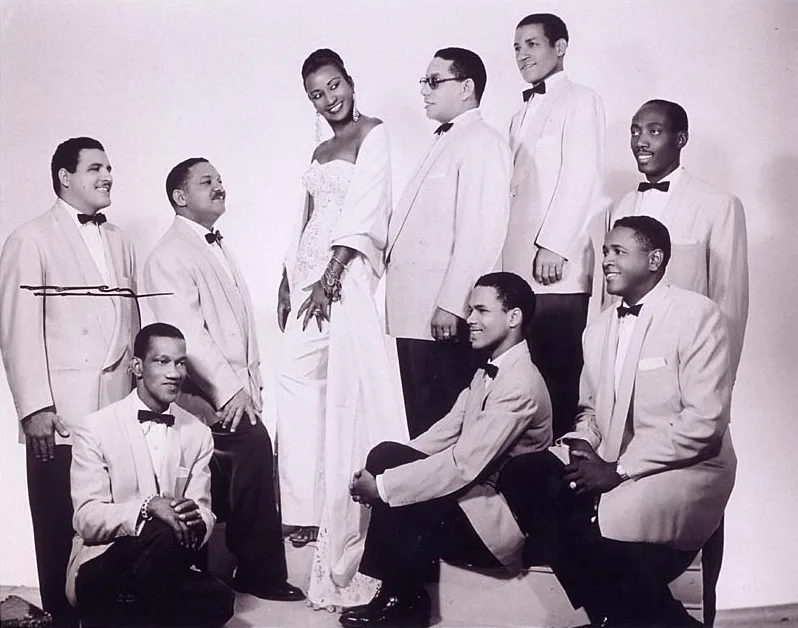
By the time she recorded it she had been unable to live in her own country for 38 years. She was born in Havana in 1925 and became famous there singing with the Sonora Matancera, the band in the cover photograph. In July 1960 she left Cuba for a few months' work in Mexico and was never able to go back.
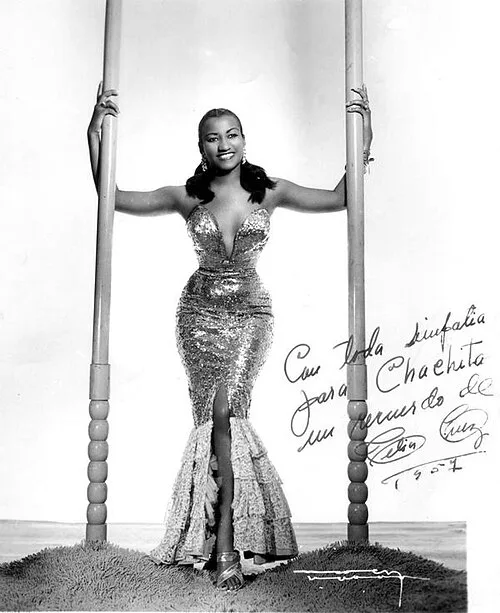
Celia Cruz en La Habana, 1957, en una copia que firmó para una admiradora. Foto: Narcy Studios (Ibrahim Arce), dominio público, vía Wikimedia Commons
Her mother was dying and the Cuban government refused her permission to visit; her mother died in 1962 without seeing her. Cruz set foot on Cuban ground once more, in 1990, at the United States naval base at Guantánamo. On her way out she took a few grams of soil in a bag. When she died in 2003, that soil was placed in her coffin.
With that behind it, "no hay que llorar" stops sounding like a party line.
Musical characteristics
For the first three minutes the song moves forward like any other: verse, chorus, an instrumental stretch, verse again, chorus again.
Then it stops moving. A section begins in which nothing new arrives: a group of voices repeats one short line without ever altering it, and Celia sings different lines over the top. That is the montuno, and it is where the song is really decided.
The two jobs are opposites. The coro holds everything fixed — same words, same pitch, same place in the bar. Singing coro in this music is closer to playing an instrument than to singing.
Celia does the reverse. She makes up words and melody as she goes, in the gap the coro leaves her. That is called soneo, or pregón, and a singer who can do it is a sonero. Here it turns into a list: for those who complain, for those who only criticise, for those who mistreat people, for those who pollute. Every line lands in the same gap, so the list can run as long as she likes.
Inside those improvisations she drops her own word: "¡Azúcar!" It is not decoration. In this music the lead singer is allowed a personal mark inside the song, and that one is hers.
This explains the running time. The album cut is 4:37 — the official channel's upload reads 4:39 — but the live performance linked below runs 5:31. Nobody is padding it out. The montuno simply has no written ending; it stops when whoever is leading decides it stops.
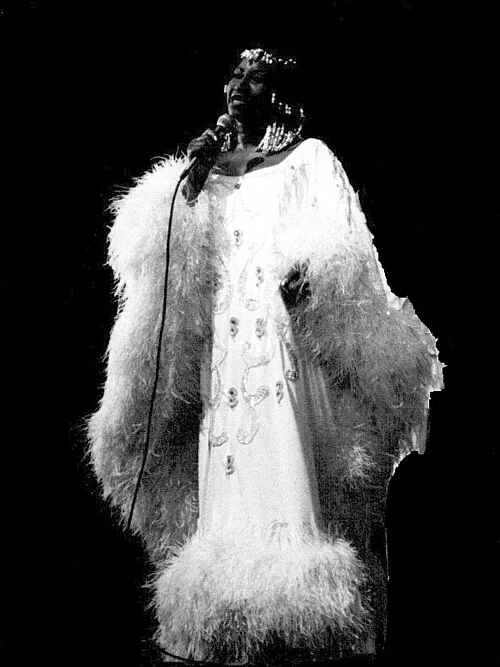
Celia Cruz en un concierto en París, 11 de abril de 1980. Foto: Lionel Decoster, CC BY-SA 3.0, vía Wikimedia Commons
Underneath, almost nothing happens. Three chords going round, no surprises, so the only thing worth listening to is who sings what.
Hard facts: C minor, 4/4, 208 BPM on the class chart, 4:37. The three chords are Cm, A♭ and G7; in the version you play, transposed to A minor, they are Am, F and E7. Form: intro · verse · chorus · interlude · verse · chorus · interlude · montuno · interlude.
One warning about the 208: the chart counts at twice the speed of your foot. Tap the pulse the way you would in any other song and you get about 104. Salsa is fast on the inside and slow on the dance floor.
Trivia and curiosities
- Her father wanted her to be a schoolteacher, and she did enrol at the teacher training college in Havana. The person who talked her out of it was one of her own teachers, who pointed out that a singer earned in a day what a teacher earned in a month. The decision was not romantic. It was arithmetic.
- Cruz did not write it, and she did not write other songs just as closely identified with her: "Bemba colorá" is by José Claro Fumero. In this music the performer weighs as much as the author, because what a sonero does over the coro is written down nowhere.
- The song travelled a long way from a Buenos Aires bombing. It appears in the Mexican film Amores perros (2000) and the American film Antwone Fisher (2002); Daniela Mercury recorded it in Portuguese and Angélique Kidjo, from Benin, recorded her own version in 2019.
- The tidy story about her — she left Cuba and became a symbol of exile — is true but trimmed. In 2004 the Miami Herald published declassified US government files: she had been refused a visa in 1952 and 1955 over suspected communist links, and was only taken off that list in 1965. Her husband said she never talked politics. Famous people's biographies almost always arrive ironed flat.
- At her funeral in 2003 the singer Víctor Manuelle sang this song unaccompanied, unplanned, and that is how the service ended. A song written to console a stranger ended up doing exactly that.
Classroom activities
- Play: the three chords in A minor — Am, F, E7 — on a loop. With ukuleles, guitar, bass and drums all going at once, the test is not playing the song. It is keeping the loop alive for three minutes without it collapsing.
- Sing: build the montuno. Half the class is the coro, with one fixed four-syllable line they never change. One person sings different lines over the top, no repeats. Swap the soloist every minute so several people try it.
- Analyse: a closed question. Play the studio track (4:37) and the live performance (5:31) in Resources. Which section is longer in the live one, and how many times does the coro come round in each? Count them.
- Create: write a four-syllable coro about something in school, then a list of ten lines that fit the gap it leaves. Steal the procedure, not the song.
Key vocabulary
- Call and response — llamada y respuesta
- Montuno — montuno: la sección final que deja de avanzar y gira sobre sí misma
- Coro — coro: el grupo que repite siempre lo mismo
- Soneo — soneo: lo que el solista improvisa encima del coro
- Sonero — sonero: el cantante capaz de improvisar así
Resources
In Year 3 — this song also works for the unit ¿Cuándo empieza una melodía a decir de dónde eres?, from the theory and history book.
Official audio — the artist's channel has no music video for this song; this is the album cut.
Live, on Colombian television — 5:31, almost a minute longer than the record. Here you can see who sings the coro.
Ukulele tutorial — JCL Guitar. Chords, strumming and tab.
Guitar tutorial — JCL Guitar, same channel, same approach.
Bass tutorial — Tablaturas y Partituras, step by step.
Drums — Mónica Esparza. Thirty seconds: just the pattern, with the notation on screen.
The montuno on piano — Alex Rivas explains the figure that turns underneath the whole final section. It is this article's concept, played.
- Tab — https://www.songsterr.com/a/wsa/celia-cruz-la-vida-es-un-carnaval-tab-s737478 (drums, bass and two guitars)
Por dónde entrar
Prueba esto antes de seguir leyendo. Alguien de la clase dice una frase corta. El resto contesta siempre la misma frase, sin cambiarla nunca. El primero puede decir lo que quiera; los demás solo tienen una frase.
Al tercer intento ya no hay que explicar nada. Funciona solo, y encima se puede seguir todo el rato.
Acabas de hacer lo que hace esta canción en su último minuto largo. Se llama llamada y respuesta, y es muchísimo más vieja que cualquier grabación. Y trae una consecuencia rara: mientras eso funcione, la canción no tiene ninguna necesidad de acabarse.
Contexto histórico
Primero, lo que casi nadie sabe: la canción no es de Celia Cruz. La escribió un argentino, Víctor Daniel, y la escribió a partir de una matanza.
El 18 de julio de 1994 un atentado destruyó la sede de la AMIA, una asociación judía de Buenos Aires. Murieron 85 personas. Víctor Daniel estaba trabajando en Venezuela y vio por televisión a una mujer que lo había perdido todo. Contó después que le habló a la pantalla: «No tiene que llorar, señora». De ahí sale el estribillo que canta medio mundo.
Guardó la canción dos años. Cuando alguien del equipo de Celia Cruz le pidió algo especial para ella, le mandó la maqueta. A ella no le convenció la introducción, pero acabó grabándola tal como estaba. Salió en 1998, en el disco Mi vida es cantar.
Cuando la grabó, ella llevaba 38 años sin poder vivir en su país. Había nacido en La Habana en 1925 y se hizo famosa allí cantando con la Sonora Matancera, la banda de la foto de portada. En julio de 1960 salió de Cuba para trabajar unos meses en México y ya no pudo volver.
Celia Cruz en La Habana, 1957, en una copia que firmó para una admiradora. Foto: Narcy Studios (Ibrahim Arce), dominio público, vía Wikimedia Commons
Su madre se estaba muriendo y el gobierno cubano le negó el permiso para ir a verla; murió en 1962 sin que ella llegara. Celia Cruz pisó suelo cubano una sola vez más, en 1990, en la base militar estadounidense de Guantánamo. Al salir cogió unos gramos de tierra en una bolsa. Cuando murió, en 2003, esa tierra se puso en su ataúd.
Con esa biografía detrás, «no hay que llorar» deja de ser una frase de fiesta.
Cómo suena
Durante los tres primeros minutos la canción avanza como cualquier otra: estrofa, estribillo, un trozo instrumental, estrofa otra vez, estribillo otra vez.
Luego deja de avanzar. Entra una sección donde ya no aparece nada nuevo: un grupo de voces repite una frase corta sin cambiarla ni una vez, y Celia canta por encima frases distintas cada vez. Eso es el montuno, y es donde se juega de verdad la canción.
Los papeles están repartidos y son opuestos. El coro lleva lo fijo: la misma frase, la misma afinación, el mismo sitio dentro del compás. Cantar coro en esta música se parece más a tocar un instrumento que a cantar.
Lo de Celia es lo contrario. Se inventa letra y melodía sobre la marcha, en el hueco que le deja el coro. A eso se le llama soneo o pregón, y al cantante capaz de hacerlo, sonero. Aquí le sale una lista: para los que se quejan, para los que solo critican, para los que maltratan, para los que contaminan. Cada frase cae en el mismo hueco. Por eso la lista puede alargarse todo lo que quiera.
Dentro de esos soneos, Celia Cruz mete su palabra: «¡Azúcar!». No es un adorno suelto. En esta música el solista tiene permiso para dejar una marca personal dentro de la canción, y esa es la suya.
Eso explica lo de la duración. En el disco son 4:37 —el vídeo del canal oficial marca 4:39—, pero la actuación en directo que tienes abajo dura 5:31. No es que la estiren: es que el montuno no tiene un final escrito. Se acaba cuando el que dirige decide que se acaba.
Celia Cruz en un concierto en París, 11 de abril de 1980. Foto: Lionel Decoster, CC BY-SA 3.0, vía Wikimedia Commons
Y debajo de todo eso apenas pasa nada. Tres acordes dando vueltas, sin sorpresas, para que lo único que llame la atención sea quién canta qué.
Datos duros: Do menor, 4/4, 208 BPM en el chart de clase, 4:37. Los tres acordes son Do menor, La bemol y Sol7; en la versión que tocáis vosotros, transportada a La menor, son Lam, Fa y Mi7. Forma: intro · estrofa · estribillo · interludio · estrofa · estribillo · interludio · montuno · interludio.
Un aviso sobre los 208: el chart cuenta al doble de velocidad que el pie. Si marcas el pulso como lo marcarías en cualquier otra canción, te salen unos 104. La salsa va rápida por dentro y se baila despacio por fuera.
Curiosidades
- La frase más repetida de la canción es, literalmente, lo que su autor le dijo a un televisor. Una letra que suena universal puede venir de un momento muy pequeño y muy concreto.
- Celia Cruz no firma esta canción, y tampoco firma otras suyas igual de conocidas: «Bemba colorá» es de José Claro Fumero. En esta música el intérprete pesa tanto como el autor, porque lo que hace un sonero encima del coro no está escrito en ninguna parte.
- Su padre quería que fuese maestra, y ella llegó a entrar en la Escuela Normal de La Habana para serlo. Quien la convenció de dejarlo fue una profesora suya: le dijo que cantando ganaría en un día lo que una maestra ganaba en un mes. La decisión no fue romántica, fue económica.
- La historia que se cuenta de ella —salió de Cuba y fue símbolo del exilio— es cierta, pero está recortada. En 2004 el Miami Herald publicó documentos desclasificados: Estados Unidos le había negado el visado en 1952 y en 1955 por sospechas de vínculos comunistas. Su marido dijo que ella nunca hablaba de política. Las biografías de la gente famosa llegan planchadas.
- En su funeral, en 2003, el cantante Víctor Manuelle cantó esta canción a capela sin que estuviera previsto, y con eso se cerró la ceremonia. Una canción escrita para consolar a una desconocida acabó haciendo exactamente eso.
Para hacer en clase
- Tocar: los tres acordes en La menor, Lam, Fa y Mi7, en bucle. Con ukeleles, guitarra, bajo y batería a la vez, la prueba no es tocar la canción: es aguantar el bucle tres minutos sin que se caiga. Si se cae, se oye enseguida de dónde viene.
- Cantar: montad el montuno. La mitad de la clase hace de coro con una frase fija de cuatro sílabas y no la cambia nunca. Una persona canta encima frases distintas, sin repetir. Cambiad de solista cada minuto para que pasen varios.
- Analizar: pregunta cerrada. Pon la grabación de estudio (4:37) y la actuación en directo (5:31) que tienes en Recursos. ¿Qué sección es más larga en la segunda, y cuántas veces suena el coro en cada una? Cuéntalas.
- Crear: escribid un coro de cuatro sílabas sobre algo del instituto y una lista de diez frases que quepan en el hueco que deja. Se copia el procedimiento, no la canción.
Vocabulario fundamental
- Llamada y respuesta — Uno propone una frase y otro contesta. Es una forma de organizar la música, no un adorno.
- Montuno — La sección en la que la canción deja de avanzar y se pone a girar sobre sí misma, con el coro fijo y el solista improvisando.
- Coro — El grupo de voces que repite siempre lo mismo. Su trabajo es no moverse.
- Soneo — Lo que el solista se inventa encima del coro: letra y melodía sobre la marcha. También se le llama pregón.
- Sonero — El cantante capaz de hacer eso. No es el que canta más bonito, es el que responde mejor.
Recursos
En 3º de ESO — esta canción también sirve para la unidad ¿Cuándo empieza una melodía a decir de dónde eres?, del libro de teoría e historia.
Audio oficial — el canal de la artista no tiene videoclip de esta canción; esto es el corte del disco.
En directo, en un programa de televisión colombiano — dura 5:31, casi un minuto más que el disco. Aquí se ve quién canta el coro.
Tutorial de ukelele — JCL Guitar. Acordes, ritmo y tablatura.
Tutorial de guitarra — JCL Guitar, del mismo canal y con el mismo planteamiento.
Tutorial de bajo — Tablaturas y Partituras, paso a paso.
Batería — Mónica Esparza. Son treinta segundos: solo el patrón, con la partitura en pantalla.
El montuno al piano — Alex Rivas explica la figura que gira debajo de toda la sección final. Es el concepto de este artículo, tocado.
- Tablatura — https://www.songsterr.com/a/wsa/celia-cruz-la-vida-es-un-carnaval-tab-s737478 (batería, bajo y dos guitarras)
Why this song
Most songs have an ending written into them. This one does not.
Its last stretch works like a game you already know. One person says something short. Everyone else answers with the same fixed line, every single time, never changing it. The first person can say anything; the others have one line only.
Play it for thirty seconds with the class and nobody has to explain it. It runs by itself, and it can keep running. That is call and response, and it is far older than recorded music. It also has a strange consequence: while it works, the song has no reason to stop.
Historical context
Start with the part almost nobody knows: the song is not Celia Cruz's. An Argentine wrote it, Víctor Daniel, and he wrote it out of a massacre.
On 18 July 1994 a bombing destroyed the AMIA building, a Jewish community centre in Buenos Aires. Eighty-five people were killed. Víctor Daniel was working in Venezuela and saw a woman on television who had lost everything. He later said he spoke to the screen: "You mustn't cry, señora." That is where the line everyone sings comes from.
He kept the song for two years. When somebody from Celia Cruz's team asked him for something special for her, he sent the demo. She was not convinced by the introduction, but she recorded it as written. It came out in 1998 on the album Mi vida es cantar.
By the time she recorded it she had been unable to live in her own country for 38 years. She was born in Havana in 1925 and became famous there singing with the Sonora Matancera, the band in the cover photograph. In July 1960 she left Cuba for a few months' work in Mexico and was never able to go back.
Celia Cruz en La Habana, 1957, en una copia que firmó para una admiradora. Foto: Narcy Studios (Ibrahim Arce), dominio público, vía Wikimedia Commons
Her mother was dying and the Cuban government refused her permission to visit; her mother died in 1962 without seeing her. Cruz set foot on Cuban ground once more, in 1990, at the United States naval base at Guantánamo. On her way out she took a few grams of soil in a bag. When she died in 2003, that soil was placed in her coffin.
With that behind it, "no hay que llorar" stops sounding like a party line.
Musical characteristics
For the first three minutes the song moves forward like any other: verse, chorus, an instrumental stretch, verse again, chorus again.
Then it stops moving. A section begins in which nothing new arrives: a group of voices repeats one short line without ever altering it, and Celia sings different lines over the top. That is the montuno, and it is where the song is really decided.
The two jobs are opposites. The coro holds everything fixed — same words, same pitch, same place in the bar. Singing coro in this music is closer to playing an instrument than to singing.
Celia does the reverse. She makes up words and melody as she goes, in the gap the coro leaves her. That is called soneo, or pregón, and a singer who can do it is a sonero. Here it turns into a list: for those who complain, for those who only criticise, for those who mistreat people, for those who pollute. Every line lands in the same gap, so the list can run as long as she likes.
Inside those improvisations she drops her own word: "¡Azúcar!" It is not decoration. In this music the lead singer is allowed a personal mark inside the song, and that one is hers.
This explains the running time. The album cut is 4:37 — the official channel's upload reads 4:39 — but the live performance linked below runs 5:31. Nobody is padding it out. The montuno simply has no written ending; it stops when whoever is leading decides it stops.
Celia Cruz en un concierto en París, 11 de abril de 1980. Foto: Lionel Decoster, CC BY-SA 3.0, vía Wikimedia Commons
Underneath, almost nothing happens. Three chords going round, no surprises, so the only thing worth listening to is who sings what.
Hard facts: C minor, 4/4, 208 BPM on the class chart, 4:37. The three chords are Cm, A♭ and G7; in the version you play, transposed to A minor, they are Am, F and E7. Form: intro · verse · chorus · interlude · verse · chorus · interlude · montuno · interlude.
One warning about the 208: the chart counts at twice the speed of your foot. Tap the pulse the way you would in any other song and you get about 104. Salsa is fast on the inside and slow on the dance floor.
Trivia and curiosities
- Her father wanted her to be a schoolteacher, and she did enrol at the teacher training college in Havana. The person who talked her out of it was one of her own teachers, who pointed out that a singer earned in a day what a teacher earned in a month. The decision was not romantic. It was arithmetic.
- Cruz did not write it, and she did not write other songs just as closely identified with her: "Bemba colorá" is by José Claro Fumero. In this music the performer weighs as much as the author, because what a sonero does over the coro is written down nowhere.
- The song travelled a long way from a Buenos Aires bombing. It appears in the Mexican film Amores perros (2000) and the American film Antwone Fisher (2002); Daniela Mercury recorded it in Portuguese and Angélique Kidjo, from Benin, recorded her own version in 2019.
- The tidy story about her — she left Cuba and became a symbol of exile — is true but trimmed. In 2004 the Miami Herald published declassified US government files: she had been refused a visa in 1952 and 1955 over suspected communist links, and was only taken off that list in 1965. Her husband said she never talked politics. Famous people's biographies almost always arrive ironed flat.
- At her funeral in 2003 the singer Víctor Manuelle sang this song unaccompanied, unplanned, and that is how the service ended. A song written to console a stranger ended up doing exactly that.
Classroom activities
- Play: the three chords in A minor — Am, F, E7 — on a loop. With ukuleles, guitar, bass and drums all going at once, the test is not playing the song. It is keeping the loop alive for three minutes without it collapsing.
- Sing: build the montuno. Half the class is the coro, with one fixed four-syllable line they never change. One person sings different lines over the top, no repeats. Swap the soloist every minute so several people try it.
- Analyse: a closed question. Play the studio track (4:37) and the live performance (5:31) in Resources. Which section is longer in the live one, and how many times does the coro come round in each? Count them.
- Create: write a four-syllable coro about something in school, then a list of ten lines that fit the gap it leaves. Steal the procedure, not the song.
Key vocabulary
- Call and response — llamada y respuesta
- Montuno — montuno: la sección final que deja de avanzar y gira sobre sí misma
- Coro — coro: el grupo que repite siempre lo mismo
- Soneo — soneo: lo que el solista improvisa encima del coro
- Sonero — sonero: el cantante capaz de improvisar así
Resources
In Year 3 — this song also works for the unit ¿Cuándo empieza una melodía a decir de dónde eres?, from the theory and history book.
Official audio — the artist's channel has no music video for this song; this is the album cut.
Live, on Colombian television — 5:31, almost a minute longer than the record. Here you can see who sings the coro.
Ukulele tutorial — JCL Guitar. Chords, strumming and tab.
Guitar tutorial — JCL Guitar, same channel, same approach.
Bass tutorial — Tablaturas y Partituras, step by step.
Drums — Mónica Esparza. Thirty seconds: just the pattern, with the notation on screen.
The montuno on piano — Alex Rivas explains the figure that turns underneath the whole final section. It is this article's concept, played.
- Tab — https://www.songsterr.com/a/wsa/celia-cruz-la-vida-es-un-carnaval-tab-s737478 (drums, bass and two guitars)