Contenidos
Johnny B. Goode — Chuck Berry (1958)
The song that invented the story of the kid with nothing but a guitar who becomes a star. Three chords, twelve bars and a riff that has been opening concerts for almost seventy years.
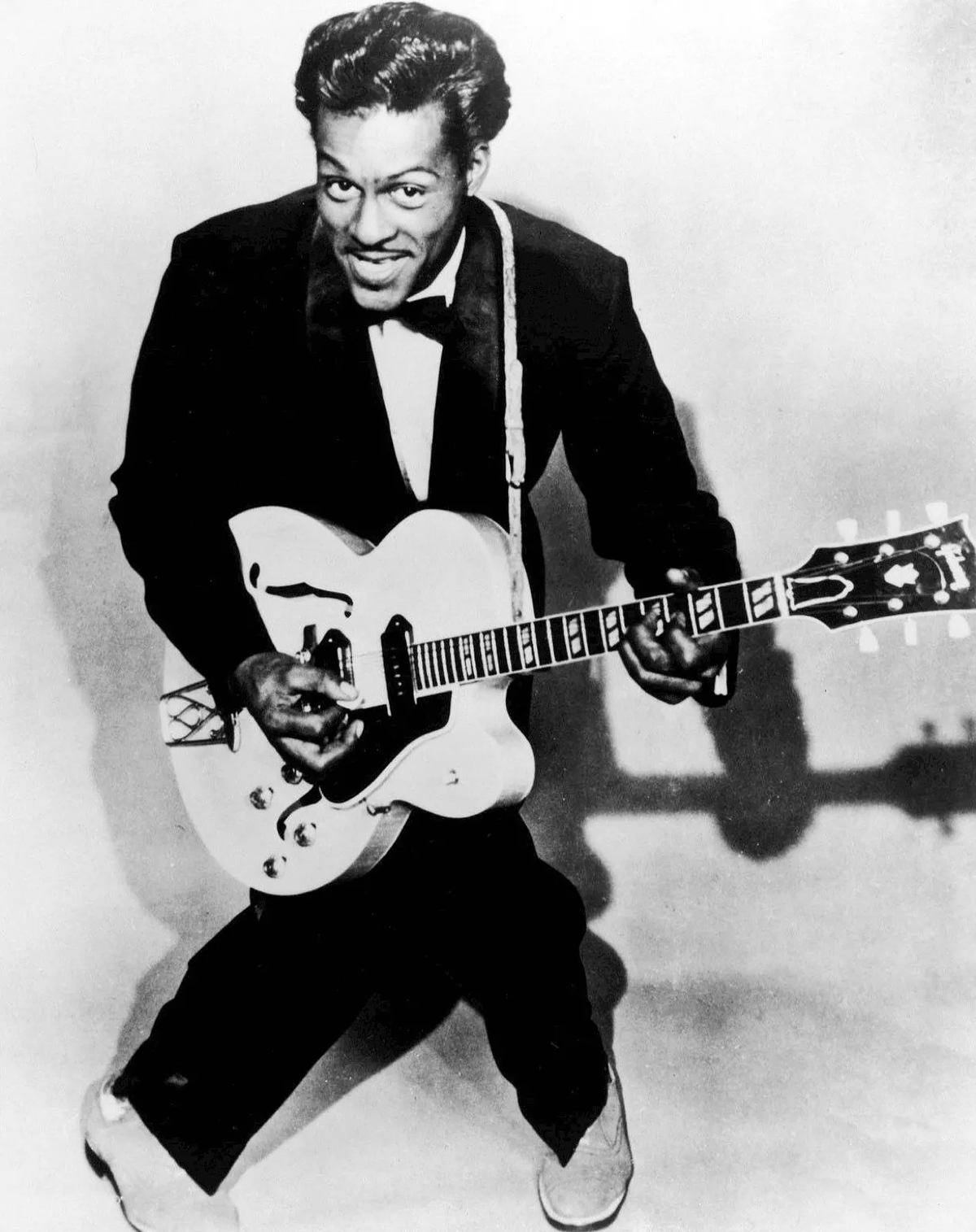
🏷️ Ficha musical
Why it's in this book
This is the second song of October, after La Bamba and Twist and Shout. All three belong to the same family: just three chords, I, IV and V, which in class are A, D and E. What is new here is the order: those three chords fall into a fixed twelve-bar cycle, the 12-bar blues, which you will find in hundreds of songs. In the room with no instruments you work on the voice and on the arrangement on paper: who plays what, and where each cycle starts. With ukuleles you put the whole cycle together with A, D and E, quietly, which is where mistakes in the form show up. In the music room the band comes in, and there is no second vocal part to rehearse: the job here is the solo, two 12-bar cycles for the guitarist and the keyboard player. The record is in B♭, one semitone higher; in class we play it in A because the chords are much more comfortable.
Why this song
If you have seen "Back to the Future", you already know it. Marty McFly gets up on stage at a 1955 school dance, plays this song and leaves everyone open-mouthed. One of the band members phones his cousin, Chuck Berry, so that he can hear it.
It is a joke: the song is Berry's, not Marty's. But the joke works because that guitar riff sounds like the beginning of something.
The question on this page is: how do you make a song with only three chords never get boring?
Historical context
Chuck Berry came from St. Louis, in the United States. He was a guitarist and a singer, and he wrote his own lyrics, which was not common in 1950s rock and roll. He recorded for Chess, a Chicago label that specialised in blues.
He wrote "Johnny B. Goode" in 1955 and released it in March 1958. It tells the story of a country boy near New Orleans who cannot read or write but plays the guitar "just like ringing a bell". And he dreams of seeing his name in lights.
The song is half autobiographical. Berry was born at 2520 Goode Avenue: Johnny's surname is his street. In the first lyrics Johnny was a "colored boy". Berry changed it to "country boy" so that radio stations would play it. In 1958, many stations would not play a song by a Black musician about a Black boy.
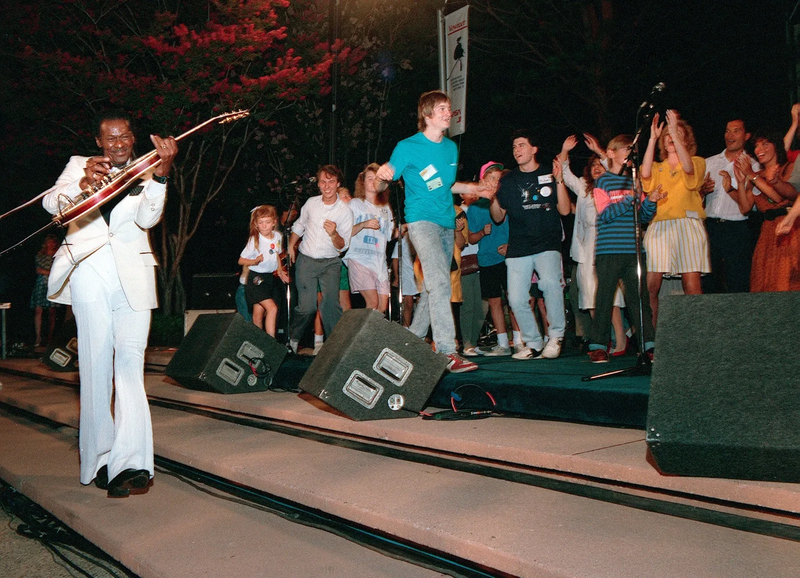
Foto: NASA/JPL-Caltech, dominio público, vía Wikimedia Commons
In this photo Berry is playing "Johnny B. Goode" itself. It is August 1989, at the NASA laboratory that runs the Voyager probes, on the night Voyager 2 flew past Neptune. That is no coincidence: the 1958 recording has been travelling on both probes since 1977, on a golden record meant to be found by another civilisation.
The recording was made in Chicago. Lafayette Leake was on piano, Willie Dixon on double bass and Fred Below on drums, three blues musicians. Keep that in mind when you listen: the band comes from the blues, and Berry's guitar goes its own way.
Musical characteristics
Three chords and a fixed cycle. The whole song uses only three chords. On the record they are B♭, E♭ and F; in class, A, D and E. What holds them together is a twelve-bar cycle: four bars on I, two on IV, two on I, two on V and two on I. That cycle repeats from beginning to end, in the verses, in the chorus and in the solo. It is called the 12-bar blues. Once you feel it in your body, you will always know where you are without looking at anyone.
The riff. The song starts with the guitar alone, playing very fast double notes and a string bend that squeals. A short guitar phrase you can recognise in two seconds is a riff. This one did not come from nowhere: Berry took it from the solo that opens "Ain't That Just Like a Woman", a 1946 song by Louis Jordan, played there by the guitarist Carl Hogan. Berry made it faster, dirtier and more his own.
Two ways of walking at once. Listen to the drums and the piano: each beat is split into two unequal parts, one long and one short, "daa-da, daa-da". That lilt is swing, and it comes from jazz and blues. Now listen to Berry's guitar: his notes are even, "da-da, da-da", with no lilt. Both happen at the same time, and that clash is what pushes the song forward. It is one of the reasons rock and roll sounded different from the blues its own musicians played.
Room for a solo. After the second chorus the voice stops and the guitar takes over the twelve-bar cycle. That is a solo: the chords stay the same underneath and someone makes up a melody on top. Because the cycle never changes, the accompanists do not have to think. And the soloist knows exactly when the solo starts and when it ends.
A piano song played on the guitar. Keith Richards, the Rolling Stones' guitarist, said Berry's chords seem written for the piano more than for the guitar. It makes sense: B♭ is a comfortable key for piano and saxophones, and a rather awkward one on guitar. That is why we play it in A in class. If you want to play along with the record, put a capo on the first fret and play A, D and E: they will sound as B♭, E♭ and F.
Hard facts: B♭ major on the record and A major in class, 4/4, 170 beats per minute, 2:39. The form: intro with the riff, verses and choruses over the same 12-bar cycle, guitar solo, and a last verse with chorus.
Guided listening
Play the official audio. At the start, the guitar is alone. Listen to the whole riff and then try to sing it quietly: if you can, you know the song's calling card.
When the singing starts, tap the beat with your foot and count bars of four beats. Listen for the first chord change in the verse: it arrives after four bars on the same chord. That is the move to IV.
In the first verse, stop paying attention to the guitar and listen only to the drums and the piano. Can you hear the "daa-da, daa-da"? That is swing.
When the chorus arrives ("Go, Johnny, go"), compare: do the chords change from the verse? No. The words change, but the twelve-bar cycle is the same.
In the solo, the voice disappears. Count the twelve bars of the cycle while the guitar improvises. If you reach the end of your count just as the cycle starts again, you have understood the 12-bar blues.
Then play the live version with Bruce Springsteen at the Rock & Roll Hall of Fame. Same cycle, a different speed and many more musicians.
Trivia and curiosities
- The song is travelling out of the solar system right now. It is on the Golden Record carried by both Voyager probes, launched in 1977, alongside Bach, Beethoven and traditional music from around the world. Of the 27 pieces of music on the record, it is the only rock and roll song.
- Berry played "Johnny B. Goode" at the very first Rock & Roll Hall of Fame ceremony, in January 1986, backed by Bruce Springsteen and the E Street Band. It was the very first ceremony, and he was among the first musicians chosen.
- In 1960 Berry released a sequel, "Bye Bye Johnny". Johnny is grown up now and leaves home to chase fame. A song with a sequel, like a film.
- The Grateful Dead reportedly played it live at least 287 times. When a song has such a clear form, any band can get it on stage without rehearsing.
Classroom activities
- Count the cycle. The whole class taps the beat with their feet. On each bar, one person holds up as many fingers as the bar number, from 1 to 12. Everyone else says the chord out loud: "A, A, A, A, D, D, A, A, E, E, A, A".
- Play the cycle on ukulele. A, D and E, one chord per bar, downstrokes on all four beats. When that works, sing the chorus on top. If you get lost, wait for the next bar 1 and come back in: that is the great advantage of a fixed cycle.
- Swing against straight. Half the class claps in swing, "daa-da, daa-da". The other half knocks even quavers on the desk with their knuckles. First separately, then together, with the record in the background. It is the same clash as between Berry's guitar and the band.
- Two solo cycles. In the music room, the band plays the cycle in A and the guitarist and the keyboard player share two 12-bar cycles: one each. To start with, the notes of the A pentatonic scale are enough. The rule: the solo starts on bar 1 and ends on bar 12, not before and not after.
Key vocabulary
- 12-bar blues — blues de 12 compases: una vuelta fija con el I, el IV y el V
- Riff — riff: frase corta que se repite y da identidad a la canción
- Swing — swing: pulso dividido en dos partes desiguales, larga y corta
- Solo — solo
- Capo — cejilla
Resources
Official audio — From Chuck Berry's official channel: the 1958 recording exactly as it came out on the single.
Live with Bruce Springsteen — Concert for the Rock & Roll Hall of Fame (official Rock & Roll Hall of Fame channel). An older Berry, with a huge band behind him and the same twelve-bar cycle.
Guitar tutorial — Marty Music. Long and thorough: the intro riff, the rhythm part and the phrases from the solo.
Ukulele tutorial — The Ukulele Teacher. The chords, the strumming and a version of the riff adapted to the ukulele.
Piano tutorial — Christian Fuchs. Explains the boogie-woogie left hand, which is what the piano does on the record.
Drum tutorial — Drums The Word. A full lesson on what Fred Below, the drummer on the recording, plays.
Bass tutorial — Matt Edjon. A simplified bass line with the tab on screen: the best way in before tackling the walking bass on the record.
- Harmonic analysis — https://www.hooktheory.com/theorytab/view/chuck-berry/johnny-b-goode
Por qué está en este libro
Esta es la segunda canción de octubre, después de La Bamba y Twist and Shout. Las tres comparten familia: solo tres acordes, el I, el IV y el V, que en clase son La, Re y Mi. Lo nuevo aquí es el orden: esos tres acordes caen en una vuelta fija de doce compases, el blues de 12, que vas a encontrar en cientos de canciones. En el aula sin nada trabajáis la voz y el arreglo en papel: quién toca qué y dónde empieza cada vuelta. Con ukelele montáis la vuelta entera con La, Re y Mi, sin volumen, que es donde se descubren los errores de forma. En el aula de música entra la banda, y aquí no hay segunda voz que ensayar: el trabajo es el solo, dos vueltas de 12 compases para el guitarrista y el teclista. El disco suena en Si♭, un semitono más agudo; en clase se toca en La porque los acordes son mucho más cómodos.
Por dónde entrar
Si has visto «Regreso al futuro», ya la conoces. Marty McFly sube al escenario de un baile de instituto en 1955, toca esta canción y deja a todo el mundo con la boca abierta. Un músico de la banda llama por teléfono a su primo, Chuck Berry, para que la escuche.
Es un chiste: la canción es de Berry, no de Marty. Pero el chiste funciona porque ese riff de guitarra suena a principio de algo.
La pregunta de esta página es: ¿cómo se consigue que una canción con solo tres acordes no aburra nunca?
Contexto histórico
Chuck Berry era de San Luis, en Estados Unidos. Era guitarrista, cantante y escribía sus propias letras, algo poco común en el rock and roll de los años cincuenta. Grababa para Chess, un sello de Chicago especializado en blues.
Escribió «Johnny B. Goode» en 1955 y la publicó en marzo de 1958. Cuenta la historia de un chico de campo, cerca de Nueva Orleans, que no sabe leer ni escribir pero toca la guitarra «just like ringing a bell», como quien toca una campana. Y sueña con ver su nombre en luces.
La canción es medio autobiográfica. Berry nació en el 2520 de Goode Avenue: el apellido de Johnny es su calle. En la primera letra Johnny era un «colored boy», un chico negro. Berry lo cambió por «country boy», chico de campo, para que las radios la pusieran. En 1958 muchas emisoras no ponían canciones de un músico negro que hablaran de un chico negro.
Foto: NASA/JPL-Caltech, dominio público, vía Wikimedia Commons
En esta foto Berry toca precisamente «Johnny B. Goode». Es agosto de 1989, en el laboratorio de la NASA que dirige las sondas Voyager, la noche en que la Voyager 2 pasó junto a Neptuno. No es casualidad: la grabación de 1958 viaja en las dos sondas desde 1977, en un disco de oro pensado para que lo encuentre otra civilización.
La grabación es de Chicago. Al piano estaba Lafayette Leake, al contrabajo Willie Dixon y a la batería Fred Below, tres músicos de blues. Fíjate en eso cuando la escuches: la banda viene del blues, y la guitarra de Berry va por otro lado.
Cómo suena
Tres acordes y una vuelta fija. Toda la canción usa solo tres acordes. En el disco son si bemol, mi bemol y fa; en clase, la, re y mi. Lo que la ordena es una vuelta de doce compases: cuatro en el I, dos en el IV, dos en el I, dos en el V y dos en el I. Esa vuelta se repite de principio a fin, en las estrofas, en el estribillo y en el solo. Se llama blues de 12 compases. Cuando la tengas en el cuerpo, sabrás siempre dónde estás sin mirar a nadie.
El riff. La canción empieza con la guitarra sola, con notas dobles muy rápidas y un estirón de cuerda que chirría. Una frase corta de guitarra que se reconoce en dos segundos es un riff. Este no salió de la nada: Berry lo tomó del solo con el que arranca «Ain't That Just Like a Woman», de Louis Jordan, de 1946. Lo tocaba allí el guitarrista Carl Hogan. Berry lo hizo más rápido, más sucio y más suyo.
Dos maneras de andar a la vez. Escucha la batería y el piano: cada pulso se divide en dos partes desiguales, una larga y una corta, «taa-ta, taa-ta». Ese balanceo es el swing, y viene del jazz y del blues. Ahora escucha la guitarra de Berry: sus notas van iguales, «ta-ta, ta-ta», sin balanceo. Las dos cosas suenan a la vez, y ese choque es lo que hace que la canción empuje hacia delante. Es uno de los secretos de por qué el rock and roll sonaba distinto al blues de sus propios músicos.
El hueco para el solo. Después del segundo estribillo la voz se calla y la guitarra se queda con la vuelta de doce compases. Eso es un solo: los acordes siguen igual debajo y alguien inventa una melodía encima. Como la vuelta es siempre la misma, el que acompaña no tiene que pensar. Y el que hace el solo sabe exactamente cuándo empieza y cuándo acaba.
Una canción de piano tocada en la guitarra. Keith Richards, el guitarrista de los Rolling Stones, dijo que los acordes de Berry parecen pensados para el piano más que para la guitarra. Tiene sentido: Si♭ es un tono cómodo para el piano y para los saxos, y bastante incómodo en la guitarra. Por eso en clase se toca en La. Si quieres tocar encima del disco, pon una cejilla en el primer traste y toca La, Re y Mi: sonarán Si♭, Mi♭ y Fa.
Datos duros: Si♭ mayor en el disco y La mayor en clase, 4/4, 170 pulsos por minuto, 2:39. La forma: intro con el riff, estrofas y estribillos sobre la misma vuelta de 12 compases, solo de guitarra y última estrofa con estribillo.
Escucha guiada
Pon el audio oficial. Al principio, la guitarra está sola. Escucha el riff entero e intenta cantarlo después en voz baja: si te sale, ya sabes cuál es la seña de identidad de la canción.
Cuando empiece a cantar, marca el pulso con el pie y cuenta compases de cuatro pulsos. Busca el primer cambio de acorde de la estrofa: llega después de cuatro compases en el mismo acorde. Es el paso al IV.
En la primera estrofa, deja de mirar la guitarra y escucha solo la batería y el piano. ¿Oyes el «taa-ta, taa-ta»? Eso es el swing.
Cuando llegue el estribillo («Go, Johnny, go»), compara: ¿cambian los acordes respecto a la estrofa? No. Cambia la letra, pero la vuelta de doce es la misma.
En el solo, la voz desaparece. Cuenta los doce compases de la vuelta mientras la guitarra improvisa. Si llegas al final de la cuenta justo cuando vuelve a empezar la vuelta, has entendido el blues de 12.
Después, pon la versión en directo con Bruce Springsteen en el Salón de la Fama del Rock. Es la misma vuelta, a otra velocidad y con muchos más músicos.
Curiosidades
- La canción viaja hoy fuera del sistema solar. Está en el Disco de Oro de las dos sondas Voyager, lanzadas en 1977, junto a Bach, Beethoven y músicas tradicionales de medio mundo. Es la única pieza de rock and roll del disco entre las 27 que lleva.
- Berry tocó «Johnny B. Goode» en la primera ceremonia del Salón de la Fama del Rock, en enero de 1986, con Bruce Springsteen y la E Street Band. Era la primera ceremonia de todas, y él estaba entre los primeros elegidos.
- En 1960 Berry sacó una segunda parte, «Bye Bye Johnny». Johnny ya es mayor y se va de casa a buscar la fama. Una canción con secuela, como una película.
- Se dice que los Grateful Dead la tocaron en directo al menos 287 veces. Cuando una canción tiene una forma tan clara, cualquier banda puede subirla al escenario sin ensayar.
Para hacer en clase
- Contar la vuelta. Toda la clase marca el pulso con el pie. En cada compás, una persona levanta tantos dedos como el número de compás, del 1 al 12. Los demás dicen en voz alta el acorde que toca: «La, La, La, La, Re, Re, La, La, Mi, Mi, La, La».
- Tocar la vuelta en ukelele. La, Re y Mi, un acorde por compás, golpes hacia abajo en los cuatro pulsos. Cuando salga, cantad el estribillo encima. Quien se pierda, que espere al siguiente compás 1 y vuelva a entrar: esa es la gran ventaja de una vuelta fija.
- Swing contra recto. La mitad de la clase da palmas en swing, «taa-ta, taa-ta». La otra mitad, con los nudillos en la mesa, toca corcheas iguales. Primero por separado y luego a la vez, con el disco de fondo. Es el choque que hay entre la guitarra de Berry y la banda.
- Dos vueltas de solo. En el aula de música, la banda toca la vuelta en La y el guitarrista y el teclista se reparten dos vueltas de 12 compases: una cada uno. Para empezar, basta con las notas de la escala pentatónica de La. La regla: el solo empieza en el compás 1 y acaba en el 12, ni antes ni después.
Vocabulario fundamental
- Blues de 12 compases — Una vuelta de doce compases con el I, el IV y el V en un orden fijo, que se repite toda la canción.
- Riff — Una frase corta, normalmente de guitarra o bajo, que se repite y identifica la canción.
- Swing — Cuando cada pulso se divide en dos partes desiguales, una larga y una corta. Hace que la música se balancee.
- Solo — Un trozo en el que un instrumento inventa una melodía encima de los acordes, y la voz se calla.
- Cejilla — Una pinza que se pone en el mástil y sube todas las cuerdas a la vez.
Recursos
Audio oficial — Del canal oficial de Chuck Berry: la grabación de 1958 tal cual salió en el sencillo.
En directo con Bruce Springsteen — Concierto del Salón de la Fama del Rock (canal oficial del Rock & Roll Hall of Fame). Berry ya mayor, con una banda enorme detrás y la misma vuelta de doce.
Tutorial de guitarra — Marty Music. Largo y completo: el riff de la intro, el ritmo de acompañamiento y las frases del solo.
Tutorial de ukelele — The Ukulele Teacher. Los acordes, el rasgueo y una versión del riff adaptada al ukelele.
Tutorial de piano — Christian Fuchs. Explica el acompañamiento boogie-woogie de la mano izquierda, que es lo que hace el piano del disco.
Tutorial de batería — Drums The Word. Una lección completa sobre lo que toca Fred Below, el batería de la grabación.
Tutorial de bajo — Matt Edjon. Una línea de bajo simplificada, con la tablatura en pantalla: la mejor puerta de entrada antes del bajo andante del disco.
- Análisis armónico — https://www.hooktheory.com/theorytab/view/chuck-berry/johnny-b-goode
Why it's in this book
This is the second song of October, after La Bamba and Twist and Shout. All three belong to the same family: just three chords, I, IV and V, which in class are A, D and E. What is new here is the order: those three chords fall into a fixed twelve-bar cycle, the 12-bar blues, which you will find in hundreds of songs. In the room with no instruments you work on the voice and on the arrangement on paper: who plays what, and where each cycle starts. With ukuleles you put the whole cycle together with A, D and E, quietly, which is where mistakes in the form show up. In the music room the band comes in, and there is no second vocal part to rehearse: the job here is the solo, two 12-bar cycles for the guitarist and the keyboard player. The record is in B♭, one semitone higher; in class we play it in A because the chords are much more comfortable.
Why this song
If you have seen "Back to the Future", you already know it. Marty McFly gets up on stage at a 1955 school dance, plays this song and leaves everyone open-mouthed. One of the band members phones his cousin, Chuck Berry, so that he can hear it.
It is a joke: the song is Berry's, not Marty's. But the joke works because that guitar riff sounds like the beginning of something.
The question on this page is: how do you make a song with only three chords never get boring?
Historical context
Chuck Berry came from St. Louis, in the United States. He was a guitarist and a singer, and he wrote his own lyrics, which was not common in 1950s rock and roll. He recorded for Chess, a Chicago label that specialised in blues.
He wrote "Johnny B. Goode" in 1955 and released it in March 1958. It tells the story of a country boy near New Orleans who cannot read or write but plays the guitar "just like ringing a bell". And he dreams of seeing his name in lights.
The song is half autobiographical. Berry was born at 2520 Goode Avenue: Johnny's surname is his street. In the first lyrics Johnny was a "colored boy". Berry changed it to "country boy" so that radio stations would play it. In 1958, many stations would not play a song by a Black musician about a Black boy.
Foto: NASA/JPL-Caltech, dominio público, vía Wikimedia Commons
In this photo Berry is playing "Johnny B. Goode" itself. It is August 1989, at the NASA laboratory that runs the Voyager probes, on the night Voyager 2 flew past Neptune. That is no coincidence: the 1958 recording has been travelling on both probes since 1977, on a golden record meant to be found by another civilisation.
The recording was made in Chicago. Lafayette Leake was on piano, Willie Dixon on double bass and Fred Below on drums, three blues musicians. Keep that in mind when you listen: the band comes from the blues, and Berry's guitar goes its own way.
Musical characteristics
Three chords and a fixed cycle. The whole song uses only three chords. On the record they are B♭, E♭ and F; in class, A, D and E. What holds them together is a twelve-bar cycle: four bars on I, two on IV, two on I, two on V and two on I. That cycle repeats from beginning to end, in the verses, in the chorus and in the solo. It is called the 12-bar blues. Once you feel it in your body, you will always know where you are without looking at anyone.
The riff. The song starts with the guitar alone, playing very fast double notes and a string bend that squeals. A short guitar phrase you can recognise in two seconds is a riff. This one did not come from nowhere: Berry took it from the solo that opens "Ain't That Just Like a Woman", a 1946 song by Louis Jordan, played there by the guitarist Carl Hogan. Berry made it faster, dirtier and more his own.
Two ways of walking at once. Listen to the drums and the piano: each beat is split into two unequal parts, one long and one short, "daa-da, daa-da". That lilt is swing, and it comes from jazz and blues. Now listen to Berry's guitar: his notes are even, "da-da, da-da", with no lilt. Both happen at the same time, and that clash is what pushes the song forward. It is one of the reasons rock and roll sounded different from the blues its own musicians played.
Room for a solo. After the second chorus the voice stops and the guitar takes over the twelve-bar cycle. That is a solo: the chords stay the same underneath and someone makes up a melody on top. Because the cycle never changes, the accompanists do not have to think. And the soloist knows exactly when the solo starts and when it ends.
A piano song played on the guitar. Keith Richards, the Rolling Stones' guitarist, said Berry's chords seem written for the piano more than for the guitar. It makes sense: B♭ is a comfortable key for piano and saxophones, and a rather awkward one on guitar. That is why we play it in A in class. If you want to play along with the record, put a capo on the first fret and play A, D and E: they will sound as B♭, E♭ and F.
Hard facts: B♭ major on the record and A major in class, 4/4, 170 beats per minute, 2:39. The form: intro with the riff, verses and choruses over the same 12-bar cycle, guitar solo, and a last verse with chorus.
Guided listening
Play the official audio. At the start, the guitar is alone. Listen to the whole riff and then try to sing it quietly: if you can, you know the song's calling card.
When the singing starts, tap the beat with your foot and count bars of four beats. Listen for the first chord change in the verse: it arrives after four bars on the same chord. That is the move to IV.
In the first verse, stop paying attention to the guitar and listen only to the drums and the piano. Can you hear the "daa-da, daa-da"? That is swing.
When the chorus arrives ("Go, Johnny, go"), compare: do the chords change from the verse? No. The words change, but the twelve-bar cycle is the same.
In the solo, the voice disappears. Count the twelve bars of the cycle while the guitar improvises. If you reach the end of your count just as the cycle starts again, you have understood the 12-bar blues.
Then play the live version with Bruce Springsteen at the Rock & Roll Hall of Fame. Same cycle, a different speed and many more musicians.
Trivia and curiosities
- The song is travelling out of the solar system right now. It is on the Golden Record carried by both Voyager probes, launched in 1977, alongside Bach, Beethoven and traditional music from around the world. Of the 27 pieces of music on the record, it is the only rock and roll song.
- Berry played "Johnny B. Goode" at the very first Rock & Roll Hall of Fame ceremony, in January 1986, backed by Bruce Springsteen and the E Street Band. It was the very first ceremony, and he was among the first musicians chosen.
- In 1960 Berry released a sequel, "Bye Bye Johnny". Johnny is grown up now and leaves home to chase fame. A song with a sequel, like a film.
- The Grateful Dead reportedly played it live at least 287 times. When a song has such a clear form, any band can get it on stage without rehearsing.
Classroom activities
- Count the cycle. The whole class taps the beat with their feet. On each bar, one person holds up as many fingers as the bar number, from 1 to 12. Everyone else says the chord out loud: "A, A, A, A, D, D, A, A, E, E, A, A".
- Play the cycle on ukulele. A, D and E, one chord per bar, downstrokes on all four beats. When that works, sing the chorus on top. If you get lost, wait for the next bar 1 and come back in: that is the great advantage of a fixed cycle.
- Swing against straight. Half the class claps in swing, "daa-da, daa-da". The other half knocks even quavers on the desk with their knuckles. First separately, then together, with the record in the background. It is the same clash as between Berry's guitar and the band.
- Two solo cycles. In the music room, the band plays the cycle in A and the guitarist and the keyboard player share two 12-bar cycles: one each. To start with, the notes of the A pentatonic scale are enough. The rule: the solo starts on bar 1 and ends on bar 12, not before and not after.
Key vocabulary
- 12-bar blues — blues de 12 compases: una vuelta fija con el I, el IV y el V
- Riff — riff: frase corta que se repite y da identidad a la canción
- Swing — swing: pulso dividido en dos partes desiguales, larga y corta
- Solo — solo
- Capo — cejilla
Resources
Official audio — From Chuck Berry's official channel: the 1958 recording exactly as it came out on the single.
Live with Bruce Springsteen — Concert for the Rock & Roll Hall of Fame (official Rock & Roll Hall of Fame channel). An older Berry, with a huge band behind him and the same twelve-bar cycle.
Guitar tutorial — Marty Music. Long and thorough: the intro riff, the rhythm part and the phrases from the solo.
Ukulele tutorial — The Ukulele Teacher. The chords, the strumming and a version of the riff adapted to the ukulele.
Piano tutorial — Christian Fuchs. Explains the boogie-woogie left hand, which is what the piano does on the record.
Drum tutorial — Drums The Word. A full lesson on what Fred Below, the drummer on the recording, plays.
Bass tutorial — Matt Edjon. A simplified bass line with the tab on screen: the best way in before tackling the walking bass on the record.
- Harmonic analysis — https://www.hooktheory.com/theorytab/view/chuck-berry/johnny-b-goode