Contenidos
Hallelujah — Leonard Cohen (1984)
A song that took years to write and years to become famous. A beat that rocks in threes, five chords and a one-word chorus you can sing as a round.
🏷️ Ficha musical
Why it's in this book
"Hallelujah" is June's anchor song, the one for the end-of-year concert, where Year 9 (3º ESO) sings six to eight songs in two and three parts. It is the only song in this book in triple time: each beat divides into three, like a slow waltz. Its chord family is I–vi–IV–V, C, A minor, F and G, and it adds a fifth chord, E seven, which is not in the key and pushes towards A minor. It is the hardest chord in the book, which is why the song comes at the end of the year. In class we play it in C, just like Cohen's record: no transposing needed. What you learn with it is to sing in several parts that do not start together: the chorus is a natural round, and each group can come in a little after the one before. In the room with nothing, we work on the rocking three-feel with our bodies and the chorus as a round; in the ukulele room, the five chords; in the music room, the Spanish guitar plays arpeggios and the keyboard holds the harmony.
Why this song
You have probably heard it in "Shrek", on a TV talent show or at some tribute. There are more than 300 versions. Hardly any of them is by Leonard Cohen, the man who wrote it.
The question on this page is: why did a song almost nobody listened to in 1984 end up belonging to everyone? And a more musical one: what does a single word repeated four times have that moves people so much?
Historical context
Leonard Cohen was a Canadian poet and novelist before he was a singer. He wrote slowly, and "Hallelujah" is the best example. He wrote between 80 and 180 draft verses, depending on who is counting. He spoke of 150. Only seven have been released.
The song came out in 1984, on the album "Various Positions". His record company, Columbia, did not want to release that album at first, and a small label put it out. Almost nobody paid attention.
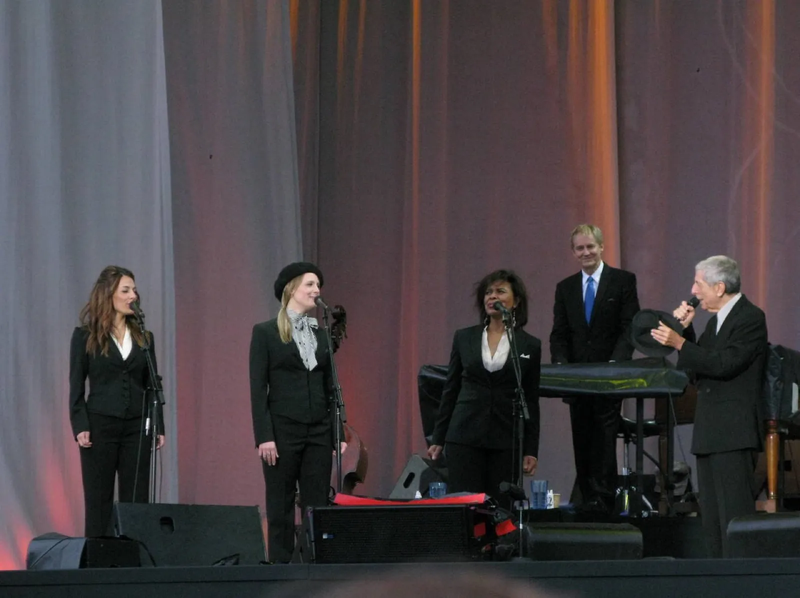
Foto: Stephen and Helen Jones, CC BY-SA 2.0, vía Wikimedia Commons
At this concert in July 2009, Cohen introduces his backing singers: Sharon Robinson, who also wrote songs with him, and the Webb sisters. In the background, on keyboards, is Neil Larsen. In his last concerts, the backing voices were as much a part of the song as his own.
The story changed in 1991. The Welsh musician John Cale recorded a version with piano. In 1994 the American Jeff Buckley recorded it, based on Cale's, with only his voice and an electric guitar. Cale's version was used in the film "Shrek" in 2001, and since then it has never stopped. When Cohen died, in November 2016, his version entered the US singles chart for the first time. Thirty-two years late.
Musical characteristics
A rocking in threes. Tap the beat with your foot: it is slow. Now listen to the accompaniment: between one beat and the next there are three notes, not two. "ONE-two-three, TWO-two-three". When each beat is split into three, we call it triple subdivision, and the song is in triple time. That is why it rocks, like a lullaby or a slow waltz. In the score it is written as 6/8: two beats per bar, each made of three quavers.
Lyrics that name their own chords. The first verse does something unusual: it describes the music that is playing while it is being sung. When Cohen sings "the fourth, the fifth, the minor fall, the major lift", the chords do exactly that. The fourth degree sounds (F), then the fifth (G), it falls to a minor chord (A minor) and lifts to a major one (F). It is a harmony lesson hidden in a song.
The chord that pushes. At the end of the verse a chord appears that does not belong to C major: E seven. Listen to it: it creates a tension that wants to go to A minor. A chord that pushes towards a chord other than the home chord is called a secondary dominant. It is the only "outsider" chord in the song, and it creates that moment of suspense just before the chorus.
A one-word chorus. The chorus is the word "hallelujah" four times, over the chords F, A minor, F, C, G, C. It comes from Hebrew and means "praise God". Because each "hallelujah" is a short, complete phrase, it can be sung as a round: one group starts and another comes in with the same phrase a little later, and the two fit together.
Hard facts: C major, 6/8 (Wikipedia writes it in 12/8), 56 beats per minute (168 quavers), 4:39. Form: verses, each followed by the chorus.
Guided listening
Play Cohen's audio. In the intro, sway from side to side with the beat. Count "one-two-three" on each sway.
In the first verse, listen to Cohen's voice: very low, almost spoken. Compare it with any pop singer you know.
When the end of the verse arrives, look for the E seven: the moment of greatest tension, just before the chorus.
In the chorus, notice who sings the "hallelujahs". Cohen alone, or with other voices?
Then play Jeff Buckley's version. The same chords and the same key, but only voice and electric guitar. Ask yourself which of the two sounds sadder to you, and why.
Trivia and curiosities
- The story goes that while writing "Hallelujah" in a New York hotel, Cohen ended up sitting on the floor in his underwear, filling notebooks and banging his head on the floor. The 150 verses did not come easily.
- The lyrics mix Bible stories, like King David and Bathsheba or Samson and Delilah, with a love story that goes wrong. That is why some people hear it as a religious song and others as a break-up song.
- In "Shrek" you hear John Cale's version, but the soundtrack album has Rufus Wainwright's. People who bought the album expecting the film version got a different one.
- Jeff Buckley died in 1997, aged thirty. His "Hallelujah" was not released as a single until 2007, and it only charted after his death.
Classroom activities
- Rocking in three. The whole class, standing, sways with the beat and claps softly on the first beat of each group of three. First without music, then with the audio.
- The five chords on ukulele. C, A minor, F, G and E seven. Start with the chorus, which only uses four: F, A minor, F, C, G, C. When that works, add the verse with the E seven.
- The chorus as a round. Three groups. The first sings the four "hallelujahs". The second starts when the first reaches the second "hallelujah". The third, one later. Boys an octave lower.
- Catch the chords in the lyrics. Listen to the first verse and raise your hand when Cohen sings "the minor fall". Does it land on the minor chord?
- Band. In the music room, the Spanish guitar plays the chords as arpeggios, note by note, following the "one-two-three". The keyboard holds them with long notes. Rehearse it as the concert finale.
Key vocabulary
- Triple subdivision — subdivisión ternaria: cada pulso dividido en tres
- Triple time — compás ternario
- Secondary dominant — dominante secundaria: aquí, el mi siete que lleva a la menor
- Round — canon
Resources
Leonard Cohen's official audio — The 1984 recording. There is no music video for this version.
Jeff Buckley, to compare — Official live video. Just voice and electric guitar.
Ukulele tutorial — Bernadette Teaches Music. An easy version.
Guitar tutorial — JustinGuitar. The chords and the strumming in three, step by step.
Keyboard tutorial — Key by Key. A beginner version, with one hand only.
Por qué está en este libro
«Hallelujah» es la canción ancla de junio, la del concierto de final de curso, en el que 3º canta de seis a ocho canciones a dos y tres voces. Es la única del libro en compás ternario: cada pulso se divide en tres, como en un vals lento. Su familia de acordes es I–vi–IV–V, do, la menor, fa y sol, y añade un quinto acorde, mi siete, que no está en la tonalidad y empuja hacia la menor. Es el acorde más difícil del libro, y por eso la canción llega al final del curso. En clase se toca en do, igual que el disco de Cohen: no hay que transportar. Lo que aprendes con ella es a cantar a varias voces que no empiezan a la vez: el estribillo es un canon natural, y cada grupo puede entrar un poco después del anterior. En el aula sin nada se trabaja el balanceo en tres con el cuerpo y el estribillo en canon; en el aula con ukelele, los cinco acordes; en el aula de música, la guitarra española toca en arpegio y el teclado sostiene la armonía.
Por dónde entrar
Es probable que la hayas oído en «Shrek», en un concurso de talentos de la tele o en algún homenaje. Hay más de 300 versiones. Casi ninguna es la de Leonard Cohen, el hombre que la escribió.
La pregunta de esta página es: ¿por qué una canción que casi nadie escuchó en 1984 acabó siendo de todos? Y otra, más musical: ¿qué tiene una sola palabra repetida cuatro veces para emocionar tanto?
Contexto histórico
Leonard Cohen fue un poeta y novelista canadiense antes de ser cantante. Escribía despacio, y «Hallelujah» es el mejor ejemplo. Escribió entre 80 y 180 estrofas en borrador, según quién las cuente. Él habló de 150. Solo siete se han publicado.
La canción salió en 1984, en el disco «Various Positions». Su discográfica, Columbia, no quiso publicar ese disco al principio, y lo sacó un sello pequeño. Casi nadie le hizo caso.
Foto: Stephen and Helen Jones, CC BY-SA 2.0, vía Wikimedia Commons
En este concierto de julio de 2009, Cohen presenta a sus coristas: Sharon Robinson, que también escribía canciones con él, y las hermanas Webb. Al fondo, al teclado, Neil Larsen. En sus últimos conciertos, las voces de los coros eran parte de la canción tanto como la suya.
La historia cambió en 1991. El músico galés John Cale grabó una versión con piano. En 1994, el estadounidense Jeff Buckley la grabó a partir de la de Cale, solo con su voz y una guitarra eléctrica. La de Cale sonó en la película «Shrek» en 2001, y desde ahí no ha parado. Cuando Cohen murió, en noviembre de 2016, su versión entró por primera vez en la lista de éxitos de Estados Unidos. Treinta y dos años tarde.
Cómo suena
Un balanceo en tres. Marca el pulso con el pie: es lento. Ahora escucha el acompañamiento: entre pulso y pulso hay tres notas, no dos. «UN-dos-tres, DOS-dos-tres». Cuando cada pulso se divide en tres, se habla de subdivisión ternaria, y la canción está en compás ternario. Por eso se mece, como una nana o un vals lento. En la partitura se escribe 6/8: dos pulsos por compás, cada uno de tres corcheas.
Una letra que dice sus acordes. La primera estrofa hace algo raro: describe la música que está sonando mientras la canta. Cuando Cohen canta «the fourth, the fifth, the minor fall, the major lift», los acordes hacen exactamente eso. Suena el cuarto grado (fa), el quinto (sol), cae a un acorde menor (la menor) y sube a uno mayor (fa). Es una lección de armonía escondida en una canción.
El acorde que empuja. Al final de la estrofa aparece un acorde que no pertenece a do mayor: mi siete. Escúchalo: crea una tensión que pide ir a la menor. Un acorde que empuja hacia otro que no es el principal se llama dominante secundaria. Es el único acorde «de fuera» de la canción, y es el que da ese momento de suspense justo antes del estribillo.
Un estribillo de una palabra. El estribillo es la palabra «hallelujah» cuatro veces, con los acordes fa, la menor, fa, do, sol, do. Viene del hebreo y significa «alabad a Dios». Como cada «hallelujah» es una frase corta y completa, se puede cantar en canon: un grupo empieza y otro entra con la misma frase un poco después, y las dos encajan.
Datos duros: do mayor, 6/8 (Wikipedia lo escribe en 12/8), 56 pulsos por minuto (168 corcheas), 4:39. Forma: estrofas, cada una seguida del estribillo.
Escucha guiada
Pon el audio de Cohen. En la intro, balancéate de un lado a otro con el pulso. Cuenta «un-dos-tres» en cada balanceo.
En la primera estrofa, escucha la voz de Cohen: muy grave, casi hablada. Compárala con la de cualquier cantante pop que conozcas.
Cuando llegue el final de la estrofa, busca el mi siete: el momento de más tensión, justo antes del estribillo.
En el estribillo, fíjate en quién canta los «hallelujah». ¿Cohen solo, o con más voces?
Después pon la versión de Jeff Buckley. Los mismos acordes y la misma tonalidad, pero solo voz y guitarra eléctrica. Pregúntate cuál de las dos te parece más triste, y por qué.
Curiosidades
- Se cuenta que, escribiendo «Hallelujah» en un hotel de Nueva York, Cohen acabó sentado en el suelo en ropa interior, llenando cuadernos y dándose golpes en la cabeza contra el suelo. Las 150 estrofas no salieron solas.
- La letra mezcla historias de la Biblia, como la del rey David y Betsabé o la de Sansón y Dalila, con una historia de amor que sale mal. Por eso unos la oyen como canción religiosa y otros como canción de desamor.
- En «Shrek» suena la versión de John Cale, pero en el disco de la banda sonora está la de Rufus Wainwright. La gente que compró el disco esperando la de la película se llevó otra.
- Jeff Buckley murió en 1997, con treinta años. Su «Hallelujah» no salió como sencillo hasta 2007, y no entró en las listas hasta después de su muerte.
Para hacer en clase
- El balanceo en tres. Toda la clase, de pie, se balancea con el pulso y da una palmada suave en el primer tiempo de cada grupo de tres. Primero sin música, después con el audio.
- Los cinco acordes en ukelele. Do, la menor, fa, sol y mi siete. Empezad por el estribillo, que solo usa cuatro: fa, la menor, fa, do, sol, do. Cuando salga, añadid la estrofa con el mi siete.
- El estribillo en canon. Tres grupos. El primero canta los cuatro «hallelujah». El segundo empieza cuando el primero va por el segundo «hallelujah». El tercero, uno después. Chicos una octava abajo.
- Cazar los acordes de la letra. Escuchad la primera estrofa y levantad la mano cuando Cohen canta «the minor fall». ¿Coincide con el acorde menor?
- Banda. En el aula de música, la guitarra española toca los acordes en arpegio, nota a nota, siguiendo el «un-dos-tres». El teclado los sostiene con notas largas. Ensayadla como cierre del concierto.
Vocabulario fundamental
- Subdivisión ternaria — Cuando cada pulso se divide en tres partes. Aquí, «un-dos-tres» en cada balanceo.
- Compás ternario — Un compás cuyos pulsos se dividen en tres. Se mece, como un vals.
- Dominante secundaria — Un acorde que empuja hacia otro que no es el principal. Aquí, el mi siete que lleva a la menor.
- Canon — Varias voces cantan la misma melodía, pero empezando en momentos distintos.
Recursos
Audio oficial de Leonard Cohen — La grabación de 1984. No hay videoclip de esta versión.
Jeff Buckley, para comparar — Vídeo oficial, en directo. Solo voz y guitarra eléctrica.
Tutorial de ukelele — Bernadette Teaches Music. Versión fácil.
Tutorial de guitarra — JustinGuitar. Los acordes y el rasgueo en tres, paso a paso.
Tutorial de teclado — Key by Key. Versión para principiantes, con una sola mano.
Why it's in this book
"Hallelujah" is June's anchor song, the one for the end-of-year concert, where Year 9 (3º ESO) sings six to eight songs in two and three parts. It is the only song in this book in triple time: each beat divides into three, like a slow waltz. Its chord family is I–vi–IV–V, C, A minor, F and G, and it adds a fifth chord, E seven, which is not in the key and pushes towards A minor. It is the hardest chord in the book, which is why the song comes at the end of the year. In class we play it in C, just like Cohen's record: no transposing needed. What you learn with it is to sing in several parts that do not start together: the chorus is a natural round, and each group can come in a little after the one before. In the room with nothing, we work on the rocking three-feel with our bodies and the chorus as a round; in the ukulele room, the five chords; in the music room, the Spanish guitar plays arpeggios and the keyboard holds the harmony.
Why this song
You have probably heard it in "Shrek", on a TV talent show or at some tribute. There are more than 300 versions. Hardly any of them is by Leonard Cohen, the man who wrote it.
The question on this page is: why did a song almost nobody listened to in 1984 end up belonging to everyone? And a more musical one: what does a single word repeated four times have that moves people so much?
Historical context
Leonard Cohen was a Canadian poet and novelist before he was a singer. He wrote slowly, and "Hallelujah" is the best example. He wrote between 80 and 180 draft verses, depending on who is counting. He spoke of 150. Only seven have been released.
The song came out in 1984, on the album "Various Positions". His record company, Columbia, did not want to release that album at first, and a small label put it out. Almost nobody paid attention.
Foto: Stephen and Helen Jones, CC BY-SA 2.0, vía Wikimedia Commons
At this concert in July 2009, Cohen introduces his backing singers: Sharon Robinson, who also wrote songs with him, and the Webb sisters. In the background, on keyboards, is Neil Larsen. In his last concerts, the backing voices were as much a part of the song as his own.
The story changed in 1991. The Welsh musician John Cale recorded a version with piano. In 1994 the American Jeff Buckley recorded it, based on Cale's, with only his voice and an electric guitar. Cale's version was used in the film "Shrek" in 2001, and since then it has never stopped. When Cohen died, in November 2016, his version entered the US singles chart for the first time. Thirty-two years late.
Musical characteristics
A rocking in threes. Tap the beat with your foot: it is slow. Now listen to the accompaniment: between one beat and the next there are three notes, not two. "ONE-two-three, TWO-two-three". When each beat is split into three, we call it triple subdivision, and the song is in triple time. That is why it rocks, like a lullaby or a slow waltz. In the score it is written as 6/8: two beats per bar, each made of three quavers.
Lyrics that name their own chords. The first verse does something unusual: it describes the music that is playing while it is being sung. When Cohen sings "the fourth, the fifth, the minor fall, the major lift", the chords do exactly that. The fourth degree sounds (F), then the fifth (G), it falls to a minor chord (A minor) and lifts to a major one (F). It is a harmony lesson hidden in a song.
The chord that pushes. At the end of the verse a chord appears that does not belong to C major: E seven. Listen to it: it creates a tension that wants to go to A minor. A chord that pushes towards a chord other than the home chord is called a secondary dominant. It is the only "outsider" chord in the song, and it creates that moment of suspense just before the chorus.
A one-word chorus. The chorus is the word "hallelujah" four times, over the chords F, A minor, F, C, G, C. It comes from Hebrew and means "praise God". Because each "hallelujah" is a short, complete phrase, it can be sung as a round: one group starts and another comes in with the same phrase a little later, and the two fit together.
Hard facts: C major, 6/8 (Wikipedia writes it in 12/8), 56 beats per minute (168 quavers), 4:39. Form: verses, each followed by the chorus.
Guided listening
Play Cohen's audio. In the intro, sway from side to side with the beat. Count "one-two-three" on each sway.
In the first verse, listen to Cohen's voice: very low, almost spoken. Compare it with any pop singer you know.
When the end of the verse arrives, look for the E seven: the moment of greatest tension, just before the chorus.
In the chorus, notice who sings the "hallelujahs". Cohen alone, or with other voices?
Then play Jeff Buckley's version. The same chords and the same key, but only voice and electric guitar. Ask yourself which of the two sounds sadder to you, and why.
Trivia and curiosities
- The story goes that while writing "Hallelujah" in a New York hotel, Cohen ended up sitting on the floor in his underwear, filling notebooks and banging his head on the floor. The 150 verses did not come easily.
- The lyrics mix Bible stories, like King David and Bathsheba or Samson and Delilah, with a love story that goes wrong. That is why some people hear it as a religious song and others as a break-up song.
- In "Shrek" you hear John Cale's version, but the soundtrack album has Rufus Wainwright's. People who bought the album expecting the film version got a different one.
- Jeff Buckley died in 1997, aged thirty. His "Hallelujah" was not released as a single until 2007, and it only charted after his death.
Classroom activities
- Rocking in three. The whole class, standing, sways with the beat and claps softly on the first beat of each group of three. First without music, then with the audio.
- The five chords on ukulele. C, A minor, F, G and E seven. Start with the chorus, which only uses four: F, A minor, F, C, G, C. When that works, add the verse with the E seven.
- The chorus as a round. Three groups. The first sings the four "hallelujahs". The second starts when the first reaches the second "hallelujah". The third, one later. Boys an octave lower.
- Catch the chords in the lyrics. Listen to the first verse and raise your hand when Cohen sings "the minor fall". Does it land on the minor chord?
- Band. In the music room, the Spanish guitar plays the chords as arpeggios, note by note, following the "one-two-three". The keyboard holds them with long notes. Rehearse it as the concert finale.
Key vocabulary
- Triple subdivision — subdivisión ternaria: cada pulso dividido en tres
- Triple time — compás ternario
- Secondary dominant — dominante secundaria: aquí, el mi siete que lleva a la menor
- Round — canon
Resources
Leonard Cohen's official audio — The 1984 recording. There is no music video for this version.
Jeff Buckley, to compare — Official live video. Just voice and electric guitar.
Ukulele tutorial — Bernadette Teaches Music. An easy version.
Guitar tutorial — JustinGuitar. The chords and the strumming in three, step by step.
Keyboard tutorial — Key by Key. A beginner version, with one hand only.