Contenidos
¿Cómo se guarda algo que solo existe mientras suena?
For the whole of human history, hearing music meant standing in front of somebody playing it. This unit is about the century when that stopped being true, and about the one thing you had to capture to make it work: timbre.
We ask ourselves
- If a flute and a guitar play the same note, how do you know which is which?
- How many people made a living playing music before loudspeakers existed?
- Why do almost all songs last about three minutes?
- Does a piece played today sound like the same piece played eighty years ago, if the score has not changed?
- If nobody had ever recorded your grandmother singing, would that version exist?
- Why did twentieth-century music turn towards percussion and towards noise?
Don't answer yet. We come back to these at the end.
The fragment
First, with no recording at all. Everyone play the same A: the flute, a voice, the guitar, the keyboard, the glockenspiel. Same note, same vibrations per second, and still nobody has to look to know who is sounding.
Now try to make them match. Make the flute sound like the guitar without it stopping being a flute. You can't. That thing that refuses to match is what this unit is about.
The second half of the fragment is four bars: the opening of the Prelude from Bach's Cello Suite no. 1, which almost everyone has heard without knowing where it came from. You listen twice — once in Pau Casals's recording, once in the Netherlands Bach Society's. More than seventy years apart.
Same score, same instrument, same notes. While they play, write down four things only: fast or slow, whether the player stops to breathe or pushes through, how much the note trembles, and whether you can hear the room. Don't say which one you prefer. Say what each one decided.
Then the whole Prelude, with nobody talking over it.
What changed
Until December 1877, every note of music ever played had been lost. All of it. There were scores, instruments and the memory of whoever had been in the room, but the sound itself stayed nowhere. Music was an event, not an object.
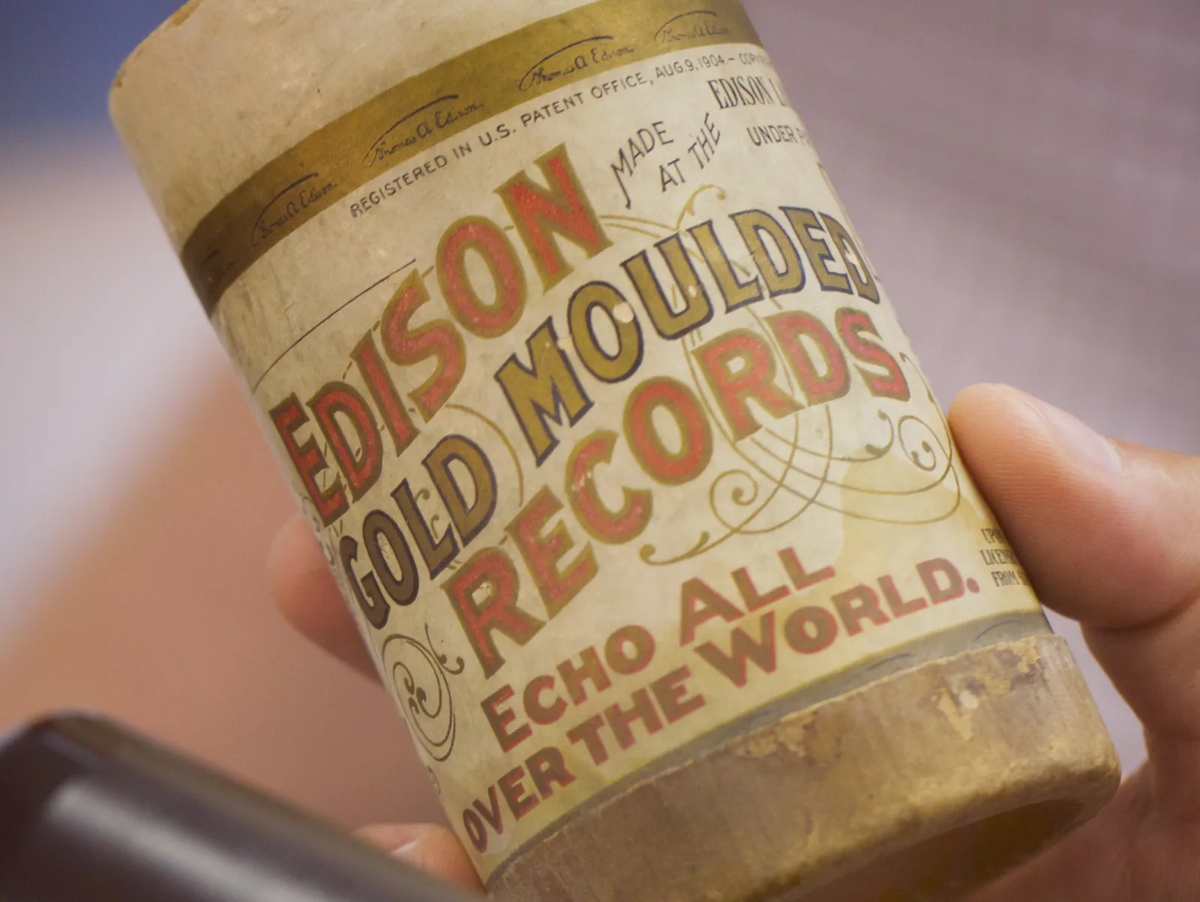
That month Edison wrapped a sheet of tinfoil around a grooved cylinder and recorded a voice that came back out. From 1888 the cylinder was made of wax, and in 1887 Emile Berliner had patented the flat-disc version, which is the one that won. What those machines kept was not the music: it was the sound.
And that is the difference that matters. A score keeps which notes and when. It does not keep who. The phonograph keeps exactly the other half, and that half has a name: timbre.
Timbre is what separates two sounds with the same pitch, the same length and the same volume. It comes from two places. First, the harmonics: above the note you recognise, higher vibrations are sounding too, and every body shares them out differently. Second, how the sound begins, which is called the attack: the hammer on the string, the pick, the breath against the edge.
The attack counts for more than you would guess. Take the beginning away from a piano note and leave only what follows, and it becomes hard to tell that it is a piano. Much of an instrument's identity fits into the first tenth of a second, and that is precisely the part a score cannot write down.
Once sound could be kept, the format started giving orders. A standard cylinder held about two minutes, and the 1908 Amberol reached four. The 78 rpm disc settled the song at around three minutes.
That limit stayed. The three-minute single was still the norm into the 1960s, and it is still roughly the length of what you played this morning. It was decided by the size of a disc made over a century ago.
It also changed who eats from this. Sound film arrived in 1927, and within two years 20,000 musicians lost their jobs playing in cinema pits. In 1930 the American union set up the Music Defense League against what they called canned music. They lost. It is the first time a machine replaced musicians in bulk, and it will not be the last.
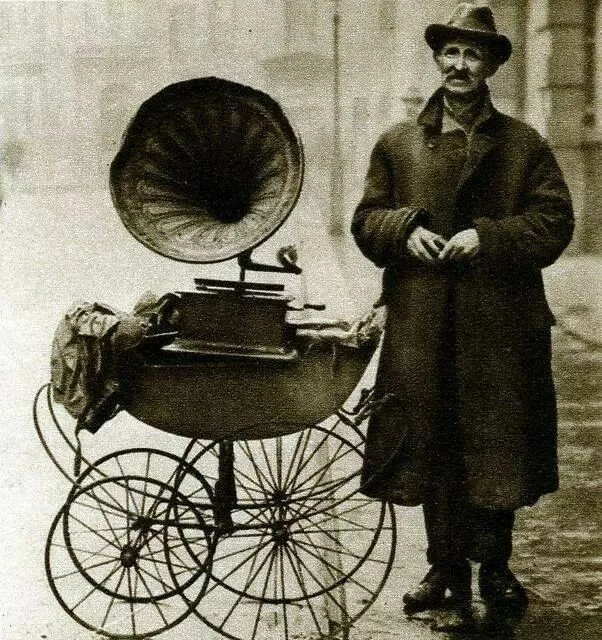
Foto: autor desconocido, dominio público, vía Wikimedia Commons
And it changed what gets played. Pau Casals found an edition of Bach's cello suites in a Barcelona shop in 1889, aged thirteen; at the time they were hardly ever performed in public. He recorded them between 1936 and 1939, the first one in Paris in June 1938.
After those discs, the six suites became core repertoire for the instrument everywhere. A recording does not only preserve: it also decides what gets preserved.
With timbre captured, timbre starts carrying the weight. Debussy heard a Javanese gamelan at the 1889 Paris Exposition Universelle, and out of it came "Pagodes", full of chords that go nowhere and stay ringing because of how they sound.
Others pushed further. Schoenberg and his circle removed the tonal centre, and with it the feeling of knowing where home is. Varèse wrote Ionisation between 1929 and 1931 for thirteen percussionists: almost everything you hear has no fixed pitch.
Hard facts: phonograph, December 1877, tinfoil; wax cylinder from 1888, about two minutes. Berliner's disc gramophone, 1887. Columbia's LP, 21 June 1948, 33⅓ rpm. Ionisation, 1929-1931, premiered 6 March 1933 in New York.
The same device elsewhere
Once timbre can be stored, it stops being decoration and becomes the thing that carries the music. These three do it, and they are worth hearing back to back:
- Birds of a Feather, Billie Eilish — the voice is recorded so close to the microphone that you hear the air and the lips. In a hall, four metres away, none of that would reach you. That timbre exists only because recording exists.
- Varèse's Ionisation — thirteen percussionists and no tune you could sing on the way out. The only thing moving from start to finish is the colour of the sound.
- The Javanese gamelan — an orchestra of gongs and metallophones whose scale does not match a piano's, and which is tuned differently from one gamelan to the next. It is not out of tune: tuning is part of timbre too.
None is better than the others. All three say the same thing: sometimes what holds music up is not the melody, it is the colour.
And here at home?
Start with what is missing. El Royo del Rabal — Pedro Nadal y Auré, Zaragoza, 1844-1905 — was the most celebrated jota singer of his time, mainly between 1860 and 1895. The phonograph already existed, and there is no record of a single cylinder or disc of him. All that survives of how he sang is what the people who heard him wrote down.
Now what is there. Antonio Aramburo, born in Erla, province of Zaragoza, in 1840, was an opera tenor who set up his own recording house in Madrid, at Calle Príncipe 12, under the name Viuda de Aramburo. It issued 48 wax cylinders sung by him, and among them is the jota from La Dolores. He paid not to disappear, and it worked.
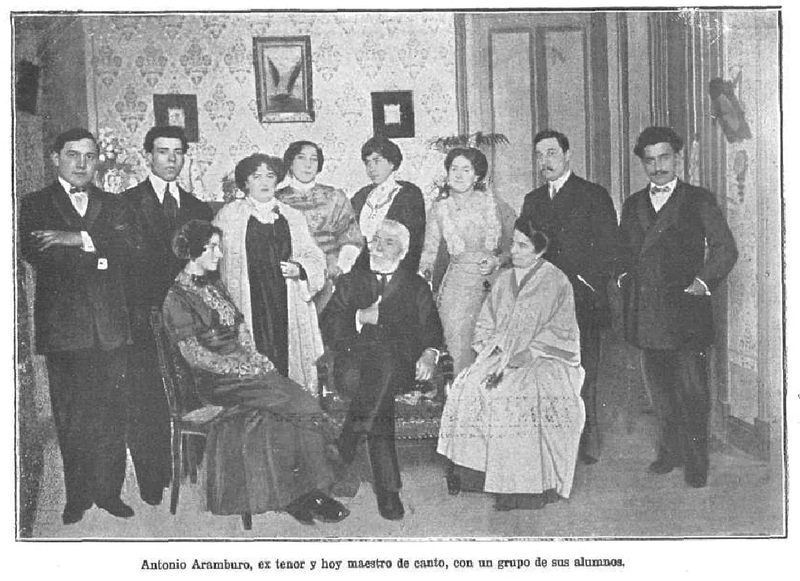
Foto: revista Caras y Caretas (Buenos Aires), 7-9-1912, n.º 727, dominio público, digitalizada por la Biblioteca Nacional de España, vía Wikimedia Commons
That jota comes from La Dolores, the opera by Tomás Bretón, premiered on 16 March 1895 at the Teatro de la Zarzuela in Madrid and set in Calatayud, in Aragón. First it left Aragón inside an opera. Then it left again, inside a cylinder.
In 1903 Isaac Albéniz recorded piano improvisations onto Edison brown wax cylinders. An improvisation is the most fragile thing there is: it is invented while it sounds and then it is over. From those, the sound survives, and you can play it.
Radio arrived in 1924 and finished the job. Radio España (EAJ-2) opened on 10 November 1924, and Radio Barcelona (EAJ-1) four days later. From then on you did not even need to buy the disc: music walked into the house by itself.
What came next is the part that looks most like a classroom. Between 1931 and 1936 the Misiones Pedagógicas travelled to some 7,000 towns and villages on 196 circuits with around 600 "missionaries". In many of them they left behind "a gramophone and a collection of records, renewed from time to time".
So a village with nobody in it who could play Bach could hear Bach for the first time.
And now a judgement, because this needs one. What got kept was not the best: it was whatever somebody chose to pay for. A tenor with money recorded himself and survives. The finest jota singer of his century had no record company and sounds nowhere. When you hear an old recording, the useful question is not whether it is good. It is who paid for the cylinder.
Classroom activities
- While the two preludes are compared: raise your hand every time the player stretches the time or stops to breathe. Afterwards we count the hands for each recording and compare the two numbers.
- While Ionisation plays: count timbres, not instruments. Write down words only — dry, metallic, low, rough — and at the end we pool how many different words came up. Then we run the count again on La Gozadera, which has more percussion timbres than you will manage to count first time.
- While Birds of a Feather plays: listen only to what is not a note. Raise your hand when you hear air, a lip, a breath.
- Play: take a four-note tune and pass it through every instrument in the room, one after another without stopping. That is orchestration. To hear it done by others, the guitar on With or Without You is a guitar with the pick stroke taken off the front; its article has the chart and the tab.
- Record: eight seconds of the classroom on a phone, played back straight away. It is literally what Edison did. The question to answer in writing is what has been lost compared with being in the room.
Key vocabulary
- Timbre — timbre: lo que distingue dos sonidos con la misma nota, duración y volumen
- Harmonics — armónicos (las vibraciones más agudas que suenan sobre la nota principal)
- Attack — ataque: cómo empieza un sonido, el golpe o el soplo inicial
- Phonograph — fonógrafo: la máquina que guardó un sonido por primera vez
- Performance decisions — criterio interpretativo: lo que decide quien toca y la partitura no dice
Resources
The songs in this unit are in the library, each with its own article, full-band chart and tab: Birds of a Feather, With or Without You, La Gozadera.
Same music, another era (1) — the Prelude from Cello Suite no. 1 played by Pau Casals. Casals recorded all six suites between 1936 and 1939.
Same music, another era (2) — the same Prelude by the Netherlands Bach Society, on instruments of Bach's time.
A piece made of timbre alone — Varèse's Ionisation, by the Ensemble Intercontemporain.
Tuning that will not fit a piano — Javanese gamelan, by the NIU School of Music ensemble.
An improvisation that was not lost — Isaac Albéniz at the piano, Edison brown wax cylinder, 1903, digitised by the Biblioteca Virtual Miguel de Cervantes.
A jota on a wax cylinder — from the zarzuela Gigantes y cabezudos, set in Zaragoza, recorded by the El Fonógrafo house.
The jota that left Aragón inside an opera — the one from La Dolores, by Tomás Bretón, played by the Agrupación Musical de Muel.
- The next question — once sound can be stored, somebody works out that it can also be manufactured. That is what "La sala donde suena esta canción no existe", the unit on the studio as an instrument from the 4th-year book, is about. It is in the library.
Nos preguntamos
- Si una flauta y una guitarra tocan la misma nota, ¿cómo sabes cuál es cuál?
- ¿Cuánta gente vivía de tocar antes de que existieran los altavoces?
- ¿Por qué casi todas las canciones duran unos tres minutos?
- ¿Suena igual una obra tocada hoy que hace ochenta años, si la partitura es la misma?
- Si nadie hubiera grabado nunca a tu abuela cantando, ¿existiría esa versión?
- ¿Por qué a la música del siglo XX le dio por la percusión y por los ruidos?
No las respondas todavía. Al final de la unidad volvemos a ellas.
El fragmento
Primero, sin poner ninguna grabación. Tocad todos el mismo la: la flauta, una voz, la guitarra, el teclado, el metalófono. Es la misma nota, las mismas vibraciones por segundo, y aun así no hace falta mirar para saber quién suena.
Ahora intentad igualarlos. Que la flauta suene como la guitarra sin dejar de ser flauta. No se puede. Eso que no se deja igualar es lo que vamos a estudiar.
La segunda parte del fragmento son cuatro compases. Los primeros del Preludio de la Suite nº 1 de Bach para violonchelo solo, que son cuatro compases que casi todo el mundo ha oído sin saber de dónde venían. Se escuchan dos veces: una en la grabación de Pau Casals y otra en la de la Netherlands Bach Society. Más de setenta años entre ellas.
Misma partitura, mismo instrumento, mismas notas. Mientras suenan, apunta solo cuatro cosas: si va rápido o lento, si el intérprete se para a respirar o sigue de largo, si la nota tiembla mucho o poco, y si oyes la sala. No digas cuál te gusta más. Di qué decidió cada uno.
Después, el Preludio entero. Sin comentar por encima.
Qué cambió
Hasta diciembre de 1877, toda la música que había sonado en la historia se había perdido. Toda. Existían las partituras, los instrumentos y la memoria de quien había estado allí, pero el sonido en sí no se quedaba en ninguna parte. La música era un acontecimiento, no un objeto.
Ese mes Edison envolvió una lámina de estaño en un cilindro con ranura y grabó una voz que luego volvió a salir. A partir de 1888 el cilindro se hizo de cera, y en 1887 Emile Berliner patentó la versión en disco plano, que es la que acabó ganando. Lo que esas máquinas guardaban no era la música: era el sonido.
Y ahí está la diferencia que importa. Una partitura guarda qué notas y cuándo. No guarda quién. El fonógrafo guarda justo lo otro, y eso que guarda tiene nombre: el timbre.
El timbre es lo que distingue dos sonidos que tienen la misma nota, la misma duración y el mismo volumen. Sale de dos sitios. Primero, de los armónicos: encima de la nota que reconoces vibran otras más agudas, y cada cuerpo las reparte a su manera. Segundo, de cómo empieza el sonido, lo que se llama el ataque: el martillo golpeando la cuerda, la púa, el soplo contra el bisel.
El ataque pesa más de lo que parece. Si a una nota de piano le quitas el arranque y dejas solo lo que viene después, cuesta reconocer que es un piano. Buena parte de la identidad de un instrumento cabe en la primera décima de segundo, y es exactamente la parte que una partitura no puede escribir.
Con el sonido guardado, el soporte empieza a mandar sobre la música. Un cilindro estándar daba unos dos minutos, y el Amberol de 1908 llegó a cuatro. El disco de 78 revoluciones dejó la canción en unos tres minutos.
Ese límite se quedó. El single de tres minutos siguió siendo la norma hasta los años sesenta, y sigue siendo más o menos la duración de lo que escuchas hoy. La decidió el tamaño de un disco de hace más de cien años.
También cambió quién come de esto. En 1927 llegó el cine sonoro, y en dos años 20.000 músicos se quedaron sin el trabajo de tocar en el foso de los cines. En 1930 el sindicato americano montó la Music Defense League contra lo que llamaban música enlatada. Perdieron. Es la primera vez que una máquina sustituye músicos en masa, y no será la última.
Foto: autor desconocido, dominio público, vía Wikimedia Commons
Y cambió qué se toca. Pau Casals encontró una edición de las suites de Bach para violonchelo en una tienda de Barcelona en 1889, con trece años; por entonces apenas se tocaban en público. Las grabó entre 1936 y 1939, la primera en París en junio de 1938.
Después de esos discos, las seis suites son repertorio central del instrumento en todo el mundo. Una grabación no solo conserva: también decide qué se conserva.
Con el timbre guardado, el timbre empieza a llevar el peso. Debussy oyó un gamelán javanés en la Exposición Universal de París de 1889, y de ahí salió «Pagodes», donde hay acordes que no van a ninguna parte y se quedan sonando por cómo suenan.
Otros tiran más lejos. Schoenberg y los suyos quitaron el centro de la tonalidad, y con él la sensación de saber dónde está tu casa. Varèse escribió Ionisation entre 1929 y 1931 para trece percusionistas: casi todo lo que suena son instrumentos sin nota fija.
Datos duros: fonógrafo, diciembre de 1877, estaño; cilindro de cera desde 1888, unos dos minutos. Gramófono de disco, Berliner, 1887. LP de Columbia, 21 de junio de 1948, 33⅓ revoluciones. Ionisation, 1929-1931, estreno el 6 de marzo de 1933 en Nueva York.
El mismo recurso en otros sitios
Cuando el timbre se puede guardar, deja de ser un adorno y pasa a ser lo que lleva la música. Estos tres lo hacen, y conviene oírlos seguidos:
- Birds of a Feather, Billie Eilish — la voz está grabada tan cerca del micrófono que oyes el aire y los labios. En una sala, a cuatro metros, eso no llegaría. Ese timbre solo existe porque existe la grabación.
- Ionisation, de Varèse — trece percusionistas y ninguna melodía que puedas cantar al salir. Lo único que se mueve de principio a fin es el color del sonido.
- El gamelán javanés — una orquesta de gongs y metalófonos cuya escala no coincide con la del piano, y que además se afina distinto de un gamelán a otro. No es que esté desafinada: es que la afinación también es timbre.
Ninguno es mejor que otro. Los tres dicen lo mismo: a veces lo que sostiene la música no es la melodía, es el color.
Y aquí, ¿qué?
Empecemos por lo que no hay. El Royo del Rabal —Pedro Nadal y Auré, Zaragoza, 1844-1905— fue el cantador de jota más celebrado de su tiempo, sobre todo entre 1860 y 1895. El fonógrafo ya existía y no hay constancia de ningún cilindro ni disco suyo. De cómo cantaba solo queda lo que escribieron los que lo oyeron.
Y sigamos por lo que sí. Antonio Aramburo, nacido en Erla, provincia de Zaragoza, en 1840, fue tenor de ópera y montó su propia casa de grabación en Madrid, en la calle Príncipe, 12, bajo el nombre de Viuda de Aramburo. Editó 48 cilindros de cera cantados por él mismo, y entre ellos está la jota de La Dolores. Pagó por no desaparecer, y le salió bien.
Foto: revista Caras y Caretas (Buenos Aires), 7-9-1912, n.º 727, dominio público, digitalizada por la Biblioteca Nacional de España, vía Wikimedia Commons
Esa jota viene de la ópera La Dolores, de Tomás Bretón, estrenada el 16 de marzo de 1895 en el Teatro de la Zarzuela de Madrid y ambientada en Calatayud. Primero salió de Aragón dentro de una ópera. Después salió otra vez, dentro de un cilindro.
En 1903 Isaac Albéniz grabó improvisaciones al piano en cilindros Edison de cera marrón. Una improvisación es lo más efímero que existe: se inventa mientras suena y se acaba. De aquellas queda el sonido, y puedes oírlo.
La radio llega en 1924 y termina el trabajo. Radio España (EAJ-2) se inauguró el 10 de noviembre de 1924 y Radio Barcelona (EAJ-1), cuatro días después. A partir de ahí ya no hace falta ni comprar el disco: la música entra en casa sola.
Lo que viene después es lo que más se parece a una clase. Entre 1931 y 1936, las Misiones Pedagógicas recorrieron unas 7.000 localidades en 196 circuitos con unos 600 misioneros, y en muchas dejaban «un gramófono y una colección de discos que se iba renovando cada cierto tiempo». Un pueblo donde no vivía nadie capaz de tocar a Bach podía, por primera vez, oír a Bach.
Y un juicio, porque aquí hace falta. Lo que se guardó no fue lo mejor: fue lo que alguien decidió pagar. Un tenor con dinero se grabó a sí mismo y sobrevive. El mejor jotero de su siglo no tenía casa de discos y no suena en ninguna parte. Cuando escuches una grabación antigua, la pregunta útil no es si es buena: es quién pagó el cilindro.
Para hacer en clase
- Durante la comparación de los dos preludios: levanta la mano cada vez que el intérprete estire el tiempo o se pare a respirar. Al final contamos cuántas manos se levantaron en cada grabación y comparamos las dos cifras.
- Durante Ionisation: cuenta timbres, no instrumentos. Apunta solo palabras —seco, metálico, grave, áspero— y al terminar ponemos en común cuántas palabras distintas han salido. Después repetimos el recuento con La Gozadera, que trae más timbres de percusión de los que vas a poder contar a la primera.
- Durante Birds of a Feather: escucha solo lo que no es nota. Levanta la mano cuando oigas el aire, un labio, una respiración.
- Tocar: cogemos una melodía de cuatro notas y la pasamos por todos los instrumentos que haya en el aula, uno detrás de otro y sin parar. Eso es orquestar. Para oírlo hecho por otros, la guitarra de With or Without You es una guitarra a la que le han quitado el golpe de la púa; su artículo trae el chart y la tablatura.
- Grabar: con un móvil, ocho segundos de la clase, y escuchadlos enseguida. Es literalmente lo que hizo Edison. La pregunta que hay que responder por escrito es qué se ha perdido respecto de estar aquí dentro.
Vocabulario fundamental
- Timbre — Lo que distingue dos sonidos que tienen la misma nota, la misma duración y el mismo volumen. Es lo que te deja reconocer un instrumento sin verlo.
- Armónicos — Las vibraciones más agudas que suenan a la vez que la nota principal. Cada instrumento las reparte a su manera, y de ahí sale su color.
- Ataque — Cómo empieza un sonido: el golpe, el roce, el soplo. Quitando el ataque, cuesta reconocer el instrumento.
- Fonógrafo — La máquina que por primera vez guardó un sonido y lo devolvió. Graba el sonido, no las notas.
- Criterio interpretativo — Las decisiones que toma quien toca y que la partitura no dice: velocidad, respiraciones, cuánto tiembla la nota.
Recursos
Las canciones de esta unidad están en la biblioteca, cada una con su artículo, su chart de banda y su tablatura: Birds of a Feather, With or Without You, La Gozadera.
La misma música, otra época (1) — el Preludio de la Suite nº 1 por Pau Casals. Casals grabó las seis suites entre 1936 y 1939.
La misma música, otra época (2) — el mismo Preludio por la Netherlands Bach Society, con instrumentos de la época de Bach.
Una pieza hecha solo de timbres — Ionisation de Varèse, por el Ensemble Intercontemporain.
La afinación que no cabe en un piano — gamelán javanés, por el conjunto de la NIU School of Music.
Una improvisación que no se perdió — Isaac Albéniz al piano, cilindro Edison de cera marrón, 1903, digitalizado por la Biblioteca Virtual Miguel de Cervantes.
Una jota en cilindro de cera — de la zarzuela Gigantes y cabezudos, ambientada en Zaragoza, en una grabación de la casa El Fonógrafo.
La jota que salió de Aragón dentro de una ópera — la de La Dolores, de Tomás Bretón, por la Agrupación Musical de Muel.
- La siguiente pregunta — cuando el sonido ya se puede guardar, alguien se da cuenta de que también se puede fabricar. De eso va «La sala donde suena esta canción no existe», la unidad sobre el estudio como instrumento del libro de 4º, en la biblioteca.
We ask ourselves
- If a flute and a guitar play the same note, how do you know which is which?
- How many people made a living playing music before loudspeakers existed?
- Why do almost all songs last about three minutes?
- Does a piece played today sound like the same piece played eighty years ago, if the score has not changed?
- If nobody had ever recorded your grandmother singing, would that version exist?
- Why did twentieth-century music turn towards percussion and towards noise?
Don't answer yet. We come back to these at the end.
The fragment
First, with no recording at all. Everyone play the same A: the flute, a voice, the guitar, the keyboard, the glockenspiel. Same note, same vibrations per second, and still nobody has to look to know who is sounding.
Now try to make them match. Make the flute sound like the guitar without it stopping being a flute. You can't. That thing that refuses to match is what this unit is about.
The second half of the fragment is four bars: the opening of the Prelude from Bach's Cello Suite no. 1, which almost everyone has heard without knowing where it came from. You listen twice — once in Pau Casals's recording, once in the Netherlands Bach Society's. More than seventy years apart.
Same score, same instrument, same notes. While they play, write down four things only: fast or slow, whether the player stops to breathe or pushes through, how much the note trembles, and whether you can hear the room. Don't say which one you prefer. Say what each one decided.
Then the whole Prelude, with nobody talking over it.
What changed
Until December 1877, every note of music ever played had been lost. All of it. There were scores, instruments and the memory of whoever had been in the room, but the sound itself stayed nowhere. Music was an event, not an object.
That month Edison wrapped a sheet of tinfoil around a grooved cylinder and recorded a voice that came back out. From 1888 the cylinder was made of wax, and in 1887 Emile Berliner had patented the flat-disc version, which is the one that won. What those machines kept was not the music: it was the sound.
And that is the difference that matters. A score keeps which notes and when. It does not keep who. The phonograph keeps exactly the other half, and that half has a name: timbre.
Timbre is what separates two sounds with the same pitch, the same length and the same volume. It comes from two places. First, the harmonics: above the note you recognise, higher vibrations are sounding too, and every body shares them out differently. Second, how the sound begins, which is called the attack: the hammer on the string, the pick, the breath against the edge.
The attack counts for more than you would guess. Take the beginning away from a piano note and leave only what follows, and it becomes hard to tell that it is a piano. Much of an instrument's identity fits into the first tenth of a second, and that is precisely the part a score cannot write down.
Once sound could be kept, the format started giving orders. A standard cylinder held about two minutes, and the 1908 Amberol reached four. The 78 rpm disc settled the song at around three minutes.
That limit stayed. The three-minute single was still the norm into the 1960s, and it is still roughly the length of what you played this morning. It was decided by the size of a disc made over a century ago.
It also changed who eats from this. Sound film arrived in 1927, and within two years 20,000 musicians lost their jobs playing in cinema pits. In 1930 the American union set up the Music Defense League against what they called canned music. They lost. It is the first time a machine replaced musicians in bulk, and it will not be the last.
Foto: autor desconocido, dominio público, vía Wikimedia Commons
And it changed what gets played. Pau Casals found an edition of Bach's cello suites in a Barcelona shop in 1889, aged thirteen; at the time they were hardly ever performed in public. He recorded them between 1936 and 1939, the first one in Paris in June 1938.
After those discs, the six suites became core repertoire for the instrument everywhere. A recording does not only preserve: it also decides what gets preserved.
With timbre captured, timbre starts carrying the weight. Debussy heard a Javanese gamelan at the 1889 Paris Exposition Universelle, and out of it came "Pagodes", full of chords that go nowhere and stay ringing because of how they sound.
Others pushed further. Schoenberg and his circle removed the tonal centre, and with it the feeling of knowing where home is. Varèse wrote Ionisation between 1929 and 1931 for thirteen percussionists: almost everything you hear has no fixed pitch.
Hard facts: phonograph, December 1877, tinfoil; wax cylinder from 1888, about two minutes. Berliner's disc gramophone, 1887. Columbia's LP, 21 June 1948, 33⅓ rpm. Ionisation, 1929-1931, premiered 6 March 1933 in New York.
The same device elsewhere
Once timbre can be stored, it stops being decoration and becomes the thing that carries the music. These three do it, and they are worth hearing back to back:
- Birds of a Feather, Billie Eilish — the voice is recorded so close to the microphone that you hear the air and the lips. In a hall, four metres away, none of that would reach you. That timbre exists only because recording exists.
- Varèse's Ionisation — thirteen percussionists and no tune you could sing on the way out. The only thing moving from start to finish is the colour of the sound.
- The Javanese gamelan — an orchestra of gongs and metallophones whose scale does not match a piano's, and which is tuned differently from one gamelan to the next. It is not out of tune: tuning is part of timbre too.
None is better than the others. All three say the same thing: sometimes what holds music up is not the melody, it is the colour.
And here at home?
Start with what is missing. El Royo del Rabal — Pedro Nadal y Auré, Zaragoza, 1844-1905 — was the most celebrated jota singer of his time, mainly between 1860 and 1895. The phonograph already existed, and there is no record of a single cylinder or disc of him. All that survives of how he sang is what the people who heard him wrote down.
Now what is there. Antonio Aramburo, born in Erla, province of Zaragoza, in 1840, was an opera tenor who set up his own recording house in Madrid, at Calle Príncipe 12, under the name Viuda de Aramburo. It issued 48 wax cylinders sung by him, and among them is the jota from La Dolores. He paid not to disappear, and it worked.
Foto: revista Caras y Caretas (Buenos Aires), 7-9-1912, n.º 727, dominio público, digitalizada por la Biblioteca Nacional de España, vía Wikimedia Commons
That jota comes from La Dolores, the opera by Tomás Bretón, premiered on 16 March 1895 at the Teatro de la Zarzuela in Madrid and set in Calatayud, in Aragón. First it left Aragón inside an opera. Then it left again, inside a cylinder.
In 1903 Isaac Albéniz recorded piano improvisations onto Edison brown wax cylinders. An improvisation is the most fragile thing there is: it is invented while it sounds and then it is over. From those, the sound survives, and you can play it.
Radio arrived in 1924 and finished the job. Radio España (EAJ-2) opened on 10 November 1924, and Radio Barcelona (EAJ-1) four days later. From then on you did not even need to buy the disc: music walked into the house by itself.
What came next is the part that looks most like a classroom. Between 1931 and 1936 the Misiones Pedagógicas travelled to some 7,000 towns and villages on 196 circuits with around 600 "missionaries". In many of them they left behind "a gramophone and a collection of records, renewed from time to time".
So a village with nobody in it who could play Bach could hear Bach for the first time.
And now a judgement, because this needs one. What got kept was not the best: it was whatever somebody chose to pay for. A tenor with money recorded himself and survives. The finest jota singer of his century had no record company and sounds nowhere. When you hear an old recording, the useful question is not whether it is good. It is who paid for the cylinder.
Classroom activities
- While the two preludes are compared: raise your hand every time the player stretches the time or stops to breathe. Afterwards we count the hands for each recording and compare the two numbers.
- While Ionisation plays: count timbres, not instruments. Write down words only — dry, metallic, low, rough — and at the end we pool how many different words came up. Then we run the count again on La Gozadera, which has more percussion timbres than you will manage to count first time.
- While Birds of a Feather plays: listen only to what is not a note. Raise your hand when you hear air, a lip, a breath.
- Play: take a four-note tune and pass it through every instrument in the room, one after another without stopping. That is orchestration. To hear it done by others, the guitar on With or Without You is a guitar with the pick stroke taken off the front; its article has the chart and the tab.
- Record: eight seconds of the classroom on a phone, played back straight away. It is literally what Edison did. The question to answer in writing is what has been lost compared with being in the room.
Key vocabulary
- Timbre — timbre: lo que distingue dos sonidos con la misma nota, duración y volumen
- Harmonics — armónicos (las vibraciones más agudas que suenan sobre la nota principal)
- Attack — ataque: cómo empieza un sonido, el golpe o el soplo inicial
- Phonograph — fonógrafo: la máquina que guardó un sonido por primera vez
- Performance decisions — criterio interpretativo: lo que decide quien toca y la partitura no dice
Resources
The songs in this unit are in the library, each with its own article, full-band chart and tab: Birds of a Feather, With or Without You, La Gozadera.
Same music, another era (1) — the Prelude from Cello Suite no. 1 played by Pau Casals. Casals recorded all six suites between 1936 and 1939.
Same music, another era (2) — the same Prelude by the Netherlands Bach Society, on instruments of Bach's time.
A piece made of timbre alone — Varèse's Ionisation, by the Ensemble Intercontemporain.
Tuning that will not fit a piano — Javanese gamelan, by the NIU School of Music ensemble.
An improvisation that was not lost — Isaac Albéniz at the piano, Edison brown wax cylinder, 1903, digitised by the Biblioteca Virtual Miguel de Cervantes.
A jota on a wax cylinder — from the zarzuela Gigantes y cabezudos, set in Zaragoza, recorded by the El Fonógrafo house.
The jota that left Aragón inside an opera — the one from La Dolores, by Tomás Bretón, played by the Agrupación Musical de Muel.
- The next question — once sound can be stored, somebody works out that it can also be manufactured. That is what "La sala donde suena esta canción no existe", the unit on the studio as an instrument from the 4th-year book, is about. It is in the library.