Contenidos
El universo sobre mí — Amaral (2005)
The only Amaral song to reach number 1 on the Spanish singles chart. A major-key verse, a chorus that darkens without changing notes, and a melody that fits into five notes.
🏷️ Ficha musical
Why it's in this book
"El universo sobre mí" is February's second song, the one that goes with "Bailando". The two share this year's chord family, i–VI–III–VII: the same loop as "Zombie" and "Despacito". In class, the chorus is played with A minor, F, C and G. But here you learn something new: the chorus changes mode compared with the verse, and the verse is in major. An honest warning: the record's verse has one extra chord, which in the class key is B flat, the hardest one on the ukulele. If you can't play it yet, play the chorus and leave the verse to the voice. In the room with no instruments, the melody in unison and a second voice a third above in the chorus. In the ukulele room, the chords. In the music room, electric guitar and drums at 93. And it's from here: Eva Amaral is from Zaragoza.
Why this song
If you have ever watched a rocket launch live, picture it with this song in the background. In 2023 the European Space Agency put it on the playlist for the launch of JUICE, a probe on its way to Jupiter. A real universe overhead.
The question on this page is: can a song turn sad without changing its notes? Here the verse and the chorus use almost the same scale, and yet they sound like two different moods.
Historical context
Amaral is two people: Eva Amaral, from Zaragoza, and Juan Aguirre, from San Sebastián. They met in Zaragoza in the early nineties and started playing together. At the end of that decade they moved to Madrid to record.
In 2005 they released Pájaros en la cabeza, their fourth album. "El universo sobre mí" was the first single from it, out on 25 February 2005. Two weeks later it went straight in at number 1 in Spain and stayed there for three weeks. It is Amaral's only number 1 on the singles chart, even though they have many songs better known from the radio.

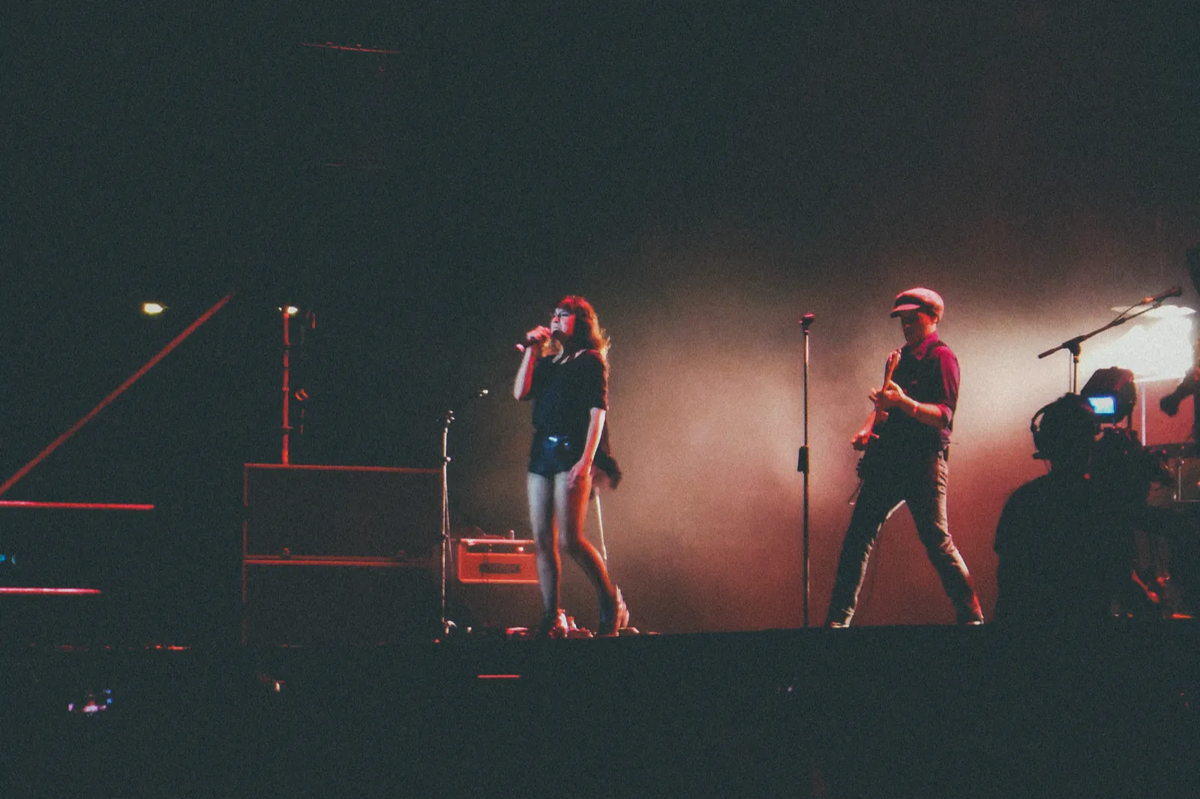
Foto: livepict.com, CC BY-SA 3.0, vía Wikimedia Commons
Eva Amaral live in 2008. The melody of this song barely moves: it goes up and down within five notes. That is why a whole stadium can sing it.
The song was first called "Solo queda una vela" ("Only one candle left"). And the intro has a story: Juan Aguirre had hurt his hand and couldn't play guitar the way he wanted, so they recorded it on keyboard. In concert they play it on a mellotron, an old keyboard that plays back recordings of real instruments.
Musical characteristics
A keyboard intro. The first thing you hear is not a guitar. It is a keyboard. Some people have compared it to the opening of the Beatles' "Strawberry Fields Forever", which also starts on a mellotron.
A major verse with a borrowed chord. The verse goes round D, C, B minor and A. D is home: it sounds in D major. But C doesn't belong to that scale. It is borrowed from another one, which is why it sounds a bit rock, a bit open. A chord that comes from outside the scale is a borrowed chord.
A chorus that darkens. When the chorus arrives, the loop changes: B minor, G, D, A, over and over. They are almost the same notes as the verse, but now home is B minor. D major and B minor share all their notes; they are called relative keys. Moving from one to the other is like looking at the same room with the light off. This loop is i–VI–III–VII, the one in "Bailando" and "Zombie".
A short melody. The verse melody goes from D up to A: just five notes. The distance between the lowest and the highest note is called the range, and here it is very narrow. That makes it good for changing voices, and leaves room for a second voice a third above in the chorus.
In class. The record is in D major. In class we take it down a tone: the chorus becomes A minor, F, C and G, and the verse C, B flat, A minor and G.
Hard facts: D major in the verse and B minor in the chorus, 4/4, 93 beats per minute, 4:07. The form: keyboard intro, then verses and choruses taking turns.
Guided listening
Play the music video. In the intro, listen for which instrument comes first. Is it a guitar?
When the voice comes in on the first verse, sing "D, C, B minor, A" in your head at each change. Notice the C: it's the one that sounds slightly odd, the borrowed one.
When the chorus arrives, pay attention to the colour. Does it sound happier or sadder than the verse? The new chords are B minor, G, D, A.
In the second chorus, sing the melody and notice how little it moves. Try singing it a third higher.
At the end, compare the last chorus with the first. Same chords. Which instruments have joined in?
Trivia and curiosities
- A lonely number 1. Amaral has songs everybody knows, but this is the only one that reached number 1 on the Spanish singles chart.
- Music for Jupiter. In 2023 the European Space Agency chose it for the launch playlist of JUICE, a probe that will study the moons of Jupiter.
- An injured hand. The intro is on keyboard because Juan Aguirre had hurt his hand. Sometimes a problem decides how a song sounds.
- Another Amaral song in this index. "Marta, Sebas, Guille y los demás", from the same album, uses the I–V–vi–IV loop. Compare them: same band, same year, two chord families.
Classroom activities
- Two colours. Ukulele: play four rounds of C, B flat, A minor, G and then four of A minor, F, C, G. Which sounds darker? Explain why, if the notes are almost the same.
- Bailando and El universo. Play the chorus of "Bailando" and, without stopping, the chorus of "El universo sobre mí" in the class key. Same loop, another song.
- In two voices. In the room with no instruments: everyone sings the chorus melody; then half the class sings it a third higher. Because the range is narrow, the second voice stays in the comfortable zone.
- Band. In the music room: drums at 93, electric guitar on the chorus chords, bass on the note that names each chord, keyboard on the intro. Everyone else on ukulele.
- Listen. With your eyes closed, raise your hand when the song moves from verse to chorus. Then explain what told you.
Key vocabulary
- Borrowed chord — acorde prestado
- Relative keys — tonalidades relativas: a major and a minor key with the same notes
- Chord loop — bucle armónico
- Range — ámbito
- Third — tercera: a second voice three notes higher
Resources
Official music video — Uploaded by Warner Music Spain.
Ukulele tutorial — Georgina Rappazzo, in Spanish.
Guitar tutorial — Fran Brea, Más que Guitarra school, in Spanish.
Piano tutorial — Sancho Parla.
Drums — CharlyDrummerMadrid. A drum version over the recording.
Por qué está en este libro
«El universo sobre mí» es la segunda canción de febrero, la que acompaña a «Bailando». Las dos comparten el bucle de la familia de este curso, i–VI–III–VII: el mismo que «Zombie» y «Despacito». En clase, el estribillo se toca con la menor, fa, do y sol. Pero aquí aprendes algo nuevo: el estribillo cambia de modo respecto a la estrofa, y la estrofa suena en mayor. Un aviso honesto: la estrofa del disco tiene un acorde de más, que en el tono de clase es un si bemol, el más difícil del ukelele. Si todavía no te sale, toca el estribillo y deja la estrofa a la voz. En el aula sin nada, la melodía al unísono y la segunda voz una tercera por encima en el estribillo. En el aula de ukeleles, los acordes. En el aula de música, guitarra eléctrica y batería a 93. Y es de aquí: Eva Amaral es de Zaragoza.
Por dónde entrar
Si alguna vez has visto despegar un cohete en directo, imagínalo con esta canción de fondo. En 2023 la Agencia Espacial Europea la metió en la lista de canciones para el lanzamiento de JUICE, una sonda que va camino de Júpiter. Un universo encima de verdad.
La pregunta de esta página es: ¿puede una canción ponerse triste sin cambiar de notas? Aquí la estrofa y el estribillo usan casi la misma escala, y aun así suenan a dos estados de ánimo distintos.
Contexto histórico
Amaral son dos: Eva Amaral, de Zaragoza, y Juan Aguirre, de San Sebastián. Se conocieron en Zaragoza a principios de los noventa y empezaron a tocar juntos. A finales de esa década se fueron a Madrid a grabar.
En 2005 publicaron Pájaros en la cabeza, su cuarto disco. «El universo sobre mí» fue la primera canción que sacaron de él, el 25 de febrero de 2005. Dos semanas después entró directamente al número 1 en España y se quedó tres semanas. Es el único número 1 de Amaral en la lista de sencillos, aunque tienen muchas canciones más conocidas por la radio.
Foto: livepict.com, CC BY-SA 3.0, vía Wikimedia Commons
Eva Amaral en directo en 2008. La melodía de esta canción se mueve muy poco: sube y baja dentro de cinco notas. Por eso la puede cantar un estadio entero.
La canción se llamaba al principio «Solo queda una vela». Y la introducción tiene una historia: Juan Aguirre se había hecho daño en la mano y no podía tocar la guitarra como quería, así que la grabaron con teclado. En los conciertos la tocan con un mellotron, un teclado antiguo que reproduce grabaciones de instrumentos de verdad.
Cómo suena
Una introducción de teclado. Lo primero que oyes no es una guitarra. Es un teclado. Hay quien lo ha comparado con el principio de «Strawberry Fields Forever», de los Beatles, que también empieza con un mellotron.
Una estrofa en mayor, con un acorde prestado. La estrofa gira sobre re, do, si menor y la. Re es la casa: suena en Re mayor. Pero el do no pertenece a esa escala. Lo toma prestado de otra, y por eso suena un poco a rock, un poco abierto. Un acorde que viene de fuera de la escala es un acorde prestado.
Un estribillo que se oscurece. Cuando llega el estribillo, el bucle cambia: si menor, sol, re, la, una y otra vez. Son casi las mismas notas que la estrofa, pero ahora la casa es si menor. Re mayor y si menor comparten todas sus notas; se dice que son tonalidades relativas. Cambiar de una a otra es como mirar la misma habitación con la luz apagada. Este bucle es i–VI–III–VII, el de «Bailando» y «Zombie».
Una melodía corta. La melodía de la estrofa va de re a la: solo cinco notas. La distancia entre la nota más grave y la más aguda se llama ámbito, y aquí es muy corto. Por eso es buena para voces que están cambiando, y deja sitio a una segunda voz una tercera por encima en el estribillo.
En clase. El disco está en Re mayor. En clase la bajamos un tono: el estribillo queda en la menor, fa, do y sol, y la estrofa en do, si bemol, la menor y sol.
Datos duros: Re mayor en la estrofa y Si menor en el estribillo, 4/4, 93 pulsos por minuto, 4:07. La forma: introducción de teclado, estrofas y estribillos que se alternan.
Escucha guiada
Pon el videoclip. En la introducción, escucha qué instrumento suena primero. ¿Es una guitarra?
Cuando entre la voz en la primera estrofa, canta por dentro «re, do, si menor, la» con cada cambio. Fíjate en el do: es el que suena un poco raro, el prestado.
Cuando llegue el estribillo, presta atención al color. ¿Suena más alegre o más triste que la estrofa? Los acordes nuevos son si menor, sol, re, la.
En el segundo estribillo, canta la melodía y fíjate en lo poco que sube y baja. Intenta cantarla una tercera por encima.
Al final, compara el último estribillo con el primero. Mismos acordes. ¿Qué instrumentos se han sumado?
Curiosidades
- Un número 1 solitario. Amaral tiene canciones que conoce todo el mundo, pero esta es la única que llegó al número 1 de la lista de sencillos en España.
- Música para Júpiter. La Agencia Espacial Europea la eligió en 2023 para la lista del lanzamiento de JUICE, una sonda que va a estudiar las lunas de Júpiter.
- Una mano lesionada. La introducción es de teclado porque Juan Aguirre se había hecho daño en la mano. A veces un problema decide cómo suena una canción.
- Otra canción de Amaral en este índice. «Marta, Sebas, Guille y los demás», del mismo disco, usa el bucle I–V–vi–IV. Comparadlas: mismo grupo, mismo año, dos familias de acordes.
Para hacer en clase
- Dos colores. Ukelele: tocad cuatro vueltas de do, si bemol, la menor, sol y después cuatro de la menor, fa, do, sol. ¿Cuál suena más oscuro? Explicad por qué, si las notas son casi las mismas.
- Bailando y El universo. Tocad el estribillo de «Bailando» y, sin parar, el de «El universo sobre mí» en el tono de clase. Mismo bucle, otra canción.
- A dos voces. En el aula sin nada: todos cantan la melodía del estribillo; luego la mitad la canta una tercera por encima. Como el ámbito es corto, la segunda voz no se sale de la zona cómoda.
- Banda. En el aula de música: batería a 93, guitarra eléctrica con los acordes del estribillo, bajo en la nota que da nombre a cada acorde, teclado con la introducción. El resto, ukelele.
- Escuchar. Con los ojos cerrados, levantad la mano cuando la canción pase de la estrofa al estribillo. Después, explicad qué os ha avisado.
Vocabulario fundamental
- Acorde prestado — Un acorde que viene de fuera de la escala de la canción. Aquí, el do de la estrofa.
- Tonalidades relativas — Una mayor y una menor que comparten todas sus notas, como Re mayor y Si menor.
- Bucle armónico — Una serie de acordes que se repite. En el estribillo, si menor, sol, re, la.
- Ámbito — La distancia entre la nota más grave y la más aguda de una melodía.
- Tercera — Una segunda voz que canta la misma melodía tres notas más arriba.
Recursos
Videoclip oficial — Subido por Warner Music Spain.
Tutorial de ukelele — Georgina Rappazzo, en castellano.
Tutorial de guitarra — Fran Brea, escuela Más que Guitarra, en castellano.
Tutorial de piano — Sancho Parla.
Batería — CharlyDrummerMadrid. Versión de batería sobre la grabación.
Why it's in this book
"El universo sobre mí" is February's second song, the one that goes with "Bailando". The two share this year's chord family, i–VI–III–VII: the same loop as "Zombie" and "Despacito". In class, the chorus is played with A minor, F, C and G. But here you learn something new: the chorus changes mode compared with the verse, and the verse is in major. An honest warning: the record's verse has one extra chord, which in the class key is B flat, the hardest one on the ukulele. If you can't play it yet, play the chorus and leave the verse to the voice. In the room with no instruments, the melody in unison and a second voice a third above in the chorus. In the ukulele room, the chords. In the music room, electric guitar and drums at 93. And it's from here: Eva Amaral is from Zaragoza.
Why this song
If you have ever watched a rocket launch live, picture it with this song in the background. In 2023 the European Space Agency put it on the playlist for the launch of JUICE, a probe on its way to Jupiter. A real universe overhead.
The question on this page is: can a song turn sad without changing its notes? Here the verse and the chorus use almost the same scale, and yet they sound like two different moods.
Historical context
Amaral is two people: Eva Amaral, from Zaragoza, and Juan Aguirre, from San Sebastián. They met in Zaragoza in the early nineties and started playing together. At the end of that decade they moved to Madrid to record.
In 2005 they released Pájaros en la cabeza, their fourth album. "El universo sobre mí" was the first single from it, out on 25 February 2005. Two weeks later it went straight in at number 1 in Spain and stayed there for three weeks. It is Amaral's only number 1 on the singles chart, even though they have many songs better known from the radio.
Foto: livepict.com, CC BY-SA 3.0, vía Wikimedia Commons
Eva Amaral live in 2008. The melody of this song barely moves: it goes up and down within five notes. That is why a whole stadium can sing it.
The song was first called "Solo queda una vela" ("Only one candle left"). And the intro has a story: Juan Aguirre had hurt his hand and couldn't play guitar the way he wanted, so they recorded it on keyboard. In concert they play it on a mellotron, an old keyboard that plays back recordings of real instruments.
Musical characteristics
A keyboard intro. The first thing you hear is not a guitar. It is a keyboard. Some people have compared it to the opening of the Beatles' "Strawberry Fields Forever", which also starts on a mellotron.
A major verse with a borrowed chord. The verse goes round D, C, B minor and A. D is home: it sounds in D major. But C doesn't belong to that scale. It is borrowed from another one, which is why it sounds a bit rock, a bit open. A chord that comes from outside the scale is a borrowed chord.
A chorus that darkens. When the chorus arrives, the loop changes: B minor, G, D, A, over and over. They are almost the same notes as the verse, but now home is B minor. D major and B minor share all their notes; they are called relative keys. Moving from one to the other is like looking at the same room with the light off. This loop is i–VI–III–VII, the one in "Bailando" and "Zombie".
A short melody. The verse melody goes from D up to A: just five notes. The distance between the lowest and the highest note is called the range, and here it is very narrow. That makes it good for changing voices, and leaves room for a second voice a third above in the chorus.
In class. The record is in D major. In class we take it down a tone: the chorus becomes A minor, F, C and G, and the verse C, B flat, A minor and G.
Hard facts: D major in the verse and B minor in the chorus, 4/4, 93 beats per minute, 4:07. The form: keyboard intro, then verses and choruses taking turns.
Guided listening
Play the music video. In the intro, listen for which instrument comes first. Is it a guitar?
When the voice comes in on the first verse, sing "D, C, B minor, A" in your head at each change. Notice the C: it's the one that sounds slightly odd, the borrowed one.
When the chorus arrives, pay attention to the colour. Does it sound happier or sadder than the verse? The new chords are B minor, G, D, A.
In the second chorus, sing the melody and notice how little it moves. Try singing it a third higher.
At the end, compare the last chorus with the first. Same chords. Which instruments have joined in?
Trivia and curiosities
- A lonely number 1. Amaral has songs everybody knows, but this is the only one that reached number 1 on the Spanish singles chart.
- Music for Jupiter. In 2023 the European Space Agency chose it for the launch playlist of JUICE, a probe that will study the moons of Jupiter.
- An injured hand. The intro is on keyboard because Juan Aguirre had hurt his hand. Sometimes a problem decides how a song sounds.
- Another Amaral song in this index. "Marta, Sebas, Guille y los demás", from the same album, uses the I–V–vi–IV loop. Compare them: same band, same year, two chord families.
Classroom activities
- Two colours. Ukulele: play four rounds of C, B flat, A minor, G and then four of A minor, F, C, G. Which sounds darker? Explain why, if the notes are almost the same.
- Bailando and El universo. Play the chorus of "Bailando" and, without stopping, the chorus of "El universo sobre mí" in the class key. Same loop, another song.
- In two voices. In the room with no instruments: everyone sings the chorus melody; then half the class sings it a third higher. Because the range is narrow, the second voice stays in the comfortable zone.
- Band. In the music room: drums at 93, electric guitar on the chorus chords, bass on the note that names each chord, keyboard on the intro. Everyone else on ukulele.
- Listen. With your eyes closed, raise your hand when the song moves from verse to chorus. Then explain what told you.
Key vocabulary
- Borrowed chord — acorde prestado
- Relative keys — tonalidades relativas: a major and a minor key with the same notes
- Chord loop — bucle armónico
- Range — ámbito
- Third — tercera: a second voice three notes higher
Resources
Official music video — Uploaded by Warner Music Spain.
Ukulele tutorial — Georgina Rappazzo, in Spanish.
Guitar tutorial — Fran Brea, Más que Guitarra school, in Spanish.
Piano tutorial — Sancho Parla.
Drums — CharlyDrummerMadrid. A drum version over the recording.