Contenidos
Don't Stop Believin' — Journey (1981)
An eighties rock song that hides its chorus until the very last minute. A piano riff, a bass line that never stops and a guitar solo: everything a five-piece band needs.
🏷️ Ficha musical
Why it's in this book
This is November's anchor song, the second big stop of the year after La Bamba and Twist and Shout. With it you change family: you leave the I–IV–V of rock and roll behind and move into the I–V–vi–IV loop, the same one as With or Without You and Chasing Cars, and the one you already sang in 1º ESO with Perfect. In class we play it with four chords, E–B–C♯m–A, or in D (D–A–Bm–G) if that suits the ukulele better; the record also slips in a G sharp minor in the second half of each loop, and we leave that chord out at first. In the room with nothing you work on "don't stop believin'" in two parts and keep the beat with your body. In the ukulele room you put the whole form together, which is the hard part here. And in the music room comes what the song is really for: the keyboard player gets the piano riff, and the guitarist gets a first real solo.
Why this song
You have heard this song in a stadium, in a TV series or in a karaoke clip, shouted by people who don't know the rest of the words. They nearly always sing the same thing: the title.
The strange thing is where that title sits. On the record, "don't stop believin'" with its chorus melody only turns up with about fifty seconds left. For more than three minutes the song makes you wait.
The question on this page is: how does a song hold together without its chorus? The answer is in the piano at the start.
Historical context
Journey were a band from San Francisco. They began in the seventies playing mostly instrumental rock, with a guitarist, Neal Schon, who had played with Santana as a teenager. Once Steve Perry became their singer, they moved to shorter songs, built for radio and for huge arenas. That sound became known as arena rock.
In 1980 the keyboard player Jonathan Cain joined. He brought a line with him. Years earlier, when he was scraping by as a musician on Sunset Boulevard in Los Angeles, he phoned his father to say he was giving up. His father told him not to stop believing, or he was done. That line is the title.
Cain, Perry and Schon wrote it, and they recorded it in 1981 in Berkeley, California, for the album Escape. The band played it in a single take. Perry recorded the vocal, almost all of it in one go too, the following week.
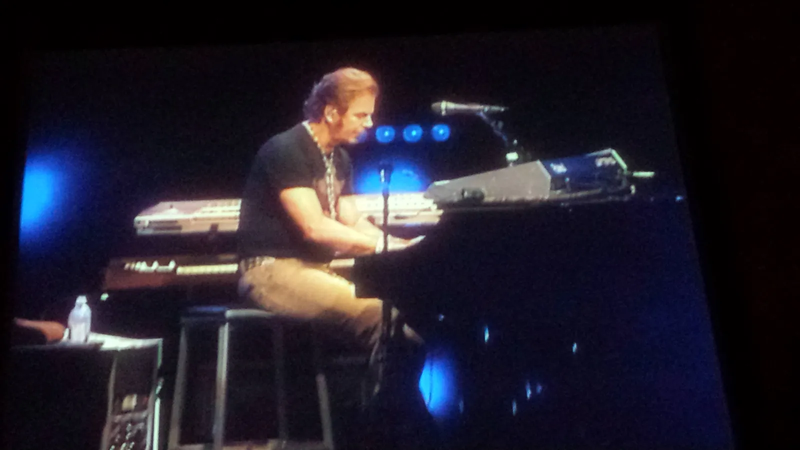
Foto: PumpkinSky, CC BY-SA 3.0, vía Wikimedia Commons
This is Jonathan Cain at the piano, at a 2014 concert in Virginia Beach, in the United States. The picture was taken off the giant screen above the stage. Notice that he sits at a piano with more keyboards behind him: on the record he also used a synthesizer.
In 1981 the song reached number 9 in the United States. It was not their biggest hit at the time. Its second life came twenty-five years later: the final scene of The Sopranos in 2007, the Glee cover in 2009, and baseball and hockey stadiums. By 2012 it was the best-selling digital song from the whole of the twentieth century.
Musical characteristics
A piano riff that never leaves. The song opens with the piano alone. The right hand plays repeated chords while the left hand walks up and down underneath. That figure repeats for almost the entire song: it is a riff, a short phrase that keeps coming back until it becomes the song's signature. If someone plays the first two seconds, you already know what song it is.
The usual loop, with a twist. The chords of the riff are E, B, C sharp minor and A: I–V–vi–IV. It is the same chord progression you have been singing since 1º ESO. But the record has a twist. In the second half of the loop, instead of going back to C sharp minor, it passes through G sharp minor (chord iii). It is a softer minor chord, and it stops the loop from sounding exactly the same twice in a row. In class we drop it at first and bring it in once the loop runs by itself.
A band that builds up. First only piano and voice. Then the bass and guitar come in. The bass plays quavers, two notes per beat, nonstop: it is the engine. On top, the guitar plays arpeggios in semiquavers, four notes per beat. The drummer, Steve Smith, asked Schon to play like that, like a train pulling the song forward. The drums hold it all together with the backbeat: the loud snare hit on beats 2 and 4.
The chorus, at the end. This song's form is upside down. There are three verses and two pre-choruses, sections that sound like "here it comes, here it comes", and the chorus only appears at the end. Before anyone sings it, it is played once in full with Schon's guitar on top: that is the solo. That is why the solo is so easy to remember. It is the melody you have been waiting three minutes for, played on guitar before anyone sings it.
Hard facts: E major, 4/4, 119 beats per minute, 4:11. The form: piano intro, verse, instrumental, half verse, pre-chorus, instrumental, verse, pre-chorus, instrumental chorus with the guitar, and the sung chorus until the fade-out.
Guided listening
Play the studio audio. In the intro, listen to the piano only. Try to separate the two hands: the right one repeats, the left one moves. Count how many chords there are before the loop starts again.
When Perry's voice comes in, keep listening to the piano. Nothing has changed: the riff is still underneath.
After the first verse the bass and guitar come in. Tap the bass quavers with your hand, two per beat. Then try to hear the fast guitar arpeggios, which go twice as fast.
In the pre-choruses, notice how the music seems to hang in the air without quite arriving. Count how many times that happens before the chorus.
At the end, when the guitar plays a long melody on its own, sing it in your head. A few seconds later Perry sings it with the title. It is the same tune.
Trivia and curiosities
- The bass line, played by Ross Valory on the record, was invented by the guitarist, Neal Schon. In a band, a part does not have to come from the person who plays it.
- The lyrics mention "South Detroit", a neighbourhood that does not exist: south of downtown Detroit there is a river, and across it, Canada. Cain called it "the city of possibilities in your mind".
- Steve Perry was hesitant at first about letting the song close The Sopranos. In the end he agreed, and downloads shot up.
- In 2022 the US Library of Congress added it to its National Recording Registry, the list of recordings worth preserving.
Classroom activities
- Play the loop. Ukulele, guitar and keyboard: E–B–C♯m–A, one chord per bar, or D–A–Bm–G if you are in D. Start with one strum per beat. Once it runs without stopping, anyone who wants to adds G sharp minor (or F sharp minor in D) in the second loop.
- The riff, two hands. The keyboard player first plays only the right-hand chords, in quavers. Then only the left hand. Both together, once each one works without looking.
- Build the form. On the board, write the form in words: intro, verse, pre-chorus, chorus. Then, with the recording, point to where you are. Closed question: how many times do you hear the pre-chorus before the chorus?
- The solo. The guitarist learns the chorus melody note by note: that is the basis of the solo. Meanwhile, everyone else sings "don't stop believin'" in two parts over the loop.
- Create. In groups, write a short song with the chorus at the end. What do the verses need so that people stick around until it arrives?
Key vocabulary
- Riff — riff: frase corta que se repite y se convierte en la firma de la canción
- Chord progression — progresión de acordes
- Quavers — corcheas: dos notas por pulso
- Backbeat — el golpe de caja en el 2 y el 4
- Pre-chorus — preestribillo: la parte que prepara el estribillo
Resources
Official live video (Houston, 1981) — There is no studio music video. This is the video the band itself puts out, from the Escape tour: the five musicians from the record playing it.
Official studio audio — The album recording, the one we use for the guided listening.
Piano tutorial — Pianote. Starts with the right-hand chords, then explains the left hand, which is the one that moves.
Guitar tutorial — Marty Music. The chords, the arpeggios and the electric guitar parts.
Guitar solo tutorial — GuitarLessons365Song. Just the solo, slowly and phrase by phrase.
Ukulele tutorial — Four Chord Simple. An easy version, with the four chords of the loop.
Bass tutorial — Nate Navarro. Plays the whole line with the tab on screen, to play along with.
Drum tutorial — Drumeo. Steve Smith, the drummer on the record, explains how he built his part.
- Harmonic analysis — https://www.hooktheory.com/theorytab/view/journey/dont-stop-believin
Por qué está en este libro
Es la canción ancla de noviembre, la segunda gran parada del curso después de La Bamba y Twist and Shout. Con ella cambias de familia: dejas el I–IV–V del rock and roll y entras en el bucle I–V–vi–IV, el mismo de With or Without You y Chasing Cars, y el que ya cantabas en 1º con Perfect. En clase se toca con cuatro acordes, E–B–C♯m–A, o en Re (D–A–Bm–G) si el ukelele lo agradece; el disco mete además un sol sostenido menor en la segunda mitad de cada vuelta, y ese acorde lo dejamos fuera al principio. En el aula sin nada trabajáis el «don't stop believin'» a dos voces y el pulso con el cuerpo. En el aula con ukelele montáis la forma entera, que aquí es lo difícil. Y en el aula de música llega lo que da sentido a la canción: el teclista con el riff de piano y el guitarrista con su primer solo de verdad.
Por dónde entrar
Esta canción la has oído en un estadio, en una serie o en un vídeo de karaoke, cantada a gritos por gente que no se sabe el resto. Casi siempre se canta lo mismo: el título.
Lo raro es dónde está ese título. En el disco, la frase «don't stop believin'» con su melodía de estribillo no llega hasta que quedan unos cincuenta segundos. Durante más de tres minutos la canción te hace esperar.
La pregunta de esta página es: ¿cómo se sostiene una canción entera sin su estribillo? La respuesta está en el piano del principio.
Contexto histórico
Journey era una banda de San Francisco. Empezó en los setenta tocando rock casi instrumental, con un guitarrista, Neal Schon, que había tocado con Santana siendo adolescente. Con el cantante Steve Perry se pasaron a canciones más cortas, hechas para la radio y para pabellones enormes. A ese sonido se le llamó rock de estadio.
En 1980 entró en la banda el teclista Jonathan Cain. Traía una frase guardada. Años antes, cuando malvivía como músico en Sunset Boulevard, en Los Ángeles, llamó a su padre para decirle que lo dejaba. El padre le contestó que no dejara de creer, o estaba acabado. Esa frase es el título.
La compusieron Cain, Perry y Schon, y la grabaron en 1981 en Berkeley (California) para el disco Escape. La banda la tocó en una sola toma. Perry grabó la voz, casi entera, también de una vez, la semana siguiente.
Foto: PumpkinSky, CC BY-SA 3.0, vía Wikimedia Commons
Este es Jonathan Cain al piano, en un concierto de 2014 en Virginia Beach (Estados Unidos). La foto está sacada de la pantalla gigante del escenario. Fíjate en que toca sentado delante de un piano y tiene más teclados detrás: en el disco usó también un sintetizador.
En 1981 la canción llegó al número 9 en Estados Unidos. No fue su mayor éxito entonces. Su segunda vida llegó veinticinco años después: la escena final de la serie Los Soprano en 2007, la versión de Glee en 2009 y los estadios de béisbol y hockey. En 2012 era la canción digital más vendida de todo el siglo XX.
Cómo suena
Un riff de piano que no se va. La canción empieza con el piano solo. La mano derecha toca acordes repetidos, y la mano izquierda va bajando y subiendo debajo. Esa figura se repite casi toda la canción: es un riff, una frase corta que vuelve una y otra vez hasta que se convierte en la firma de la canción. Si alguien toca los dos primeros segundos, ya sabes qué canción es.
El bucle de siempre, con una trampa. Los acordes del riff son mi, si, do sostenido menor y la: I–V–vi–IV. Es la misma progresión de acordes que llevas cantando desde 1º. Pero el disco tiene una trampa. En la segunda mitad de la vuelta, en lugar de volver al do sostenido menor, pasa por un sol sostenido menor (el acorde iii). Es un acorde menor más suave, y hace que la vuelta no suene exactamente igual dos veces seguidas. En clase lo quitamos al principio y lo metemos cuando el bucle ya salga solo.
Una banda que se va sumando. Primero solo piano y voz. Luego entran el bajo y la guitarra. El bajo toca corcheas, dos golpes por pulso, sin parar: es el motor. Encima, la guitarra hace arpegios en semicorcheas, cuatro notas por pulso. El batería, Steve Smith, le pidió a Schon que tocara así, como un tren que tira de la canción hacia delante. Y la batería sostiene todo con el backbeat: el golpe fuerte de caja en el 2 y en el 4.
El estribillo, al final. La forma de esta canción está al revés. Hay tres estrofas y dos preestribillos, partes que suenan a «ya llega, ya llega», y el estribillo no aparece hasta el final. Antes de que nadie lo cante, suena una vez entero con la guitarra de Schon por encima: es el solo. Por eso el solo es tan fácil de recordar. Es la melodía que llevas tres minutos esperando, tocada en guitarra antes de cantarse.
Datos duros: Mi mayor, 4/4, 119 pulsos por minuto, 4:11. La forma: intro de piano, estrofa, instrumental, media estrofa, preestribillo, instrumental, estrofa, preestribillo, estribillo instrumental con la guitarra, y estribillo cantado hasta el fundido.
Escucha guiada
Pon el audio de estudio. En la intro, escucha solo el piano. Intenta separar las dos manos: la derecha repite, la izquierda se mueve. Cuenta cuántos acordes hay antes de que la vuelta empiece otra vez.
Cuando entra la voz de Perry, sigue escuchando el piano. No ha cambiado nada: el riff sigue debajo.
Después de la primera estrofa entran el bajo y la guitarra. Marca con la mano las corcheas del bajo, dos por pulso. Después intenta oír los arpegios rápidos de la guitarra, que van al doble de velocidad.
En los preestribillos, fíjate en que la música se queda como suspendida, sin terminar de llegar. Cuenta cuántas veces pasa eso antes del estribillo.
Al final, cuando la guitarra toca sola una melodía larga, cántala por dentro. Unos segundos después la canta Perry con el título. Es la misma.
Curiosidades
- La línea de bajo, la que toca Ross Valory en el disco, la inventó el guitarrista, Neal Schon. En una banda, cada parte no tiene por qué salir del que la toca.
- La letra habla de «South Detroit», un barrio que no existe: al sur del centro de Detroit está el río, y al otro lado, Canadá. Cain dijo que era «la ciudad de las posibilidades que tienes en la cabeza».
- Steve Perry no quería al principio que la canción sonara en el final de Los Soprano. Después aceptó, y las descargas se dispararon.
- En 2022 la Biblioteca del Congreso de Estados Unidos la guardó en su registro de grabaciones que hay que conservar.
Para hacer en clase
- Tocar el bucle. Ukelele, guitarra y teclado: E–B–C♯m–A, un acorde por compás, o D–A–Bm–G si estáis en Re. Primero un golpe por pulso. Cuando salga sin parar, quien quiera mete el sol sostenido menor (o el fa sostenido menor en Re) en la segunda vuelta.
- El riff, con dos manos. El teclista toca primero solo los acordes de la mano derecha, en corcheas. Luego solo la mano izquierda. Las dos juntas, cuando cada una salga sin mirar.
- Montar la forma. En la pizarra, escribid la forma con letras: intro, estrofa, preestribillo, estribillo. Después, con la grabación, señalad en qué momento estáis. Pregunta cerrada: ¿cuántas veces se oye el preestribillo antes del estribillo?
- El solo. El guitarrista aprende la melodía del estribillo nota a nota: esa es la base del solo. Mientras, el resto canta «don't stop believin'» a dos voces encima del bucle.
- Crear. En grupos, escribid una canción corta con el estribillo al final. ¿Qué hace falta en las estrofas para que la gente aguante hasta llegar a él?
Vocabulario fundamental
- Riff — Una frase corta que se repite y se convierte en la firma de la canción. Aquí, el piano del principio.
- Progresión de acordes — Una serie de acordes que se repite en el mismo orden. Aquí, mi, si, do sostenido menor y la.
- Corcheas — Dos notas por pulso. Es lo que toca el bajo sin parar.
- Backbeat — El golpe fuerte de caja en el 2 y el 4 de cada compás.
- Preestribillo — La parte que prepara el estribillo y hace esperar su llegada.
Recursos
Directo oficial (Houston, 1981) — No hay videoclip de estudio. Este es el vídeo que publica la propia banda, de la gira de Escape: los cinco del disco tocando.
Audio de estudio oficial — La grabación del disco, la que usamos para la escucha guiada.
Tutorial de piano — Pianote. Empieza por los acordes de la mano derecha y luego explica la mano izquierda, que es la que se mueve.
Tutorial de guitarra — Marty Music. Los acordes, los arpegios y las partes de la eléctrica.
Tutorial del solo de guitarra — GuitarLessons365Song. Solo el solo, despacio y por frases.
Tutorial de ukelele — Four Chord Simple. Versión fácil, con los cuatro acordes del bucle.
Tutorial de bajo — Nate Navarro. Toca la línea entera con la tablatura en pantalla, para tocar encima.
Tutorial de batería — Drumeo. Steve Smith, el batería del disco, explica cómo construyó su parte.
- Análisis armónico — https://www.hooktheory.com/theorytab/view/journey/dont-stop-believin
Why it's in this book
This is November's anchor song, the second big stop of the year after La Bamba and Twist and Shout. With it you change family: you leave the I–IV–V of rock and roll behind and move into the I–V–vi–IV loop, the same one as With or Without You and Chasing Cars, and the one you already sang in 1º ESO with Perfect. In class we play it with four chords, E–B–C♯m–A, or in D (D–A–Bm–G) if that suits the ukulele better; the record also slips in a G sharp minor in the second half of each loop, and we leave that chord out at first. In the room with nothing you work on "don't stop believin'" in two parts and keep the beat with your body. In the ukulele room you put the whole form together, which is the hard part here. And in the music room comes what the song is really for: the keyboard player gets the piano riff, and the guitarist gets a first real solo.
Why this song
You have heard this song in a stadium, in a TV series or in a karaoke clip, shouted by people who don't know the rest of the words. They nearly always sing the same thing: the title.
The strange thing is where that title sits. On the record, "don't stop believin'" with its chorus melody only turns up with about fifty seconds left. For more than three minutes the song makes you wait.
The question on this page is: how does a song hold together without its chorus? The answer is in the piano at the start.
Historical context
Journey were a band from San Francisco. They began in the seventies playing mostly instrumental rock, with a guitarist, Neal Schon, who had played with Santana as a teenager. Once Steve Perry became their singer, they moved to shorter songs, built for radio and for huge arenas. That sound became known as arena rock.
In 1980 the keyboard player Jonathan Cain joined. He brought a line with him. Years earlier, when he was scraping by as a musician on Sunset Boulevard in Los Angeles, he phoned his father to say he was giving up. His father told him not to stop believing, or he was done. That line is the title.
Cain, Perry and Schon wrote it, and they recorded it in 1981 in Berkeley, California, for the album Escape. The band played it in a single take. Perry recorded the vocal, almost all of it in one go too, the following week.
Foto: PumpkinSky, CC BY-SA 3.0, vía Wikimedia Commons
This is Jonathan Cain at the piano, at a 2014 concert in Virginia Beach, in the United States. The picture was taken off the giant screen above the stage. Notice that he sits at a piano with more keyboards behind him: on the record he also used a synthesizer.
In 1981 the song reached number 9 in the United States. It was not their biggest hit at the time. Its second life came twenty-five years later: the final scene of The Sopranos in 2007, the Glee cover in 2009, and baseball and hockey stadiums. By 2012 it was the best-selling digital song from the whole of the twentieth century.
Musical characteristics
A piano riff that never leaves. The song opens with the piano alone. The right hand plays repeated chords while the left hand walks up and down underneath. That figure repeats for almost the entire song: it is a riff, a short phrase that keeps coming back until it becomes the song's signature. If someone plays the first two seconds, you already know what song it is.
The usual loop, with a twist. The chords of the riff are E, B, C sharp minor and A: I–V–vi–IV. It is the same chord progression you have been singing since 1º ESO. But the record has a twist. In the second half of the loop, instead of going back to C sharp minor, it passes through G sharp minor (chord iii). It is a softer minor chord, and it stops the loop from sounding exactly the same twice in a row. In class we drop it at first and bring it in once the loop runs by itself.
A band that builds up. First only piano and voice. Then the bass and guitar come in. The bass plays quavers, two notes per beat, nonstop: it is the engine. On top, the guitar plays arpeggios in semiquavers, four notes per beat. The drummer, Steve Smith, asked Schon to play like that, like a train pulling the song forward. The drums hold it all together with the backbeat: the loud snare hit on beats 2 and 4.
The chorus, at the end. This song's form is upside down. There are three verses and two pre-choruses, sections that sound like "here it comes, here it comes", and the chorus only appears at the end. Before anyone sings it, it is played once in full with Schon's guitar on top: that is the solo. That is why the solo is so easy to remember. It is the melody you have been waiting three minutes for, played on guitar before anyone sings it.
Hard facts: E major, 4/4, 119 beats per minute, 4:11. The form: piano intro, verse, instrumental, half verse, pre-chorus, instrumental, verse, pre-chorus, instrumental chorus with the guitar, and the sung chorus until the fade-out.
Guided listening
Play the studio audio. In the intro, listen to the piano only. Try to separate the two hands: the right one repeats, the left one moves. Count how many chords there are before the loop starts again.
When Perry's voice comes in, keep listening to the piano. Nothing has changed: the riff is still underneath.
After the first verse the bass and guitar come in. Tap the bass quavers with your hand, two per beat. Then try to hear the fast guitar arpeggios, which go twice as fast.
In the pre-choruses, notice how the music seems to hang in the air without quite arriving. Count how many times that happens before the chorus.
At the end, when the guitar plays a long melody on its own, sing it in your head. A few seconds later Perry sings it with the title. It is the same tune.
Trivia and curiosities
- The bass line, played by Ross Valory on the record, was invented by the guitarist, Neal Schon. In a band, a part does not have to come from the person who plays it.
- The lyrics mention "South Detroit", a neighbourhood that does not exist: south of downtown Detroit there is a river, and across it, Canada. Cain called it "the city of possibilities in your mind".
- Steve Perry was hesitant at first about letting the song close The Sopranos. In the end he agreed, and downloads shot up.
- In 2022 the US Library of Congress added it to its National Recording Registry, the list of recordings worth preserving.
Classroom activities
- Play the loop. Ukulele, guitar and keyboard: E–B–C♯m–A, one chord per bar, or D–A–Bm–G if you are in D. Start with one strum per beat. Once it runs without stopping, anyone who wants to adds G sharp minor (or F sharp minor in D) in the second loop.
- The riff, two hands. The keyboard player first plays only the right-hand chords, in quavers. Then only the left hand. Both together, once each one works without looking.
- Build the form. On the board, write the form in words: intro, verse, pre-chorus, chorus. Then, with the recording, point to where you are. Closed question: how many times do you hear the pre-chorus before the chorus?
- The solo. The guitarist learns the chorus melody note by note: that is the basis of the solo. Meanwhile, everyone else sings "don't stop believin'" in two parts over the loop.
- Create. In groups, write a short song with the chorus at the end. What do the verses need so that people stick around until it arrives?
Key vocabulary
- Riff — riff: frase corta que se repite y se convierte en la firma de la canción
- Chord progression — progresión de acordes
- Quavers — corcheas: dos notas por pulso
- Backbeat — el golpe de caja en el 2 y el 4
- Pre-chorus — preestribillo: la parte que prepara el estribillo
Resources
Official live video (Houston, 1981) — There is no studio music video. This is the video the band itself puts out, from the Escape tour: the five musicians from the record playing it.
Official studio audio — The album recording, the one we use for the guided listening.
Piano tutorial — Pianote. Starts with the right-hand chords, then explains the left hand, which is the one that moves.
Guitar tutorial — Marty Music. The chords, the arpeggios and the electric guitar parts.
Guitar solo tutorial — GuitarLessons365Song. Just the solo, slowly and phrase by phrase.
Ukulele tutorial — Four Chord Simple. An easy version, with the four chords of the loop.
Bass tutorial — Nate Navarro. Plays the whole line with the tab on screen, to play along with.
Drum tutorial — Drumeo. Steve Smith, the drummer on the record, explains how he built his part.
- Harmonic analysis — https://www.hooktheory.com/theorytab/view/journey/dont-stop-believin