Contenidos
Dona nobis pacem — Canon tradicional
Three words in Latin, three phrases and three groups singing different things at the same time. That is how a round is built.

🏷️ Ficha musical
Why it's in this book
Dona nobis pacem is October's round, in the first month of the year. It is the simplest way to sing in parts: you all sing the same melody, but each group starts eight bars after the one before. So, without learning anything new, you already sound like three parts. Here the round is the second part. We sing it mostly in the room with no instruments, as a warm-up, and in the music room only the xylophones join in, with a drone on C. It is not a song for the whole band, and that is fine: it is there to tune your ear before everything else.
Why this song
You have probably sung "Frère Jacques" in groups that start one after another. That is a round.
Dona nobis pacem works the same way, but it sounds bigger. The question on this page is: how can three groups sing different things at once without it sounding like a mess?
Historical context
"Dona nobis pacem" is Latin. It means "grant us peace". It is the last line of a prayer in the Mass, the Agnus Dei. Many composers have set it to music: Beethoven, Vaughan Williams, Honegger.
This round, though, has no known composer. Many books say "Mozart", but nobody has found any proof. Serious hymn books sign it as traditional. Some people say it is four or five hundred years old; that is not proven either.
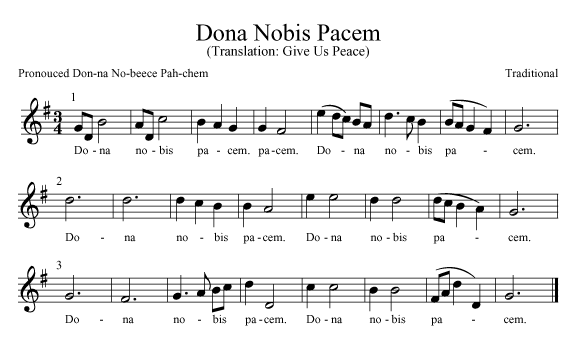
Partitura: dominio público, vía Wikimedia Commons
This is how the round is written: three phrases, one per stave, numbered 1, 2 and 3. Group one starts with phrase 1. When it reaches phrase 2, group two starts with phrase 1. And so on, until all three sound together.
What we do know is that it is sung all over the world, by school choirs, in churches and in concerts. And it comes back every time there is a war: in 2022, choirs such as Six de Chœur, from Germany, recorded it for peace in Ukraine.
Musical characteristics
Three phrases that fit. The round has three phrases of eight bars. Each has its own character. The first moves around a lot. The second has long, high notes. The third goes down to the low notes. When they sound together, each one fills the gaps in the others.
Several melodies at once. When several different melodies sound at the same time, it is called polyphony. A round is the easiest kind of polyphony: every voice sings the same melody, but they come in at different times.
A calm waltz. Count the beats: "one-two-three, one-two-three". The round is in 3/4, the same time signature as a waltz. That is why it sways.
A note that holds it up. In the music room, the xylophones play a drone on C: a low note that never changes. On that floor, the three voices sound good the whole time.
Facts: composer unknown, 3/4, three phrases of eight bars, in three parts. In class, C major.
Guided listening
Play the performance from Norrköping (Sweden). Several choirs and the audience sing together, with a conductor leading everything.
At the start, listen to a single melody. Learn how it goes.
When the second group comes in, try to follow only the first one. It is harder than it looks.
When all three groups are singing, stop following anyone and listen to the whole. You no longer hear three melodies: you hear chords.
At the end, notice how it finishes. Does everyone stop together, or does each group finish its own phrase?
Trivia and curiosities
- It is credited to Mozart in many places, but there is no proof. A famous name makes a tune seem more important, even when it is not his.
- A round does not need an accompaniment. The voices accompany each other, because each phrase is designed to sound with the other two.
- In a 1970s American TV series, M.A.S.H., the characters sing it in a Christmas episode. A song about peace turns up in a series about a war.
Classroom activities
- One voice. The whole class learns the three phrases in unison, in order. Count "one-two-three" in each bar.
- Round in two. Split the class into two groups. Group two starts when group one reaches phrase 2.
- Round in three. Three groups, each coming in eight bars later. Go round three times, and each group stops when it finishes its third time.
- Drone. In the music room, a group of xylophones plays C on the first beat of each bar. Does it help you not get lost?
Key vocabulary
- Polyphony — polifonía
- Round (canon) — canon
- 3/4 time — compás de 3/4: tres pulsos, como el vals
- Drone — bordón
Resources
Performance — Several choirs and the audience, in Norrköping (Sweden), 2007. Conducted by Leif Ahlberg.
To learn it part by part — Julie Gaulke. The three parts recorded separately and then together.
Another performance, to compare — Six de Chœur, a vocal group from Göttingen (Germany), in 2022, for peace in Ukraine.
Ukulele tutorial — John Morgan Guitar.
Guitar tutorial — John Morgan Guitar.
Keyboard — RoadToVirtuosity. An easy piano arrangement.
Por qué está en este libro
Dona nobis pacem es el canon de octubre, el primer mes del curso. Es la forma más sencilla de cantar a varias voces: todos cantáis la misma melodía, pero cada grupo empieza ocho compases después que el anterior. Así, sin aprender nada nuevo, ya sonáis a tres voces. Aquí el canon es la segunda voz. Lo cantamos sobre todo en el aula sin instrumentos, como calentamiento, y en el aula de música solo lo acompañan los xilófonos con un bordón de Do. No es canción para la banda entera, y está bien: sirve para afinar el oído antes de todo lo demás.
Por dónde entrar
Seguro que has cantado «Frère Jacques» o «Martinillo» en grupos que empiezan uno detrás de otro. Eso es un canon.
Dona nobis pacem funciona igual, pero suena más grande. La pregunta de esta página es: ¿cómo es posible que tres grupos canten cosas distintas a la vez y no suene a desastre?
Contexto histórico
«Dona nobis pacem» es latín. Significa «danos la paz». Es la última frase de una oración de la misa, el Agnus Dei. Muchos compositores le han puesto música: Beethoven, Vaughan Williams, Honegger.
Este canon, en cambio, no tiene autor conocido. En muchos libros pone «Mozart», pero nadie ha encontrado ninguna prueba. Los cancioneros serios lo firman como tradicional. Algunos dicen que es de hace cuatrocientos o quinientos años; tampoco está demostrado.
Partitura: dominio público, vía Wikimedia Commons
Así se escribe el canon: tres frases, una por pentagrama, numeradas 1, 2 y 3. El grupo uno empieza por la frase 1. Cuando llega a la 2, el grupo dos empieza por la 1. Y así hasta que suenan las tres a la vez.
Lo que sí sabemos es que se canta en todo el mundo, en coros de colegios, iglesias y conciertos. Y que vuelve cada vez que hay una guerra: en 2022, coros como Six de Chœur, de Alemania, lo grabaron por la paz en Ucrania.
Cómo suena
Tres frases que encajan. El canon tiene tres frases de ocho compases. Cada una tiene su carácter. La primera se mueve bastante. La segunda tiene notas largas y agudas. La tercera baja hasta las notas graves. Cuando suenan juntas, unas rellenan los huecos de las otras.
Varias melodías a la vez. Cuando suenan varias melodías distintas al mismo tiempo, se llama polifonía. El canon es la forma más fácil de polifonía: todas las voces cantan la misma melodía, pero entran en momentos distintos.
Un vals tranquilo. Cuenta los pulsos: «un-dos-tres, un-dos-tres». El canon va en 3/4, el mismo compás que un vals. Por eso se balancea.
Una nota que lo sostiene. En el aula de música, los xilófonos tocan un bordón en Do: una nota grave que no cambia. Sobre ese suelo, las tres voces suenan bien todo el rato.
Datos: autor desconocido, 3/4, tres frases de ocho compases, a tres voces. En clase, Do mayor.
Escucha guiada
Pon la interpretación de Norrköping (Suecia). Varios coros y el público cantan juntos, con un director que lo guía todo.
Al principio, escucha una sola melodía. Apréndete cómo suena.
Cuando entre el segundo grupo, intenta seguir solo al primero. Es más difícil de lo que parece.
Cuando suenen los tres grupos, deja de seguir a nadie y escucha el conjunto. Ya no oyes tres melodías: oyes acordes.
Al final, fíjate en cómo termina. ¿Paran todos a la vez, o cada grupo acaba su frase?
Curiosidades
- Se lo atribuyen a Mozart en muchos sitios, pero no hay ninguna prueba. Un nombre famoso hace que una melodía parezca más importante, aunque no sea suyo.
- Un canon no necesita acompañamiento. Las voces se acompañan entre ellas, porque cada frase está pensada para sonar con las otras dos.
- En una serie de televisión estadounidense de los años setenta, M.A.S.H., los personajes lo cantan en un capítulo de Navidad. Es una canción de paz que aparece en una serie sobre una guerra.
Para hacer en clase
- Una sola voz. Toda la clase aprende las tres frases al unísono, en orden. Contad «un-dos-tres» en cada compás.
- Canon a dos. Dividid la clase en dos grupos. El grupo dos empieza cuando el grupo uno llega a la frase 2.
- Canon a tres. Tres grupos, cada uno entra ocho compases después. Dad tres vueltas y acabad cada grupo cuando termine su tercera vuelta.
- Bordón. En el aula de música, un grupo de xilófonos toca Do en el primer pulso de cada compás. ¿Ayuda a no perderse?
Vocabulario fundamental
- Polifonía — Varias melodías distintas que suenan a la vez.
- Canon — Todas las voces cantan la misma melodía, pero cada una empieza más tarde.
- 3/4 — Un compás de tres pulsos, como el vals: «un-dos-tres».
- Bordón — Una nota grave que se repite sin moverse, como un suelo bajo la música.
Recursos
Interpretación — Varios coros y el público, en Norrköping (Suecia), 2007. Dirige Leif Ahlberg.
Para aprenderlo por voces — Julie Gaulke. Las tres voces grabadas por separado y después juntas.
Otra interpretación, para comparar — Six de Chœur, un grupo vocal de Gotinga (Alemania), en 2022, por la paz en Ucrania.
Tutorial de ukelele — John Morgan Guitar.
Tutorial de guitarra — John Morgan Guitar.
Teclado — RoadToVirtuosity. Arreglo fácil para piano.
Why it's in this book
Dona nobis pacem is October's round, in the first month of the year. It is the simplest way to sing in parts: you all sing the same melody, but each group starts eight bars after the one before. So, without learning anything new, you already sound like three parts. Here the round is the second part. We sing it mostly in the room with no instruments, as a warm-up, and in the music room only the xylophones join in, with a drone on C. It is not a song for the whole band, and that is fine: it is there to tune your ear before everything else.
Why this song
You have probably sung "Frère Jacques" in groups that start one after another. That is a round.
Dona nobis pacem works the same way, but it sounds bigger. The question on this page is: how can three groups sing different things at once without it sounding like a mess?
Historical context
"Dona nobis pacem" is Latin. It means "grant us peace". It is the last line of a prayer in the Mass, the Agnus Dei. Many composers have set it to music: Beethoven, Vaughan Williams, Honegger.
This round, though, has no known composer. Many books say "Mozart", but nobody has found any proof. Serious hymn books sign it as traditional. Some people say it is four or five hundred years old; that is not proven either.
Partitura: dominio público, vía Wikimedia Commons
This is how the round is written: three phrases, one per stave, numbered 1, 2 and 3. Group one starts with phrase 1. When it reaches phrase 2, group two starts with phrase 1. And so on, until all three sound together.
What we do know is that it is sung all over the world, by school choirs, in churches and in concerts. And it comes back every time there is a war: in 2022, choirs such as Six de Chœur, from Germany, recorded it for peace in Ukraine.
Musical characteristics
Three phrases that fit. The round has three phrases of eight bars. Each has its own character. The first moves around a lot. The second has long, high notes. The third goes down to the low notes. When they sound together, each one fills the gaps in the others.
Several melodies at once. When several different melodies sound at the same time, it is called polyphony. A round is the easiest kind of polyphony: every voice sings the same melody, but they come in at different times.
A calm waltz. Count the beats: "one-two-three, one-two-three". The round is in 3/4, the same time signature as a waltz. That is why it sways.
A note that holds it up. In the music room, the xylophones play a drone on C: a low note that never changes. On that floor, the three voices sound good the whole time.
Facts: composer unknown, 3/4, three phrases of eight bars, in three parts. In class, C major.
Guided listening
Play the performance from Norrköping (Sweden). Several choirs and the audience sing together, with a conductor leading everything.
At the start, listen to a single melody. Learn how it goes.
When the second group comes in, try to follow only the first one. It is harder than it looks.
When all three groups are singing, stop following anyone and listen to the whole. You no longer hear three melodies: you hear chords.
At the end, notice how it finishes. Does everyone stop together, or does each group finish its own phrase?
Trivia and curiosities
- It is credited to Mozart in many places, but there is no proof. A famous name makes a tune seem more important, even when it is not his.
- A round does not need an accompaniment. The voices accompany each other, because each phrase is designed to sound with the other two.
- In a 1970s American TV series, M.A.S.H., the characters sing it in a Christmas episode. A song about peace turns up in a series about a war.
Classroom activities
- One voice. The whole class learns the three phrases in unison, in order. Count "one-two-three" in each bar.
- Round in two. Split the class into two groups. Group two starts when group one reaches phrase 2.
- Round in three. Three groups, each coming in eight bars later. Go round three times, and each group stops when it finishes its third time.
- Drone. In the music room, a group of xylophones plays C on the first beat of each bar. Does it help you not get lost?
Key vocabulary
- Polyphony — polifonía
- Round (canon) — canon
- 3/4 time — compás de 3/4: tres pulsos, como el vals
- Drone — bordón
Resources
Performance — Several choirs and the audience, in Norrköping (Sweden), 2007. Conducted by Leif Ahlberg.
To learn it part by part — Julie Gaulke. The three parts recorded separately and then together.
Another performance, to compare — Six de Chœur, a vocal group from Göttingen (Germany), in 2022, for peace in Ukraine.
Ukulele tutorial — John Morgan Guitar.
Guitar tutorial — John Morgan Guitar.
Keyboard — RoadToVirtuosity. An easy piano arrangement.