Contenidos
Counting Stars — OneRepublic (2013)
A song about not being able to sleep, with a rhythm you play with your feet and hands. Four chords you already know, placed in a different order.
🏷️ Ficha musical
Why it's in this book
"Counting Stars" comes in March, when you have already played "Zombie", "Despacito" and "Bailando". It is here because it uses the same four chords as those three, but starts the loop somewhere else: in class, A minor, C, G and F, instead of A minor, F, C and G. That is called rotating the loop, and it proves that a chord is not a fixed place: it is a function, and its role changes depending on where you put it. Its rhythm of stomps and claps, the stomp-clap, can be done entirely with your body, so in the room with no instruments the song sounds complete. In the ukulele room you play the four chords, and in the music room the drums copy the feet-and-hands pattern and the ukebass comes in. The record is in C sharp minor, an awkward key for ukulele: in class we bring it down to A minor.
Why this song
Stand up. Stomp, stomp, clap. Stomp, stomp, clap. Keep it going at a good pace and sing the start of the chorus on top. If you have ever heard it, your body already knows which song this is.
The question on this page is: how can a song about not being able to sleep make you want to move so much?
Historical context
OneRepublic are a band from Colorado, in the United States. Their singer, Ryan Tedder, is also one of the most in-demand pop songwriters in the world: he has written songs for many stars.
Tedder started "Counting Stars" in summer 2012, in a house rented by Jay-Z and Beyoncé. He thought about offering it to Beyoncé, but felt it did not suit her. He kept it for his band. He said the idea came from a very obscure folk song he heard around that time.
The song is about something very ordinary: lying awake at night worrying about money and whether your plans will work out. Instead of counting sheep, the person who cannot sleep counts stars.
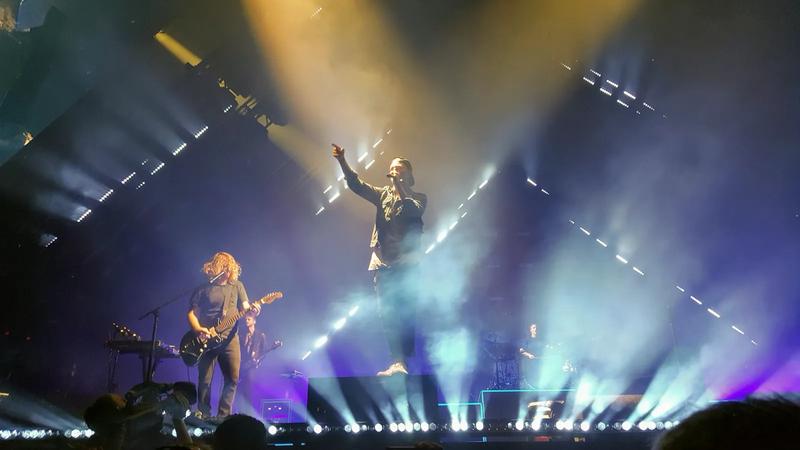
Foto: Keenman76, CC BY-SA 4.0, vía Wikimedia Commons
OneRepublic in Toronto in 2017, four years after "Counting Stars". The lights and the arena are pure pop; the idea behind the song came from folk.
It was number 1 in the UK and number 2 in the United States. In Spain it reached number 4. Its video, filmed in New Orleans, was the first by a band to pass one billion views on YouTube.
Musical characteristics
Four rotated chords. On the record the song turns on C sharp minor, E, B and A. In class, transposed, they are A minor, C, G and F. These are the same four chords as the chord loop in "Zombie" and "Despacito", but starting from another point and in another order. In "Despacito", in class: A minor, F, C, G. Here: A minor, C, G, F. Changing the order of a loop without changing its chords is called rotating the progression.
Why it sounds different. The first chord is the same, the minor one. But the second is no longer F: it is C, a bright major chord. That is why "Counting Stars" sounds less dark than "Zombie", even though they share the chords.
Feet and hands. The rhythm of the song can be played with your body: stomps and claps. This style is called stomp-clap. It was very popular in pop songs of those years. What matters most is the beat: a steady pulse, like a clock, that never speeds up or slows down.
Folk inside pop. Listen to the acoustic guitar at the start. It sounds almost like a campfire song. Then drums, bass and backing vocals join in, and it becomes stadium pop. That mix is what Wikipedia calls folk pop.
Hard facts: C♯ minor on the record and A minor in class, 4/4, 122 beats per minute, 4:17. The form: intro, verse, pre-chorus, chorus, twice; bridge and final chorus.
Guided listening
Play the music video. In the intro, count the instruments you can hear. Are there drums yet, or is the guitar keeping the beat?
In the first verse, tap the beat with your foot. When the percussion comes in, check whether your foot and the song are still together.
When the chorus arrives, start your stomp, stomp, clap. Notice that it still fits, even though the song is now full of instruments.
In the bridge, notice what changes and what stays. Are the same four chords still there?
Then play eight bars of "Zombie". Play them on the ukulele in the "Zombie" order and then in the "Counting Stars" order. Same chords, different order.
Trivia and curiosities
- Tedder nearly gave it to Beyoncé. If he had, it might not exist as we know it.
- The video shows the band playing in a basement while, upstairs, a religious service with singing and dancing is going on. At the end the ceiling caves in.
- In September 2023 the band released a new version, slower and with a different backing. Same song, another tempo: compare them.
- In Canada it took 34 weeks to reach number 1. It was a record for a slow climb.
Classroom activities
- Stomp-clap. In the room with no instruments, standing up: stomp, stomp, clap, at 122 beats per minute. First without music, then with the record. Once it works, the verse chorus in unison and the chorus with a third above.
- Rotate the loop. Ukulele: A minor, C, G, F, one chord per bar. Then A minor, F, C, G, the "Despacito" order in class. Which sounds brighter?
- Band. In the music room: the drums copy the stomp-clap (bass drum for the feet, snare for the claps), the ukebass plays the main note of each chord, and everyone else plays ukulele.
- March recording. Record the whole song and listen back in the next lesson. Did the beat speed up in the chorus?
Key vocabulary
- Chord loop — bucle armónico
- Rotating a progression — rotar una progresión
- Stomp-clap — base rítmica de pisotones y palmadas
- Beat — pulso
- Folk pop — folk pop: pop con aire de canción popular
Resources
Official music video — Filmed in New Orleans: the band in the basement, a service upstairs.
Ukulele tutorial — Ukeplayalongs. A play-along in A minor: the same key we use in class.
Guitar tutorial — JustinGuitar. An easy, step-by-step lesson.
Piano tutorial — Atlantic Notes. Easy version.
Drum tutorial — DRUMMATE. The pattern with the score on screen.
Body percussion — La Clave de José. A listening map with body percussion, in Spanish.
Por qué está en este libro
«Counting Stars» llega en marzo, cuando ya has tocado «Zombie», «Despacito» y «Bailando». Está aquí porque usa los mismos cuatro acordes de esas tres, pero empezando el bucle por otro sitio: en clase, la menor, do, sol y fa, en vez de la menor, fa, do y sol. Eso se llama rotar el bucle, y es la prueba de que un acorde no es un sitio fijo: es una función, y su papel cambia según dónde lo pongas. Además, su ritmo de pisotones y palmas, el stomp-clap, se hace entero con el cuerpo, así que en el aula sin nada la canción suena completa. En el aula de ukeleles tocáis los cuatro acordes, y en el aula de música la batería copia el patrón de pies y palmas y entra el ukebajo. El disco está en do sostenido menor, un tono incómodo para el ukelele: en clase la bajamos a la menor.
Por dónde entrar
Ponte de pie. Pie, pie, palma. Pie, pie, palma. Hazlo a buen ritmo y canta encima el principio del estribillo. Si lo has oído alguna vez, tu cuerpo ya sabe qué canción es.
La pregunta de esta página es: ¿cómo puede una canción sobre no poder dormir dar tantas ganas de moverse?
Contexto histórico
OneRepublic es un grupo de Colorado, en Estados Unidos. Su cantante, Ryan Tedder, es además uno de los compositores de pop más buscados del mundo: ha escrito canciones para muchas estrellas.
Tedder empezó «Counting Stars» en el verano de 2012, en una casa que tenían alquilada Jay-Z y Beyoncé. Pensó en ofrecérsela a Beyoncé, pero le pareció que no le iba. Se la quedó para su grupo. Contó que la inspiración le vino de una canción folk muy poco conocida que escuchó esos días.
La canción habla de algo muy corriente: quedarse despierto por la noche preocupado por el dinero y por si los planes saldrán bien. En vez de contar ovejas, el que no duerme cuenta estrellas.
Foto: Keenman76, CC BY-SA 4.0, vía Wikimedia Commons
OneRepublic en Toronto en 2017, cuatro años después de «Counting Stars». Las luces y el estadio son de pop; la idea de la canción vino del folk.
Fue número 1 en el Reino Unido y número 2 en Estados Unidos. En España llegó al número 4. Su videoclip, rodado en Nueva Orleans, fue el primero de un grupo en pasar los mil millones de visitas en YouTube.
Cómo suena
Cuatro acordes rotados. En el disco, la canción gira sobre do sostenido menor, mi, si y la. En clase, transportada, son la menor, do, sol y fa. Son los mismos cuatro acordes del bucle armónico de «Zombie» y «Despacito», pero empezando por otro sitio y en otro orden. En «Despacito», en clase: la menor, fa, do, sol. Aquí: la menor, do, sol, fa. Cambiar el orden del bucle sin cambiar sus acordes se llama rotar la progresión.
Por qué suena distinta. El acorde de inicio es el mismo, el menor. Pero el segundo ya no es fa, sino do, un acorde mayor y luminoso. Por eso «Counting Stars» suena menos oscura que «Zombie», aunque comparta los acordes.
Pies y palmas. La base rítmica de la canción se puede hacer con el cuerpo: pisotones y palmadas. Este estilo se llama stomp-clap, de stomp, pisotón, y clap, palmada. Fue muy popular en el pop de esos años. Lo importante es el pulso: un golpe regular, como un reloj, que no se acelera ni se frena.
El folk dentro del pop. Fíjate en la guitarra acústica del principio. Suena casi a canción de campamento. Después se suman la batería, el bajo y los coros, y la canción se convierte en pop de estadio. Esa mezcla es la que Wikipedia llama folk pop.
Datos duros: Do♯ menor en el disco y La menor en clase, 4/4, 122 pulsos por minuto, 4:17. La forma: intro, estrofa, preestribillo, estribillo, dos veces; puente y estribillo final.
Escucha guiada
Pon el videoclip. En la intro, cuenta los instrumentos que oyes. ¿Hay ya batería, o el pulso lo lleva la guitarra?
En la primera estrofa, marca el pulso con el pie. Cuando entre la percusión, comprueba si tu pie y la canción siguen juntos.
Cuando llega el estribillo, empieza tu patrón de pie, pie, palma. Fíjate en que encaja aunque la canción se haya llenado de instrumentos.
En el puente, fíjate en qué cambia y qué se mantiene. ¿Siguen los mismos cuatro acordes?
Después pon ocho compases de «Zombie». Tócalos en el ukelele en el orden de «Zombie» y luego en el de «Counting Stars». Mismos acordes, otro orden.
Curiosidades
- Tedder estuvo a punto de dársela a Beyoncé. Si lo hubiera hecho, quizá no existiría como la conocemos.
- El videoclip muestra al grupo tocando en un sótano mientras arriba se celebra una ceremonia religiosa con cantos y bailes. Al final se hunde el techo.
- En septiembre de 2023 el grupo sacó una versión nueva, más lenta y con otro acompañamiento. Misma canción, otro tempo: compáralas.
- En Canadá tardó 34 semanas en llegar al número 1. Fue un récord de subida lenta.
Para hacer en clase
- Stomp-clap. En el aula sin nada, de pie: pie, pie, palma, a 122 pulsos por minuto. Primero sin música, después con el disco. Cuando salga, el coro de la estrofa al unísono y el estribillo con una tercera por encima.
- Rotar el bucle. Ukelele: la menor, do, sol, fa, un acorde por compás. Después, la menor, fa, do, sol, el orden de «Despacito» en clase. ¿Cuál suena más luminoso?
- Banda. En el aula de música: la batería copia el patrón de pies y palmas (bombo en los pies, caja en las palmas), el ukebajo toca la nota principal de cada acorde y el resto con ukelele.
- Grabación de marzo. Grabad la canción entera y escuchadla en la clase siguiente. ¿Se aceleró el pulso en el estribillo?
Vocabulario fundamental
- Bucle armónico — Una serie de acordes que se repite. Aquí: la menor, do, sol, fa, en clase.
- Rotar una progresión — Cambiar el orden del bucle sin cambiar sus acordes.
- Stomp-clap — Una base rítmica hecha con pisotones y palmadas.
- Pulso — El golpe regular de la música, como un reloj.
- Folk pop — Pop con instrumentos y aire de canción popular, como la guitarra acústica.
Recursos
Videoclip oficial — Rodado en Nueva Orleans: el grupo en el sótano, una ceremonia en el piso de arriba.
Tutorial de ukelele — Ukeplayalongs. Para tocar encima, en la menor: el mismo tono que usamos en clase.
Tutorial de guitarra — JustinGuitar. Lección fácil, paso a paso.
Tutorial de piano — Atlantic Notes. Versión fácil.
Tutorial de batería — DRUMMATE. El patrón con partitura en pantalla.
Percusión corporal — La Clave de José. Musicograma con percusión corporal, en castellano.
Why it's in this book
"Counting Stars" comes in March, when you have already played "Zombie", "Despacito" and "Bailando". It is here because it uses the same four chords as those three, but starts the loop somewhere else: in class, A minor, C, G and F, instead of A minor, F, C and G. That is called rotating the loop, and it proves that a chord is not a fixed place: it is a function, and its role changes depending on where you put it. Its rhythm of stomps and claps, the stomp-clap, can be done entirely with your body, so in the room with no instruments the song sounds complete. In the ukulele room you play the four chords, and in the music room the drums copy the feet-and-hands pattern and the ukebass comes in. The record is in C sharp minor, an awkward key for ukulele: in class we bring it down to A minor.
Why this song
Stand up. Stomp, stomp, clap. Stomp, stomp, clap. Keep it going at a good pace and sing the start of the chorus on top. If you have ever heard it, your body already knows which song this is.
The question on this page is: how can a song about not being able to sleep make you want to move so much?
Historical context
OneRepublic are a band from Colorado, in the United States. Their singer, Ryan Tedder, is also one of the most in-demand pop songwriters in the world: he has written songs for many stars.
Tedder started "Counting Stars" in summer 2012, in a house rented by Jay-Z and Beyoncé. He thought about offering it to Beyoncé, but felt it did not suit her. He kept it for his band. He said the idea came from a very obscure folk song he heard around that time.
The song is about something very ordinary: lying awake at night worrying about money and whether your plans will work out. Instead of counting sheep, the person who cannot sleep counts stars.
Foto: Keenman76, CC BY-SA 4.0, vía Wikimedia Commons
OneRepublic in Toronto in 2017, four years after "Counting Stars". The lights and the arena are pure pop; the idea behind the song came from folk.
It was number 1 in the UK and number 2 in the United States. In Spain it reached number 4. Its video, filmed in New Orleans, was the first by a band to pass one billion views on YouTube.
Musical characteristics
Four rotated chords. On the record the song turns on C sharp minor, E, B and A. In class, transposed, they are A minor, C, G and F. These are the same four chords as the chord loop in "Zombie" and "Despacito", but starting from another point and in another order. In "Despacito", in class: A minor, F, C, G. Here: A minor, C, G, F. Changing the order of a loop without changing its chords is called rotating the progression.
Why it sounds different. The first chord is the same, the minor one. But the second is no longer F: it is C, a bright major chord. That is why "Counting Stars" sounds less dark than "Zombie", even though they share the chords.
Feet and hands. The rhythm of the song can be played with your body: stomps and claps. This style is called stomp-clap. It was very popular in pop songs of those years. What matters most is the beat: a steady pulse, like a clock, that never speeds up or slows down.
Folk inside pop. Listen to the acoustic guitar at the start. It sounds almost like a campfire song. Then drums, bass and backing vocals join in, and it becomes stadium pop. That mix is what Wikipedia calls folk pop.
Hard facts: C♯ minor on the record and A minor in class, 4/4, 122 beats per minute, 4:17. The form: intro, verse, pre-chorus, chorus, twice; bridge and final chorus.
Guided listening
Play the music video. In the intro, count the instruments you can hear. Are there drums yet, or is the guitar keeping the beat?
In the first verse, tap the beat with your foot. When the percussion comes in, check whether your foot and the song are still together.
When the chorus arrives, start your stomp, stomp, clap. Notice that it still fits, even though the song is now full of instruments.
In the bridge, notice what changes and what stays. Are the same four chords still there?
Then play eight bars of "Zombie". Play them on the ukulele in the "Zombie" order and then in the "Counting Stars" order. Same chords, different order.
Trivia and curiosities
- Tedder nearly gave it to Beyoncé. If he had, it might not exist as we know it.
- The video shows the band playing in a basement while, upstairs, a religious service with singing and dancing is going on. At the end the ceiling caves in.
- In September 2023 the band released a new version, slower and with a different backing. Same song, another tempo: compare them.
- In Canada it took 34 weeks to reach number 1. It was a record for a slow climb.
Classroom activities
- Stomp-clap. In the room with no instruments, standing up: stomp, stomp, clap, at 122 beats per minute. First without music, then with the record. Once it works, the verse chorus in unison and the chorus with a third above.
- Rotate the loop. Ukulele: A minor, C, G, F, one chord per bar. Then A minor, F, C, G, the "Despacito" order in class. Which sounds brighter?
- Band. In the music room: the drums copy the stomp-clap (bass drum for the feet, snare for the claps), the ukebass plays the main note of each chord, and everyone else plays ukulele.
- March recording. Record the whole song and listen back in the next lesson. Did the beat speed up in the chorus?
Key vocabulary
- Chord loop — bucle armónico
- Rotating a progression — rotar una progresión
- Stomp-clap — base rítmica de pisotones y palmadas
- Beat — pulso
- Folk pop — folk pop: pop con aire de canción popular
Resources
Official music video — Filmed in New Orleans: the band in the basement, a service upstairs.
Ukulele tutorial — Ukeplayalongs. A play-along in A minor: the same key we use in class.
Guitar tutorial — JustinGuitar. An easy, step-by-step lesson.
Piano tutorial — Atlantic Notes. Easy version.
Drum tutorial — DRUMMATE. The pattern with the score on screen.
Body percussion — La Clave de José. A listening map with body percussion, in Spanish.