Contenidos
Count on Me — Bruno Mars (2010)
A song about friendship, with a guitar, some bongos and five chords. It is the first song of the year because the whole class can sing it from day one.

🏷️ Ficha musical
Why it's in this book
"Count on Me" opens the school year in October. It has five easy chords in the ukulele's home key, a relaxed strum and a chorus the whole class sings together. In class we play it exactly as on the record, in C major: C, E minor, A minor, G and F. Four of those chords belong to the big pop loop you will play all year in Love Story, Anti-Hero and Riptide; E minor is the extra one, so we call it "the loop with one chord too many". The bridge brings a sixth chord, D minor, which you do not know yet: it arrives before Christmas. In the classroom with no instruments we sing it with body percussion; with ukuleles we strum the chords; and in the music room the ukulele bass plays the bottom note of each chord while the cajón or brushes keep the beat. The second voice sings a third above on the title line.
Why this song
The chorus line is a count: "like one, two, three". If you can count to three, you already know half the chorus.
Now listen to everything else. No loud drums, no synthesizers. One guitar, some bongos and a voice that is in no hurry.
The question on this page is: how do you make a song that sounds like an afternoon on the beach with friends? Here, the answer fits into five chords.
Historical context
Bruno Mars was born in Honolulu, Hawaii. He grew up in a family of musicians and was performing in his father's shows when he was very small.
In 2010 he released his first album, Doo-Wops & Hooligans. "Count on Me" had come out a few months earlier on a short record, an EP. He wrote it with two friends, Philip Lawrence and Ari Levine. The three of them worked as a team called The Smeezingtons.
The recording is almost home-made. Mars and Levine played every instrument themselves. Critics talked about its "Hawaiian" sound: it feels like the beach, even though it was recorded in a Los Angeles studio.
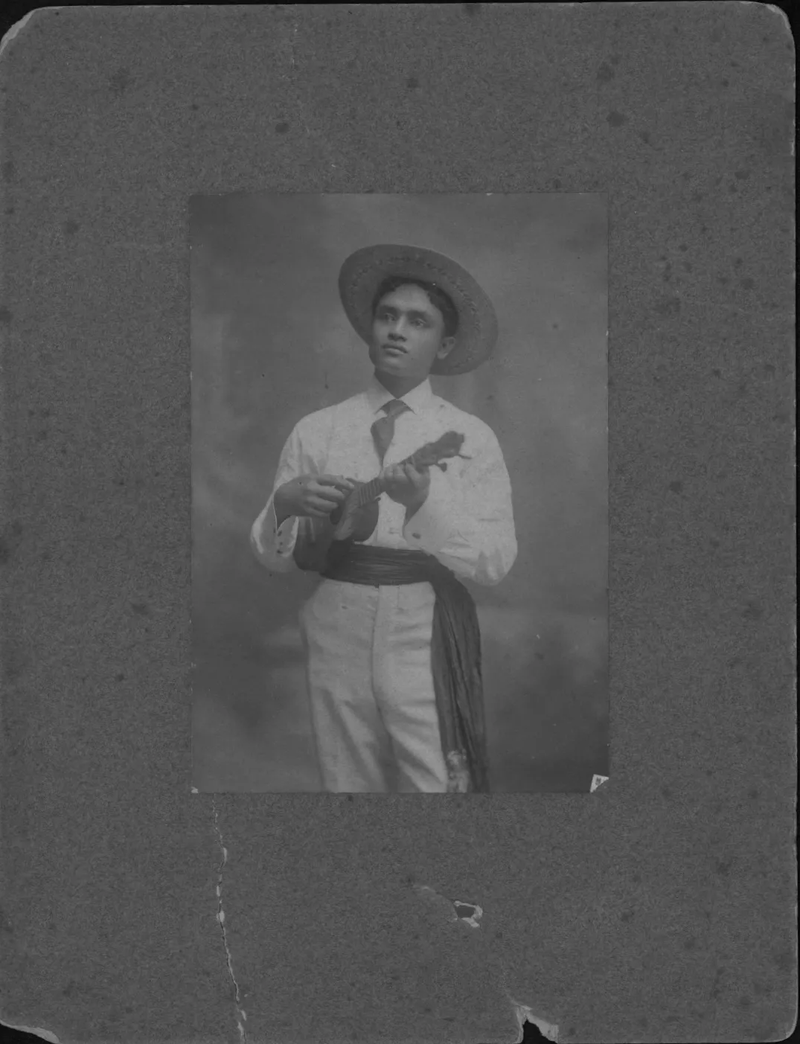
Foto: Beach Photo Studio, dominio público, vía Wikimedia Commons
A Hawaiian musician with his ukulele, photographed in 1901 in Buffalo, in the United States. The ukulele is the instrument of Hawaii, where Bruno Mars comes from. Two critics compared "Count on Me" to Israel Kamakawiwoʻole's "Over the Rainbow", a version sung with nothing but a ukulele.
In the United States it was never even released as a single. Even so, it has sold enough to go platinum five times there. In Spain it reached number 7 in 2013, three years after it came out.
Musical characteristics
A calm beat. The song moves at 89 beats per minute, a walking pace. Each bar has four beats and the guitar strums gently. That relaxed strumming is what makes it feel so calm.
Five chords in a row. The verses and the chorus use the same series: C, E minor, A minor, G and F. It repeats again and again. A series of chords that repeats is called a chord progression. This one is almost the most famous loop in pop, with one chord added: E minor, a stepping stone between C and A minor.
A chorus for everyone. The chorus melody is short and easy to remember. It is made for lots of people to sing together. That is why it works so well with a choir: five thousand children from a school choir sang it together at Wembley Arena in London.
The bridge changes colour. Near the end there is a different section, the bridge. It starts on D minor, a chord we have not heard before. It is a short detour before the chorus comes back.
Beach instruments. Besides the acoustic guitar you can hear bongos: two small joined drums played with the fingers. They give the song its beach feel.
Hard facts: C major, 4/4, 89 beats per minute, 3:14. The form: intro and verse, chorus, verse, chorus, bridge and final chorus.
Guided listening
Play the video. At the start, tap the beat on the desk. Count "one, two, three, four" and check that the guitar fits.
In the first verse, look for the bongos. They are quiet, under the guitar.
When the chorus arrives, count the chords: there are five, and then they start again.
When you hear a section that sounds like neither the verse nor the chorus, you have reached the bridge. Listen to how the colour changes on its first chord.
In the last chorus, sing the title line yourself. Listen for other voices singing along with Bruno Mars.
Trivia and curiosities
- Not everyone liked the "one, two, three" line. A Canadian critic used it as an example of lazy rhyming. That is exactly why everyone remembers it.
- In 2014 it was used in a car advert during the Super Bowl, the American football final. That same year, Bruno Mars played the half-time show. It was a coincidence.
- It was included on a charity album to help the victims of a typhoon in the Philippines in 2013.
- In 2011 two South Korean singers, Lee Ki-chan and G.NA, released their own version on CD. In one year the song had travelled from Hawaii to Seoul.
Classroom activities
- Count the beats. The whole class taps the beat with their feet during the chorus. Then clap only on the first beat of each bar.
- Play the five chords. Ukulele: C, E minor, A minor, G and F, one chord per bar. Start with one downstroke per beat. When that works, try down-down-up-up-down.
- Sing and play together. Start with the chorus only. If the chord changes make you stop, play one strum per bar and sing on top.
- Second voice. One group sings the title melody and another sings a third above. Listen to whether the two voices blend without clashing.
- Band. In the music room, the ukulele bass plays the note that names each chord (C, E, A, G, F). The cajón or brushes keep the beat without covering the voices.
Key vocabulary
- Strumming — rasgueo
- Chord progression — progresión de acordes
- Chorus — estribillo
- Bridge — puente: la parte distinta que lleva de vuelta al estribillo
- Bongos — bongos
Resources
Official lyric video — From Bruno Mars's channel. There is no music video with actors: this is the official one.
Ukulele tutorial — Mister Row's Music. Level 1: you play along with the song, starting with open strings.
Guitar tutorial — Easy 2 Play Music. An easy version, with chords and lyrics on screen.
Piano tutorial — Betacustic. A slow beginner version, with sheet music.
Live, to compare — Bruno Mars at an MTV session. Listen for what changes when he sings it live.
Por qué está en este libro
«Count on Me» abre el curso en octubre. Tiene cinco acordes fáciles en el tono del ukelele, un rasgueo tranquilo y un estribillo que la clase entera canta a la vez. En clase la tocamos igual que el disco, en Do mayor: do, mi menor, la menor, sol y fa. Cuatro de esos acordes son los del gran bucle del pop que vas a tocar todo el año en Love Story, Anti-Hero o Riptide; mi menor es el que sobra, y por eso la llamamos «el bucle con un acorde de más». El puente trae un sexto acorde, re menor, que todavía no sabes: llega antes de Navidad. En el aula sin instrumentos la cantamos con percusión corporal; con ukelele, rasgueamos los acordes; y en el aula de música el ukebajo toca las notas de abajo de cada acorde y el cajón o las escobillas llevan el ritmo. La segunda voz canta una tercera por encima en el verso del título.
Por dónde entrar
La frase del estribillo es una cuenta: «like one, two, three». Si sabes contar hasta tres en inglés, ya te sabes la mitad del estribillo.
Ahora fíjate en cómo suena todo lo demás. No hay batería fuerte, no hay sintetizadores. Una guitarra, unos bongos y una voz que no tiene prisa.
La pregunta de esta página es: ¿cómo se hace una canción que suene a tarde de playa con amigos? Aquí la respuesta cabe en cinco acordes.
Contexto histórico
Bruno Mars nació en Honolulu, en Hawái. Creció en una familia de músicos y de muy pequeño ya actuaba en los espectáculos de su padre.
En 2010 sacó su primer disco, Doo-Wops & Hooligans. «Count on Me» ya había salido unos meses antes en un disco corto, un EP. La compuso con dos amigos, Philip Lawrence y Ari Levine. Los tres firmaban juntos con un nombre de equipo: The Smeezingtons.
La grabación es casi casera. Mars y Levine tocaron todos los instrumentos ellos solos. La crítica habló de su «sonido hawaiano»: suena a playa, aunque se grabó en un estudio de Los Ángeles.
Foto: Beach Photo Studio, dominio público, vía Wikimedia Commons
Un músico hawaiano con su ukelele, fotografiado en 1901 en Buffalo (Estados Unidos). El ukelele es el instrumento de Hawái, la tierra de Bruno Mars. Dos críticos compararon «Count on Me» con «Over the Rainbow» de Israel Kamakawiwoʻole, que es una versión cantada solo con ukelele.
En Estados Unidos ni siquiera salió como sencillo. Aun así, se ha vendido tanto que tiene cinco discos de platino. En España llegó al número 7 en 2013, tres años después de salir.
Cómo suena
Un pulso tranquilo. La canción va a 89 pulsos por minuto, un paso de paseo. Cada compás tiene cuatro pulsos y la guitarra rasguea sin apretar. Ese rasgueo relajado es lo que da la sensación de calma.
Cinco acordes en fila. Las estrofas y el estribillo usan la misma serie: do, mi menor, la menor, sol y fa. Se repite una y otra vez. Una serie de acordes que se repite se llama progresión de acordes. Esta es casi el bucle más famoso del pop, con un acorde añadido: el mi menor, que hace de puente entre do y la menor.
El estribillo, de todos. La melodía del estribillo es corta y fácil de recordar. Está pensada para que la cante mucha gente a la vez. Por eso funciona tan bien en un coro: cinco mil niños de un coro escolar la cantaron juntos en el Wembley Arena de Londres.
El puente cambia de color. Hacia el final llega una parte distinta, el puente. Empieza por re menor, un acorde que no había salido. Es como un desvío corto antes de volver al estribillo.
Instrumentos de playa. Además de la guitarra acústica suenan unos bongos: dos tamborcillos unidos que se tocan con los dedos. Dan ese aire de música de playa.
Datos duros: Do mayor, 4/4, 89 pulsos por minuto, 3:14. La forma: intro y estrofa, estribillo, estrofa, estribillo, puente y estribillo final.
Escucha guiada
Pon el vídeo. En el arranque, marca el pulso con la mano en la mesa. Cuenta «uno, dos, tres, cuatro» y comprueba que la guitarra encaja.
En la primera estrofa, busca los bongos. Suenan bajito, debajo de la guitarra.
Cuando llegue el estribillo, cuenta los acordes: son cinco, y luego vuelven a empezar.
Cuando oigas una parte que no se parece ni a la estrofa ni al estribillo, has llegado al puente. Escucha cómo cambia el color en el primer acorde.
En el último estribillo, canta tú también la frase del título. Fíjate en si hay otras voces cantando con Bruno Mars.
Curiosidades
- La frase del estribillo, «like one, two, three», no le gustó a todo el mundo. Un crítico canadiense la puso como ejemplo de rima fácil. Justo por eso la recuerda todo el mundo.
- En 2014 sonó en un anuncio de coches durante la Super Bowl, la final del fútbol americano. Ese mismo año, Bruno Mars actuó en el descanso del partido. Fue una coincidencia.
- Se usó en un disco benéfico para ayudar a las víctimas de un tifón en Filipinas en 2013.
- En 2011 dos cantantes de Corea del Sur, Lee Ki-chan y G.NA, sacaron su propia versión en disco. La canción había viajado de Hawái a Seúl en un año.
Para hacer en clase
- Contar los pulsos. Toda la clase marca el pulso con el pie mientras suena el estribillo. Luego, palmada solo en el primer pulso de cada compás.
- Tocar los cinco acordes. Ukelele: do, mi menor, la menor, sol y fa, un acorde por compás. Empezad con un golpe hacia abajo en cada pulso. Cuando salga, probad abajo-abajo-arriba-arriba-abajo.
- Cantar y tocar a la vez. Primero solo el estribillo. Si el cambio de acorde os hace parar, tocad un solo golpe por compás y cantad encima.
- Segunda voz. Un grupo canta la melodía del título y otro canta una tercera por encima. Escuchad si las dos voces suenan juntas sin chocar.
- Banda. En el aula de música, el ukebajo toca la nota que da nombre a cada acorde (do, mi, la, sol, fa). El cajón o las escobillas marcan el pulso sin tapar las voces.
Vocabulario fundamental
- Rasgueo — Pasar los dedos por todas las cuerdas a la vez. Aquí es suave y sin prisa.
- Progresión de acordes — Una serie de acordes que se repite en el mismo orden. Aquí: do, mi menor, la menor, sol, fa.
- Estribillo — La parte que vuelve igual varias veces y que todo el mundo canta.
- Puente — Una parte distinta, casi al final, que lleva de vuelta al estribillo.
- Bongos — Dos tambores pequeños unidos que se tocan con los dedos.
Recursos
Vídeo oficial con letra — Del canal de Bruno Mars. No hay videoclip con actores: este es el vídeo oficial.
Tutorial de ukelele — Mister Row's Music. Nivel 1: se toca encima de la canción, primero con cuerdas al aire.
Tutorial de guitarra — Easy 2 Play Music. Versión fácil, con los acordes y la letra en pantalla.
Tutorial de piano — Betacustic. Versión lenta para principiantes, con la partitura.
En directo, para comparar — Bruno Mars en una sesión de MTV. Escucha qué cambia cuando la canta en directo.
Why it's in this book
"Count on Me" opens the school year in October. It has five easy chords in the ukulele's home key, a relaxed strum and a chorus the whole class sings together. In class we play it exactly as on the record, in C major: C, E minor, A minor, G and F. Four of those chords belong to the big pop loop you will play all year in Love Story, Anti-Hero and Riptide; E minor is the extra one, so we call it "the loop with one chord too many". The bridge brings a sixth chord, D minor, which you do not know yet: it arrives before Christmas. In the classroom with no instruments we sing it with body percussion; with ukuleles we strum the chords; and in the music room the ukulele bass plays the bottom note of each chord while the cajón or brushes keep the beat. The second voice sings a third above on the title line.
Why this song
The chorus line is a count: "like one, two, three". If you can count to three, you already know half the chorus.
Now listen to everything else. No loud drums, no synthesizers. One guitar, some bongos and a voice that is in no hurry.
The question on this page is: how do you make a song that sounds like an afternoon on the beach with friends? Here, the answer fits into five chords.
Historical context
Bruno Mars was born in Honolulu, Hawaii. He grew up in a family of musicians and was performing in his father's shows when he was very small.
In 2010 he released his first album, Doo-Wops & Hooligans. "Count on Me" had come out a few months earlier on a short record, an EP. He wrote it with two friends, Philip Lawrence and Ari Levine. The three of them worked as a team called The Smeezingtons.
The recording is almost home-made. Mars and Levine played every instrument themselves. Critics talked about its "Hawaiian" sound: it feels like the beach, even though it was recorded in a Los Angeles studio.
Foto: Beach Photo Studio, dominio público, vía Wikimedia Commons
A Hawaiian musician with his ukulele, photographed in 1901 in Buffalo, in the United States. The ukulele is the instrument of Hawaii, where Bruno Mars comes from. Two critics compared "Count on Me" to Israel Kamakawiwoʻole's "Over the Rainbow", a version sung with nothing but a ukulele.
In the United States it was never even released as a single. Even so, it has sold enough to go platinum five times there. In Spain it reached number 7 in 2013, three years after it came out.
Musical characteristics
A calm beat. The song moves at 89 beats per minute, a walking pace. Each bar has four beats and the guitar strums gently. That relaxed strumming is what makes it feel so calm.
Five chords in a row. The verses and the chorus use the same series: C, E minor, A minor, G and F. It repeats again and again. A series of chords that repeats is called a chord progression. This one is almost the most famous loop in pop, with one chord added: E minor, a stepping stone between C and A minor.
A chorus for everyone. The chorus melody is short and easy to remember. It is made for lots of people to sing together. That is why it works so well with a choir: five thousand children from a school choir sang it together at Wembley Arena in London.
The bridge changes colour. Near the end there is a different section, the bridge. It starts on D minor, a chord we have not heard before. It is a short detour before the chorus comes back.
Beach instruments. Besides the acoustic guitar you can hear bongos: two small joined drums played with the fingers. They give the song its beach feel.
Hard facts: C major, 4/4, 89 beats per minute, 3:14. The form: intro and verse, chorus, verse, chorus, bridge and final chorus.
Guided listening
Play the video. At the start, tap the beat on the desk. Count "one, two, three, four" and check that the guitar fits.
In the first verse, look for the bongos. They are quiet, under the guitar.
When the chorus arrives, count the chords: there are five, and then they start again.
When you hear a section that sounds like neither the verse nor the chorus, you have reached the bridge. Listen to how the colour changes on its first chord.
In the last chorus, sing the title line yourself. Listen for other voices singing along with Bruno Mars.
Trivia and curiosities
- Not everyone liked the "one, two, three" line. A Canadian critic used it as an example of lazy rhyming. That is exactly why everyone remembers it.
- In 2014 it was used in a car advert during the Super Bowl, the American football final. That same year, Bruno Mars played the half-time show. It was a coincidence.
- It was included on a charity album to help the victims of a typhoon in the Philippines in 2013.
- In 2011 two South Korean singers, Lee Ki-chan and G.NA, released their own version on CD. In one year the song had travelled from Hawaii to Seoul.
Classroom activities
- Count the beats. The whole class taps the beat with their feet during the chorus. Then clap only on the first beat of each bar.
- Play the five chords. Ukulele: C, E minor, A minor, G and F, one chord per bar. Start with one downstroke per beat. When that works, try down-down-up-up-down.
- Sing and play together. Start with the chorus only. If the chord changes make you stop, play one strum per bar and sing on top.
- Second voice. One group sings the title melody and another sings a third above. Listen to whether the two voices blend without clashing.
- Band. In the music room, the ukulele bass plays the note that names each chord (C, E, A, G, F). The cajón or brushes keep the beat without covering the voices.
Key vocabulary
- Strumming — rasgueo
- Chord progression — progresión de acordes
- Chorus — estribillo
- Bridge — puente: la parte distinta que lleva de vuelta al estribillo
- Bongos — bongos
Resources
Official lyric video — From Bruno Mars's channel. There is no music video with actors: this is the official one.
Ukulele tutorial — Mister Row's Music. Level 1: you play along with the song, starting with open strings.
Guitar tutorial — Easy 2 Play Music. An easy version, with chords and lyrics on screen.
Piano tutorial — Betacustic. A slow beginner version, with sheet music.
Live, to compare — Bruno Mars at an MTV session. Listen for what changes when he sings it live.