Contenidos
Chasing Cars — Snow Patrol (2006)
Three chords, a guitar repeating a single note and a band that joins in bit by bit. It is the most-played song on British radio this century, and almost nothing happens in it.
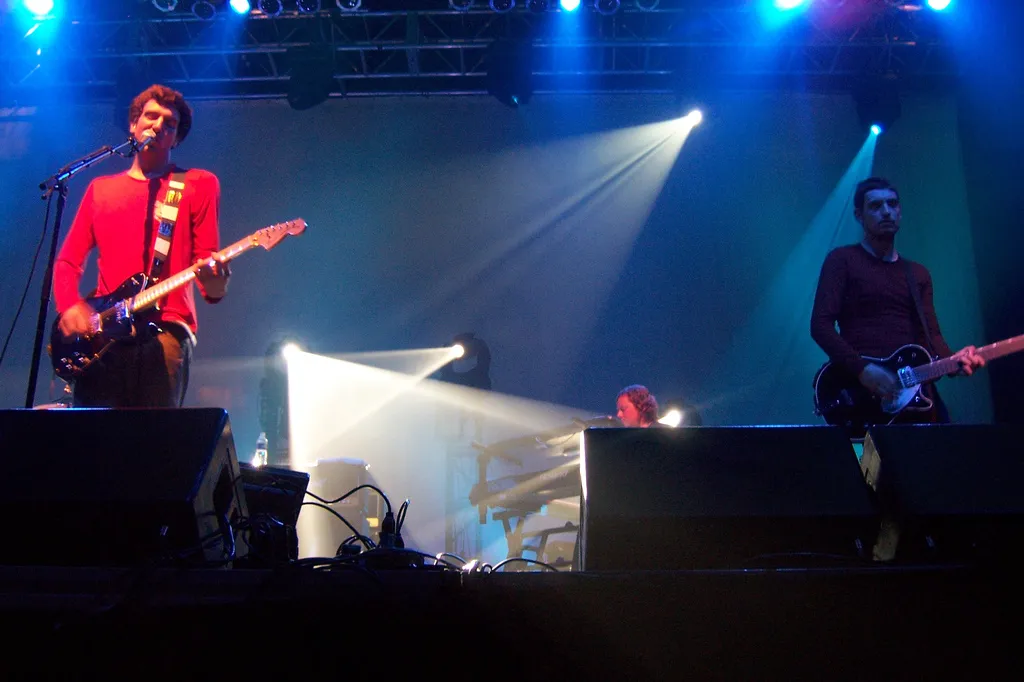
🏷️ Ficha musical
Why it's in this book
This song belongs to November, the month of Don't Stop Believin'. It is part of family B, the I–V–vi–IV loop, but the minor chord is missing here: there are only three chords, A–E–D. That makes it the easiest way into the family. They are also the same three chords as Johnny B. Goode and Sin documentos, which you played in October, just in a different order. In the room with nothing, you sing it a cappella over a beat of stamps and claps; in the ukulele room, you play the three chords with a quaver strum (E is the hard one: practise it on its own); in the music room, it is the band's turn. There the job is dynamics: you leave one round of A–E–D without singing for the solo, and in the last chorus someone sings the second part, an octave or a third above.
Why this song
If anyone at home watches Grey's Anatomy, they have already heard it. It played at the end of season two, in 2006, and from then on it became the song for the moments when someone says goodbye.
The question on this page is a different one. This song has three chords and hardly ever changes. How does the ending sound huge if the harmony is the same as at the start?
Historical context
Snow Patrol is a band from Northern Ireland. By the mid-2000s they were filling venues in the UK, but in the United States almost nobody knew them.
Gary Lightbody, the singer, wrote "Chasing Cars" in the garden of his producer Jacknife Lee's cottage in Kent. He called it the purest love song he had ever written: no dark twist at the end.
The title comes from his father. Lightbody had a crush on a girl who ignored him, and his father told him he was like a dog chasing a car: you will never catch it, and if you did, you would not know what to do with it.
The song came out on the album Eyes Open in 2006. The breakthrough came through television: in May it played in the Grey's Anatomy season finale, and by September it was the most downloaded song on iTunes in the US.
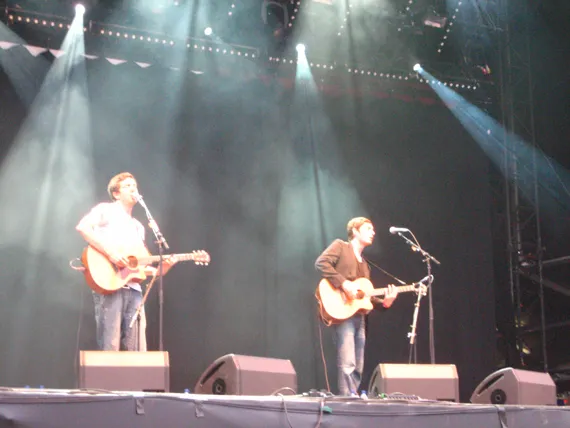
Foto: slushpup / Dani, CC BY 2.0, vía Wikimedia Commons
This photo is from the Pukkelpop festival in Belgium, in August 2006. Lightbody and guitarist Nathan Connolly play alone, on two acoustic guitars. The song holds up like this, without a band. That is exactly what you will do in the ukulele room.
Musical characteristics
A note that does not move. The song opens with an electric guitar playing one single note, over and over, in quavers: two hits per beat, always the same. The chords change underneath, but that note stays. It works like a clock that never stops. A figure that repeats without changing is called an ostinato.
Three chords. The whole song turns on A, E and D. The E chord has G♯ in the bass (E/G♯), so the bass moves from A to G♯, just one step down, before it reaches D. That is why you hardly notice the first change: the bass slides instead of jumping. This chord progression is I–V–IV, the rock & roll family from October in a different order.
How it grows. Here is the answer to the opening question. The harmony never changes. What changes is how many people are playing and how hard. First the guitar and the voice. Then the bass. The drums take their time. At the end, everyone together, and the voice moves up into a higher register. When a song gets gradually louder, that is a crescendo. And when what grows is the number of instruments playing together, what changes is the texture.
For the band. This song is a test of dynamics, not speed. The drummer has to resist hitting hard from the start. The bass player has few notes, but the step from A to G♯ has to land in time. And the solo is not about showing off with lots of notes: it is a melody that fills one round with no vocals.
Hard facts: A major, 4/4, 104 beats per minute, 4:27. The form, by ear: intro, verse, chorus, verse, chorus, bridge, final chorus and ending.
Guided listening
Play the music video. At the start, find the guitar's repeated note. Clap softly with it: two claps per beat. If you can do it, you have found the ostinato.
In the first verse, count the instruments. There are very few. Notice how low Lightbody is singing.
When the first chorus arrives, listen to the bass. Try to hear the step from A down to G♯, just before D.
Find the moment the drums come in. Ask yourself: what happened before it to make that first hit stand out so much?
At the end, compare it with the beginning. The same three chords. Now everyone is playing, louder, and the voice is higher. That journey from one end to the other is the crescendo.
Trivia and curiosities
- In 2019 it was revealed as the most-played song on UK radio this century. A slow song with no dance chorus beat twenty years of pop. What keeps it going is that it fits almost any moment.
- It spent 111 weeks in the UK top 75, most of them with no physical single on sale: downloads alone. It was one of the first songs to show that legal downloads could keep a hit alive for years.
- There are two music videos. In the British one, Lightbody lies on the ground as it starts to rain. In the American one, he lies down in crowded places (a diner, a crossroads, a subway car) and people step over him. Both repeat the image in the lyrics: just lying there.
- All five band members are credited as writers, not only the singer. In a song with so few notes, every part matters, and the credits show it.
Classroom activities
- Room with nothing: the ostinato with your body. Half the class plays the repeated note as soft claps, two per beat. The other half sings the chorus melody. Each time round, more people join the clapping: you build the crescendo without instruments.
- Ukulele room: three chords. A, E and D, one chord per bar, with downward quaver strums. E is the hard one on ukulele: practise the change from D to E on its own, ten times, before playing the whole song.
- Music room: the dynamics map. Before playing, write on the board which instruments play in each section and how loud (pp, p, mf, f). Play it following the map. Listen back to the recording: can you hear the crescendo, or did you play everything at the same volume?
- The solo and the second part. Leave one round of A–E–D without singing. The guitarist or the keyboard player makes up a melody with notes from A major. In the last chorus, one voice sings the same tune an octave higher or a third above.
Key vocabulary
- Ostinato — ostinato: una figura que se repite sin cambiar
- Chord progression — progresión de acordes
- Crescendo — crescendo: de suave a fuerte poco a poco
- Texture — textura: cuántas capas suenan a la vez
- Dynamics — dinámica: los cambios de volumen
Resources
Official music video — From Snow Patrol's official channel. Watch where Lightbody is lying.
Guitar tutorial — JustinGuitar. An easy version, to get started with the three chords.
Ukulele tutorial — The Ukulele Teacher. A full tutorial of the song on ukulele.
Piano tutorial — PHianonize. An easy version, good for the band's keyboard player.
Drum tutorial — Jack Young. How to play the song on drums, section by section.
Bass — Lucian Miron. The record's bass line with the tab on screen: watch for the step from A to G♯.
- Harmonic analysis — https://www.hooktheory.com/theorytab/view/snow-patrol/chasing-cars
Por qué está en este libro
Esta canción es de noviembre, el mes de Don't Stop Believin'. Pertenece a la familia B, la del bucle I–V–vi–IV, pero aquí falta el acorde menor: solo hay tres, A–E–D. Por eso es la puerta más fácil a la familia. Además, son los mismos tres acordes de Johnny B. Goode y Sin documentos, que tocasteis en octubre, solo que en otro orden. En el aula sin nada se canta a capela con un pulso de pies y palmas; en el aula de ukelele, los tres acordes con un rasgueo de corcheas (el Mi es el acorde difícil: practicadlo aparte); en el aula de música, la banda. Allí el trabajo es la dinámica: dejáis una vuelta de A–E–D sin cantar para el solo, y en el último estribillo alguien canta la segunda voz, a la octava o a una tercera.
Por dónde entrar
Si alguien en casa ve Anatomía de Grey, ya la ha oído. Sonó al final de la segunda temporada, en 2006, y desde ahí se convirtió en la canción de los momentos en que alguien se despide.
La pregunta de esta página es otra. Esta canción tiene tres acordes y casi nunca cambia. ¿Cómo consigue que el final suene enorme si la armonía es la misma que al principio?
Contexto histórico
Snow Patrol es una banda de Irlanda del Norte. A mediados de los 2000 ya llenaba salas en Reino Unido, pero en Estados Unidos casi nadie la conocía.
Gary Lightbody, el cantante, escribió «Chasing Cars» en el jardín de la casa de su productor, Jacknife Lee, en el sur de Inglaterra. Él mismo la llamó la canción de amor más pura que había escrito: sin giro oscuro al final.
El título viene de su padre. Lightbody estaba colado por una chica que no le hacía caso, y su padre le dijo que era como un perro persiguiendo un coche: nunca lo vas a pillar, y si lo pillas no sabrías qué hacer con él.
La canción salió en el disco Eyes Open, en 2006. El salto llegó por la televisión: en mayo sonó en el final de temporada de Anatomía de Grey, y en septiembre era la canción más descargada de iTunes en Estados Unidos.
Foto: slushpup / Dani, CC BY 2.0, vía Wikimedia Commons
Esta foto es del festival Pukkelpop (Bélgica), en agosto de 2006. Lightbody y Nathan Connolly, el guitarrista, tocan solos con dos acústicas. La canción aguanta así, sin banda. Es justo lo que haréis en el aula de ukelele.
Cómo suena
Una nota que no se mueve. La canción empieza con una guitarra eléctrica que toca una sola nota, una y otra vez, en corcheas: dos golpes por pulso, siempre iguales. Debajo cambian los acordes, pero esa nota sigue ahí. Es como un reloj que no para. Una figura que se repite sin cambiar se llama ostinato.
Tres acordes. Toda la canción gira sobre La, Mi y Re. El Mi lleva el sol sostenido en el bajo (E/G♯), y así el bajo pasa del la al sol sostenido, una nota justo por debajo, antes de llegar al re. Por eso el primer cambio casi no se nota: el bajo se desliza en vez de saltar. Esta progresión de acordes es I–V–IV, la familia del rock & roll de octubre pero en otro orden.
Cómo crece. Aquí está la respuesta a la pregunta del principio. La armonía no cambia nunca. Lo que cambia es cuánta gente toca y con qué fuerza. Primero la guitarra y la voz. Luego el bajo. La batería tarda en entrar. Al final, todos a la vez, y la voz sube de registro. Cuando una canción va de suave a fuerte poco a poco, se llama crescendo. Y cuando lo que crece es el número de instrumentos que suenan juntos, lo que cambia es la textura.
Para la banda. Esta canción es un examen de dinámica, no de velocidad. El batería tiene que aguantar las ganas de tocar fuerte desde el principio. El bajista toca pocas notas, pero el paso del la al sol sostenido tiene que caer a tiempo. Y el solo no es de lucirse con muchas notas: es una melodía que rellena una vuelta sin voz.
Datos duros: La mayor, 4/4, 104 pulsos por minuto, 4:27. La forma, de oído: intro, estrofa, estribillo, estrofa, estribillo, puente, estribillo final y cierre.
Escucha guiada
Pon el videoclip. Al principio, busca la nota repetida de la guitarra. Da palmas suaves con ella: dos por pulso. Si te sale, ya tienes el ostinato.
En la primera estrofa, cuenta los instrumentos. Son muy pocos. Fíjate en lo bajo que canta Lightbody.
Cuando llegue el primer estribillo, escucha el bajo. Intenta oír el paso del la al sol sostenido, justo antes del re.
Busca el momento en que entra la batería. Pregúntate: ¿qué ha pasado antes para que ese golpe se note tanto?
En el final, compara con el principio. Los mismos tres acordes. Ahora suenan todos, más fuerte, y la voz canta más agudo. Ese camino de un extremo al otro es el crescendo.
Curiosidades
- En 2019 se supo que era la canción más emitida en la radio británica en lo que iba de siglo. Una canción lenta, sin estribillo de baile, le ganó a todo el pop de veinte años. Lo que la mantiene es que se puede poner en cualquier momento.
- Estuvo 111 semanas en el top 75 británico. Casi todas sin disco físico a la venta: solo con descargas. Fue de las primeras canciones que demostraron que la descarga legal podía sostener un éxito durante años.
- Hay dos videoclips. En el británico, Lightbody está tumbado en el suelo mientras empieza a llover. En el estadounidense se tumba en sitios llenos de gente (una cafetería, un cruce, un vagón de metro) y la gente pasa por encima. Los dos repiten la imagen de la letra: quedarse tumbado.
- La firman los cinco miembros de la banda, no solo el cantante. En una canción con tan pocas notas, cada parte cuenta, y eso se nota en los créditos.
Para hacer en clase
- Aula sin nada: el ostinato con el cuerpo. La mitad de la clase hace la nota repetida con palmas suaves, dos por pulso. La otra mitad canta la melodía del estribillo. A cada vuelta, sumad gente a las palmas: así construís el crescendo sin instrumentos.
- Aula de ukelele: tres acordes. La, Mi y Re, un acorde por compás, con rasgueo de corcheas hacia abajo. El Mi es el difícil en ukelele: practicad el cambio de Re a Mi solo, diez veces, antes de tocar la canción entera.
- Aula de música: el mapa de la dinámica. Antes de tocar, apuntad en la pizarra qué instrumentos suenan en cada parte y con qué fuerza (pp, p, mf, f). Tocadla siguiendo el mapa. Escuchad la grabación: ¿se nota el crescendo, o habéis tocado todo igual de fuerte?
- El solo y la segunda voz. Dejad una vuelta de A–E–D sin cantar. El guitarrista o el teclista inventa una melodía con las notas de La mayor. En el último estribillo, una voz canta lo mismo una octava por encima o una tercera más arriba.
Vocabulario fundamental
- Ostinato — Una figura que se repite sin cambiar mientras lo demás se mueve. Aquí, la nota de la guitarra.
- Progresión de acordes — Una serie de acordes que se repite en el mismo orden. Aquí, La, Mi, Re.
- Crescendo — Ir de suave a fuerte poco a poco.
- Textura — Cuántas capas de sonido suenan a la vez y cómo se combinan.
- Dinámica — Los cambios de volumen de una música, de muy suave a muy fuerte.
Recursos
Videoclip oficial — Del canal oficial de Snow Patrol. Fíjate en dónde está tumbado Lightbody.
Tutorial de guitarra — JustinGuitar. Versión fácil, para empezar con los tres acordes.
Tutorial de ukelele — The Ukulele Teacher. Tutorial completo de la canción en ukelele.
Tutorial de piano — PHianonize. Versión fácil, buena para el teclista de la banda.
Tutorial de batería — Jack Young. Cómo tocar la canción en la batería, parte por parte.
Bajo — Lucian Miron. La línea del disco con la tablatura en pantalla: fíjate en el paso del la al sol sostenido.
- Análisis armónico — https://www.hooktheory.com/theorytab/view/snow-patrol/chasing-cars
Why it's in this book
This song belongs to November, the month of Don't Stop Believin'. It is part of family B, the I–V–vi–IV loop, but the minor chord is missing here: there are only three chords, A–E–D. That makes it the easiest way into the family. They are also the same three chords as Johnny B. Goode and Sin documentos, which you played in October, just in a different order. In the room with nothing, you sing it a cappella over a beat of stamps and claps; in the ukulele room, you play the three chords with a quaver strum (E is the hard one: practise it on its own); in the music room, it is the band's turn. There the job is dynamics: you leave one round of A–E–D without singing for the solo, and in the last chorus someone sings the second part, an octave or a third above.
Why this song
If anyone at home watches Grey's Anatomy, they have already heard it. It played at the end of season two, in 2006, and from then on it became the song for the moments when someone says goodbye.
The question on this page is a different one. This song has three chords and hardly ever changes. How does the ending sound huge if the harmony is the same as at the start?
Historical context
Snow Patrol is a band from Northern Ireland. By the mid-2000s they were filling venues in the UK, but in the United States almost nobody knew them.
Gary Lightbody, the singer, wrote "Chasing Cars" in the garden of his producer Jacknife Lee's cottage in Kent. He called it the purest love song he had ever written: no dark twist at the end.
The title comes from his father. Lightbody had a crush on a girl who ignored him, and his father told him he was like a dog chasing a car: you will never catch it, and if you did, you would not know what to do with it.
The song came out on the album Eyes Open in 2006. The breakthrough came through television: in May it played in the Grey's Anatomy season finale, and by September it was the most downloaded song on iTunes in the US.
Foto: slushpup / Dani, CC BY 2.0, vía Wikimedia Commons
This photo is from the Pukkelpop festival in Belgium, in August 2006. Lightbody and guitarist Nathan Connolly play alone, on two acoustic guitars. The song holds up like this, without a band. That is exactly what you will do in the ukulele room.
Musical characteristics
A note that does not move. The song opens with an electric guitar playing one single note, over and over, in quavers: two hits per beat, always the same. The chords change underneath, but that note stays. It works like a clock that never stops. A figure that repeats without changing is called an ostinato.
Three chords. The whole song turns on A, E and D. The E chord has G♯ in the bass (E/G♯), so the bass moves from A to G♯, just one step down, before it reaches D. That is why you hardly notice the first change: the bass slides instead of jumping. This chord progression is I–V–IV, the rock & roll family from October in a different order.
How it grows. Here is the answer to the opening question. The harmony never changes. What changes is how many people are playing and how hard. First the guitar and the voice. Then the bass. The drums take their time. At the end, everyone together, and the voice moves up into a higher register. When a song gets gradually louder, that is a crescendo. And when what grows is the number of instruments playing together, what changes is the texture.
For the band. This song is a test of dynamics, not speed. The drummer has to resist hitting hard from the start. The bass player has few notes, but the step from A to G♯ has to land in time. And the solo is not about showing off with lots of notes: it is a melody that fills one round with no vocals.
Hard facts: A major, 4/4, 104 beats per minute, 4:27. The form, by ear: intro, verse, chorus, verse, chorus, bridge, final chorus and ending.
Guided listening
Play the music video. At the start, find the guitar's repeated note. Clap softly with it: two claps per beat. If you can do it, you have found the ostinato.
In the first verse, count the instruments. There are very few. Notice how low Lightbody is singing.
When the first chorus arrives, listen to the bass. Try to hear the step from A down to G♯, just before D.
Find the moment the drums come in. Ask yourself: what happened before it to make that first hit stand out so much?
At the end, compare it with the beginning. The same three chords. Now everyone is playing, louder, and the voice is higher. That journey from one end to the other is the crescendo.
Trivia and curiosities
- In 2019 it was revealed as the most-played song on UK radio this century. A slow song with no dance chorus beat twenty years of pop. What keeps it going is that it fits almost any moment.
- It spent 111 weeks in the UK top 75, most of them with no physical single on sale: downloads alone. It was one of the first songs to show that legal downloads could keep a hit alive for years.
- There are two music videos. In the British one, Lightbody lies on the ground as it starts to rain. In the American one, he lies down in crowded places (a diner, a crossroads, a subway car) and people step over him. Both repeat the image in the lyrics: just lying there.
- All five band members are credited as writers, not only the singer. In a song with so few notes, every part matters, and the credits show it.
Classroom activities
- Room with nothing: the ostinato with your body. Half the class plays the repeated note as soft claps, two per beat. The other half sings the chorus melody. Each time round, more people join the clapping: you build the crescendo without instruments.
- Ukulele room: three chords. A, E and D, one chord per bar, with downward quaver strums. E is the hard one on ukulele: practise the change from D to E on its own, ten times, before playing the whole song.
- Music room: the dynamics map. Before playing, write on the board which instruments play in each section and how loud (pp, p, mf, f). Play it following the map. Listen back to the recording: can you hear the crescendo, or did you play everything at the same volume?
- The solo and the second part. Leave one round of A–E–D without singing. The guitarist or the keyboard player makes up a melody with notes from A major. In the last chorus, one voice sings the same tune an octave higher or a third above.
Key vocabulary
- Ostinato — ostinato: una figura que se repite sin cambiar
- Chord progression — progresión de acordes
- Crescendo — crescendo: de suave a fuerte poco a poco
- Texture — textura: cuántas capas suenan a la vez
- Dynamics — dinámica: los cambios de volumen
Resources
Official music video — From Snow Patrol's official channel. Watch where Lightbody is lying.
Guitar tutorial — JustinGuitar. An easy version, to get started with the three chords.
Ukulele tutorial — The Ukulele Teacher. A full tutorial of the song on ukulele.
Piano tutorial — PHianonize. An easy version, good for the band's keyboard player.
Drum tutorial — Jack Young. How to play the song on drums, section by section.
Bass — Lucian Miron. The record's bass line with the tab on screen: watch for the step from A to G♯.
- Harmonic analysis — https://www.hooktheory.com/theorytab/view/snow-patrol/chasing-cars