Contenidos
¿Quién toca la batería en esta canción?
Almost none of the songs you listen to today have a person playing the drums. This unit is about who plays them instead, and what changed the day a drummer stopped being necessary.
We ask ourselves
- Is anybody actually playing the drums on this song?
- Why do so many eighties songs have exactly the same snare sound?
- If a machine never tires and never misses, what is lost?
- How many people does it take to record a song today?
- Can you play with your body what a machine does?
- If a programmed song could last as long as it likes, why does it still last three minutes?
Don't answer yet. We come back to these at the end.
The fragment
Before playing any song, we build the grid together. Sixteen slots, which is one bar of 4/4 counted in sixteenth notes.
- Feet stamp on slots 1, 5, 9 and 13. That is the kick drum, and it is what we call four on the floor.
- Hands clap only on 5 and 13. That is the snare, landing on the weak beats.
- Mouth makes a ts on every odd slot. That is the hi-hat.
When the three layers hold together without speeding up, you have done what a drum machine does. The hard part is not the pattern: it is keeping it identical.
Now play Blinding Lights, all of it, with nobody talking over it.
What changed
For seventy years, recording drums meant the same thing: a person, a room with the right reverberation, a set of microphones and several hours. And it meant something more important: the drummer decided how the song breathed. Pushing a beat, hitting harder in the chorus, tiring towards the end.
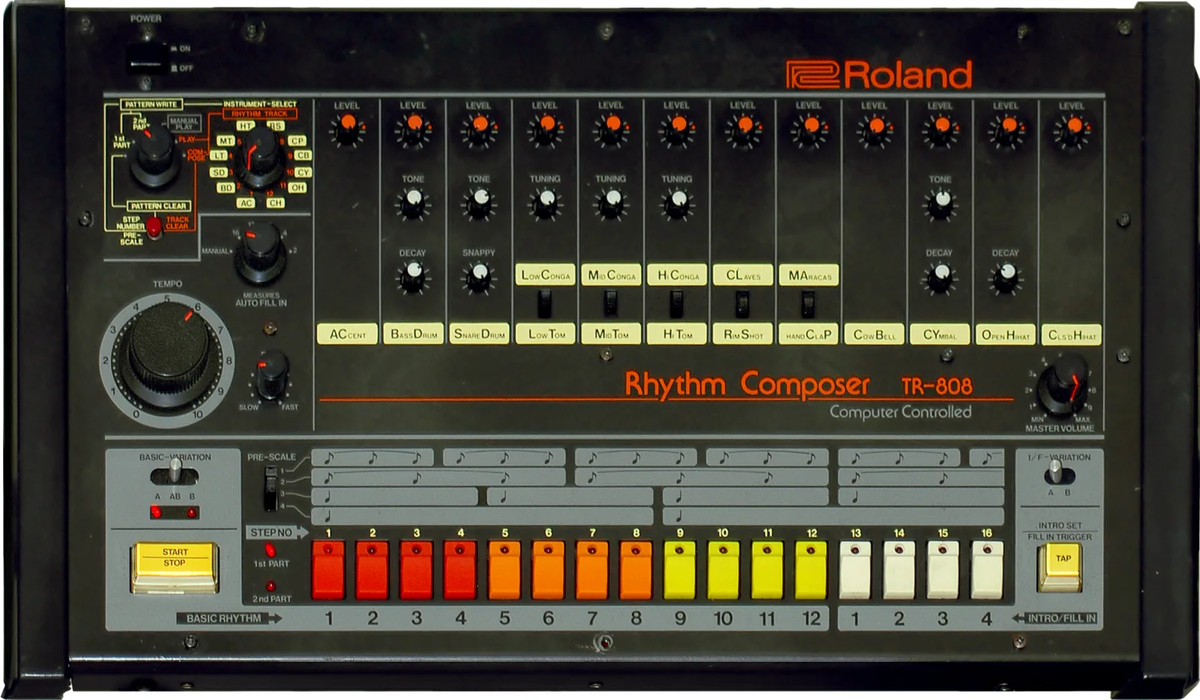
In 1980 Roland put the TR-808 on sale. It cost a thousand dollars, when Linn's rival machine cost five thousand. It did not imitate a real kit well, and that flaw became its identity: that long kick and that dry clap do not sound like drums, they sound like the 808, and you can still recognise them in songs written long after it stopped being made.
What changes in the ear is one specific thing: exactness. A programmed hit always lands in the same place with the same force. The song stops breathing and starts turning. That identical repeating figure is called a loop, and once you hear it you no longer expect something different to happen; you expect things to pile on top. That is why so many programmed songs grow in layers rather than in sections.
And it changes who is in the room. With a drum machine one person alone can finish a song, and the producer becomes another instrumentalist. Drums stop being something you play and become something you write, slot by slot, and something you can fix without playing again.
Hard facts: Roland TR-808, 1980, programmable, one thousand dollars. LinnDrum, 1982-1985, around five thousand units, designed by Roger Linn, already using recorded sounds from a real kit. Between them they account for most of what the decade sounds like.
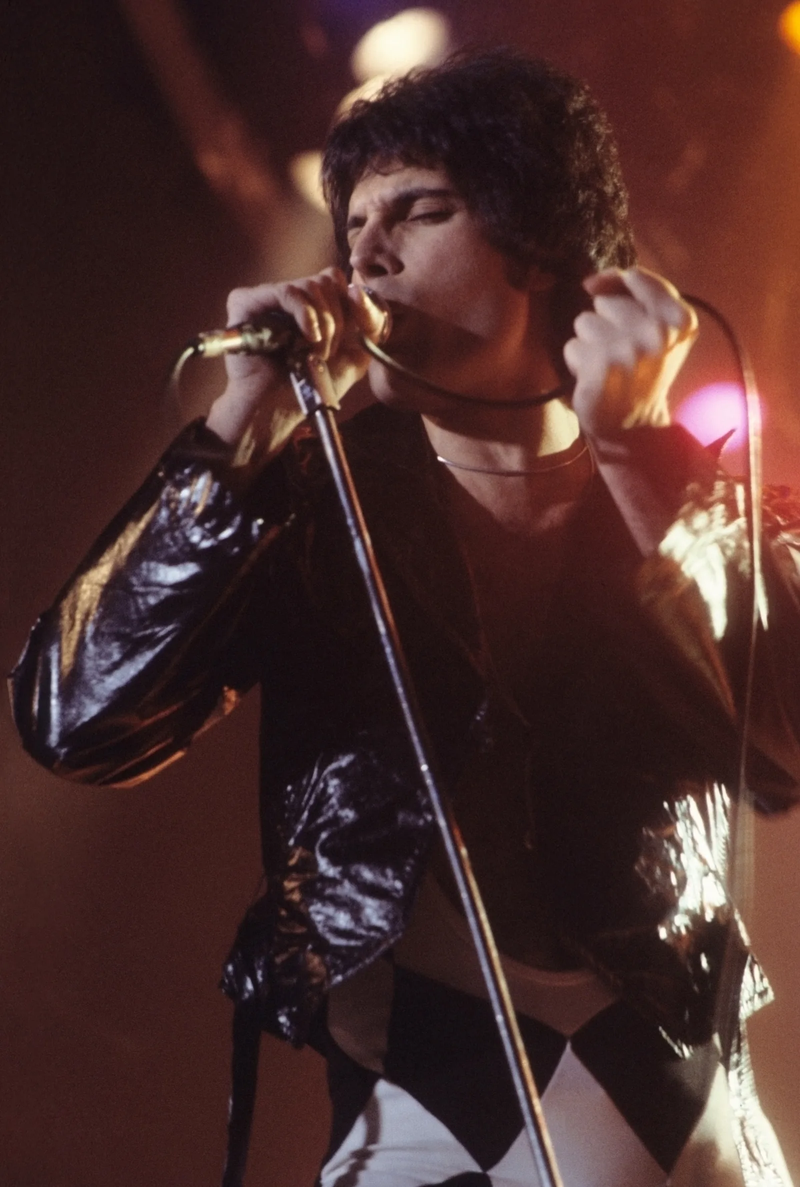
Foto: Carl Lender, CC BY-SA 3.0, vía Wikimedia Commons
The same device elsewhere
The drum machine did not invent the loop. It made it cheap. These three prove it, and they are worth hearing back to back:
- Blinding Lights — the base never changes. The only thing that moves is how many people are playing on top of it.
- Ravel's Boléro (1928) — the snare repeats the same bar for fifteen minutes without varying once. It is a person acting as a machine, and it is exhausting to play.
- The Cuban clave — five strokes that repeat and organise everything else. It has done so for centuries without any machine.
None is better than the others. All three do the same job: put something unchanging underneath, so that what happens on top can mean something.
And here at home?
In Madrid the machine arrives early. Aviador Dro is founded in 1979 and is the pioneering Spanish electronic pop band, looking towards Kraftwerk and Devo. Soon after, Mecano takes the synthesiser to number one, which is what the Maquillaje article in the library is about.
In Zaragoza the eighties sound like something else. Héroes del Silencio forms in the middle of the decade with guitar, bass and played drums, and before them what there is is the Nueva Canción Aragonesa, led by Labordeta. The bridge between the two worlds is a man from Zaragoza, Santiago Auserón, who came out of the Madrid scene with Radio Futura.
It is an awkward fact and that is exactly why it is worth telling: the drum machine arrived here late and unevenly. The sound of the eighties in Aragón is a guitar, not a box.
Classroom activities
- While Blinding Lights plays: everyone raises a hand when a new layer comes in. Afterwards we count how many hands went up, and in what order.
- While We Will Rock You plays: half the class keeps the sixteen-slot grid with feet and hands. Same function, body instead of machine.
- Play: we build Blinding Lights with the band. The full-band chart and the tab are attached to its own article.
- Create: programme two bars and repeat them for one minute, adding a layer every eight bars and never changing the base. Steal the procedure, not the song.
Key vocabulary
- Drum machine — caja de ritmos: una máquina que toca percusión a partir de un patrón escrito
- Grid — rejilla (las casillas en que se divide el compás para programar)
- Loop — bucle: una figura que se repite idéntica
- Four on the floor — el bombo en los cuatro tiempos
- To quantise — cuantizar: mover cada golpe a la casilla exacta
Resources
The songs in this unit are in the library, each with its own article, full-band chart and tab: Blinding Lights, We Will Rock You, Saturn.
The song of the unit — Blinding Lights, The Weeknd (2019). Its article, with the full-band chart and the tab, is in the library.
The body version — We Will Rock You, Queen (1977).
The loop in the orchestra — Ravel's Boléro, hr-Sinfonieorchester. Watch the snare: it never stops and never changes.
The loop without a machine — how to play the Cuban clave, the pattern that organises son and salsa.
- More from this era — "The 1980s Musical Revolution: Synths, Screens and Sequencers", in the library.
- In Spanish — "Maquillaje", Mecano (1982), in the library.
Nos preguntamos
- ¿La batería de esta canción la toca alguien?
- ¿Por qué tantas canciones de los ochenta tienen exactamente el mismo sonido de caja?
- Si una máquina no se cansa ni se equivoca, ¿qué se pierde?
- ¿Cuántas personas hacen falta para grabar una canción actual?
- ¿Se puede tocar con el cuerpo lo que hace una máquina?
- ¿Por qué una canción programada puede durar lo que quiera y aun así dura tres minutos?
No las respondas todavía. Al final de la unidad volvemos a ellas.
El fragmento
Antes de poner ninguna canción, montamos la rejilla entre todos. Son dieciséis casillas, que es un compás de 4/4 contado en semicorcheas.
- Los pies pisan en las casillas 1, 5, 9 y 13. Eso es el bombo, y es lo que llamamos four on the floor.
- Las palmas suenan solo en la 5 y en la 13. Eso es la caja, y cae en los tiempos débiles.
- La boca hace un ts en las casillas impares. Ese es el charles.
Cuando las tres capas se sostienen a la vez sin acelerar, ya has hecho lo que hace una caja de ritmos. Lo difícil no es el patrón: es que no cambie.
Ahora sí, Blinding Lights entera y sin comentarios por encima.
Qué cambió
Durante setenta años, grabar una batería significaba lo mismo: una persona, una sala con la reverberación adecuada, una colección de micrófonos y unas cuantas horas. Y significaba algo más importante, que es que el batería decidía cómo respiraba la canción. Adelantaba un golpe, apretaba en el estribillo, se cansaba al final.
En 1980 Roland puso a la venta la TR-808. Costaba mil dólares, cuando la máquina rival de Linn costaba cinco mil. No imitaba bien a una batería real, y eso, que era su defecto, acabó siendo su identidad: ese bombo largo y ese chasquido seco no suenan a batería, suenan a la 808, y hoy los reconoces en canciones que no habían nacido cuando ella se fabricó.
Lo que cambia en el oído es una cosa concreta: la exactitud. Un golpe programado cae siempre en el mismo sitio, con la misma fuerza. La canción deja de respirar y empieza a girar. A esa figura que se repite idéntica se le llama bucle, y cuando la escuchas ya no esperas que pase algo distinto, sino que esperas que se sumen cosas encima. Por eso tantas canciones programadas crecen por capas en vez de por secciones.
Y cambia quién está en la sala. Con una caja de ritmos, una persona sola puede terminar una canción, y el productor pasa a ser un instrumentista más. La batería deja de ser algo que se toca y pasa a ser algo que se escribe, casilla a casilla, y que se puede corregir sin volver a tocarla.
Datos duros: TR-808, Roland, 1980, programable, mil dólares. LinnDrum, 1982-1985, unas cinco mil unidades, diseñada por Roger Linn, ya con sonidos grabados de una batería de verdad. Entre las dos se reparte casi todo lo que suena en la década.
Foto: Carl Lender, CC BY-SA 3.0, vía Wikimedia Commons
El mismo recurso en otros sitios
La caja de ritmos no inventó el bucle. Lo que hizo fue abaratarlo. Estos tres lo demuestran, y conviene oírlos seguidos:
- Blinding Lights — la base no cambia en toda la canción. Lo único que se mueve es cuánta gente toca encima.
- Boléro, de Ravel (1928) — la caja repite el mismo compás durante quince minutos sin variar una sola vez. Es una persona haciendo de máquina, y es agotador de tocar.
- La clave cubana — cinco golpes que se repiten y sobre los que se organiza todo lo demás. Lleva siglos funcionando sin ninguna máquina.
Ninguno es mejor que otro. Los tres hacen lo mismo: poner algo que no cambia debajo, para que lo de encima signifique algo.
Y aquí, ¿qué?
En Madrid la máquina llega pronto. Aviador Dro se funda en 1979 y es el grupo pionero del pop electrónico en España, mirando a Kraftwerk y a Devo. Poco después Mecano convierte el sintetizador en número uno, y de eso va el artículo de Maquillaje que ya está en la biblioteca.
En Zaragoza los ochenta suenan a otra cosa. Héroes del Silencio se forma a mediados de la década con guitarra, bajo y batería tocada, y antes de ellos lo que hay es la Nueva Canción Aragonesa, con Labordeta a la cabeza. El puente entre los dos mundos es un zaragozano, Santiago Auserón, que con Radio Futura viene de la movida madrileña.
Es un dato incómodo y por eso merece contarse: la caja de ritmos llegó aquí tarde y de forma desigual. El sonido de los ochenta en Aragón es una guitarra, no una caja.
Para hacer en clase
- Durante la escucha de Blinding Lights: cada uno levanta la mano cuando entre una capa nueva. Al final contamos cuántas manos se habían levantado y en qué orden.
- Durante la escucha de We Will Rock You: media clase hace la rejilla de dieciséis con pies y palmas mientras suena. Es la misma función con el cuerpo en vez de con la máquina.
- Tocar: montamos Blinding Lights con la banda. El chart de banda y la tablatura están en su artículo.
- Crear: programad dos compases y repetidlos durante un minuto, añadiendo una capa cada ocho compases y sin cambiar nunca la base. Se trata de robar el procedimiento, no la canción.
Vocabulario fundamental
- Caja de ritmos — Una máquina que toca percusión a partir de un patrón que tú escribes. No graba a nadie: genera el sonido.
- Rejilla — Las casillas en las que se divide un compás para programar. Dieciséis casillas es un compás de 4/4 en semicorcheas.
- Bucle — Una figura que se repite idéntica todas las veces. Es lo que hace que la canción gire en vez de avanzar.
- Four on the floor — El bombo en los cuatro tiempos del compás. Es la base de casi toda la música de baile desde los setenta.
- Cuantizar — Mover cada golpe a la casilla exacta. Es lo que le quita el error humano a una grabación, y también lo que le quita el balanceo.
Recursos
Las canciones de esta unidad están en la biblioteca, cada una con su artículo, su chart de banda y su tablatura: Blinding Lights, We Will Rock You, Saturn.
La canción de la unidad — Blinding Lights, The Weeknd (2019). El artículo, con su chart de banda y su tablatura, está en la biblioteca.
La versión con el cuerpo — We Will Rock You, Queen (1977).
El bucle en la orquesta — Boléro de Ravel, por la hr-Sinfonieorchester. Fíjate en la caja: no para ni cambia en toda la pieza.
El bucle sin máquina — cómo se toca la clave cubana, el patrón sobre el que se organiza el son y la salsa.
- Más de esta época — «The 1980s Musical Revolution: Synths, Screens and Sequencers», en la biblioteca.
- En español — «Maquillaje», Mecano (1982), en la biblioteca.
We ask ourselves
- Is anybody actually playing the drums on this song?
- Why do so many eighties songs have exactly the same snare sound?
- If a machine never tires and never misses, what is lost?
- How many people does it take to record a song today?
- Can you play with your body what a machine does?
- If a programmed song could last as long as it likes, why does it still last three minutes?
Don't answer yet. We come back to these at the end.
The fragment
Before playing any song, we build the grid together. Sixteen slots, which is one bar of 4/4 counted in sixteenth notes.
- Feet stamp on slots 1, 5, 9 and 13. That is the kick drum, and it is what we call four on the floor.
- Hands clap only on 5 and 13. That is the snare, landing on the weak beats.
- Mouth makes a ts on every odd slot. That is the hi-hat.
When the three layers hold together without speeding up, you have done what a drum machine does. The hard part is not the pattern: it is keeping it identical.
Now play Blinding Lights, all of it, with nobody talking over it.
What changed
For seventy years, recording drums meant the same thing: a person, a room with the right reverberation, a set of microphones and several hours. And it meant something more important: the drummer decided how the song breathed. Pushing a beat, hitting harder in the chorus, tiring towards the end.
In 1980 Roland put the TR-808 on sale. It cost a thousand dollars, when Linn's rival machine cost five thousand. It did not imitate a real kit well, and that flaw became its identity: that long kick and that dry clap do not sound like drums, they sound like the 808, and you can still recognise them in songs written long after it stopped being made.
What changes in the ear is one specific thing: exactness. A programmed hit always lands in the same place with the same force. The song stops breathing and starts turning. That identical repeating figure is called a loop, and once you hear it you no longer expect something different to happen; you expect things to pile on top. That is why so many programmed songs grow in layers rather than in sections.
And it changes who is in the room. With a drum machine one person alone can finish a song, and the producer becomes another instrumentalist. Drums stop being something you play and become something you write, slot by slot, and something you can fix without playing again.
Hard facts: Roland TR-808, 1980, programmable, one thousand dollars. LinnDrum, 1982-1985, around five thousand units, designed by Roger Linn, already using recorded sounds from a real kit. Between them they account for most of what the decade sounds like.
Foto: Carl Lender, CC BY-SA 3.0, vía Wikimedia Commons
The same device elsewhere
The drum machine did not invent the loop. It made it cheap. These three prove it, and they are worth hearing back to back:
- Blinding Lights — the base never changes. The only thing that moves is how many people are playing on top of it.
- Ravel's Boléro (1928) — the snare repeats the same bar for fifteen minutes without varying once. It is a person acting as a machine, and it is exhausting to play.
- The Cuban clave — five strokes that repeat and organise everything else. It has done so for centuries without any machine.
None is better than the others. All three do the same job: put something unchanging underneath, so that what happens on top can mean something.
And here at home?
In Madrid the machine arrives early. Aviador Dro is founded in 1979 and is the pioneering Spanish electronic pop band, looking towards Kraftwerk and Devo. Soon after, Mecano takes the synthesiser to number one, which is what the Maquillaje article in the library is about.
In Zaragoza the eighties sound like something else. Héroes del Silencio forms in the middle of the decade with guitar, bass and played drums, and before them what there is is the Nueva Canción Aragonesa, led by Labordeta. The bridge between the two worlds is a man from Zaragoza, Santiago Auserón, who came out of the Madrid scene with Radio Futura.
It is an awkward fact and that is exactly why it is worth telling: the drum machine arrived here late and unevenly. The sound of the eighties in Aragón is a guitar, not a box.
Classroom activities
- While Blinding Lights plays: everyone raises a hand when a new layer comes in. Afterwards we count how many hands went up, and in what order.
- While We Will Rock You plays: half the class keeps the sixteen-slot grid with feet and hands. Same function, body instead of machine.
- Play: we build Blinding Lights with the band. The full-band chart and the tab are attached to its own article.
- Create: programme two bars and repeat them for one minute, adding a layer every eight bars and never changing the base. Steal the procedure, not the song.
Key vocabulary
- Drum machine — caja de ritmos: una máquina que toca percusión a partir de un patrón escrito
- Grid — rejilla (las casillas en que se divide el compás para programar)
- Loop — bucle: una figura que se repite idéntica
- Four on the floor — el bombo en los cuatro tiempos
- To quantise — cuantizar: mover cada golpe a la casilla exacta
Resources
The songs in this unit are in the library, each with its own article, full-band chart and tab: Blinding Lights, We Will Rock You, Saturn.
The song of the unit — Blinding Lights, The Weeknd (2019). Its article, with the full-band chart and the tab, is in the library.
The body version — We Will Rock You, Queen (1977).
The loop in the orchestra — Ravel's Boléro, hr-Sinfonieorchester. Watch the snare: it never stops and never changes.
The loop without a machine — how to play the Cuban clave, the pattern that organises son and salsa.
- More from this era — "The 1980s Musical Revolution: Synths, Screens and Sequencers", in the library.
- In Spanish — "Maquillaje", Mecano (1982), in the library.