Contenidos
Bamboleo — Gipsy Kings (1987)
A band of French gitanos who sing in Spanish, a song stitched together from two others and a guitar that plays harmony and percussion at the same time. That is rumba, and in Year 10 it is yours.
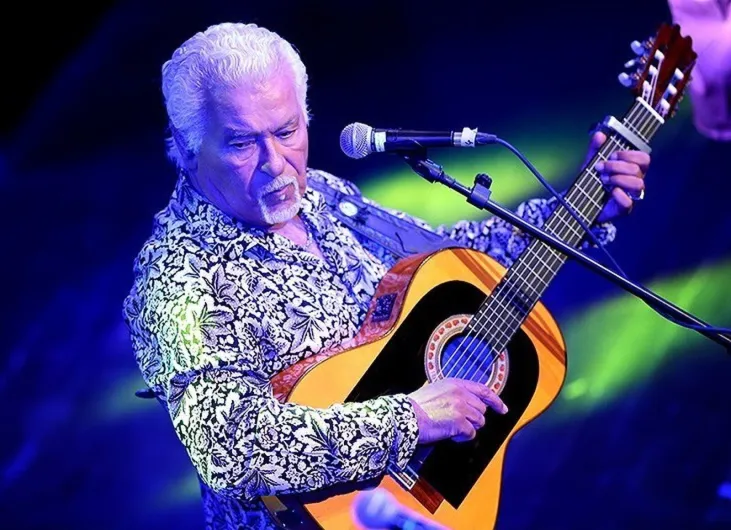
🏷️ Ficha musical
Why it's in this book
It is one of February's three songs, the month of the Latin minor, together with Despechá and Flowers. It comes in through rumba: you do not play it in Year 7 or Year 9, and it is the style closest to the Spanish guitars in your classroom. In class we play it over the Andalusian cadence, A minor, G, F and E, the same falling chords you heard in Hit the Road Jack in Year 9 and will hear again in La Flaca this year. The record is in F sharp minor; in class we take it down to A minor. To be straight with you: only the intro of this song has been analysed, so part of the work is checking by ear how much of the record fits that cadence. In the room with no instruments you sing the "bamboleo" chorus in unison with rumba claps. With ukuleles, the four chords. In the music room the Spanish guitar plays the rumba strum and the soloists improvise over the cadence.
Why this song
You have probably heard it at a wedding, at a street party or in an advert, and sung the chorus without knowing what it was about. "Bamboleo" means swaying, wobbling. And that is what everyone does when it plays.
The odd thing is something else. It is one of the best-known Spanish-language songs in the world, and it is played by musicians born in France.
Historical context
The Gipsy Kings come from Arles, in the south of France. Their parents were Spanish gitanos, Spanish Romani, who had fled Spain during the Civil War. That is why they sing mostly in Spanish.
The group started as a family: the father, José Reyes, played with his sons. Reyes means "kings", hence the name. They played at weddings, parties and in the street. Their first two albums went almost unnoticed.
In 1987 they released their third album, named after the band. "Bamboleo" was on it. The album spent forty weeks on the US charts, something very few Spanish-language records had done.
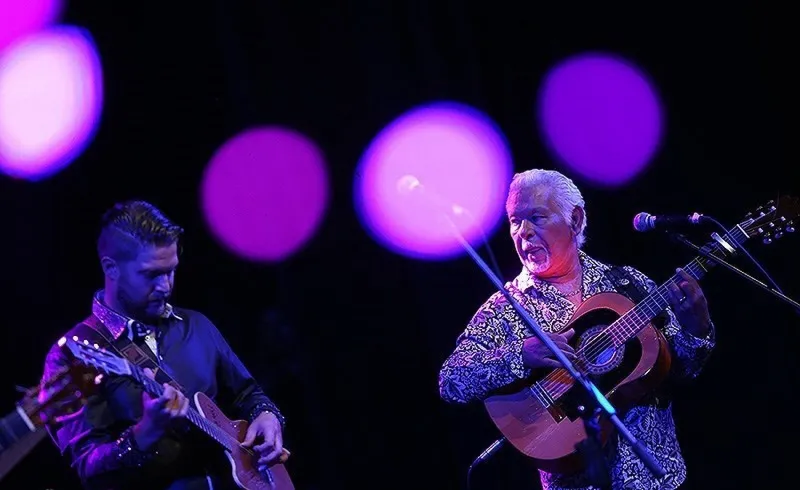
Foto: Meghdad Madadi, CC BY 4.0, vía Wikimedia Commons
This is how the group sounds live: several guitars at once, all strumming, and someone singing on top. The photo is from a concert in Tehran, Iran, in 2016. Almost thirty years after the album, the song was still in the set.
The song did not come out of nowhere. It is a blend of two earlier songs. The verse comes from "Caballo viejo", by the Venezuelan Simón Díaz (1980). The chorus comes from "Bamboleô", a Brazilian song by André Filho from 1931. The Gipsy Kings took both, changed the lyrics and gave them their own rhythm.
Musical characteristics
Rumba. The style is called Catalan rumba: it was born among the gitanos of Barcelona, mixing flamenco with Cuban rhythms, and the Gipsy Kings took it around the world. Its trademark is the guitar. It does not just play chords: with the right hand, the guitarist strikes and mutes the strings on some strokes. That muted stroke sounds almost like a snare drum. It is a strum that works as harmony and percussion at once.
An intro that sways. According to Hooktheory, the intro stays on a single chord, F sharp minor, which keeps changing colour inside. It is a vamp: a base that repeats and waits for the voice to come in.
The Andalusian cadence. In class, the song rests on four chords that go down: A minor, G, F, E. Listen to the bass: A, G, F, E, four steps downwards. That descent is called the Andalusian cadence, and it is the harmony of flamenco. The last chord, E major, leaves the phrase hanging and asks to start again.
Many voices, one melody. The chorus is not sung in harmony: everyone sings the same melody at the same time. It is a unison, which is why any audience can sing along.
Transposing. The record is in F sharp minor. In class we take it down three semitones, to A minor, because there the chords fit on ukulele and Spanish guitar without a capo. If you want to play along with the record on guitar, put a capo on the second fret and play the E minor shapes: E minor, D, C, B.
Hard facts: F sharp minor on the record and A minor in class, 4/4, 120 beats per minute, 3:25.
Guided listening
Play the music video. In the intro, listen to the guitars. Try to separate two things: the notes of the chords and the dry, muted hits. Those hits are rumba's percussion.
When the voice comes in, listen to the bass. Does it step downwards? Count how many steps before it starts again.
When the chorus arrives, sing "bamboleo" with them. Is everyone singing the same melody, or are there different voices?
Look for the moments when a guitar plays melody instead of chords. What are the other guitars doing meanwhile? That base is what will hold up your solos in class.
Trivia and curiosities
- A French band singing in Spanish with melodies from Venezuela and Brazil. The song is a map: it shows how music travels between countries.
- The band's name is a translation: Reyes, the family surname, in English.
- One of the founders, Chico Bouchikhi, was French-Moroccan and married to a daughter of the Reyes father. He left the group in 1991.
- Julio Iglesias and Celia Cruz also recorded it, each in their own way. The chorus survives every change of style.
Classroom activities
- Rumba claps. Room with no instruments: half the class keeps the beat with their feet; the other half claps sharply on 2 and 4. On top, everyone sings "bamboleo" in unison.
- The cadence on ukulele. A minor, G, F, E, one chord per bar. Sing the lowest note of each chord while you play: A, G, F, E. That way you hear the descent.
- The rumba strum. Spanish guitar and guitalele, with the rumba tutorial in Resources: first only the muted strokes, on 2 and 4; then with the chords.
- Solo turns. Music room: the band keeps the Andalusian cadence going. Each soloist gets one full round with the notes of A minor. When you reach E major, try ending your phrase on G sharp.
- Check it. Listen to the record with a capo on the second fret and the E minor shapes (E minor, D, C, B). In which parts does the cadence fit, and in which does it not? Write it down: it is information nobody has checked yet.
Key vocabulary
- Catalan rumba — rumba catalana
- Strum — rasgueo
- Vamp — vamp: base que se repite y espera a la voz o al solo
- Andalusian cadence — cadencia andaluza
- Unison — unísono
Resources
Official music video
Guitar tutorial — Guitar Vibration (Piou d'Ambrosio). The song on guitar, in rumba style.
The rumba strum — Carlo Espresso. Three steps to learn the rumba flamenca strum. It works for this song and for any rumba.
Ukulele tutorial — Andy Ramos. To play along with the song.
Piano tutorial — La Tecla Música. The piano accompaniment, in Spanish and without sheet music.
Drums, played along — Pavel Rak. Not a lesson, but you can see how a rumba beat is played on a drum kit.
Bass, with tab — Darbass. The bass line with tab.
- Harmonic analysis (intro only) — Hooktheory: https://www.hooktheory.com/theorytab/view/gipsy-kings/bamboleo
Por qué está en este libro
Es una de las tres canciones de febrero, el mes del menor latino, junto a Despechá y Flowers. Entra por la rumba: ni en 1º ni en 3º la tocáis, y es la música que más cerca os queda de la guitarra española del aula. En clase la tocamos sobre la cadencia andaluza, la menor, sol, fa y mi, el mismo bajar de acordes que en 3º sonaba en Hit the Road Jack y que en 4º volverá en La Flaca. El disco está en fa sostenido menor; en clase la bajamos a la menor. Os lo decimos claro: de esta canción solo está analizada la intro, así que parte del trabajo es comprobar con el oído cuánto del disco cabe en esa cadencia. En el aula sin instrumentos cantáis el coro «bamboleo» al unísono con palmas de rumba. Con ukelele, los cuatro acordes. En el aula de música la española lleva el rasgueo de rumba y los solistas improvisan sobre la cadencia.
Por dónde entrar
Probablemente la has oído en una boda, en una verbena o en un anuncio, y has cantado el estribillo sin saber de qué iba. «Bamboleo» significa balancearse, tambalearse. Y eso es lo que hace todo el mundo cuando suena.
Lo raro es otra cosa. Es una de las canciones en castellano más conocidas del mundo, y la tocan unos músicos nacidos en Francia.
Contexto histórico
Los Gipsy Kings vienen de Arles, en el sur de Francia. Sus padres eran gitanos españoles que habían huido de España durante la Guerra Civil. Por eso cantan sobre todo en castellano.
El grupo empezó como una familia: el padre, José Reyes, tocaba con sus hijos. Reyes significa «kings», y de ahí el nombre. Tocaban en bodas, en fiestas y en la calle. Sus dos primeros discos pasaron casi sin ruido.
En 1987 sacaron su tercer disco, con su nombre. Ahí estaba «Bamboleo». El disco estuvo cuarenta semanas en las listas de Estados Unidos, algo que muy pocos discos en castellano habían conseguido.
Foto: Meghdad Madadi, CC BY 4.0, vía Wikimedia Commons
Así suena el grupo en directo: varias guitarras a la vez, todas rasgueando, y alguien cantando encima. La foto es de un concierto en Teherán (Irán), en 2016. Casi treinta años después del disco, la canción seguía en el repertorio.
La canción no salió de la nada. Es una mezcla de dos canciones anteriores. La estrofa viene de «Caballo viejo», del venezolano Simón Díaz (1980). El estribillo viene de «Bamboleô», una canción brasileña de André Filho de 1931. Los Gipsy Kings cogieron las dos, cambiaron la letra y les pusieron su ritmo.
Cómo suena
La rumba. El estilo se llama rumba catalana: nació entre los gitanos de Barcelona, mezclando el flamenco con ritmos cubanos, y los Gipsy Kings la llevaron por todo el mundo. Su seña es la guitarra. No solo toca acordes: con la mano derecha, el guitarrista golpea y apaga las cuerdas en algunos golpes. Ese golpe apagado suena casi como una caja de batería. Es un rasgueo que hace de armonía y de percusión a la vez.
Una intro que se balancea. Según Hooktheory, la intro se queda en un solo acorde, fa sostenido menor, que va cambiando de color por dentro. Es un vamp: una base que se repite y espera a que entre la voz.
La cadencia andaluza. En clase, la canción se apoya en cuatro acordes que bajan: la menor, sol, fa, mi. Fíjate en el bajo: la, sol, fa, mi, cuatro escalones hacia abajo. Esa bajada se llama cadencia andaluza, y es la armonía del flamenco. El último acorde, mi mayor, deja la frase en el aire y pide volver a empezar.
Muchas voces, una melodía. El estribillo no se canta a varias voces: lo cantan todos la misma melodía, a la vez. Es un unísono, y por eso cualquier público lo puede cantar con ellos.
Transportar. El disco está en fa sostenido menor. En clase la bajamos tres semitonos, a la menor, porque ahí los acordes caben en el ukelele y en la española sin cejilla. Si quieres tocar encima del disco con la guitarra, pon la cejilla en el segundo traste y toca los acordes de mi menor: mi menor, re, do, si.
Datos duros: fa sostenido menor en el disco y la menor en clase, 4/4, 120 pulsos por minuto, 3:25.
Escucha guiada
Pon el videoclip. En la intro, escucha las guitarras. Intenta separar dos cosas: las notas de los acordes y los golpes secos, apagados. Esos golpes son la percusión de la rumba.
Cuando entra la voz, fíjate en el bajo. ¿Baja por escalones? Cuenta cuántos antes de volver a empezar.
Cuando llega el estribillo, canta «bamboleo» con ellos. ¿Cantan todos la misma melodía o hay voces distintas?
Busca los momentos en los que una guitarra toca melodía en lugar de acordes. ¿Qué hacen mientras tanto las demás guitarras? Esa base es la que sostendrá vuestros solos en clase.
Curiosidades
- Una banda francesa que canta en castellano con melodías de Venezuela y de Brasil. La canción es un mapa: muestra cómo viaja la música entre países.
- El nombre del grupo es una traducción: Reyes, el apellido de la familia, en inglés.
- Uno de los fundadores, Chico Bouchikhi, era franco-marroquí y estaba casado con una hija del padre de los Reyes. Dejó el grupo en 1991.
- Julio Iglesias y Celia Cruz también la grabaron, cada uno a su manera. El estribillo sobrevive a todos los cambios de estilo.
Para hacer en clase
- Palmas de rumba. Aula sin instrumentos: media clase marca el pulso con los pies; la otra media hace palmas en el 2 y el 4, secas. Encima, todos cantan «bamboleo» al unísono.
- La cadencia en el ukelele. La menor, sol, fa, mi, un acorde por compás. Cantad la nota más grave de cada acorde mientras tocáis: la, sol, fa, mi. Así se oye la bajada.
- El rasgueo de rumba. Española y guitalele, con el tutorial de rumba de Recursos: primero solo los golpes apagados, en el 2 y el 4; después, con los acordes.
- Solos por turnos. Aula de música: la banda mantiene la cadencia andaluza. Cada solista, una vuelta entera con las notas de la menor. Al llegar a mi mayor, probad a terminar la frase en la nota sol sostenido.
- Comprobar. Escuchad el disco con la cejilla en el segundo traste y los acordes de mi menor (mi menor, re, do, si). ¿En qué partes encaja la cadencia y en cuáles no? Apuntadlo: es información que todavía nadie ha contrastado.
Vocabulario fundamental
- Rumba catalana — Rumba nacida entre los gitanos de Barcelona. Mezcla flamenco y ritmos cubanos.
- Rasgueo — Golpear las cuerdas con la mano derecha. En la rumba, algunos golpes se apagan y suenan a percusión.
- Vamp — Una base que se repite y espera a la voz o al solo.
- Cadencia andaluza — Cuatro acordes que bajan por escalones: la menor, sol, fa, mi. Es la armonía del flamenco.
- Unísono — Todos cantan la misma melodía a la vez.
Recursos
Videoclip oficial
Tutorial de guitarra — Guitar Vibration (Piou d'Ambrosio). La canción en guitarra, con el estilo de la rumba.
El rasgueo de rumba — Carlo Espresso. Tres pasos para aprender el rasgueo de la rumba flamenca. Sirve para esta canción y para cualquier rumba.
Tutorial de ukelele — Andy Ramos. Para tocar encima de la canción.
Tutorial de piano — La Tecla Música. El acompañamiento al piano, en castellano y sin partitura.
Batería, versión tocada — Pavel Rak. No es una lección, pero se ve cómo se toca un ritmo de rumba en la batería.
Bajo, con tablatura — Darbass. La línea de bajo con la tablatura.
- Análisis armónico (solo la intro) — Hooktheory: https://www.hooktheory.com/theorytab/view/gipsy-kings/bamboleo
Why it's in this book
It is one of February's three songs, the month of the Latin minor, together with Despechá and Flowers. It comes in through rumba: you do not play it in Year 7 or Year 9, and it is the style closest to the Spanish guitars in your classroom. In class we play it over the Andalusian cadence, A minor, G, F and E, the same falling chords you heard in Hit the Road Jack in Year 9 and will hear again in La Flaca this year. The record is in F sharp minor; in class we take it down to A minor. To be straight with you: only the intro of this song has been analysed, so part of the work is checking by ear how much of the record fits that cadence. In the room with no instruments you sing the "bamboleo" chorus in unison with rumba claps. With ukuleles, the four chords. In the music room the Spanish guitar plays the rumba strum and the soloists improvise over the cadence.
Why this song
You have probably heard it at a wedding, at a street party or in an advert, and sung the chorus without knowing what it was about. "Bamboleo" means swaying, wobbling. And that is what everyone does when it plays.
The odd thing is something else. It is one of the best-known Spanish-language songs in the world, and it is played by musicians born in France.
Historical context
The Gipsy Kings come from Arles, in the south of France. Their parents were Spanish gitanos, Spanish Romani, who had fled Spain during the Civil War. That is why they sing mostly in Spanish.
The group started as a family: the father, José Reyes, played with his sons. Reyes means "kings", hence the name. They played at weddings, parties and in the street. Their first two albums went almost unnoticed.
In 1987 they released their third album, named after the band. "Bamboleo" was on it. The album spent forty weeks on the US charts, something very few Spanish-language records had done.
Foto: Meghdad Madadi, CC BY 4.0, vía Wikimedia Commons
This is how the group sounds live: several guitars at once, all strumming, and someone singing on top. The photo is from a concert in Tehran, Iran, in 2016. Almost thirty years after the album, the song was still in the set.
The song did not come out of nowhere. It is a blend of two earlier songs. The verse comes from "Caballo viejo", by the Venezuelan Simón Díaz (1980). The chorus comes from "Bamboleô", a Brazilian song by André Filho from 1931. The Gipsy Kings took both, changed the lyrics and gave them their own rhythm.
Musical characteristics
Rumba. The style is called Catalan rumba: it was born among the gitanos of Barcelona, mixing flamenco with Cuban rhythms, and the Gipsy Kings took it around the world. Its trademark is the guitar. It does not just play chords: with the right hand, the guitarist strikes and mutes the strings on some strokes. That muted stroke sounds almost like a snare drum. It is a strum that works as harmony and percussion at once.
An intro that sways. According to Hooktheory, the intro stays on a single chord, F sharp minor, which keeps changing colour inside. It is a vamp: a base that repeats and waits for the voice to come in.
The Andalusian cadence. In class, the song rests on four chords that go down: A minor, G, F, E. Listen to the bass: A, G, F, E, four steps downwards. That descent is called the Andalusian cadence, and it is the harmony of flamenco. The last chord, E major, leaves the phrase hanging and asks to start again.
Many voices, one melody. The chorus is not sung in harmony: everyone sings the same melody at the same time. It is a unison, which is why any audience can sing along.
Transposing. The record is in F sharp minor. In class we take it down three semitones, to A minor, because there the chords fit on ukulele and Spanish guitar without a capo. If you want to play along with the record on guitar, put a capo on the second fret and play the E minor shapes: E minor, D, C, B.
Hard facts: F sharp minor on the record and A minor in class, 4/4, 120 beats per minute, 3:25.
Guided listening
Play the music video. In the intro, listen to the guitars. Try to separate two things: the notes of the chords and the dry, muted hits. Those hits are rumba's percussion.
When the voice comes in, listen to the bass. Does it step downwards? Count how many steps before it starts again.
When the chorus arrives, sing "bamboleo" with them. Is everyone singing the same melody, or are there different voices?
Look for the moments when a guitar plays melody instead of chords. What are the other guitars doing meanwhile? That base is what will hold up your solos in class.
Trivia and curiosities
- A French band singing in Spanish with melodies from Venezuela and Brazil. The song is a map: it shows how music travels between countries.
- The band's name is a translation: Reyes, the family surname, in English.
- One of the founders, Chico Bouchikhi, was French-Moroccan and married to a daughter of the Reyes father. He left the group in 1991.
- Julio Iglesias and Celia Cruz also recorded it, each in their own way. The chorus survives every change of style.
Classroom activities
- Rumba claps. Room with no instruments: half the class keeps the beat with their feet; the other half claps sharply on 2 and 4. On top, everyone sings "bamboleo" in unison.
- The cadence on ukulele. A minor, G, F, E, one chord per bar. Sing the lowest note of each chord while you play: A, G, F, E. That way you hear the descent.
- The rumba strum. Spanish guitar and guitalele, with the rumba tutorial in Resources: first only the muted strokes, on 2 and 4; then with the chords.
- Solo turns. Music room: the band keeps the Andalusian cadence going. Each soloist gets one full round with the notes of A minor. When you reach E major, try ending your phrase on G sharp.
- Check it. Listen to the record with a capo on the second fret and the E minor shapes (E minor, D, C, B). In which parts does the cadence fit, and in which does it not? Write it down: it is information nobody has checked yet.
Key vocabulary
- Catalan rumba — rumba catalana
- Strum — rasgueo
- Vamp — vamp: base que se repite y espera a la voz o al solo
- Andalusian cadence — cadencia andaluza
- Unison — unísono
Resources
Official music video
Guitar tutorial — Guitar Vibration (Piou d'Ambrosio). The song on guitar, in rumba style.
The rumba strum — Carlo Espresso. Three steps to learn the rumba flamenca strum. It works for this song and for any rumba.
Ukulele tutorial — Andy Ramos. To play along with the song.
Piano tutorial — La Tecla Música. The piano accompaniment, in Spanish and without sheet music.
Drums, played along — Pavel Rak. Not a lesson, but you can see how a rumba beat is played on a drum kit.
Bass, with tab — Darbass. The bass line with tab.
- Harmonic analysis (intro only) — Hooktheory: https://www.hooktheory.com/theorytab/view/gipsy-kings/bamboleo