Contenidos
Bad Guy — Billie Eilish (2019)
An almost empty song: a bass line, some finger snaps and a whispering voice. With that little, Billie Eilish and her brother reached number 1 in the United States.

🏷️ Ficha musical
Why it's in this book
"Bad Guy" is the March song, and it comes together with "Bella ciao". Both use the same three chords, A minor, D minor and E7, even though one belongs to the 20th century and the other to the 21st. That shows that a progression is a place many songs can visit, not a song. Here the bass is the song: a three-note riff played by the ukebass and the xylophone. In your classroom with no instruments, you sing the half-spoken verse, which leaves nobody out, and the choir says "duh". With ukuleles you play Am–Dm–E7. In the music room, the ukebass plays the riff, the drums stay dry and the keyboard does the "duh". At the end of the term you record it.
Why this song
If you have played Plants vs. Zombies, this song may ring a bell. Billie Eilish has said the music from that video game was one of her starting points. The other was the theme song of a Disney series, "Wizards of Waverly Place".
That is where the cartoon feel of the synth riff comes from. The song is a little scary and a little funny at the same time.
The question on this page is: how many instruments does it take to reach number 1? The answer: very few.
Historical context
Billie Eilish was born in Los Angeles in 2001. She records her songs with her older brother, Finneas O'Connell, who produces them. They started at home, without a big studio.
"Bad Guy" came out on 29 March 2019, the same day as her first full album. Billie was 17. The two siblings wrote it together.
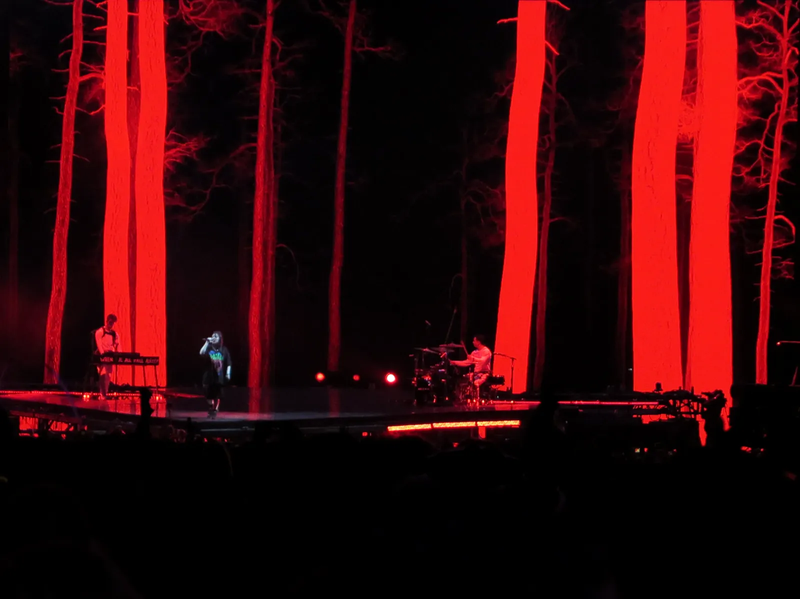
Foto: AtticBrat, CC BY-SA 4.0, vía Wikimedia Commons
This is how it sounded live in 2019, at the Coachella festival: three people on a huge stage. Billie sings, Finneas plays keyboard and there is a drummer at the back. Nothing else is needed.
The song reached number 1 in the United States. In doing so it ended a record run: "Old Town Road", by Lil Nas X, had been at the top for 19 weeks in a row. In 2020 it won the two biggest Grammys a song can win.
Musical characteristics
Almost nothing. Listen to the start: a bass, a kick drum and some finger snaps. That is all. The snaps are recorded very close and very loud, so they sound like a drum hit. When only a few instruments play, each one is very clear.
The bass is in charge. In most songs the bass stays underneath, holding things up. Here it is at the front. It plays a short pattern of notes that repeats again and again. That is called a riff: a short phrase that repeats and that you recognise at once.
A voice that almost speaks. Billie does not shout or hold long notes. She whispers, as if telling you a secret. In the chorus she almost talks. That is why anyone can sing this song: you do not need to reach difficult notes.
Three slightly scary chords. The song turns around three chords. The first two are minor and sound dark. The third changes one note, and that note pulls hard back to the first chord, like a magnet. That third chord is called the dominant: it wants to go home. This series is called a chord progression, and its name is i–iv–V7.
The "duh". After the chorus, Billie says "duh". Right after it, the cartoon-like synth riff comes in. That is the moment everybody remembers.
A second song inside. Near the end, everything changes. The beat slows down and the sound becomes darker and lower. It is as if another song had started. A change like this is a tempo change.
A warning for when you play. The record is in G minor: Gm–Cm–D7. In class you play it in A minor, Am–Dm–E7, one tone higher, because those chords are much easier on the ukulele. Moving a whole song to another pitch is called transposing.
Hard facts: G minor on the record and A minor in class, 4/4, 135 beats per minute in the first part and slower in the second, 3:14. The form: a fast song with verse, chorus and the "duh", then a slow final section.
Guided listening
Play the music video. At the start, count how many different sounds you hear. Do you get to five?
When she starts singing, focus on the bass. Hum it. That is the riff you will play on ukebass and xylophone.
When the "duh" arrives, listen to what comes right after it. It is another riff, this time on synth. Compare it with the bass riff: which one is higher?
Now wait for the final section. Tap the beat with your hand before and after the change. Does your hand go faster or slower?
Trivia and curiosities
- One of the sounds in the song is not an instrument: the beeping of a pedestrian crossing in Sydney. Billie recorded it on her phone in 2017. Any sound can end up in a song.
- There is a version with Justin Bieber, from July 2019. The chords are the same; only the singers change.
- Billie wrote the song at 16 or 17, and her brother produced it. The whole album was a family job.
- "Bad Guy" and "Bella ciao", which many of you know from the series "Money Heist", share the three chords. Try it: play Am–Dm–E7 and sing one song and then the other on top.
Classroom activities
- Snaps and voice. No instruments: half the class snaps on beats 2 and 4, the other half says the half-spoken verse. Then everyone says "duh" together.
- The riff. Ukebass and xylophone: learn the bass riff and repeat it non-stop while the others listen. When it works, someone says the verse on top.
- The three chords. Ukulele: Am, Dm, E7, one chord per bar. Notice E7: what does it ask you to do next?
- Two songs, one place. Play Am–Dm–E7 and sing a bit of "Bad Guy" and then a bit of "Bella ciao". Do both fit? Answer yes or no.
- Record it. In the music room, with the band: ukebass on the riff, dry drums, keyboard on the "duh". Record it and listen back next lesson.
Key vocabulary
- Riff — riff: frase corta que se repite
- Dominant — dominante: el acorde que tira hacia el primero
- Chord progression — progresión de acordes
- Tempo change — cambio de tempo
- Transposing — transportar: pasar la canción entera a otra altura
Resources
Official music video — From Billie Eilish's channel. Directed by Dave Meyers.
Ukulele tutorial — Bernadette Teaches Music. Chords and strumming, slowly.
Guitar tutorial — Marty Music. The riff and the chords.
Keyboard tutorial — Bitesize Piano. An easy version.
Drum tutorial — MusoverseDrums. How to play the song's beat.
Por qué está en este libro
«Bad Guy» es la canción de marzo, y llega a la vez que «Bella ciao». Las dos usan los mismos tres acordes, la menor, re menor y mi siete, aunque una es del siglo XX y la otra del XXI. Así se ve que una progresión es un lugar al que pueden ir muchas canciones, no una canción. Aquí además el bajo es la canción: un riff de tres notas que tocan el ukebajo y el xilófono. En tu aula, sin instrumentos, cantáis el verso medio hablado, que no deja a nadie fuera, y el coro hace el «duh» hablado. Con el ukelele tocáis Am–Dm–E7. En el aula de música, el ukebajo lleva el riff, la batería toca seca y el teclado hace el «duh». Al final del trimestre la grabáis.
Por dónde entrar
Si has jugado a Plants vs. Zombies, esta canción te va a sonar de algo. Billie Eilish ha contado que la música de ese videojuego fue una de sus ideas de partida. La otra fue la sintonía de una serie de Disney, «Los magos de Waverly Place».
De ahí sale el aire de dibujo animado que tiene el riff de sintetizador. Es una canción que da un poco de miedo y un poco de risa a la vez.
La pregunta de esta página es: ¿cuántos instrumentos hacen falta para llegar al número 1? La respuesta es: muy pocos.
Contexto histórico
Billie Eilish nació en Los Ángeles en 2001. Graba sus canciones con su hermano mayor, Finneas O'Connell, que las produce. Empezaron en casa, sin un gran estudio.
«Bad Guy» salió el 29 de marzo de 2019, el mismo día que su primer disco largo. Billie tenía 17 años. La escribieron entre los dos hermanos.
Foto: AtticBrat, CC BY-SA 4.0, vía Wikimedia Commons
Así sonaba en directo en 2019, en el festival de Coachella: tres personas en un escenario enorme. Billie canta, Finneas toca el teclado y detrás hay un batería. No hace falta más.
La canción llegó al número 1 en Estados Unidos. Al hacerlo, cortó un récord: «Old Town Road», de Lil Nas X, llevaba 19 semanas seguidas en lo más alto. En 2020 ganó los dos Grammy más importantes a una canción.
Cómo suena
Casi nada. Escucha el principio: un bajo, un bombo y unos chasquidos de dedos. Nada más. Los chasquidos están grabados muy cerca y muy fuertes, para que suenen como un golpe de batería. Cuando suenan pocos instrumentos, cada uno se oye muy claro.
El bajo manda. En casi todas las canciones el bajo va por debajo, sosteniendo. Aquí está delante. Es un dibujo corto de notas que se repite una y otra vez. A eso se le llama riff: una frase corta que se repite y que reconoces enseguida.
Una voz que casi habla. Billie no grita ni hace notas largas. Susurra, como si te contara un secreto. En el estribillo casi habla. Por eso esta canción la puede cantar cualquiera: no hace falta llegar a notas difíciles.
Tres acordes que dan un poco de miedo. La canción gira sobre tres acordes. Los dos primeros son menores y suenan oscuros. El tercero cambia una nota, y esa nota tira con fuerza hacia el primero, como un imán. Ese tercer acorde se llama dominante: es el que pide volver a casa. A esta serie se la llama progresión de acordes, y su nombre es i–iv–V7.
El «duh». Después del estribillo, Billie dice «duh» (algo así como «pues claro»). Justo después entra el riff de sintetizador con aire de dibujo animado. Es el momento que todo el mundo recuerda.
Una segunda canción dentro. Hacia el final, todo cambia. El ritmo se vuelve más lento y el sonido más oscuro y grave. Es como si empezara otra canción. Un cambio así se llama cambio de tempo.
Un aviso para cuando toques. El disco está en sol menor: Gm–Cm–D7. En clase lo tocáis en la menor, Am–Dm–E7, un tono más agudo, porque en ukelele esos acordes son mucho más fáciles. Pasar una canción a otra altura se llama transportar.
Datos duros: sol menor en el disco y la menor en clase, 4/4, 135 pulsos por minuto en la primera parte y más lento en la segunda, 3:14. La forma: una canción rápida con verso, estribillo y el «duh», y después una parte final lenta.
Escucha guiada
Pon el videoclip. Al principio, cuenta cuántos sonidos distintos oyes. ¿Llegas a cinco?
Cuando empiece a cantar, fíjate en el bajo. Tararéalo. Es el riff que vais a tocar con el ukebajo y el xilófono.
Cuando llegue el «duh», escucha lo que entra justo detrás. Es otro riff, ahora de sintetizador. Compáralo con el del bajo: ¿cuál es más agudo?
Ahora espera a la parte final. Marca el pulso con la mano antes y después del cambio. ¿Tu mano va más rápida o más lenta?
Curiosidades
- Entre los sonidos de la canción hay uno que no es un instrumento: el pitido de un semáforo de peatones de Sídney. Billie lo grabó con el móvil en 2017. Cualquier sonido puede acabar en una canción.
- Hay una versión con Justin Bieber, de julio de 2019. Los acordes son los mismos; cambia quién canta.
- Billie compuso la canción con 16 o 17 años, y la produjo su hermano. El disco entero se hizo en familia.
- «Bad Guy» y «Bella ciao», la canción que muchos conocéis por la serie «La casa de papel», comparten los tres acordes. Pruébalo: toca Am–Dm–E7 y canta encima una y luego la otra.
Para hacer en clase
- Chasquidos y voz. Sin instrumentos: media clase hace los chasquidos en el pulso 2 y 4, la otra media dice el verso medio hablado. Después, todos a la vez el «duh».
- El riff. Ukebajo y xilófono: aprended el riff del bajo y repetidlo sin parar mientras el resto escucha. Cuando salga, que alguien diga el verso encima.
- Los tres acordes. Ukelele: Am, Dm, E7, un acorde por compás. Fijaos en el E7: ¿qué os pide hacer después?
- Dos canciones, un lugar. Tocad Am–Dm–E7 y cantad encima un trozo de «Bad Guy» y luego un trozo de «Bella ciao». ¿Encajan las dos? Contestad sí o no.
- Grabar. En el aula de música, con la banda: ukebajo con el riff, batería seca, teclado con el «duh». Grabadlo y escuchadlo en la sesión siguiente.
Vocabulario fundamental
- Riff — Una frase corta que se repite y que reconoces enseguida. Aquí, el dibujo del bajo.
- Dominante — El acorde que tira hacia el primero, como un imán. Aquí, E7 en clase y D7 en el disco.
- Progresión de acordes — Una serie de acordes que se repite en el mismo orden. Aquí, i–iv–V7.
- Cambio de tempo — Cuando la canción pasa a ir más rápida o más lenta.
- Transportar — Pasar una canción entera a otra altura sin cambiar nada más.
Recursos
Videoclip oficial — Del canal de Billie Eilish. Dirigido por Dave Meyers.
Tutorial de ukelele — Bernadette Teaches Music. Los acordes y el rasgueo, despacio.
Tutorial de guitarra — Marty Music. El riff y los acordes.
Tutorial de teclado — Bitesize Piano. Versión fácil.
Tutorial de batería — MusoverseDrums. Cómo tocar el ritmo de la canción.
Why it's in this book
"Bad Guy" is the March song, and it comes together with "Bella ciao". Both use the same three chords, A minor, D minor and E7, even though one belongs to the 20th century and the other to the 21st. That shows that a progression is a place many songs can visit, not a song. Here the bass is the song: a three-note riff played by the ukebass and the xylophone. In your classroom with no instruments, you sing the half-spoken verse, which leaves nobody out, and the choir says "duh". With ukuleles you play Am–Dm–E7. In the music room, the ukebass plays the riff, the drums stay dry and the keyboard does the "duh". At the end of the term you record it.
Why this song
If you have played Plants vs. Zombies, this song may ring a bell. Billie Eilish has said the music from that video game was one of her starting points. The other was the theme song of a Disney series, "Wizards of Waverly Place".
That is where the cartoon feel of the synth riff comes from. The song is a little scary and a little funny at the same time.
The question on this page is: how many instruments does it take to reach number 1? The answer: very few.
Historical context
Billie Eilish was born in Los Angeles in 2001. She records her songs with her older brother, Finneas O'Connell, who produces them. They started at home, without a big studio.
"Bad Guy" came out on 29 March 2019, the same day as her first full album. Billie was 17. The two siblings wrote it together.
Foto: AtticBrat, CC BY-SA 4.0, vía Wikimedia Commons
This is how it sounded live in 2019, at the Coachella festival: three people on a huge stage. Billie sings, Finneas plays keyboard and there is a drummer at the back. Nothing else is needed.
The song reached number 1 in the United States. In doing so it ended a record run: "Old Town Road", by Lil Nas X, had been at the top for 19 weeks in a row. In 2020 it won the two biggest Grammys a song can win.
Musical characteristics
Almost nothing. Listen to the start: a bass, a kick drum and some finger snaps. That is all. The snaps are recorded very close and very loud, so they sound like a drum hit. When only a few instruments play, each one is very clear.
The bass is in charge. In most songs the bass stays underneath, holding things up. Here it is at the front. It plays a short pattern of notes that repeats again and again. That is called a riff: a short phrase that repeats and that you recognise at once.
A voice that almost speaks. Billie does not shout or hold long notes. She whispers, as if telling you a secret. In the chorus she almost talks. That is why anyone can sing this song: you do not need to reach difficult notes.
Three slightly scary chords. The song turns around three chords. The first two are minor and sound dark. The third changes one note, and that note pulls hard back to the first chord, like a magnet. That third chord is called the dominant: it wants to go home. This series is called a chord progression, and its name is i–iv–V7.
The "duh". After the chorus, Billie says "duh". Right after it, the cartoon-like synth riff comes in. That is the moment everybody remembers.
A second song inside. Near the end, everything changes. The beat slows down and the sound becomes darker and lower. It is as if another song had started. A change like this is a tempo change.
A warning for when you play. The record is in G minor: Gm–Cm–D7. In class you play it in A minor, Am–Dm–E7, one tone higher, because those chords are much easier on the ukulele. Moving a whole song to another pitch is called transposing.
Hard facts: G minor on the record and A minor in class, 4/4, 135 beats per minute in the first part and slower in the second, 3:14. The form: a fast song with verse, chorus and the "duh", then a slow final section.
Guided listening
Play the music video. At the start, count how many different sounds you hear. Do you get to five?
When she starts singing, focus on the bass. Hum it. That is the riff you will play on ukebass and xylophone.
When the "duh" arrives, listen to what comes right after it. It is another riff, this time on synth. Compare it with the bass riff: which one is higher?
Now wait for the final section. Tap the beat with your hand before and after the change. Does your hand go faster or slower?
Trivia and curiosities
- One of the sounds in the song is not an instrument: the beeping of a pedestrian crossing in Sydney. Billie recorded it on her phone in 2017. Any sound can end up in a song.
- There is a version with Justin Bieber, from July 2019. The chords are the same; only the singers change.
- Billie wrote the song at 16 or 17, and her brother produced it. The whole album was a family job.
- "Bad Guy" and "Bella ciao", which many of you know from the series "Money Heist", share the three chords. Try it: play Am–Dm–E7 and sing one song and then the other on top.
Classroom activities
- Snaps and voice. No instruments: half the class snaps on beats 2 and 4, the other half says the half-spoken verse. Then everyone says "duh" together.
- The riff. Ukebass and xylophone: learn the bass riff and repeat it non-stop while the others listen. When it works, someone says the verse on top.
- The three chords. Ukulele: Am, Dm, E7, one chord per bar. Notice E7: what does it ask you to do next?
- Two songs, one place. Play Am–Dm–E7 and sing a bit of "Bad Guy" and then a bit of "Bella ciao". Do both fit? Answer yes or no.
- Record it. In the music room, with the band: ukebass on the riff, dry drums, keyboard on the "duh". Record it and listen back next lesson.
Key vocabulary
- Riff — riff: frase corta que se repite
- Dominant — dominante: el acorde que tira hacia el primero
- Chord progression — progresión de acordes
- Tempo change — cambio de tempo
- Transposing — transportar: pasar la canción entera a otra altura
Resources
Official music video — From Billie Eilish's channel. Directed by Dave Meyers.
Ukulele tutorial — Bernadette Teaches Music. Chords and strumming, slowly.
Guitar tutorial — Marty Music. The riff and the chords.
Keyboard tutorial — Bitesize Piano. An easy version.
Drum tutorial — MusoverseDrums. How to play the song's beat.