Contenidos
¿Por qué todo el mundo da la palmada en el mismo sitio?
Put a song on in a school yard with fifty people in it and nearly all of them will clap in the same place. Nobody told them where. This unit is about that place, about who put it there, and about when it reached Spain.
We ask ourselves
- When a whole class claps, why does everybody land together?
- Where is the strong beat of a song: where your feet go, or where your hands go?
- Can you clap somewhere else and have the song survive it?
- Why do so many rock songs use the same three chords in the same order?
- What is a drummer doing when it looks like they are doing nothing?
- Why does music recorded sixty years ago still lift a whole arena?
Don't answer yet. We come back to these at the end.
The fragment
Before we play anything, we build it with the body. Count out loud — one, two, three, four — and start again, without speeding up.
- Feet mark all four numbers. That is the pulse and it never stops.
- Hands clap on one and on three.
That comes out by itself, because it is what a march does. Now move the clap one number to the right: two and four. The feet carry on unchanged. You will get it wrong, and so will the whole class, for a good while.
When it finally holds, you notice something else. With the clap on one and three the body marches. With the clap on two and four the body sways. Same pulse, same hands.
Now play Chain of Fools, all of it, with nobody talking over it.
What changed
What you just heard is a drummer who never moves for the whole song, which lasts under three minutes. The drummer, Roger Hawkins, puts the kick on one and three, and the snare on two and four. Nothing else. And nothing else is needed.
For centuries, in the music that was written down in Europe, the weight fell on the one. A bar of four was explained as strong, weak, medium, weak: beats 2 and 4 were the weak beats, the filler. That logic marches well, because the foot lands where the accent lands.
African American music in the twentieth century moved the hit onto the beats that were left over. That hit on two and four is called the backbeat, and it is the commonest case of a wider idea, syncopation: putting the accent where the ear is not expecting one.
It did not arrive all at once. For years it was a climax device: in Dixieland jazz it was saved for the last chorus, the shout chorus, when the band leaned in to finish. Earl Palmer, a drummer from New Orleans, said that is exactly where he took it from.
What Palmer did was strip out the ending. He put it in from the first bar to the last, always the same, always in the same spot. It stopped being a shove and became the floor everything else stands on.
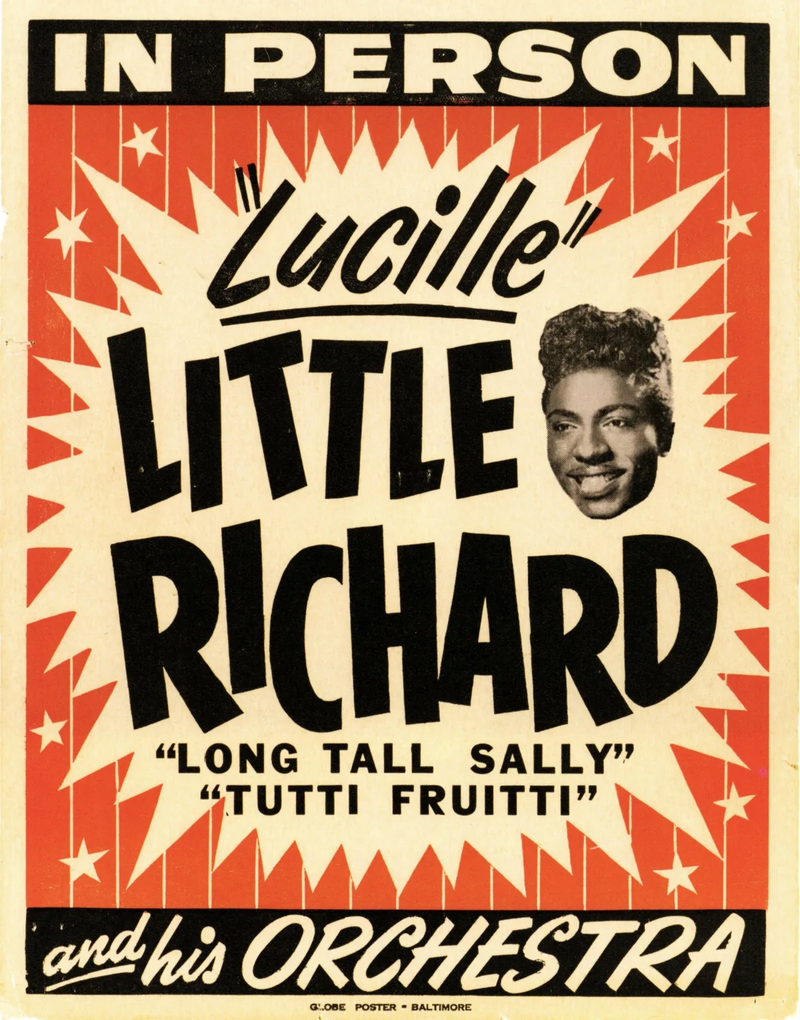
Globe Poster, Baltimore, 1950s. Public domain, via Wikimedia Commons
The other half of the invention is the frame: the twelve-bar blues. Twelve bars over three chords, then round again. With those two things — a hit that never moves and a loop everyone knows — you can play with people you have never met, with no sheet music in front of you.
And here is my own verdict: the frame wore out and the hit did not. Repeating those twelve bars with nothing new on top, by the mid sixties they already sounded like a formula. The backbeat is intact sixty years later.
The three songs in this unit prove it, and not one of them is a blues. Chain of Fools has one chord. Sweet Home Alabama has three, but not the blues ones and not in that order. We Will Rock You has no instruments at all for most of its length. In all three, the hit lands on two and four.
Hard facts. Clapping on the weak beat as early as "Roll 'Em Pete", Pete Johnson and Big Joe Turner, 1938. Backbeat marked from start to finish in "Good Rockin' Tonight", Wynonie Harris, 1948; Earl Palmer claimed "The Fat Man", Fats Domino, 1949 for himself.
"Lucille" was recorded on 30 July 1956 at J&M Studios in New Orleans and released in February 1957 on Specialty, with Palmer on drums. The twelve-bar blues is twelve bars over the first, fourth and fifth degrees of the scale.
The same device elsewhere
The backbeat is not only a rock thing, and you do not need a drum kit for it to exist. Three places where the hit also lands off the strong beat, and they are worth hearing back to back:
- Uptown Funk (2015) — the clap never moves off two and four. Everything else is deliberately off the beat, and you only notice because that clap is nailed down. It is in the library.
- Chopin's mazurkas — a bar of three, with the strong accents placed on the second or third beat instead of the first, and with no fixed order. Chopin wrote fifty-nine of them, between 1824 and 1849.
- Samba from Rio de Janeiro — the surdo de marcação, the deepest drum in the section, sounds on the second beat of the basic "one, two". Everything above it hangs off that second hit.
Samba and funk share an African root. The mazurka has nothing to do with either. And all three find the same thing: the body answers better when the hit does not land where it was due.
And here at home?
While Earl Palmer was recording "Lucille" in New Orleans, nothing like it was on Spanish radio. Rock and roll did not come in here through the broadcasters: it came in through a foreign military base.
The Madrid Pacts of 1953 brought three United States Air Force bases to Spain: Torrejón, Morón and Zaragoza. Zaragoza Air Base was USAF from 1958 to 1992. The records arrived with the airmen, and the first Spanish rockers arrived with the records.
The best known was called Rocky Kan, and he worked there. He put it like this: "It all started in 1960, more or less. On the base, since I had good English and listened to people like Elvis Presley and Paul Anka, I caught the bug." The press of the day called him Spain's "first rock and roller".
Alongside him were Baby, Gavy Sender's and Chico Valento. Zaragoza was an odd case: here rock came out as a solo singer, while in Madrid, Barcelona or Valencia the norm was bands. Around those same years the two members of Dúo Dinámico were doing military service in the city.
They made their names on Plataforma de Estrellas, a Sunday-morning contest held at the Teatro Fleta, and at the summer Festivales de Arte in the Jardín de Invierno.
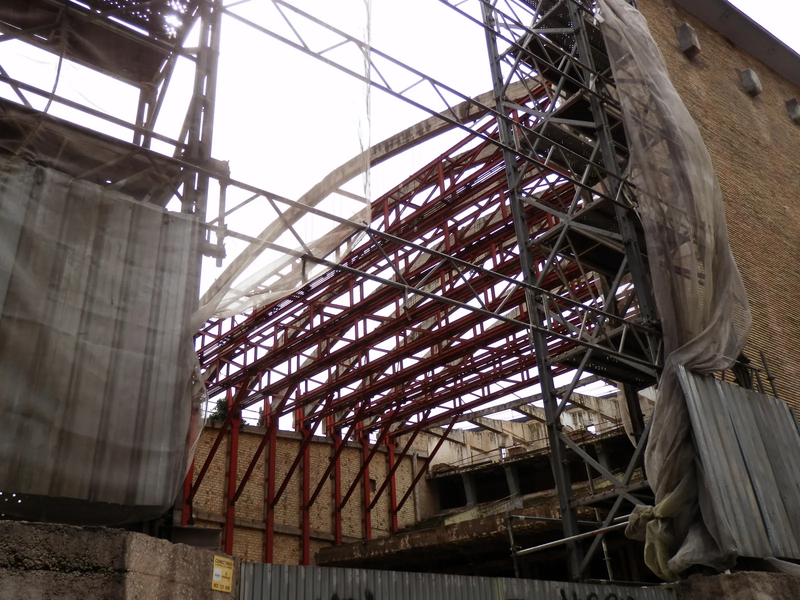
Foto: Jzh2074, CC BY-SA 4.0, vía Wikimedia Commons
Cinema did the rest. King Creole, the Elvis film, is from 1958 and opened in Zaragoza in 1961.
Now count the years, because this is the uncomfortable part. "Lucille" comes out in 1957. Rocky Kan starts "in 1960, more or less". The Elvis film arrives three years late. The backbeat landed here about five years behind, through the back door, and no Spanish station brought it.
Classroom activities
- While Chain of Fools plays: the whole class claps on two and four from the first guitar, before the drums come in. Count how many bars go by until the snare agrees with you.
- While Sweet Home Alabama plays: half the class claps only on two, the other half only on four. Nobody does both. The first slip is audible.
- While We Will Rock You plays: one group does the two stomps, another does the clap. The hands group is playing the backbeat with no drums and no instruments.
- Play: we build Chain of Fools with the band. One chord, and the drums do exactly what this unit is about. The full-band chart and the tab are attached to its own article. Anyone who wants more chords can go to Sweet Home Alabama, which has them.
- Find an exception: everyone brings a song of their own. While it plays, the class claps on two and four. The one that resists is the interesting one.
Key vocabulary
- Weak beat — parte débil: los tiempos 2 y 4 del compás de cuatro
- Backbeat — el golpe en los tiempos 2 y 4, donde la gente da palmas sola
- Syncopation — síncopa: poner el acento donde el oído no lo espera
- Shout chorus — el último estribillo del jazz de Dixieland, de donde salió el backbeat
- Twelve-bar blues — blues de doce compases: doce compases sobre tres acordes
Resources
The songs in this unit are in the library, each with its own article, full-band chart and tab: Chain of Fools, Sweet Home Alabama, We Will Rock You.
The song the unit opens with — Chain of Fools, Aretha Franklin (1967). Its article, with the full-band chart and the tab, is in the library.
The backbeat with nothing on top — Sweet Home Alabama, Lynyrd Skynyrd (1974), also in the library.
The backbeat with no drum kit — We Will Rock You, Queen (1977), also in the library.
Where the hit stops moving — "Lucille", Little Richard (1957), with Earl Palmer on drums.
The accent out of place, on a piano — Chopin's Mazurka Op. 7 No. 1, played by Krzysztof Książek, on the Chopin Institute channel.
The second beat in charge — the drum section of the Mangueira samba school, live. Listen for the deepest drum.
Spain's first rock and roller — Rocky Kan sings "Dixieland Rock" and "King Creole".
- The same hit in current pop — "Uptown Funk", Mark Ronson and Bruno Mars (2015), in the library.
- Where all this comes from — "Pioneers of Rock and Roll: Little Richard, Elvis Presley and Chuck Berry", in the library.
- The companion unit — "Who is playing the drums on this song?", on the drum machine, in the library.
Nos preguntamos
- Cuando una clase entera da palmas, ¿por qué coincide casi siempre?
- ¿Dónde está el golpe fuerte de una canción: donde pisas o donde palmeas?
- ¿Se puede dar la palmada en otro sitio y que la canción aguante?
- ¿Por qué tantas canciones de rock usan los mismos tres acordes en el mismo orden?
- ¿Qué está haciendo un batería cuando parece que no hace nada?
- ¿Por qué una música grabada hace sesenta años todavía levanta un pabellón entero?
No las respondas todavía. Al final de la unidad volvemos a ellas.
El fragmento
Antes de poner nada, lo montamos con el cuerpo. Se cuenta en voz alta —uno, dos, tres, cuatro— y se vuelve a empezar, sin acelerar.
- Los pies marcan los cuatro números. Ese es el pulso y no para nunca.
- Las manos dan una palmada en el uno y otra en el tres.
Eso sale solo, porque es lo que hace una marcha. Ahora mueve la palmada un número a la derecha: dos y cuatro. Los pies siguen igual. Vas a fallar, y la clase entera contigo, durante un buen rato.
Cuando por fin se sostiene, se nota otra cosa. Con la palmada en uno y tres el cuerpo desfila. Con la palmada en dos y cuatro el cuerpo se balancea. Es el mismo pulso y son las mismas manos.
Ahora sí, Chain of Fools entera y sin comentar por encima.
Qué cambió
Lo que acabas de oír es una batería que no se mueve del sitio en los menos de tres minutos que dura la canción. El batería, Roger Hawkins, pone el bombo en el uno y el tres, y la caja en el dos y el cuatro. Nada más. Y es lo único que hace falta.
Durante siglos, en la música que se escribía en Europa, el peso caía en el uno. Un compás de cuatro se explicaba como fuerte, débil, semifuerte, débil: los tiempos 2 y 4 eran las partes débiles, las que rellenaban. Con esa lógica se marcha bien, porque el pie cae donde cae el acento.
La música afroamericana del siglo XX movió el golpe a las partes que sobraban. A ese golpe en el dos y el cuatro se le llama backbeat, y es el caso más repetido de una idea más general, la síncopa: poner el acento donde el oído no lo espera.
No apareció de golpe. Durante años fue un recurso de clímax: en el jazz de Dixieland se guardaba para el último estribillo, el shout chorus, cuando la banda apretaba para terminar. Earl Palmer, batería de Nueva Orleans, decía que lo sacó justo de ahí.
Lo que hizo Palmer fue quitarle el carácter de final. Lo puso desde el primer compás hasta el último, siempre igual, siempre en el mismo sitio. Dejó de ser un empujón y pasó a ser el suelo sobre el que se apoya todo lo demás.
Globe Poster, Baltimore, años cincuenta. Dominio público, vía Wikimedia Commons
La otra mitad del invento es el armazón: el blues de doce compases. Doce compases sobre tres acordes, y vuelta a empezar. Con esas dos cosas —un golpe que no se mueve y una vuelta que todos conocen— puedes tocar con gente a la que no has visto nunca y sin una sola partitura delante.
Y aquí va un juicio mío: el armazón se gastó y el golpe no. A base de repetir los doce compases sin nada nuevo encima, a mediados de los sesenta ya sonaban a fórmula. El backbeat sigue intacto sesenta años después.
Las tres canciones de esta unidad lo demuestran, y ninguna es un blues. Chain of Fools tiene un acorde. Sweet Home Alabama tiene tres, pero no son los del blues ni van en ese orden. We Will Rock You no tiene ni un instrumento durante casi toda la canción. En las tres, el golpe cae en dos y cuatro.
Datos duros. Palmas en la parte débil ya en «Roll 'Em Pete», de Pete Johnson y Big Joe Turner, 1938. Backbeat marcado de principio a fin en «Good Rockin' Tonight», de Wynonie Harris, 1948; Earl Palmer reclamaba para sí «The Fat Man», de Fats Domino, 1949.
«Lucille» se graba el 30 de julio de 1956 en los estudios J&M de Nueva Orleans y se publica en febrero de 1957 en Specialty, con Palmer a la batería. El blues de doce compases son doce compases sobre el primer, el cuarto y el quinto grado de la escala.
El mismo recurso en otros sitios
El backbeat no es solo cosa del rock, y no hace falta una batería para que exista. Tres sitios donde el golpe tampoco cae donde lo esperas, y conviene oírlos seguidos:
- Uptown Funk (2015) — la palmada no se mueve del dos y el cuatro en toda la canción. Todo lo demás va a destiempo a propósito, y solo se nota porque esa palmada está clavada. Está en la biblioteca.
- Las mazurcas de Chopin — compás de tres, y los acentos fuertes colocados en el segundo o el tercer tiempo en vez de en el primero, sin un orden fijo. Chopin escribió cincuenta y nueve, entre 1824 y 1849.
- La samba de Río de Janeiro — el surdo de marcação, el tambor más grave de la percusión de una escuela de samba, suena en el segundo tiempo del «uno, dos». Todo lo que va encima cuelga de ese segundo golpe.
La samba y el funk comparten raíz africana. La mazurca no tiene nada que ver con ninguna de las dos. Y las tres descubren lo mismo: que el cuerpo responde mejor cuando el golpe no cae donde tocaba.
Y aquí, ¿qué?
Mientras Earl Palmer grababa «Lucille» en Nueva Orleans, en la radio española no sonaba nada parecido. El rock and roll no entró aquí por las emisoras: entró por un recinto militar extranjero.
Los Pactos de Madrid de 1953 trajeron tres bases de la fuerza aérea estadounidense a España: Torrejón, Morón y Zaragoza. La base aérea de Zaragoza fue de la USAF desde 1958 hasta 1992. Con los soldados llegaron los discos, y con los discos, los primeros rockeros españoles.
El más conocido se llamaba Rocky Kan y trabajaba allí. Lo contó así: «Todo empezó en 1960, más o menos. En la base, como dominaba el inglés y escuchaba a gente como Elvis Presley y Paul Anka, me entró la afición». La prensa de entonces lo llamó «el primer rockanrollista» de España.
Con él estaban Baby, Gavy Sender's y Chico Valento. Zaragoza fue un caso raro: aquí el rock salió en forma de cantante solista, mientras en Madrid, Barcelona o Valencia lo normal eran los conjuntos. Por esos mismos años los dos del Dúo Dinámico hacían la mili en la ciudad.
Se daban a conocer en Plataforma de Estrellas, un concurso que se celebraba los domingos por la mañana en el Teatro Fleta, y en los Festivales de Arte del Jardín de Invierno.
Foto: Jzh2074, CC BY-SA 4.0, vía Wikimedia Commons
El cine hizo el resto. King Creole, la película de Elvis, es de 1958 y se estrenó en Zaragoza en 1961.
Ahora cuenta los años, porque es la parte incómoda. «Lucille» sale en 1957. Rocky Kan empieza «en 1960, más o menos». La película de Elvis llega con tres años de retraso. Aquí el backbeat aterrizó unos cinco años tarde y por la puerta de atrás, y no lo trajo ninguna emisora española.
Para hacer en clase
- Mientras suena Chain of Fools: toda la clase da palmas en dos y cuatro desde la primera guitarra, antes de que entre la batería. Cuenta cuántos compases pasan hasta que la caja os da la razón.
- Mientras suena Sweet Home Alabama: media clase palmea solo en el dos y la otra media solo en el cuatro. Nadie hace las dos. Al primer despiste se oye.
- Mientras suena We Will Rock You: un grupo hace las dos pisadas y otro la palmada. El grupo de las manos está tocando el backbeat sin batería y sin instrumentos.
- Tocar: montamos Chain of Fools con la banda. Tiene un solo acorde y la batería hace exactamente lo de esta unidad. El chart de banda y la tablatura están en su artículo. Quien quiera más acordes, que se vaya a Sweet Home Alabama, que también los trae.
- Buscar una excepción: cada uno trae una canción suya. Mientras suena, la clase da palmas en dos y cuatro. La que se resista es la interesante.
Vocabulario fundamental
- Parte débil — Los tiempos 2 y 4 del compás de cuatro. Se llaman así porque en la música escrita europea el peso caía en el 1 y el 3.
- Backbeat — El golpe en los tiempos 2 y 4. Es el sitio donde la gente da palmas sin que nadie se lo pida.
- Síncopa — Poner el acento donde el oído no lo espera. El backbeat es el caso más repetido de la música popular.
- Shout chorus — El último estribillo del jazz de Dixieland, donde la banda apretaba para terminar. De ahí salió el backbeat antes de ocupar la canción entera.
- Blues de doce compases — Un armazón de doce compases sobre tres acordes, que se repite igual. Sobre él se montó casi todo el rock and roll.
Recursos
Las canciones de esta unidad están en la biblioteca, cada una con su artículo, su chart de banda y su tablatura: Chain of Fools, Sweet Home Alabama, We Will Rock You.
La canción con la que se abre la unidad — Chain of Fools, Aretha Franklin (1967). Su artículo, con el chart de banda y la tablatura, está en la biblioteca.
El backbeat sin adornos — Sweet Home Alabama, Lynyrd Skynyrd (1974), también en la biblioteca.
El backbeat sin batería — We Will Rock You, Queen (1977), también en la biblioteca.
Donde el golpe ya no se mueve — «Lucille», Little Richard (1957), con Earl Palmer a la batería.
El acento fuera de sitio en un piano — mazurca op. 7 n.º 1 de Chopin, por Krzysztof Książek, en el canal del Instituto Chopin.
El segundo tiempo mandando — la batería de la escuela de samba Mangueira, en directo. Busca el tambor más grave.
El primer rockanrollista de España — Rocky Kan canta «Dixieland Rock» y «King Creole».
- El mismo golpe en pop de ahora — «Uptown Funk», Mark Ronson y Bruno Mars (2015), en la biblioteca.
- De dónde sale todo esto — «Pioneers of Rock and Roll: Little Richard, Elvis Presley and Chuck Berry», en la biblioteca.
- La unidad hermana — «¿Quién toca la batería en esta canción?», sobre la caja de ritmos, en la biblioteca.
We ask ourselves
- When a whole class claps, why does everybody land together?
- Where is the strong beat of a song: where your feet go, or where your hands go?
- Can you clap somewhere else and have the song survive it?
- Why do so many rock songs use the same three chords in the same order?
- What is a drummer doing when it looks like they are doing nothing?
- Why does music recorded sixty years ago still lift a whole arena?
Don't answer yet. We come back to these at the end.
The fragment
Before we play anything, we build it with the body. Count out loud — one, two, three, four — and start again, without speeding up.
- Feet mark all four numbers. That is the pulse and it never stops.
- Hands clap on one and on three.
That comes out by itself, because it is what a march does. Now move the clap one number to the right: two and four. The feet carry on unchanged. You will get it wrong, and so will the whole class, for a good while.
When it finally holds, you notice something else. With the clap on one and three the body marches. With the clap on two and four the body sways. Same pulse, same hands.
Now play Chain of Fools, all of it, with nobody talking over it.
What changed
What you just heard is a drummer who never moves for the whole song, which lasts under three minutes. The drummer, Roger Hawkins, puts the kick on one and three, and the snare on two and four. Nothing else. And nothing else is needed.
For centuries, in the music that was written down in Europe, the weight fell on the one. A bar of four was explained as strong, weak, medium, weak: beats 2 and 4 were the weak beats, the filler. That logic marches well, because the foot lands where the accent lands.
African American music in the twentieth century moved the hit onto the beats that were left over. That hit on two and four is called the backbeat, and it is the commonest case of a wider idea, syncopation: putting the accent where the ear is not expecting one.
It did not arrive all at once. For years it was a climax device: in Dixieland jazz it was saved for the last chorus, the shout chorus, when the band leaned in to finish. Earl Palmer, a drummer from New Orleans, said that is exactly where he took it from.
What Palmer did was strip out the ending. He put it in from the first bar to the last, always the same, always in the same spot. It stopped being a shove and became the floor everything else stands on.
Globe Poster, Baltimore, 1950s. Public domain, via Wikimedia Commons
The other half of the invention is the frame: the twelve-bar blues. Twelve bars over three chords, then round again. With those two things — a hit that never moves and a loop everyone knows — you can play with people you have never met, with no sheet music in front of you.
And here is my own verdict: the frame wore out and the hit did not. Repeating those twelve bars with nothing new on top, by the mid sixties they already sounded like a formula. The backbeat is intact sixty years later.
The three songs in this unit prove it, and not one of them is a blues. Chain of Fools has one chord. Sweet Home Alabama has three, but not the blues ones and not in that order. We Will Rock You has no instruments at all for most of its length. In all three, the hit lands on two and four.
Hard facts. Clapping on the weak beat as early as "Roll 'Em Pete", Pete Johnson and Big Joe Turner, 1938. Backbeat marked from start to finish in "Good Rockin' Tonight", Wynonie Harris, 1948; Earl Palmer claimed "The Fat Man", Fats Domino, 1949 for himself.
"Lucille" was recorded on 30 July 1956 at J&M Studios in New Orleans and released in February 1957 on Specialty, with Palmer on drums. The twelve-bar blues is twelve bars over the first, fourth and fifth degrees of the scale.
The same device elsewhere
The backbeat is not only a rock thing, and you do not need a drum kit for it to exist. Three places where the hit also lands off the strong beat, and they are worth hearing back to back:
- Uptown Funk (2015) — the clap never moves off two and four. Everything else is deliberately off the beat, and you only notice because that clap is nailed down. It is in the library.
- Chopin's mazurkas — a bar of three, with the strong accents placed on the second or third beat instead of the first, and with no fixed order. Chopin wrote fifty-nine of them, between 1824 and 1849.
- Samba from Rio de Janeiro — the surdo de marcação, the deepest drum in the section, sounds on the second beat of the basic "one, two". Everything above it hangs off that second hit.
Samba and funk share an African root. The mazurka has nothing to do with either. And all three find the same thing: the body answers better when the hit does not land where it was due.
And here at home?
While Earl Palmer was recording "Lucille" in New Orleans, nothing like it was on Spanish radio. Rock and roll did not come in here through the broadcasters: it came in through a foreign military base.
The Madrid Pacts of 1953 brought three United States Air Force bases to Spain: Torrejón, Morón and Zaragoza. Zaragoza Air Base was USAF from 1958 to 1992. The records arrived with the airmen, and the first Spanish rockers arrived with the records.
The best known was called Rocky Kan, and he worked there. He put it like this: "It all started in 1960, more or less. On the base, since I had good English and listened to people like Elvis Presley and Paul Anka, I caught the bug." The press of the day called him Spain's "first rock and roller".
Alongside him were Baby, Gavy Sender's and Chico Valento. Zaragoza was an odd case: here rock came out as a solo singer, while in Madrid, Barcelona or Valencia the norm was bands. Around those same years the two members of Dúo Dinámico were doing military service in the city.
They made their names on Plataforma de Estrellas, a Sunday-morning contest held at the Teatro Fleta, and at the summer Festivales de Arte in the Jardín de Invierno.
Foto: Jzh2074, CC BY-SA 4.0, vía Wikimedia Commons
Cinema did the rest. King Creole, the Elvis film, is from 1958 and opened in Zaragoza in 1961.
Now count the years, because this is the uncomfortable part. "Lucille" comes out in 1957. Rocky Kan starts "in 1960, more or less". The Elvis film arrives three years late. The backbeat landed here about five years behind, through the back door, and no Spanish station brought it.
Classroom activities
- While Chain of Fools plays: the whole class claps on two and four from the first guitar, before the drums come in. Count how many bars go by until the snare agrees with you.
- While Sweet Home Alabama plays: half the class claps only on two, the other half only on four. Nobody does both. The first slip is audible.
- While We Will Rock You plays: one group does the two stomps, another does the clap. The hands group is playing the backbeat with no drums and no instruments.
- Play: we build Chain of Fools with the band. One chord, and the drums do exactly what this unit is about. The full-band chart and the tab are attached to its own article. Anyone who wants more chords can go to Sweet Home Alabama, which has them.
- Find an exception: everyone brings a song of their own. While it plays, the class claps on two and four. The one that resists is the interesting one.
Key vocabulary
- Weak beat — parte débil: los tiempos 2 y 4 del compás de cuatro
- Backbeat — el golpe en los tiempos 2 y 4, donde la gente da palmas sola
- Syncopation — síncopa: poner el acento donde el oído no lo espera
- Shout chorus — el último estribillo del jazz de Dixieland, de donde salió el backbeat
- Twelve-bar blues — blues de doce compases: doce compases sobre tres acordes
Resources
The songs in this unit are in the library, each with its own article, full-band chart and tab: Chain of Fools, Sweet Home Alabama, We Will Rock You.
The song the unit opens with — Chain of Fools, Aretha Franklin (1967). Its article, with the full-band chart and the tab, is in the library.
The backbeat with nothing on top — Sweet Home Alabama, Lynyrd Skynyrd (1974), also in the library.
The backbeat with no drum kit — We Will Rock You, Queen (1977), also in the library.
Where the hit stops moving — "Lucille", Little Richard (1957), with Earl Palmer on drums.
The accent out of place, on a piano — Chopin's Mazurka Op. 7 No. 1, played by Krzysztof Książek, on the Chopin Institute channel.
The second beat in charge — the drum section of the Mangueira samba school, live. Listen for the deepest drum.
Spain's first rock and roller — Rocky Kan sings "Dixieland Rock" and "King Creole".
- The same hit in current pop — "Uptown Funk", Mark Ronson and Bruno Mars (2015), in the library.
- Where all this comes from — "Pioneers of Rock and Roll: Little Richard, Elvis Presley and Chuck Berry", in the library.
- The companion unit — "Who is playing the drums on this song?", on the drum machine, in the library.