Contenidos
¿Quién pagaba la música cuando nadie compraba entradas?
You can stream almost anything ever recorded. Of a thousand years of Greek and Roman music you can stream four lines, and even those come with a warning.
We ask ourselves
- If nobody recorded any of it, how can anyone say what it sounded like?
- Did anyone play just for pleasure, or was somebody always paying?
- What job did music do that nothing else could do?
- When you write a melody down, what gets written and what is left out?
- If two groups sing the same score and sound different, which one is wrong?
- Why does a bone instrument survive and a song does not?
Don't answer yet. We come back to these at the end.
The fragment
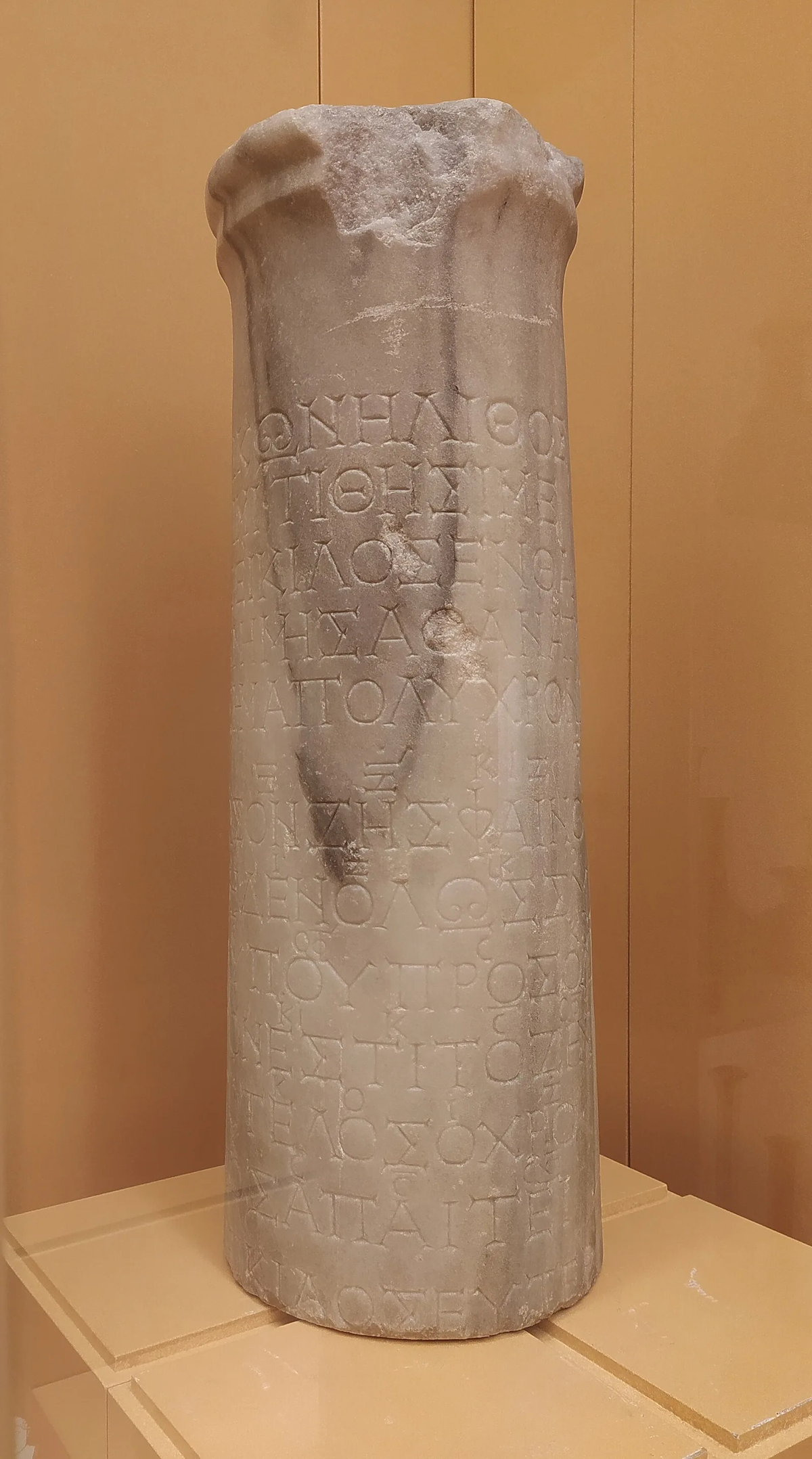
Four Greek lines do have music written above them. They are carved on a marble column about two thousand years old. We are going to sing them.
The text, with rough pronunciation and the meaning:
- Ὅσον ζῇς, φαίνου — hoson zes, phainou — While you live, shine
- μηδὲν ὅλως σὺ λυποῦ — meden holos su lupou — grieve over nothing
- πρὸς ὀλίγον ἐστὶ τὸ ζῆν — pros oligon esti to zen — life lasts a short while
- τὸ τέλος ὁ χρόνος ἀπαιτεῖ — to telos ho chronos apaitei — time claims its end
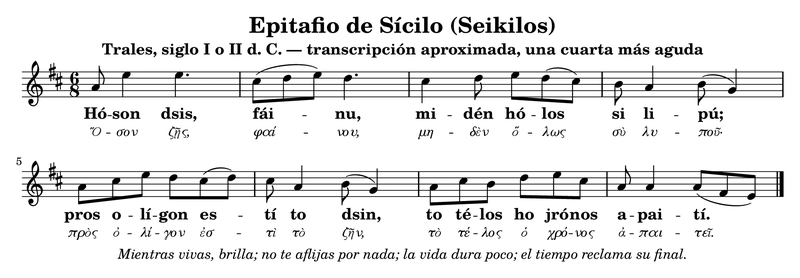
Score: modern transcription engraved for this unit; public-domain melody
First the rhythm of line one, clapped: one short clap, one worth two, one worth three. Then the pitches. On the syllables ho-son zes the melody goes A – E – E, jumping up a fifth straight away. On phai-nou it runs C♯ – D – E and lands on D.
Once that line works, sing all four in a row. The four lines last exactly the same. The whole melody fits inside one octave, E to E, and the last note of the piece is the low E, which never appears anywhere else.
Two honest warnings. The version we sing is written a fourth above what the Greek signs indicate, so an ordinary voice can reach it. And the speed does not come from the stone: it comes from whoever is singing.
What changed
Start with the money, which is the most useful question. In Athens the festival choruses were not paid for by the audience. They were paid for by a rich citizen whose turn it was. He was the choregos, and covering rehearsals, costumes and a room was a public duty, like a tax. If his chorus won, he got a bronze tripod and dedicated it to a god.
Outside the theatre, music was almost always working. At a sacrifice the aulos played while the animal was led to the altar. On a trireme an auletes gave the rowers the stroke, and he was crew, like the helmsman. At a banquet you hired whoever played and danced. At a burial you sang, which is exactly what we have just been doing.
Thucydides wrote the army case down when he described the battle of Mantinea in 418 BC. The Spartans advanced slowly to the music of many pipers, and he says what it was for: nothing to do with religion, but so that they would move evenly, in step, without breaking ranks. That is the clearest definition of function you will read, and an eyewitness wrote it.
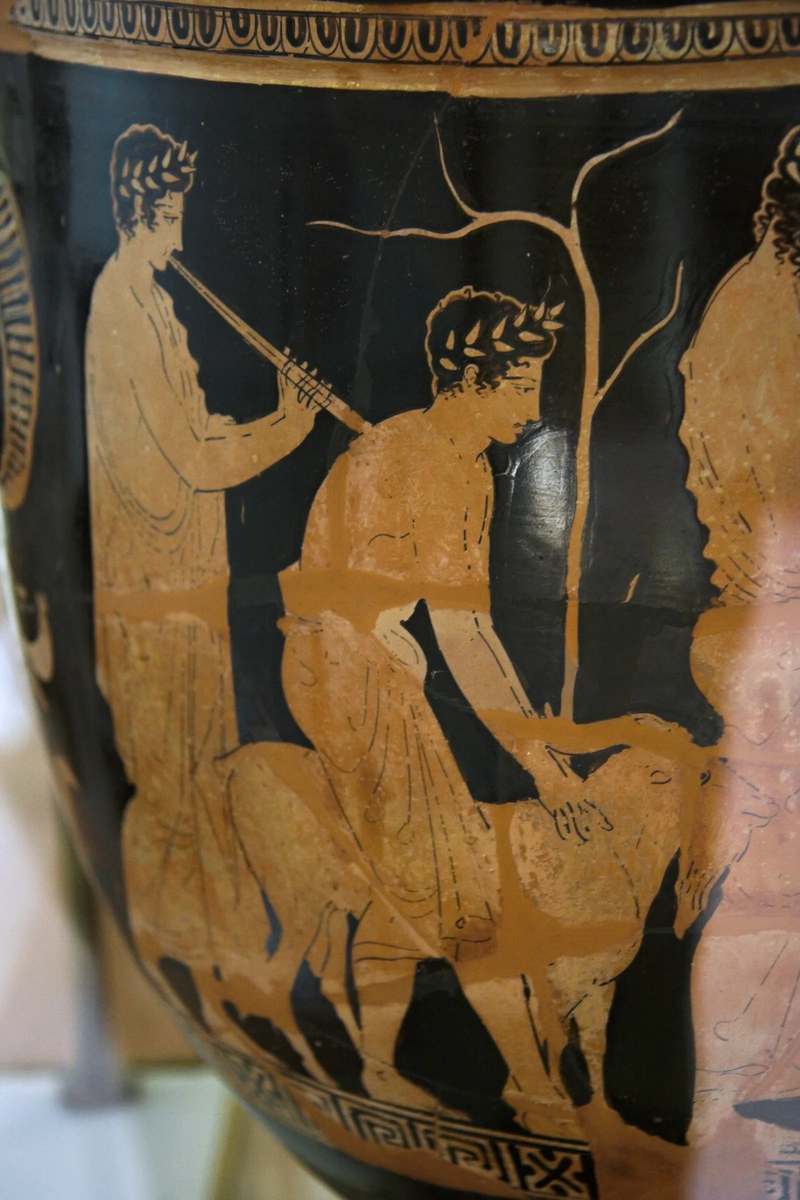
Foto: Zde, CC BY-SA 4.0, vía Wikimedia Commons
Then, at some point, somebody decided to write it down. That is what changed. The Greeks put letters above the syllables of the text, plus a dash or two to say how long each one lasted. That is enough to sing something again a thousand years later, which is why the Seikilos epitaph still exists.
Now look at what that system records and what it does not. A sound has four parameters: pitch, duration, intensity and timbre. Greek notation writes the first two and says nothing about the other two. Not how loud, not what with.
Test it by ear. Whistle the first four notes, then sing them: same pitch, same duration, a completely different timbre. The hook of I Ain't Worried is whistled; played on a guitar it would be the same notes and a different song.
That is the parameter no recording of the epitaph can take from the stone, because the stone does not carry it. Whoever records it chooses whether a woman sings it, whether a lyre doubles the line, whether it comes out loud or soft. Half of what you hear was decided ten years ago.
Objects behave the same way, and it is worth saying plainly. From a buried aulos you can measure the finger holes and work out approximate pitches. But what made the aulos sound was a double reed of cane, and cane is organic material that does not reach us: anyone rebuilding the instrument has to make one again by trial and error. The part that most defines a timbre is exactly the part that is missing.
There is a third route, which is looking. Greek pottery shows aulos players blowing; Roman mosaics show musicians holding a lyre. An image tells you how many were playing, how they held the instrument and what was going on around them. It tells you nothing about a single note.
Three hard facts, to keep at hand:
- Seikilos epitaph — marble from Tralles in present-day Turkey, first or second century AD. Found around 1883 during railway works; now in the National Museum of Denmark.
- Delphic hymns — two, carved on the wall of the Athenian Treasury at Delphi and found in 1893. The second, signed by Limenios, was performed in 128 BC.
- Hydraulis, the water organ — invented in Greece in the third century BC. The best-preserved example was found in Hungary in 1931 and carries an inscription dated 228 AD.
The same device elsewhere
The epitaph is a single vocal line, with no chords underneath, over a text that gives the orders. That is called monody, and it did not end with Rome. These three do the same job, and they are worth hearing back to back:
- We Will Rock You — for most of the song there is not one chord: voices, feet and hands. What holds it up is not the notes but the timbre and the force, which is precisely what nobody writes down.
- Gregorian chant — one line, in Latin, no harmony, no dynamics marked and no tempo written. A thousand years after the epitaph, the same unsolved problem.
- Vedic chanting from India — a repertoire carried by memory for around three thousand years without a single note written. UNESCO recognised it in 2008 as intangible heritage.
All three answer the same question differently. The Vedic case is the most interesting for us: if nobody writes anything, the only way to keep a music alive is for someone to repeat it exactly, for a lifetime, in front of someone else.
And here at home?
From Roman Zaragoza a whole building has survived. The theatre of Caesaraugusta was built in the first half of the first century, held about six thousand spectators and stood until the third century, when its stone started being carted off to build walls. It stayed lost under the city until a survey brought it back to light in 1972. You can visit it.
A floor has survived too. In the so-called House of Orpheus, a grand home from the end of the second century or the beginning of the third, the dining room measured seventy square metres and was paved with a mosaic nine metres by six: Orpheus playing, and the animals stopped to listen. It is in the Museo de Zaragoza. Whoever ate there ate on top of a musician.
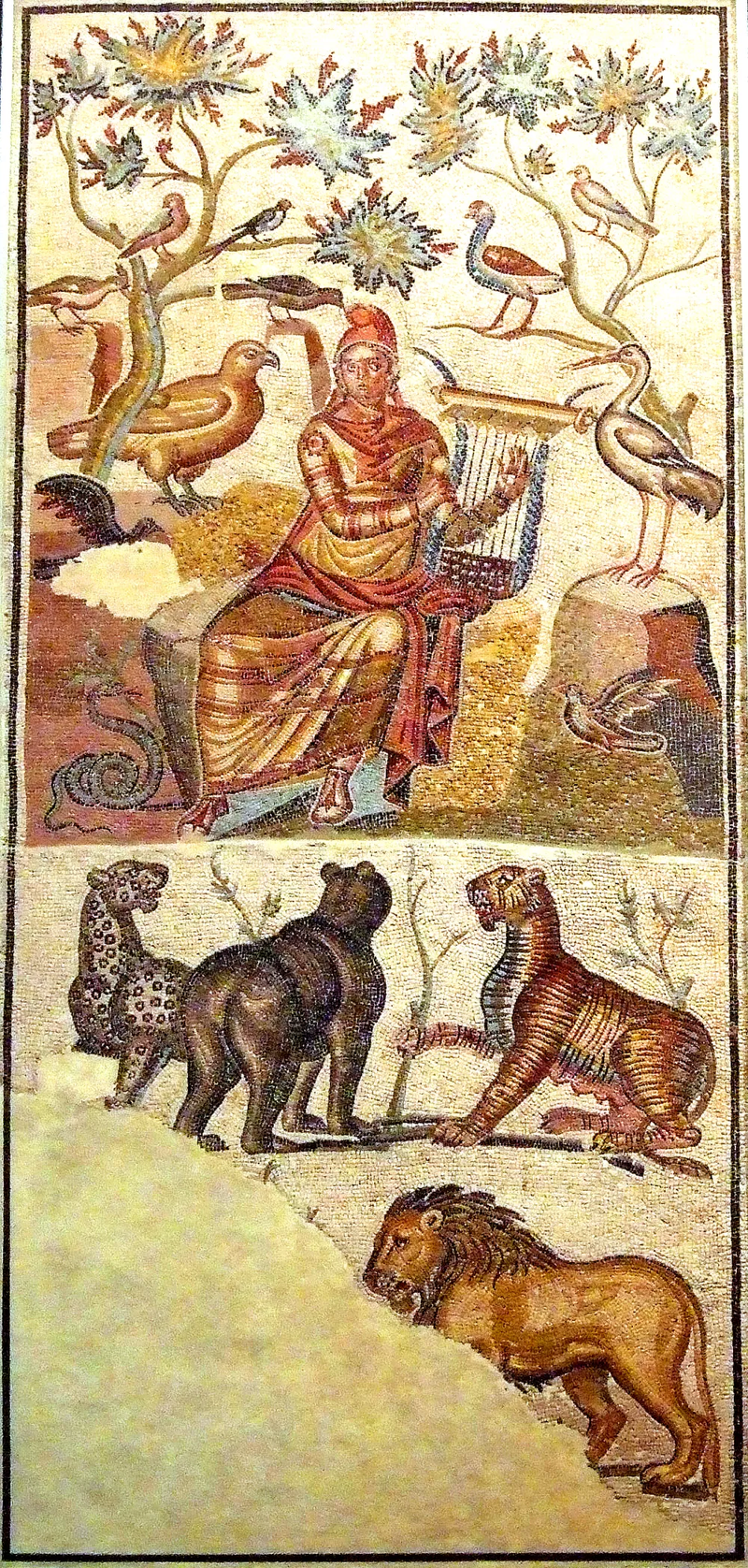
Foto: Ecelan, CC BY-SA 3.0, vía Wikimedia Commons
And a poet has survived. Martial was born in Bilbilis Augusta, next to today's Calatayud, between AD 38 and 41, and left for Rome in his twenties. His epigrams describe the dancers from southern Hispania who performed at Roman banquets, and he names what they carried: crusmata baetica, metal castanets. A good part of what is known about those musicians comes from a man born near Calatayud.
Here is the unit's problem reproduced in miniature. Of the music of Caesaraugusta we have a building, a pavement and some verses. We have the seating capacity, the size of the room and the name of the instrument. We do not have the sound.
Classroom activities
- While the epitaph plays: half the class sings it at full volume and the other half almost whispers it, at the same time. Same pitch, same duration, different intensity. Then decide which half is wrong. The answer is that the stone does not say.
- While the Delphic hymn on the aulos plays: count how many separate sounds you can pick out at once. The aulos has two pipes and one person blowing.
- While We Will Rock You plays: raise your hand the moment the first chord arrives. Until then you are hearing monody, just like at Delphi.
- Play: we build We Will Rock You with the band. The chart and the tab are attached to its own article.
- Create: write any four syllables and put only pitch and duration above them, nothing else. Hand it to another group and have them sing it, choosing timbre and intensity. Compare the two versions of the same score.
Key vocabulary
- Parameters of sound — parámetros del sonido: altura, duración, intensidad y timbre
- Timbre — timbre (what tells you a note is a whistle and not a voice)
- Notation — notación (the system for writing music down)
- Monody — monodia: una sola línea melódica, sin acordes debajo
- Aulos — aulós: instrumento griego de dos tubos con caña doble
Resources
The songs in this unit are in the library, each with its own article, full-band chart and tab: We Will Rock You, I Ain't Worried.
The Seikilos epitaph sung — the four lines we work on in class.
How the stone is read — Armand D'Angour of Oxford University shows the letters written above the text, explains how they are deciphered, and ends with a choir singing the Delphic hymn with the aulos.
The epitaph decoded sign by sign — first the story of the stone, then the melody, then the rhythm: where every note and every duration of what we sing in class comes from.
A Delphic hymn on the real instrument — Barnaby Brown plays the paean of Athenaios on a reconstruction of the Louvre aulos.
The aulos at full stretch — Callum Armstrong plays both pipes at once and breathes without stopping. Notice how many sounds come out of one person.
Aristoxenus's three rhythms — Lina Palera, lyre in hand, explains how the Greeks understood rhythm: sounds arriving at regular intervals are not enough, some have to weigh more than others. They called the strong beat thesis and the weak one arsis. From there come their three basic rhythms: dactylic, in two beats; iambic, in three; and paeonic, in five. They are the same 2/4, 3/4 and 5/4 we write today.
The missing piece — how the aulos's double reed of cane is made today, the one part of the instrument no excavation ever delivers.
The kithara — Peter Pringle shows a reconstruction of the kithara of classical Greece: how it is built, how it is held and how it sounds with silk strings.
Tuning without a tuner — how a lyre was tuned in antiquity, string by string and by ear, following what the Greek treatises describe.
Three ways to share out the notes — the Greeks tuned the same group of four strings in three different ways, and one of them uses notes a piano does not have. You hear all three.
The water organ — the hydraulis rebuilt, within the European Music Archaeology Project.
The water organ from the inside — an animation of how it worked: the pumps, the water tank that keeps the pressure steady and the valve under each pipe.
The musician on the mosaic — the myth of Orpheus and Eurydice in under five minutes, animated by TED-Ed. Orpheus is the one playing on the floor of the House of Orpheus.
One line, a thousand years later — Gregorian chant by the monks of Santo Domingo de Silos.
Keeping music without writing it — the tradition of Vedic chanting, on the UNESCO channel.
The theatre under Zaragoza — the Ruta de Caesaraugusta museums, on the fiftieth anniversary of the find.
Monody in pop — We Will Rock You, Queen (1977).
- The stone — Seikilos epitaph and Delphic Hymns on Wikipedia.
- The ancient source on the army — Thucydides, History of the Peloponnesian War, book 5, paragraph 70.
- Round the corner — Museo del Teatro de Caesaraugusta and Museo de Zaragoza, where the Orpheus mosaic is.
- Vedic chanting — the UNESCO entry.
Nos preguntamos
- Si nadie grabó nada, ¿cómo puede alguien decir cómo sonaba?
- ¿Alguien tocaba solo por gusto, o siempre había alguien pagando?
- ¿Qué trabajo hacía la música que no pudiera hacer otra cosa?
- Al escribir una melodía, ¿qué se escribe y qué se queda fuera?
- Si dos grupos cantan la misma partitura y suenan distinto, ¿quién se equivoca?
- ¿Por qué se conserva un instrumento de hueso y no se conserva una canción?
No las respondas todavía. Al final de la unidad volvemos a ellas.
El fragmento
Hay cuatro versos griegos que sí tienen música escrita encima. Están grabados en una columna de mármol de hace unos dos mil años. Los vamos a cantar.
El texto, con la pronunciación aproximada y la traducción:
- Ὅσον ζῇς, φαίνου — hóson dsis, fáinu — Mientras vivas, brilla
- μηδὲν ὅλως σὺ λυποῦ — midén hólos si lipú — no te aflijas por nada
- πρὸς ὀλίγον ἐστὶ τὸ ζῆν — pros olígon estí to dsin — la vida dura poco
- τὸ τέλος ὁ χρόνος ἀπαιτεῖ — to télos ho jrónos apaití — el tiempo reclama su final
Partitura: transcripción moderna grabada para esta unidad; melodía de dominio público
Primero, solo el ritmo del verso uno, con palmas: una palmada corta, una larga que dura dos, otra que dura tres. Después entran las alturas. Sobre las sílabas ho-son dsis, la melodía hace la – mi – mi, y sube de golpe una quinta en la primera sílaba. Sobre fái-nu hace do♯ – re – mi deprisa y se para en re.
Cuando ese verso salga, van los cuatro seguidos. Los cuatro duran exactamente lo mismo. La melodía entera cabe en una octava, de mi a mi, y la última nota de la pieza es el mi grave, que no aparece ni una sola vez antes.
Dos advertencias honestas. La versión que cantamos está escrita una cuarta por encima de lo que indican los signos griegos, para que llegue una voz normal. Y la velocidad no la pone la piedra: la pone quien canta.
Qué cambió
Empecemos por el dinero, que es la pregunta más útil. En Atenas, los coros de las fiestas no los pagaba el público: los pagaba un ciudadano rico al que le tocaba. Se llamaba corego, y costear los ensayos, el vestuario y el local era una obligación pública, igual que pagar un impuesto. Si ganaba, se llevaba un trípode y lo dedicaba a un dios.
Fuera del teatro, la música estaba trabajando casi siempre. En un sacrificio sonaba el aulós mientras el animal iba hacia el altar. En un trirreme, un auletés marcaba a los remeros el ritmo de la palada, y era parte de la tripulación, como el timonel. En un banquete se contrataba a quien tocara y bailara. Y en un entierro se cantaba, que es exactamente lo que estamos cantando nosotros.
El caso del ejército lo dejó escrito Tucídides al contar la batalla de Mantinea, en el 418 a. C. Los espartanos avanzaron despacio, al son de muchos flautistas, y él aclara para qué: no era cosa de religión, sino para que avanzaran todos a la vez, sin romper la formación. Es la definición más clara de función que vas a leer, y la escribió alguien que estuvo allí.
Foto: Zde, CC BY-SA 4.0, vía Wikimedia Commons
Y entonces, en algún momento, alguien decidió escribirla. Eso es lo que cambió. Los griegos pusieron letras encima de las sílabas del texto, y una rayita o dos para decir cuánto duraba cada una. Con eso basta para volver a cantar algo mil años después, y por eso el epitafio de Sícilo sigue existiendo.
Ahora mira lo que ese sistema escribe y lo que no. Un sonido tiene cuatro parámetros: altura, duración, intensidad y timbre. La notación griega anota los dos primeros y no dice nada de los otros dos. Ni de lo fuerte que suena, ni de con qué suena.
Prueba a comprobarlo de oído. Silba las cuatro notas del comienzo y luego cántalas: misma altura, misma duración, otro timbre por completo. El gancho de I Ain't Worried va silbado, y tocado con una guitarra serían las mismas notas y otra canción.
Ese es el parámetro que ninguna grabación del epitafio puede sacar de la piedra, porque la piedra no lo trae. Quien graba el epitafio elige si lo canta una mujer, si lo dobla una lira y si suena fuerte o flojo. La mitad de lo que oyes es una decisión de hace diez años.
Con los objetos pasa algo parecido, y conviene decirlo sin adornos. De un aulós enterrado se pueden medir los agujeros y deducir alturas aproximadas. Pero lo que hacía sonar el aulós era una caña doble, y la caña es materia orgánica que no llega hasta nosotros: quien reconstruye el instrumento tiene que fabricarla otra vez a base de pruebas. El parámetro que más define un timbre es precisamente el que falta.
Queda un tercer camino, que es mirar. En la cerámica griega hay auletas soplando, y en los mosaicos romanos hay músicos con la lira en la mano. Una imagen te dice cuántos tocaban, cómo cogían el instrumento y en qué situación estaban. No te dice ni una nota.
Tres datos duros, para tenerlos a mano:
- Epitafio de Sícilo — mármol de Trales, en la actual Turquía, siglo I o II d. C. Se halló hacia 1883 durante las obras del ferrocarril y hoy está en el Museo Nacional de Dinamarca.
- Himnos délficos — dos, grabados en el muro del Tesoro de los Atenienses en Delfos y hallados en 1893. El segundo, firmado por Limenio, se representó en el 128 a. C.
- Hydraulis, el órgano de agua — inventado en Grecia en el siglo III a. C. El ejemplar mejor conservado se encontró en Hungría en 1931 y lleva una inscripción del 228 d. C.
El mismo recurso en otros sitios
El epitafio es una línea de voz sola, sin acordes debajo, sobre un texto que manda. A eso se le llama monodia, y no se acabó con Roma. Estos tres hacen lo mismo y conviene oírlos seguidos:
- We Will Rock You — durante casi toda la canción no hay un solo acorde: hay voces, pies y palmas. Lo que la sostiene no son las notas, sino el timbre y la fuerza, que es justo lo que no se escribe.
- Canto gregoriano — una línea, en latín, sin armonía, sin indicaciones de intensidad y sin velocidad escrita. Mil años después del epitafio, el mismo problema sin resolver.
- Canto védico de la India — un repertorio transmitido de memoria durante unos tres mil años sin escribir una sola nota. La UNESCO lo reconoció en 2008 como patrimonio inmaterial.
Los tres resuelven la misma pregunta de formas distintas. El védico es el más interesante para nosotros: si nadie escribe nada, la única manera de conservar una música es que alguien la repita exactamente, toda la vida, delante de otro.
Y aquí, ¿qué?
De la Zaragoza romana ha llegado un edificio entero. El teatro de Caesaraugusta se construyó en la primera mitad del siglo I, cabían unos seis mil espectadores y siguió en pie hasta el siglo III, cuando empezaron a llevarse sus piedras para levantar murallas. Estuvo perdido bajo la ciudad hasta que unas prospecciones lo sacaron a la luz en 1972. Se puede visitar.
También ha llegado un suelo. En la llamada Casa de Orfeo, una vivienda señorial de finales del siglo II o comienzos del III, el comedor medía setenta metros cuadrados y estaba pavimentado con un mosaico de nueve por seis metros: Orfeo tocando y los animales parados a escuchar. Está en el Museo de Zaragoza. Quien comía ahí comía encima de un músico.
Foto: Ecelan, CC BY-SA 3.0, vía Wikimedia Commons
Y ha llegado un poeta. Marcial nació en Bílbilis Augusta, junto a la actual Calatayud, entre el 38 y el 41 d. C., y se fue a Roma a los veintitantos. En sus epigramas describe a las bailarinas del sur de Hispania que actuaban en los banquetes romanos, y nombra el instrumento que llevaban: los crusmata baetica, unas castañuelas de metal. Buena parte de lo que se sabe de aquellas músicas viene de un bilbilitano.
Aquí está el problema de la unidad reproducido en pequeño. De la música de Caesaraugusta tenemos un edificio, un pavimento y unos versos. Tenemos el aforo, el tamaño de la sala y el nombre del instrumento. No tenemos el sonido.
Para hacer en clase
- Mientras suena el epitafio: media clase lo canta con todo el aire y la otra media lo canta casi en susurro, a la vez. Misma altura, misma duración, distinta intensidad. Cuando acabe, decidid cuál de las dos está mal. La respuesta es que la piedra no lo dice.
- Mientras suena el himno délfico en el aulós: contad cuántos sonidos distintos sois capaces de distinguir a la vez. El aulós tiene dos tubos y una sola persona soplando.
- Mientras suena We Will Rock You: levantad la mano en cuanto aparezca el primer acorde. Hasta ese momento estáis oyendo monodia, igual que en Delfos.
- Tocar: montamos We Will Rock You con la banda. El chart y la tablatura están en su artículo.
- Crear: escribid cuatro sílabas cualesquiera y ponedles encima solo altura y duración, sin nada más. Pasádselo a otro grupo y que lo cante eligiendo timbre e intensidad. Comparad las dos versiones de la misma partitura.
Vocabulario fundamental
- Parámetros del sonido — Las cuatro cosas que definen un sonido: altura (grave o agudo), duración (largo o corto), intensidad (fuerte o flojo) y timbre (con qué suena).
- Timbre — Lo que te permite saber que una nota la hace un silbido y no una voz, aunque sea exactamente la misma nota.
- Notación — El sistema para escribir música. El griego anotaba altura y duración con letras y rayitas encima del texto.
- Monodia — Una sola línea melódica, sin acordes ni segundas voces debajo.
- Aulós — Instrumento griego de dos tubos con caña doble, que se tocaban a la vez. Los romanos lo llamaban tibia.
Recursos
Las canciones de esta unidad están en la biblioteca, cada una con su artículo, su chart de banda y su tablatura: We Will Rock You, I Ain't Worried.
El epitafio de Sícilo cantado — los cuatro versos que trabajamos en clase.
Cómo se lee la piedra — Armand D'Angour, de la Universidad de Oxford, enseña las letras que van encima del texto, explica cómo se descifran y termina con un coro cantando el himno délfico con el aulós. Subtítulos en castellano.
El epitafio descifrado signo a signo — primero la historia de la piedra, después la melodía y por último el ritmo: de dónde sale cada nota y cada duración de lo que cantamos en clase.
Un himno délfico en el instrumento de verdad — Barnaby Brown toca el peán de Ateneo en una reconstrucción del aulós del Louvre.
El aulós a pleno rendimiento — Callum Armstrong toca los dos tubos a la vez y respira sin dejar de soplar. Fíjate en cuántos sonidos salen de una sola persona.
Los tres ritmos de Aristóxeno — Lina Palera, con la lira, cuenta cómo entendían el ritmo los griegos: no basta con que los sonidos lleguen a intervalos regulares, hace falta que unos pesen más que otros. Al tiempo fuerte lo llamaban tesis y al débil, arsis. De ahí salen sus tres ritmos básicos: el dactílico, de dos tiempos; el yámbico, de tres, y el peónico, de cinco. Son los mismos 2/4, 3/4 y 5/4 que escribimos hoy. Está en inglés: activa los subtítulos automáticos en castellano.
La pieza que falta — cómo se fabrica hoy la caña doble del aulós, la parte del instrumento que no llega en ninguna excavación.
La cítara — Peter Pringle enseña una reconstrucción de la cítara de la Grecia clásica: cómo está hecha, cómo se sujeta y cómo suena con cuerdas de seda.
Afinar sin afinador — cómo se afinaba una lira en la Antigüedad, cuerda a cuerda y de oído, siguiendo lo que cuentan los tratados griegos.
Tres maneras de repartir las notas — los griegos afinaban el mismo grupo de cuatro cuerdas de tres formas distintas, y una de ellas usa notas que no existen en un piano. Se oyen las tres.
El órgano de agua — el hydraulis reconstruido, dentro del European Music Archaeology Project.
El órgano de agua por dentro — una animación de cómo funcionaba: las bombas, el depósito de agua que mantiene la presión y las válvulas de cada tubo.
El músico del mosaico — el mito de Orfeo y Eurídice en menos de cinco minutos, animado por TED-Ed. Orfeo es el que toca en el suelo de la Casa de Orfeo.
Una línea sola, mil años después — canto gregoriano por el coro de monjes de Santo Domingo de Silos.
Conservar sin escribir — la tradición del canto védico, en el canal de la UNESCO.
El teatro que había debajo de Zaragoza — los museos de la Ruta de Caesaraugusta, por los cincuenta años del hallazgo.
La monodia en el pop — We Will Rock You, Queen (1977).
- La piedra — Epitafio de Sícilo y Himnos délficos a Apolo en Wikipedia.
- La fuente antigua sobre el ejército — Tucídides, Guerra del Peloponeso, libro 5, párrafo 70.
- Aquí al lado — Museo del Teatro de Caesaraugusta y Museo de Zaragoza, donde está el mosaico de Orfeo.
- El canto védico — ficha de la UNESCO.
We ask ourselves
- If nobody recorded any of it, how can anyone say what it sounded like?
- Did anyone play just for pleasure, or was somebody always paying?
- What job did music do that nothing else could do?
- When you write a melody down, what gets written and what is left out?
- If two groups sing the same score and sound different, which one is wrong?
- Why does a bone instrument survive and a song does not?
Don't answer yet. We come back to these at the end.
The fragment
Four Greek lines do have music written above them. They are carved on a marble column about two thousand years old. We are going to sing them.
The text, with rough pronunciation and the meaning:
- Ὅσον ζῇς, φαίνου — hoson zes, phainou — While you live, shine
- μηδὲν ὅλως σὺ λυποῦ — meden holos su lupou — grieve over nothing
- πρὸς ὀλίγον ἐστὶ τὸ ζῆν — pros oligon esti to zen — life lasts a short while
- τὸ τέλος ὁ χρόνος ἀπαιτεῖ — to telos ho chronos apaitei — time claims its end
Score: modern transcription engraved for this unit; public-domain melody
First the rhythm of line one, clapped: one short clap, one worth two, one worth three. Then the pitches. On the syllables ho-son zes the melody goes A – E – E, jumping up a fifth straight away. On phai-nou it runs C♯ – D – E and lands on D.
Once that line works, sing all four in a row. The four lines last exactly the same. The whole melody fits inside one octave, E to E, and the last note of the piece is the low E, which never appears anywhere else.
Two honest warnings. The version we sing is written a fourth above what the Greek signs indicate, so an ordinary voice can reach it. And the speed does not come from the stone: it comes from whoever is singing.
What changed
Start with the money, which is the most useful question. In Athens the festival choruses were not paid for by the audience. They were paid for by a rich citizen whose turn it was. He was the choregos, and covering rehearsals, costumes and a room was a public duty, like a tax. If his chorus won, he got a bronze tripod and dedicated it to a god.
Outside the theatre, music was almost always working. At a sacrifice the aulos played while the animal was led to the altar. On a trireme an auletes gave the rowers the stroke, and he was crew, like the helmsman. At a banquet you hired whoever played and danced. At a burial you sang, which is exactly what we have just been doing.
Thucydides wrote the army case down when he described the battle of Mantinea in 418 BC. The Spartans advanced slowly to the music of many pipers, and he says what it was for: nothing to do with religion, but so that they would move evenly, in step, without breaking ranks. That is the clearest definition of function you will read, and an eyewitness wrote it.
Foto: Zde, CC BY-SA 4.0, vía Wikimedia Commons
Then, at some point, somebody decided to write it down. That is what changed. The Greeks put letters above the syllables of the text, plus a dash or two to say how long each one lasted. That is enough to sing something again a thousand years later, which is why the Seikilos epitaph still exists.
Now look at what that system records and what it does not. A sound has four parameters: pitch, duration, intensity and timbre. Greek notation writes the first two and says nothing about the other two. Not how loud, not what with.
Test it by ear. Whistle the first four notes, then sing them: same pitch, same duration, a completely different timbre. The hook of I Ain't Worried is whistled; played on a guitar it would be the same notes and a different song.
That is the parameter no recording of the epitaph can take from the stone, because the stone does not carry it. Whoever records it chooses whether a woman sings it, whether a lyre doubles the line, whether it comes out loud or soft. Half of what you hear was decided ten years ago.
Objects behave the same way, and it is worth saying plainly. From a buried aulos you can measure the finger holes and work out approximate pitches. But what made the aulos sound was a double reed of cane, and cane is organic material that does not reach us: anyone rebuilding the instrument has to make one again by trial and error. The part that most defines a timbre is exactly the part that is missing.
There is a third route, which is looking. Greek pottery shows aulos players blowing; Roman mosaics show musicians holding a lyre. An image tells you how many were playing, how they held the instrument and what was going on around them. It tells you nothing about a single note.
Three hard facts, to keep at hand:
- Seikilos epitaph — marble from Tralles in present-day Turkey, first or second century AD. Found around 1883 during railway works; now in the National Museum of Denmark.
- Delphic hymns — two, carved on the wall of the Athenian Treasury at Delphi and found in 1893. The second, signed by Limenios, was performed in 128 BC.
- Hydraulis, the water organ — invented in Greece in the third century BC. The best-preserved example was found in Hungary in 1931 and carries an inscription dated 228 AD.
The same device elsewhere
The epitaph is a single vocal line, with no chords underneath, over a text that gives the orders. That is called monody, and it did not end with Rome. These three do the same job, and they are worth hearing back to back:
- We Will Rock You — for most of the song there is not one chord: voices, feet and hands. What holds it up is not the notes but the timbre and the force, which is precisely what nobody writes down.
- Gregorian chant — one line, in Latin, no harmony, no dynamics marked and no tempo written. A thousand years after the epitaph, the same unsolved problem.
- Vedic chanting from India — a repertoire carried by memory for around three thousand years without a single note written. UNESCO recognised it in 2008 as intangible heritage.
All three answer the same question differently. The Vedic case is the most interesting for us: if nobody writes anything, the only way to keep a music alive is for someone to repeat it exactly, for a lifetime, in front of someone else.
And here at home?
From Roman Zaragoza a whole building has survived. The theatre of Caesaraugusta was built in the first half of the first century, held about six thousand spectators and stood until the third century, when its stone started being carted off to build walls. It stayed lost under the city until a survey brought it back to light in 1972. You can visit it.
A floor has survived too. In the so-called House of Orpheus, a grand home from the end of the second century or the beginning of the third, the dining room measured seventy square metres and was paved with a mosaic nine metres by six: Orpheus playing, and the animals stopped to listen. It is in the Museo de Zaragoza. Whoever ate there ate on top of a musician.
Foto: Ecelan, CC BY-SA 3.0, vía Wikimedia Commons
And a poet has survived. Martial was born in Bilbilis Augusta, next to today's Calatayud, between AD 38 and 41, and left for Rome in his twenties. His epigrams describe the dancers from southern Hispania who performed at Roman banquets, and he names what they carried: crusmata baetica, metal castanets. A good part of what is known about those musicians comes from a man born near Calatayud.
Here is the unit's problem reproduced in miniature. Of the music of Caesaraugusta we have a building, a pavement and some verses. We have the seating capacity, the size of the room and the name of the instrument. We do not have the sound.
Classroom activities
- While the epitaph plays: half the class sings it at full volume and the other half almost whispers it, at the same time. Same pitch, same duration, different intensity. Then decide which half is wrong. The answer is that the stone does not say.
- While the Delphic hymn on the aulos plays: count how many separate sounds you can pick out at once. The aulos has two pipes and one person blowing.
- While We Will Rock You plays: raise your hand the moment the first chord arrives. Until then you are hearing monody, just like at Delphi.
- Play: we build We Will Rock You with the band. The chart and the tab are attached to its own article.
- Create: write any four syllables and put only pitch and duration above them, nothing else. Hand it to another group and have them sing it, choosing timbre and intensity. Compare the two versions of the same score.
Key vocabulary
- Parameters of sound — parámetros del sonido: altura, duración, intensidad y timbre
- Timbre — timbre (what tells you a note is a whistle and not a voice)
- Notation — notación (the system for writing music down)
- Monody — monodia: una sola línea melódica, sin acordes debajo
- Aulos — aulós: instrumento griego de dos tubos con caña doble
Resources
The songs in this unit are in the library, each with its own article, full-band chart and tab: We Will Rock You, I Ain't Worried.
The Seikilos epitaph sung — the four lines we work on in class.
How the stone is read — Armand D'Angour of Oxford University shows the letters written above the text, explains how they are deciphered, and ends with a choir singing the Delphic hymn with the aulos.
The epitaph decoded sign by sign — first the story of the stone, then the melody, then the rhythm: where every note and every duration of what we sing in class comes from.
A Delphic hymn on the real instrument — Barnaby Brown plays the paean of Athenaios on a reconstruction of the Louvre aulos.
The aulos at full stretch — Callum Armstrong plays both pipes at once and breathes without stopping. Notice how many sounds come out of one person.
Aristoxenus's three rhythms — Lina Palera, lyre in hand, explains how the Greeks understood rhythm: sounds arriving at regular intervals are not enough, some have to weigh more than others. They called the strong beat thesis and the weak one arsis. From there come their three basic rhythms: dactylic, in two beats; iambic, in three; and paeonic, in five. They are the same 2/4, 3/4 and 5/4 we write today.
The missing piece — how the aulos's double reed of cane is made today, the one part of the instrument no excavation ever delivers.
The kithara — Peter Pringle shows a reconstruction of the kithara of classical Greece: how it is built, how it is held and how it sounds with silk strings.
Tuning without a tuner — how a lyre was tuned in antiquity, string by string and by ear, following what the Greek treatises describe.
Three ways to share out the notes — the Greeks tuned the same group of four strings in three different ways, and one of them uses notes a piano does not have. You hear all three.
The water organ — the hydraulis rebuilt, within the European Music Archaeology Project.
The water organ from the inside — an animation of how it worked: the pumps, the water tank that keeps the pressure steady and the valve under each pipe.
The musician on the mosaic — the myth of Orpheus and Eurydice in under five minutes, animated by TED-Ed. Orpheus is the one playing on the floor of the House of Orpheus.
One line, a thousand years later — Gregorian chant by the monks of Santo Domingo de Silos.
Keeping music without writing it — the tradition of Vedic chanting, on the UNESCO channel.
The theatre under Zaragoza — the Ruta de Caesaraugusta museums, on the fiftieth anniversary of the find.
Monody in pop — We Will Rock You, Queen (1977).
- The stone — Seikilos epitaph and Delphic Hymns on Wikipedia.
- The ancient source on the army — Thucydides, History of the Peloponnesian War, book 5, paragraph 70.
- Round the corner — Museo del Teatro de Caesaraugusta and Museo de Zaragoza, where the Orpheus mosaic is.
- Vedic chanting — the UNESCO entry.