Contenidos
Anti-Hero — Taylor Swift (2022)
A song that laughs at itself: "I'm the problem". Underneath, the usual four chords, but starting from a different place.
🏷️ Ficha musical
Why it's in this book
"Anti-Hero" arrives in January, next to Riptide, and it is here for one lesson: the same four chords sound different depending on which one you start with. In November you played the loop C, G, A minor, F in Love Story. Anti-Hero uses exactly those four, but starts on F: F, C, G, A minor. We call that rotating the loop. The whole song is that loop, from start to finish, so your left hand has nothing new to learn: the new part is in your ear. In the classroom with no instruments we make the drum beat with claps; with ukuleles we strum the rotated loop; and in the music room the drummer plays that same clapping pattern and the ukulele bass plays the bottom notes. The second voice sings the answer in the chorus, "it's me, hi".
Why this song
"It's me, hi, I'm the problem, it's me." That line became a meme as soon as the song came out. You have probably seen it in videos that have nothing to do with Taylor Swift.
The funny thing is that it is a confession. One of the most famous singers in the world says the problem in her life is herself.
The question on this page is musical: if Anti-Hero uses the same four chords as Love Story, why does it sound so different?
Historical context
Fourteen years passed between Love Story and Anti-Hero. Taylor Swift left country behind, moved to pop and became one of the best-selling artists in the world.
In 2022 she released Midnights, her tenth album: songs about sleepless nights. She made it with Jack Antonoff, a producer she had been working with for years.
Swift said Anti-Hero is about her insecurities: feeling that fame has grown so big that it is hard to feel like a normal person. In the song she makes fun of herself, and that made her feel close to a lot of people.
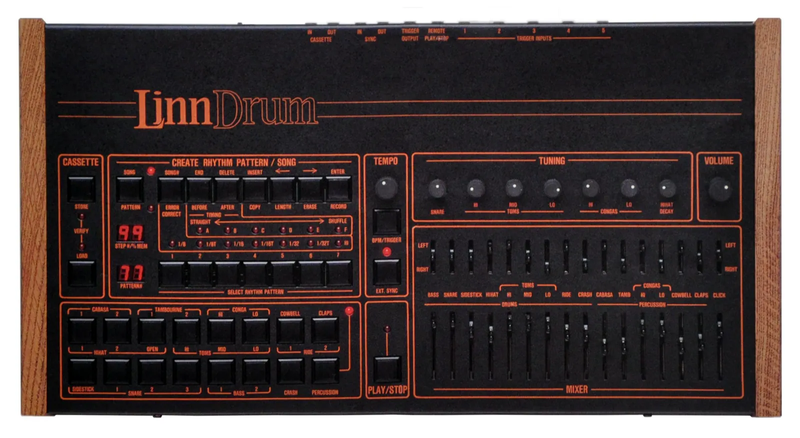
Foto: Linn Electronics, CC BY-SA 3.0, vía Wikimedia Commons
A LinnDrum, the 1982 drum machine you hear in the drums of Anti-Hero. Each button triggers a recorded drum sound: kick, snare, cymbals, claps. In the 1980s it was all over pop music.
The song spent eight weeks at number 1 in the United States. On the day it came out, it was streamed on Spotify more than any other song on its first day.
Musical characteristics
A rotated loop. The whole song goes round four chords. On the record they are A, E, B and C sharp minor. In class we play them in C: F, C, G, A minor. Compare them with Love Story (C, G, A minor, F) and you will see they are the same. Only the first one changes. Starting on F makes the song feel as if it never quite gets home: it never starts on the chord of rest.
1980s drums. Nobody plays the drums: it is a drum machine, a box that plays back recorded drum sounds. Antonoff added an effect that makes the sound tremble. That is why it sounds like 80s pop, even though the song is from 2022.
Synthesizers. On top there are synthesizers, keyboards that create sound electronically. Antonoff used an old one, an Oberheim OB-8, which he said sounds like an old organ in a baseball stadium.
A line that answers back. In the chorus, Swift says something and then answers herself. That way of singing, one phrase that calls and another that replies, is called call and response. It is what makes the chorus so catchy.
Hard facts: E major, 4/4, 97 beats per minute, 3:20. The form: verse, pre-chorus, chorus, verse, pre-chorus, chorus, bridge and final choruses.
Guided listening
Play the music video. The video is longer than the song because it includes acted scenes; focus on the music.
When the song begins, clap along with the drum machine. Notice how dry it sounds, almost mechanical.
In the first verse, count the chords. There are four and they start again. They do not change for the whole song.
When the chorus arrives, find the line that answers back. How many words does the answer have?
In the final choruses, the music stops now and then while Swift keeps singing. Listen to how everything snaps back in.
Trivia and curiosities
- Antonoff said he started Anti-Hero from an idea in "Out of the Woods", another song he had made with Swift in 2014.
- Swift wrote and directed the music video herself. It won six MTV awards, including Video of the Year.
- In the video there are three Taylor Swifts at once, each one a different side of her personality.
- There was also a duet version with Bleachers, Jack Antonoff's own band.
Classroom activities
- From the old loop to the new one. On ukulele, play C, G, A minor, F (Love Story). Without stopping, now start on F: F, C, G, A minor. What changes in the sound?
- Clapping drums. Feet on beats 1 and 3, claps on 2 and 4, like a drum machine: everyone exactly together.
- Call and response. Half the class sings the first part of the chorus and the other half answers "it's me, hi".
- Band. The drummer plays the pattern you clapped. The ukulele bass plays the bottom note of each chord: F, C, G, A.
- Compare. Listen to ten seconds of Love Story and ten of Anti-Hero. Write one word for what makes them different if the chords are the same.
Key vocabulary
- Rotating a loop — rotar un bucle: los mismos acordes, empezando por otro
- Drum machine — caja de ritmos
- Synthesizer — sintetizador
- Call and response — llamada y respuesta
Resources
Official music video — Written and directed by Taylor Swift. It runs longer than the song because of the acted scenes.
Ukulele tutorial — Ricky Somborn. A play-along, with chords and lyrics.
Guitar tutorial — Easy 2 Play Music. An easy version, with the chords on screen.
Piano tutorial — Atlantic Notes. An easy keyboard version.
Por qué está en este libro
«Anti-Hero» llega en enero, al lado de Riptide, y está aquí para una sola lección: los mismos cuatro acordes suenan distinto según por cuál empiezas. En noviembre tocaste en Love Story el bucle do, sol, la menor, fa. Anti-Hero usa exactamente esos cuatro, pero empieza por fa: fa, do, sol, la menor. A eso lo llamamos rotar el bucle. Toda la canción es ese bucle, de principio a fin, así que la mano izquierda no tiene que aprender nada: lo nuevo está en el oído. En el aula sin instrumentos se hace la batería con palmas; con ukelele, rasgueamos el bucle rotado; y en el aula de música la batería toca ese mismo patrón de palmas y el ukebajo lleva las notas de abajo. La segunda voz hace la respuesta del estribillo, «it's me, hi».
Por dónde entrar
«It's me, hi, I'm the problem, it's me.» Esa frase se convirtió en meme en cuanto salió la canción. La has visto en vídeos que no tienen nada que ver con Taylor Swift.
Lo curioso es que es una confesión. Una de las cantantes más famosas del mundo dice que el problema de su vida es ella misma.
La pregunta de esta página es musical: si Anti-Hero usa los mismos cuatro acordes que Love Story, ¿por qué suena tan distinta?
Contexto histórico
Entre Love Story y Anti-Hero pasaron catorce años. Taylor Swift dejó el country, se pasó al pop y se convirtió en una de las artistas que más venden del mundo.
En 2022 sacó Midnights, su décimo disco. La idea era un disco de canciones sobre las noches sin dormir. Lo hizo con Jack Antonoff, un productor con el que trabajaba desde hacía años.
Swift contó que Anti-Hero habla de sus inseguridades: de sentir que la fama se ha hecho tan grande que le cuesta sentirse una persona normal. En la canción se ríe de sí misma, y eso la hizo cercana para mucha gente.
Foto: Linn Electronics, CC BY-SA 3.0, vía Wikimedia Commons
Una LinnDrum, la caja de ritmos de 1982 que suena en la batería de Anti-Hero. Cada botón dispara el sonido grabado de un instrumento de batería: bombo, caja, platos, palmas. En los años 80 sonaba en medio pop.
La canción fue número 1 en Estados Unidos durante ocho semanas. El día que salió se escuchó en Spotify más que ninguna otra canción en su primer día.
Cómo suena
Un bucle rotado. Toda la canción da vueltas a cuatro acordes. En el disco son la, mi, si y do sostenido menor. En clase los tocamos en Do: fa, do, sol, la menor. Si los comparas con Love Story (do, sol, la menor, fa), verás que son los mismos. Solo cambia el primero. Empezar por fa hace que la canción suene como si no acabara de llegar a casa: nunca empieza en el acorde de reposo.
Una batería de los años 80. La batería no la toca nadie: es una caja de ritmos, una máquina que reproduce sonidos de batería grabados. Antonoff le añadió un efecto que hace temblar el sonido. Por eso suena a pop de los 80, aunque la canción es de 2022.
Sintetizadores. Encima suenan sintetizadores, teclados que fabrican el sonido con electricidad. Antonoff usó uno antiguo, un Oberheim OB-8, que según él suena a órgano viejo de estadio.
Una frase que contesta. En el estribillo, Swift dice algo y luego se contesta a sí misma. Esa forma de cantar, una frase que pregunta y otra que responde, se llama llamada y respuesta. Es lo que hace que el estribillo se pegue.
Datos duros: Mi mayor, 4/4, 97 pulsos por minuto, 3:20. La forma: estrofa, preestribillo, estribillo, estrofa, preestribillo, estribillo, puente y estribillos finales.
Escucha guiada
Pon el videoclip. El vídeo dura más que la canción porque lleva escenas de teatro; tú quédate con la música.
Cuando empiece la canción, marca con palmas lo que hace la caja de ritmos. Fíjate en que es un sonido seco, casi de máquina.
En la primera estrofa, cuenta los acordes. Son cuatro y vuelven a empezar. No cambian en toda la canción.
Cuando llegue el estribillo, busca la frase que contesta. ¿Cuántas palabras tiene la respuesta?
En los estribillos del final, la música se para a ratos y Swift sigue cantando. Escucha cómo vuelve todo de golpe.
Curiosidades
- Antonoff dijo que empezó Anti-Hero a partir de una idea de «Out of the Woods», otra canción que había hecho con Swift en 2014.
- Swift escribió y dirigió el videoclip ella misma. Ganó seis premios MTV, entre ellos el de Vídeo del Año.
- En el vídeo aparecen tres Taylor Swift a la vez, cada una con una parte distinta de su personalidad.
- Hubo una versión a dúo con Bleachers, el grupo del propio Jack Antonoff.
Para hacer en clase
- Del bucle viejo al nuevo. Tocad en ukelele do, sol, la menor, fa (Love Story). Sin parar, empezad ahora por fa: fa, do, sol, la menor. ¿Qué cambia en cómo suena?
- La batería con palmas. Pies en el pulso 1 y 3, palmas en el 2 y 4, como una caja de ritmos: todos exactamente a la vez.
- Llamada y respuesta. Una mitad de la clase canta la primera parte del estribillo y la otra contesta «it's me, hi».
- Banda. La batería toca el patrón que habéis hecho con palmas. El ukebajo toca la nota de abajo de cada acorde: fa, do, sol, la.
- Comparar. Escuchad diez segundos de Love Story y diez de Anti-Hero. Escribid en una palabra qué las hace distintas si los acordes son los mismos.
Vocabulario fundamental
- Rotar un bucle — Tocar los mismos acordes en el mismo orden, pero empezando por otro.
- Caja de ritmos — Una máquina que toca sonidos de batería grabados.
- Sintetizador — Un teclado que fabrica el sonido con electricidad.
- Llamada y respuesta — Una frase que pregunta y otra que contesta.
Recursos
Videoclip oficial — Escrito y dirigido por Taylor Swift. Dura más que la canción porque lleva escenas de teatro.
Tutorial de ukelele — Ricky Somborn. Se toca encima de la canción, con acordes y letra.
Tutorial de guitarra — Easy 2 Play Music. Versión fácil, con los acordes en pantalla.
Tutorial de piano — Atlantic Notes. Versión fácil para teclado.
Why it's in this book
"Anti-Hero" arrives in January, next to Riptide, and it is here for one lesson: the same four chords sound different depending on which one you start with. In November you played the loop C, G, A minor, F in Love Story. Anti-Hero uses exactly those four, but starts on F: F, C, G, A minor. We call that rotating the loop. The whole song is that loop, from start to finish, so your left hand has nothing new to learn: the new part is in your ear. In the classroom with no instruments we make the drum beat with claps; with ukuleles we strum the rotated loop; and in the music room the drummer plays that same clapping pattern and the ukulele bass plays the bottom notes. The second voice sings the answer in the chorus, "it's me, hi".
Why this song
"It's me, hi, I'm the problem, it's me." That line became a meme as soon as the song came out. You have probably seen it in videos that have nothing to do with Taylor Swift.
The funny thing is that it is a confession. One of the most famous singers in the world says the problem in her life is herself.
The question on this page is musical: if Anti-Hero uses the same four chords as Love Story, why does it sound so different?
Historical context
Fourteen years passed between Love Story and Anti-Hero. Taylor Swift left country behind, moved to pop and became one of the best-selling artists in the world.
In 2022 she released Midnights, her tenth album: songs about sleepless nights. She made it with Jack Antonoff, a producer she had been working with for years.
Swift said Anti-Hero is about her insecurities: feeling that fame has grown so big that it is hard to feel like a normal person. In the song she makes fun of herself, and that made her feel close to a lot of people.
Foto: Linn Electronics, CC BY-SA 3.0, vía Wikimedia Commons
A LinnDrum, the 1982 drum machine you hear in the drums of Anti-Hero. Each button triggers a recorded drum sound: kick, snare, cymbals, claps. In the 1980s it was all over pop music.
The song spent eight weeks at number 1 in the United States. On the day it came out, it was streamed on Spotify more than any other song on its first day.
Musical characteristics
A rotated loop. The whole song goes round four chords. On the record they are A, E, B and C sharp minor. In class we play them in C: F, C, G, A minor. Compare them with Love Story (C, G, A minor, F) and you will see they are the same. Only the first one changes. Starting on F makes the song feel as if it never quite gets home: it never starts on the chord of rest.
1980s drums. Nobody plays the drums: it is a drum machine, a box that plays back recorded drum sounds. Antonoff added an effect that makes the sound tremble. That is why it sounds like 80s pop, even though the song is from 2022.
Synthesizers. On top there are synthesizers, keyboards that create sound electronically. Antonoff used an old one, an Oberheim OB-8, which he said sounds like an old organ in a baseball stadium.
A line that answers back. In the chorus, Swift says something and then answers herself. That way of singing, one phrase that calls and another that replies, is called call and response. It is what makes the chorus so catchy.
Hard facts: E major, 4/4, 97 beats per minute, 3:20. The form: verse, pre-chorus, chorus, verse, pre-chorus, chorus, bridge and final choruses.
Guided listening
Play the music video. The video is longer than the song because it includes acted scenes; focus on the music.
When the song begins, clap along with the drum machine. Notice how dry it sounds, almost mechanical.
In the first verse, count the chords. There are four and they start again. They do not change for the whole song.
When the chorus arrives, find the line that answers back. How many words does the answer have?
In the final choruses, the music stops now and then while Swift keeps singing. Listen to how everything snaps back in.
Trivia and curiosities
- Antonoff said he started Anti-Hero from an idea in "Out of the Woods", another song he had made with Swift in 2014.
- Swift wrote and directed the music video herself. It won six MTV awards, including Video of the Year.
- In the video there are three Taylor Swifts at once, each one a different side of her personality.
- There was also a duet version with Bleachers, Jack Antonoff's own band.
Classroom activities
- From the old loop to the new one. On ukulele, play C, G, A minor, F (Love Story). Without stopping, now start on F: F, C, G, A minor. What changes in the sound?
- Clapping drums. Feet on beats 1 and 3, claps on 2 and 4, like a drum machine: everyone exactly together.
- Call and response. Half the class sings the first part of the chorus and the other half answers "it's me, hi".
- Band. The drummer plays the pattern you clapped. The ukulele bass plays the bottom note of each chord: F, C, G, A.
- Compare. Listen to ten seconds of Love Story and ten of Anti-Hero. Write one word for what makes them different if the chords are the same.
Key vocabulary
- Rotating a loop — rotar un bucle: los mismos acordes, empezando por otro
- Drum machine — caja de ritmos
- Synthesizer — sintetizador
- Call and response — llamada y respuesta
Resources
Official music video — Written and directed by Taylor Swift. It runs longer than the song because of the acted scenes.
Ukulele tutorial — Ricky Somborn. A play-along, with chords and lyrics.
Guitar tutorial — Easy 2 Play Music. An easy version, with the chords on screen.
Piano tutorial — Atlantic Notes. An easy keyboard version.