The Soul of Brazil: From Bossa Nova to MPB
Explore the rich world of Brazilian music — from the intimate harmonies of bossa nova to the power of samba and MPB. Includes practical work on piano, ukulele, and melody.
Introduction
Brazil has produced some of the most distinctive and influential musical traditions in the world. From the intimate whisper of bossa nova in a Rio de Janeiro café to the thunderous energy of a samba school parading through the streets during Carnival, Brazilian music is a rich tapestry woven from African, Indigenous, and European threads.
In this unit, we will explore four key dimensions of Brazilian music: Bossa Nova, Samba, MPB (Música Popular Brasileira), and the harmonic language of chords with tensions that gives this music its characteristic sophistication. You will also learn to play iconic pieces on piano, ukulele, and as a melody instrument.
1. Bossa Nova: The New Wave
Bossa nova (literally "new trend" or "new wave") emerged in the late 1950s and early 1960s in Rio de Janeiro. It developed as a more intimate, harmonically sophisticated style of samba, combining the rhythmic DNA of Brazilian music with the harmonic complexity that had been evolving in Brazilian guitar playing since the 1920s.
Key Characteristics
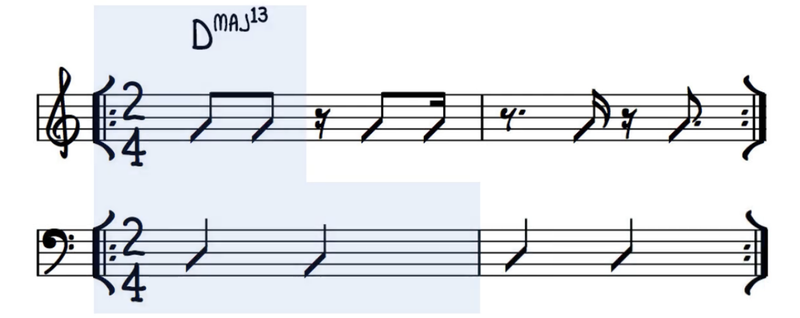
- Rhythm: A calm, syncopated pattern derived from samba. The guitar synthesizes the entire samba percussion section: the thumb imitates the surdo (bass drum), while the fingers phrase like the tamborim.
- Harmony: Rich chords with added 7ths, 9ths, and other tensions. Complex progressions with chromatic movement and "ambiguous" harmonies that blur major and minor.
- Vocals: Soft, understated singing close to speech — a radical departure from the operatic style of earlier Brazilian popular music.
- Instrumentation: Primarily nylon-string guitar and voice, sometimes with piano, bass, and light percussion.
Key Figures
- João Gilberto — Created the definitive bossa nova guitar beat, extracting it from the traditional samba batucada
- Antônio Carlos Jobim (Tom Jobim) — Composer of "The Girl from Ipanema," "Corcovado," and dozens of standards
- Vinícius de Moraes — Poet and lyricist who wrote many of the most beloved bossa nova texts
- Stan Getz & Astrud Gilberto — Their 1964 recording brought bossa nova to international audiences
2. Samba: The Heartbeat of Brazil
Samba is a set of Afro-Brazilian music and dance traditions characterized by a lively 2/4 time rhythm. It developed through cultural exchanges between Africans, Indigenous peoples, and Europeans during the 19th century, originating primarily in Bahia among Afro-descendant communities before expanding to Rio de Janeiro through migration.
Types of Samba
- Samba de Roda: The original circle dance form from Bahia — recognized by UNESCO as Intangible Cultural Heritage
- Samba-Enredo: The elaborate theme songs performed by samba schools during Carnival parades
- Samba-Canção: A slower, more romantic form that influenced bossa nova
- Pagode: A more intimate, acoustic style popular since the 1980s
- Samba de Partido Alto: An improvisational form with call-and-response vocals
The Samba School
Samba schools (escolas de samba) are community organizations that prepare elaborate performances for Carnival. The bateria (percussion section) can include hundreds of musicians playing instruments like the surdo, tamborim, pandeiro, cuíca, agogô, and repinique.
Samba pattern
3. MPB: Música Popular Brasileira
MPB emerged in the late 1960s as a post-bossa nova movement that revisited traditional Brazilian styles — samba, samba-canção, baião — while combining them with international influences from jazz, rock, and avant-garde music. It became the intellectual backbone of Brazilian popular music.
Key Characteristics
- Harmonic complexity: Building on bossa nova's jazz-influenced chords
- Elaborate lyrics: Drawing on a deep connection between Brazilian popular music and poetry dating back to the 1920s
- Cultural mission: Artists sought to create a style that reflected authentic Brazilian culture
- Diversity: Each artist generated their own trends within the genre — there is no single MPB sound
Key Artists
- Caetano Veloso — Leader of the Tropicália movement, blending Brazilian traditions with psychedelic rock
- Gilberto Gil — Multi-instrumentalist, former Minister of Culture, and Tropicália pioneer
- Elis Regina — One of the greatest Brazilian vocalists, known for her powerful interpretations
- Chico Buarque — Songwriter and novelist whose politically charged lyrics defined an era
- Jorge Ben Jor — Creator of the samba-rock fusion, composer of "Mas Que Nada"
- Djavan — Blended MPB with soul, jazz, and Afro-Brazilian rhythms
Tropicália
A short-lived but enormously influential artistic movement within MPB (1967-1969), Tropicália mixed Brazilian popular music with avant-garde art, psychedelic rock, and political protest. Led by Caetano Veloso and Gilberto Gil, it was both a musical revolution and a challenge to Brazil's military dictatorship.
4. Chords with Tensions: The Harmonic Language
One of the most distinctive features of Brazilian music is its sophisticated use of harmony. Understanding "chords with tensions" is essential for playing bossa nova and MPB authentically.
What Are Tensions?
Tensions (also called "extensions") are notes added beyond the basic triad (1-3-5) and seventh (7) to create richer, more colorful chords:
- 9th: Adds warmth and openness (e.g., Cmaj9 = C-E-G-B-D)
- 11th: Creates a suspended, floating quality (e.g., Dm11 = D-F-A-C-G)
- 13th: Adds brightness and complexity (e.g., G13 = G-B-D-F-E)
- Altered tensions: ♭9, ♯9, ♯11, ♭13 — these create more tension and color on dominant chords
Common Bossa Nova Chord Voicings
In bossa nova, chords are typically voiced in compact shapes that move smoothly from one to the next (voice leading). Some essential voicing principles:
- Drop the root: Let the bass player handle it — focus on the 3rd, 7th, and tensions
- Chromatic movement: Move inner voices by half steps between chords
- II-V-I progressions: The harmonic backbone of bossa nova (e.g., Dm7 → G7(♭9) → Cmaj7)
- Tritone substitutions: Replace a dominant chord with the dominant a tritone away (G7 → D♭7)
Practical Work
🎹 Piano: "The Girl from Ipanema" (Chords)
"The Girl from Ipanema" (1962), composed by Tom Jobim with lyrics by Vinícius de Moraes, is one of the most recorded songs in history — second only to "Yesterday" by The Beatles. It won a Grammy for Record of the Year in 1965.
Key chord progression (key of F major):
- A section: Fmaj7 | Fmaj7 | G13 | G13 | Gm7 | G♭7(♯11) | Fmaj7 | G♭7(♯11)
- B section (modulates!): G♭maj7 | G♭maj7 | B9 | B9 | F♯m9 | F♯m9 | D9 | D9
Practice tips:
- Learn the left-hand bossa nova rhythmic pattern in 2/4 time
- Voice the chords in the right hand using 3-note voicings (3rd, 7th, tension)
- Practice the A section until the chord changes feel smooth before attempting the B section modulation
🎸 Ukulele: Bossa Nova Rhythm
The bossa nova rhythm on ukulele adapts the guitar pattern into a thumb-and-fingers strumming technique:
Basic pattern (2/4 time):
- Beat 1: Thumb plays bass note (string 4 or 3)
- "And" of 1: Fingers strum up
- Beat 2: Rest (silence — this is what gives bossa nova its breathing quality)
- "And" of 2: Fingers strum up
Chords to practice with:
- Cmaj7 → Dm7 → G7 → Cmaj7 (basic II-V-I)
- Am7 → D7 → Gmaj7 → Cmaj7 (circle of fifths)
Tips: Keep everything soft and relaxed. Bossa nova is about subtlety, not volume. The spaces between the notes are as important as the notes themselves.
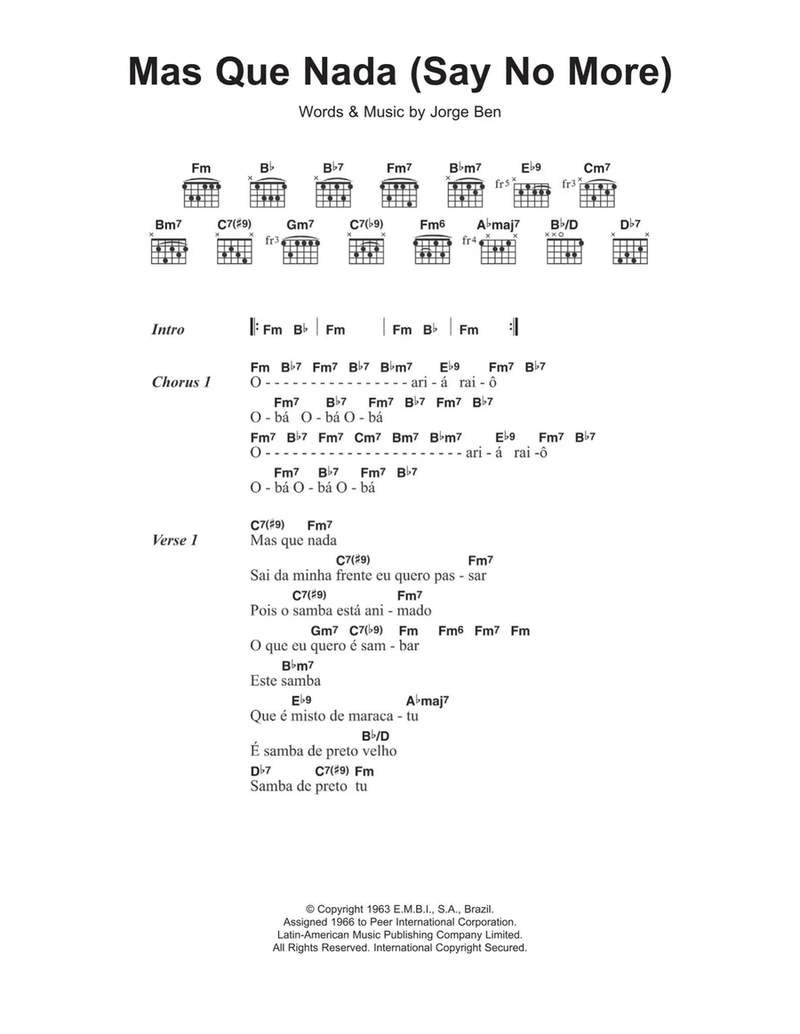
🎤 Melody: "Mas Que Nada"
"Mas Que Nada" was written by Jorge Ben (now Jorge Ben Jor) and originally recorded in 1962. It was voted the fifth-greatest Brazilian song by Rolling Stone Brazil and was inducted into the Latin Grammy Hall of Fame in 2013.
Learning the melody:
- The song is in A minor with a strong samba groove
- The melody uses a pentatonic scale with chromatic passing tones
- The rhythmic feel is syncopated — emphasize off-beats and anticipations
- The chorus ("Ooo... ariá raiô") uses call-and-response — perfect for group performance
Practice approach:
- First, learn the rhythm by clapping/singing along with a recording
- Then learn the pitches slowly, phrase by phrase
- Finally, combine rhythm and pitch at tempo
Resources
Essential Listening
- Getz/Gilberto (1964) — The album that brought bossa nova to the world
- Chega de Saudade by João Gilberto (1959) — The first bossa nova album
- Tropicália: ou Panis et Circenses (1968) — The manifesto album of Tropicália
- Elis & Tom (1974) — Elis Regina and Tom Jobim together
- Samba Esquema Novo by Jorge Ben (1963) — Contains the original "Mas Que Nada"
Further Reading
- Wikipedia: Bossa Nova
- Wikipedia: Samba
- Wikipedia: Música Popular Brasileira
- Wikipedia: The Girl from Ipanema
Did You Know? 🧠
- "The Girl from Ipanema" is believed to be the second most recorded song in history, after "Yesterday" by The Beatles. The 1964 recording was inducted into the Grammy Hall of Fame.
- The bossa nova guitar beat was created by João Gilberto, who spent months in isolation perfecting a way to synthesize an entire samba percussion section on a single guitar. His thumb played like a surdo and his fingers phrased like a tamborim.
- The word "samba" originally referred to various Afro-Brazilian circle dances with roots in the Congo and Angola. It has been recognized by UNESCO as part of Brazil's intangible cultural heritage.
- "Mas Que Nada" by Jorge Ben Jor was voted the 5th greatest Brazilian song of all time by Rolling Stone Brazil.
- Tropicália artists Caetano Veloso and Gilberto Gil were arrested and exiled by Brazil's military dictatorship in 1969 for their politically provocative art.
- Brazilian popular musicians have been using complex chord extensions since the 1920s — this harmonic sophistication evolved in parallel with jazz, not as a simple borrowing from it.